Zaidwood Capital

Category: Capital Markets

  • What Is Gen AI? Complete Guide and Examples for 2026

    What Is Gen AI? Complete Guide and Examples for 2026

    Table of Contents

    Understanding Generative AI Basics

    What is gen ai? At Zaidwood Capital, we often field this question from clients navigating the evolving landscape of corporate advisory services. Generative AI represents a transformative subset of artificial intelligence designed to create original content, such as text, images, and code, based on patterns learned from vast datasets. Unlike traditional AI, which excels at prediction and analysis of existing data, generative models pioneer content innovation, opening new avenues in mergers and acquisitions, capital formation, and due diligence processes.

    To grasp generative artificial intelligence basics, consider its evolution from early neural networks to landmark models like GPT series, which revolutionized AI content creation fundamentals. Drawing from a reliable generative AI primer, these systems employ large language models trained on diverse data to generate human-like outputs without true comprehension, mimicking creativity through statistical patterns. This distinguishes them from conventional tools focused solely on classification or optimization, enabling dynamic synthesis in strategic workflows.

    In our full-cycle advisory solutions, generative AI applications streamline operations, from automated report generation in due diligence to crafting tailored pitch decks for capital raising. For instance, generative AI examples include producing customized investor presentations that highlight deal structures with precision, enhancing efficiency while maintaining compliance. We integrate these tools to deliver strategic insights faster, supporting clients in high-stakes transactions.

    These basics lay the groundwork for exploring how generative AI integrates into deeper business layers, empowering advisory excellence at Zaidwood Capital.

    Core Fundamentals of Generative AI

    At Zaidwood Capital, we recognize generative AI as a transformative technology that leverages machine learning to produce new content, such as text, images, or code, rather than merely analyzing existing data. This innovation builds on foundational artificial intelligence principles but shifts focus toward creation, enabling applications in corporate advisory like generating preliminary financial models or due diligence outlines. Understanding these basics equips our clients in mergers and acquisitions with tools to enhance strategic planning and capital formation processes.

    The evolution of generative AI traces back to advancements in machine learning, where early systems focused on pattern recognition, evolving into sophisticated models capable of mimicking human-like creativity. This progression, detailed in resources like the generative AI student guide, highlights how neural networks form the backbone, processing vast datasets to learn and generate outputs. As we observe in our deals, this shift addresses what is gen ai vs ai by emphasizing generative capabilities over traditional predictive functions, fostering innovative advisory workflows.

    The following table compares key aspects of generative AI and traditional AI to clarify differences for readers:

    AspectTraditional AIGenerative AI
    Primary FunctionPredicts or classifies data based on patternsCreates new original content from learned patterns
    ExamplesRecommendation systems, fraud detectionText generation, image synthesis
    Data UsageAnalyzes existing datasetsGenerates novel outputs mimicking training data

    In advisory implications, traditional AI excels at fraud detection in due diligence, while generative AI, as seen in our capital raising mandates, automates synthetic data generation methods for scenario modeling. Drawing from Zaidwood Capital’s FAQ on AI integration, this allows for faster financial projections without compromising accuracy, though ethical oversight remains crucial to avoid biases in outputs.

    Delving into technical components, generative AI relies on neural networks—layered algorithms inspired by the human brain—that process inputs through interconnected nodes to identify patterns. Transformers, a key architecture in models like the GPT series, enable efficient handling of sequential data, such as language, by using attention mechanisms to weigh contextual relevance. Training involves feeding these models massive datasets, often billions of parameters, refined via techniques like supervised fine-tuning to produce coherent results.

    • Neural Networks: Core building blocks that learn from data, enabling pattern-based outputs.
    • Transformers: Revolutionize processing by focusing on relationships within data sequences.
    • Training Processes: Involves pre-training on diverse corpora followed by task-specific adjustments.

    Generative ai examples include chatbots drafting pitch decks or image tools visualizing transaction flows, showcasing creative AI technologies in action. We apply generative ai applications in equity advisory to simulate market scenarios, streamlining transactions while upholding ethical standards like transparency in AI-assisted reports. For instance, in due diligence, it generates initial risk assessments, but human review ensures compliance.

    By integrating these fundamentals, Zaidwood Capital empowers clients to navigate AI’s role in full-cycle M&A and capital advisory, fostering informed decision-making amid evolving technologies.

    In-Depth Exploration of Generative AI

    Generative AI represents a transformative force in our advisory services, enabling precise analysis and strategic insights for mergers and acquisitions. At Zaidwood Capital, we leverage these technologies to streamline due diligence and enhance capital formation processes. This section examines the technical underpinnings and evolutionary trajectory of generative AI, focusing on its integration into capital markets.

    Technical Mechanisms and RAG Integration

    Transformer models form the backbone of modern generative AI, utilizing self-attention mechanisms to process sequential data efficiently. These architectures weigh the importance of different words in a sentence, allowing the model to capture long-range dependencies critical for coherent text generation. For instance, in our due diligence workflows, transformers enable the synthesis of complex financial narratives from disparate data sources.

    A key advancement addressing limitations in factual accuracy is Retrieval-Augmented Generation, or RAG. What is RAG in gen ai? It combines a retrieval component that fetches relevant external documents with a generative model to produce responses grounded in real-time information, mitigating issues like hallucinations where models fabricate details. As detailed in recent arXiv surveys, RAG architectures—categorized into retriever-centric, generator-centric, and hybrid designs—enhance large language models by conditioning outputs on retrieved evidence. This improves performance on question-answering tasks, with benchmarks like RGB and MultiHop-RAG showing up to 20% gains in factual consistency compared to standard models.

    The following table compares RAG against standard generative AI, highlighting improvements in factual accuracy for business applications:

    FeatureStandard Gen AIRAG-Enhanced Gen AI
    Data RetrievalRelies solely on training dataAugments with real-time external retrieval
    AccuracyProne to hallucinationsReduces errors via grounded responses
    Use in AdvisoryGeneral content generationPrecise due diligence summaries

    In advisory contexts, RAG proves invaluable; for example, during M&A due diligence, it retrieves current market data from arXiv-cited sources to generate accurate summaries of competitive landscapes, reducing errors that could mislead transaction strategies. However, training generative models presents challenges, including bias amplification from datasets and scalability issues with computational demands. We mitigate these through rigorous validation, ensuring outputs align with our full-cycle due diligence standards.

    Evolution of Generative AI Technology

    The journey of generative AI began with Generative Adversarial Networks (GANs) in 2014, where two neural networks—a generator and discriminator—competed to produce realistic synthetic data, such as images. This marked a shift from rule-based systems to data-driven creation, laying groundwork for applications in financial modeling. Early limitations, like mode collapse in GANs, prompted exploration into variational autoencoders, offering probabilistic approaches for diverse outputs.

    Advancements accelerated with diffusion models, which iteratively refine noise into structured data, powering tools like Stable Diffusion for high-fidelity generation. Transformer-based models, such as GPT series, revolutionized text generation by scaling to billions of parameters, enabling generative ai examples like automated report drafting in our equity advisory. From GANs to these scaled architectures, progress has emphasized efficiency and multimodal capabilities, integrating text, images, and code. ArXiv analyses highlight metrics like perplexity reductions of over 50% in recent iterations, underscoring improved coherence.

    In capital markets and M&A processes, these evolutions yield profound implications. Generative ai applications now facilitate real-time market analysis, simulating deal scenarios to optimize capital raising. We observe how augmented generation systems, informed by AI retrieval methods, enhance strategic documentation, providing clients with predictive insights on transaction velocities. Ethical considerations, guided by frameworks like generative AI policy, ensure transparent deployment, with human oversight preventing misuse in sensitive advisory roles.

    Looking ahead, the transition toward agentic AI—extending generative foundations with autonomous reasoning—promises further integration into our services. As per arXiv surveys, agentic systems address GenAI’s static limitations by incorporating planning and tool use, potentially automating multi-step due diligence. This evolution aligns with our Velocity Matrix, accelerating deal execution while upholding precision in capital advisory.

    Practical Applications in Business

    At Zaidwood Capital, we leverage generative AI to transform corporate advisory processes, enhancing efficiency in mergers and acquisitions, capital formation, and strategic documentation. These AI-driven business tools enable our team to deliver full-cycle M&A and capital advisory services with greater precision, drawing on our experience in over 300 deals totaling $24.4 billion in transaction volume. By integrating practical gen AI uses, we streamline workflows while maintaining the rigorous due diligence essential to our clients’ success.

    Generative AI in M&A and Capital Formation

    In buy-side and sell-side mandates, generative AI supports scenario modeling and advisory workflows, including pitch decks and due diligence. For instance, AI assists in generating automated valuations for equity and debt advisory, allowing us to explore funding structures like mezzanine debt or growth equity more rapidly. Here, generative ai examples include using AI to simulate transaction outcomes based on market data, helping clients visualize potential synergies without extensive manual analysis.

    When selecting tools for these tasks, we evaluate factors such as integration ease, data security, and output accuracy to align with our Velocity Matrix approach for faster execution. Understanding what is gen ai tools reveals their core as models capable of creating content from prompts, tailored for advisory needs.

    The following table provides an overview of key gen AI tools and their business applications:

    ToolApplicationBenefit in Advisory
    GPT ModelsReport generationFaster due diligence summaries
    DALL-EVisual aidsEnhanced pitch decks
    Custom RAG SystemsData synthesisAccurate market analysis

    These tools enhance our advisory capabilities by accelerating information synthesis and visualization. For example, GPT models expedite the review of financial statements and operational audits, as outlined in our buy-side M&A processes, reducing time from weeks to days while flagging risks like revenue discrepancies or IT vulnerabilities.

    Following tool implementation, a case study from our work illustrates these benefits. In a recent capital formation mandate for a family office exploring alternative investments 2026, we employed custom RAG systems to synthesize data from our Deal Vault, integrating insights on private equity and hedge funds. This AI-driven approach facilitated thorough due diligence, verifying alignments with client goals amid economic uncertainty, and supported strategic allocation without compromising on illiquidity assessments. Challenges include ensuring model accuracy through human oversight, which we address via our team’s 80+ years of collective expertise, mitigating biases in AI outputs.

    Enhancing Strategic Documentation

    Generative AI applications revolutionize business plans and financial modeling in corporate finance, allowing us to produce pro forma financials and pitch decks with streamlined precision. Tools like advanced language models automate the creation of narrative sections in business plans, incorporating market trends and financial projections to support capital raising efforts.

    In our practice, we use these AI-driven business tools to generate initial drafts of strategic documentation, which our advisors then refine for fairness opinions and transaction advisory. For equity advisory, AI aids in modeling liquidity solutions, while for debt structures like asset-based lending, it simulates cash flow scenarios. A key generative ai application here is in full-cycle due diligence documentation, where AI compiles legal and operational findings into cohesive reports, enhancing clarity for institutional LP placements.

    Advanced Generative AI Techniques

    At Zaidwood Capital, we leverage advanced generative AI techniques to enhance our advisory services in mergers and acquisitions and capital formation. Building on foundational models, these innovations enable more sophisticated decision-making for our clients in the middle market. In particular, agentic AI represents a significant evolution, addressing limitations in traditional generative systems by introducing goal-oriented autonomy.

    Agentic AI systems extend generative AI by incorporating reasoning, planning, and interaction capabilities. Unlike standard generative models that respond directly to prompts, agentic frameworks act independently to achieve broader objectives. For instance, they integrate multimodal inputs—combining text, images, and data—through fine-tuning processes that adapt models to specific domains like financial analysis. We employ these techniques to streamline due diligence, ensuring comprehensive reviews of financial, legal, and operational aspects. Autonomous AI systems also mitigate errors by reflecting on past actions and adjusting strategies in real-time, drawing from reinforcement learning principles.

    CharacteristicGenerative AIAgentic AI
    AutonomyResponds to promptsActs independently on goals
    ApplicationsContent creationWorkflow automation
    In AdvisoryReport draftingDeal monitoring

    This table highlights how agentic AI surpasses generative counterparts in handling complex, multi-step tasks. According to recent research on arXiv, agentic systems enhance execution by integrating tools and memory, reducing error accumulation and improving adaptability—key for advisory workflows.

    Our final offerings in the gen AI practice include integrated platforms that combine these techniques for end-to-end advisory support. What is the final offering in the gen AI practice? It encompasses customized AI-driven tools for fairness opinions and LP placements, connecting clients to our network of over 4,000 investors. For advanced uses, generative AI applications extend to buy-side M&A, where we generate scenario models and predictive analytics.

    • Multimodal fine-tuning for diverse data integration.
    • Agentic planning loops for iterative problem-solving.
    • Risk-aware deployment with transparency protocols.

    Frequently Asked Questions on Generative AI

    1. What is generative AI technology?
      Generative AI technology creates new content, such as text, images, or code, from learned patterns in data. Unlike traditional analytics, it generates original outputs, powering tools like chatbots and content creators to streamline advisory documentation in our full-cycle M&A processes.
    2. How does generative AI differ from traditional AI?
      Traditional AI focuses on pattern recognition and prediction, while generative AI actively produces novel content. In advisory contexts, this distinction enables us to automate report generation, offering faster insights for buy-side M&A strategies without compromising accuracy.
    3. What role does RAG play in generative AI?
      Retrieval-Augmented Generation (RAG) integrates external data retrieval with generative models for more accurate, context-specific responses. For our clients, RAG enhances AI query resolutions in due diligence, pulling real-time market data to inform valuation models and risk assessments effectively.
    4. What are some generative AI examples in business applications?
      Generative AI examples include automated pitch deck creation and scenario modeling for capital raising. In our services, it supports strategic documentation, generating pro forma financials and simulating deal outcomes, which accelerates decision-making while tying into broader generative AI applications like synthetic data for training.

    Key Takeaways on Generative AI

    Generative AI, commonly queried as ‘what is gen ai,’ revolutionizes content creation by generating novel outputs from vast datasets, differing from traditional AI through its creative synthesis. We’ve examined its core definitions, key distinctions, generative ai applications across industries, and advanced techniques like fine-tuning models for precision.

    In our corporate advisory at Zaidwood Capital, these AI innovation highlights drive efficiency gains in mergers and acquisitions and capital advisory, accelerating due diligence and optimizing deal structures for middle-market enterprises, as informed by our extensive transaction experience.

    Looking ahead, we encourage exploring AI-enhanced strategies to elevate your financial operations. Reach out to Zaidwood for tailored guidance, remembering that outcomes depend on market conditions and involve inherent risks.

    Resources

  • Bookeeping: Complete Guide for Small Business Owners

    Bookeeping: Complete Guide for Small Business Owners

    Table of Contents

    Essential Bookkeeping Basics for Small Businesses

    We at Zaidwood Capital recognize that effective bookkeeping forms the backbone of small business financial management. Bookkeeping involves the systematic recording of financial transactions, ensuring every dollar in and out is tracked accurately. For small business owners juggling multiple roles, this process prevents chaos and supports informed decision-making from day one.

    At its core, small business bookkeeping is essential for tax preparation, cash flow monitoring, and regulatory compliance. The IRS requires retaining receipts and records for at least three years to substantiate income and expenses, avoiding penalties that can derail a growing venture. Consider a retail shop in Sheridan, Wyoming, where tracking inventory costs through financial record-keeping reveals profitable product lines and seasonal trends, enabling better purchasing decisions.

    Startups often handle basic tasks in-house, but scaling businesses benefit from outsourced bookkeeping to manage complexity. Professional services mitigate common pitfalls, such as overlooked deductions or audit triggers. While bookkeepers focus on daily transactions, accountants provide deeper analysis—a key distinction in bookkeeping vs accounting. Accounting support for SMBs ensures compliance while laying groundwork for advanced strategies like debt advisory and equity raising, areas where Zaidwood Capital excels in integrating robust documentation with corporate finance consulting.

    Do small businesses need these services? Absolutely, to navigate risks and fuel growth. In the following sections, we explore fundamental roles, costs, and strategies to build a solid financial foundation.

    Core Principles of Small Business Bookkeeping

    Effective bookkeeping forms the foundation of financial management for small and medium-sized businesses, ensuring accurate tracking that supports informed decision-making and future growth. Our experience at Zaidwood Capital shows how these fundamentals prepare companies for capital raising and mergers and acquisitions by maintaining transparent records that facilitate due diligence. By mastering daily financial tracking and generating key reports, SMBs can avoid common pitfalls and align with compliance standards.

    Understanding Daily Transaction Recording

    Daily transaction recording is a cornerstone of small business bookkeeping, involving the systematic logging of all income, expenses, and reconciliations to preserve financial integrity. For instance, a freelance consultant might enter client invoices as income upon issuance, categorize supply purchases as expenses, and reconcile bank statements weekly to catch discrepancies early. This process, often called daily financial tracking, prevents errors that could escalate during audits or expansion phases.

    Tools like accounting software streamline these tasks, automating categorization and integration with bank feeds for efficiency. According to IRS guidelines, businesses must retain supporting documents such as receipts and invoices for 3 to 7 years, emphasizing the need for organized irs record keeping for small businesses. Our advisory work reveals that consistent practices reduce compliance risks and build a reliable data trail essential for strategic planning.

    Selecting the right bookkeeping method depends on factors like business type, size, and growth aspirations. Service-based operations with straightforward cash flows often benefit from simpler approaches, while product-heavy firms may require more nuanced tracking to reflect ongoing obligations accurately.

    AspectCash BasisAccrual Basis
    Recognition of RevenueWhen cash is receivedWhen earned (invoice date)
    SuitabilityIdeal for small, service-based businessesRequired for complex/inventory businesses

    Cash basis offers simplicity for startups focused on immediate cash management, but accrual basis provides a fuller picture of financial health, which is crucial as businesses scale toward opportunities like M&A. This method better captures future obligations and revenues, aiding in valuation and investor presentations. Transitioning to accrual can enhance readiness for capital formation by demonstrating sustainable growth trajectories.

    Key Financial Statements for SMBs

    Key financial statements serve as the primary outputs of robust small business bookkeeping, offering insights into profitability, position, and liquidity. The income statement, or profit and loss report, summarizes revenues minus expenses over a period, revealing net income or loss. For a retail shop, this might highlight seasonal sales peaks against fixed costs like rent, guiding pricing adjustments.

    The balance sheet provides a snapshot of assets, liabilities, and equity at a specific point, ensuring assets equal liabilities plus equity. It helps assess solvency, such as verifying that inventory investments align with available capital. Meanwhile, the cash flow statement tracks actual cash inflows and outflows across operating, investing, and financing activities, crucial for managing working capital in volatile markets.

    • Income Statement: Tracks performance; essential for tax prep as per SCORE resources, integrating expense logs with seasonal obligations.
    • Balance Sheet: Shows financial position; supports due diligence by verifying asset values.
    • Cash Flow Statement: Monitors liquidity; prevents cash crunches during growth.

    Do small businesses need professional bookkeeping services? Absolutely, especially as complexity grows—errors in these statements can lead to overstated profits or undetected shortfalls, complicating payroll and HR compliance. Outsourced bookkeeping mitigates these risks, providing expert oversight that aligns with IRS standards and frees owners for core operations. In our capital advisory role, we see how precise statements bolster credibility with investors, tying foundational practices to successful equity raises and M&A executions.

    Exploring Bookkeeping Processes in Depth

    At Zaidwood Capital, we emphasize the importance of robust financial foundations in supporting mergers and acquisitions and capital advisory services. Understanding bookkeeping processes in depth enables small businesses to maintain accurate records that facilitate due diligence and strategic planning. This section examines the nuanced roles within financial management and explores outsourcing as a scalable solution for growing enterprises.

    Role Differentiation: Bookkeeper vs. Accountant

    We recommend distinguishing between bookkeepers and accountants to ensure optimal financial oversight, particularly as businesses prepare for capital transactions. Bookkeepers focus on the day-to-day aspects of bookkeeping, such as entering financial transactions, reconciling bank statements, and generating basic reports like income statements. These tasks maintain the integrity of financial data, providing a clear snapshot of cash flow and expenses. In contrast, accountants delve into analysis, interpreting that data to offer insights on profitability, tax strategies, and compliance with regulations.

    Qualifications further highlight these differences. Bookkeepers typically hold an associate degree and proficiency in software like QuickBooks, while accountants often possess a bachelor’s degree and certifications such as CPA, enabling them to handle complex audits and financial forecasting. For small businesses, involve a bookkeeper for routine transaction management to keep operations smooth, and engage an accountant during tax season or when scaling for equity raises. This division ensures efficiency without overburdening internal resources.

    Consider a tech startup we advised: initial bookkeeping handled in-house for basic entries, but as funding discussions arose, an accountant’s analytical expertise proved essential for projecting valuations. Such role clarity aids in due diligence, linking everyday records to broader strategic goals.

    The following table outlines key duties to illustrate these distinctions:

    FactorIn-HouseOutsourced
    Cost StructureFixed salary plus benefitsVariable monthly fee
    ScalabilityLimited by staff capacityFlexible with business growth

    This comparison underscores how bookkeepers lay the groundwork, while accountants provide the strategic elevation needed for informed decisions in capital advisory contexts. By addressing the question of differences for small businesses, we help clients allocate resources effectively, enhancing overall financial health.

    Outsourcing Options and Cost Factors

    For growing small businesses, outsourced bookkeeping offers flexibility and expertise that in-house efforts may lack, aligning with our full-cycle due diligence services at Zaidwood Capital. Benefits include cost savings through variable pricing, access to specialized knowledge in areas like payroll and HR integration, and reduced compliance risks. Outsourcing allows focus on core operations, such as preparing for debt or equity financing, while professionals manage transaction management and reporting. A retail client we supported transitioned to external financial services during expansion, freeing time for market analysis and investor outreach.

    Pricing structures vary based on business size and complexity. Hourly rates range from $20 to $50, suitable for occasional needs, while monthly packages for comprehensive small business bookkeeping fall between $500 and $2,000. For trades businesses, as noted in regional benchmarks, costs average $500 to $1,200 monthly, covering invoicing, job costing, and tax preparation setup. These models are deductible business expenses, providing additional value.

    When selecting providers, consider these criteria:

    1. Experience with your industry and integration with tools like payroll systems.
    2. Certifications and references to ensure reliability.
    3. Scalability for growth phases, such as during M&A preparations.
    4. Transparent pricing without hidden fees.

    To address how much outsourcing costs, tiered examples include basic plans at $300-700 for freelancers and premium at $1,000+ for firms offering strategic insights. This approach not only saves time—owners spend 120 hours annually on DIY tasks—but also mitigates errors like overpaid taxes, supporting precise financials for capital transactions.

    As small and medium-sized businesses (SMBs) scale, evaluating scalability becomes critical; in-house limitations can hinder growth, while outsourcing adapts seamlessly to increasing transaction volumes. The following table contrasts these approaches:

    SoftwareKey FeaturesPricingBest For
    QuickBooksInvoicing, payroll integration$25+/monthMost US-based SMBs
    XeroBank feeds, multi-currency$13+/monthCloud-focused ops

    In-house suits stable operations with steady volumes, yet outsourced bookkeeping excels for dynamic SMBs navigating capital raises, offering expertise that pays for itself through better cash flow management and decision-making. For complex finances, we advise integrating these services with strategic advisory, such as linking to a small business tax preparation guide to streamline compliance ahead of transactions. This positions businesses for efficient due diligence and sustained growth.

    Implementing Bookkeeping in Daily Operations

    We recognize that integrating bookkeeping into daily operations is essential for small businesses seeking financial clarity and growth opportunities. At Zaidwood Capital, we advise starting with robust systems that not only track transactions but also align with broader financial strategies, such as preparing for debt advisory services. This section outlines practical tools and processes to streamline these efforts, ensuring compliance and efficiency while highlighting how accurate records can support access to tailored financing solutions.

    Tools and Software for Efficient Tracking

    Effective small business bookkeeping begins with selecting the right operational financial tools that automate routine tasks and provide real-time insights. We recommend platforms like QuickBooks for its comprehensive features tailored to growing enterprises, including automated invoicing and expense categorization. These integrated record systems simplify daily tracking, allowing owners to focus on core activities rather than manual data entry.

    To set up such software, follow these steps: 1) Create a chart of accounts to organize income, expenses, assets, and liabilities based on your business structure. 2) Establish categorization rules for transactions, such as tagging vendor payments or client receipts automatically. 3) Connect bank feeds for seamless import of statements, reducing errors and saving time. This initial configuration, which takes about 2-4 hours, forms the foundation for scalable bookkeeping.

    When evaluating options, consider integration needs like compatibility with payroll modules and ease of generating reports for lenders. The following table compares popular bookkeeping software options, focusing on features relevant to small businesses:

    PracticeStandard BookkeepingAdvanced for Growth
    ForecastingBasic monthly reviewsScenario modeling
    ComplianceAnnual tax prepFull-cycle audits

    Selection criteria such as cost, user interface, and scalability should guide your choice. For instance, QuickBooks excels in domestic operations with strong add-on support, while Xero suits businesses with global transactions. Following this evaluation, we suggest weighing pros and cons: QuickBooks offers robust compliance tools but may require training, whereas Xero promotes collaboration yet demands reliable internet. These factors tie directly to maintaining accurate records that facilitate compliance and future capital pursuits.

    What questions should small business owners ask a bookkeeping provider? We recommend inquiring about:

    • Their experience with industries similar to yours and proficiency in your chosen software.
    • How they ensure data security, including adherence to policies like the zaidwood capital privacy policy.
    • Timelines for setup and ongoing support to integrate with your workflows.
    • Methods for customizing reports to align with lending applications.

    Incorporating bookkeeping here enhances operational efficiency, but for complex scaling, professional oversight may be necessary.

    Integrating Payroll and Compliance Checks

    Aligning bookkeeping with payroll and HR tasks is crucial for regulatory adherence and operational smoothness. We guide clients to link these functions through software that handles withholding calculations, tax filings, and employee deductions automatically. This integration not only minimizes errors but also ensures records support strategic needs, such as demonstrating financial health for debt advisory engagements at Zaidwood Capital.

    Begin by syncing payroll modules within your bookkeeping system: 1) Input employee details, including tax IDs and deduction preferences. 2) Set up automated withholding for federal, state, and local taxes per IRS guidelines. 3) Generate payslips and W-2 forms, retaining copies for at least four years as required by IRS record-keeping rules for employee forms. This process aligns daily operations with HR compliance, covering aspects like overtime tracking and benefits administration.

    For outsourced bookkeeping scenarios, providers can manage these integrations, ensuring seamless reporting for audits. However, always verify their familiarity with regulatory updates to avoid penalties. Accurate payroll records, bolstered by consistent categorization, directly aid in preparing documentation for financing, where lenders review cash flow and compliance history.

    To illustrate workflow differences, consider the following comparison of payroll methods:

    MethodAccuracyCost
    Manual CalculationHigh risk of errorLow initial cost
    Automated SoftwareHigh (audit-ready)Subscription-based

    Manual methods suit very small teams but risk inconsistencies that could complicate growth strategies. Automated systems, conversely, streamline processes and provide audit-ready trails, ideal for businesses eyeing expansion through capital formation. We advise transitioning to automation for scalability, linking it to broader financial planning.

    In compliance checks, focus on daily, quarterly filings and annual reconciliations. Use checklists: Verify deduction accuracy monthly, reconcile payroll with general ledger quarterly, and conduct annual reviews for discrepancies. Caution on data security is paramount; implement multi-factor authentication and regular backups to protect sensitive information. These practices not only meet HR requirements but also position your business favorably for advisory services, where precise records unlock competitive financing terms via our extensive lender network.

    While basic implementation handles daily needs, advanced scenarios may require specialized support to navigate complexities beyond standard operations.

    Advanced Bookkeeping Strategies for Growth

    In our advisory work at Zaidwood Capital, we frequently guide expanding small businesses through the transition from foundational record-keeping to more nuanced practices that align with ambitious growth objectives. As companies scale, especially when preparing for capital events like mergers or equity raises, advanced bookkeeping becomes essential. This involves not just accurate tracking but strategic integration that supports decision-making and investor confidence. For instance, a manufacturing firm eyeing an acquisition might leverage sophisticated techniques to ensure its financials reflect potential synergies, positioning it favorably in due diligence processes.

    One key strategy centers on pro forma financials and scenario planning, elevating basic bookkeeping to strategic financial modeling. Here, businesses create forward-looking statements that model various growth paths, incorporating variables like market expansions or revenue streams from new products. We incorporate the keyword bookkeeping in this context, as robust forecasting distinguishes viable opportunities from risks. Small business bookkeeping tools, such as integrated software suites, enable this by automating projections and linking them to real-time data, while outsourced bookkeeping specialists handle the complexities of multi-scenario analysis.

    Advanced compliance practices further enhance readiness, moving beyond annual tax preparation to proactive measures like SOX preparation. This ensures financial reporting withstands scrutiny during capital raises, mitigating regulatory hurdles. Ties to M&A due diligence are critical; full-cycle audits reveal operational efficiencies and valuation drivers that standard approaches overlook. Strategic documentation, including pitch decks, transforms raw data into compelling narratives for stakeholders, highlighting growth potential through growth-oriented record-keeping.

    Preparing financials for such events requires a clear distinction between routine and elevated practices. The following table outlines this comparison in the context of M&A readiness:

    MetricRoutine PracticeGrowth-Oriented
    Data DepthBasic Income/ExpenseSegmented profitability
    ComplianceIRS GuidelinesSOX/Due Diligence Ready

    This framework illustrates how advanced methods build investor trust by providing deeper insights. For example, scenario modeling can quantify the impact of an acquisition, while due diligence prep uncovers hidden value, directly supporting liquidity solutions.

    In our experience, these strategies unlock access to extensive investor networks, much like those we maintain with over 500 private equity firms and family offices. Our aggregate transaction volume exceeds $24.4 billion across more than 300 deals, demonstrating the real-world impact of precise financial preparation. For businesses exploring alternative investments 2026, integrating such bookkeeping enhances appeal in equity and debt advisory contexts.

    To implement effectively, consider these advanced tips:

    • Engage outsourced bookkeeping early for SOX-aligned processes.
    • Develop pitch decks with pro forma integrations to showcase scalability.
    • Conduct regular scenario reviews tied to M&A timelines.
    • Leverage advisory partnerships for network introductions during capital events.

    These approaches not only fortify financial health but also pave the way for sustainable expansion, addressing common queries on scaling professional services in dynamic growth phases.

    Common Bookkeeping Questions Answered

    In this financial Q&A on bookkeeping, we address key concerns for small businesses, drawing from our strategic advisory insights to clarify essential practices.

    What is the difference between a bookkeeper and an accountant?

    Bookkeepers handle day-to-day transaction recording and basic financial organization, while accountants provide analysis, tax preparation, and strategic advice. We recommend combining both for comprehensive SMB record queries.

    What are the typical costs for outsourced bookkeeping?

    Costs range from $500 to $2,500 monthly, depending on transaction volume and complexity. Outsourced bookkeeping offers scalable solutions without in-house overhead, as discussed in our service overviews.

    Do small businesses need dedicated bookkeeping services?

    Yes, small business bookkeeping ensures accurate records for compliance and growth planning. It prepares firms for capital raising by maintaining reliable financial data, tying into our full-cycle advisory.

    How does bookkeeping integrate with payroll management?

    Bookkeeping tracks payroll expenses and deductions, ensuring seamless integration with accounting software. This prevents errors and supports timely reporting, enhancing overall financial health.

    What compliance tips should businesses follow for bookkeeping?

    Maintain detailed records and use secure software for IRS adherence. We suggest consulting professionals, noting our Terms & Conditions disclaim specific guarantees on outcomes. Always verify with legal advisors.

    How to vet a bookkeeping provider?

    Evaluate experience, references, and software proficiency. Firms like harris and partners exemplify thorough vetting; we advise aligning with your strategic finance needs.

    Building Strong Financial Foundations Through Bookkeeping

    In summary, mastering bookkeeping forms the cornerstone of financial stability for small businesses, from grasping fundamentals and streamlining processes to linking them with advanced capital strategies. Proactive management ensures compliance while unlocking growth opportunities, serving as essential SMB growth tools. At Zaidwood Capital, we emphasize consulting professionals for tailored guidance, including options like small business bookkeeping or outsourced bookkeeping to integrate these financial strategy essentials seamlessly. Explore our broader advisory services to elevate your operations—review our Terms & Conditions for details on engaging responsibly.

    Resources

  • Best Debt Advisory for 2026: Trusted Options

    Best Debt Advisory for 2026: Trusted Options

    Table of Contents

    In today’s volatile markets, particularly in the US, debt advisory plays a crucial role in empowering business leaders and investors to fuel mergers and acquisitions without diluting equity. As economic shifts toward 2026 demand innovative financing, strategic debt guidance bridges valuation gaps and optimizes capital structures for sustainable growth.

    Debt advisory services provide expert counsel on debt instruments tailored to funding needs, from mezzanine and venture debt to asset-based lending. At Zaidwood Capital, we leverage our debt advisory services to connect clients to over 15 billion USD in deployable capital through a network of more than 4,000 institutional investors. With 24.4 billion USD in aggregate transaction volume across 300+ deals, we deliver cost-efficient solutions that preserve ownership and offer tax advantages, ensuring competitive terms and rapid execution.

    Discover key benefits in the following listicle, highlighting how our boutique expertise drives strategic capital debt strategies for your M&A success.

    1. Enhance M&A Deal Structures

    In the fast-paced world of mergers and acquisitions, balancing valuation expectations and funding sources often presents significant hurdles. M&A debt financing emerges as a strategic tool, enabling buyers to secure capital without excessive equity dilution, thus preserving ownership control while accelerating deal timelines. At Zaidwood Capital, our M&A capital advisory services integrate acquisition funding strategies to bridge these gaps effectively.

    We provide comprehensive debt advisory throughout the M&A process, leveraging mezzanine debt for flexible valuation adjustments and seamless integration with due diligence to mitigate risks. Our full-cycle approach encompasses deal structuring, lender introductions from our network of over 4,000 investors, and tailored solutions for mid-market transactions. Drawing from our $24.4 billion in aggregate transaction volume across buy-side and sell-side mandates, we ensure clients achieve optimized structures that enhance viability and cost efficiency compared to equity-only approaches. This methodology, informed by proven advisory processes, supports precise execution and long-term value creation.

    Consider a mid-market acquisition where a client sought to fund a strategic buyout. Our team arranged mezzanine financing to cover the equity shortfall, closing the deal swiftly without ownership concessions. To leverage similar benefits, engage experienced advisors early to align financing with your transaction goals.

    2. Access Mezzanine and Venture Debt

    In today’s competitive landscape, debt advisory services provide essential hybrid financing solutions that enable businesses to fuel growth without diluting ownership entirely. These specialized debt options bridge the gap between traditional loans and equity, offering flexible capital for strategic expansions or acquisitions.

    Mezzanine debt serves as subordinated financing, often including equity warrants, ideal for mid-market companies pursuing mergers and acquisitions or operational scaling. It features higher interest rates but lenient covenants, with repayment terms typically spanning 5-7 years. Venture debt, meanwhile, supports early-stage firms by extending cash runway post-equity rounds, minimizing equity surrender through attached warrants. We structure these facilities to align with client objectives, emphasizing competitive terms and policy considerations like tax integration for efficient capital formation in the US.

    As a leading financial advisory firm, we leverage our extensive network of over 3,000 lenders to arrange mezzanine and venture debt, having facilitated more than $800 million in tailored solutions. This approach ensures mid-market clients access scalable funding swiftly, often closing deals in under 60 days.

    3. Differentiate Debt from Equity Paths

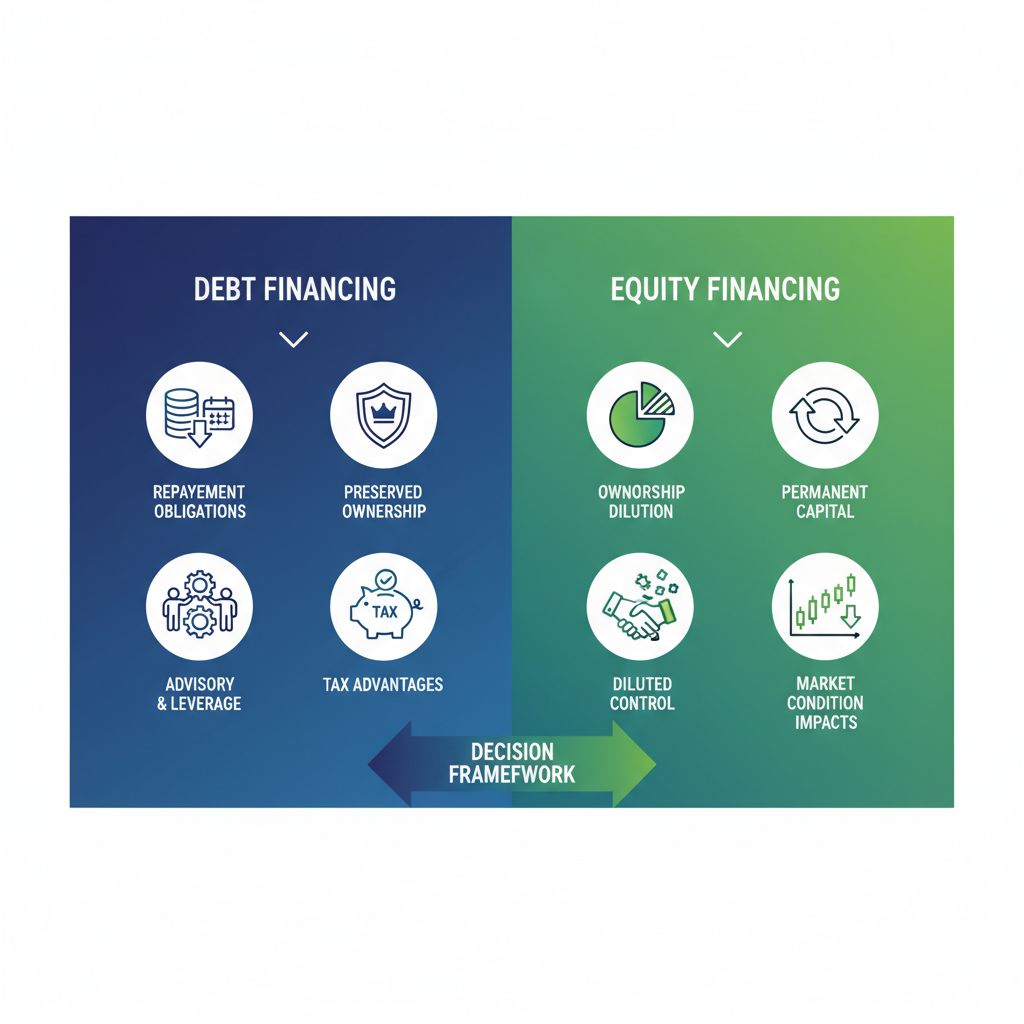
    When optimizing capital structures, clients often face the dilemma of equity vs debt financing. Should you opt for debt advisory to maintain control, or embrace equity for long-term growth? At Zaidwood Capital, we guide decisions that align with your strategic objectives, balancing risks and rewards effectively.

    Debt financing involves repayment obligations with interest, preserving ownership while leveraging assets, whereas equity introduces ownership dilution but supplies permanent capital without repayment pressures. Our debt advisory services assess leverage ratios and market conditions to recommend optimal paths, considering tax deductibility of interest versus equity’s dividend flexibility. For US deals, regulatory compliance, such as in debt advisory SEC filing examples, ensures structured integrity. Policy insights on corporate integration further highlight capital advisory contrasts, aiding informed selection through an evaluation framework that weighs cost, control, and scalability.

    Consider a mid-sized firm seeking expansion: We at Zaidwood structure mixed financings, blending debt for immediate needs and equity for sustained innovation, drawing on our dual expertise to deliver tailored solutions that enhance value without compromising autonomy.

    Infographic comparing debt and equity financing paths in capital advisory

    Visual comparison of debt and equity financing options for strategic capital structuring

    4. Implement Forward-Looking Strategies

    As economic uncertainties loom in 2026, effective debt advisory becomes essential for businesses navigating volatility. We at Zaidwood Capital emphasize adaptive strategies that incorporate sustainable practices and technological innovations to safeguard financial health.

    Key trends include ESG-linked debt instruments, which tie financing terms to environmental and social performance metrics, and digital lending platforms powered by blockchain for streamlined transactions. Scenario planning helps mitigate interest rate fluctuations by modeling various economic paths, while integrating these with M&A activities creates resilient capital structures. Emerging US regulations on digital assets, such as those surrounding distributed ledger technology (DLT) bonds as outlined by the ICMA, demand proactive compliance. Our market insights and extensive network enable timely execution of these future debt tactics.

    For instance, we guide clients through strategic financing planning via a transaction advisory agreement, ensuring alignment with long-term goals. Tip: Regularly review portfolios against regulatory updates to maintain agility and capitalize on opportunities.

    5. Leverage Boutique Firm Advantages

    Boutique firms offer unique advisory network benefits in debt advisory in the US, providing personalized attention and agility that larger institutions often cannot match. We focus on tailored financing solutions, ensuring clients receive bespoke strategies aligned with their specific goals.

    Unlike standardized products from big banks, boutique financing expertise enables faster execution through dedicated teams unburdened by bureaucracy. This approach delivers deeper due diligence without the conflicts inherent in FINRA broker dealer firms, which must balance multiple client interests. Our regulatory clarity as independent advisors allows unbiased guidance, drawing on extensive networks for efficient capital access. With over 300 completed deals and connections to more than 4,000 investors, we streamline transactions while maintaining transparency and compliance.

    For optimal results, vet advisors by reviewing their track record and network depth. At Zaidwood Capital, our 4,000+ investor connections and $24.4 billion in aggregate transaction volume demonstrate proven advisory network benefits, helping clients secure funding swiftly and securely.

    6. Streamline Due Diligence Processes

    In the complex landscape of mergers and acquisitions and financing, thorough due diligence serves as a critical safeguard against unforeseen risks. Our full-cycle approach at Zaidwood Capital integrates comprehensive reviews across financial, legal, operational, and commercial domains to support informed decision-making in debt transactions.

    We begin with financial audits, scrutinizing balance sheets, cash flows, and projections to identify discrepancies. Legal assessments evaluate contracts, compliance, and liabilities, while operational reviews examine supply chains and processes. Commercial evaluations assess market positioning and revenue viability. For debt deals, we prioritize risks such as covenant compliance and lender protections, drawing from established agreement standards to ensure alignment with transaction terms. This phased diligence mitigates exposure and uncovers value drivers.

    At Zaidwood, proprietary tools like our secured data room enhance efficiency, enabling seamless documentation and collaboration. Clients preparing for debt advisory should organize key records in advance, facilitating smoother reviews and faster execution. By streamlining these processes, we bridge strategic planning with reliable safeguards.

    Maximize Capital Efficiency Ahead

    In today’s dynamic financial landscape, debt advisory emerges as a pivotal tool for optimizing M&A transactions and capital structures. We’ve explored enhanced deal structures, diverse debt types like mezzanine and venture debt, which offer advantages over equity financing through lower dilution and tax benefits. Looking to 2026, boutique firms provide agile diligence and integrated strategies that drive financing optimization and superior outcomes.

    At Zaidwood Capital, our comprehensive advisory services leverage a vast network of over 4,000 investors and $24.4 billion in aggregate transaction volume to connect clients with tailored strategic debt solutions. We guide businesses through efficient processes, ensuring transparency and alignment with objectives, drawing on proven expertise in hundreds of deals.

    Embrace these opportunities to maximize capital efficiency in the evolving US market—contact us today to discuss your needs.

    Resources