Table of Contents
Navigating Emerging Markets M&A
Emerging markets M&A represents a vibrant arena for growth-oriented investors, with global transaction volumes in developing economies projected to surge by 15% annually through 2026, driven by rapid urbanization and tech adoption in regions like Southeast Asia and Latin America. These cross-border deals in growth markets offer unique opportunities for expansion, yet they demand nuanced navigation amid regulatory and economic variances.
At Zaidwood Capital, we specialize in mergers and acquisitions advisory, providing full-cycle support for buy-side and sell-side mandates. Our extensive network of over 4,000 institutional investors and access to more than $15 billion in deployable capital enable us to connect clients with strategic partners effectively. With $24.4 billion in aggregate transaction experience and over 300 completed deals, we handle complexities from due diligence to capital formation. For instance, we recently advised on a cross-border acquisition in Africa, facilitating a seamless integration for a mid-market tech firm seeking regional dominance.
This guide explores key drivers such as economic expansion and regulatory reforms fueling M&A in developing economies. We delve into 2026 opportunities, persistent challenges, proven strategies, and the rising influence of sovereign wealth funds on these transactions.
We encourage corporate clients and fund managers to evaluate these dynamics thoughtfully. Our professional approach equips you to assess risks and rewards, fostering informed decisions in this evolving landscape without any guarantees of outcomes.
Key Drivers and Fundamentals of Emerging Markets M&A
Emerging markets M&A represents a dynamic arena where rapid economic expansion intersects with strategic corporate maneuvers, offering substantial growth potential for investors and firms alike. These transactions often stem from unique macroeconomic and geopolitical forces that differentiate them from traditional deal-making in growth regions. As global capital flows shift toward high-potential areas, understanding these drivers becomes essential for navigating acquisition trends in developing areas effectively.
At the core of emerging markets M&A are several key drivers propelling deal activity. Rapid urbanization transforms urban landscapes, creating demand for infrastructure and real estate investments that spur cross-border acquisitions. Digital transformation accelerates technology adoption, enabling startups and incumbents to merge for scalable innovations. Commodity booms, particularly in resources like metals and energy in Latin America and Africa, attract foreign buyers seeking supply chain security. Geopolitical shifts, such as new trade agreements in the Middle East and Southeast Asia, further facilitate market entry through joint ventures and strategic partnerships. These elements collectively fuel a robust pipeline of opportunities, where volatility in valuations requires tailored adjustments to account for currency fluctuations and political risks.
Macroeconomic factors provide the foundational momentum for emerging markets M&A. High GDP growth rates, often reaching 7-10% annually in regions like Asia-Pacific, contrast sharply with the 2-4% in developed economies, drawing investors to undervalued assets amid expanding consumer bases. According to theoretical models from the NBER’s cross-border mergers research, productivity gains and knowledge transfers amplify these incentives, with emerging market premiums estimated at 20-30% higher returns potential compared to mature markets. Reforms in regulatory environments, including eased foreign direct investment caps in India and Brazil, reduce barriers and encourage inbound capital, while commodity price cycles sustain interest in resource-rich nations. These dynamics not only heighten deal volumes but also necessitate robust due diligence to mitigate exchange rate and inflation volatilities inherent in these economies.
Sector-specific fundamentals further illuminate the vibrancy of emerging markets M&A. In technology, consolidation in Southeast Asia’s fintech sector exemplifies how digital platforms merge to capture burgeoning digital economies, with deals often structured as equity swaps to align interests. Healthcare in Africa sees acquisitions driven by population growth and urbanization, where international firms partner locally to access untapped markets. Energy transitions in the Middle East leverage commodity expertise for renewable integrations, fostering joint ventures that blend global technology with regional resources. These trends underscore the need for adaptive M&A processes, including scenario-based valuations that factor in local market volatilities and growth trajectories.
The following table compares key drivers across emerging and developed markets, highlighting the distinct advantages that make growth regions particularly attractive for strategic investments.
| Driver Category | Emerging Markets | Developed Markets |
| Economic Growth Rate | 7-10% annual GDP growth in regions like Asia-Pacific | 2-4% stable but slower GDP growth |
| Regulatory Environment | Reforms encouraging foreign investment, e.g., eased FDI caps | Mature but restrictive antitrust scrutiny |
| Market Maturity | Undervalued assets with consolidation potential | Saturated markets with premium valuations |
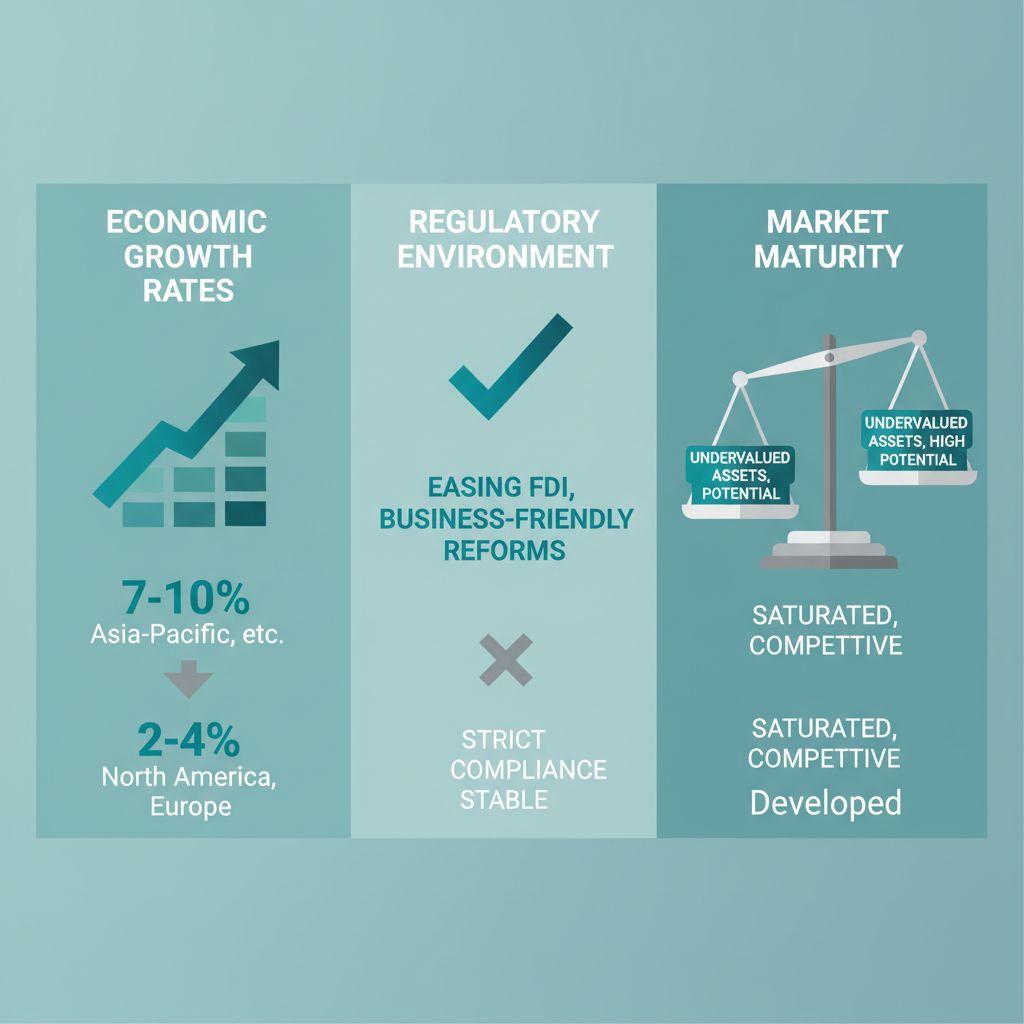
Key drivers of emerging markets M&A versus developed markets
Data sourced from Zaidwood transaction insights and NBER paper on cross-border theory. This comparison reveals how emerging markets’ higher growth and reform-driven openness create asymmetric opportunities, though they demand vigilant risk assessment. In contrast, developed markets offer stability but limited upside, influencing investor preferences toward diversification into developing areas for portfolio enhancement.
We at Zaidwood Capital leverage our extensive network of over 4,000 institutional and private investors, accessing more than $15 billion in deployable capital, to guide clients through these complexities. Our capital advisory services encompass full-cycle due diligence and strategic documentation, ensuring seamless execution with our proven $24.4 billion in aggregate transaction volume across 300+ deals. This expertise positions us to structure joint ventures and mitigate risks effectively in volatile environments.
These drivers not only propel emerging markets M&A but also present nuanced challenges that our tailored approaches address, setting the stage for deeper exploration of regional opportunities and strategic implementations in the subsequent sections.
In-Depth Analysis of Opportunities and Challenges
As we look toward 2026, emerging markets M&A presents a landscape rich with potential for strategic growth, yet tempered by complex capital formation dynamics. At Zaidwood Capital, we leverage our expertise as a leading financial advisory firm to guide clients through these intricacies, utilizing proprietary tools like our Velocity Matrix to streamline transactions in volatile regions.
Investment Opportunities Shaping 2026
Projections for 2026 highlight renewables and fintech as pivotal sectors driving high-potential deals in emerging markets. In renewables, solar and wind projects in emerging Asia, such as deals in India and Vietnam, offer substantial returns due to supportive government incentives and rising energy demands. Fintech innovations, particularly digital payment platforms, are surging in Latin America, with countries like Brazil and Mexico leading in adoption rates projected to exceed 20% annual growth, according to industry forecasts. These opportunities stem from undervalued assets and expanding consumer bases, enabling rapid market penetration.
We facilitate these prospects through our capital introduction services, connecting clients to a network of over 4,000 institutional investors with access to more than $15 billion in deployable capital. For instance, our equity advisory helps secure growth equity for fintech startups, while capital formation strategies align with sovereign wealth fund interests in sustainable infrastructure. This approach not only accelerates deal execution but also maximizes ROI in high-growth environments.
Evaluating these opportunities requires a structured comparison to weigh benefits against potential pitfalls. The following table outlines key aspects of emerging markets M&A:
| Aspect | Opportunities | Challenges |
| Market Access | Rapid entry to high-growth consumer bases | Currency volatility and repatriation restrictions |
| Valuation | Undervalued targets yielding high ROI potential | Opaque financial reporting |
| Regulatory | Favorable FDI policies in select regions | Bureaucratic delays and political risks |
This comparison underscores the allure of rapid market expansion, balanced by the need for robust risk assessment. Our full-cycle due diligence processes, encompassing financial, legal, and operational reviews, empower clients to capitalize on undervalued targets while navigating valuation complexities.
Building on this, regional variations further inform strategic planning. Drawing from NBER research on cross-border mergers, we observe distinct patterns in productivity gains and market frictions. Asia often benefits from efficient knowledge transfers in tech sectors, whereas Latin America excels in resource-driven consolidations. The subsequent table highlights these differences:
| Strategy Element | Buy-Side | Sell-Side |
| Target Identification | Scouting undervalued assets via network | Positioning company for maximum valuation |
| Negotiation Focus | Due diligence on synergies and risks | Highlighting growth potential and IP |
| Capital Needs | Structuring acquisition financing | Attracting premium bids |
These insights reveal Asia’s edge in scalable tech integrations, while Latin America’s consumer focus drives fintech momentum. Clients leveraging our M&A advisory can tailor approaches to these nuances, enhancing deal success rates through targeted capital introductions.
Capital formation in emerging markets faces significant barriers, including limited local liquidity and stringent repatriation rules that complicate funding flows. In regions like sub-Saharan Africa or parts of Southeast Asia, high interest rates and underdeveloped bond markets exacerbate these issues, often delaying transactions by months. Political uncertainties further deter investors, leading to fragmented equity pools and reliance on short-term debt.
We address these hurdles through our comprehensive debt and equity advisory services. For instance, our mezzanine and venture debt solutions bridge funding gaps, providing flexible structures like asset-based lending to maintain cash flow during expansions. In a recent anonymized case drawn from common client scenarios, we mitigated liquidity constraints by arranging equipment financing, enabling a fintech firm in emerging Asia to scale operations without diluting equity.
Our full-cycle due diligence plays a central role in risk mitigation, verifying financial statements and probing operational efficiencies to uncover hidden liabilities early. This proactive stance, supported by secure data rooms, ensures compliance and builds investor confidence. By integrating these strategies, we streamline capital raising, turning potential obstacles into opportunities for sustainable growth.
Theoretical Insights from Cross-Border Deals
Economic theories on multinational firms provide a robust lens for understanding cross-border deals in emerging markets. Drawing from NBER research, such as Kenneth Ahern’s framework on mergers, we see how productivity gains and knowledge transfers drive acquisition decisions over greenfield investments. In developing economy consolidations, market frictions like regulatory barriers amplify the value of mergers for swift market entry, as evidenced by empirical studies showing higher ROI in integrated operations.
Applying these models to practical contexts, we observe that in growth market acquisitions, currency risks can be offset by hedging strategies within M&A structures. The theory posits that firms with superior financial integration, akin to our Velocity Matrix, achieve better outcomes amid volatility. For 2026, this translates to prioritizing deals in renewables where knowledge spillovers enhance long-term value.
We apply these insights in our advisory, using theoretical models to inform due diligence and valuation, ensuring clients navigate cross-border complexities with precision. This theoretical grounding not only validates projections but also guides strategy applications, paving the way for practical implementations in subsequent deal executions.
Strategies for Successful Emerging Markets Deals
In the dynamic landscape of emerging markets M&A, achieving successful outcomes requires a blend of strategic foresight and execution precision. At Zaidwood Capital, we specialize in guiding clients through these complex transactions, leveraging our extensive network to facilitate strategic acquisitions in frontier markets. Our expertise in fairness opinions and institutional introductions ensures efficient deal execution in high-growth areas, whether pursuing buy-side opportunities or optimizing sell-side processes.
Buy-Side and Sell-Side Approaches
For buy-side mandates in emerging markets, we focus on precise target identification to scout undervalued assets that align with clients’ growth objectives. This involves setting criteria for market fit, financial stability, and synergy potential, utilizing our proprietary Deal Vault for vetted opportunities. We then conduct thorough due diligence to validate financials, legal status, and operational viability, mitigating risks inherent in these volatile regions. Strategic valuation follows, employing discounted cash flow models and comparable analyses to establish defensible pricing.
On the sell-side, our approach emphasizes preparation to maximize valuation. We position companies through comprehensive audits and narrative development that highlight growth potential, intellectual property, and market positioning. Auctions are managed to attract premium bids from our network of over 4,000 institutional investors, including private equity firms and family offices. Negotiation support includes crafting letters of intent and earn-outs tailored to emerging market dynamics.
The following table compares key elements of buy-side and sell-side strategies in emerging markets:
| Influence Area | Sovereign Wealth Funds | Traditional PE/VC |
| Capital Scale | $ trillions in assets for large deals | Billions focused on mid-market |
| Strategic Focus | Geopolitical and infrastructure priorities | ROI-driven sector bets |
| Risk Appetite | Long-term tolerance for volatility | Shorter horizons with exits |
This comparison underscores how buy-side efforts prioritize risk-adjusted value creation, while sell-side tactics aim to showcase untapped potential. Clients benefit from our full-cycle advisory, which streamlines these processes for faster closings and superior returns.
Capital Structuring Techniques
Effective capital structuring is crucial for emerging markets deals, where traditional financing may fall short. We offer mezzanine debt options that bridge senior loans and equity, providing flexible terms with equity conversion features to support expansion in high-growth areas. This hybrid instrument minimizes dilution while offering lenders upside participation, ideal for infrastructure-heavy transactions.
Growth equity injections, on the other hand, fuel scaling without ceding control, drawing from our investor rolodex to secure commitments from venture capital and family offices. For debt-focused structures, we arrange venture debt and asset-based lending, leveraging cash flows for repayment in resource-constrained environments. Equity advisory includes liquidity solutions that align with long-term stakeholder goals.
Drawing from our capital raising frameworks, the table below contrasts debt and equity structures, informed by Zaidwood’s transaction data:
| Feature | Debt Financing | Equity Financing |
| Cost of Capital | Lower (Tax deductible) | Higher (Opportunity cost) |
| Control | No dilution | Partial loss of control |
| Flexibility | Fixed repayment schedules | No repayment obligation |
These structures enable tailored financing; for instance, mezzanine debt has facilitated over $500 million in deals through our network, balancing leverage with growth potential. We customize these based on client needs, ensuring alignment with emerging market volatilities.
Integration with Due Diligence
Integrating due diligence throughout the deal cycle is essential for risk-managed execution in emerging markets. We oversee full-cycle processes, starting with initial screening and progressing to in-depth financial, legal, operational, and commercial reviews. This includes assessing cross-border mergers theory to navigate regulatory hurdles and cultural alignments.
Post-merger integration planning follows closing, focusing on operational synergies and cultural harmonization to realize value. Our team provides fairness opinions and transaction advisory, drawing on institutional introductions for seamless execution. By embedding diligence at every phase, we minimize surprises and enhance long-term success.
Advanced Insights and Market Outlook
As we look ahead, the landscape for emerging markets M&A continues to evolve rapidly, driven by global economic shifts and increasing investor interest in high-growth regions. At Zaidwood Capital, we provide strategic consulting to navigate these dynamics, connecting our clients with influential players through our LP placement services. This forward-looking perspective highlights key trends and opportunities that sophisticated investors should consider for the period from 2026 to 2030.
Over the next five years, we anticipate a pronounced shift toward sustainability-focused investments in emerging markets. Infrastructure projects, particularly in renewable energy and digital connectivity, will likely attract substantial capital as governments prioritize resilient economies. Advanced frontier market deals will emphasize ESG compliance to mitigate regulatory risks, while future-oriented consolidations in sectors like logistics and agribusiness promise robust returns. Drawing from our comprehensive M&A advisory framework, which underscores precise target identification and robust due diligence, these trends align with proactive risk management in volatile environments. We project that geopolitical stability in regions such as the Middle East and Asia will further accelerate infrastructure M&A, fostering cross-border partnerships that enhance long-term value creation. This outlook reflects our analysis of market forces, including diversification into private markets and real assets, as outlined in our educational resources on 2026 investment strategies.
Sovereign wealth funds play a pivotal role in shaping emerging markets, often injecting stability amid uncertainty. These entities, managing vast resources from resource-rich nations, exert significant influence on infrastructure M&A by aligning investments with national development goals. Unlike traditional investors, sovereign funds prioritize geopolitical and infrastructural priorities, enabling large-scale projects that traditional private equity and venture capital firms might avoid due to scale constraints. Their long-term horizon allows for tolerance of volatility, supporting initiatives in energy transition and urban development in Asia and the Middle East. This strategic involvement not only bridges funding gaps but also catalyzes broader economic integration, as seen in recent deals leveraging sovereign backing for sustainable infrastructure.
To illustrate these landscape shifts, the following table compares the influences of sovereign wealth funds against traditional PE/VC investors:
| Attribute | Sovereign Wealth Funds | Traditional PE/VC |
| Primary Objective | National Strategic Growth | High Financial ROI |
| Investment Horizon | Long-term (10+ years) | Short-to-Medium (3-7 years) |
| Deal Sensitivity | High Geopolitical impact | High Market volatility |
This comparison underscores how sovereign funds enable transformative deals in emerging markets, often complementing the agility of traditional investors. At Zaidwood Capital, our extensive network of over 4,000 institutional investors, including sovereign wealth funds, positions us to facilitate these connections effectively.
Through our advanced services, we structure LP commitments with sophisticated terms, such as performance-linked incentives and co-investment options, tailored to client objectives. Clients gain exclusive access to our deal vault, a proprietary resource aggregating opportunities in frontier markets valued at billions. We also offer insights into volatility management, employing scenario-based planning to safeguard portfolios against currency fluctuations and policy changes. Our full-cycle due diligence ensures thorough evaluation, drawing on our aggregate transaction volume exceeding $24.4 billion.
For deeper exploration, our FAQ on Capital Raising 3 addresses common queries about LP placements and emerging market strategies, providing actionable guidance to optimize your approach.
Frequently Asked Questions on Emerging Markets
Addressing key queries on emerging markets M&A, we provide clarity for strategic decision-making.
How does Zaidwood Capital mitigate risks in emerging markets? We conduct full-cycle due diligence, covering financial, legal, and operational aspects to identify and address potential challenges early.
What sectors show promise in emerging markets for 2026? Renewables and technology sectors lead growth opportunities, driven by innovation and sustainable development demands in these dynamic regions.
How can we facilitate partnerships with sovereign wealth funds? Through our extensive network of over 4,000 investors, we make targeted introductions to align clients with institutional partners for capital formation.
What strategies optimize deals in high-growth areas like Africa? We leverage our M&A advisory expertise and strategic documentation, including pitch decks, to streamline transactions and enhance investor appeal.
How does Zaidwood support overall emerging markets engagement? Our Financial Services 3.0 methodology, including the Sovereign Data Nexus, ensures precise market access and rapid execution for transformative outcomes.
Leveraging Expertise for Emerging Markets Success
Emerging markets M&A presents unique drivers like rapid economic expansion and untapped opportunities, alongside strategies for risk mitigation and a promising outlook for informed participants. This guide has outlined pathways to navigate these dynamics effectively.
At Zaidwood Capital, we deliver tailored advisory through our full-cycle M&A services, granting access to over $15 billion in deployable capital and a network exceeding 4,000 institutional investors. Our expertise ensures precise execution and confident decisions.
We invite you to book a call for consultations on your M&A or capital needs. Explore our M&A advisory services further to pursue opportunities in growth markets together.
Resources