Zaidwood Capital

Tag: Financial Services 3.0

  • Software Solutions: Complete Guide for Small Businesses

    Software Solutions: Complete Guide for Small Businesses

    Table of Contents

    Essential HR Software Solutions for Business Growth

    In today’s competitive landscape, HR tech adoption has surged, with over 70% of small and mid-sized businesses implementing software solutions to manage their workforce effectively. These platforms address the growing need for streamlined operations as companies scale more broadly.

    At Zaidwood Capital, we see how boutique M&A advisory intersects with human capital management, where accurate workforce data becomes crucial during due diligence. For instance, robust hr software for small businesses enhances scalability for startups seeking capital formation or navigating mergers, improving data accuracy that supports our full-cycle due diligence processes, including human capital assessments. This alignment not only bolsters operational efficiency but also strengthens valuation in growth strategies, as highlighted in our services overview on comprehensive transaction support.

    This article explores essential HR management platforms, previewing three standout options: BambooHR for intuitive employee management, Gusto for seamless payroll and benefits, and Rippling for integrated workforce optimization tools. These hrms for small business exemplify practical tools that complement strategic financial consulting.

    By leveraging such solutions, businesses achieve cost savings through automation and ensure regulatory adherence, mitigating risks in compliance-heavy environments like M&A preparations.

    BambooHR: Streamlined HR for Small Teams

    BambooHR stands out among human capital management tools as a user-friendly software solutions platform designed for small businesses seeking efficient employee management systems. It simplifies core HR functions like onboarding and performance tracking, enabling teams to scale operations without overwhelming administrative tasks. This approach supports strategic decisions in equity advisory, where accurate human capital data proves invaluable during capital raising or M&A preparations.

    Key Features

    BambooHR offers an intuitive interface that streamlines hr software for small businesses through automated workflows. Key capabilities include:

    • Employee self-service portals for updating personal information and viewing pay stubs, reducing HR inquiries by up to 80% as noted in NYU studies on human capital tools.
    • Onboarding automation that digitizes paperwork and training schedules, accelerating new hire integration.
    • Performance management tools with goal setting and feedback modules to track progress.
    • Benefits administration for easy enrollment in health plans and handling time-off requests.
    • Compliance modules supporting EEO reporting and ACA filings to ensure regulatory adherence.
    • Integrations with payroll providers like Gusto for seamless data transfer.
    • Custom reporting dashboards for insights into workforce metrics.

    These features position BambooHR as a robust compliance automation platform, particularly useful in due diligence processes. For instance, its reporting aids M&A evaluations by providing verifiable employee data, a detail we at Zaidwood Capital often highlight in advisory engagements.

    Pricing

    BambooHR structures pricing into Essentials at $6 per user per month and Full Service at $8.25 per user per month, both requiring annual billing. According to SHRM’s 2025 trends, these tiers align with average small business costs, offering value without hidden fees.

    Pros and Cons

    Pros:

    • Ease of use with an intuitive dashboard accessible to non-HR staff.
    • Mobile app for on-the-go employee management.
    • Customizable workflows tailored to specific business needs.
    • Strong customer support with responsive assistance.

    Cons:

    • Limited international support for global teams.
    • Basic reporting lacks advanced analytics for larger scales.
    • Integration costs can add up for multiple third-party tools.

    In our experience at Zaidwood, these pros enhance operational efficiency during growth phases, while the cons suggest evaluating scalability early.

    Best For

    BambooHR excels as an hrms for small business with 1-50 employees focused on core HR needs without complex analytics. It reduces administrative burdens, freeing resources for strategic initiatives like those in our capital advisory services, where streamlined human capital data supports informed transaction decisions.

    Gusto: Comprehensive Payroll for Growing Businesses

    Gusto stands out as a leading platform for small to mid-sized businesses, offering an all-in-one solution for payroll processing, benefits administration, and compliance management. Building on the HR foundations discussed with BambooHR, Gusto excels in automating financial workflows that ensure accurate reporting and employee satisfaction. In our experience at Zaidwood Capital, precise payroll data plays a crucial role in financial due diligence during capital advisory engagements, helping clients prepare robust documentation for investors.

    Key Features

    Gusto’s features streamline operations for growing teams. Direct deposit ensures timely payments to employees and contractors, while the benefits marketplace simplifies health insurance enrollment and other perks. Compliance alerts automate tax filings and W-2 handling, adhering to labor laws for teams up to 100 members. Integrations with time tracking tools enhance accuracy, and built-in HR tools provide essential automation benefits for hrms for small business. These elements reduce manual errors, delivering strong ROI by minimizing penalties and improving efficiency in payroll management systems.

    Pricing

    Gusto offers tiered plans: Simple at $40 base monthly plus $6 per user, Plus at $80 base plus $12 per user, and Premium with custom pricing. Aligning with HR software pricing trends, where averages range from $20 to $50 per user monthly, Gusto positions hr software for small businesses as a premium yet scalable option, especially for those integrating benefits administration software.

    Pros and Cons

    Pros: Seamless payroll and tax handling saves time and ensures accuracy; excellent customer support guides users through setup; easy onboarding facilitates quick adoption for growing firms.

    Cons: Higher costs for basic needs may strain tight budgets; limited advanced HR functionalities compared to full suites; availability restricted to US operations only, lacking global reach.

    These aspects highlight Gusto’s strengths in core financial tasks while noting areas for expansion, such as deeper integrations needed for mid-sized operations leading into tools like Rippling.

    Best For

    Gusto is ideal for small businesses prioritizing payroll accuracy and compliance during capital-seeking scenarios. As robust software solutions, it supports strategic documentation in equity advisory, enabling firms to present clean financials to investors. Our advisory work at Zaidwood underscores how such platforms bolster due diligence, fostering trust in growth equity pursuits.

    Rippling: Integrated HR and IT for Mid-Sized Firms

    At Zaidwood Capital, we recognize Rippling as a powerful all-in-one platform that unifies HR, payroll, and IT management for mid-sized firms navigating growth. This software solution streamlines employee lifecycle processes, from onboarding to compliance, providing actionable insights that support our full-cycle due diligence in M&A transactions.

    Rippling’s features position it as a leader among software solutions for integrated benefits. Key capabilities include:

    • Global payroll and benefits administration, handling multi-country regulations with automated tax filings.
    • Device management and app provisioning, enabling secure IT distribution to new hires.
    • AI-driven analytics for workforce trends and performance metrics.
    • Comprehensive compliance suite ensuring adherence to international labor laws.

    These tools reduce onboarding time by 50%, as noted in human capital management studies, fostering efficient IT-HR sync.

    Pricing starts at $8 per user per month for the Core plan, scales to $11.50 for Pro, and offers custom Enterprise options tailored to complex needs.

    Pros of Rippling include seamless IT-HR integration tools that automate workflows and provide global support, enhancing scalability for expanding operations. Its automation depth delivers operational insights vital for fairness opinions in M&A. However, cons involve a steep learning curve, higher pricing compared to basic options, and added complexity that may overwhelm smaller teams transitioning from hr software for small businesses.

    Rippling excels as a unified workforce platform best for mid-sized companies with 50-500 employees seeking hrms for small business evolution into robust systems. We leverage such integrations in our advisory services to prepare clients for M&A readiness, ensuring compliance and data unification drive strategic value.

    Comparing Top HR Software Solutions

    When evaluating software solutions for human resources management, businesses often seek tools that align with their growth stages and operational demands. At Zaidwood Capital, we recognize that robust HR platforms can enhance due diligence processes in mergers and acquisitions by streamlining human capital oversight. This comparison focuses on three popular options—BambooHR, Gusto, and Rippling—to highlight key differences in features and suitability for small and mid-sized enterprises.

    Selecting the right HR tool requires considering scalability, especially for firms navigating expansion or advisory needs. For instance, hr software for small businesses must offer intuitive interfaces without overwhelming complexity. Factors like integration capabilities and cost efficiency play crucial roles in ensuring long-term value, as hrms for small business environments prioritize ease of adoption alongside compliance support.

    The following table provides a side-by-side view of these solutions across essential criteria:

    FeatureBambooHRGustoRippling
    Basic automation and integrationsFull payroll processing with tax complianceGlobal payroll and IT-integrated benefits
    $6-8.25$6-12 + base fee$8+
    US-focused EEO/ACALabor law and tax filingsInternational and IT compliance
    Small teams (1-50)Payroll-focused small/midMid-sized integrated ops (50+)

    Gusto stands out for its payroll simplicity, ideal for teams emphasizing tax compliance without global needs, while Rippling provides deeper integrations for scaling operations. BambooHR suits straightforward small-team administration. According to SHRM’s 2025 trends, rising modular pricing reflects the demand for flexible HR platform comparisons, allowing businesses to customize without excess costs.

    These tool evaluation matrices underscore how integrated HR systems support strategic human capital management, a vital aspect in our M&A advisory work. From our capital advisory lens, choosing scalable options like these can mitigate risks during transactions, ensuring seamless talent retention and compliance in post-deal environments.

    Such comparisons reveal trade-offs in functionality versus affordability, guiding informed selections that align with broader business objectives. For growing firms, prioritizing tools with strong integration—such as Rippling’s IT features—can facilitate smoother transitions in advisory scenarios, ultimately bolstering operational resilience.

    In our experience at Zaidwood Capital, these insights into HR technology directly inform capital strategies, helping clients optimize human resources as part of full-cycle due diligence for successful mergers and acquisitions.

    Selecting HR Software for Strategic Success

    In summary, effective software solutions like BambooHR, Gusto, and Rippling offer substantial benefits for businesses navigating growth. BambooHR excels in user-friendly hr software for small businesses, providing essential tools for employee management at a cost-effective rate. Gusto streamlines payroll and compliance, while Rippling delivers comprehensive features for scalable operations. These platforms enhance efficiency, ensure regulatory adherence, and optimize human capital, drawing from the comparisons outlined earlier.

    Implementing these systems starts with a thorough needs assessment to align features with organizational goals. For hrms for small business, prioritize intuitive interfaces and integration capabilities to minimize disruption. Train teams adequately and monitor performance metrics post-launch to refine usage. Best practices emphasize phased rollouts, ensuring seamless adoption without overwhelming resources.

    At Zaidwood Capital, we integrate HR strategies with broader financial planning through our zaidwood capital advisory services. Robust HR data supports due diligence in M&A capital advisory, where human capital assessments mitigate risks and inform valuations. Our network provides access to institutional investors, tying HR efficiency to capital formation success.

    We encourage consulting our advisors for tailored strategic HR platforms. As growth-oriented tools evolve, they remain vital for sustainable expansion in dynamic markets.

    Resources

  • What Is Gen AI? Complete Guide and Examples for 2026

    What Is Gen AI? Complete Guide and Examples for 2026

    Table of Contents

    Understanding Generative AI Basics

    What is gen ai? At Zaidwood Capital, we often field this question from clients navigating the evolving landscape of corporate advisory services. Generative AI represents a transformative subset of artificial intelligence designed to create original content, such as text, images, and code, based on patterns learned from vast datasets. Unlike traditional AI, which excels at prediction and analysis of existing data, generative models pioneer content innovation, opening new avenues in mergers and acquisitions, capital formation, and due diligence processes.

    To grasp generative artificial intelligence basics, consider its evolution from early neural networks to landmark models like GPT series, which revolutionized AI content creation fundamentals. Drawing from a reliable generative AI primer, these systems employ large language models trained on diverse data to generate human-like outputs without true comprehension, mimicking creativity through statistical patterns. This distinguishes them from conventional tools focused solely on classification or optimization, enabling dynamic synthesis in strategic workflows.

    In our full-cycle advisory solutions, generative AI applications streamline operations, from automated report generation in due diligence to crafting tailored pitch decks for capital raising. For instance, generative AI examples include producing customized investor presentations that highlight deal structures with precision, enhancing efficiency while maintaining compliance. We integrate these tools to deliver strategic insights faster, supporting clients in high-stakes transactions.

    These basics lay the groundwork for exploring how generative AI integrates into deeper business layers, empowering advisory excellence at Zaidwood Capital.

    Core Fundamentals of Generative AI

    At Zaidwood Capital, we recognize generative AI as a transformative technology that leverages machine learning to produce new content, such as text, images, or code, rather than merely analyzing existing data. This innovation builds on foundational artificial intelligence principles but shifts focus toward creation, enabling applications in corporate advisory like generating preliminary financial models or due diligence outlines. Understanding these basics equips our clients in mergers and acquisitions with tools to enhance strategic planning and capital formation processes.

    The evolution of generative AI traces back to advancements in machine learning, where early systems focused on pattern recognition, evolving into sophisticated models capable of mimicking human-like creativity. This progression, detailed in resources like the generative AI student guide, highlights how neural networks form the backbone, processing vast datasets to learn and generate outputs. As we observe in our deals, this shift addresses what is gen ai vs ai by emphasizing generative capabilities over traditional predictive functions, fostering innovative advisory workflows.

    The following table compares key aspects of generative AI and traditional AI to clarify differences for readers:

    AspectTraditional AIGenerative AI
    Primary FunctionPredicts or classifies data based on patternsCreates new original content from learned patterns
    ExamplesRecommendation systems, fraud detectionText generation, image synthesis
    Data UsageAnalyzes existing datasetsGenerates novel outputs mimicking training data

    In advisory implications, traditional AI excels at fraud detection in due diligence, while generative AI, as seen in our capital raising mandates, automates synthetic data generation methods for scenario modeling. Drawing from Zaidwood Capital’s FAQ on AI integration, this allows for faster financial projections without compromising accuracy, though ethical oversight remains crucial to avoid biases in outputs.

    Delving into technical components, generative AI relies on neural networks—layered algorithms inspired by the human brain—that process inputs through interconnected nodes to identify patterns. Transformers, a key architecture in models like the GPT series, enable efficient handling of sequential data, such as language, by using attention mechanisms to weigh contextual relevance. Training involves feeding these models massive datasets, often billions of parameters, refined via techniques like supervised fine-tuning to produce coherent results.

    • Neural Networks: Core building blocks that learn from data, enabling pattern-based outputs.
    • Transformers: Revolutionize processing by focusing on relationships within data sequences.
    • Training Processes: Involves pre-training on diverse corpora followed by task-specific adjustments.

    Generative ai examples include chatbots drafting pitch decks or image tools visualizing transaction flows, showcasing creative AI technologies in action. We apply generative ai applications in equity advisory to simulate market scenarios, streamlining transactions while upholding ethical standards like transparency in AI-assisted reports. For instance, in due diligence, it generates initial risk assessments, but human review ensures compliance.

    By integrating these fundamentals, Zaidwood Capital empowers clients to navigate AI’s role in full-cycle M&A and capital advisory, fostering informed decision-making amid evolving technologies.

    In-Depth Exploration of Generative AI

    Generative AI represents a transformative force in our advisory services, enabling precise analysis and strategic insights for mergers and acquisitions. At Zaidwood Capital, we leverage these technologies to streamline due diligence and enhance capital formation processes. This section examines the technical underpinnings and evolutionary trajectory of generative AI, focusing on its integration into capital markets.

    Technical Mechanisms and RAG Integration

    Transformer models form the backbone of modern generative AI, utilizing self-attention mechanisms to process sequential data efficiently. These architectures weigh the importance of different words in a sentence, allowing the model to capture long-range dependencies critical for coherent text generation. For instance, in our due diligence workflows, transformers enable the synthesis of complex financial narratives from disparate data sources.

    A key advancement addressing limitations in factual accuracy is Retrieval-Augmented Generation, or RAG. What is RAG in gen ai? It combines a retrieval component that fetches relevant external documents with a generative model to produce responses grounded in real-time information, mitigating issues like hallucinations where models fabricate details. As detailed in recent arXiv surveys, RAG architectures—categorized into retriever-centric, generator-centric, and hybrid designs—enhance large language models by conditioning outputs on retrieved evidence. This improves performance on question-answering tasks, with benchmarks like RGB and MultiHop-RAG showing up to 20% gains in factual consistency compared to standard models.

    The following table compares RAG against standard generative AI, highlighting improvements in factual accuracy for business applications:

    FeatureStandard Gen AIRAG-Enhanced Gen AI
    Data RetrievalRelies solely on training dataAugments with real-time external retrieval
    AccuracyProne to hallucinationsReduces errors via grounded responses
    Use in AdvisoryGeneral content generationPrecise due diligence summaries

    In advisory contexts, RAG proves invaluable; for example, during M&A due diligence, it retrieves current market data from arXiv-cited sources to generate accurate summaries of competitive landscapes, reducing errors that could mislead transaction strategies. However, training generative models presents challenges, including bias amplification from datasets and scalability issues with computational demands. We mitigate these through rigorous validation, ensuring outputs align with our full-cycle due diligence standards.

    Evolution of Generative AI Technology

    The journey of generative AI began with Generative Adversarial Networks (GANs) in 2014, where two neural networks—a generator and discriminator—competed to produce realistic synthetic data, such as images. This marked a shift from rule-based systems to data-driven creation, laying groundwork for applications in financial modeling. Early limitations, like mode collapse in GANs, prompted exploration into variational autoencoders, offering probabilistic approaches for diverse outputs.

    Advancements accelerated with diffusion models, which iteratively refine noise into structured data, powering tools like Stable Diffusion for high-fidelity generation. Transformer-based models, such as GPT series, revolutionized text generation by scaling to billions of parameters, enabling generative ai examples like automated report drafting in our equity advisory. From GANs to these scaled architectures, progress has emphasized efficiency and multimodal capabilities, integrating text, images, and code. ArXiv analyses highlight metrics like perplexity reductions of over 50% in recent iterations, underscoring improved coherence.

    In capital markets and M&A processes, these evolutions yield profound implications. Generative ai applications now facilitate real-time market analysis, simulating deal scenarios to optimize capital raising. We observe how augmented generation systems, informed by AI retrieval methods, enhance strategic documentation, providing clients with predictive insights on transaction velocities. Ethical considerations, guided by frameworks like generative AI policy, ensure transparent deployment, with human oversight preventing misuse in sensitive advisory roles.

    Looking ahead, the transition toward agentic AI—extending generative foundations with autonomous reasoning—promises further integration into our services. As per arXiv surveys, agentic systems address GenAI’s static limitations by incorporating planning and tool use, potentially automating multi-step due diligence. This evolution aligns with our Velocity Matrix, accelerating deal execution while upholding precision in capital advisory.

    Practical Applications in Business

    At Zaidwood Capital, we leverage generative AI to transform corporate advisory processes, enhancing efficiency in mergers and acquisitions, capital formation, and strategic documentation. These AI-driven business tools enable our team to deliver full-cycle M&A and capital advisory services with greater precision, drawing on our experience in over 300 deals totaling $24.4 billion in transaction volume. By integrating practical gen AI uses, we streamline workflows while maintaining the rigorous due diligence essential to our clients’ success.

    Generative AI in M&A and Capital Formation

    In buy-side and sell-side mandates, generative AI supports scenario modeling and advisory workflows, including pitch decks and due diligence. For instance, AI assists in generating automated valuations for equity and debt advisory, allowing us to explore funding structures like mezzanine debt or growth equity more rapidly. Here, generative ai examples include using AI to simulate transaction outcomes based on market data, helping clients visualize potential synergies without extensive manual analysis.

    When selecting tools for these tasks, we evaluate factors such as integration ease, data security, and output accuracy to align with our Velocity Matrix approach for faster execution. Understanding what is gen ai tools reveals their core as models capable of creating content from prompts, tailored for advisory needs.

    The following table provides an overview of key gen AI tools and their business applications:

    ToolApplicationBenefit in Advisory
    GPT ModelsReport generationFaster due diligence summaries
    DALL-EVisual aidsEnhanced pitch decks
    Custom RAG SystemsData synthesisAccurate market analysis

    These tools enhance our advisory capabilities by accelerating information synthesis and visualization. For example, GPT models expedite the review of financial statements and operational audits, as outlined in our buy-side M&A processes, reducing time from weeks to days while flagging risks like revenue discrepancies or IT vulnerabilities.

    Following tool implementation, a case study from our work illustrates these benefits. In a recent capital formation mandate for a family office exploring alternative investments 2026, we employed custom RAG systems to synthesize data from our Deal Vault, integrating insights on private equity and hedge funds. This AI-driven approach facilitated thorough due diligence, verifying alignments with client goals amid economic uncertainty, and supported strategic allocation without compromising on illiquidity assessments. Challenges include ensuring model accuracy through human oversight, which we address via our team’s 80+ years of collective expertise, mitigating biases in AI outputs.

    Enhancing Strategic Documentation

    Generative AI applications revolutionize business plans and financial modeling in corporate finance, allowing us to produce pro forma financials and pitch decks with streamlined precision. Tools like advanced language models automate the creation of narrative sections in business plans, incorporating market trends and financial projections to support capital raising efforts.

    In our practice, we use these AI-driven business tools to generate initial drafts of strategic documentation, which our advisors then refine for fairness opinions and transaction advisory. For equity advisory, AI aids in modeling liquidity solutions, while for debt structures like asset-based lending, it simulates cash flow scenarios. A key generative ai application here is in full-cycle due diligence documentation, where AI compiles legal and operational findings into cohesive reports, enhancing clarity for institutional LP placements.

    Advanced Generative AI Techniques

    At Zaidwood Capital, we leverage advanced generative AI techniques to enhance our advisory services in mergers and acquisitions and capital formation. Building on foundational models, these innovations enable more sophisticated decision-making for our clients in the middle market. In particular, agentic AI represents a significant evolution, addressing limitations in traditional generative systems by introducing goal-oriented autonomy.

    Agentic AI systems extend generative AI by incorporating reasoning, planning, and interaction capabilities. Unlike standard generative models that respond directly to prompts, agentic frameworks act independently to achieve broader objectives. For instance, they integrate multimodal inputs—combining text, images, and data—through fine-tuning processes that adapt models to specific domains like financial analysis. We employ these techniques to streamline due diligence, ensuring comprehensive reviews of financial, legal, and operational aspects. Autonomous AI systems also mitigate errors by reflecting on past actions and adjusting strategies in real-time, drawing from reinforcement learning principles.

    CharacteristicGenerative AIAgentic AI
    AutonomyResponds to promptsActs independently on goals
    ApplicationsContent creationWorkflow automation
    In AdvisoryReport draftingDeal monitoring

    This table highlights how agentic AI surpasses generative counterparts in handling complex, multi-step tasks. According to recent research on arXiv, agentic systems enhance execution by integrating tools and memory, reducing error accumulation and improving adaptability—key for advisory workflows.

    Our final offerings in the gen AI practice include integrated platforms that combine these techniques for end-to-end advisory support. What is the final offering in the gen AI practice? It encompasses customized AI-driven tools for fairness opinions and LP placements, connecting clients to our network of over 4,000 investors. For advanced uses, generative AI applications extend to buy-side M&A, where we generate scenario models and predictive analytics.

    • Multimodal fine-tuning for diverse data integration.
    • Agentic planning loops for iterative problem-solving.
    • Risk-aware deployment with transparency protocols.

    Frequently Asked Questions on Generative AI

    1. What is generative AI technology?
      Generative AI technology creates new content, such as text, images, or code, from learned patterns in data. Unlike traditional analytics, it generates original outputs, powering tools like chatbots and content creators to streamline advisory documentation in our full-cycle M&A processes.
    2. How does generative AI differ from traditional AI?
      Traditional AI focuses on pattern recognition and prediction, while generative AI actively produces novel content. In advisory contexts, this distinction enables us to automate report generation, offering faster insights for buy-side M&A strategies without compromising accuracy.
    3. What role does RAG play in generative AI?
      Retrieval-Augmented Generation (RAG) integrates external data retrieval with generative models for more accurate, context-specific responses. For our clients, RAG enhances AI query resolutions in due diligence, pulling real-time market data to inform valuation models and risk assessments effectively.
    4. What are some generative AI examples in business applications?
      Generative AI examples include automated pitch deck creation and scenario modeling for capital raising. In our services, it supports strategic documentation, generating pro forma financials and simulating deal outcomes, which accelerates decision-making while tying into broader generative AI applications like synthetic data for training.

    Key Takeaways on Generative AI

    Generative AI, commonly queried as ‘what is gen ai,’ revolutionizes content creation by generating novel outputs from vast datasets, differing from traditional AI through its creative synthesis. We’ve examined its core definitions, key distinctions, generative ai applications across industries, and advanced techniques like fine-tuning models for precision.

    In our corporate advisory at Zaidwood Capital, these AI innovation highlights drive efficiency gains in mergers and acquisitions and capital advisory, accelerating due diligence and optimizing deal structures for middle-market enterprises, as informed by our extensive transaction experience.

    Looking ahead, we encourage exploring AI-enhanced strategies to elevate your financial operations. Reach out to Zaidwood for tailored guidance, remembering that outcomes depend on market conditions and involve inherent risks.

    Resources

  • Harris and Partners Alternatives: Top Boutique Banks for M&A

    Harris and Partners Alternatives: Top Boutique Banks for M&A

    Table of Contents

    In the dynamic landscape of middle market M&A, where transactions typically range from $10 million to $500 million, companies seek agile partners to navigate complex deals. Firms like harris and partners exemplify how boutique investment banks provide tailored advisory in this space, focusing on niche sectors and personalized service. At Zaidwood Capital, we specialize in streamlining these transactions for private equity firms, family offices, and businesses with revenues exceeding $1 million.

    Middle market M&A involves mergers, acquisitions, and strategic partnerships that drive growth for mid-sized enterprises. Boutique investment banks, or specialized M&A advisors, differ from larger institutions by offering focused expertise and faster execution without bureaucratic delays. Niche investment firms like ours emphasize relationship-driven approaches to ensure seamless outcomes.

    We at Zaidwood Capital bring unmatched credentials, with an aggregate transaction volume of $24.4 billion across more than 300 completed deals. Our full-cycle M&A advisory services encompass due diligence in financial, legal, and operational areas, alongside capital introductions to our network of over 4,000 institutional and private investors and access to $15 billion in deployable capital. Through Zaidwood Capital Services, we integrate digital marketing and capital markets savvy for efficient buy-side and sell-side mandates.

    This guide explores fundamentals of boutique banking, advanced strategies, and best practices. We transition next to core principles, equipping you to leverage opportunities in this evolving market.

    Core Principles of Middle Market M&A Advisory

    Middle market mergers and acquisitions represent a dynamic segment of the financial landscape, focusing on companies with annual revenues between $10 million and $500 million. These transactions often involve complex negotiations tailored to the unique needs of growing businesses, where boutique M&A advisory firms play a pivotal role. Our team at Zaidwood Capital specializes in guiding clients through these processes, leveraging our extensive experience to ensure seamless execution.

    At the core of middle market M&A are key deal structures, including asset purchases, stock acquisitions, and mergers of equals. Buy-side processes involve identifying targets, conducting initial valuations, and negotiating terms, while sell-side engagements focus on preparing confidential information memorandums and soliciting bids. Due diligence forms the backbone of these transactions, encompassing financial audits to verify revenue streams, legal reviews for compliance and liabilities, and operational assessments of supply chains and management teams.

    Boutique vs Traditional Banks: Key Service Differences

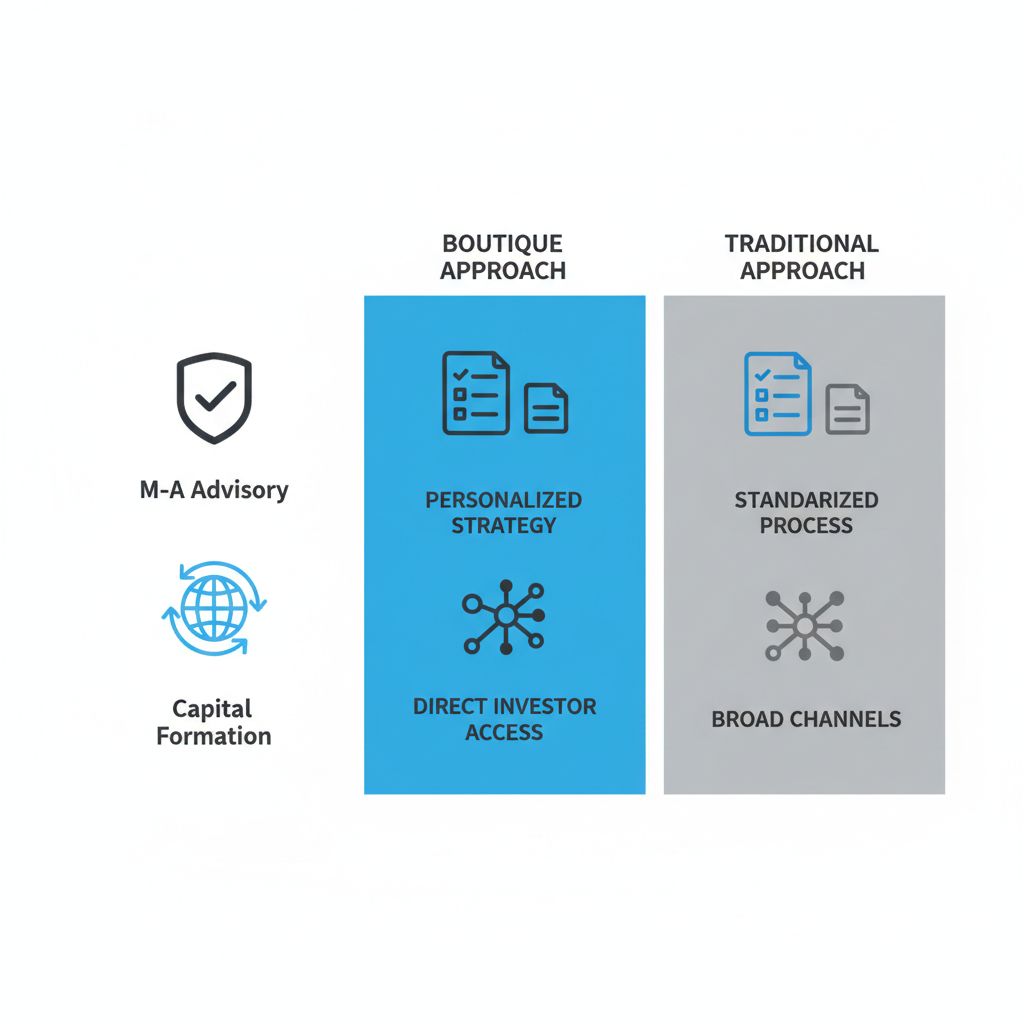
    Service AreaBoutique Approach (e.g., Zaidwood)Traditional Bank Approach
    M&A AdvisoryTailored buy/sell-side with full due diligence (300+ deals experience)Broad mandates with standardized processes
    Capital FormationDirect access to 4,000+ investors via Velocity MatrixLimited network introductions

    Building on these differences, boutique firms excel in integrating capital raising with advisory services. This holistic approach not only streamlines transactions but also enhances strategic positioning in competitive markets.

    Infographic comparing boutique versus traditional bank approaches in middle market M&A advisory services

    Boutique vs traditional M&A advisory comparison for middle market

    In-Depth Analysis of Capital Formation Strategies

    Equity and Debt Advisory Essentials

    We structure mezzanine debt as a hybrid financing tool, positioned between senior debt and equity to provide flexible capital for expansion. This subordinated option offers businesses higher leverage while minimizing ownership loss, ideal for firms scaling operations post-acquisition. Venture debt complements this by extending cash runways for early-stage companies, often without warrants that dilute equity.

    Financing TypeZaidwood CapabilitiesTypical Harris-Style Firm
    Debt AdvisoryMezzanine, asset-based with $15B networkLimited to basic loans
    Equity AdvisoryGrowth equity introductions to 4,000+ investorsStandard placements

    Due Diligence in Boutique Deals

    Our full-cycle due diligence process is a cornerstone of successful boutique deals, encompassing financial, operational, and legal reviews to identify synergies and red flags early. We begin with financial modeling, scrutinizing pro forma statements and cash flow projections to validate deal viability. Legal reviews follow, examine contracts, IP rights, and regulatory compliance. In specialized financing firms, we extend this to emerging markets M&A, where geopolitical factors demand rigorous scrutiny.

    Implementing M&A and Capital Strategies in Practice

    Step-by-Step Deal Execution Guide

    • Investor Matching: Drawing from our network of over 4,000 institutions and $15B in deployable capital, we curate tailored introductions.
    • Due Diligence Execution: We conduct full-cycle reviews, encompassing financial audits, legal compliance checks, and operational evaluations using SEC regulatory resources.
    • Documentation Preparation: Clients receive customized pitch decks, pro forma financials, business plans, and fairness opinions.
    Tool/AspectZaidwood OfferingStandard Boutique
    Investor Network4,000+ institutions, $15B capitalSmaller, regional focus
    DocumentationPitch decks, pro formas via Deal VaultBasic templates

    Case Studies in Middle Market Success

    Through rolodex-driven introductions to family offices and venture capital sources, we structured a hybrid mezzanine debt facility for a manufacturing firm that bridged senior loans and equity, minimizing dilution. In another case, we developed a compelling narrative around intellectual property for a tech firm, utilizing investor outreach to sovereign wealth funds and endowments for competitive bidding.

    Advanced Topics in Boutique Debt and Equity Advisory

    Advanced due diligence forms the backbone of our process, encompassing human capital assessments to evaluate team dynamics and commercial viability to scrutinize market positioning. Capital introductions represent a cornerstone of our elite advisory networks, connecting clients to sovereign wealth funds and endowments. profissionais who cultivate deep relationships with private equity sponsors position themselves for success. Our investment bankers 2025 insights validate this strategy.

    Advanced FeatureZaidwood StrengthBoutique Baseline
    Investor Access$15B deployable via 4,000+ connectionsLimited introductions

    Common Questions on Boutique M&A Services

    • How do I select a boutique investment bank? Evaluate track records and sector focus. At Zaidwood Capital, our $24.4B transaction volume provides proven expertise.
    • Timeline for due diligence? Usually 4-8 weeks, covering financial, legal, and operational reviews.
    • Regulatory considerations? Utilize FINRA regulatory tools for filings and disclosures.

    Leveraging Boutique Expertise for Your M&A Success

    In navigating middle market M&A, boutique investment banks offer tailored strategies that drive efficient transactions. At Zaidwood Capital, we provide full-cycle advisory, from due diligence to capital formation, empowering clients with innovative tools like our Velocity Matrix for rapid execution. contact us today to explore how our expertise can support your success.

    Resources