Zaidwood Capital

Tag: Business Finance

  • PEO vs ASO Comparison: Complete Benefits and Costs Guide

    PEO vs ASO Comparison: Complete Benefits and Costs Guide

    Table of Contents

    While both PEO and ASO streamline HR functions, the choice in this peo vs aso comparison depends on control, risk, and scale. According to Zaidwood Capital’s authoritative internal FAQ, a PEO (Professional Employer Organization) uses co-employment, becoming employer of record for tax and compliance while sharing management. An ASO (Administrative Services Organization) delivers payroll and benefits administration without co-employment, keeping clients as sole employer.

    Key differences include:

    • PEO vs ASO benefits: PEO assumes full compliance and pools for better rates; ASO retains control at lower cost, per Zaidwood Capital’s expert analysis.
    • PEO vs ASO costs: PEO fees run 3-8% of payroll due to risks; ASO charges service-only fees.

    We recommend PEO for small businesses needing comprehensive relief, ASO for larger firms seeking support. Once selected, here’s how to get started with your PEO or ASO.

    1. Master Key Differences

    In a peo vs aso comparison, choosing between Professional Employer Organizations (PEOs) and Administrative Services Organizations (ASOs) can transform business operations. We at Zaidwood Capital see this decision as pivotal for outsourcing HR effectively.

    Key Differences

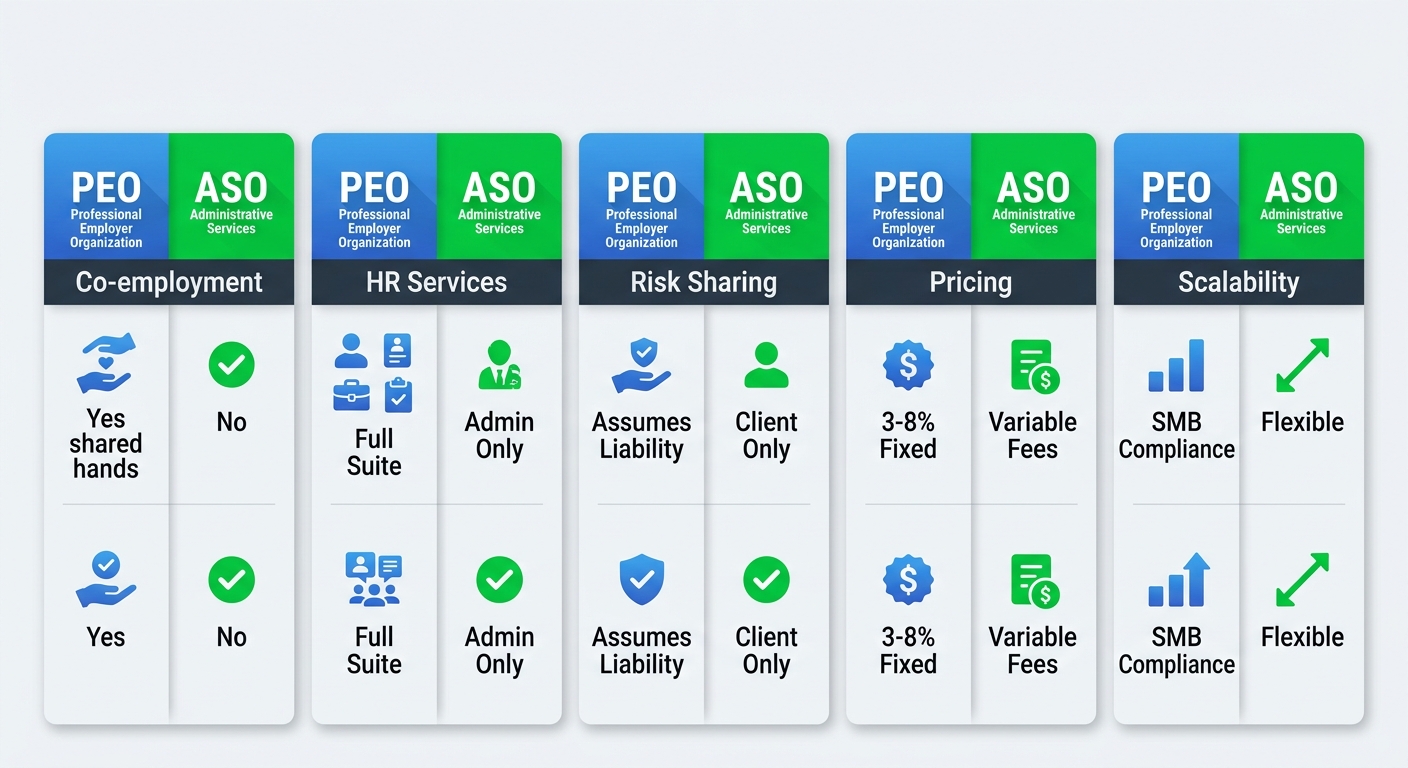
    • Co-employment: PEOs establish co-employment, becoming the employer of record. PEO advantage: Comprehensive compliance support. ASO limitation: No shared employment status.
    • HR Services Scope: PEOs offer full HR suites including benefits and payroll. PEO benefit: Integrated solutions for peo vs aso benefits. ASO focus: Administrative tasks only.
    • Risk Sharing: PEOs assume liability for workers’ comp and compliance. PEO pro: Shared risks reduce client exposure. ASO con: Clients retain full liability.
    • Pricing Model: PEOs use fixed fees for predictability. PEO stability in peo vs aso costs. ASO variability: Pay-per-service billing.
    • Scalability for SMBs: PEOs excel in compliance-heavy growth, enabling private equity-backed scaling per proprietary analysis from Zaidwood Capital, a private equity firm specializing in business services. Structures appeal to private equity firms. PEO strength: Regulatory readiness. ASO flexibility: Quick adjustments.
    Infographic comparing PEO and ASO on co-employment, HR services, risk sharing, pricing, and scalability with icons and minimal labels

    Key differences between PEO and ASO services illustrated

    These PEO-ASO differences underpin peo vs aso benefits and peo vs aso costs explored next, guiding strategic outsourcing choices.

    2. Decode Co-Employment

    Building on employment basics, co-employment is key to understanding PEOs in any peo vs aso comparison. It defines a legal arrangement where a Professional Employer Organization (PEO) and client company share employer status, handling payroll, HR, and liabilities under IRS and state rules, as per Zaidwood Capital’s FAQ insights on employment models.

    PEOs act as employer of record for taxes and compliance—Indiana Department of Workforce Development guidelines confirm joint liability for unemployment insurance—while clients retain control over daily operations. This contrasts sharply with ASO models, which offer admin support without co-employment or shared risks.

    Key responsibilities:

    • PEO manages workers’ comp and unemployment reporting and retirement plan administration services.
    • Client oversees workplace safety and discrimination claims.

    Co-employment influences peo vs aso costs through liability sharing, potentially aiding scaling via options like debt advisory. With co-employment decoded, explore peo vs aso benefits and costs ahead.

    3. Unpack Service Ranges

    Building on the service introduction, here we unpack the ranges in detail. Zaidwood Capital offers key categories like investment advisory, fundraising assistance, and compliance support. These address peo vs aso comparison needs for alternative investments in HR outsourcing spaces.

    Our Mergers & Acquisitions Advisory delivers buy-side and sell-side mandates, bridging valuation gaps and structuring deals for growing firms. Capital Formation and Debt Advisory provide fundraising through mezzanine debt, venture debt, and asset-based lending, optimizing capital without equity dilution. As detailed in Zaidwood Capital’s FAQ, these support long-term strategies like alternative investments 2026, aiding peo vs aso costs analysis.

    Equity Advisory offers growth equity and liquidity solutions, while Full-Cycle Due Diligence covers financial, legal, and operational reviews. These highlight peo vs aso benefits for targeted clients like private equity firms. Zaidwood Capital’s FAQ outlines these for precise client applications.

    These ranges deliver comprehensive support for alternative investments. Key advantages are explored next.

    4. Break Down Costs

    Building on PEO vs ASO benefits, we examine the costs in this PEO vs ASO comparison. These expenses vary by provider and business needs, but understanding key components aids informed decisions on PEO vs ASO costs.

    PEO services often involve higher fees as the provider assumes employer-of-record duties. Typical costs include:

    • Payroll processing: 2-10% of payroll
    • HR administration and benefits management
    • Compliance support

    Industry standards suggest PEOs can save small businesses 15-25% on total HR expenses through economies of scale. Factors like employee count and industry add-ons influence pricing.

    ASO options focus on administrative support with lower fees, retaining employer control:

    • Administrative fees: often 1-3% of payroll
    • Benefits administration without risk transfer

    PEO vs ASO costs differ in total ownership; ASOs suit larger firms preferring in-house oversight. Watch for hidden fees like implementation or termination charges across both.

    Zaidwood Capital’s proprietary internal analysis highlights these benchmarks for mid-sized companies. With costs clarified, explore implementation steps ahead.

    5. Weigh the Benefits

    Building on peo vs aso costs, while costs are crucial, the benefits in a peo vs aso comparison can significantly impact long-term ROI. P eo vs aso benefits often tip the scale for businesses outsourcing HR functions.

    PEO offers comprehensive support through co-employment. Key advantages, per Zaidwood Capital FAQ insights, include:

    • Full HR compliance relief, handling regulations and audits.
    • Access to premium employee benefits at group rates.
    • Risk mitigation by transferring employment liabilities.
    • Streamlined payroll and onboarding.

    ASO provides flexibility without co-employment. Benefits highlighted in the same authoritative internal FAQ include:

    • Cost savings on payroll processing and administration.
    • Retained employer control over hiring and culture.
    • Customizable HR services tailored to needs.
    • Scalable solutions for growing firms.

    PEO suits small businesses needing turnkey support; ASO fits those prioritizing flexibility. Weigh your operations against these peo vs aso comparison factors. With benefits weighed, consider implementation next.

    6. Assess Small Biz Fit

    Building on PEO basics, now assess your fit. Wondering if your small business is ready for a PEO? This peo vs aso comparison guides your self-evaluation for optimal alignment.

    Key Fit Criteria

    • Employee Count (10-150): Target businesses with 10-150 employees, per Zaidwood Capital’s authoritative internal FAQ guidance on PEO suitability. A 25-employee tech firm saved 20% admin time via PEO fit assessment.
    • Administrative HR Burden: You face moderate-to-high HR admin loads. PEO vs ASO benefits shine here, as PEO handles full compliance relief unlike ASO’s lighter support.
    • Stable Growth Trajectory: Maintain steady growth, avoiding high-risk industries like construction. Zaidwood Capital FAQ stresses stable operations for best PEO results.
    • Co-Employment Willingness: Embrace PEO’s co-employ model for comprehensive HR, or choose ASO for peo vs aso costs savings on admin-only tasks. Weigh pros and cons carefully.

    Score your fit on a 1-10 scale. If 7+, contact Zaidwood Capital for tailored advice. If you fit well, explore next steps in implementation.

    7. Spot Risk Factors

    Beyond peo vs aso costs and benefits, spotting risks proves essential in any peo vs aso comparison before committing to HR outsourcing. Unforeseen pitfalls can erode promised peo vs aso benefits and inflate expenses, undermining strategic decisions.

    Beware of these critical risks in comparing PEO and ASO:

    • Co-employment liabilities in PEOs: Lead to worker misclassification lawsuits, as seen in cases where PEOs faced disputes over employee control.
    • Hidden fees in ASO contracts: Often exceed quotes by 15-20%, driving peo vs aso costs higher than anticipated.
    • Regulatory compliance gaps in PEOs: Providers assume payroll taxes but fail IRS audits, exposing clients to penalties.
    • Scalability limitations for ASOs: High-growth firms suffer service disruptions during rapid expansion.
    • Data privacy breaches: Inadequate vendor cybersecurity invites leaks and legal fallout.

    Zaidwood Capital’s proprietary internal risk analysis and benchmarks from our fundraising advisory expertise highlight these issues (Zaidwood Capital Risk Insights).

    Verify risks against provider track records using our insights. Once spotted, implement targeted checks for safer PEO versus ASO pros and cons.

    8. Drive Smart Choices

    Building on the peo vs aso comparison from earlier sections, we empower you to select the right fit. Understanding PEO versus ASO differences turns analysis into action. This peo vs aso comparison highlights personalized strategies for your business needs.

    Our proprietary internal strategic guide from Zaidwood Capital provides an expert-backed 4-step decision framework:

    1) Assess company size and HR complexity. Evaluate employee count and administrative demands.
    2) Weigh peo vs aso benefits like compliance versus flexibility. Match risk tolerance to advantages.
    3) Analyze peo vs aso costs, including setup fees and scalability. Project long-term financial impact.
    4) Schedule a consultation with Zaidwood Capital. Gain tailored insights.

    Use this self-evaluation checklist:

    • High growth trajectory? Favor ASO flexibility.
    • Risk-averse operations? Choose PEO compliance.
    • Complex benefits? Opt for PEO expertise.
    • Budget constraints? Prioritize ASO efficiency.

    Apply this framework now. Contact us at Zaidwood Capital for your smart choice.

    Optimal HR Outsourcing Strategy

    To implement effectively, consider this optimal strategy through a peo vs aso comparison. Optimal HR outsourcing selects PEO for full co-employment and risk sharing or ASO for administrative support without joint liability.

    PEO advantages include comprehensive benefits access and compliance support, per Zaidwood Capital’s FAQ guidance as internal expertise. ASO focuses on HR tasks while retaining employer control. Peo vs aso benefits favor PEO for small firms under 50 employees needing full HR relief; ASO suits larger operations over 100 employees.

    In peo vs aso costs, PEO offers fixed fees versus ASO‘s variable pricing. Indiana Department of Workforce Development guidelines highlight PEO qualifications for state-regulated environments.

    Strategy checklist:

    • Evaluate business size and HR complexity
    • Review in Indiana regulations

    Next, explore steps to select your provider.

    This article was researched and written with the assistance of AI tools.

    Resources

  • ERISA Compliance Service: Complete Guide for 2026

    ERISA Compliance Service: Complete Guide for 2026

    Table of Contents

    Small businesses sponsoring retirement plans like 401(k)s face ERISA compliance challenges, especially those with over 100 participants requiring full adherence. We understand the burden on limited resources. Even plans with fewer participants benefit from proactive compliance and regular reviews to prevent issues. An erisa compliance service simplifies this by handling documentation, fiduciary duties, Form 5500 filings, disclosures, and avoiding prohibited transactions.

    Common pitfalls include late employee contributions or inadequate fee disclosures, risking penalties. Erisa wrap documents bundle multiple plans into one master document, streamlining administration. Timely form 5500 filing ensures annual reporting. Penalties range from monetary fines to corrective orders and can jeopardize a plan’s tax-qualified status, so accurate recordkeeping and timely deposit of employee contributions are essential. Our Zaidwood Capital team, demonstrating proven experience in ERISA navigation for small businesses, recommends outsourcing these tasks. We offer tailored support.

    The U.S. Department of Labor (DOL) offers authoritative guidance through retirement plan correction programs, such as the Self-Correction Program (SCP), Audit CAP, and VFCP, to fix operational failures without severe penalties per DOL guidelines.

    Take these steps:

    • Assess your plan’s current ERISA status, including participant counts, contribution timeliness, and fee disclosures.
    • Use DOL correction tools if errors exist, such as SCP, VFCP, or DFVCP for late filings.
    • Consult our Zaidwood Capital team for personalized erisa compliance service and fiduciary support to implement remediation and ensure ongoing compliance.

    ERISA Compliance Fundamentals

    Building on plan categorization, ERISA compliance fundamentals apply specifically to most private-sector employer-sponsored retirement plans. The Employee Retirement Income Security Act of 1974 (ERISA) sets minimum standards for these plans, excluding governmental and church plans. It protects participants by mandating fiduciary responsibilities and reporting. Businesses seeking a reliable erisa compliance service benefit from expert guidance to navigate these rules effectively.

    ERISA covers pension and welfare benefit plans established by employers or employee organizations. Exceptions include plans with fewer than 100 participants for certain reporting or top-hat plans for executives. Core compliance pillars include strict fiduciary duties under the prudence standard, enforced by the U.S. Department of Labor (DOL). Plans with 100 or more participants face form 5500 filing obligations annually, detailing assets, participants, and investments.

    Key requirements encompass:

    • Fiduciary responsibilities: Act solely in participants’ interests with loyalty and prudence.
    • Reporting and disclosure: Submit Form 5500 filings and provide participant statements.
    • Prohibited transactions: Avoid self-dealing or conflicts of interest.
    • Plan amendments: Update timely for legal changes.

    Understanding plan coverage helps determine ERISA applicability. Most employer-sponsored retirement plans fall under ERISA if they provide benefits like pensions or 401(k)s. Smaller plans may qualify for simplified reporting if under 100 participants, but fiduciary duties remain stringent. This distinction affects compliance burdens significantly.

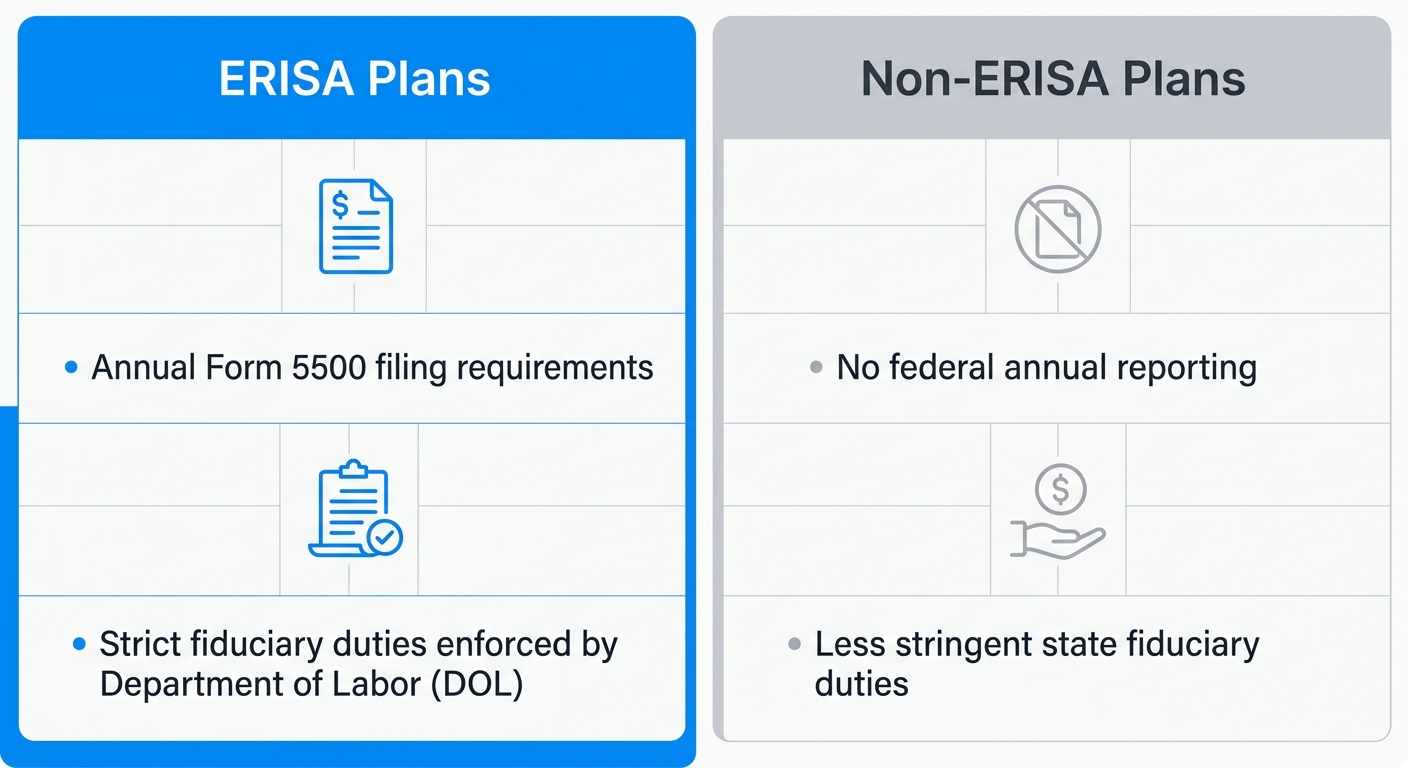
    ERISA vs. Non-ERISA Plans Comparison

    Table comparing key differences between ERISA-governed plans and non-ERISA plans to illustrate compliance scope.

    ERISA vs. Non-ERISA Plans Comparison
    AspectERISA PlansNon-ERISA Plans
    Reporting RequirementsAnnual Form 5500 filing requiredNo federal annual reporting
    Fiduciary DutiesStrict standards enforced by DOLState law may apply, less stringent

    ERISA plans impose rigorous federal oversight, ideal for larger operations but burdensome for small businesses. Non-ERISA plans, often governmental or church-related, enjoy state-level flexibility with fewer reporting demands. For small businesses, this means lighter administrative loads outside ERISA, yet venturing into covered plans heightens fiduciary risks. Even alternative investments 2026 must adhere to ERISA fiduciary standards, demanding prudent selection and monitoring. At Zaidwood Capital, our equity advisory services in ERISA contexts guide clients through these implications, as per our internal expertise.

    These differences underscore why small businesses weigh plan structures carefully. Transitioning to ERISA compliance elevates protections but requires robust processes. Professional support mitigates penalties, which can reach 100% of taxes due for violations.

    Infographic comparing ERISA Plans and Non-ERISA Plans side-by-side with icons and key requirements

    ERISA vs Non-ERISA Plans comparison for compliance fundamentals

    The DOL offers correction programs for inadvertent failures, cited as authoritative government guidance. Options include the Voluntary Fiduciary Correction Program (VFCP) for prohibited transactions, Audit CAP for audit findings, and self-correction under SCP. Erisa wrap documents bundle amendments into a master document, streamlining compliance as a key tool.

    A professional erisa compliance service helps avoid pitfalls. These basics set the stage for deeper dives into fiduciary duties and advanced strategies.

    In-Depth ERISA Requirements and Pitfalls

    Building on core ERISA requirements, we delve into fiduciary duties, common pitfalls, and the vital role of erisa compliance service in ensuring plan integrity for retirement sponsors.

    Fiduciary Responsibilities Under ERISA

    ERISA imposes stringent fiduciary responsibilities on plan administrators to safeguard participant interests. Fiduciaries must adhere to the duty of prudence, requiring diversified investments and thorough due diligence to minimize risks. The exclusive benefit rule mandates that plan assets serve solely participants, prohibiting personal gain. The duty of loyalty demands impartial decisions free from conflicts.

    Common breaches erode these standards. Self-dealing occurs when fiduciaries direct plan assets to their own ventures, as seen in cases where managers funneled funds to affiliated entities, triggering DOL investigations. Failure to monitor delegated responsibilities, such as neglecting investment advisor performance, invites liability. Excessive fees from undisclosed relationships exemplify loyalty violations. These lapses expose fiduciaries to personal liability, including repayment of losses plus interest.

    We at Zaidwood Capital emphasize proactive oversight through our compliance frameworks, drawing on internal expertise to guide sponsors in fulfilling these duties effectively.

    Common Compliance Issues and Risks

    Frequent ERISA compliance issues threaten plan viability and sponsor finances. Late form 5500 filing draws severe penalties, while inadequate participant disclosures mislead beneficiaries on fees and options. Prohibited transactions, like loans to disqualified persons, violate core protections. The U.S. Department of Labor outlines correction programs such as the Delinquent Filer Voluntary Compliance Program for late filings and the Voluntary Fiduciary Correction Program for breaches, citing government penalty guidelines.

    ERISA compliance services mitigate these risks via automated filings, regular audits, and tailored training, often integrated alongside equity advisory services. Key ERISA pitfalls and service preventions include late filings and fiduciary errors, which carry steep consequences but yield to structured interventions.

    Common ERISA Violations vs. Prevention Methods
    ViolationConsequencesPrevention via Services
    Late Form 5500Penalties up to $2,670/dayAutomated reminders and filing
    Fiduciary BreachPersonal liabilityTraining and audits

    These measures, informed by U.S. Department of Labor programs, substantially reduce exposure. Zaidwood Capital’s internal expertise in ERISA compliance solutions delivers automated tools and audits, preserving tax-qualified status and shielding sponsors from litigation.

    Role of Wrap Documents in Compliance

    Erisa wrap documents serve as master plans that envelop vendor documents in bundled 401(k) or cafeteria arrangements, ensuring overarching ERISA adherence. Sponsors adopt these via board resolution, incorporating platform specifics into a unified fiduciary framework.

    Benefits include streamlined administration, centralized fiduciary oversight, and simplified amendments across multiple vendors. Plan sponsors avoid fragmented compliance gaps, as wraps enforce uniform standards on investments and disclosures. Zaidwood Capital leverages our capital formation services to support these bundled solutions effectively.

    Common implementation errors involve incomplete vendor integration or untimely adoption, risking non-compliance. Proper execution demands legal review and annual updates. Mastering these elements fortifies compliance—explore practical implementation strategies next.

    Our team provides tailored implementation checklists, annual review schedules, and vendor-integration protocols to help sponsors maintain documentation, update plans timely, and demonstrate fiduciary diligence across multiple plan platforms consistently.

    Implementing ERISA Compliance Strategies

    Now that you understand core ERISA requirements, we guide you through practical implementation strategies. At Zaidwood Capital, our erisa compliance service equips plan sponsors with proven approaches to meet obligations efficiently and minimize risks.

    Outsourcing ERISA Compliance Benefits

    Outsourcing ERISA compliance delivers clear advantages for plan sponsors seeking reliability without building internal capabilities. First, it provides access to specialized ERISA expertise, ensuring up-to-date knowledge of complex regulations. Second, third-party audits reduce compliance risks by identifying issues early. Third, it saves time for internal teams, allowing focus on core business activities. For instance, outsourcing often includes preparation of erisa wrap documents, streamlining document management as outlined in Zaidwood Capital’s internal company policies.

    Review our terms and conditions for details on service agreements that support these benefits.

    The following table compares key factors of in-house versus outsourced approaches:

    In-House vs. Outsourced ERISA Compliance
    FactorIn-HouseOutsourced
    CostVariable, staff timePredictable fees
    ExpertiseInternal knowledge gapsSpecialist access

    This comparison highlights how outsourcing offers predictable costs and expert support, ideal for plans lacking dedicated resources. According to Zaidwood Capital’s proprietary guidelines, these factors help sponsors select based on operational scale. Transitioning from this overview, many opt for outsourcing to leverage external strengths while maintaining oversight.

    Step-by-Step Form 5500 Process

    Form 5500 filing represents a critical annual requirement for ERISA plans. Plan administrators must follow precise steps to avoid penalties. Begin by gathering participant data by the plan’s quarter-end. Next, complete Schedule H or I if assets exceed $250,000. Then, review for late filing penalties, which can reach $2,670 daily. Submit electronically via EFAST2 by July 31. Finally, retain records for potential IRS audits.

    1. Gather comprehensive participant data by quarter-end to ensure accuracy.
    2. Determine and complete Schedule H or I based on plan assets over $250,000.
    3. Assess risks of late penalties up to $2,670 per day per DOL guidelines.
    4. File the annual Form 5500 submission through EFAST2 by the July 31 deadline.
    5. Archive all records securely for IRS or DOL audit readiness.

    These steps, drawn from standard practices, safeguard compliance. Industry standards emphasize electronic submission to streamline form 5500 filing processes.

    Building an Internal Compliance Framework

    Alternatively, for those preferring control, building an in-house framework fosters long-term self-reliance. Appoint a dedicated compliance officer to oversee daily operations. Implement annual training using DOL checklists for all relevant staff. Automate tracking with software like Ascensus to monitor deadlines efficiently. Conduct mock audits quarterly to test readiness.

    Practical tips include:

    1. Designate a compliance officer accountable for ERISA adherence.
    2. Roll out annual training programs based on DOL checklists.
    3. Deploy automation tools such as Ascensus for deadline tracking.
    4. Schedule quarterly mock audits to simulate real DOL reviews.

    Zaidwood Capital’s internal policies underscore the value of structured training in maintaining robust systems. This approach suits larger plans with resources for sustained investment.

    In summary, choose outsourcing for expertise and efficiency or in-house for control, depending on plan size and complexity. Once implemented, ongoing vigilance through monitoring ensures sustained ERISA alignment.

    Advanced ERISA Considerations

    Building on core requirements, advanced ERISA considerations focus on remediation strategies for retirement plan sponsors facing compliance challenges. Escalating risks such as fiduciary breaches or operational failures demand proactive erisa compliance service to avoid penalties and preserve tax-qualified status. We at Zaidwood Capital emphasize early intervention through structured correction programs.

    Common compliance risks include late participant contributions, improper plan amendments, or prohibited transactions, which can trigger audits and excise taxes. Plan sponsors must assess error severity to select appropriate remedies, ensuring participant protections remain intact. Sponsors should document corrective actions, communicate promptly with affected participants, and retain records of remediation steps to demonstrate good-faith efforts and protect participant benefits and plan integrity.

    The following table outlines key options for addressing compliance failures:

    ERISA Corrections: Self vs. DOL Programs
    Options for addressing compliance failures.

    ERISA Corrections: Self vs. DOL Programs
    MethodEligibilityCost
    Self-CorrectionMinor errorsLow
    DOL VFCPSignificant issuesFiling fees

    Self-correction suits minor errors correctable without DOL involvement, offering low or no cost under IRS Self-Correction Program (SCP) guidelines. For significant issues like fiduciary violations, the U.S. Department of Labor (DOL) Voluntary Fiduciary Correction Program (VFCP) requires a formal application process, per DOL authoritative government program guidelines for retirement plan corrections. This structured approach resolves complex failures while minimizing sanctions.

    Erisa wrap documents streamline administration by bundling multiple plan amendments into a single compliant wrapper, enhancing efficiency for sponsors managing evolving regulations. Timely form 5500 filing fulfills annual reporting obligations; late or inaccurate submissions incur penalties under DOL‘s Delinquent Filer Voluntary Compliance Program (DFVCP).

    Expert erisa compliance service ensures seamless navigation of these complexities. Contact Zaidwood Capital, attributed as our internal firm resource for professional compliance assistance, for tailored guidance.

    ERISA Compliance FAQ

    What is an ERISA compliance service?

    An erisa compliance service assists employers in meeting federal ERISA regulations for retirement plans. It offers solutions like wrap documents to streamline compliance. Zaidwood Capital’s internal FAQ guidance highlights these essential tools for fiduciaries.

    What are ERISA wrap documents?

    Erisawrap documents bundle existing plan documents into one master compliant document. This approach ensures all components meet ERISA standards efficiently. Plan sponsors use them to simplify administration and reduce risks.

    What is Form 5500 filing?

    Form 5500 filing requires annual reporting to the DOL for retirement plans with assets over $250,000. It discloses financials, participant data, and plan operations. Timely submissions prevent penalties and maintain compliance.

    How does Zaidwood Capital assist with ERISA compliance?

    We provide expert erisa compliance service through detailed FAQ resources on our platform. Our guidance covers wrap solutions and filing needs. Contact us for tailored support.

    For personalized advice, see our contact page.

    Key Takeaways for ERISA Compliance

    To distill the essentials, effective ERISA compliance service ensures retirement plans meet federal standards and safeguard participant interests.

    • Prepare ERISA wrap documents to provide accurate participant disclosures required under ERISA regulations.
    • Complete timely form 5500 filing to prevent penalties reaching up to $2,400 per day for late submissions.
    • Conduct annual audits mandatory for plans exceeding 100 participants to verify compliance.
    • Fulfill fiduciary responsibilities by selecting investments with prudent care and due diligence.
    • Consult experts for customized strategies in ERISA compliance service tailored to your plan.

    Contact us at Zaidwood Capital for tailored ERISA support.

    This article was researched and written with the assistance of AI tools.

    Resources

  • Bookeeping: Complete Guide for Small Business Owners

    Bookeeping: Complete Guide for Small Business Owners

    Table of Contents

    Essential Bookkeeping Basics for Small Businesses

    We at Zaidwood Capital recognize that effective bookkeeping forms the backbone of small business financial management. Bookkeeping involves the systematic recording of financial transactions, ensuring every dollar in and out is tracked accurately. For small business owners juggling multiple roles, this process prevents chaos and supports informed decision-making from day one.

    At its core, small business bookkeeping is essential for tax preparation, cash flow monitoring, and regulatory compliance. The IRS requires retaining receipts and records for at least three years to substantiate income and expenses, avoiding penalties that can derail a growing venture. Consider a retail shop in Sheridan, Wyoming, where tracking inventory costs through financial record-keeping reveals profitable product lines and seasonal trends, enabling better purchasing decisions.

    Startups often handle basic tasks in-house, but scaling businesses benefit from outsourced bookkeeping to manage complexity. Professional services mitigate common pitfalls, such as overlooked deductions or audit triggers. While bookkeepers focus on daily transactions, accountants provide deeper analysis—a key distinction in bookkeeping vs accounting. Accounting support for SMBs ensures compliance while laying groundwork for advanced strategies like debt advisory and equity raising, areas where Zaidwood Capital excels in integrating robust documentation with corporate finance consulting.

    Do small businesses need these services? Absolutely, to navigate risks and fuel growth. In the following sections, we explore fundamental roles, costs, and strategies to build a solid financial foundation.

    Core Principles of Small Business Bookkeeping

    Effective bookkeeping forms the foundation of financial management for small and medium-sized businesses, ensuring accurate tracking that supports informed decision-making and future growth. Our experience at Zaidwood Capital shows how these fundamentals prepare companies for capital raising and mergers and acquisitions by maintaining transparent records that facilitate due diligence. By mastering daily financial tracking and generating key reports, SMBs can avoid common pitfalls and align with compliance standards.

    Understanding Daily Transaction Recording

    Daily transaction recording is a cornerstone of small business bookkeeping, involving the systematic logging of all income, expenses, and reconciliations to preserve financial integrity. For instance, a freelance consultant might enter client invoices as income upon issuance, categorize supply purchases as expenses, and reconcile bank statements weekly to catch discrepancies early. This process, often called daily financial tracking, prevents errors that could escalate during audits or expansion phases.

    Tools like accounting software streamline these tasks, automating categorization and integration with bank feeds for efficiency. According to IRS guidelines, businesses must retain supporting documents such as receipts and invoices for 3 to 7 years, emphasizing the need for organized irs record keeping for small businesses. Our advisory work reveals that consistent practices reduce compliance risks and build a reliable data trail essential for strategic planning.

    Selecting the right bookkeeping method depends on factors like business type, size, and growth aspirations. Service-based operations with straightforward cash flows often benefit from simpler approaches, while product-heavy firms may require more nuanced tracking to reflect ongoing obligations accurately.

    AspectCash BasisAccrual Basis
    Recognition of RevenueWhen cash is receivedWhen earned (invoice date)
    SuitabilityIdeal for small, service-based businessesRequired for complex/inventory businesses

    Cash basis offers simplicity for startups focused on immediate cash management, but accrual basis provides a fuller picture of financial health, which is crucial as businesses scale toward opportunities like M&A. This method better captures future obligations and revenues, aiding in valuation and investor presentations. Transitioning to accrual can enhance readiness for capital formation by demonstrating sustainable growth trajectories.

    Key Financial Statements for SMBs

    Key financial statements serve as the primary outputs of robust small business bookkeeping, offering insights into profitability, position, and liquidity. The income statement, or profit and loss report, summarizes revenues minus expenses over a period, revealing net income or loss. For a retail shop, this might highlight seasonal sales peaks against fixed costs like rent, guiding pricing adjustments.

    The balance sheet provides a snapshot of assets, liabilities, and equity at a specific point, ensuring assets equal liabilities plus equity. It helps assess solvency, such as verifying that inventory investments align with available capital. Meanwhile, the cash flow statement tracks actual cash inflows and outflows across operating, investing, and financing activities, crucial for managing working capital in volatile markets.

    • Income Statement: Tracks performance; essential for tax prep as per SCORE resources, integrating expense logs with seasonal obligations.
    • Balance Sheet: Shows financial position; supports due diligence by verifying asset values.
    • Cash Flow Statement: Monitors liquidity; prevents cash crunches during growth.

    Do small businesses need professional bookkeeping services? Absolutely, especially as complexity grows—errors in these statements can lead to overstated profits or undetected shortfalls, complicating payroll and HR compliance. Outsourced bookkeeping mitigates these risks, providing expert oversight that aligns with IRS standards and frees owners for core operations. In our capital advisory role, we see how precise statements bolster credibility with investors, tying foundational practices to successful equity raises and M&A executions.

    Exploring Bookkeeping Processes in Depth

    At Zaidwood Capital, we emphasize the importance of robust financial foundations in supporting mergers and acquisitions and capital advisory services. Understanding bookkeeping processes in depth enables small businesses to maintain accurate records that facilitate due diligence and strategic planning. This section examines the nuanced roles within financial management and explores outsourcing as a scalable solution for growing enterprises.

    Role Differentiation: Bookkeeper vs. Accountant

    We recommend distinguishing between bookkeepers and accountants to ensure optimal financial oversight, particularly as businesses prepare for capital transactions. Bookkeepers focus on the day-to-day aspects of bookkeeping, such as entering financial transactions, reconciling bank statements, and generating basic reports like income statements. These tasks maintain the integrity of financial data, providing a clear snapshot of cash flow and expenses. In contrast, accountants delve into analysis, interpreting that data to offer insights on profitability, tax strategies, and compliance with regulations.

    Qualifications further highlight these differences. Bookkeepers typically hold an associate degree and proficiency in software like QuickBooks, while accountants often possess a bachelor’s degree and certifications such as CPA, enabling them to handle complex audits and financial forecasting. For small businesses, involve a bookkeeper for routine transaction management to keep operations smooth, and engage an accountant during tax season or when scaling for equity raises. This division ensures efficiency without overburdening internal resources.

    Consider a tech startup we advised: initial bookkeeping handled in-house for basic entries, but as funding discussions arose, an accountant’s analytical expertise proved essential for projecting valuations. Such role clarity aids in due diligence, linking everyday records to broader strategic goals.

    The following table outlines key duties to illustrate these distinctions:

    FactorIn-HouseOutsourced
    Cost StructureFixed salary plus benefitsVariable monthly fee
    ScalabilityLimited by staff capacityFlexible with business growth

    This comparison underscores how bookkeepers lay the groundwork, while accountants provide the strategic elevation needed for informed decisions in capital advisory contexts. By addressing the question of differences for small businesses, we help clients allocate resources effectively, enhancing overall financial health.

    Outsourcing Options and Cost Factors

    For growing small businesses, outsourced bookkeeping offers flexibility and expertise that in-house efforts may lack, aligning with our full-cycle due diligence services at Zaidwood Capital. Benefits include cost savings through variable pricing, access to specialized knowledge in areas like payroll and HR integration, and reduced compliance risks. Outsourcing allows focus on core operations, such as preparing for debt or equity financing, while professionals manage transaction management and reporting. A retail client we supported transitioned to external financial services during expansion, freeing time for market analysis and investor outreach.

    Pricing structures vary based on business size and complexity. Hourly rates range from $20 to $50, suitable for occasional needs, while monthly packages for comprehensive small business bookkeeping fall between $500 and $2,000. For trades businesses, as noted in regional benchmarks, costs average $500 to $1,200 monthly, covering invoicing, job costing, and tax preparation setup. These models are deductible business expenses, providing additional value.

    When selecting providers, consider these criteria:

    1. Experience with your industry and integration with tools like payroll systems.
    2. Certifications and references to ensure reliability.
    3. Scalability for growth phases, such as during M&A preparations.
    4. Transparent pricing without hidden fees.

    To address how much outsourcing costs, tiered examples include basic plans at $300-700 for freelancers and premium at $1,000+ for firms offering strategic insights. This approach not only saves time—owners spend 120 hours annually on DIY tasks—but also mitigates errors like overpaid taxes, supporting precise financials for capital transactions.

    As small and medium-sized businesses (SMBs) scale, evaluating scalability becomes critical; in-house limitations can hinder growth, while outsourcing adapts seamlessly to increasing transaction volumes. The following table contrasts these approaches:

    SoftwareKey FeaturesPricingBest For
    QuickBooksInvoicing, payroll integration$25+/monthMost US-based SMBs
    XeroBank feeds, multi-currency$13+/monthCloud-focused ops

    In-house suits stable operations with steady volumes, yet outsourced bookkeeping excels for dynamic SMBs navigating capital raises, offering expertise that pays for itself through better cash flow management and decision-making. For complex finances, we advise integrating these services with strategic advisory, such as linking to a small business tax preparation guide to streamline compliance ahead of transactions. This positions businesses for efficient due diligence and sustained growth.

    Implementing Bookkeeping in Daily Operations

    We recognize that integrating bookkeeping into daily operations is essential for small businesses seeking financial clarity and growth opportunities. At Zaidwood Capital, we advise starting with robust systems that not only track transactions but also align with broader financial strategies, such as preparing for debt advisory services. This section outlines practical tools and processes to streamline these efforts, ensuring compliance and efficiency while highlighting how accurate records can support access to tailored financing solutions.

    Tools and Software for Efficient Tracking

    Effective small business bookkeeping begins with selecting the right operational financial tools that automate routine tasks and provide real-time insights. We recommend platforms like QuickBooks for its comprehensive features tailored to growing enterprises, including automated invoicing and expense categorization. These integrated record systems simplify daily tracking, allowing owners to focus on core activities rather than manual data entry.

    To set up such software, follow these steps: 1) Create a chart of accounts to organize income, expenses, assets, and liabilities based on your business structure. 2) Establish categorization rules for transactions, such as tagging vendor payments or client receipts automatically. 3) Connect bank feeds for seamless import of statements, reducing errors and saving time. This initial configuration, which takes about 2-4 hours, forms the foundation for scalable bookkeeping.

    When evaluating options, consider integration needs like compatibility with payroll modules and ease of generating reports for lenders. The following table compares popular bookkeeping software options, focusing on features relevant to small businesses:

    PracticeStandard BookkeepingAdvanced for Growth
    ForecastingBasic monthly reviewsScenario modeling
    ComplianceAnnual tax prepFull-cycle audits

    Selection criteria such as cost, user interface, and scalability should guide your choice. For instance, QuickBooks excels in domestic operations with strong add-on support, while Xero suits businesses with global transactions. Following this evaluation, we suggest weighing pros and cons: QuickBooks offers robust compliance tools but may require training, whereas Xero promotes collaboration yet demands reliable internet. These factors tie directly to maintaining accurate records that facilitate compliance and future capital pursuits.

    What questions should small business owners ask a bookkeeping provider? We recommend inquiring about:

    • Their experience with industries similar to yours and proficiency in your chosen software.
    • How they ensure data security, including adherence to policies like the zaidwood capital privacy policy.
    • Timelines for setup and ongoing support to integrate with your workflows.
    • Methods for customizing reports to align with lending applications.

    Incorporating bookkeeping here enhances operational efficiency, but for complex scaling, professional oversight may be necessary.

    Integrating Payroll and Compliance Checks

    Aligning bookkeeping with payroll and HR tasks is crucial for regulatory adherence and operational smoothness. We guide clients to link these functions through software that handles withholding calculations, tax filings, and employee deductions automatically. This integration not only minimizes errors but also ensures records support strategic needs, such as demonstrating financial health for debt advisory engagements at Zaidwood Capital.

    Begin by syncing payroll modules within your bookkeeping system: 1) Input employee details, including tax IDs and deduction preferences. 2) Set up automated withholding for federal, state, and local taxes per IRS guidelines. 3) Generate payslips and W-2 forms, retaining copies for at least four years as required by IRS record-keeping rules for employee forms. This process aligns daily operations with HR compliance, covering aspects like overtime tracking and benefits administration.

    For outsourced bookkeeping scenarios, providers can manage these integrations, ensuring seamless reporting for audits. However, always verify their familiarity with regulatory updates to avoid penalties. Accurate payroll records, bolstered by consistent categorization, directly aid in preparing documentation for financing, where lenders review cash flow and compliance history.

    To illustrate workflow differences, consider the following comparison of payroll methods:

    MethodAccuracyCost
    Manual CalculationHigh risk of errorLow initial cost
    Automated SoftwareHigh (audit-ready)Subscription-based

    Manual methods suit very small teams but risk inconsistencies that could complicate growth strategies. Automated systems, conversely, streamline processes and provide audit-ready trails, ideal for businesses eyeing expansion through capital formation. We advise transitioning to automation for scalability, linking it to broader financial planning.

    In compliance checks, focus on daily, quarterly filings and annual reconciliations. Use checklists: Verify deduction accuracy monthly, reconcile payroll with general ledger quarterly, and conduct annual reviews for discrepancies. Caution on data security is paramount; implement multi-factor authentication and regular backups to protect sensitive information. These practices not only meet HR requirements but also position your business favorably for advisory services, where precise records unlock competitive financing terms via our extensive lender network.

    While basic implementation handles daily needs, advanced scenarios may require specialized support to navigate complexities beyond standard operations.

    Advanced Bookkeeping Strategies for Growth

    In our advisory work at Zaidwood Capital, we frequently guide expanding small businesses through the transition from foundational record-keeping to more nuanced practices that align with ambitious growth objectives. As companies scale, especially when preparing for capital events like mergers or equity raises, advanced bookkeeping becomes essential. This involves not just accurate tracking but strategic integration that supports decision-making and investor confidence. For instance, a manufacturing firm eyeing an acquisition might leverage sophisticated techniques to ensure its financials reflect potential synergies, positioning it favorably in due diligence processes.

    One key strategy centers on pro forma financials and scenario planning, elevating basic bookkeeping to strategic financial modeling. Here, businesses create forward-looking statements that model various growth paths, incorporating variables like market expansions or revenue streams from new products. We incorporate the keyword bookkeeping in this context, as robust forecasting distinguishes viable opportunities from risks. Small business bookkeeping tools, such as integrated software suites, enable this by automating projections and linking them to real-time data, while outsourced bookkeeping specialists handle the complexities of multi-scenario analysis.

    Advanced compliance practices further enhance readiness, moving beyond annual tax preparation to proactive measures like SOX preparation. This ensures financial reporting withstands scrutiny during capital raises, mitigating regulatory hurdles. Ties to M&A due diligence are critical; full-cycle audits reveal operational efficiencies and valuation drivers that standard approaches overlook. Strategic documentation, including pitch decks, transforms raw data into compelling narratives for stakeholders, highlighting growth potential through growth-oriented record-keeping.

    Preparing financials for such events requires a clear distinction between routine and elevated practices. The following table outlines this comparison in the context of M&A readiness:

    MetricRoutine PracticeGrowth-Oriented
    Data DepthBasic Income/ExpenseSegmented profitability
    ComplianceIRS GuidelinesSOX/Due Diligence Ready

    This framework illustrates how advanced methods build investor trust by providing deeper insights. For example, scenario modeling can quantify the impact of an acquisition, while due diligence prep uncovers hidden value, directly supporting liquidity solutions.

    In our experience, these strategies unlock access to extensive investor networks, much like those we maintain with over 500 private equity firms and family offices. Our aggregate transaction volume exceeds $24.4 billion across more than 300 deals, demonstrating the real-world impact of precise financial preparation. For businesses exploring alternative investments 2026, integrating such bookkeeping enhances appeal in equity and debt advisory contexts.

    To implement effectively, consider these advanced tips:

    • Engage outsourced bookkeeping early for SOX-aligned processes.
    • Develop pitch decks with pro forma integrations to showcase scalability.
    • Conduct regular scenario reviews tied to M&A timelines.
    • Leverage advisory partnerships for network introductions during capital events.

    These approaches not only fortify financial health but also pave the way for sustainable expansion, addressing common queries on scaling professional services in dynamic growth phases.

    Common Bookkeeping Questions Answered

    In this financial Q&A on bookkeeping, we address key concerns for small businesses, drawing from our strategic advisory insights to clarify essential practices.

    What is the difference between a bookkeeper and an accountant?

    Bookkeepers handle day-to-day transaction recording and basic financial organization, while accountants provide analysis, tax preparation, and strategic advice. We recommend combining both for comprehensive SMB record queries.

    What are the typical costs for outsourced bookkeeping?

    Costs range from $500 to $2,500 monthly, depending on transaction volume and complexity. Outsourced bookkeeping offers scalable solutions without in-house overhead, as discussed in our service overviews.

    Do small businesses need dedicated bookkeeping services?

    Yes, small business bookkeeping ensures accurate records for compliance and growth planning. It prepares firms for capital raising by maintaining reliable financial data, tying into our full-cycle advisory.

    How does bookkeeping integrate with payroll management?

    Bookkeeping tracks payroll expenses and deductions, ensuring seamless integration with accounting software. This prevents errors and supports timely reporting, enhancing overall financial health.

    What compliance tips should businesses follow for bookkeeping?

    Maintain detailed records and use secure software for IRS adherence. We suggest consulting professionals, noting our Terms & Conditions disclaim specific guarantees on outcomes. Always verify with legal advisors.

    How to vet a bookkeeping provider?

    Evaluate experience, references, and software proficiency. Firms like harris and partners exemplify thorough vetting; we advise aligning with your strategic finance needs.

    Building Strong Financial Foundations Through Bookkeeping

    In summary, mastering bookkeeping forms the cornerstone of financial stability for small businesses, from grasping fundamentals and streamlining processes to linking them with advanced capital strategies. Proactive management ensures compliance while unlocking growth opportunities, serving as essential SMB growth tools. At Zaidwood Capital, we emphasize consulting professionals for tailored guidance, including options like small business bookkeeping or outsourced bookkeeping to integrate these financial strategy essentials seamlessly. Explore our broader advisory services to elevate your operations—review our Terms & Conditions for details on engaging responsibly.

    Resources