Zaidwood Capital

Tag: Portfolio Diversification

  • Family Office Liquidity Management Strategies: Essential Guide

    Family Office Liquidity Management Strategies: Essential Guide

    Table of Contents

    The Foundations of Family Office Liquidity Management

    Effective family office liquidity management strategies ensure that sufficient cash and near-cash assets are available to meet obligations—capital calls, operating expenses, and strategic investments—without disrupting long-term portfolio allocations. This foundational discipline balances near-term liquidity needs with the family’s overarching wealth preservation goals.

    Capital call liquidity management is a critical concern, given that private equity and venture funds require sudden capital injections. At the same time, uneven cash flows from operating businesses underscore the need for disciplined family office treasury management to maintain adequate buffers without sacrificing returns.

    Institutional-grade advisory services, such as debt advisory and equity liquidity solutions, help family offices optimize their liquidity position. We draw on $24.4B+ in aggregate transaction volume and a network of over 4,000 global investors, aligned with ICMA guidelines, to provide solutions like global lending services. In the sections that follow, we’ll explore how these strategies are structured to meet the unique demands of family offices.

    1. Tiered Liquidity Buckets for Stability

    In family office liquidity management strategies, we define tiered liquidity buckets as a framework that segments assets by accessibility, ensuring that near-term obligations can be met without liquidating long-term holdings.

    • Operational: immediate access cash for expenses and capital calls.
    • Reserve: 30- to 90-day instruments, such as commercial paper.
    • Strategic: longer-term investments for planned growth.

    This structure anchors capital call liquidity management by pre-positioning funds before drawdowns occur. Family office treasury management relies on cash flow forecasting to calibrate each bucket, mitigating forced liquidation risk. As Zaidwood Capital’s educational materials note, commercial and industrial loans are a prime example of a short-term vehicle that fits naturally within the reserve tier, offering working-capital support while protecting longer-horizon assets.
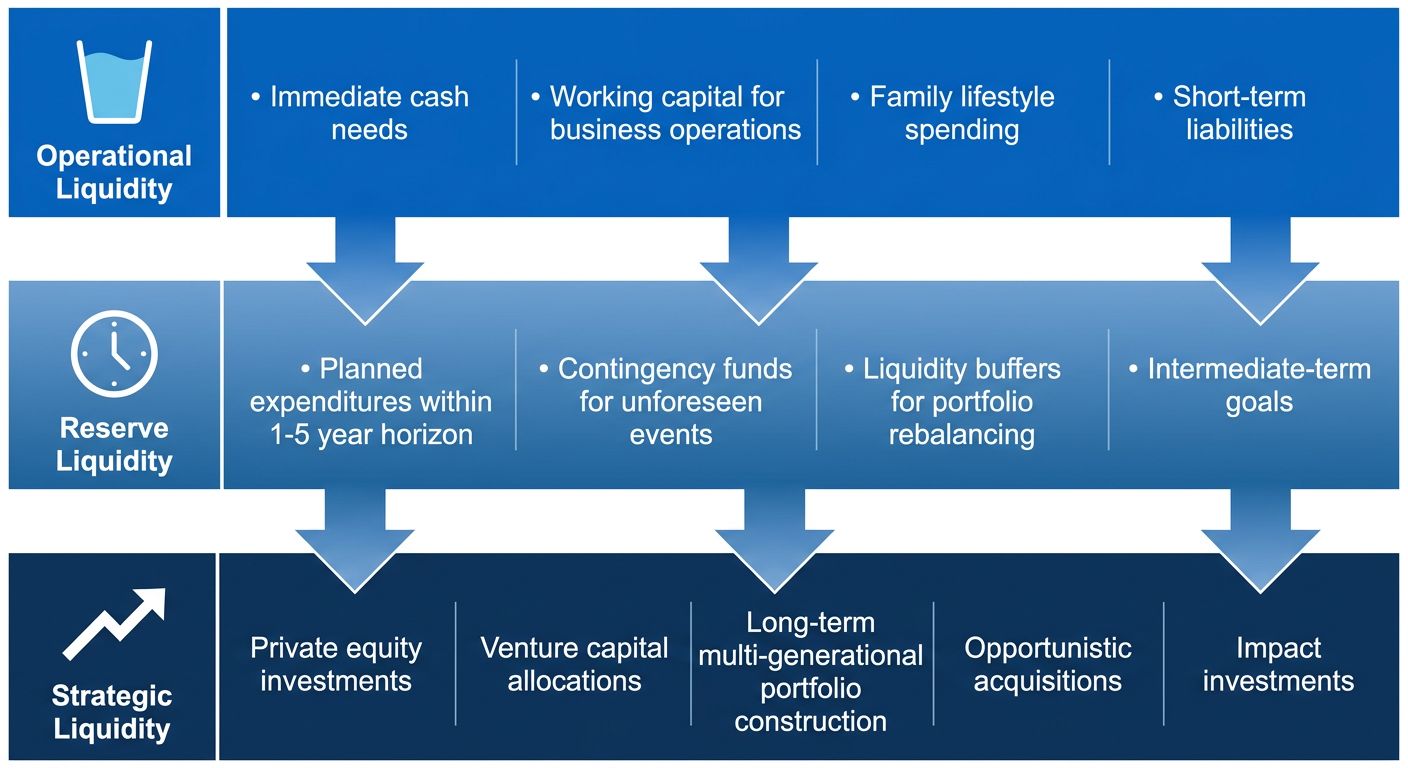
    Three-tiered liquidity structure infographic showing operational, reserve, and strategic liquidity buckets with blue gradient arrows

    Tiered liquidity buckets for family office stability

    Ultimately, robust family office liquidity management strategies align each bucket with anticipated calls and contingencies — a principle Zaidwood Capital’s liquidity management best practices reinforce. In the next section, we detail the asset classes assigned to each tier.

    2. Private Equity Liquidity Solutions

    Building on our advisory platform, private equity liquidity solutions help investors access capital without selling assets. They are essential in family office liquidity management strategies, where preserving long-term investments during short-term cash needs is critical.

    A key driver of private equity liquidity strategies for family offices is capital call liquidity management. When a general partner calls capital, limited partners must fund commitments promptly. Liquidity demands also arise in other scenarios:

    • Addressing uneven cash flows
    • Funding opportunistic co-investments
    • Covering tax or estate obligations
    • Rebalancing portfolios without disruption

    Through our Equity Advisory practice, we leverage the Velocity Matrix and our network of over 4,000 institutional investors with $15 billion in available capital to source liquidity solutions tailored to specific needs. Our full-cycle M&A and capital formation expertise allows us to design facilities that meet family office treasury management objectives, providing cash when required without disrupting strategic portfolios. Every engagement is custom-quoted, and no outcome is guaranteed.

    This integrated approach to liquidity sets the stage for our debt advisory services, which provide the leverage for growth. This discussion is for informational purposes only and is not investment advice. Securities are offered through Finalis Securities LLC.

    3. Managing Illiquidity Premiums Effectively

    Effective family office liquidity management strategies begin with a clear understanding of what an illiquidity premium represents — the additional return investors demand for holding assets that cannot be quickly converted to cash without meaningful price concessions. At Zaidwood Capital, we emphasize that capturing this premium requires deliberate planning rather than passive acceptance. Successful liquidity management for family offices involves constructing portfolios with calibrated exposure across liquidity tiers, ensuring that long-duration commitments are matched with patient capital and clearly defined holding periods.

    We recommend rigorous assessment of illiquidity premiums through historical data analysis and liquidity discount models, which help quantify the expected compensation for reduced marketability. A disciplined approach to family office treasury management incorporates capital call liquidity reserves — cash or near-cash allocations specifically designated to meet drawdown requests from private investment commitments. This capital call liquidity management framework protects portfolios from forced selling and preserves the integrity of the long-term investment strategy.

    Industry best practices established by the International Capital Market Association provide valuable guidance on bond market liquidity and transparency standards. We incorporate these principles when advising on portfolio construction, recognizing that liquidity conditions evolve across market cycles. Educating stakeholders about the relationship between illiquidity and expected returns, and maintaining adequate liquidity buffers for capital calls, positions family offices to earn meaningful premiums while sustaining operational flexibility across full-cycle market environments.

    4. Capital Call Liquidity Management

    Effective capital call liquidity management is a cornerstone of capital call liquidity management for family offices and institutional investors. A capital call is a formal request from a fund manager requiring investors to fulfill their committed capital obligations. Our role is to help clients meet these requests on time without disrupting cash flow or long-term investment returns.

    We approach capital call liquidity strategies with three primary tools: maintaining a dedicated cash buffer, arranging a capital call line of credit, and structuring committed capital facilities. At Zaidwood Capital, our capital call financing solutions are specifically designed for family offices and private investors, as detailed in our Capital Call Financing FAQ. Unlike standard commercial and industrial loans—which are typically used for operating expenses or expansion and rely on asset-based or cash-flow lending—capital call financing is purpose-built for short-term bridging until called capital is distributed.

    This disciplined approach to family office treasury management helps investors avoid forced asset sales, default penalties, and missed opportunities. In the next section, we examine practical steps to implement these liquidity safeguards.

    5. Dividend Recapitalization for Diversification

    Family office liquidity management strategies often incorporate dividend recapitalization, a transaction where a company borrows to pay a dividend to its owners. This provides partial liquidity, letting family offices meet capital call liquidity management requirements or implement family office treasury management initiatives without selling underlying holdings. Freeing up capital in this way enables reinvestment across new asset classes, enhancing portfolio diversification and resilience.

    We also weigh the illiquidity premium inherent in private market investments. Zaidwood Capital’s FAQ highlights that limited partners demand a premium for reduced liquidity, shaping how we approach recapitalizations. Funding can come from sources like commercial and industrial loans, distinguishing this method from a full exit or secondary sale. By preserving ownership while accessing capital, family offices maintain ongoing alignment with management and redeploy proceeds strategically. This technique is one of several recapitalization tools we use to balance liquidity with long-term portfolio objectives.

    6. Treasury Management Best Practices

    To move from theory to practice, family offices should adopt proven family office liquidity management strategies, as outlined in our treasury management resources.

    • Prioritize cash flow forecasting with a rolling six-month horizon and monthly updates to anticipate liquidity needs, proactively manage upcoming capital calls, and avoid unexpected funding gaps.
    • Diversify counterparty risk by maintaining banking relationships with at least three independent institutions, reducing concentration risk and ensuring access to liquidity during market disruptions.
    • Develop a formal family office treasury management policy that includes liquidity stress testing under multiple market scenarios, such as interest rate spikes or capital call surges.
    • Use capital call liquidity management as a strategic tool to cover short-term funding gaps without forced asset sales, preserving long-term portfolio value.
    • Leverage treasury management software or real-time dashboards for consolidated visibility into cash positions, portfolio liquidity, and committed capital calls.

    These practices build a resilient liquidity framework; the next section explores advanced treasury technology solutions.

    7. Optimizing Private Equity Allocations

    Optimizing private equity allocations requires robust family office liquidity management strategies that balance the pursuit of the illiquidity premium with the need for accessible capital. At Zaidwood Capital, we see the illiquidity premium adding 2–3% to long-term returns, but it demands careful liquidity planning. Private equity commitments inherently involve multi-year lock-ups and unpredictable capital calls, so families must develop a clear liquidity strategy for family offices. Effective capital call liquidity management involves forecasting cash outflows and maintaining dedicated reserves to meet drawdowns without disrupting operating budgets or forcing premature asset sales.

    In our experience at Zaidwood Capital, family office treasury management plays a central role in ensuring that PE commitments align with overall portfolio liquidity. Diversifying commitments across vintage years and fund strategies mitigates concentration risk and smooths cash flow demands. We advise family offices to set allocation targets based on their investment horizon and liquidity constraints, not solely on return expectations. With these optimization principles, family offices can move to execute their private equity strategy confidently.

    8. Leveraging Capital Advisory Expertise

    Given these complexities, leveraging our Full-Cycle M&A and capital advisory expertise becomes essential. When designing in family office liquidity management strategies, we assess asset composition and cash flow profiles to select appropriate financing instruments.

    Through our full-cycle advisory process, we help family offices and companies prepare for the rigorous institutional qualification procedures associated with asset-based lending and cash flow financing. As outlined in our internal FAQ, this includes compiling audited financials, three-to-five-year cash flow projections, and detailed business plans that demonstrate creditworthiness. For capital call liquidity management, such financing can provide committed credit lines that support fund contributions without forcing asset sales.

    Our treasury management advisory, grounded in the best practices shared in our Treasury Management FAQ, strengthens family office treasury management by introducing disciplined cash flow forecasting, efficient working capital management, and strategic deployment of liquidity reserves. We work to ensure that surplus cash is invested in line with the family office’s risk tolerance and near-term cash needs.

    Zaidwood Capital’s institutional network—connecting to over 4,000 investors with more than $15 billion in deployable capital—can be structured to support both capital call liquidity management and ongoing treasury requirements.

    With this advisory support, family offices can build resilient liquidity strategies aligned with long-term objectives.

    Building a Resilient Liquidity Framework for Your Family Office

    To address capital efficiency challenges in family office liquidity management strategies, we recommend structuring a resilience framework across distinct tiers. Begin by segregating operational, reserve, and growth liquidity to align cash flows with investment horizons. A disciplined treasury function underpins effective capital call liquidity management, ensuring obligations are met without forced asset disposals.

    • Maintain a contingency reserve equal to 10–15% of committed capital to cover unexpected drawdowns.
    • Embed SEC regulatory updates into risk assessments, staying current with evolving compliance expectations.
    • Use capital call financing as a bridge, preserving invested assets during liquidity events.
    • Benchmark your approach against international wealth management firms to refine family office treasury management protocols.

    A robust framework transforms liquidity from a constraint into a strategic advantage for multi-generational wealth stewardship.

    Resources

  • Alternative Investments 2026: Complete Guide for Investors

    Alternative Investments 2026: Complete Guide for Investors

    Table of Contents

    As we head into alternative investments 2026, economic uncertainty and persistently low yields on traditional assets like stocks and bonds are pushing investors toward non-traditional asset classes for the coming year. These emerging alternative opportunities ahead offer potential for diversification, reduced volatility, and enhanced returns in a shifting financial landscape. At Zaidwood Capital, we recognize how these dynamics can strengthen diversified portfolios without promising specific outcomes.

    Alternative investments encompass assets beyond conventional equities and fixed income, including private equity, hedge funds, real assets such as infrastructure and real estate, and private credit. Projections for 2026 indicate heightened demand for private credit amid rising interest rates, providing attractive yield opportunities for those seeking income generation. Institutional networks play a crucial role in unlocking access to these illiquid markets, while broader trends like sustainability integration are reshaping how alternatives align with long-term environmental and social goals. We also monitor developments in alternative investments retirement plans as plan sponsors and institutional fiduciaries evaluate the inclusion of alternatives in retirement menus.

    We at Zaidwood Capital bring over 80 years of collective experience in M&A advisory and capital formation, having facilitated more than 300 deals with an aggregate transaction volume exceeding $24.4 billion. Our connections to over 4,000 institutional and private investors, along with access to more than $15 billion in deployable capital, position us to offer informed insights on navigating these opportunities. This expertise supports capital introductions and strategic advisory tailored to client needs.

    This guide explores the fundamentals of alternative investments, key trends shaping 2026, and practical allocation strategies. By providing educational content on these topics, we aim to equip investors with foundational knowledge. Note that this information is for informational purposes only and not investment advice; consult your legal, tax, and financial advisors before making decisions.

    Investments involve risk, and past performance does not guarantee future results.

    Core Principles of Alternative Investments

    At Zaidwood Capital, we recognize the growing importance of alternative investments 2026 as portfolios seek resilience amid evolving economic landscapes. Alternative investments encompass assets beyond traditional stocks and bonds, including private equity, hedge funds, real estate, and commodities. These non-conventional assets for future portfolios offer unique opportunities for diversification and potential returns, particularly in private markets where institutional access has historically dominated. Over the past decades, their evolution has been driven by regulatory changes and technological advancements, making them more accessible through structures like feeder funds.

    Defining alternative investments starts with their distinction from conventional securities. Unlike publicly traded stocks or bonds, alternatives often involve direct ownership in private entities or specialized strategies. We observe at Zaidwood that these assets typically feature longer investment horizons and require thorough due diligence to mitigate complexities. For instance, private equity involves acquiring stakes in non-public companies to foster growth, while hedge funds employ diverse tactics like leverage and derivatives. This foundational shift addresses the limitations of traditional markets, providing exposure to underrepresented sectors. Regulatory frameworks, such as those outlined by FINRA, further shape access; as noted in their guidance, “a feeder fund is an investment vehicle that pools together capital from different investors and then directs that capital into a larger master fund.”

    Key characteristics of diversified investment alternatives ahead include several core attributes that define their appeal and challenges. These assets generally exhibit higher return potential due to their active management and illiquidity premiums, but they come with elevated risks. Illiquidity stands out, as investments may lock capital for years, contrasting with the daily tradability of stocks. Risk profiles vary, often amplified by market volatility or operational dependencies, yet this is balanced by strong diversification benefits that reduce correlation with broader indices. At Zaidwood, our full-cycle due diligence—encompassing financial, legal, and operational reviews—helps evaluate these traits, drawing on insights from the zaidwood capital team, including Bryann Cabral’s expertise in transaction structuring. Additionally, fees tend to be layered, with management and performance components, while transparency can be limited due to private nature. Tax implications also demand careful consideration, often involving complex reporting best addressed with professional advisors.

    Examining core examples illuminates their practical roles. Private equity represents a cornerstone, where investors fund buyouts or growth initiatives in private firms, aiming for substantial exits upon maturity. This structure, as we facilitate at Zaidwood, leverages operational improvements for 10-15% targeted returns, though with high illiquidity. Hedge funds, meanwhile, offer flexibility through strategies like long-short equity or global macro plays, adapting to 2026’s uncertainties with variable 8-12% expectations. Real estate provides tangible assets via direct properties or REIT alternatives, enhancing income streams. Feeder funds, per FINRA, enable retail access by lowering minimums while pooling into master vehicles, though with limitations like redemption restrictions up to 10 years. Commodities and infrastructure round out options, each contributing to portfolio balance.

    As economic forecasts for 2026 highlight volatility from geopolitical shifts and interest rate adjustments, alternatives matter profoundly for risk mitigation. Zaidwood’s transaction insights, alongside TIAA retirement trends, underscore their role in sustaining long-term growth without over-reliance on public markets.

    Asset TypeRisk ProfileExpected ReturnsLiquidityDiversification Benefit
    Stocks/BondsLow to MediumMedium (5-8%)HighModerate
    Private EquityHighHigh (10-15%)LowStrong
    Hedge FundsMedium to HighVariable (8-12%)MediumEnhanced

    Data sourced from Zaidwood’s transaction insights and TIAA retirement trends. This comparison reveals how alternatives like private equity and hedge funds introduce illiquidity trade-offs for superior diversification, crucial in 2026 portfolios facing correlated traditional risks. Enhanced benefits from these vehicles can lower overall volatility, as uncorrelated returns buffer downturns—yet demand alignment with investor tolerance and horizons. We at Zaidwood emphasize evaluating these implications through rigorous analysis to avoid unintended exposures.

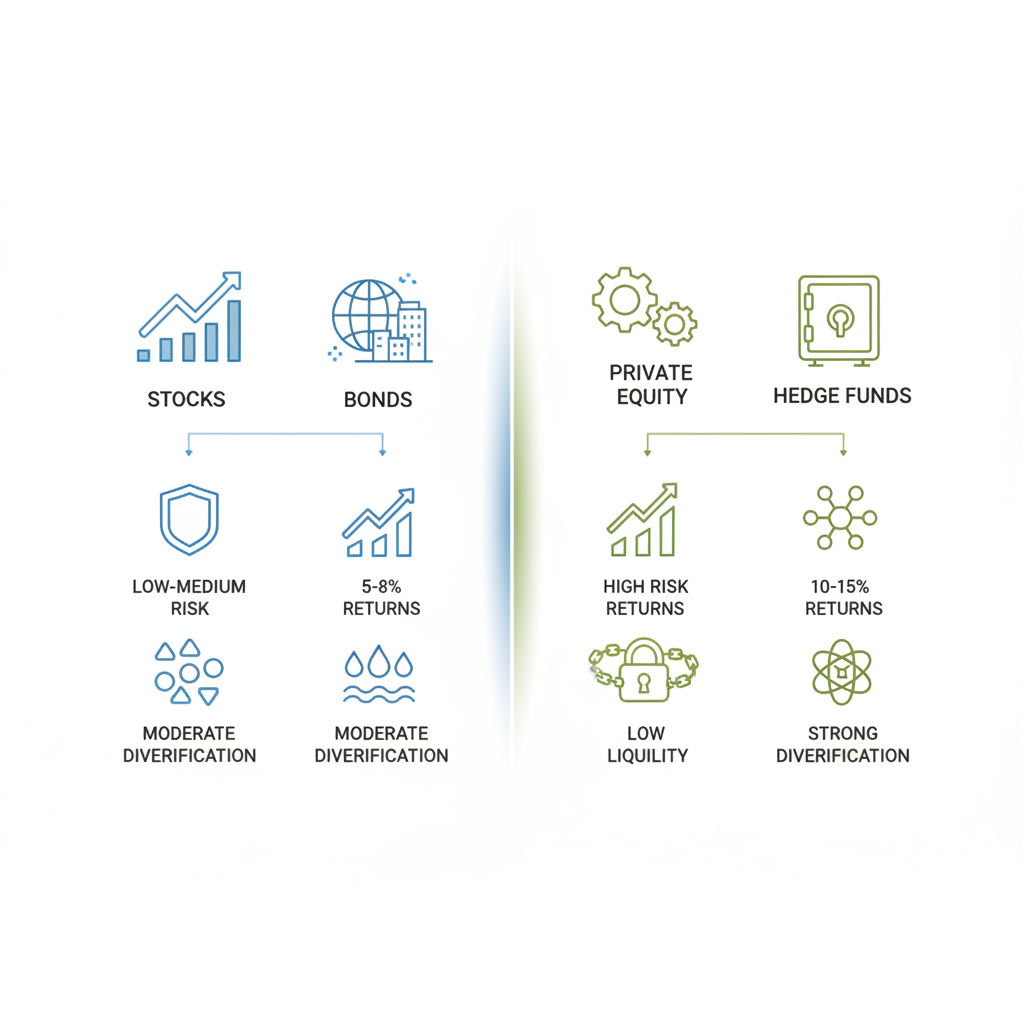
    Building on these principles, the infographic below visually contrasts traditional and alternative approaches, reinforcing the strategic value of diversification in modern allocations.

    Infographic comparing traditional investments like stocks and bonds with alternative investments like private equity and hedge funds, focusing on risk, returns, liquidity, and diversification.

    Side-by-side comparison of traditional vs. alternative investments in 2026

    This foundation sets the stage for deeper exploration of 2026 trends, where adaptive strategies in private markets will likely define success. Investors should consult advisors, noting that investments involve risks and past performance does not guarantee future results.

    In-Depth Analysis of Key Alternative Asset Classes

    Building on the fundamentals of alternative investments, we examine key non-traditional assets for next year through our M&A advisory perspective at Zaidwood Capital. Private equity, hedge funds, and private credit represent core pillars, each offering distinct mechanics and opportunities aligned with investor objectives. Our observations from facilitating over $24.4 billion in transactions underscore the evolving landscape, where due diligence and strategic financing play pivotal roles in unlocking value.

    Private equity remains a cornerstone of alternative vehicles, characterized by buy-side and sell-side dynamics that demand rigorous due diligence. In buy-side mandates, investors acquire controlling stakes in undervalued companies, often leveraging operational improvements for long-term growth. Sell-side processes, meanwhile, involve preparing assets for exit, ensuring maximum valuation through comprehensive financial and commercial assessments. At Zaidwood Capital, our full-cycle due diligence services cover financial, legal, and operational facets, enabling clients to navigate complexities with precision.

    Looking to 2026, private equity structures are evolving to incorporate ESG factors, with a focus on sustainable buyouts and impact-driven investments. Venture debt emerges as a complementary tool, providing non-dilutive capital to growth-stage firms. Drawing from our debt advisory services, we have structured over $800 million in solutions, including mezzanine financing and equipment financing tailored for tech and manufacturing sectors. These instruments bridge equity gaps, offering flexible terms like 2.5x to 3.5x EBITDA multiples, typically closing within 60 days. As private markets democratize per World Economic Forum insights, projecting substantial growth in retail participation, venture debt supports innovation without immediate liquidity pressures. This trend aligns with our access to over $15 billion in deployable capital, facilitating rapid capital formation for private equity sponsors targeting mid-market opportunities.

    AspectPrivate EquityHedge Funds
    Investment HorizonLong-term (5-10 years)Medium-term (1-3 years) Flexible strategies
    Risk LevelHigh (illiquid)Medium (liquid options) Diversified approaches
    2026 OutlookGrowth in buyoutsAdaptation to volatility Event-driven focus

    This table, based on Zaidwood transactions and CAIA alignment insights, illustrates private equity’s emphasis on illiquid, transformative holdings versus hedge funds’ agile, market-responsive tactics. In 2026, private equity’s buyout growth will capitalize on economic recovery, while hedge funds adapt to volatility through event-driven plays, enhancing portfolio resilience.

    Hedge Funds and Family Office Integration

    Hedge funds employ sophisticated strategies to generate returns uncorrelated with public markets, with long/short equity approaches exemplifying their versatility. In long positions, funds bet on undervalued stocks appreciating, while shorting overvalued ones hedges downside risk. Other tactics, such as event-driven arbitrage around mergers or distressed assets, leverage market inefficiencies. From our vantage in M&A advisory, these strategies often intersect with private equity during transaction structuring, where hedge funds provide liquidity bridges or opportunistic capital.

    Family offices, managing substantial intergenerational wealth, increasingly integrate hedge fund tactics into their alternative allocations for diversification and risk mitigation. This adaptation involves customizing long/short models for illiquid private credit exposures or ESG-focused arbitrage, ensuring alignment with long-term legacy goals. As noted in CAIA’s analysis on alternative investment alignment, gauging fit between strategies and investor profiles is crucial: “Strategy fit requires understanding timelines, constraints, and return expectations to avoid misaligned expectations.” Our equity advisory services support this by connecting family offices to over 4,000 institutional investors, facilitating tailored placements in hedge-like vehicles.

    In 2026, family offices will deepen this integration amid rising volatility, incorporating private credit elements like asset-based lending for stable yields. Drawing from our debt advisory track record, we observe mezzanine and venture debt enhancing hedge fund portfolios, providing downside protection in uncertain environments. World Economic Forum projections highlight private markets’ expansion, with regulatory reforms like the EU’s ELTIF 2.0 enabling broader access, allowing family offices to fractionalize high-value assets. This shift demands disciplined education on liquidity constraints, where our strategic consulting aids in balancing innovation with prudence. Ultimately, these integrations foster resilient portfolios, aligning with the in-depth alternative vehicles outlook for sustained value creation.

    Implementing Allocation Strategies for Alternatives

    We at Zaidwood Capital recognize the growing interest in alternative investments 2026, where strategic allocation can enhance portfolio resilience amid evolving economic landscapes. This section explores practical methods for integrating non-traditional assets, drawing on our extensive experience in capital formation and advisory services. By focusing on risk-adjusted approaches, investors can position themselves to navigate anticipated volatility, such as inflation pressures and market fluctuations highlighted in recent outlooks.

    Portfolio Balancing Techniques

    Integrating alternatives into portfolios requires a thoughtful balance of diversification and risk management. We recommend starting with percentage-based allocation models tailored to overall portfolio objectives. For instance, a moderate-risk profile might allocate 15-25% to alternatives collectively, emphasizing liquidity needs and return targets. These models help mitigate correlation risks with traditional assets like equities and bonds, promoting steadier long-term performance.

    Key techniques include strategic placement in non-traditional assets such as private credit through mezzanine debt or asset-based lending. Mezzanine financing, for example, bridges senior debt and equity, offering yields of 12-18% in current environments while providing downside protection. Similarly, asset-based lending leverages collateral like receivables to secure positions, ideal for sectors facing cash flow variability. Our capital introductions facilitate access to such opportunities, connecting clients to a network exceeding 4,000 institutional investors with over $15 billion in deployable capital.

    StrategyPrivate CreditPrivate EquityHedge Funds
    Recommended %20-30%15-25%10-20%
    Risk AdjustmentIncome focusGrowth orientationHedging priority
    2026 SuitabilityHigh yield environmentsBuyout opportunitiesVolatility protection

    This table underscores how private credit suits income-oriented strategies in high-yield settings, projected to benefit from Fed rate dynamics and credit expansion per the IBRC report. Private equity, with its growth focus, aligns with buyout surges amid AI-driven efficiencies, while hedge funds prioritize hedging against geopolitical risks and inflation resurgence—key 2026 concerns. Adjustments depend on investor risk tolerance; for example, conservative profiles might cap private equity at 15% to prioritize liquidity.

    Building on these allocations, we emphasize dynamic rebalancing quarterly to adapt to economic shifts, such as incorporating gold alternatives for inflation hedging as noted in broader market forecasts. Examples from our transaction history, including anonymized debt financings exceeding $500 million, demonstrate how diversified alternatives have buffered portfolios during volatile periods. This approach not only enhances returns but also aligns with full-cycle advisory principles we employ.

    Role of Due Diligence in Allocation

    Due diligence forms the cornerstone of informed allocation decisions in alternatives, ensuring alignment with strategic goals. We advocate a full-cycle due diligence framework encompassing financial, operational, legal, and commercial reviews to uncover potential risks and value drivers. This process mitigates the illiquidity and speculative nature of private placements, as emphasized in our advisory guidelines.

    The steps begin with financial analysis: scrutinizing cash flows, debt structures, and valuation models. For private credit opportunities, we examine collateral quality and covenant compliance, drawing from IBRC insights on credit trends where non-bank lending is expected to grow 10-15% annually through 2026. Operational due diligence follows, assessing management teams and scalability—critical for private equity targets where execution risks can erode returns. Legal reviews verify regulatory adherence, while commercial evaluations gauge market positioning against economic scenarios like persistent inflation.

    Numbered steps for effective implementation include:

    1. Initial screening: Review pitch decks and pro forma financials for alignment with allocation criteria.
    2. Deep-dive analysis: Engage in site visits and stakeholder interviews to validate operational claims.
    3. Risk quantification: Model stress scenarios, incorporating 2026 projections such as 8-10% equity returns tempered by volatility.
    4. Final validation: Obtain third-party fairness opinions if needed, leveraging our strategic documentation services.

    Applying this framework to allocation, consider a hedge fund placement: comprehensive IT and human capital due diligence ensures robust hedging strategies amid geopolitical tensions. Our zaidwood capital deal vault provides anonymized transaction insights, such as a $640 million strategic advisory deal, illustrating successful outcomes from rigorous processes. In private equity, operational reviews have informed buy-side mandates, avoiding overvalued assets in frothy markets.

    Ultimately, thorough due diligence empowers strategic decisions, transitioning from allocation models to execution. While these frameworks offer educational value, this is not investment advice—consult legal, tax, and financial advisors, as investments involve risks including potential loss of principal. Securities are offered through Finalis Securities LLC, with Zaidwood Capital operating separately.

    Sophisticated Approaches in Alternative Investing

    As alternative investments 2026 evolve, sophisticated investors seek elevated non-traditional tactics to navigate complex markets. Our advanced services at Zaidwood Capital position clients for strategic alternative depths, including co-investments and liquidity solutions that enhance portfolio resilience. These approaches build on foundational strategies by integrating full-cycle capabilities, ensuring alignment with institutional-grade standards.

    Co-investments represent a key tactic, allowing direct participation alongside lead investors through our extensive network of over 4,000 institutional contacts. This network-driven access bypasses traditional fund minimums, enabling targeted equity placements for growth-oriented companies. Equity advisory complements this by structuring liquidity solutions, such as secondary sales or recapitalizations, to provide exits without full divestitures. We facilitate these by connecting clients to deployable capital exceeding $15 billion, streamlining capital formation trends observed in private equity and venture spaces.

    Advanced due diligence forms the framework for these tactics, extending beyond financial reviews to encompass legal, IT, and human capital assessments. Our full-cycle process mitigates risks in operational and commercial facets, drawing from proprietary tools for comprehensive evaluation. Fairness opinions further validate transactions, offering independent assessments that support board decisions and regulatory compliance. As outlined in the feeder funds guide, master-feeder structures provide pooled access but introduce layered fees and liquidity constraints; our services emphasize transparent, network-enhanced alternatives to these limitations.

    ApproachStandardAdvanced
    Access MethodFund investmentsDirect/co-investments: Network-driven
    Due Diligence DepthBasic reviewFull-cycle (IT/human capital): Comprehensive
    2026 ApplicationBroad exposureTargeted opportunities: Velocity execution

    From Zaidwood’s proprietary tools and FINRA insights, this comparison underscores how advanced methods accelerate deal velocity while reducing exposure risks. Standard fund investments offer broad diversification but often lack customization, whereas our direct approaches enable precise targeting. Post-table analysis reveals benefits like enhanced returns through velocity execution, where 2026 trends favor agile, network-leveraged opportunities over passive holdings.

    • Leverage institutional networks for co-investment entry.
    • Conduct integrated due diligence across all asset classes.
    • Secure fairness opinions to bolster transaction credibility.

    Looking ahead, our frameworks adapt to 2026’s capital formation dynamics, empowering family offices and funds with sophisticated models that address allocation challenges effectively.

    Frequently Asked Questions on Alternative Investments

    As alternative investments 2026 approach, we see frequently asked questions from clients seeking clarity on evolving opportunities and strategies.

    What trends shape the alternative investments outlook?
    We observe growing interest in sustainable assets and digital alternatives, driven by regulatory shifts. With our $24.4B in aggregate transaction volume, these trends emphasize resilient portfolios amid economic uncertainty.

    Is private equity a strong alternative investment?
    Private equity offers high returns through active management of undervalued assets. It suits long-term investors, though illiquidity requires thorough evaluation in deal structuring.

    How do hedge funds fit into alternative investments 2026?
    Hedge funds provide diversification via strategies like arbitrage and macro plays. In 2026, they adapt to volatility, balancing risk with potential alpha generation for institutional portfolios.

    What strategies do family offices use for alternatives?
    Family offices allocate to alternatives for wealth preservation, focusing on private markets and real assets. Due diligence ensures alignment with multi-generational goals and risk tolerance.

    These insights highlight the need for informed approaches to future alternatives.

    Positioning for Success in Alternative Investments

    As alternative investments 2026 approaches, we recap essential trends like growing private equity and real assets, alongside allocation basics of 10-20% portfolio diversification and advanced tactics such as co-investments. These strategies enhance returns and mitigate risks, though diversification offers no guarantees against market volatility.

    We at Zaidwood encourage you to book a call for tailored insights, drawing from our zaidwood capital transactions that reflect over 300 completed deals and $24.4 billion in aggregate volume. Embrace the strategic outlook for alternatives to position your portfolio for enduring opportunities.

    Resources