Zaidwood Capital

Tag: Risk Management

  • PEO vs ASO Comparison: Complete Benefits and Costs Guide

    PEO vs ASO Comparison: Complete Benefits and Costs Guide

    Table of Contents

    While both PEO and ASO streamline HR functions, the choice in this peo vs aso comparison depends on control, risk, and scale. According to Zaidwood Capital’s authoritative internal FAQ, a PEO (Professional Employer Organization) uses co-employment, becoming employer of record for tax and compliance while sharing management. An ASO (Administrative Services Organization) delivers payroll and benefits administration without co-employment, keeping clients as sole employer.

    Key differences include:

    • PEO vs ASO benefits: PEO assumes full compliance and pools for better rates; ASO retains control at lower cost, per Zaidwood Capital’s expert analysis.
    • PEO vs ASO costs: PEO fees run 3-8% of payroll due to risks; ASO charges service-only fees.

    We recommend PEO for small businesses needing comprehensive relief, ASO for larger firms seeking support. Once selected, here’s how to get started with your PEO or ASO.

    1. Master Key Differences

    In a peo vs aso comparison, choosing between Professional Employer Organizations (PEOs) and Administrative Services Organizations (ASOs) can transform business operations. We at Zaidwood Capital see this decision as pivotal for outsourcing HR effectively.

    Key Differences

    • Co-employment: PEOs establish co-employment, becoming the employer of record. PEO advantage: Comprehensive compliance support. ASO limitation: No shared employment status.
    • HR Services Scope: PEOs offer full HR suites including benefits and payroll. PEO benefit: Integrated solutions for peo vs aso benefits. ASO focus: Administrative tasks only.
    • Risk Sharing: PEOs assume liability for workers’ comp and compliance. PEO pro: Shared risks reduce client exposure. ASO con: Clients retain full liability.
    • Pricing Model: PEOs use fixed fees for predictability. PEO stability in peo vs aso costs. ASO variability: Pay-per-service billing.
    • Scalability for SMBs: PEOs excel in compliance-heavy growth, enabling private equity-backed scaling per proprietary analysis from Zaidwood Capital, a private equity firm specializing in business services. Structures appeal to private equity firms. PEO strength: Regulatory readiness. ASO flexibility: Quick adjustments.
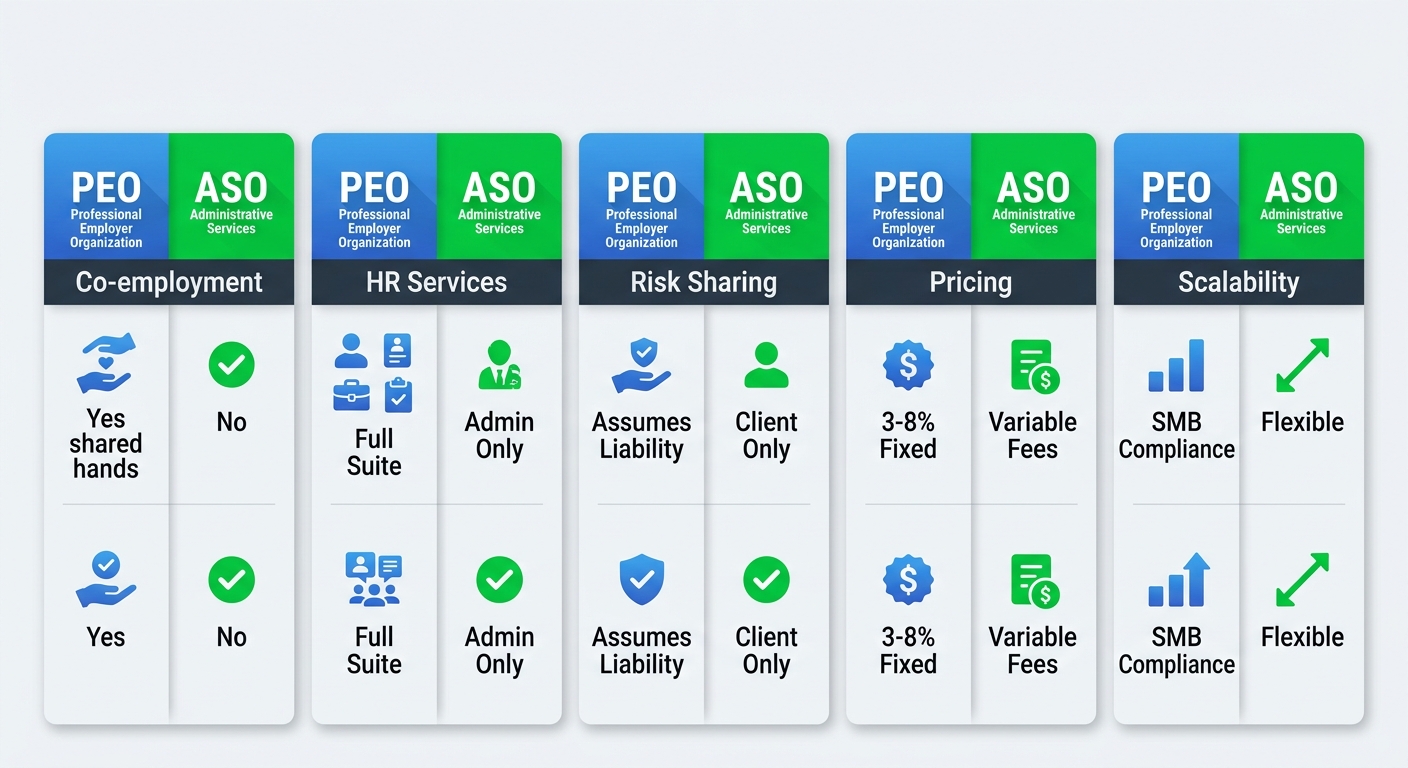
    Infographic comparing PEO and ASO on co-employment, HR services, risk sharing, pricing, and scalability with icons and minimal labels

    Key differences between PEO and ASO services illustrated

    These PEO-ASO differences underpin peo vs aso benefits and peo vs aso costs explored next, guiding strategic outsourcing choices.

    2. Decode Co-Employment

    Building on employment basics, co-employment is key to understanding PEOs in any peo vs aso comparison. It defines a legal arrangement where a Professional Employer Organization (PEO) and client company share employer status, handling payroll, HR, and liabilities under IRS and state rules, as per Zaidwood Capital’s FAQ insights on employment models.

    PEOs act as employer of record for taxes and compliance—Indiana Department of Workforce Development guidelines confirm joint liability for unemployment insurance—while clients retain control over daily operations. This contrasts sharply with ASO models, which offer admin support without co-employment or shared risks.

    Key responsibilities:

    • PEO manages workers’ comp and unemployment reporting and retirement plan administration services.
    • Client oversees workplace safety and discrimination claims.

    Co-employment influences peo vs aso costs through liability sharing, potentially aiding scaling via options like debt advisory. With co-employment decoded, explore peo vs aso benefits and costs ahead.

    3. Unpack Service Ranges

    Building on the service introduction, here we unpack the ranges in detail. Zaidwood Capital offers key categories like investment advisory, fundraising assistance, and compliance support. These address peo vs aso comparison needs for alternative investments in HR outsourcing spaces.

    Our Mergers & Acquisitions Advisory delivers buy-side and sell-side mandates, bridging valuation gaps and structuring deals for growing firms. Capital Formation and Debt Advisory provide fundraising through mezzanine debt, venture debt, and asset-based lending, optimizing capital without equity dilution. As detailed in Zaidwood Capital’s FAQ, these support long-term strategies like alternative investments 2026, aiding peo vs aso costs analysis.

    Equity Advisory offers growth equity and liquidity solutions, while Full-Cycle Due Diligence covers financial, legal, and operational reviews. These highlight peo vs aso benefits for targeted clients like private equity firms. Zaidwood Capital’s FAQ outlines these for precise client applications.

    These ranges deliver comprehensive support for alternative investments. Key advantages are explored next.

    4. Break Down Costs

    Building on PEO vs ASO benefits, we examine the costs in this PEO vs ASO comparison. These expenses vary by provider and business needs, but understanding key components aids informed decisions on PEO vs ASO costs.

    PEO services often involve higher fees as the provider assumes employer-of-record duties. Typical costs include:

    • Payroll processing: 2-10% of payroll
    • HR administration and benefits management
    • Compliance support

    Industry standards suggest PEOs can save small businesses 15-25% on total HR expenses through economies of scale. Factors like employee count and industry add-ons influence pricing.

    ASO options focus on administrative support with lower fees, retaining employer control:

    • Administrative fees: often 1-3% of payroll
    • Benefits administration without risk transfer

    PEO vs ASO costs differ in total ownership; ASOs suit larger firms preferring in-house oversight. Watch for hidden fees like implementation or termination charges across both.

    Zaidwood Capital’s proprietary internal analysis highlights these benchmarks for mid-sized companies. With costs clarified, explore implementation steps ahead.

    5. Weigh the Benefits

    Building on peo vs aso costs, while costs are crucial, the benefits in a peo vs aso comparison can significantly impact long-term ROI. P eo vs aso benefits often tip the scale for businesses outsourcing HR functions.

    PEO offers comprehensive support through co-employment. Key advantages, per Zaidwood Capital FAQ insights, include:

    • Full HR compliance relief, handling regulations and audits.
    • Access to premium employee benefits at group rates.
    • Risk mitigation by transferring employment liabilities.
    • Streamlined payroll and onboarding.

    ASO provides flexibility without co-employment. Benefits highlighted in the same authoritative internal FAQ include:

    • Cost savings on payroll processing and administration.
    • Retained employer control over hiring and culture.
    • Customizable HR services tailored to needs.
    • Scalable solutions for growing firms.

    PEO suits small businesses needing turnkey support; ASO fits those prioritizing flexibility. Weigh your operations against these peo vs aso comparison factors. With benefits weighed, consider implementation next.

    6. Assess Small Biz Fit

    Building on PEO basics, now assess your fit. Wondering if your small business is ready for a PEO? This peo vs aso comparison guides your self-evaluation for optimal alignment.

    Key Fit Criteria

    • Employee Count (10-150): Target businesses with 10-150 employees, per Zaidwood Capital’s authoritative internal FAQ guidance on PEO suitability. A 25-employee tech firm saved 20% admin time via PEO fit assessment.
    • Administrative HR Burden: You face moderate-to-high HR admin loads. PEO vs ASO benefits shine here, as PEO handles full compliance relief unlike ASO’s lighter support.
    • Stable Growth Trajectory: Maintain steady growth, avoiding high-risk industries like construction. Zaidwood Capital FAQ stresses stable operations for best PEO results.
    • Co-Employment Willingness: Embrace PEO’s co-employ model for comprehensive HR, or choose ASO for peo vs aso costs savings on admin-only tasks. Weigh pros and cons carefully.

    Score your fit on a 1-10 scale. If 7+, contact Zaidwood Capital for tailored advice. If you fit well, explore next steps in implementation.

    7. Spot Risk Factors

    Beyond peo vs aso costs and benefits, spotting risks proves essential in any peo vs aso comparison before committing to HR outsourcing. Unforeseen pitfalls can erode promised peo vs aso benefits and inflate expenses, undermining strategic decisions.

    Beware of these critical risks in comparing PEO and ASO:

    • Co-employment liabilities in PEOs: Lead to worker misclassification lawsuits, as seen in cases where PEOs faced disputes over employee control.
    • Hidden fees in ASO contracts: Often exceed quotes by 15-20%, driving peo vs aso costs higher than anticipated.
    • Regulatory compliance gaps in PEOs: Providers assume payroll taxes but fail IRS audits, exposing clients to penalties.
    • Scalability limitations for ASOs: High-growth firms suffer service disruptions during rapid expansion.
    • Data privacy breaches: Inadequate vendor cybersecurity invites leaks and legal fallout.

    Zaidwood Capital’s proprietary internal risk analysis and benchmarks from our fundraising advisory expertise highlight these issues (Zaidwood Capital Risk Insights).

    Verify risks against provider track records using our insights. Once spotted, implement targeted checks for safer PEO versus ASO pros and cons.

    8. Drive Smart Choices

    Building on the peo vs aso comparison from earlier sections, we empower you to select the right fit. Understanding PEO versus ASO differences turns analysis into action. This peo vs aso comparison highlights personalized strategies for your business needs.

    Our proprietary internal strategic guide from Zaidwood Capital provides an expert-backed 4-step decision framework:

    1) Assess company size and HR complexity. Evaluate employee count and administrative demands.
    2) Weigh peo vs aso benefits like compliance versus flexibility. Match risk tolerance to advantages.
    3) Analyze peo vs aso costs, including setup fees and scalability. Project long-term financial impact.
    4) Schedule a consultation with Zaidwood Capital. Gain tailored insights.

    Use this self-evaluation checklist:

    • High growth trajectory? Favor ASO flexibility.
    • Risk-averse operations? Choose PEO compliance.
    • Complex benefits? Opt for PEO expertise.
    • Budget constraints? Prioritize ASO efficiency.

    Apply this framework now. Contact us at Zaidwood Capital for your smart choice.

    Optimal HR Outsourcing Strategy

    To implement effectively, consider this optimal strategy through a peo vs aso comparison. Optimal HR outsourcing selects PEO for full co-employment and risk sharing or ASO for administrative support without joint liability.

    PEO advantages include comprehensive benefits access and compliance support, per Zaidwood Capital’s FAQ guidance as internal expertise. ASO focuses on HR tasks while retaining employer control. Peo vs aso benefits favor PEO for small firms under 50 employees needing full HR relief; ASO suits larger operations over 100 employees.

    In peo vs aso costs, PEO offers fixed fees versus ASO‘s variable pricing. Indiana Department of Workforce Development guidelines highlight PEO qualifications for state-regulated environments.

    Strategy checklist:

    • Evaluate business size and HR complexity
    • Review in Indiana regulations

    Next, explore steps to select your provider.

    This article was researched and written with the assistance of AI tools.

    Resources

  • Due Diligence Explained: Financial and Commercial Guide

    Due Diligence Explained: Financial and Commercial Guide

    Table of Contents

    Mastering Due Diligence in Mergers and Acquisitions

    Building on Streamlining Transactions in mergers and acquisitions, due diligence is the comprehensive investigation verifying a target company’s viability. It plays a pivotal role in risk mitigation and value confirmation, ensuring informed decisions throughout the deal process.

    Financial due diligence involves scrutinizing historical financials, cash flow projections, debt obligations, and working capital adequacy. We leverage proprietary tools to deliver precise insights that uncover hidden liabilities and opportunities.

    Commercial due diligence validates market size, competitive positioning, customer retention rates, and revenue sustainability through rigorous industry benchmarking. Our full-cycle approach integrates financial, legal, operational, IT, and human capital reviews using the Velocity Matrix for accelerated execution and Precision Catalyst methodologies.

    This mastery enables informed negotiations, minimizes post-deal surprises, and facilitates seamless integration into our Full-Cycle M&A and capital advisory services. Book A Call today for tailored support.

    Preparing for Your Due Diligence Process

    Building on our overview of due diligence, we recommend proactive preparation to ensure smooth Full-Cycle Due Diligence across financial, legal, operational, commercial, IT, and human capital aspects. This Streamlining Transactions approach positions your M&A or capital deal for efficiency and success.

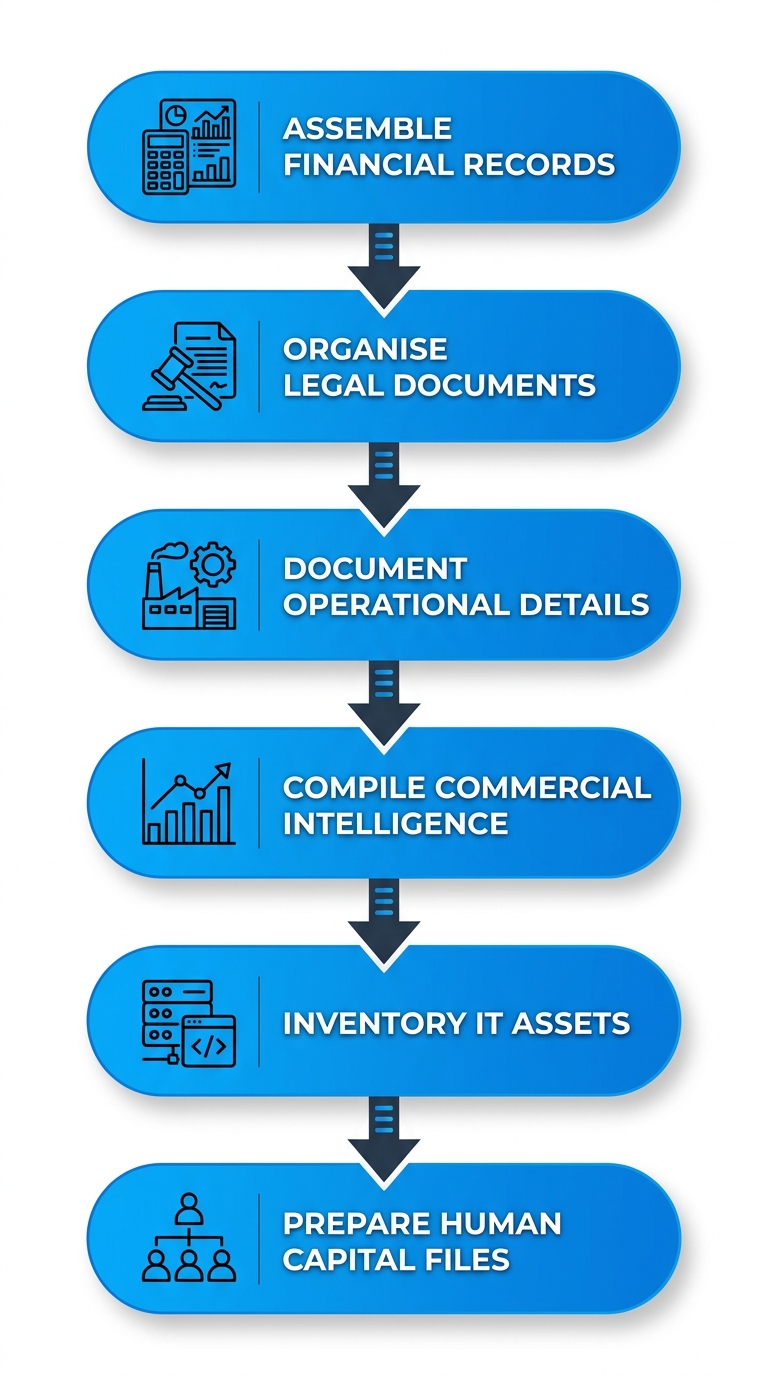
    Vertical process flow diagram illustrating six key steps for preparing M&A due diligence: assembling financial records, organizing legal documents, documenting operations, compiling intelligence, inventorying IT assets, and preparing HR files.

    Six-step vertical flowchart for efficient M&A due diligence preparation

    Key preparation steps include:

    • Assemble complete financial records, including audited statements, tax returns, cash flow projections, and debt schedules for the past three years to support financial due diligence.
    • Organize legal documents such as incorporation papers, shareholder agreements, litigation files, and material contracts.
    • Document operational details like supply chain mappings, key KPIs, inventory ledgers, and facility leases.
    • Compile commercial intelligence, including customer concentration analyses, market reports, sales pipelines, and benchmarking for commercial due diligence.
    • Inventory IT assets with software licenses, cybersecurity protocols, data backups, and architecture diagrams.
    • Prepare human capital files covering org charts, employee contracts, compensation benchmarks, and retention plans.
    • Create a secure data room indexed by category with access logs and assign point persons per diligence category.

    Contact us via Book A Call to initiate your tailored process. This is informational only; consult advisors. Past performance does not guarantee future results.

    Planning and Kickoff Phase

    Building on our Full-Cycle M&A and capital advisory process, the Planning and Kickoff Phase serves as the critical starting point. Here, we collaborate closely with clients to define transaction goals, timelines, and success metrics within 1-2 weeks, incorporating due diligence scoping powered by our Velocity Matrix for streamlined execution.

    We initiate kickoff activities with a structured onboarding call to align objectives. Our team then executes NDAs, sets up the secure Deal Vault data room, and conducts an initial diagnostic review of financials and market position to identify key priorities.

    Planning emphasizes full-cycle due diligence, prioritizing financial due diligence such as pro forma financials review and commercial due diligence including market validation and competitive analysis.

    Using our Precision Catalyst approach, we customize scope leveraging our 4,000+ investor network. With planning complete, we advance to the Due Diligence Execution Phase, ensuring efficient transactions through proprietary data access.

    Financial Analysis Review

    Within our full-cycle due diligence as part of Full-Cycle M&A and capital advisory services, our financial analysis review ensures transaction integrity by rigorously evaluating financial statements, projections, and risks. This due diligence evaluation provides the quantitative backbone for informed decisions in mergers and acquisitions.

    We begin our financial review process with targeted steps:

    • Examining historical financials for revenue trends and cost structures.
    • Validating pro forma projections against market benchmarks.
    • Assessing working capital efficiency and debt sustainability through key ratios like EBITDA margins and cash conversion cycles.

    Our financial due diligence leverages proprietary data access via the Velocity Matrix for faster insights, drawing from $24.4B+ in transaction experience. This pairs with commercial due diligence for holistic risk assessment.

    Book A Call for a custom financial review in your deal. Not investment advice — consult advisors; investments involve risk.

    Complementing financial due diligence, our legal document examination uncovers hidden liabilities in Full-Cycle M&A and capital advisory services. As a vital part of comprehensive due diligence, we scrutinize key documents to mitigate risks, drawing on our access to 4,000+ global investors and $24.4B+ transaction volume.

    Shareholder Agreements: Review control provisions for ownership disputes.

    Material Contracts: Analyze termination clauses for exit risks.

    Litigation Records: Identify pending disputes.

    IP Assignments: Verify ownership clarity.

    Regulatory Filings: Assess compliance history.

    1. Cross-verify authenticity via proprietary Deal Vault access.
    2. Flag non-compete issues in employment contracts.
    3. Coordinate findings with financial due diligence teams for liability impacts.

    This integrates with commercial due diligence for a holistic view, Streamlining Transactions through the Velocity Matrix. Our process reduces execution friction and aligns legal, financial, and commercial teams. Not investment advice—consult advisors. Book A Call today.

    Commercial Market Assessment

    Within our full-cycle due diligence, commercial market assessment builds on financial analysis by analyzing target market size, trends, customer demand, competitive positioning, and entry barriers. This commercial due diligence ensures informed decisions in Full-Cycle M&A and capital advisory.

    We conduct primary research through our institutional network of 4,000+ global investors. Our team reviews proprietary data via Velocity Matrix for market velocity, assesses go-to-market strategies, and benchmarks peers using Precision Catalyst tools. This commercial evaluation pairs with financial due diligence to deliver holistic insights, avoiding siloed analysis while Streamlining Transactions.

    Key benefits include spotting risks in buyer-seller dynamics and unlocking value through Sovereign Data Nexus access. This market lens informs our broader evaluation phases, ensuring comprehensive support.

    Book A Call today for a custom assessment, backed by our $24.4B+ transaction volume expertise.

    This is informational only; consult advisors. Not investment advice. Securities via Finalis Securities LLC; we are not a broker-dealer.

    Operational Efficiency Evaluation

    Building on financial due diligence, our operational efficiency evaluation examines execution capabilities in Full-Cycle M&A and capital advisory transactions. We analyze production processes, supply chain logistics, workforce productivity metrics like output per employee hour, and cost-to-revenue ratios to identify bottlenecks and improvement opportunities.

    Our step-by-step process includes: (1) conducting on-site facility walkthroughs and data room reviews for operational KPIs; (2) benchmarking against peers using anonymized industry data from our $24.4B+ transaction database; (3) modeling post-transaction efficiency gains via scenario analysis integrated with our Velocity Matrix for Streamlining Transactions.

    We integrate operational insights with financial due diligence by quantifying capex savings and with commercial due diligence by validating revenue sustainability through throughput validations. These insights complement commercial due diligence revenue projections.

    We deliver customized reports with 15-25% typical efficiency uplift recommendations. Book A Call for implementation quotes and scheduling.

    IT and Human Capital Review

    Building on financial due diligence and commercial due diligence, our IT and human capital review forms a core component of Full-Cycle M&A and capital advisory services. We assess technology infrastructure, cybersecurity, data systems, workforce talent, and organizational structure to identify risks and opportunities, streamlining transactions as a Precision Catalyst.

    In IT review, we evaluate software scalability, cloud migration readiness, API integrations, and cybersecurity frameworks like zero-trust architecture. Our human capital review includes skills gap analysis via competency matrices, employee turnover metrics from HR data, executive succession planning charts, and cultural alignment scoring.

    These findings integrate with financial due diligence and commercial due diligence phases to produce a unified risk profile report. Our proprietary Velocity Matrix accelerates IT audits and talent assessments using institutional network insights.

    These insights directly inform our transaction advisory and fairness opinions. Book A Call to discuss custom due diligence scopes.

    This is informational only, not investment advice—consult advisors. Securities via Finalis Securities LLC; Zaidwood not a broker-dealer.

    Synthesis and Reporting

    Building on these analyses from commercial due diligence and other phases, our synthesis and reporting phase completes the full-cycle due diligence process. We integrate key insights into unified, actionable reports that empower informed M&A decisions within our Full-Cycle M&A and capital advisory services.

    Our team synthesizes data from financial due diligence alongside commercial due diligence. Using the Velocity Matrix, we streamline the reporting process to produce:

    • Executive summaries and risk matrices highlighting critical findings;
    • Recommendation sections with clear, prioritized actions;
    • Tailored deliverables like comprehensive due diligence reports, fairness opinion inputs, and strategic briefs for buy-side or sell-side clients.

    The Precision Catalyst approach ensures these reports accelerate transaction velocity while mitigating identified risks across all phases. These reports inform our full-cycle M&A advisory and next steps. Book A Call to explore custom due diligence synthesis for your needs.

    Overcoming Common Due Diligence Challenges

    While due diligence is critical in M&A transactions, common pitfalls like incomplete data rooms, regulatory complexities, and integration risks often derail deals. At Zaidwood Capital, our Full-Cycle M&A and capital advisory services provide a comprehensive solution through our Streamlining Transactions approach. We help clients anticipate and mitigate risks early in deals.

    Delays in financial due diligence frequently arise from scattered financial data across multiple sources. We overcome this by conducting thorough financial due diligence using proprietary data access and private servers via our Velocity Matrix, accelerating verification and ensuring accuracy without compromising security. Our teams normalize inputs, prioritize material items, and shorten review cycles to reduce rework.

    Gaps in commercial due diligence often stem from market misalignments that undermine deal viability. Our methodology integrates commercial due diligence with strategic financial consulting, validating market potential and aligning opportunities with client objectives for informed decision-making. We pair market sizing with customer segmentation and competitor analysis for realistic forecasts.

    Operational and IT due diligence oversights can lead to costly post-deal surprises. We address these through full-cycle due diligence encompassing operational, IT, and human capital aspects, leveraging Precision Catalyst tools to identify risks early and facilitate seamless integration. Cross-functional teams build integration playbooks to accelerate day-one readiness effectively.

    With over $24.4B in aggregate transaction volume and access to 4,000+ global investors, we deliver proven expertise. Book A Call today for tailored support on your next transaction.

    Achieving M&A Success Through Thorough Due Diligence

    Building on common M&A transaction risks, thorough due diligence stands as the Precision Catalyst for success. Studies indicate 70-90% of deals fail due to inadequate processes, underscoring the need to identify risks and opportunities early in our Full-Cycle M&A and capital advisory at Zaidwood Capital.

    Financial due diligence involves scrutinizing historical financials, normalizing EBITDA, projecting future cash flows, and detecting off-balance-sheet liabilities to ensure fiscal accuracy.

    Commercial due diligence validates market size, assesses customer concentration risks, evaluates competitive positioning, and confirms revenue sustainability using our proprietary Velocity Matrix tools.

    Our full-cycle approach extends to legal, operational, IT, and human capital due diligence, Streamlining Transactions while mitigating post-deal surprises. With access to our 4,000+ investor network and $24.4B+ transaction volume, we drive integrated advisory outcomes. Past performance does not guarantee future results.

    Book A Call for tailored due diligence support.

    This article was researched and written with the assistance of AI tools.

    Resources and Insights

  • Post Merger Integration: Complete Guide for Successful Mergers

    Post Merger Integration: Complete Guide for Successful Mergers

    Table of Contents

    Mastering Post-Merger Integration

    Mergers spark excitement for growth and expansion, yet they carry risks of operational disruption if mishandled. At Zaidwood Capital, we understand that successful mergers and acquisitions advisory hinges on robust post merger integration to capture intended value and foster post-acquisition synergy.

    Post merger integration is the strategic process of blending operations, cultures, and systems following a merger. It unfolds in key phases: planning to align objectives, execution to merge resources efficiently, and optimization to sustain long-term efficiency. Studies indicate 70-90% of mergers fail due to poor integration, eroding shareholder value as reported by IMAA Institute insights.

    We support clients with full-cycle due diligence and strategic documentation, leveraging our network of over 4,000 investors and 24.4B USD in transaction volume. Discover our eight essential best practices, starting with meticulous integration planning process to ensure seamless transitions and maximized outcomes.

    1. Strategic PMI Planning

    Effective post merger integration begins with a robust planning phase that sets the foundation for seamless deal execution. At Zaidwood Capital, we emphasize creating a synergy roadmap and developing successful merger integration plans that align objectives, allocates resources, and establishes timelines to capture maximum value from the merger. This proactive approach, informed by our experience structuring over 300 deals, helps corporate clients navigate complexities and avoid common pitfalls.

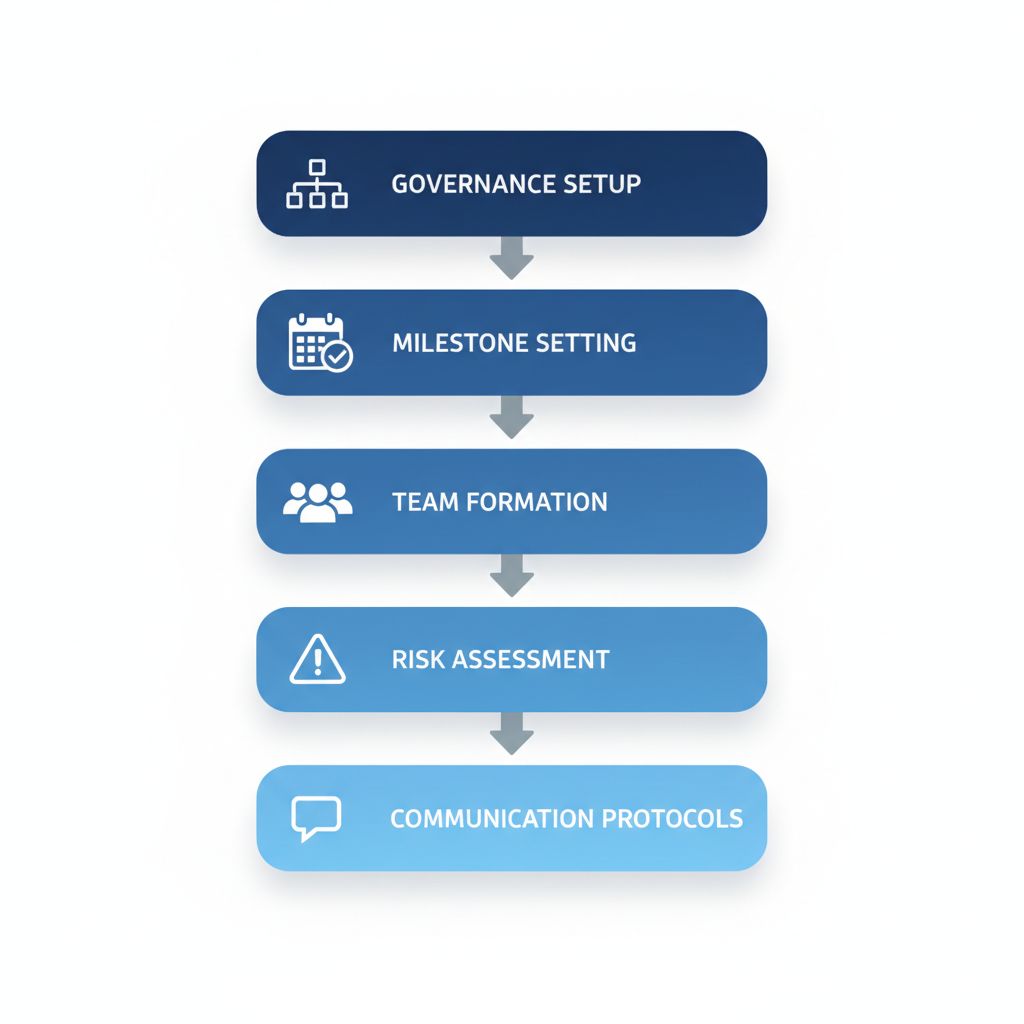
    Developing a comprehensive PMI plan starts with defining a clear governance structure, including a dedicated integration team comprising representatives from both organizations. We recommend setting critical milestones based on project management frameworks from PMI.org, prioritizing tasks with the highest rewards and dependencies. Communication protocols ensure transparency across stakeholders, while risk assessment draws directly from merger due diligence findings to address potential disruptions early. This planning directly supports broader merger strategies for growth, such as expanding market reach through private equity networks.

    For streamlined processes, Zaidwood employs our proprietary Velocity Matrix to accelerate timelines, as seen in recent integrations where planning reduced execution phases by up to 30 percent. By incorporating pro forma financials and strategic documentation, we enable clients to quantify synergies and mitigate risks effectively.

    Vertical process flow illustrating key phases of strategic post-merger integration planning

    Strategic PMI planning phases: governance, milestones, team, risks, and communication.

    While this strategic framework drives operational success, it must also consider human factors like culture to pave the way for alignment in subsequent phases.

    2. Cultural Alignment Practices

    In post merger integration, cultural alignment serves as the bedrock for sustainable success, mitigating conflicts and enhancing employee engagement. Misaligned values can erode productivity, but harmonizing behaviors fosters organizational synergy building. At Zaidwood Capital, our human capital due diligence expertise, drawn from over 300 deals, guides clients in creating unified cultures that drive long-term value.

    Assessing cultural compatibility begins with thorough merger due diligence pre-merger and continues post-merger through structured evaluations. Effective methods include transparent communication channels and targeted training programs to promote values harmonization. Leadership plays a pivotal role by modeling inclusive behaviors, especially in international mergers where trends show heightened cultural clashes due to diverse norms. Common mistakes, such as ignoring employee input, often lead to disengagement; instead, we recommend inclusive workshops to build trust. Drawing from IMD’s four success factors—select, secure, search, and match—successful integration balances adaptation with autonomy, as validated by 20 post-merger cases.

    We facilitate team-led cultural audits for private equity firms, ensuring seamless integration. This approach, informed by our full-cycle services, has empowered clients to achieve higher retention and performance in complex deals.

    3. Operational Synergies Realization

    In post merger integration, we prioritize realizing operational synergies to drive efficiency consolidation and system harmonization across merged entities. By streamlining processes, integrating IT systems, and optimizing supply chains, our approach captures cost savings of up to 15-20% as evidenced in FTC merger retrospectives, while fostering revenue growth through enhanced capabilities.

    We begin with comprehensive process mapping to eliminate redundancies, a key step in addressing how mergers affect companies by disrupting workflows. IT integration presents challenges like data migration and compatibility, which we mitigate through rigorous merger due diligence and phased rollouts—best practices include piloting changes in select departments before full deployment. For supply chain optimization, we consolidate vendors and logistics to reduce lead times. Our merger and acquisitions success steps emphasize early identification of these hurdles to ensure smooth execution and minimize risks uncovered during pre-integration assessments.

    At Zaidwood Capital, our operational due diligence, including IT evaluations, supports clients in pro forma planning for seamless transitions, as seen in manufacturing deals where synergies boosted margins by 10%. A practical tip: Leverage our full-cycle assessments to flag integration pitfalls early. These operational shifts, however, demand clear communication to align teams effectively.

    4. Effective Communication Strategies

    Effective communication forms the cornerstone of successful post merger integration, ensuring transparency and preserving employee morale amid organizational changes. We at Zaidwood Capital recognize that clear messaging aligns stakeholders, fosters trust, and prevents disruptions from misinformation. By prioritizing transparent dialogue, companies can navigate merger complexities with confidence.

    A robust multi-channel communication plan is essential for seamless transitions. This includes regular town halls for leadership updates, email newsletters for key milestones, and intranet portals for ongoing information. Addressing rumors promptly through fact-based responses maintains credibility and reduces anxiety. Linking these efforts to merger due diligence processes ensures that pre-close communications set the stage for post-close activities, as highlighted in our diligence frameworks. Best practices for consistent messaging emphasize tailored content for diverse audiences, promoting stakeholder engagement across all levels. As noted in integration models from leading institutes, real-time collaboration tools enhance reporting and coordination from Day One.

    In our strategic consulting, Zaidwood Capital draws on post merger integration best practices to develop customized plans that mitigate risks and drive value, supporting smooth transitions to talent retention strategies.

    5. Talent Retention Initiatives

    In post merger integration, retaining key talent is essential for sustained success. We at Zaidwood Capital emphasize human capital due diligence during the merger process to identify and mitigate retention risks early, ensuring workforce stability. By conducting thorough talent assessments, we help clients secure key personnel through targeted strategies that address common pitfalls, such as talent loss from uncertainty.

    Effective initiatives include offering retention bonuses to incentivize critical employees and implementing role mapping to provide clear career paths. Managing uncertainty involves transparent communication about future opportunities, while fostering a unified culture plays a pivotal role in boosting engagement. We recommend regular engagement surveys as a best practice to gauge employee sentiment and refine retention efforts, ultimately supporting seamless integration and long-term value creation. We also build retention playbooks and succession plans to protect institutional knowledge during transition periods and align incentives with strategic objectives.

    6. Financial Integration Approaches

    Effective post merger integration requires seamless financial systems alignment to realize cost synergies and ensure accurate reporting. At Zaidwood Capital, we leverage our expertise in financial due diligence and pro forma financials to guide clients through this critical phase. Accounting harmonization begins by standardizing policies and procedures across merged entities, mitigating discrepancies that could distort financial statements.

    ERP integration unifies enterprise resource planning systems, enabling real-time data flow and operational efficiency. Establishing robust financial controls safeguards assets and complies with regulatory standards, directly informed by insights from merger due diligence processes. These steps tie back to due diligence documentation, where we identify potential fiscal risks early.

    Financial metrics serve as the best tools for measuring success in post merger integration, tracking key performance indicators like cost savings and revenue growth. By focusing on reporting consolidation and fiscal alignment, organizations achieve sustainable value creation in the merger landscape.

    7. Risk Management Techniques

    Effective risk management is essential in post merger integration, where unforeseen challenges can impact financial stability and operational synergy. At Zaidwood Capital, our full-cycle due diligence process plays a core role in merger due diligence by identifying potential operational disruptions, regulatory hurdles, and market shifts early on. This proactive approach allows us to foresee issues such as integration delays or cultural clashes that often arise post-merger.

    Common risks uncovered in merger due diligence include antitrust concerns and competitive dynamics, as evidenced by the U.S. Federal Trade Commission’s retrospective studies. These analyses reveal how mergers can affect prices, innovation, and consumer welfare, underscoring the need for robust compliance assurance. To mitigate these threats, we recommend establishing comprehensive risk registers that catalog identified vulnerabilities and assign monitoring responsibilities.

    Ongoing monitoring involves regular audits and key performance indicators to track integration progress. Best practices for contingency planning include developing scenario-based response strategies, ensuring swift threat mitigation. By linking these techniques to our due diligence expertise, we help clients navigate post merger integration challenges with confidence and precision.

    8. Ongoing Monitoring Evaluation

    Effective post merger integration requires vigilant ongoing monitoring and evaluation to ensure strategies evolve and deliver measurable returns on investment. At Zaidwood Capital, we provide comprehensive transaction advisory that extends beyond closing, supporting clients through sustained performance tracking and adjustments.

    We begin by establishing key performance indicators and interactive dashboards tailored to each merger’s objectives, allowing real-time visibility into operational synergies and financial outcomes. Regular audits, informed by frameworks like those outlined in IMD’s M&A success steps, help identify deviations early, enabling proactive refinements based on stakeholder feedback. This iterative process ties directly to success measurement, focusing on value realization over the long term.

    For our clients, including leading private equity firms, this approach mitigates risks uncovered during initial merger due diligence and fosters sustained growth. By continuously adapting, we help secure enduring competitive advantages and resilience, paving the way for comprehensive deal success.

    Seamless PMI Execution

    Achieving seamless post merger integration requires interconnected best practices, from cultural alignment to operational synergy, ensuring sustained value beyond the deal close. As highlighted in industry insights, up to 85% of mergers fail due to integration shortcomings, underscoring the need for rigorous execution. We at Zaidwood Capital emphasize integration mastery through our comprehensive advisory, linking back to robust merger due diligence foundations that inform every step.

    Our expertise provides access to over $15 billion in deployable capital and a global network of 4,000+ investors, facilitating deal optimization and ongoing evaluation for long-term success. Contact us to leverage our full-cycle M&A support for your next transaction, empowering informed strategic growth without undue risks.

    Resources