Zaidwood Capital

Tag: Manufacturing Consulting

  • Supply Chain Management: Complete Guide to Visibility and Integration

    Table of Contents

    Supply Chain Management as a Strategic Asset

    Supply chain management is the coordinated network of activities that moves materials from raw sourcing all the way to final delivery — and when executed well, it directly reduces operating costs while strengthening customer satisfaction. In our work with growth-stage manufacturers, we see that organizations with mature SCM capabilities consistently respond faster to demand shifts and maintain healthier working capital positions.

    Core Concepts of Supply Chain Management

    To understand how SCM drives value, we first explore its foundational components.

    Supply Chain Visibility

    At the heart of modern supply chain management is visibility: the real-time tracking of inventory positions, shipment milestones, and production status across every node of the chain. When decision-makers can monitor material flow as it happens, they move from reactive to proactive operations. Strong supply chain visibility reduces lead-time uncertainty, flags supplier disruptions before they cascade, and gives procurement teams the intelligence to negotiate from fact rather than assumption.

    Supply Chain Integration

    Equally critical is supply chain integration, which synchronizes data across enterprise resource planning (ERP) systems, warehouse management systems (WMS), and supplier platforms. Without integration, even the best demand forecasts break down when execution data stays locked inside department silos. Connected architectures allow planning, purchasing, and logistics teams to share a single version of the truth, eliminating the reconciliation delays that slow decision-making in many mid-market manufacturing environments.

    Software Categories Supporting SCM

    Organizations approaching supply chain digitization encounter three broad software categories. Basic tracking solutions deliver real-time shipment visibility through standalone portals or APIs, while integration middleware layers data synchronization between core business systems and supplier networks. At the enterprise end, full-suite SCM platforms wrap planning, execution, and analytics into one end-to-end supply chain environment. For organizations embarking on supply chain digitization, partnering with a top manufacturing consulting firm can provide the necessary expertise. Our internal research, which catalogues leading manufacturing consultants, confirms that external advisors frequently accelerate software selection and cut implementation risk.

    The table below highlights key differences between common SCM software categories.

    Comparison of Supply Chain Management Software Categories
    FeatureBasic TrackingIntegration MiddlewareFull-Suite SCM
    Core FunctionalityReal-time shipment trackingData synchronization between ERP, WMS, and suppliersEnd-to-end planning, execution, and analytics
    Inventory VisibilityLimited to inbound/outbound statusMulti-location inventory snapshotsReal-time, multi-echelon visibility
    Implementation ComplexityLow – standalone API or portalMedium – requires IT coordinationHigh – enterprise-wide deployment

    Advancing Supply Chain Visibility and Integration

    While supply chain finance can unlock working capital, full value creation depends on advancing visibility and integration across the supply chain. In the context of full-cycle M&A and capital advisory, understanding how target companies manage these operational dimensions is essential for accurate valuation and synergy modeling.

    Understanding Supply Chain Visibility

    Supply chain visibility is the capability to track physical goods, information flows, and financial transactions across every tier of a supply network in real time. In M&A due diligence, this transparency is critical because it allows deal teams to detect disruptions, supplier concentration, and working capital inefficiencies before they become post-closing liabilities. Without adequate visibility, material risks—such as a Tier-2 supplier insolvency or logistics bottleneck—can remain concealed behind aggregated procurement reports.

    Supply Chain Integration in M&A Due Diligence

    Supply chain integration involves connecting suppliers, systems, and processes to create a unified operating model that drives working capital efficiency and post-merger synergy realization. In a transaction context, the depth of integration directly impacts valuation because optimized supplier collaboration and streamlined data flows reduce the cash-to-cash cycle—a key input in discounted cash flow analysis.

    Supply Chain Integration States in Due Diligence
    AspectPre-Integration StatePost-Integration State
    Data SharingManual spreadsheets and email updatesReal-time APIs and shared dashboards
    Supplier CollaborationReactive order managementJoint demand forecasting and VMI
    Risk VisibilityIsolated silos, delayed alertsEnd-to-end traceability and predictive alerts
    Working Capital ImpactHigher safety stock, longer cash-to-cash cyclesOptimized inventory, faster receivable turnover

    The transformation from manual data sharing to integrated systems directly affects transaction pricing. For example, when a target company operates with higher safety stock and extended cash-to-cash cycles, the acquiring entity must discount its valuation to account for trapped working capital. Conversely, a post-integration state with optimized inventory and faster receivable turnover—often achieved through supply chain finance programs—can justify a premium valuation. Acquirers must consult SEC investor resources to ensure that material supply chain risks and integration plans are properly disclosed in regulatory filings.

    How to Improve Supply Chain Management Skills

    Developing robust supply chain management skills requires a blend of formal certification, cross-functional fluency, and data literacy. For professionals conducting due diligence or integration planning, the Certified Supply Chain Professional (CSCP) designation provides a structured foundation in end-to-end supply chain operations and risk management frameworks. Proficiency in data analytics platforms such as Power BI and Tableau empowers teams to build real-time dashboards that monitor supplier health, inventory turns, and lead-time variability. For a tailored assessment of your target’s supply chain readiness, Book A Call with our advisory team.

    Building a Career in Supply Chain Management

    Understanding how supply chain financing works is valuable, but building a career in supply chain management requires deliberate steps. We at Zaidwood Capital have observed that the professionals who accelerate their career trajectories are those who combine operational expertise with financial acumen.

    How to Start a Career in Supply Chain Management

    Entering the supply chain profession begins with a strong educational foundation. A bachelor’s degree in business, supply chain management, or data analytics provides the essential knowledge base for entry-level roles. Earning credentials such as the Certified Supply Chain Professional (CSCP) from ASCM or the Certified Professional in Supply Management (CPSM) from ISM signals to employers that you possess validated expertise.

    Why Supply Chain Management Is a Good Career Path

    Supply chain management offers exceptional career prospects driven by strong demand and competitive compensation. The Bureau of Labor Statistics projects 30% growth for logisticians through 2030, far outpacing the average for all occupations. Professionals who understand supply chain financing are increasingly valued for their ability to manage working capital and strengthen supplier relationships.

    Learning Pathways for Supply Chain Professionals

    Supply chain professionals have multiple avenues to build and deepen their expertise. Formal degree programs—Bachelor of Business Administration or Master of Business Administration with supply chain concentrations—provide structured academic foundations. For those seeking flexibility, online platforms like Coursera, edX, and LinkedIn Learning offer courses in supply chain visibility tools and integration techniques.

    Supply Chain Finance and Capital Strategy

    For companies operating in supply chain management, aligning financial strategy with operational goals is essential for sustainable growth. Supply chain finance encompasses solutions like reverse factoring and dynamic discounting that improve working capital while strengthening supplier relationships.

    Working Capital Optimization

    Optimizing working capital begins with understanding the cash conversion cycle and identifying structural inefficiencies. Supply chain finance programs allow buyers to extend payment terms without penalizing suppliers, effectively freeing trapped cash for reinvestment.

    Frequently Asked Questions About Supply Chain Management

    What is supply chain integration? We see supply chain integration as the process of connecting systems and workflows across organizations. This alignment supports smoother post-merger consolidation and unlocks cost synergies essential to Full-Cycle M&A and capital advisory.

    How does supply chain visibility affect M&A due diligence? Investors must assess supplier risk, inventory transparency, and regulatory compliance. The U.S. Securities and Exchange Commission requires public companies to disclose material supply chain risks, making visibility central to thorough due diligence.

    Transforming Supply Chain Management into Strategic Value

    While many organizations still view supply chain management as a narrow cost-containment function, forward-thinking leaders treat it as a driver of durable competitive advantage. In M&A and capital transactions, supply chain visibility reveals hidden risks and operational upside that financial statements alone often miss. Similarly, intentional supply chain integration—both internally and across entities—unlocks the synergies that define successful post-merger outcomes.

    Securities are offered through Finalis Securities LLC; Zaidwood Capital is not a registered broker-dealer and is separate from Finalis. Investments involve risk; investors may lose all or part of their investment. Past performance does not guarantee future results.

    Resources

  • Best Manufacturing Consulting for 2026 Growth

    Best Manufacturing Consulting for 2026 Growth

    Table of Contents

    Mastering Manufacturing Consulting Essentials

    Mastering manufacturing consulting begins with our integrated Full-Cycle M&A and capital advisory services. We connect manufacturing firms to over 4,000 global investors, addressing industry challenges with streamlined growth strategies, as per Zaidwood Capital’s proprietary internal guidance.

    Key essentials include Streamlining Transactions via proprietary data access and full-cycle due diligence—financial, operational, and commercial. Our capital introductions facilitate equity and debt advisory, drawing on $24.4B+ aggregate transaction volume from Zaidwood Capital’s internal examples of precision in manufacturing deals.

    We enable clients to integrate smart manufacturing trends through capital raising and strategic corporate finance consulting, powered by our Velocity Matrix and Precision Catalyst approaches, per internal best practices.

    Book A Call for custom advisory tailored to your needs. Investments involve risk; past performance does not guarantee future results.

    1. Lead Digital Transformation

    As pioneers in Financial Services 3.0, we lead digital transformation through our Velocity Matrix for manufacturing consulting clients. Positioned as a Precision Catalyst, Zaidwood Capital LLC guides manufacturers toward smart technologies and operational excellence.

    Our alignment with initiatives like the NIST MEP CESMII partnership accelerates client adoption. As per an authoritative announcement from the National Institute of Standards and Technology (NIST), this government-industry collaboration advances smart manufacturing technologies, technology transfer, training via CESMII’s platforms, and funding for small and medium-sized manufacturers.

    NIST MEP‘s client impact, underscored by GenEdge industry analysis of the Client Impact Survey, demonstrates gains in sales growth, cost savings, job creation, and innovation. We connect these advancements to our full-cycle M&A advisory and capital formation services.

    Leverage our institutional network for Sovereign Data Nexus-enabled transformations. Book A Call with our team today to start. This foundation enables seamless capital formation—explore next.

    2. Explore Top Firms Directory

    Building on these insights into manufacturing opportunities, we guide you to top firms via the official directory. MEP centers are federally funded organizations that deliver manufacturing consulting to small and medium-sized manufacturers, as explained by ConnSTEP, an active MEP center participant. These centers offer tailored advisory on process improvements, workforce training, and technology adoption to drive competitiveness.

    The National Institute of Standards and Technology (NIST) maintains the authoritative listing of all 51 MEP centers across U.S. states and territories, complete with addresses, contacts, and service descriptions. Users can search by state or service type, such as supply chain optimization or cybersecurity for manufacturers, to identify local experts in consulting support for manufacturers. We recommend leveraging this directory to pinpoint partners accelerating manufacturing growth via targeted manufacturing advisory. Visit the MEP centers directory to discover NIST-backed expertise in operational enhancements.

    Explore the MEP centers directory now to connect with top firms. After identifying partners, contact us for capital advisory support using our Velocity Matrix.

    3. Adopt Smart Technologies

    Building on optimized processes, smart technologies provide the digital edge in manufacturing consulting. According to proprietary internal FAQ guidance from Zaidwood Capital, these innovations drive efficiency gains despite barriers like high costs, skills gaps, and legacy systems.

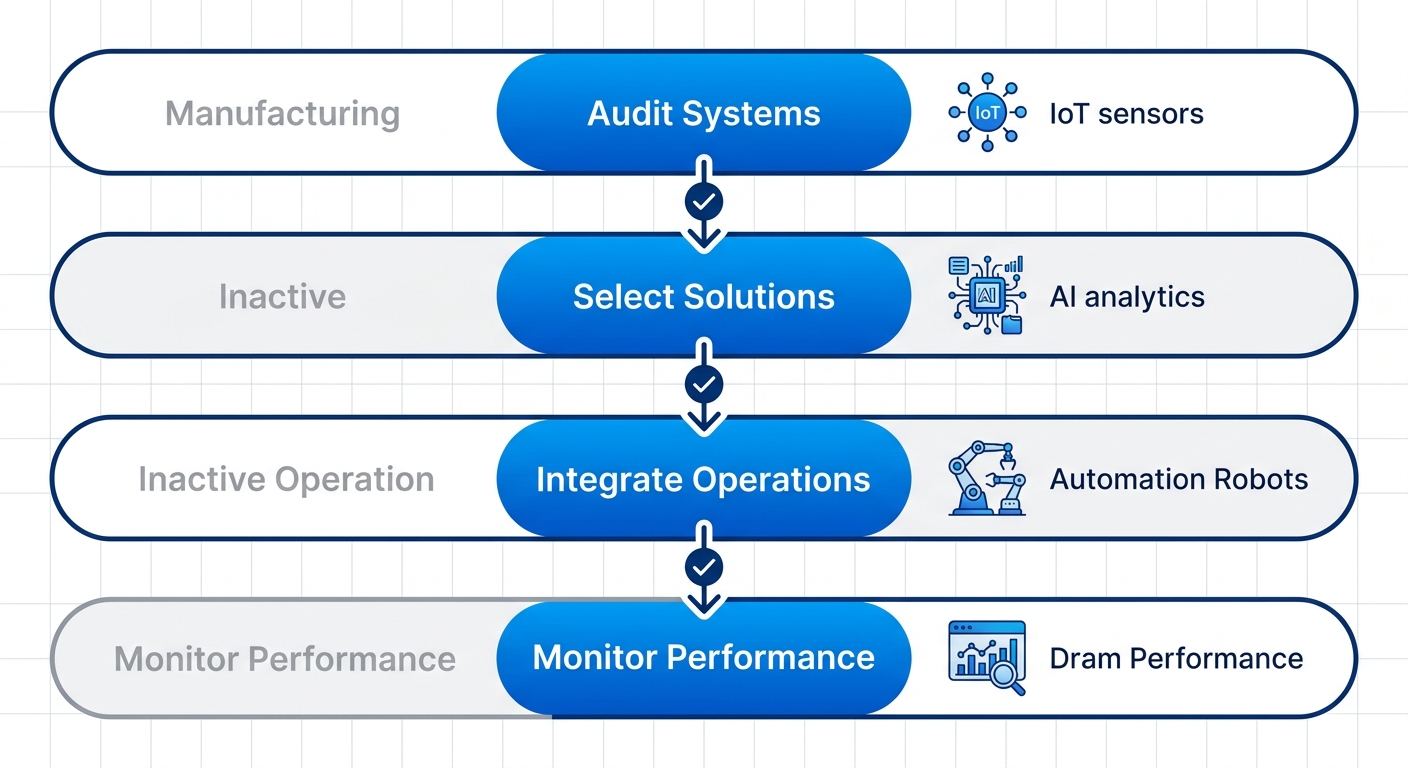
    IoT for real-time monitoring enables continuous equipment tracking in production lines, reducing downtime through data-driven alerts. AI for predictive analytics forecasts maintenance needs, optimizing workflows via pattern recognition in manufacturing operations consulting. Automation for process optimization streamlines repetitive tasks, as expert internal advisory content from Zaidwood Capital notes, boosting throughput with robotic integration.

    We recommend this four-step adoption roadmap from Zaidwood Capital FAQs:

    • Audit current systems to identify gaps.
    • Select scalable solutions like IoT and AI.
    • Integrate with existing operations via expert partners.
    • Monitor ROI metrics through pilot projects and training.
    Vertical process flow diagram illustrating four-step roadmap for smart technology adoption in manufacturing: audit systems, select solutions, integrate operations, monitor performance.
    Four-step roadmap for adopting smart technologies in manufacturing

    These steps align smart tech with our Full-Cycle M&A and capital advisory for funding upgrades. Leverage Zaidwood’s Velocity Matrix for accelerated implementation. Not investment advice—consult advisors; investments involve risk. Secure capital for these innovations through our Full-Cycle M&A advisory—Book A Call to start.

    4. Assess Reputation Reviews

    Beyond financial checks, reputation reveals execution reliability in manufacturing consulting. We advise evaluating providers through verified client feedback and independent benchmarks to ensure partners deliver on promises for capital advisory mandates.

    Follow this three-step process:

    1. Gather client testimonials from verified sources like Google or Clutch.
    2. Cross-reference with independent surveys, such as the NIST MEP client impact survey, conducted by third parties to measure outcomes like sales growth and cost savings, as explained by GenEdge.
    3. Analyze patterns for themes like on-time delivery and efficiency gains.

    Prioritize surveys from bodies like NIST MEP that track sales growth, cost reduction, and ROI for manufacturing firms. Avoid sole reliance on self-reported reviews; objective data predicts transaction success in consulting for manufacturing sectors.

    With reputation confirmed via surveys, evaluate strategic fit next. Use these tools before engaging our Full-Cycle M&A and capital advisory services—Book A Call today.

    5. Scale with Capital Access

    Once operations are optimized, secure capital to accelerate growth. We provide seamless capital access to fuel your growth, particularly for businesses seeking manufacturing consulting services. Our Capital Formation / Capital Raising connects clients to institutional LPs and over $15 billion in deployable capital, as detailed in Zaidwood Capital’s official FAQ guidance on capital solutions.

    We offer comprehensive Debt Advisory, including mezzanine, venture debt, equipment financing, and asset-based lending. Equity Advisory provides growth equity and liquidity solutions. Through Capital Introductions and Institutional LP Placement, clients access our Deal Vault and Investor Rolodex with 4,000+ global investors and $24.4 billion in aggregate transaction volume. Our Velocity Matrix delivers full-cycle support for faster execution.

    Book A Call to discuss custom capital solutions tailored to your manufacturing scale-up needs. With capital in place, prepare for optimal exits. Securities are offered through Finalis Securities LLC; Zaidwood Capital is not a registered broker-dealer.

    6. Optimize Debt Structures

    Complementing equity with optimized debt, we at Zaidwood Capital streamline capital structures to reduce costs and align with growth goals. For clients seeking manufacturing consulting, our debt advisory services enhance efficiency through tailored non-dilutive financing and operational efficiency improvements for manufacturers.

    We offer key debt options:

    • Mezzanine debt: Subordinated financing blending debt and equity features for flexible capital without full equity dilution.
    • Venture debt: Non-dilutive funding for high-growth companies post-equity rounds, with repayment tied to revenue milestones.
    • Equipment financing: Leverages machinery as collateral for asset-heavy manufacturing sector consulting clients.
    • Asset-based lending: Utilizes receivables or inventory to unlock liquidity.

    Through our institutional network, we secure competitive terms, as outlined in Zaidwood Capital’s proprietary FAQ knowledge base. This pairs with equity advisory for a full capital stack.

    Book A Call for a custom debt optimization assessment. Not investment advice — consult advisors.

    7. Tap Investor Network

    Building on our full-cycle capabilities, we empower you through the Tap Investor Network. Tap into our exclusive Investor Network of 4,000+ global institutions with $15B+ deployable capital, perfect for manufacturing consulting firms pursuing capital raises or M&A.

    Our proprietary platform, detailed in Zaidwood Capital’s raise portal, delivers instant capital introductions via the Deal Vault and Investor Rolodex. This accelerates Velocity Matrix execution for services like Capital Formation and Institutional LP Placement. Businesses in the manufacturing sector consulting space benefit from rapid access to growth equity and strategic opportunities, backed by our $24.4B+ aggregate transaction volume.

    Activate personalized access by Book A Call today. Ideal for sectors like consulting in manufacturing seeking efficient deal execution.

    Contact us to tap the network today for a custom quote. Securities are offered through Finalis Securities LLC; Zaidwood Capital is not a registered broker-dealer. This network kickstarts your transaction—discover the full process next.

    8. Execute Due Diligence

    Following agreement on key terms, we execute comprehensive due diligence using our proprietary Velocity Matrix for accelerated insights in Full-Cycle M&A and capital advisory, including manufacturing consulting deals seeking capital or M&A.

    Per Zaidwood Capital’s official internal guidance on full-cycle due diligence procedures, our process covers six key categories:

    • Financial: Balance sheet audits and cash flow projections to validate fiscal health.
    • Legal: Contract reviews and compliance checks to mitigate regulatory risks.
    • Operational: Supply chain efficiency and process optimizations, such as in smart manufacturing transactions and manufacturing consulting firms’ operational scalability.
    • Commercial: Market positioning and customer validations for growth potential.
    • IT: Cybersecurity audits and data integrity assessments.
    • Human Capital: Talent assessments and culture fit evaluations.

    Integrating our 4,000+ investor network and $24.4B+ transaction experience via Precision Catalyst methodologies mitigates risks, maximizes value, and advances to seamless transaction closing. Book A Call to discuss tailored execution. Not investment advice — consult your legal, tax, and financial advisors before making decisions.

    Partner for Manufacturing Success

    In manufacturing, success demands a trusted partner—we deliver manufacturing consulting expertise. We partner with manufacturing leaders for success using our Precision Catalyst approach to accelerate growth via targeted capital and M&A strategies.

    Our Full-Cycle M&A and capital advisory covers buy-side and sell-side mandates for plant expansions or divestitures. We raise capital from our 4,000+ global investor network and provide debt advisory for equipment financing. Zaidwood Capital’s internal resources confirm our $24.4B+ transaction volume in industrial sectors.

    We integrate smart manufacturing capabilities for operational scaling, leveraging AI predictive maintenance and digital twins to minimize downtime and boost efficiency by 20-30%, per Zaidwood Capital expertise. Our manufacturing consulting extends to specialized debt and equity solutions.

    Book A Call to explore how our Velocity Matrix streamlines your manufacturing journey. Not investment advice—consult your advisors.

    This article was researched and written with the assistance of AI tools.

    Resources