Zaidwood Capital

Category: Financial Due Diligence

  • Energy Mergers and Acquisitions Advisory: Key Trends Guide

    Energy Mergers and Acquisitions Advisory: Key Trends Guide

    Table of Contents

    Energy Mergers and Acquisitions Advisory at a Glance

    Energy mergers and acquisitions advisory is a specialized service that guides energy companies through buy-side, sell-side, and capital-structure transactions in oil and gas mergers and the broader energy sector. Our firm provides strategic counsel to navigate complex deal landscapes, from initial opportunity assessment to final closing, ensuring alignment with long-term corporate objectives.

    As a Boutique M&A and Capital Advisory Firm, Zaidwood Capital applies a Full-Cycle M&A methodology, leveraging proprietary tools such as our Sovereign Data Nexus, Precision Catalyst, and Velocity Matrix to deliver data-driven outcomes. We track energy m&a trends in real time, ensuring our strategies reflect the latest market dynamics. Our team applies deep investment-banking discipline to every energy mandate — learn more about what is an investment bank and how that expertise shapes our approach. This combination of forensic analytics and global execution capability positions us to guide clients through transformative energy transactions worldwide.

    Preparing for an Energy M&A Transaction

    Building on the current landscape, careful preparation lays the foundation for a successful transaction. Working with a trusted energy mergers and acquisitions advisory partner can help navigate the complexities ahead. A structured approach that addresses strategic, financial, and operational groundwork helps ensure deals proceed efficiently.

    Strategic Self-Assessment. The preparation process follows the key steps in tech mergers and acquisitions, adapted for the energy sector’s unique regulatory and asset considerations. We help evaluate assets, liabilities, and strategic fit—whether the company operates in renewable energy or pursues oil and gas mergers.

    Financial Readiness. Audited financials, pro forma projections, and energy-specific valuation metrics like reserve-based lending (RBL) and net asset value (NAV) are essential. Our team ensures these materials are organized and ready for rigorous buyer due diligence.

    Advisory Team & Due Diligence. A qualified M&A team—including a Boutique M&A and Capital Advisory Firm, energy-specialized legal counsel, and accounting advisors—is critical. We organize asset data, environmental reports, and regulatory records in a secure deal vault, leveraging our Sovereign Data Nexus platform to align with current energy M&A trends.

    Confidential Marketing. A tailored confidential information memorandum (CIM) and a data room streamline investor diligence. Using Precision Catalyst, we target strategic and financial buyers; typical mid-market preparations span 3–6 months, with regulatory considerations (FERC, antitrust) addressed early.

    Once these preparatory steps are complete, attention turns to properly valuing the business.

    Assess Your Energy Company’s Readiness for M&A

    Given the capital-intensive nature of the sector, successful energy mergers and acquisitions advisory engagements start with a candid internal evaluation of your company’s readiness across five critical domains. We recommend a structured approach that examines the following:

    • Financial health: debt levels, EBITDA trends, cash flow stability, and access to capital.
    • Operational efficiency: asset utilization, production costs, technology integration, and workforce skills.
    • Regulatory compliance: environmental permits, emissions standards, and SEC financial reporting requirements.
    • Market positioning: portfolio diversification, commodity price exposure, and competitive landscape within current energy m&a trends.
    • Leadership alignment: management’s transaction experience and willingness to undergo due diligence, especially in oil and gas mergers.

    Once you have a clear readiness profile, you can move to engaging the right advisory partner. According to Zaidwood Capital, the cost of advisory services for tech mergers and acquisitions can vary significantly; typical structures include retainer fees, success fees, or hybrid models. Factoring these costs into your readiness budget is a prudent step.

    Conduct Comprehensive Due Diligence

    In energy mergers and acquisitions advisory, comprehensive due diligence is the crucial phase that uncovers hidden risks and validates deal assumptions. We begin by examining the asset portfolio—for oil and gas mergers, that means analyzing proved and probable reserves, production profiles, and lifting costs.

    Next, we scrutinize financial health: audited statements, tax structures, debt covenants, and commodity hedging strategies reveal potential liabilities. Operational efficiency assessments focus on aging infrastructure, technology integration, and workforce capabilities. Regulatory compliance is paramount—we evaluate EPA environmental standards, FERC requirements for pipelines, BLM land-use rules, and pending litigation or decommissioning obligations. Energy M&A trends, including commodity price volatility, geopolitical supply chain risks, and shifting subsidies, inform our market risk analysis.

    Throughout this process, we coordinate specialists, manage secure data rooms, and deliver independent valuation points to accelerate decision-making.
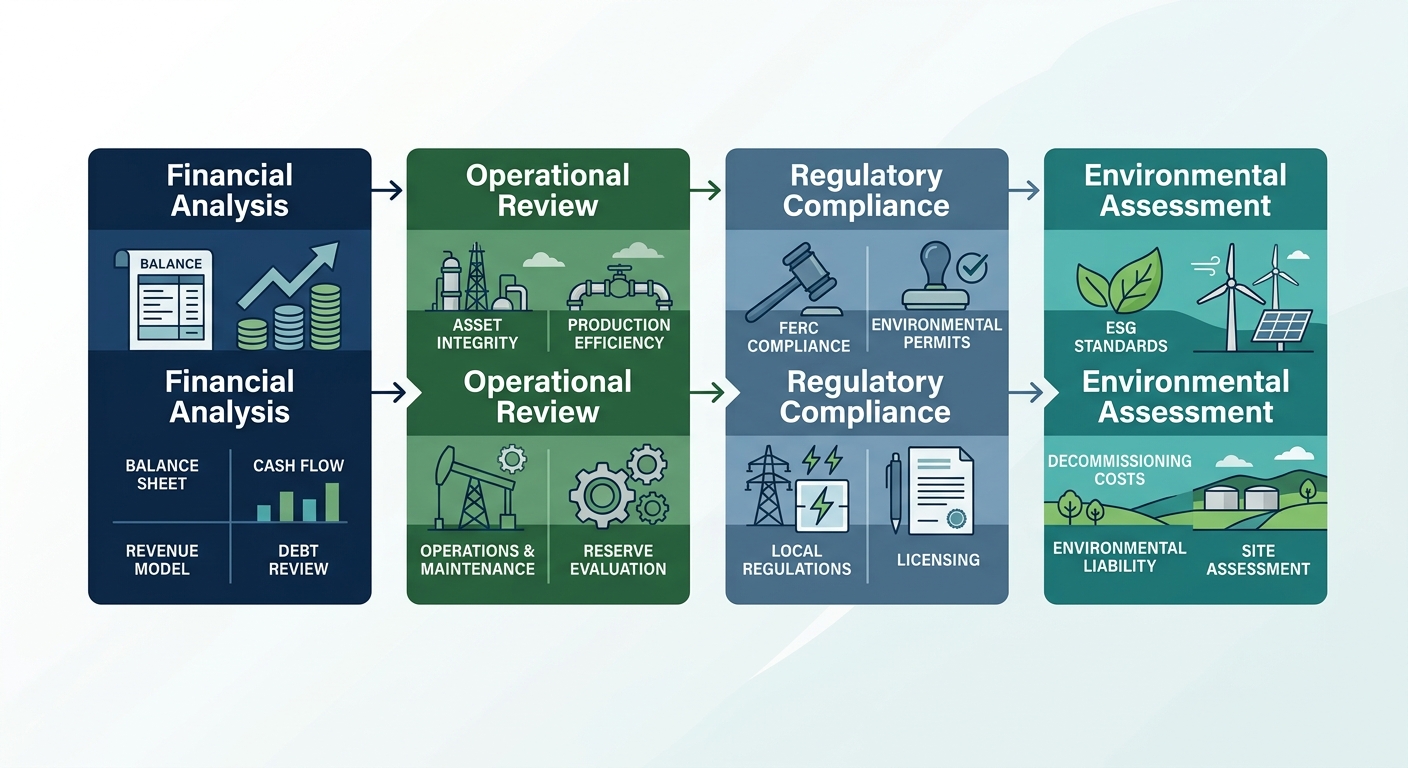
    Due diligence infographic with four panels: financial analysis, operational review, regulatory compliance, and environmental assessment, connected by arrows to show sequential review process.
    Four-panel due diligence infographic for energy M&A

    By applying this rigorous, structured approach, we help clients navigate complexity and negotiate from a position of strength, ensuring that strategic fit and long-term energy transition goals are met.

    Value Your Energy Business Accurately

    In energy mergers and acquisitions advisory, accurate valuation is the bedrock of a successful deal. Current trends in energy M&A underscore that precision in pricing can make the difference in attracting serious buyers. Commodity price volatility and shifting regulations compound this need, requiring a thorough, dispassionate assessment.

    Valuation accuracy directly shapes advisory fee structures. As Zaidwood Capital’s FAQ on advisory models explains, success fees tied to deal value are common. In oil and gas merger activity, fluctuating asset prices make a precise figure essential for fair cost allocation. A valuation grounded in market reality safeguards against disproportionate advisory expenses.

    We at Zaidwood Capital, a Boutique M&A and Capital Advisory Firm, apply full-cycle M&A discipline to energy valuations, ensuring every engagement begins with a defensible number. With an accurate valuation in hand, the next step is selecting the right advisory approach.

    Select the Right M&A Advisor for Your Energy Company

    Navigating energy deals requires a specialized energy mergers and acquisitions advisory firm that understands oil and gas mergers and renewables alike. As energy M&A trends evolve, we at Zaidwood Capital believe sector expertise is non-negotiable.

    We evaluate advisors on their proven track record in similar-sized transactions, deep regulatory knowledge of FERC and state oil and gas commissions, and access to a global network of energy-focused investors. Advisors should also demonstrate capital markets expertise, raising equity and debt for energy companies, and provide anonymized case studies. Proprietary data platforms like the Sovereign Data Nexus enable enhanced due diligence and valuation.

    Unlike large banks, a Boutique M&A and Capital Advisory Firm provides senior-level attention, faster decision-making, and full-cycle support. Steer clear of advisors lacking transparency in their deal pipeline or a demonstrable network of energy-focused limited partners.

    Choosing a partner with both deep-domain expertise and a full-cycle approach is the foundation of a successful energy transaction.

    Structure and Negotiate the Deal

    Once a suitable target is identified, the deal structuring and negotiation phase begins, firmly led by our expertise in energy mergers and acquisitions advisory.

    • Valuation analysis: We apply CFA Institute best practices to assess asset worth, leveraging our Velocity Matrix for rapid scenario modeling and Sovereign Data Nexus for data-backed valuation benchmarks.
    • Term sheet negotiation: We guide clients through typical oil and gas mergers levers, including asset valuation adjustments, earn-outs, and indemnity clauses.
    • Due diligence integration: We synthesize findings into revised terms, ensuring alignment with evolving energy M&A trends.

    Structuring is iterative, demanding constant alignment of financial and strategic goals. Streamlining Transactions with Business Development and Financial Expertise, Zaidwood Capital refines every term to maximize client value. After terms are negotiated, the path to closing relies on precise execution and secured data management.

    Navigating regulatory approvals is a cornerstone of energy mergers and acquisitions advisory in today’s market. The FTC, DOJ, and FERC rigorously review energy transactions, while the Hart-Scott-Rodino Act imposes pre-merger notification requirements that demand careful timing. As energy m&a trends reflect a tightening regulatory environment, acquirers and sellers must plan accordingly.

    Environmental reviews under NEPA add layers of complexity for both renewables and oil and gas mergers, especially when drilling or infrastructure permits are involved. Cross-border deals face added scrutiny from CFIUS, which can block acquisitions of critical energy assets. Building robust compliance pathways early is essential to avoid costly delays.

    At Zaidwood Capital, we map these approval frameworks to each transaction’s timeline, leveraging our proprietary Sovereign Data Nexus to monitor regulatory shifts in real time. A proactive approach to navigating regulatory dynamics in energy M&A not only mitigates risk but accelerates execution into due diligence and structuring.

    Execute Post-Merger Integration for Maximum Value

    Once the deal closes, the real work begins: post-merger integration. In energy mergers and acquisitions advisory, disciplined PMI separates value-creating transactions from those that erode returns. We anchor integration on three pillars: clear integration planning, deliberate cultural alignment, and rigorous operational synergy tracking.

    Amid evolving energy M&A trends, oil and gas mergers demand concrete KPIs for cost synergies, revenue gains, and talent retention, reviewed quarterly. Zaidwood Capital’s healthcare M&A research shows that 70% of deals underperform due to cultural misalignment—a pattern mirrored in energy transactions. With deep energy mergers and acquisitions advisory, we customize integration plans to sector-specific dynamics, reducing friction and accelerating synergy capture.

    Our Sovereign Data Nexus consolidates data across legacy systems in real time, speeding system unification. The Velocity Matrix then accelerates milestone tracking, enabling faster, evidence-based decisions. We never guarantee a specific outcome; each integration carries unique risks and demands adaptive execution.

    With a solid integration plan, the combined entity is positioned for sustained growth. In the next section, we explore long-term value creation through strategic portfolio management. Past performance does not guarantee future results; investors may lose all or part of their investment.

    Overcoming Common Hurdles in Energy M&A Advisory

    Navigating the energy mergers and acquisitions advisory landscape requires a clear-eyed view of recurring hurdles. Even when the macro environment looks favorable, several obstacles can slow or derail a transaction. Our experience highlights four challenges that demand structured responses.

    Regulatory and permitting complexity tops the list. In cross-border oil and gas mergers, for instance, firms often face overlapping environmental reviews, antitrust scrutiny, and national-security considerations. We deploy our secure Deal Vault to organize due diligence early, enabling clients to respond to inquiries with consistency—without promising a faster timeline.

    Commodity-price volatility widens the bid-ask spread, a hallmark of energy M&A trends that makes valuation a moving target. We use a structured negotiation framework alongside transparent data rooms to surface mutually acceptable valuation bases, aligning buyer and seller expectations despite fluctuating oil-and-gas benchmarks. The discipline narrows the gap without guaranteeing a fixed price.

    Asset-level uncertainty—legacy infrastructure, decommissioning liabilities, ESG factors—complicates price discovery. Our Sovereign Data Nexus maps operational and environmental data to ground pricing discussions in facts. Our recent healthcare M&A analysis shows that valuation corrections are sector-agnostic, while our 2026 forecast anticipates convergence that mirrors the energy transition.

    Post-merger integration difficulty—cultural clashes, operational overlap, technology misalignment—often undermines deal logic. We embed full-cycle oversight from initial diligence through post-close planning, helping clients anticipate friction points and design alignment measures. No process eliminates every risk, but a disciplined, data-rich approach improves outcomes. That’s where a full-cycle boutique like Zaidwood Capital earns its role.

    Achieving a Successful Energy M&A Transaction

    Given the sector’s constant evolution, achieving a successful energy mergers and acquisitions advisory engagement demands strategic clarity and rigorous execution. We approach each mandate as a custom alignment of buyer and seller objectives, ensuring that the rationale for the transaction is firmly grounded in long-term value creation rather than short-term market momentum.

    Keeping pace with energy M&A trends — such as the accelerating shift into clean infrastructure and ongoing consolidation in oil and gas — requires advisors who can anticipate market movements before they become consensus. In oil and gas mergers, for instance, precise asset-level valuation and deft navigation of regulatory frameworks separate value-accretive deals from those that destroy shareholder capital. Our Full-Cycle M&A platform combines sophisticated financial structuring with proprietary deal flow intelligence from Sovereign Data Nexus, while Precision Catalyst targets the right institutional counterparties and our Velocity Matrix compresses execution timelines so clients can capture windows of opportunity that traditional processes miss.

    As a Boutique M&A and Capital Advisory Firm, we believe superior outcomes are built on a foundation of continuous learning. Our team’s commitment to ongoing investment professional education — benchmarked against the CFA Institute’s globally recognized ethical and analytical standards — ensures that every engagement benefits from the latest strategic frameworks. Ultimately, a boutique partner armed with proprietary tools and specialized sector fluency significantly increases the probability of a successful, expedited close.

    Resources

  • Best Quality of Earnings Report for Mid-Market Deals 2026

    Best Quality of Earnings Report for Mid-Market Deals 2026

    Table of Contents

    The Role of Quality of Earnings Reports in Mid-Market M&A

    Following a comprehensive due diligence review, buyers and lenders in mid-market M&A transactions focus on the Quality of Earnings (QoE) report, an independent assessment of a target company’s historical financial performance, adjusted for non-recurring items. This analysis goes far beyond audited financials by evaluating revenue sustainability, customer concentration, and the normalization of operating expenses and working capital. A well-prepared quality of earnings report provides a clearer view of recurring EBITDA, which serves as the foundation for valuation and debt sizing.

    Why QoE Matters in Mid-Market Deals

    The insights from an earnings quality analysis routinely reshape transaction terms. Buyers use the adjusted EBITDA to support purchase price adjustments, earnout structures, and net-working-capital targets. Lenders, in turn, demand a validated earnings baseline before committing acquisition debt. Moreover, the QoE often uncovers deferred-revenue patterns or concentration risks that, if ignored, can surface as costly post-close liabilities. In mid-market transactions where information gaps are common, a thorough QoE report reduces post-close surprises and gives the commissioning party a stronger negotiating position.

    Because mid-market companies frequently lack the internal resources to produce a GAAP-independent earnings analysis on their own, many engage specialized M&A advisors to manage the QoE process. At Zaidwood Capital, we integrate the QoE directly into our full-cycle due diligence offering, coordinating with independent accounting firms to deliver a report that buy-side and sell-side clients can rely on during negotiation and financing. We handle all financial data in accordance with rigorous confidentiality standards. For information on how we protect client information, please review Zaidwood Capital Privacy Policy.

    What Defines a Quality of Earnings Report

    A critical subset of due diligence, central to mid-market transaction diligence, is the Quality of Earnings Report, a financial analysis that evaluates the recurring, normalized earnings of a target company. At Zaidwood Capital, we define a QoE report as a rigorous assessment of earnings sustainability, designed to strip out non-recurring items and present a true picture of operating performance. This analysis is a cornerstone of our full-cycle due diligence process for mid-market M&A transactions.

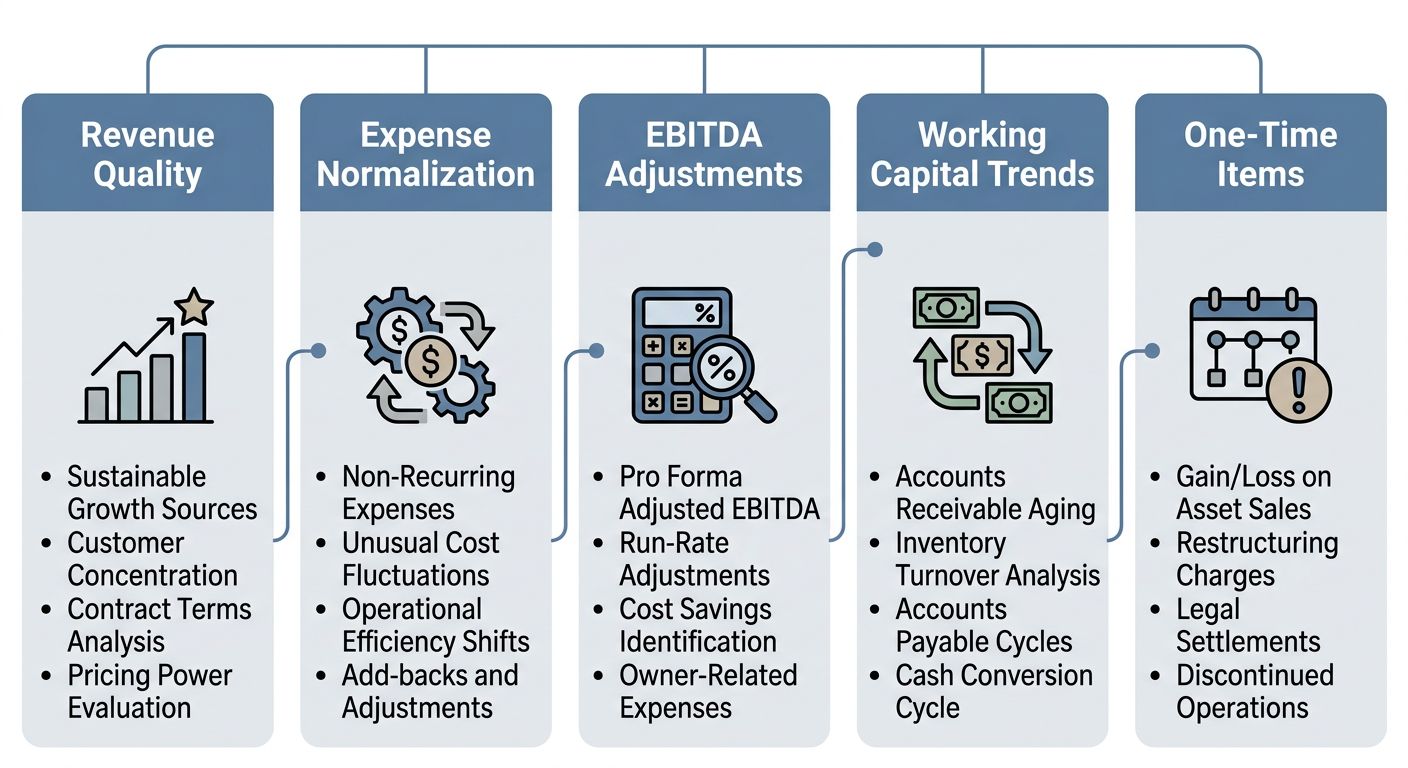
    A comprehensive earnings quality analysis examines several critical areas. Revenue quality scrutinizes the predictability and diversification of income streams. Expense normalization adjusts for one-time costs, owner’s compensation, or other out-of-ordinary expenses. EBITDA adjustments remove non-operating or non-cash items to reflect sustainable earnings. Working capital trends highlight operational liquidity needs and potential cash drags. One-time items, such as litigation settlements or asset sales, are excluded to reveal the underlying earning power. These dimensions collectively inform whether the company’s earnings are sustainable and repeatable for future periods.

    Infographic with five columns representing core areas of a quality of earnings analysis: Revenue Quality, Expense Normalization, EBITDA Adjustments, Working Capital Trends, and One-Time Items, each with icons and bullet lists on a muted blue and gray palette.

    Zaidwood Capital’s Quality of Earnings analysis framework visualized in five key areas.

    By producing a normalized earnings base, the QoE report helps both buyers and sellers reach consensus on valuation. For buy-side M&A professionals, this analysis highlights the true recurring profitability of a target, removing distortions that could inflate or deflate the purchase price. Sellers also benefit, as a well-documented QoE report can justify a premium and accelerate negotiation.

    As part of our Full-Cycle M&A and capital advisory services, we integrate QoE analysis into every engagement to provide clients with clear, defensible financial insights. The report is not an audit; it does not verify financial statement accuracy in compliance with accounting standards. Instead, it offers transaction-specific intelligence that traditional audits often miss. Zaidwood Capital utilizes QoE reports as a core component of its full-cycle due diligence, ensuring that both buy-side and sell-side mandates are grounded in reliable earnings data. By identifying true economic earnings, a QoE report streamlines negotiations and reduces the risk of post-close surprises.

    Next, we examine the core components that define a comprehensive QoE analysis.

    Securities are offered through Finalis Securities LLC, an independent entity from Zaidwood Capital. This content is for informational purposes and does not constitute investment advice.

    Core Components of a Quality of Earnings Analysis

    A quality of earnings report for mid-market deals goes beyond audited financials to uncover the true recurring cash flow a buyer can rely on. In this section, we break down the three pillars of a quality of earnings analysis: normalization adjustments, working capital scrutiny, and EBITDA sustainability. Drawing on Zaidwood Capital’s due diligence expertise, we show how each component strengthens deal-making for institutional and private investors.

    Normalization Adjustments and Add-Backs

    Normalization adjustments strip away non-operational or inflated expenses to present a clean EBITDA. These adjustments are critical because audited financials may include non-recurring gains or expenses that distort the company’s sustainable earning power. In our analyses, we identify above-market owner compensation, one-time legal fees, personal expenses run through the business, and related-party transactions at non-market terms.

    • Owner’s Compensation Adjustment: Aligning above-market owner salary and benefits to industry-standard compensation for a replacement manager
    • Non-Recurring Expenses: One-time legal fees, consulting engagements, relocation costs, or restructuring charges unlikely to repeat post-acquisition
    • Personal Expenses: Personal travel, entertainment, vehicles, or family members on payroll not related to business operations
    • Related-Party Transactions: Above-market rent, management fees, or service charges paid to entities owned by the seller or their family

    We substantiate each adjustment with corroborating evidence—payroll records, lease agreements, invoices—and provide a clear rationale in our reports. A quality of earnings analysis also flags off-balance-sheet liabilities like operating leases or contingent obligations that can alter deal value. For example, an owner drawing $600,000 when market rate is $200,000 inflates expenses by $400,000, a typical adjustment we see. By documenting every add-back, we give buyers confidence in the normalized earnings figure. Additionally, QoE reports look beyond the balance sheet to identify contingent payments or environmental indemnities that may not be booked but represent real future cash outflows.

    Working Capital Analysis and Debt-Like Items

    Working capital analysis determines the normalized net operating capital needed post-acquisition. We assess seasonal needs, payment cycles, and industry norms, then compare that to the target company’s actual levels. The gap—whether surplus or deficit—becomes an adjustment to the purchase price. For instance, if a business has excess working capital relative to its normalized requirement, the buyer may credit the seller for that amount at closing; conversely, a deficiency reduces the price. Our QoE reports present these adjustments with supporting schedules so that both buyers and sellers can negotiate from a common understanding.

    Debt-like items are obligations that function as debt but are not on the balance sheet as such. Examples include deferred revenue, underfunded pensions, or installment sale obligations. We identify these, quantify their impact, and deduct them from the equity value, just as we would formal debt. This analysis prevents the buyer from inheriting hidden financial burdens and ensures the enterprise value accurately reflects the business’s true financial position.

    EBITDA Quality and Sustainability Assessment

    EBITDA sustainability evaluation dissects the recurring nature of earnings. We examine revenue concentration risk—if a company depends on a single customer for more than 10% of revenue, that concentration creates vulnerability. Customer retention trends, contract renewal probabilities, and churn rates indicate how sticky the revenue base is. We also assess margin stability, checking whether gross and operating margins are sustainable or eroded by pricing pressure. In emerging markets M&A, we place extra focus on revenue concentration and retention because currency swings, regulatory shifts, and political instability can quickly reshape earnings. We evaluate supplier relationships to ensure margins are not artificially supported by short-term concessions, and we consider macroeconomic trends that could influence future earnings. Through our QoE reports, we help buyers distinguish durable cash flows from those that could evaporate post-acquisition, providing a forward-looking perspective essential for informed investment decisions.

    Selecting a Quality of Earnings Provider for Your Mid-Market Deal

    A quality of earnings report for mid-market deals is one of the most important tools for de-risking an acquisition, and choosing the right provider directly influences the credibility of your financial analysis. For companies in the $20M–$100M revenue range, the provider’s expertise, speed, and post-engagement support can make a material difference in how the QoE findings are received by lenders, underwriters, and counterparties.

    Evaluating Boutique Firm Expertise for QoE Analysis

    Boutique firms such as Zaidwood Capital specialize in delivering a highly tailored Quality of Earnings analysis that aligns with the specific dynamics of mid-market transactions. Their teams typically bring deep industry knowledge and direct senior partner involvement, ensuring that the engagement is led by an experienced professional who understands both the financial and strategic dimensions of the deal. In contrast, Big Four accounting firms offer a broad, generalist approach with standardized QoE templates that can miss the nuances of niche sectors. Mid-tier regional firms occupy a middle ground, providing moderate specialization but often with less senior oversight than a dedicated boutique.

    The critical differentiator is the level of partner engagement. At a boutique, the senior team leads the QoE analysis from start to finish, which shortens feedback loops and results in a more focused report. Big Four firms typically rely on junior staff for the bulk of the fieldwork, with partner review at the conclusion, while mid-tier firms show variability in senior involvement. This direct access to senior talent often translates into faster turnaround times and more actionable insights for the acquirer.

    The following comparison table summarizes key distinctions to inform your selection.

    Common Add-Backs and Adjustments in Quality of Earnings Reports
    Adjustment TypeDescriptionTypical EBITDA ImpactCommon Example
    Owner’s Compensation AdjustmentAligning above-market owner salary and benefits to industry-standard compensation for a replacement manager+$150,000 to $500,000 add-backOwner paying themselves $600,000 when market rate for a general manager is $200,000
    Non-Recurring ExpensesOne-time legal fees, consulting engagements, relocation costs, or restructuring charges unlikely to repeat post-acquisition+$50,000 to $300,000 add-back$200,000 in legal fees from a one-time litigation matter
    Personal ExpensesPersonal travel, entertainment, vehicles, or family members on payroll not related to business operations+$25,000 to $150,000 add-backCompany-leased luxury vehicle used primarily for personal use
    Related-Party TransactionsAbove-market rent, management fees, or service charges paid to entities owned by the seller or their family+$75,000 to $400,000 add-backPaying $30,000/month rent to a seller-owned LLC when market rate is $15,000

    Boutique firms consistently deliver deep specialization and hands-on partner involvement, often completing a QoE engagement in as little as 2–4 weeks—roughly half the time of a Big Four engagement. Moreover, firms like Zaidwood Capital adhere to established capital markets best practices, incorporating frameworks from ICMA capital markets to ensure the analysis meets rigorous industry standards. This commitment to both speed and quality makes boutique advisors a compelling choice for mid-market acquirers.

    Scope and Cost Expectations for Mid-Market Companies

    For a $20M–$100M-revenue company, the scope of a Quality of Earnings engagement should be calibrated to deal complexity and the acquirer’s specific concerns. A one-size-fits-all report rarely adds value; instead, the engagement scope must be defined collaboratively, focusing on revenue recognition policies, working capital trends, customer concentration risks, and any carve-out adjustments that could affect normalized EBITDA. At Zaidwood Capital, we work directly with buyers to design a custom scope that addresses the unique drivers of the target business, avoiding unnecessary line items that inflate cost without improving decision-making.

    Cost expectations reflect the level of customization. Boutique firms like Zaidwood Capital typically quote $25,000–$50,000 for a $20M-revenue company, while Big Four firms can range from $75,000 to over $150,000 for a similar-sized engagement. Mid-tier regional firms generally fall between $40,000 and $80,000. All figures are custom quotes and depend on data availability, the number of entities involved, and the speed required. We emphasize that our pricing is never a fixed fee; each engagement is priced based on the precise scope and timeline agreed upon, with full-cycle support extending from the initial QoE analysis through deal close.

    Integrating QoE Findings into Deal Structuring

    A Quality of Earnings report is not just a diligence artifact—it directly shapes the final deal terms. When normalized EBITDA adjustments reveal that reported earnings overstate true recurring cash flow, buyers can negotiate purchase price reductions or post-closing true-ups. Earnout structures become more defensible when the QoE identifies revenue volatility or concentration risks that warrant contingent payments. Similarly, representation and warranty insurance underwriters increasingly rely on QoE findings to set coverage limits and exclusions, making a thorough report a valuable risk-transfer tool.

    At Zaidwood Capital, our full-cycle advisory model ensures that QoE insights flow seamlessly into the negotiation and documentation phases. We translate EBITDA adjustments into specific purchase price adjustment mechanisms, design earnout milestones linked to verifiable financial metrics, and help acquirers present the QoE to insurers to secure favorable underwriting terms. This integrated approach reduces re-trading risk and accelerates the path to a signed purchase agreement. Once you have selected the right partner, the next step is implementing a disciplined QoE process that turns financial analysis into concrete deal terms. As with any investment, past performance does not guarantee future results, and we recommend consulting professional advisors to tailor the approach to your deal.

    How Quality of Earnings Reports Influence Purchase Price and Deal Terms

    A quality of earnings report for mid-market deals does more than flag accounting irregularities; it serves as the core negotiating lever for adjusting the purchase price and crafting protective deal provisions. At Zaidwood Capital, we treat the QoE report as the definitive source for reconciling reported financials with normalized economic reality. This alignment is essential before we engage in price discussions.

    In our experience, the most direct impact of the QoE report is a purchase price adjustment derived from normalized EBITDA. When the report strips out non-recurring revenue or one-time expenses, it recalibrates the basis on which the acquisition multiple is applied. A lower sustainable EBITDA can reduce the implied valuation, prompting the buyer to seek a price reduction. Conversely, a seller whose earnings prove clean and recurring can leverage the report to sustain or elevate the offer. Beyond EBITDA, the working capital peg—determined by historical QoE trend analysis—can shift the final cash consideration. If the report reveals that the target’s normalized net working capital is lower than originally represented, the buyer rightfully demands a dollar-for-dollar reduction at closing. Sellers with positive QoE results often use this as a shield against overly burdensome indemnification clauses, while buyers rely on the analysis to insert additional covenants or expand representations and warranties when risks are evident.

    Earnout structures are another area where QoE findings carry substantial weight. We typically link earnout payments to forward-looking financial metrics that have been validated by the quality of earnings (QoE) review. This ensures that post-closing milestones are both achievable and reflective of the business’s true earning power, reducing disputes later. Likewise, indemnification horizons and escrow amounts are calibrated to the specific risks flagged in the report. A revenue recognition issue might extend the survival period for related claims and increase the escrow holdback, while a clean report shortens those protections. Underpinning this rigor are regulatory standards that shape our financial analysis. FINRA securities regulation, administered by the Financial Industry Regulatory Authority, sets expectations for broker-dealer reporting that influence how we assess earnings quality in private transactions. Similarly, SEC securities regulation, enforced by the U.S. Securities and Exchange Commission, mandates GAAP compliance and reinforces the importance of accurate data in all valuations. In the following section, we demonstrate how these adjustments play out in a real mid-market transaction.

    Common Questions About Quality of Earnings Reports in Mid-Market Deals

    After establishing the importance of a quality of earnings report for mid-market deals, we address the most common questions buyers and sellers ask before engaging a QoE provider.

    What is a quality of earnings report, and why is it essential for mid-market deals? A QoE analysis examines earnings sustainability and quality, revealing adjustments needed in private-company financials and uncovering risks like customer concentration.

    How does a QoE differ from standard due diligence, and what adjustments does it uncover? Unlike standard due diligence, a QoE report serves as a complementary tool—used by advisors like Zaidwood Capital—to examine normalized EBITDA, margin trends, and working capital, separating recurring from one-time items and revenue mix.

    How does a QoE report impact valuation and deal structure? By surfacing these insights, a QoE can bridge valuation gaps and influence purchase price multiples, giving both sides clearer grounds for negotiation.

    Next, we’ll walk through the practical steps of commissioning a QoE report for your mid-market transaction.

    Leveraging Quality of Earnings Reports for Smarter M&A Decisions

    A Quality of Earnings report for mid-market deals dissects financials to expose sustainable earnings by stripping out one-offs. It flags risks like premature revenue booking, strengthening your negotiation position. Mid-market firms with less polished reporting especially benefit. At Zaidwood Capital, a quality of earnings report for mid-market deals anchors our full-cycle due diligence, alongside operational, commercial, and IT assessments, to deliver a complete picture. Compliance with SEC securities regulation ensures data reliability, and leveraging QoE minimizes post-close shocks. Deeper insight drives smarter M&A decisions.

    Resources

  • Due Diligence Explained: Financial and Commercial Guide

    Due Diligence Explained: Financial and Commercial Guide

    Table of Contents

    Mastering Due Diligence in Mergers and Acquisitions

    Building on Streamlining Transactions in mergers and acquisitions, due diligence is the comprehensive investigation verifying a target company’s viability. It plays a pivotal role in risk mitigation and value confirmation, ensuring informed decisions throughout the deal process.

    Financial due diligence involves scrutinizing historical financials, cash flow projections, debt obligations, and working capital adequacy. We leverage proprietary tools to deliver precise insights that uncover hidden liabilities and opportunities.

    Commercial due diligence validates market size, competitive positioning, customer retention rates, and revenue sustainability through rigorous industry benchmarking. Our full-cycle approach integrates financial, legal, operational, IT, and human capital reviews using the Velocity Matrix for accelerated execution and Precision Catalyst methodologies.

    This mastery enables informed negotiations, minimizes post-deal surprises, and facilitates seamless integration into our Full-Cycle M&A and capital advisory services. Book A Call today for tailored support.

    Preparing for Your Due Diligence Process

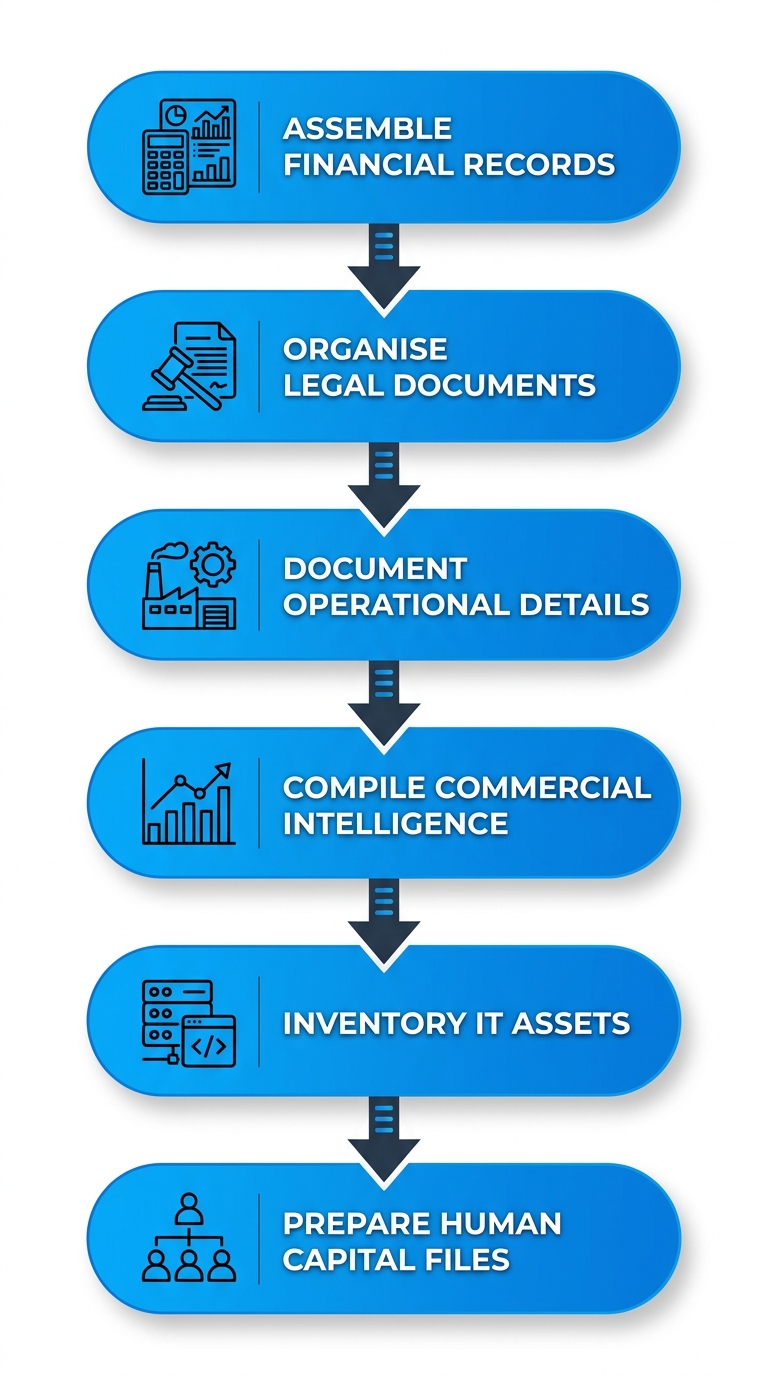
    Building on our overview of due diligence, we recommend proactive preparation to ensure smooth Full-Cycle Due Diligence across financial, legal, operational, commercial, IT, and human capital aspects. This Streamlining Transactions approach positions your M&A or capital deal for efficiency and success.

    Vertical process flow diagram illustrating six key steps for preparing M&A due diligence: assembling financial records, organizing legal documents, documenting operations, compiling intelligence, inventorying IT assets, and preparing HR files.

    Six-step vertical flowchart for efficient M&A due diligence preparation

    Key preparation steps include:

    • Assemble complete financial records, including audited statements, tax returns, cash flow projections, and debt schedules for the past three years to support financial due diligence.
    • Organize legal documents such as incorporation papers, shareholder agreements, litigation files, and material contracts.
    • Document operational details like supply chain mappings, key KPIs, inventory ledgers, and facility leases.
    • Compile commercial intelligence, including customer concentration analyses, market reports, sales pipelines, and benchmarking for commercial due diligence.
    • Inventory IT assets with software licenses, cybersecurity protocols, data backups, and architecture diagrams.
    • Prepare human capital files covering org charts, employee contracts, compensation benchmarks, and retention plans.
    • Create a secure data room indexed by category with access logs and assign point persons per diligence category.

    Contact us via Book A Call to initiate your tailored process. This is informational only; consult advisors. Past performance does not guarantee future results.

    Planning and Kickoff Phase

    Building on our Full-Cycle M&A and capital advisory process, the Planning and Kickoff Phase serves as the critical starting point. Here, we collaborate closely with clients to define transaction goals, timelines, and success metrics within 1-2 weeks, incorporating due diligence scoping powered by our Velocity Matrix for streamlined execution.

    We initiate kickoff activities with a structured onboarding call to align objectives. Our team then executes NDAs, sets up the secure Deal Vault data room, and conducts an initial diagnostic review of financials and market position to identify key priorities.

    Planning emphasizes full-cycle due diligence, prioritizing financial due diligence such as pro forma financials review and commercial due diligence including market validation and competitive analysis.

    Using our Precision Catalyst approach, we customize scope leveraging our 4,000+ investor network. With planning complete, we advance to the Due Diligence Execution Phase, ensuring efficient transactions through proprietary data access.

    Financial Analysis Review

    Within our full-cycle due diligence as part of Full-Cycle M&A and capital advisory services, our financial analysis review ensures transaction integrity by rigorously evaluating financial statements, projections, and risks. This due diligence evaluation provides the quantitative backbone for informed decisions in mergers and acquisitions.

    We begin our financial review process with targeted steps:

    • Examining historical financials for revenue trends and cost structures.
    • Validating pro forma projections against market benchmarks.
    • Assessing working capital efficiency and debt sustainability through key ratios like EBITDA margins and cash conversion cycles.

    Our financial due diligence leverages proprietary data access via the Velocity Matrix for faster insights, drawing from $24.4B+ in transaction experience. This pairs with commercial due diligence for holistic risk assessment.

    Book A Call for a custom financial review in your deal. Not investment advice — consult advisors; investments involve risk.

    Complementing financial due diligence, our legal document examination uncovers hidden liabilities in Full-Cycle M&A and capital advisory services. As a vital part of comprehensive due diligence, we scrutinize key documents to mitigate risks, drawing on our access to 4,000+ global investors and $24.4B+ transaction volume.

    Shareholder Agreements: Review control provisions for ownership disputes.

    Material Contracts: Analyze termination clauses for exit risks.

    Litigation Records: Identify pending disputes.

    IP Assignments: Verify ownership clarity.

    Regulatory Filings: Assess compliance history.

    1. Cross-verify authenticity via proprietary Deal Vault access.
    2. Flag non-compete issues in employment contracts.
    3. Coordinate findings with financial due diligence teams for liability impacts.

    This integrates with commercial due diligence for a holistic view, Streamlining Transactions through the Velocity Matrix. Our process reduces execution friction and aligns legal, financial, and commercial teams. Not investment advice—consult advisors. Book A Call today.

    Commercial Market Assessment

    Within our full-cycle due diligence, commercial market assessment builds on financial analysis by analyzing target market size, trends, customer demand, competitive positioning, and entry barriers. This commercial due diligence ensures informed decisions in Full-Cycle M&A and capital advisory.

    We conduct primary research through our institutional network of 4,000+ global investors. Our team reviews proprietary data via Velocity Matrix for market velocity, assesses go-to-market strategies, and benchmarks peers using Precision Catalyst tools. This commercial evaluation pairs with financial due diligence to deliver holistic insights, avoiding siloed analysis while Streamlining Transactions.

    Key benefits include spotting risks in buyer-seller dynamics and unlocking value through Sovereign Data Nexus access. This market lens informs our broader evaluation phases, ensuring comprehensive support.

    Book A Call today for a custom assessment, backed by our $24.4B+ transaction volume expertise.

    This is informational only; consult advisors. Not investment advice. Securities via Finalis Securities LLC; we are not a broker-dealer.

    Operational Efficiency Evaluation

    Building on financial due diligence, our operational efficiency evaluation examines execution capabilities in Full-Cycle M&A and capital advisory transactions. We analyze production processes, supply chain logistics, workforce productivity metrics like output per employee hour, and cost-to-revenue ratios to identify bottlenecks and improvement opportunities.

    Our step-by-step process includes: (1) conducting on-site facility walkthroughs and data room reviews for operational KPIs; (2) benchmarking against peers using anonymized industry data from our $24.4B+ transaction database; (3) modeling post-transaction efficiency gains via scenario analysis integrated with our Velocity Matrix for Streamlining Transactions.

    We integrate operational insights with financial due diligence by quantifying capex savings and with commercial due diligence by validating revenue sustainability through throughput validations. These insights complement commercial due diligence revenue projections.

    We deliver customized reports with 15-25% typical efficiency uplift recommendations. Book A Call for implementation quotes and scheduling.

    IT and Human Capital Review

    Building on financial due diligence and commercial due diligence, our IT and human capital review forms a core component of Full-Cycle M&A and capital advisory services. We assess technology infrastructure, cybersecurity, data systems, workforce talent, and organizational structure to identify risks and opportunities, streamlining transactions as a Precision Catalyst.

    In IT review, we evaluate software scalability, cloud migration readiness, API integrations, and cybersecurity frameworks like zero-trust architecture. Our human capital review includes skills gap analysis via competency matrices, employee turnover metrics from HR data, executive succession planning charts, and cultural alignment scoring.

    These findings integrate with financial due diligence and commercial due diligence phases to produce a unified risk profile report. Our proprietary Velocity Matrix accelerates IT audits and talent assessments using institutional network insights.

    These insights directly inform our transaction advisory and fairness opinions. Book A Call to discuss custom due diligence scopes.

    This is informational only, not investment advice—consult advisors. Securities via Finalis Securities LLC; Zaidwood not a broker-dealer.

    Synthesis and Reporting

    Building on these analyses from commercial due diligence and other phases, our synthesis and reporting phase completes the full-cycle due diligence process. We integrate key insights into unified, actionable reports that empower informed M&A decisions within our Full-Cycle M&A and capital advisory services.

    Our team synthesizes data from financial due diligence alongside commercial due diligence. Using the Velocity Matrix, we streamline the reporting process to produce:

    • Executive summaries and risk matrices highlighting critical findings;
    • Recommendation sections with clear, prioritized actions;
    • Tailored deliverables like comprehensive due diligence reports, fairness opinion inputs, and strategic briefs for buy-side or sell-side clients.

    The Precision Catalyst approach ensures these reports accelerate transaction velocity while mitigating identified risks across all phases. These reports inform our full-cycle M&A advisory and next steps. Book A Call to explore custom due diligence synthesis for your needs.

    Overcoming Common Due Diligence Challenges

    While due diligence is critical in M&A transactions, common pitfalls like incomplete data rooms, regulatory complexities, and integration risks often derail deals. At Zaidwood Capital, our Full-Cycle M&A and capital advisory services provide a comprehensive solution through our Streamlining Transactions approach. We help clients anticipate and mitigate risks early in deals.

    Delays in financial due diligence frequently arise from scattered financial data across multiple sources. We overcome this by conducting thorough financial due diligence using proprietary data access and private servers via our Velocity Matrix, accelerating verification and ensuring accuracy without compromising security. Our teams normalize inputs, prioritize material items, and shorten review cycles to reduce rework.

    Gaps in commercial due diligence often stem from market misalignments that undermine deal viability. Our methodology integrates commercial due diligence with strategic financial consulting, validating market potential and aligning opportunities with client objectives for informed decision-making. We pair market sizing with customer segmentation and competitor analysis for realistic forecasts.

    Operational and IT due diligence oversights can lead to costly post-deal surprises. We address these through full-cycle due diligence encompassing operational, IT, and human capital aspects, leveraging Precision Catalyst tools to identify risks early and facilitate seamless integration. Cross-functional teams build integration playbooks to accelerate day-one readiness effectively.

    With over $24.4B in aggregate transaction volume and access to 4,000+ global investors, we deliver proven expertise. Book A Call today for tailored support on your next transaction.

    Achieving M&A Success Through Thorough Due Diligence

    Building on common M&A transaction risks, thorough due diligence stands as the Precision Catalyst for success. Studies indicate 70-90% of deals fail due to inadequate processes, underscoring the need to identify risks and opportunities early in our Full-Cycle M&A and capital advisory at Zaidwood Capital.

    Financial due diligence involves scrutinizing historical financials, normalizing EBITDA, projecting future cash flows, and detecting off-balance-sheet liabilities to ensure fiscal accuracy.

    Commercial due diligence validates market size, assesses customer concentration risks, evaluates competitive positioning, and confirms revenue sustainability using our proprietary Velocity Matrix tools.

    Our full-cycle approach extends to legal, operational, IT, and human capital due diligence, Streamlining Transactions while mitigating post-deal surprises. With access to our 4,000+ investor network and $24.4B+ transaction volume, we drive integrated advisory outcomes. Past performance does not guarantee future results.

    Book A Call for tailored due diligence support.

    This article was researched and written with the assistance of AI tools.

    Resources and Insights