
Zaidwood Capital

Category: Human Capital Management

  • Employee Benefits Michigan: Complete Guide for 2026

    Employee Benefits Michigan: Complete Guide for 2026

    Table of Contents

    In Michigan specifically, businesses face rising costs and regulatory changes when managing employee benefits in Michigan. Compliant programs ensure talent retention while meeting state mandates like workers’ compensation and unemployment insurance, as outlined in authoritative guidelines from the Michigan Department of Civil Service.

    Employers can enhance packages with voluntary benefits in Michigan, such as supplemental health or life insurance, tailored to workforce needs. Professional Employer Organizations (PEO) simplify administration through co-employment models, pooling risk for better rates and compliance.

    At Zaidwood Capital, we deliver employee benefits consulting in Michigan as part of our full-cycle advisory. Book A Call for custom solutions. Not investment advice—consult advisors. Optimizing benefits positions your business for scalable growth—contact us to integrate with capital advisory.

    Employee Benefits Landscape in Michigan

    In Michigan, the employee benefits landscape adapts to a diverse workforce dominated by manufacturing hubs and rural communities. Voluntary benefits play a key role in boosting employee satisfaction without imposing direct costs on employers. According to Michigan Department of Civil Service authoritative state government data on benefits structures, these programs align with local demographics, where blue-collar and family-oriented workers seek accessible coverage options.

    Vision insurance stands out as fully employee-paid, meeting high demand in areas like Detroit and Grand Rapids to support blue-collar workforce needs. Dental insurance proves essential for family plans, addressing healthcare access gaps in the Upper Peninsula and northern Michigan. Critical illness coverage offers tax-free supplemental protection, fitting M&A retention strategies for firms. State guidelines for employee benefits enrollment in Michigan provide clear processes, as seen in annual open enrollment resources. Zaidwood Capital internal expertise on streamlined benefits via PEO models highlights efficient administration.

    Comparison of Voluntary Benefits Options in Michigan

    Table comparing popular voluntary benefits for Michigan employers, highlighting cost-neutral options and employee appeal.

    Comparison of Voluntary Benefits Options in Michigan
    Benefit TypeCost to EmployerEmployee CoverageMichigan Relevance
    Vision InsuranceNone (employee-paid)100% voluntaryHigh demand in manufacturing hubs
    Dental InsuranceNone100% voluntaryEssential for family plans
    Critical IllnessNoneSupplemental coverageTax-free benefits

    Data sourced from Michigan employer surveys and state guidelines emphasize no direct cost for employers in voluntary benefits Michigan programs. These options deliver strong employee appeal, with critical illness aligning tax-free benefits to M&A-driven retention in voluntary benefits Michigan contexts. Employers gain retention advantages without payroll strain, per Zaidwood Capital insights.

    This table underscores how voluntary benefits Michigan strategies enhance competitiveness amid economic shifts. Michigan voluntary employee benefits like these support workforce stability in manufacturing and rural economies, where employee benefits consulting Michigan can optimize implementation.
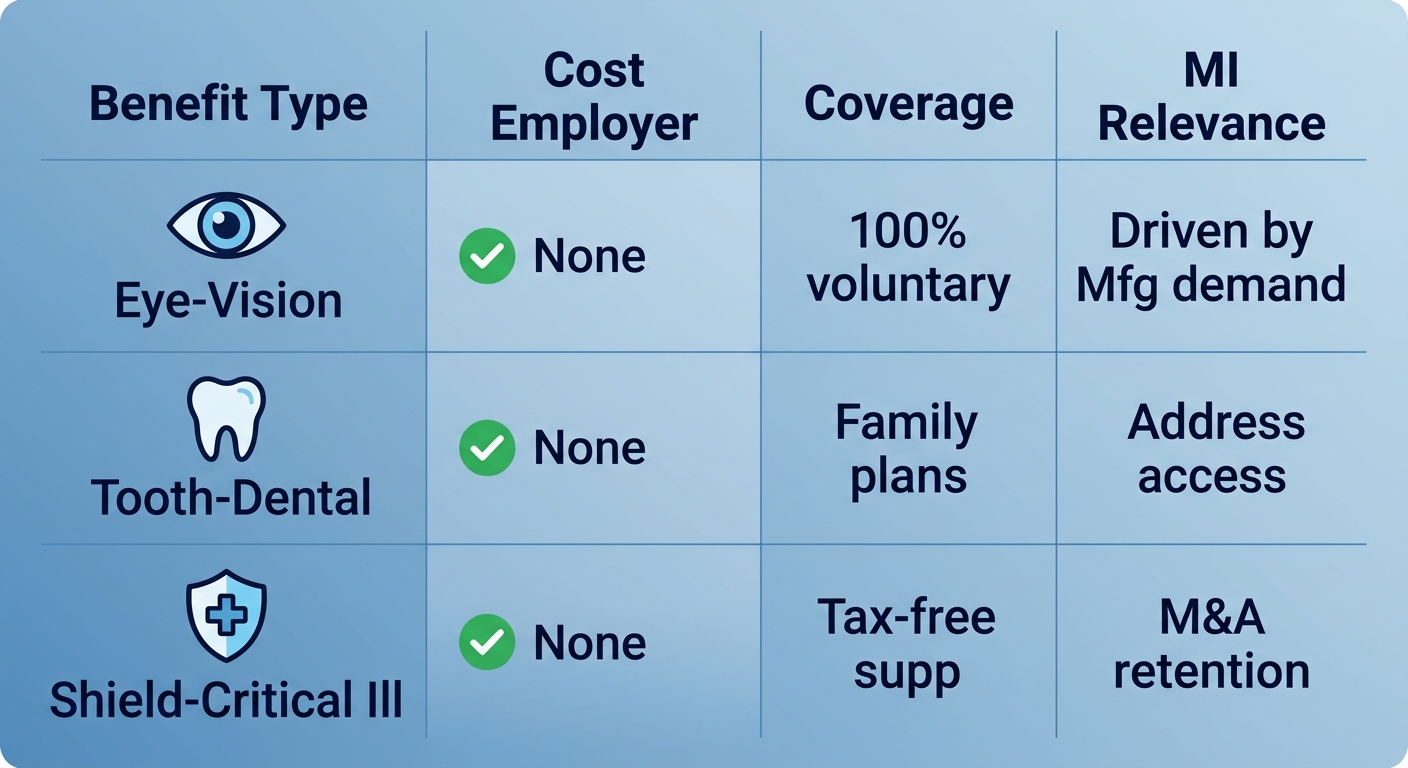
    Infographic table comparing three voluntary benefits: Vision, Dental, Critical Illness for Michigan employers, zero cost, icons and checkmarks.

    Michigan voluntary benefits comparison: zero employer cost, icons for vision, dental, critical illness

    We observe that Michigan employers benefit from these cost-neutral approaches to foster loyalty and adapt to local needs.

    Employee Benefits Services for Michigan Businesses

    We deliver employee benefits consulting Michigan services tailored to address state-specific regulations, such as the Michigan Affordable Prepaid Tuition program and health insurance mandates. These employee benefits Michigan programs help businesses attract and retain top talent in a competitive market, serving as a key human capital retention tool that aligns with broader strategic financial consulting.

    Our full-cycle approach draws from human capital due diligence expertise to design cost-effective, compliant benefits packages for businesses in Michigan. We ensure packages meet local compliance while optimizing for employee satisfaction and employer tax efficiencies. This comprehensive strategy positions Michigan firms for sustainable growth.

    Voluntary benefits Michigan offerings include:

    • Supplemental life insurance for added family protection.
    • Short- and long-term disability coverage to support recovery.
    • Accident insurance for unexpected injuries.
    • Critical illness plans with lump-sum payouts.

    Enrollment is streamlined through flexible platforms, offering tax advantages like pre-tax premiums that reduce employer FICA contributions.

    We integrate cyber security consulting into employee benefits frameworks to protect sensitive data in administration systems, including ongoing monitoring and audits. As outlined in Zaidwood Capital’s authoritative internal overview, this includes risk assessments and compliance audits essential for safeguarding employee information amid rising cyber threats.

    Book A Call today to explore custom employee benefits Michigan solutions.

    Key Considerations for Michigan Benefits Programs

    In Michigan, employee benefits Michigan programs are vital for boosting employee retention while ensuring strict compliance with state regulations. Businesses overlooking these Michigan-specific factors risk penalties, talent loss, and operational disruptions, making tailored strategies essential for success.

    Michigan mandates programs like workers’ compensation and unemployment insurance, with eligibility tied to employee classifications and payroll thresholds. Zaidwood Capital’s authoritative internal FAQ resource outlines exact criteria, emphasizing coverage for full-time workers and seasonal thresholds to maintain legal standing.

    Voluntary benefits Michigan options, such as health savings accounts or life insurance, offer flexibility but must align with state insurance rules for tax advantages and portability.

    Tax implications demand attention to employer contribution minimums under Michigan law. For holistic strategies, employee benefits consulting Michigan experts advise integrating cyber security consulting to address modern risks beyond traditional programs.

    We recommend seeking expert guidance via Book A Call for custom consultation. Not investment advice—consult advisors. We support these considerations through our strategic consulting and planning.

    Steps to Implement Benefits in Michigan

    Building on key considerations for employee benefits Michigan, businesses can follow these structured steps with our employee benefits consulting Michigan guidance. Zaidwood Capital’s proprietary internal guidance streamlines compliance and optimization.

    Step 1: Conduct a workforce needs assessment. Evaluate demographics, coverage gaps, and Michigan Department of Insurance regulations. Zaidwood Capital’s FAQ details this process; our capital advisory funds targeted expansions.

    Step 2: Research and select providers. Focus on cost-effective group plans for health, dental, vision, and voluntary benefits Michigan. Our Velocity Matrix accelerates provider vetting.

    Step 3: Design customized packages. Integrate voluntary benefits Michigan like life insurance via enrollment platforms. Our full-cycle due diligence ensures seamless integration.

    Step 4: Ensure legal compliance. Address ACA and Michigan Paid Medical Leave Act filings. Zaidwood Capital’s expert FAQ outlines these; we provide strategic support.

    Step 5: Launch and administer. Use communications for open enrollment, followed by reviews. Our institutional networks fund ongoing enhancements.

    Contact our team via Book A Call for tailored support. Not investment advice — consult advisors.

    Optimizing Your Michigan Benefits Strategy

    Building on local market dynamics, customizing employee benefits in Michigan attracts top talent in a competitive labor market. Our employee benefits consulting in Michigan ensures state compliance and cost efficiency, per Zaidwood Capital’s proprietary internal guidance.

    Voluntary benefits in Michigan, like supplemental insurance, enhance retention without straining core budgets. We integrate these via Strategic Financial & Corporate Finance Consulting in our Full-Cycle M&A and capital advisory.

    Book A Call for tailored strategies tied to your capital goals.

    This article was researched and written with the assistance of AI tools.

    Resources

  • Software Solutions: Complete Guide for Small Businesses

    Software Solutions: Complete Guide for Small Businesses

    Table of Contents

    Essential HR Software Solutions for Business Growth

    In today’s competitive landscape, HR tech adoption has surged, with over 70% of small and mid-sized businesses implementing software solutions to manage their workforce effectively. These platforms address the growing need for streamlined operations as companies scale more broadly.

    At Zaidwood Capital, we see how boutique M&A advisory intersects with human capital management, where accurate workforce data becomes crucial during due diligence. For instance, robust hr software for small businesses enhances scalability for startups seeking capital formation or navigating mergers, improving data accuracy that supports our full-cycle due diligence processes, including human capital assessments. This alignment not only bolsters operational efficiency but also strengthens valuation in growth strategies, as highlighted in our services overview on comprehensive transaction support.

    This article explores essential HR management platforms, previewing three standout options: BambooHR for intuitive employee management, Gusto for seamless payroll and benefits, and Rippling for integrated workforce optimization tools. These hrms for small business exemplify practical tools that complement strategic financial consulting.

    By leveraging such solutions, businesses achieve cost savings through automation and ensure regulatory adherence, mitigating risks in compliance-heavy environments like M&A preparations.

    BambooHR: Streamlined HR for Small Teams

    BambooHR stands out among human capital management tools as a user-friendly software solutions platform designed for small businesses seeking efficient employee management systems. It simplifies core HR functions like onboarding and performance tracking, enabling teams to scale operations without overwhelming administrative tasks. This approach supports strategic decisions in equity advisory, where accurate human capital data proves invaluable during capital raising or M&A preparations.

    Key Features

    BambooHR offers an intuitive interface that streamlines hr software for small businesses through automated workflows. Key capabilities include:

    • Employee self-service portals for updating personal information and viewing pay stubs, reducing HR inquiries by up to 80% as noted in NYU studies on human capital tools.
    • Onboarding automation that digitizes paperwork and training schedules, accelerating new hire integration.
    • Performance management tools with goal setting and feedback modules to track progress.
    • Benefits administration for easy enrollment in health plans and handling time-off requests.
    • Compliance modules supporting EEO reporting and ACA filings to ensure regulatory adherence.
    • Integrations with payroll providers like Gusto for seamless data transfer.
    • Custom reporting dashboards for insights into workforce metrics.

    These features position BambooHR as a robust compliance automation platform, particularly useful in due diligence processes. For instance, its reporting aids M&A evaluations by providing verifiable employee data, a detail we at Zaidwood Capital often highlight in advisory engagements.

    Pricing

    BambooHR structures pricing into Essentials at $6 per user per month and Full Service at $8.25 per user per month, both requiring annual billing. According to SHRM’s 2025 trends, these tiers align with average small business costs, offering value without hidden fees.

    Pros and Cons

    Pros:

    • Ease of use with an intuitive dashboard accessible to non-HR staff.
    • Mobile app for on-the-go employee management.
    • Customizable workflows tailored to specific business needs.
    • Strong customer support with responsive assistance.

    Cons:

    • Limited international support for global teams.
    • Basic reporting lacks advanced analytics for larger scales.
    • Integration costs can add up for multiple third-party tools.

    In our experience at Zaidwood, these pros enhance operational efficiency during growth phases, while the cons suggest evaluating scalability early.

    Best For

    BambooHR excels as an hrms for small business with 1-50 employees focused on core HR needs without complex analytics. It reduces administrative burdens, freeing resources for strategic initiatives like those in our capital advisory services, where streamlined human capital data supports informed transaction decisions.

    Gusto: Comprehensive Payroll for Growing Businesses

    Gusto stands out as a leading platform for small to mid-sized businesses, offering an all-in-one solution for payroll processing, benefits administration, and compliance management. Building on the HR foundations discussed with BambooHR, Gusto excels in automating financial workflows that ensure accurate reporting and employee satisfaction. In our experience at Zaidwood Capital, precise payroll data plays a crucial role in financial due diligence during capital advisory engagements, helping clients prepare robust documentation for investors.

    Key Features

    Gusto’s features streamline operations for growing teams. Direct deposit ensures timely payments to employees and contractors, while the benefits marketplace simplifies health insurance enrollment and other perks. Compliance alerts automate tax filings and W-2 handling, adhering to labor laws for teams up to 100 members. Integrations with time tracking tools enhance accuracy, and built-in HR tools provide essential automation benefits for hrms for small business. These elements reduce manual errors, delivering strong ROI by minimizing penalties and improving efficiency in payroll management systems.

    Pricing

    Gusto offers tiered plans: Simple at $40 base monthly plus $6 per user, Plus at $80 base plus $12 per user, and Premium with custom pricing. Aligning with HR software pricing trends, where averages range from $20 to $50 per user monthly, Gusto positions hr software for small businesses as a premium yet scalable option, especially for those integrating benefits administration software.

    Pros and Cons

    Pros: Seamless payroll and tax handling saves time and ensures accuracy; excellent customer support guides users through setup; easy onboarding facilitates quick adoption for growing firms.

    Cons: Higher costs for basic needs may strain tight budgets; limited advanced HR functionalities compared to full suites; availability restricted to US operations only, lacking global reach.

    These aspects highlight Gusto’s strengths in core financial tasks while noting areas for expansion, such as deeper integrations needed for mid-sized operations leading into tools like Rippling.

    Best For

    Gusto is ideal for small businesses prioritizing payroll accuracy and compliance during capital-seeking scenarios. As robust software solutions, it supports strategic documentation in equity advisory, enabling firms to present clean financials to investors. Our advisory work at Zaidwood underscores how such platforms bolster due diligence, fostering trust in growth equity pursuits.

    Rippling: Integrated HR and IT for Mid-Sized Firms

    At Zaidwood Capital, we recognize Rippling as a powerful all-in-one platform that unifies HR, payroll, and IT management for mid-sized firms navigating growth. This software solution streamlines employee lifecycle processes, from onboarding to compliance, providing actionable insights that support our full-cycle due diligence in M&A transactions.

    Rippling’s features position it as a leader among software solutions for integrated benefits. Key capabilities include:

    • Global payroll and benefits administration, handling multi-country regulations with automated tax filings.
    • Device management and app provisioning, enabling secure IT distribution to new hires.
    • AI-driven analytics for workforce trends and performance metrics.
    • Comprehensive compliance suite ensuring adherence to international labor laws.

    These tools reduce onboarding time by 50%, as noted in human capital management studies, fostering efficient IT-HR sync.

    Pricing starts at $8 per user per month for the Core plan, scales to $11.50 for Pro, and offers custom Enterprise options tailored to complex needs.

    Pros of Rippling include seamless IT-HR integration tools that automate workflows and provide global support, enhancing scalability for expanding operations. Its automation depth delivers operational insights vital for fairness opinions in M&A. However, cons involve a steep learning curve, higher pricing compared to basic options, and added complexity that may overwhelm smaller teams transitioning from hr software for small businesses.

    Rippling excels as a unified workforce platform best for mid-sized companies with 50-500 employees seeking hrms for small business evolution into robust systems. We leverage such integrations in our advisory services to prepare clients for M&A readiness, ensuring compliance and data unification drive strategic value.

    Comparing Top HR Software Solutions

    When evaluating software solutions for human resources management, businesses often seek tools that align with their growth stages and operational demands. At Zaidwood Capital, we recognize that robust HR platforms can enhance due diligence processes in mergers and acquisitions by streamlining human capital oversight. This comparison focuses on three popular options—BambooHR, Gusto, and Rippling—to highlight key differences in features and suitability for small and mid-sized enterprises.

    Selecting the right HR tool requires considering scalability, especially for firms navigating expansion or advisory needs. For instance, hr software for small businesses must offer intuitive interfaces without overwhelming complexity. Factors like integration capabilities and cost efficiency play crucial roles in ensuring long-term value, as hrms for small business environments prioritize ease of adoption alongside compliance support.

    The following table provides a side-by-side view of these solutions across essential criteria:

    FeatureBambooHRGustoRippling
    Basic automation and integrationsFull payroll processing with tax complianceGlobal payroll and IT-integrated benefits
    $6-8.25$6-12 + base fee$8+
    US-focused EEO/ACALabor law and tax filingsInternational and IT compliance
    Small teams (1-50)Payroll-focused small/midMid-sized integrated ops (50+)

    Gusto stands out for its payroll simplicity, ideal for teams emphasizing tax compliance without global needs, while Rippling provides deeper integrations for scaling operations. BambooHR suits straightforward small-team administration. According to SHRM’s 2025 trends, rising modular pricing reflects the demand for flexible HR platform comparisons, allowing businesses to customize without excess costs.

    These tool evaluation matrices underscore how integrated HR systems support strategic human capital management, a vital aspect in our M&A advisory work. From our capital advisory lens, choosing scalable options like these can mitigate risks during transactions, ensuring seamless talent retention and compliance in post-deal environments.

    Such comparisons reveal trade-offs in functionality versus affordability, guiding informed selections that align with broader business objectives. For growing firms, prioritizing tools with strong integration—such as Rippling’s IT features—can facilitate smoother transitions in advisory scenarios, ultimately bolstering operational resilience.

    In our experience at Zaidwood Capital, these insights into HR technology directly inform capital strategies, helping clients optimize human resources as part of full-cycle due diligence for successful mergers and acquisitions.

    Selecting HR Software for Strategic Success

    In summary, effective software solutions like BambooHR, Gusto, and Rippling offer substantial benefits for businesses navigating growth. BambooHR excels in user-friendly hr software for small businesses, providing essential tools for employee management at a cost-effective rate. Gusto streamlines payroll and compliance, while Rippling delivers comprehensive features for scalable operations. These platforms enhance efficiency, ensure regulatory adherence, and optimize human capital, drawing from the comparisons outlined earlier.

    Implementing these systems starts with a thorough needs assessment to align features with organizational goals. For hrms for small business, prioritize intuitive interfaces and integration capabilities to minimize disruption. Train teams adequately and monitor performance metrics post-launch to refine usage. Best practices emphasize phased rollouts, ensuring seamless adoption without overwhelming resources.

    At Zaidwood Capital, we integrate HR strategies with broader financial planning through our zaidwood capital advisory services. Robust HR data supports due diligence in M&A capital advisory, where human capital assessments mitigate risks and inform valuations. Our network provides access to institutional investors, tying HR efficiency to capital formation success.

    We encourage consulting our advisors for tailored strategic HR platforms. As growth-oriented tools evolve, they remain vital for sustainable expansion in dynamic markets.

    Resources