
Table of Contents
- Generative AI: Transforming Financial Advisory and Deal Execution
- Core Concepts of Generative AI
- How Generative AI Works: Architectures and Mechanisms
- Practical Applications and Tools for Financial Advisors
- Agentic AI and the Future of Generative AI Systems
- Frequently Asked Questions About Generative AI
- Embracing Generative AI in Capital Markets
Generative AI: Transforming Financial Advisory and Deal Execution
Building on our technology-first approach to Financial Services 3.0, generative AI—often queried as ‘what is gen ai’—is revolutionizing how a Boutique M&A and Capital Advisory Firm like ours executes deals. By automating complex analytical and content-creation tasks, this technology accelerates every stage of the transaction lifecycle, from sourcing proprietary opportunities to closing with institutional investors. Our commitment to streamlining transactions with business development and financial expertise is amplified by these capabilities.
For example, our Sovereign Data Nexus scans private data servers using proprietary algorithms to surface off-market opportunities, while Precision Catalyst generates pitch decks, pro formas, and transaction memos in minutes—dramatically reducing preparation time. The Velocity Matrix analyzes investor preferences and behavior to prioritize introductions, matching companies with the most receptive capital partners. By integrating machine learning to analyze investor appetite and forecast engagement, these tools enable us to execute full-cycle M&A with enhanced speed and deeper data, accelerating due diligence and investor outreach without displacing the strategic judgment that defines our advisory.
Our enterprise AI capital raising platform embodies this transformation by combining proprietary data with automated outreach and document generation, enabling our team to focus on strategic negotiation and advisory. Generative AI is not a replacement for human expertise; it is a force multiplier that amplifies our ability to streamline transactions and deliver informed outcomes. Looking ahead, these AI-driven capabilities are shaping the next generation of deal execution.
Core Concepts of Generative AI
Having established the basics of artificial intelligence, we now examine the core concepts that distinguish generative AI from traditional predictive models. For professionals exploring what is gen ai, the distinction is rooted in capability: generative AI is a subset of artificial intelligence that creates new content—text, images, code—rather than classifying or predicting existing patterns. This fundamental shift in output unlocks transformative potential across industries, including financial services.
The following table summarizes the key differences between traditional AI and generative AI across four critical dimensions:
| Aspect | Traditional AI | Generative AI |
|---|---|---|
| Primary Purpose | Classify, predict, recommend | Create, generate, synthesize |
| Output Type | Labels, probabilities, scores | New content (text, images, code) |
| Example Techniques | Logistic regression, random forests, SVMs | Transformer models (GPT, BERT), GANs, VAEs |
| Financial Service Use | Fraud detection, credit scoring | Automated report generation, scenario simulation |
Traditional AI excels at pattern recognition tasks such as predicting loan default risk or flagging suspicious transactions. In contrast, generative AI models produce novel outputs that mimic human creativity, enabling entirely new workflows in capital markets and advisory services.
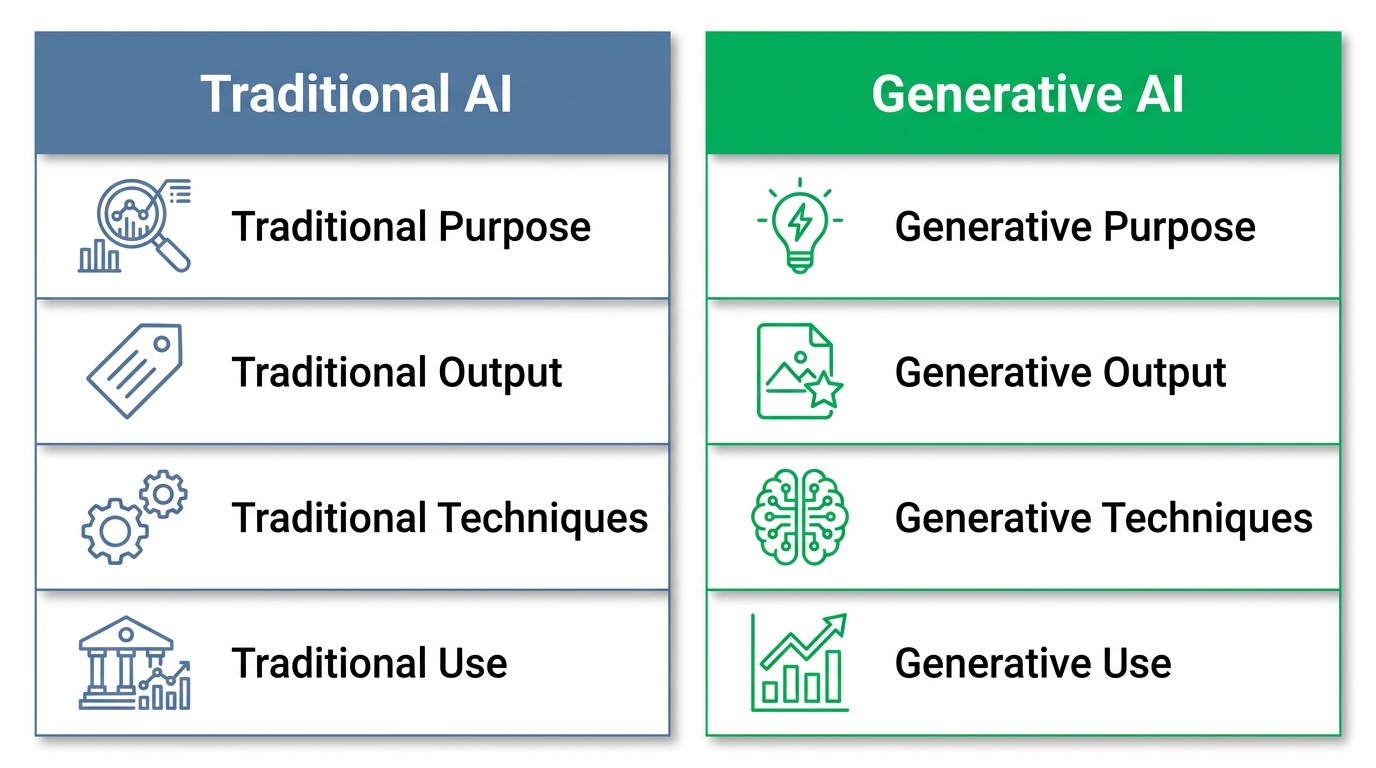
Comparison of Traditional AI vs Generative AI core concepts.
The underlying techniques that power generative AI have advanced rapidly. Transformer models such as GPT and BERT use attention mechanisms to process sequential data, making them ideal for natural language generation. Generative Adversarial Networks (GANs) pit two neural networks against each other to produce highly realistic synthetic data, while Variational Autoencoders (VAEs) learn compressed representations that can be sampled to create new examples. These methods have expanded generative ai examples into fields like content marketing, drug discovery, and financial analysis.
In financial services, generative ai applications are gaining traction among investment professionals. According to the CFA Institute AI in finance, firms are already piloting automated generation of quarterly report narratives and performing scenario simulations for risk assessment. These tools help analysts draft pitch book narratives, synthesize market commentary, and model complex portfolio outcomes—always under human oversight to ensure accuracy and fiduciary responsibility. We emphasize that generative AI models require careful oversight and are not substitutes for human judgment; capabilities vary across implementations and the technology continues to evolve.
With these core concepts in mind, we can now explore the key generative AI models driving innovation in financial services.
How Generative AI Works: Architectures and Mechanisms
Now that we know what gen AI is and why it’s reshaping the M&A landscape, let’s explore its inner workings. As a Boutique M&A and Capital Advisory Firm, we see firsthand how these technologies turn massive document sets into actionable intelligence.
The Transformer Revolution and Self-Attention
At the heart of modern generative AI lies the Transformer architecture—a neural network design that processes entire sequences of text in parallel. Unlike older models that read documents word-by-word, Transformers use a mechanism called self-attention to weigh the importance of every word relative to every other word within a sentence or paragraph. Think of self-attention as a high-speed highlighter that marks the most relevant phrases and then weaves them into a unified understanding of context.
This capability is invaluable for M&A due diligence. Imagine a Transformer scanning a 100-page due diligence report: it can instantly identify cross-references between a “material adverse change” clause buried in a legal appendix and a revenue risk disclosure tucked inside the financial section. That level of long-range context is what makes LLMs and Transformer-based foundational models so effective at summarization, risk flagging, and document comparison. Concrete generative AI examples like this show how AI generative models streamline what used to be days of manual review.
Retrieval-Augmented Generation (RAG): Grounding AI in Facts
Retrieval-Augmented Generation, or RAG, extends the power of generative AI by connecting it to external knowledge bases. Instead of relying solely on static training data, a RAG pipeline first retrieves up-to-date documents from a secure source—such as a client’s Sovereign Data Nexus data room—and then generates an answer grounded in those fresh facts. This hybrid approach dramatically improves factuality and timeliness, answering the common question “What is RAG in generative AI?” with a practical blueprint: fetch, then generate.
For financial advisory work, real-world generative AI applications like automated due diligence reports benefit enormously from RAG. While a standalone model might hallucinate outdated figures, RAG can pull the latest financials directly from your M&A due diligence services data room, ensuring that every insight is anchored in current deal-room truth. Transaction teams thus gain the speed of AI without sacrificing the accuracy that high-stakes negotiations demand.
Fine-Tuning vs. RAG: A Deeper Comparison
When we design AI-assisted workflows, a critical choice emerges: should we fine-tune a model or deploy a RAG system? The decision pivots on whether we need deep behavioral adaptation or real-time fact retrieval. The table below lays out the core trade-offs.
| Aspect | Fine-Tuning | RAG |
|---|---|---|
| Knowledge Freshness | Fixed at training time | Can use latest external data |
| Computational Cost | High (requires retraining) | Moderate (embedding + retrieval) |
| Customization | Deep behavior change | No model change; retrieval-driven |
| Use in M&A | Tailoring model to deal documentation style | Real-time due diligence fact retrieval |
| Example Token Cost | High upfront, lower per-query | Lower upfront, variable per-query |
Fine-tuning excels at molding a model’s writing style and tone—ideal for preserving the specific voice of a firm’s past M&A memoranda. RAG, by contrast, keeps the model’s behavior unchanged but arms it with the freshest possible data, making it the go-to choice for tasks that turn on shifting financials or regulatory filings.
Choosing Between Fine-Tuning and RAG
For a capital advisory firm, the right approach depends on the task. When we require a model to emulate our deal documentation style precisely, fine-tuning delivers deep, permanent behavior changes. However, for real-time due diligence—where pulling the latest competitor financials or risk disclosures is paramount—RAG proves indispensable. Our own M&A due diligence services often combine both: a fine-tuned base model that understands our tone, layered with RAG retrieval to ground every answer in live data. Understanding these mechanisms equips us to deploy generative AI effectively across the full M&A lifecycle—our next topic.
Practical Applications and Tools for Financial Advisors
Having defined generative AI, we now turn to its practical applications. Understanding what is gen AI helps advisors unlock its potential as a force multiplier across advisory workflows. Generative AI tools—systems that create text, code, images, or audio from user prompts—are already reshaping how financial advisors execute M&A tasks.
Generative AI Tools by Modality
The table below provides generative AI examples, mapping each modality to concrete finance use cases. Text generators such as ChatGPT, Claude, and Gemini produce natural language content, while code assistants like GitHub Copilot and Codeium accelerate scripting. Image generators including DALL·E 3, Midjourney, and Runway create visuals, and audio platforms like ElevenLabs and Suno generate speech and music.
| Tool Category | Example Tools | Primary Capability | Finance Use Case |
|---|---|---|---|
| Text Generation | ChatGPT, Claude, Gemini | Natural language creation and conversation | Automated investor letters, deal memos, Q&A documents |
| Code Generation | GitHub Copilot, Codeium | Generate and debug code from prompts | Automated financial model scripts, dataroom extraction pipelines |
| Image/Video Generation | DALL·E 3, Midjourney, Runway | Create images and video from text | Pitch deck visuals, marketing collateral, scenario animations |
| Audio/Music Generation | ElevenLabs, Suno | Speech synthesis, music composition | Voiceovers for presentation videos, investor call summaries |
These tools do more than automate routine outputs—they augment decision-making. Text generation can draft personalized investor letters from board meeting transcripts in minutes, while code generation scripts can scrape and structure deal data from a virtual data room into a financial model without manual entry. The result is faster cycle times and higher-quality deliverables. They also reduce repetitive manual tasks and enable advisors to focus on higher-value client strategy, governance, bespoke valuation, and scenario analysis.
M&A Workflows Enhanced by Generative AI
Generative AI tools are systems that produce new content—text, code, images, or audio—based on user prompts. Their generative AI applications in M&A span every phase: text models generate due diligence summaries, code tools build valuation scripts and automate data extraction, image generators produce pitch deck graphics, and audio models create voiceovers for investor presentations. Understanding what is an investment bank provides context: according to Zaidwood Capital’s own guidance on what is an investment bank, investment banks traditionally orchestrate deal sourcing, due diligence, and negotiation—roles that generative AI accelerates rather than replaces. By embedding these tools, advisors can run sensitivity analyses, draft Q&A documents, and prepare presentations with greater speed and consistency.
Integration into the Advisory Lifecycle
At Zaidwood Capital, we embed these tools across our Full-Cycle M&A process. Our Sovereign Data Nexus serves as the secure foundation, while generative AI enhances the accuracy of pro forma models and the impact of strategic documentation. This approach reflects our commitment as a Boutique M&A and Capital Advisory Firm to deliver premium, technology-enabled service—what we call Financial Services 3.0. Our integration of these tools into the advisory lifecycle exemplifies how we leverage technology to serve our clients.
Agentic AI and the Future of Generative AI Systems
With a solid understanding of generative AI, we can now examine its evolution into agentic AI. To appreciate this shift, we first answer what is gen ai — a class of models that produce text, images, or code in direct response to user prompts. Common generative ai examples include drafting pitch decks, summarizing diligence documents, and building pro forma financial models. These generative ai applications already streamline parts of the deal lifecycle, yet they remain reactive tools awaiting human instruction.
Agentic AI moves beyond prompt-response workflows. It describes systems that can set subgoals, use external tools, and act autonomously to achieve a defined objective without step-by-step human guidance. This leap from content generation to autonomous goal pursuit fundamentally changes how we think about AI-powered deal execution.
The following table contrasts the capabilities and limitations of generative AI and agentic AI across five key dimensions.
| Aspect | Generative AI | Agentic AI |
|---|---|---|
| Core Function | Generate content from prompts | Act autonomously to achieve goals |
| Decision Making | Suggests, creates options | Takes actions, iterates plans |
| Interaction Style | Reactive (user prompts) | Proactive (pursues subgoals) |
| Finance Use Case | Drafting documents, analysis | Automated negotiation bots, autonomous due diligence agents |
| Complexity Level | Medium | High (multi-step reasoning, tool use) |
Examining these rows reveals a clear trajectory. The core function shifts from passive generation to active goal pursuit, while the decision-making column moves from suggestion to action. In the finance use case, we already see agentic AI powering automated negotiation bots that run price-discovery algorithms and autonomous due diligence agents that screen documents while performing logical reasoning — a substantial leap from the document-drafting role of generative models. The interaction style becomes proactive, and complexity rises sharply because multi-step reasoning and tool use demand coordination that generative AI does not require.
These autonomous capabilities do not promise guaranteed deal outcomes or replace seasoned human judgment. Instead, they enhance our ability to process information, identify patterns, and execute routine workflows at the Velocity Matrix pace that modern M&A demands. As autonomous agentic systems become more capable, we note that regulatory bodies such as the FCC communications regulation are beginning to examine their impact on communications and transaction frameworks.
For Zaidwood Capital, agentic AI represents the next frontier for Financial Services 3.0 — a paradigm where proprietary infrastructure like our Sovereign Data Nexus could one day interoperate with autonomous agents that handle preliminary screening, document triage, and investor matching. While we remain firmly grounded in human-led advisory, we are watching this evolution closely, because implications for deal execution are already starting to take shape — a topic we explore next.
Frequently Asked Questions About Generative AI
We now address common questions about what gen AI is and its practical role in M&A.
Q: What is generative AI? When asked ‘what is gen AI,’ we describe it as AI that generates new content—text, data, or images—rather than only analyzing existing information. It powers tasks like report drafting and scenario generation.
Q: What are examples of generative AI? Generative AI examples in M&A include automated financial report drafts, synthetic data for scenario modeling, and personalized pitch decks for targeted investor outreach.
Q: How is generative AI used in M&A and capital advisory? Generative AI applications include summarizing due diligence documents, synthesizing market drivers like regulatory changes and demographic trends from our analysis, and tailoring investor communications. We ensure data security via Sovereign Data Nexus and rely on human oversight to mitigate risks.
Understanding gen AI’s role helps firms streamline transactions with our Precision Catalyst approach.
Embracing Generative AI in Capital Markets
What is gen ai? Generative AI refers to algorithms that create new content—financial models, investor narratives—based on learned patterns, transforming M&A and capital markets. Generative ai examples include AI-generated due diligence summaries that reduce review time by 60% and automated pitch book drafting tailored to investor preferences. Broader generative ai applications range from real-time scenario analysis for deal structuring to personalized investor outreach campaigns. We at Zaidwood Capital, a Boutique M&A and Capital Advisory Firm with proprietary data infrastructure, are uniquely positioned to harness these advancements for our clients.