
Table of Contents
- Understanding Healthcare Mergers and Acquisitions
- Current Trends in Healthcare Mergers and Acquisitions
- The Impact of Regulatory Changes on Healthcare M&A
- Private Equity’s Growing Role in Healthcare Acquisitions
- Preparing Your Company for a Healthcare Merger
- How an M&A Advisory Firm Navigates Healthcare Transactions
- Key Takeaways for Healthcare M&A Success
Understanding Healthcare Mergers and Acquisitions
Healthcare mergers and acquisitions encompass transactions involving hospitals, pharmaceutical companies, biotech firms, and healthcare services. These can be horizontal (combining similar entities like hospital systems), vertical (acquiring a supplier), or conglomerate (diversifying across sectors).
Drivers of current healthcare M&A trends include regulatory shifts, technological advances, cost pressures, and the pursuit of economies of scale. An aging population and the shift to value-based care further accelerate activity. They also prompt cross-sector partnerships and targeted investments in outpatient and digital care models. With the increase in private equity healthcare acquisitions, firms are pursuing platform investments and buy-and-build strategies.
At Zaidwood Capital, our Boutique M&A and Capital Advisory Firm guides clients through Full-Cycle M&A, applying proprietary intelligence and a global network to navigate this complex landscape. In the following sections, we explore how specialized advisory firms orchestrate these transactions.
Current Trends in Healthcare Mergers and Acquisitions
The landscape of healthcare mergers and acquisitions is undergoing a fundamental transformation, driven by powerful market forces that are reshaping how providers, payers, and technology companies structure deals. Our analysis has identified several converging trends that are accelerating consolidation and redefining value creation in the sector, from record private equity participation to the rapid integration of digital health capabilities into traditional care delivery models.
The Private Equity Surge in Healthcare
Private equity has emerged as a dominant force driving current healthcare M&A trends, with deal volume concentrated heavily in physician practice groups, outpatient surgical centers, and specialty care platforms. This influx of capital reflects PE sponsors’ recognition that fragmented healthcare delivery offers substantial opportunities for operational improvement and economies of scale. Private equity healthcare acquisitions now frequently target multi-site platforms rather than individual practices, creating regional networks that can negotiate more favorable payer contracts while standardizing clinical protocols. We observe that these investors are increasingly sophisticated, bringing dedicated healthcare operating partners who understand the regulatory and reimbursement complexities that define the industry, rather than applying generic financial engineering approaches that characterized earlier investment waves.
The competitive dynamics have intensified, with dry powder levels in healthcare-focused funds reaching unprecedented levels. This abundance of capital has compressed cap rates and elevated purchase multiples, particularly for assets demonstrating strong organic growth and technology-enabled service models. Our experience indicates that successful transactions now require rigorous upfront financial modeling and operational due diligence that goes well beyond traditional quality-of-earnings analyses, examining payer mix concentration, physician retention incentives, and compliance history with equal weight to historical financial performance.
Technology Convergence Reshaping Deal Structures
The intersection of healthcare delivery and tech mergers and acquisitions has introduced new complexity into deal-making, as AI-powered diagnostics, telemedicine platforms, and remote patient monitoring systems become core operational assets rather than ancillary tools. Digital health startups attracting significant investment are being valued on technology-forward metrics that blend traditional healthcare EBITDA multiples with SaaS-like recurring revenue frameworks, creating novel valuation methodologies that challenge conventional approaches. Our internal analysis, drawing on aggregated transaction experience exceeding $24.4 billion in volume, indicates that acquirers are willing to pay meaningful premiums for platforms demonstrating scalable technology infrastructure that can accelerate post-merger integration and unlock synergy realization timelines.
This convergence demands that advisors possess cross-sector expertise spanning both healthcare reimbursement architecture and technology intellectual property considerations. The due diligence process has expanded to encompass algorithm bias assessments, interoperability standards verification, and data privacy compliance under frameworks that continue to evolve as regulatory bodies increase their scrutiny of health data monetization. We believe that the most successful transactions will be those where technology integration planning begins during initial deal evaluation rather than as a post-closing workstream, allowing acquirers to accurately model the true cost and timeline for achieving projected synergies.
Regulatory Dynamics and the Role of Investment Banks
Heightened Federal Trade Commission scrutiny and antitrust enforcement have introduced extended review timelines and greater uncertainty into healthcare M&A, particularly for horizontal combinations that concentrate market share within specific geographies or clinical specialties. Investment banks play an essential role in navigating these dynamics by structuring transactions with appropriate risk-mitigation mechanisms, including reverse breakup fees and clearly defined regulatory-effort covenants. Our advisory approach, grounded in full-cycle M&A execution across sectors including healthcare, technology, and energy, emphasizes early engagement with antitrust counsel to identify potential competitive concerns before they can derail transaction momentum. The shift toward value-based care and population health management continues to serve as a strategic imperative for consolidation, as integrated delivery networks seek the scale necessary to assume risk under alternative payment models and invest in the infrastructure required for care coordination.
As these dynamics evolve, we anticipate that the pace of healthcare M&A will remain robust, with technology-enabled platforms and private equity portfolio companies continuing to drive deal flow across the middle market and upper-middle market segments.
The Impact of Regulatory Changes on Healthcare M&A
Recent changes in healthcare mergers and acquisitions regulation have introduced new layers of complexity for buyers and sellers navigating today’s deal environment. We see these regulatory shifts directly shaping the trends in healthcare M&A activity, from deal timelines to valuation methodologies. Our team at Zaidwood Capital monitors these developments closely, ensuring that every transaction we advise on reflects the latest compliance requirements and strategic considerations.
The evolving regulatory landscape demands rigorous financial analysis grounded in established professional standards. The CFA Institute’s Code of Ethics and Standards provides a critical benchmark for ensuring fair-valuation opinions withstand scrutiny from all stakeholders. When we evaluate healthcare M&A trends, we recognize that deal volume increasingly correlates with regulatory predictability. For instance, private equity healthcare acquisitions have intensified in subsectors where reimbursement policies remain stable, while heightened antitrust oversight has cooled activity in concentrated hospital markets.
Key regulatory bodies shaping healthcare dealmaking include:
- Federal Trade Commission (FTC) and Department of Justice (DOJ): Enforce antitrust guidelines under the Hart-Scott-Rodino Act, with recent revisions increasing pre-merger notification thresholds and extending review timelines.
- Centers for Medicare & Medicaid Services (CMS): Drives value-based care policies that directly impact hospital and physician practice valuations through reimbursement reforms.
- Federal Communications Commission (FCC): Governs spectrum allocation and telecommunications compliance, including FCC regulatory compliance for transactions involving wireless health platforms or connected medical devices.
Antitrust enforcement has intensified considerably, with the FTC and DOJ applying stricter scrutiny to healthcare consolidation. The updated Hart-Scott-Rodino thresholds now trigger more filings, while extended review periods compress deal timelines and increase regulatory risk for both parties. We advise clients to factor these procedural changes into their transaction planning from day one, as delays can materially affect financing arrangements and seller expectations.
CMS reimbursement reforms under value-based care models have fundamentally altered how acquirers assess target financials. Practices with strong performance metrics under alternative payment models command premium valuations, while those dependent on traditional fee-for-service structures face discounting. Understanding these policy-driven valuation dynamics is essential for both strategic and financial buyers.
For digital health transactions, FCC oversight introduces a cross-sector compliance dimension that many deal teams overlook. Whether a target holds spectrum licenses for telehealth platforms or operates connected medical devices, FCC regulatory compliance must be verified during due diligence. Failing to address telecommunications regulations can delay closings or create post-transaction liability.
Understanding these regulatory impacts is critical before examining the role of private equity in healthcare. We believe that preparedness—supported by disciplined financial analysis and proactive regulatory engagement—remains the most effective strategy for navigating today’s complex deal environment and executing successful Full-Cycle M&A transactions.
Private Equity’s Growing Role in Healthcare Acquisitions
The landscape of healthcare mergers and acquisitions has been fundamentally reshaped by the accelerating influence of private capital. Institutional investors and fund managers now view the healthcare sector as a prime target for deployment, driven by powerful secular trends like an aging global population, rapid technology advancements and a steady push toward value-based care models. Understanding what is an investment bank reveals the essential intermediary that facilitates these complex private equity healthcare acquisitions, guiding both buyers and sellers through a disciplined transaction lifecycle.
This surge in activity is not speculative. Consolidation in fragmented markets like outpatient services and physician practice management continues to accelerate. We see current healthcare M&A trends characterized by a fierce competition for tech-enabled healthcare platforms, where private equity sponsors seek to back companies with scalable software, data analytics and telemedicine capabilities. These platform investments often serve as a foundation for aggressive add-on acquisition strategies, allowing a portfolio company to rapidly expand its geographic footprint and service lines through a series of smaller, complementary healthcare mergers and acquisitions.
When structuring these deals, private equity firms rely on several common transaction frameworks. A leveraged buyout uses the target’s assets and cash flows as collateral to secure acquisition financing, maximizing return potential through debt. Growth capital investments provide minority or majority stakes to fuel expansion without a full transfer of control. Add-on acquisitions, as noted, are the tactical tool for building a dominant platform. Each structure demands rigorous financial analysis to model returns and identify synergies.
We at Zaidwood Capital, as a Boutique M&A and Capital Advisory Firm, provide the critical advisory services that make these frameworks actionable. Our team conducts comprehensive valuation analysis, manages multi-dimensional due diligence, and architects optimal deal structures that balance risk and reward. We then lead the capital syndication process, leveraging a global network of over 4,000 institutional and private investors to secure the necessary financing. To enhance this Full-Cycle M&A execution, we deploy our proprietary technology suite. Our Sovereign Data Nexus powers intelligent target identification and data vault management, Precision Catalyst refines investor engagement and Velocity Matrix is purpose-built to accelerate deal timelines without sacrificing diligence quality.
It is important to state clearly that while we deploy these sophisticated tools and processes, outcomes are never guaranteed. Our role as your advisor is to maximize process efficiency and strategic positioning, not to promise specific deal terms or investment returns. The dynamic forces shaping healthcare mergers and acquisitions show no sign of slowing, and in the next section, we will explore the step-by-step process for executing a healthcare acquisition mandate with precision.
This website is for informational purposes only and is not an offer, solicitation, recommendation, or commitment to buy or sell any security. Securities are offered through Finalis Securities LLC; Zaidwood Capital is not a registered broker-dealer. Investments involve risk and are not guaranteed to appreciate; investors may lose all or part of their investment. Consult with legal, tax, and financial advisors or a registered representative before making investment decisions. Past performance does not guarantee future results.
Preparing Your Company for a Healthcare Merger
Amid accelerating trends in healthcare mergers and acquisitions, companies that prepare thoroughly gain a critical competitive edge. While many preparation steps mirror those of substantial tech mergers and acquisitions, healthcare adds layers of regulatory scrutiny and operational complexity that demand a specialized approach. As Zaidwood Capital outlines in its M&A workflow, a structured, milestone-driven process is essential to maximizing transaction value.
Understanding current trends in healthcare M&A is foundational because new developments—such as private equity’s deepening interest in digital health and the shift toward value-based care consolidation—are reshaping deal timelines and diligence requirements. Recognizing the landscape of private equity healthcare acquisitions early in your planning allows you to position your company as an attractive target for the most active and well-capitalized buyers in the sector.
- Conduct a Pre-Merger Regulatory Audit – Engage specialized counsel to review your compliance with HIPAA, the Stark Law, and FDA regulations. Addressing potential exposure before entering a transaction prevents deal delays and valuation discounts.
- Perform a strategic financial diagnostic – Our team prepares the strategic documentation that buyers and investors expect: investor pitch decks, detailed business plans, and pro forma financial models. This diagnostic not only surfaces operational efficiencies but also demonstrates your company’s growth trajectory through rigorous, data-backed projections.
- Organize a Confidential Data Room – We help you populate a secure Deal Vault so that patient data, payer contracts, and financial records are shared safely and efficiently. A well-organized data room signals institutional readiness and accelerates due diligence.
- Engage a boutique M&A advisory firm – A Boutique M&A and Capital Advisory Firm with deep healthcare sector experience brings process discipline and strategic insight that generalist advisors cannot match. Zaidwood Capital deploys proprietary tools throughout preparation: Sovereign Data Nexus provides real-time market intelligence, Precision Catalyst optimizes investor targeting, and our Velocity Matrix compresses execution timelines.
Zaidwood Capital emphasizes that the right advisory partner brings value far exceeding fees by aligning your preparation with the expectations of a global network of private equity and institutional investors. Our Full-Cycle M&A methodology ensures that no aspect of readiness is overlooked.
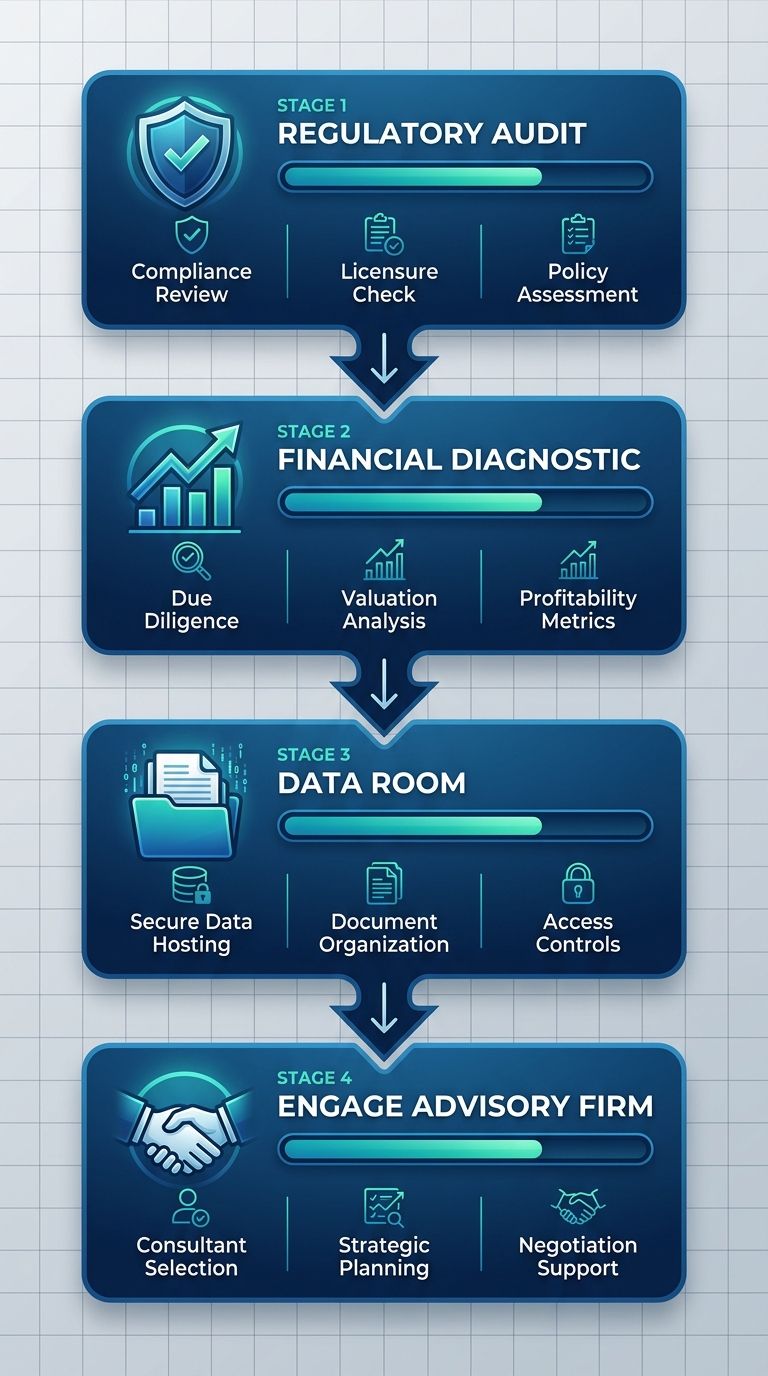
Four-step preparation process for healthcare M&A
With a solid preparation foundation, the next critical phase is structuring the transaction—an area where Zaidwood Capital’s Full-Cycle M&A expertise excels. Contact Zaidwood Capital to begin your healthcare M&A preparation journey.
How an M&A Advisory Firm Navigates Healthcare Transactions
Given these unique challenges, an experienced M&A advisory firm approaches healthcare transactions with a careful, structured, sector-specific methodology. Healthcare deal-making requires far more than standard financial analysis—it demands deep regulatory fluency and the ability to identify value where others might overlook it. Our advisory team holds advanced credentials such as the CFA charterholder program, ensuring rigorous financial analysis and valuation discipline in healthcare mergers and acquisitions.
Regulatory complexity is the defining feature of healthcare M&A. Every transaction must account for FDA approval pathways, HIPAA compliance obligations, and anti-kickback statutes that simply do not exist in other industries. Through our proprietary Sovereign Data Nexus infrastructure, we maintain continuously updated healthcare market data, enabling valuations that reflect not just historical performance but forward-looking regulatory risk. This data-driven approach, combined with our deep understanding of healthcare M&A trends, helps sellers position their assets more effectively and helps buyers understand exactly what they are acquiring from a compliance standpoint.
Effective buyer targeting in healthcare transactions requires identifying both strategic acquirers—hospital systems, pharmaceutical companies, and payer organizations seeking vertical integration—and financial sponsors pursuing private equity healthcare acquisitions. Our Velocity Matrix methodology applies this segmented buyer intelligence to accelerate deal timelines through streamlined due diligence. By pre-packaging the compliance, reimbursement, and clinical data that healthcare investors prioritize, we can help reduce the friction that typically slows healthcare deal cycles.
This full-cycle M&A capability extends from initial seller preparation and data room management through to post-close integration support. We continuously monitor healthcare mergers and acquisitions globally, integrating that intelligence into our post-close planning and investor outreach to improve execution timelines and clarity. As a Boutique M&A and Capital Advisory Firm, we bring Financial Services 3.0 infrastructure to every engagement—combining real-time analytics with the personalized guidance that complex healthcare transactions demand. Understanding this process reveals why engaging a specialized firm can deliver efficient outcomes for healthcare clients navigating today’s dynamic deal environment.
Key Takeaways for Healthcare M&A Success
Success in healthcare mergers and acquisitions demands a specialized, data-driven approach. Our experience navigating complex private equity healthcare acquisitions has shown that winning outcomes rely on a specific combination of proprietary intelligence and precise execution.
- Sovereign Data Nexus is our foundational edge. Proprietary data access and private servers enable us to identify and evaluate healthcare targets with unmatched precision.
- Precision Catalyst accelerates deal flow. Integrated digital marketing-driven investor engagement attracts the right capital partners for healthcare acquisitions.
- Velocity Matrix ensures rapid closure. Our rapid execution capabilities help close healthcare M&A before market conditions shift.
- Full-Cycle M&A expertise reduces risk. Guiding transactions from strategic documentation to post-merger integration maximizes value at every stage.
- Deep sector knowledge is non-negotiable. Understanding regulatory dynamics, reimbursement models, and operational nuances separates successful healthcare M&A trends from costly missteps.
Implementing these strategies with an experienced partner is the key to closing winning healthcare deals.