Zaidwood Capital

Tag: M&A Due Diligence

  • M&A Due Diligence Services: Complete Guide for 2026

    M&A Due Diligence Services: Complete Guide for 2026

    Table of Contents

    Essential Guide to M&A Due Diligence Services

    Building on the role of investment banks in M&A, a critical component of any transaction is the comprehensive evaluation delivered by M&A due diligence services. Due diligence is the detailed examination of a target company’s financials, operations, legal standing, and strategic fit to identify potential risks and validate the transaction thesis.

    The process encompasses four main pillars: financial due diligence, which scrutinizes historical and projected financial performance; legal due diligence, which reviews contracts, intellectual property, and regulatory compliance; operational due diligence, which assesses internal processes and scalability; and strategic/commercial due diligence, which evaluates market positioning and synergy potential. While thorough, due diligence is a risk mitigation tool, not a guarantee of success.

    Zaidwood Capital, a Boutique M&A and Capital Advisory Firm, streamlines transactions—particularly the due diligence phase—by offering the Sovereign Data Nexus secure data room that enables controlled document exchange. As investment banks, we coordinate due diligence across financial, legal, and operational workstreams, acting as gatekeepers and advisors. Understanding what is an investment bank helps clarify how we structure and oversee each step of this rigorous process.

    By converting raw data into actionable insights, thorough due diligence empowers decision-makers to negotiate from a position of clarity. The following sections break down each type of due diligence and how boutique firms streamline them.

    Core Components of M&A Due Diligence

    The cornerstone of a successful transaction is a thorough due diligence process. When clients engage us for M&A due diligence services, we structure the review around five interconnected areas: Financial, Legal, Operational, Commercial, and Strategic. Each area addresses distinct risks and opportunities that collectively shape the investment thesis.

    Comparison Table: Key Diligence Areas at a Glance
    Diligence AreaFocusKey Questions Answered
    FinancialHistorical and projected financial statements, working capital, debt structureAre revenue and margin trends sustainable? Are there hidden liabilities?
    LegalContracts, litigation history, IP ownership, regulatory complianceAre there pending lawsuits or IP encumbrances? Do contracts contain change-of-control clauses?
    OperationalSupply chain, IT systems, workforce, facilitiesHow resilient is the supply chain? Are key person dependencies manageable?
    CommercialCustomer concentration, market competitiveness, sales pipelineAre top customers locked in or at risk? Is the revenue base diversified?
    StrategicFit with acquirer’s long-term plan, cultural alignment, synergy potentialWill the target accelerate or dilute the acquirer’s strategic objectives?

    Financial diligence scrutinizes historical and projected income statements, balance sheets, and cash flows to validate performance trends. We assess working capital adequacy, debt structure, and off-balance-sheet exposures that could mask hidden liabilities. The goal is to confirm that reported earnings translate into sustainable cash generation and to quantify any adjustments needed to normalize the target’s financial position.

    Legal diligence examines the target’s contract portfolio, litigation history, intellectual property ownership, and regulatory compliance. We pay special attention to change-of-control provisions that could trigger termination or consent rights. All legal and financial reviews are conducted in alignment with CFA Institute professional standards for objectivity and thoroughness, ensuring no material legal risk is overlooked.

    Operational diligence probes the resilience of the supply chain, the robustness of IT systems, and the composition of the workforce. We evaluate key person dependencies and facility redundancies that could disrupt post-close operations. Understanding these operational levers allows us to quantify integration risks and identify quick wins that enhance value from day one.

    Commercial diligence assesses customer concentration, the health of the sales pipeline, market competitiveness, and revenue diversification. By analyzing contract renewals and switching costs, we determine whether top customers are locked in or at risk of churn. A diversified revenue base reduces post-transaction volatility and strengthens the platform’s long-term growth trajectory.

    Strategic diligence evaluates how well the target aligns with the acquirer’s long-term plan, cultural values, and synergy potential. We map revenue and cost synergies to concrete integration milestones, ensuring that the deal advances the acquirer’s strategic objectives rather than diluting them. A systematic review across all five areas uncovers both hidden risks and value-creation opportunities.

    Each component warrants a deeper dive; in the following pages we examine the specific methodologies and best practices for each diligence area. Our approach, refined through extensive technology M&A experience as captured in our guide to tech transaction steps, ensures that no dimension of risk escapes scrutiny.

    In-Depth Process Walkthrough of M&A Due Diligence

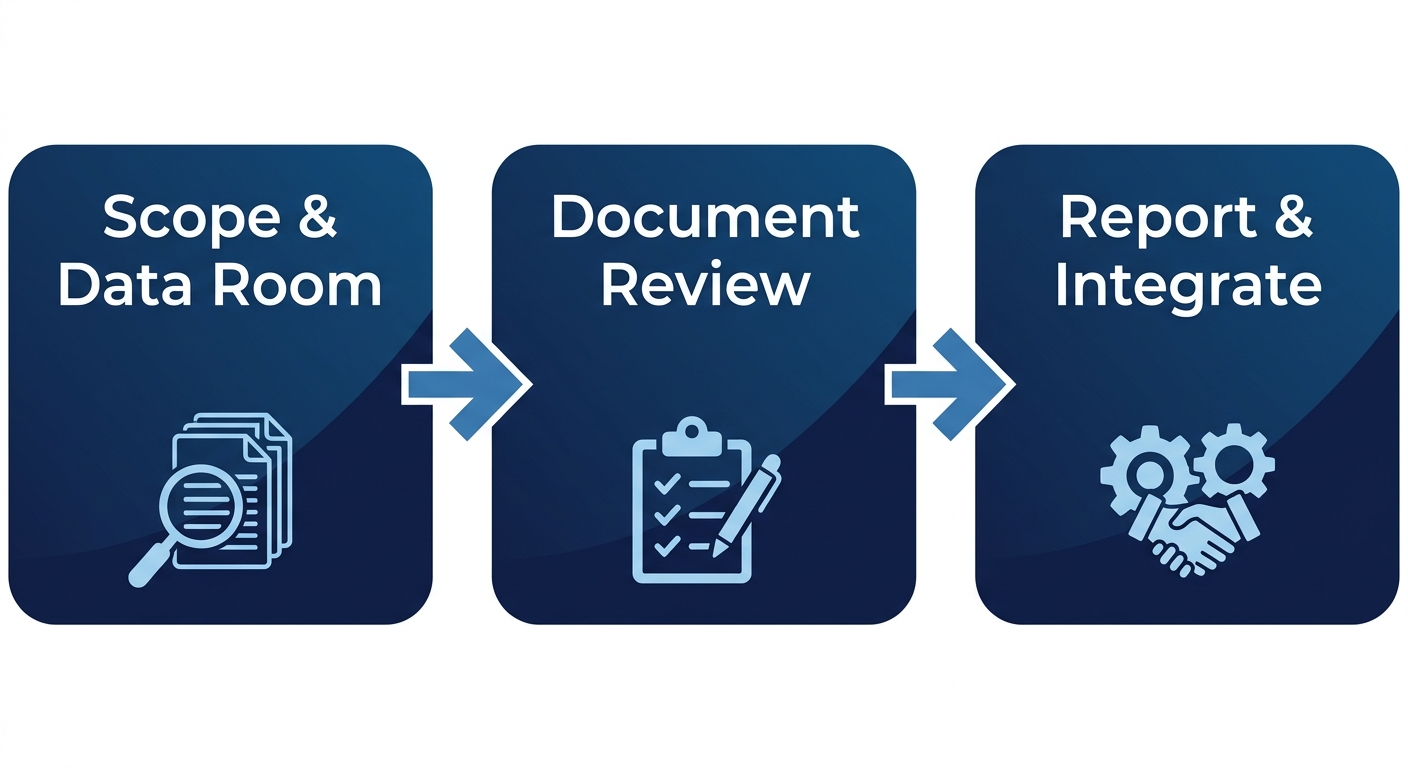
    Now we examine the three phases that make up a comprehensive due diligence process. A walkthrough of our M&A due diligence services reveals how scoping, review, and integration work together to mitigate risk.

    Phase 1: Scoping and Data Room Preparation

    Comparison Table: Financial vs. Operational Due Diligence
    DimensionFinancial DiligenceOperational Diligence
    Primary goalValidate historical accuracy and future earnings capacityAssess the sustainability of operations and efficiency of processes
    Key documentsAudited P&L, balance sheet, cash flow, tax returnsSOPs, org chart, IT architecture, supplier contracts
    Typical teamCPAs, valuation analysts, FP&A specialistsOperations consultants, supply chain experts, HR specialists
    OutputQuality of earnings report, debt capacity analysisOperational risk matrix, integration readiness score

    Phase 1 begins with scoping sessions where our deal team and the buyer’s leadership jointly identify the value drivers and critical risk areas—such as customer concentration, key-person dependency, or regulatory exposure—that will shape the diligence agenda. From those discussions, we build a detailed data request list that typically includes multiple years of audited financial statements (P&L, balance sheet, cash flow), material customer and vendor contracts, IP registrations, employment agreements, and corporate governance documents. A secure virtual data room—our deal vault—is then deployed on our Sovereign Data Nexus platform. The environment is structured with a folder hierarchy that mirrors the diligence workstreams: financial, legal, commercial, and operations. We configure tiered access controls so that legal reviewers, for example, can only access contract folders, while financial analysts see only the finance section. We also align the workstream teams on review timelines, assign responsibilities, and confirm that all requested materials have been uploaded. This disciplined preparation is the foundation that makes the subsequent document review efficient and secure.

    Phase 2: Document Review and Issue Identification

    In Phase 2, our specialists simultaneously review financial statements, legal contracts, operational KPIs, and commercial agreements to surface risks and validate the target’s representations. Financial analysts verify historical earnings, working capital trends, and revenue quality by examining audited P&L, balance sheets, and tax returns, flagging any non-recurring items or accounting policy inconsistencies. Legal counsel scrutinizes customer and vendor contracts for change-of-control triggers, assignment restrictions, and indemnity provisions, and they review employment agreements for retention risks and non-compete enforceability. On the operational side, we assess KPIs such as revenue per employee, system uptime, and supply-chain resilience, comparing them against industry benchmarks to spot inefficiencies. Throughout the phase, we use the data room’s built-in Q&A module to submit targeted questions to the seller’s management; each response is logged and cross-referenced. This iterative process often brings hidden liabilities to the surface. The data room’s Q&A module tracks each query and response, and we cross-reference answers against the original documents to verify consistency. The issue log is shared with the buyer’s deal team in real time, enabling collaborative prioritization. As we illustrate in our complete guide on tech mergers and acquisitions, deep document review frequently uncovers unreported contingent liabilities or non-compliant IP assignments that can affect valuation. In regulated sectors, we also overlay compliance checks against FTC, CMS, and FCC standards, informed by our internal research on how regulatory shifts influence transaction risk. All identified issues are entered into a shared issue log, assigned severity ratings, and prioritized for the subsequent reporting phase.

    Phase 3: Reporting, Remediation, and Deal Integration

    In Phase 3, our team synthesizes all findings into a comprehensive diligence report, beginning with an executive summary that highlights the most critical risks and opportunities. The report segments findings by financial, legal, and operational dimensions, each with a severity rating. Red flags—such as excessive customer concentration, material litigation, or compliance exposures—are escalated immediately and can influence valuation adjustments or the inclusion of special indemnities in the purchase agreement. Our reporting delivers the core M&A due diligence services as actionable intelligence that shapes the client’s negotiation posture. We typically hold a findings review session with the buyer’s leadership to walk through every issue and agree on remediation priorities. To bridge the gap between diligence and post-close execution, we use our Velocity Matrix to translate key risks into a structured 100-day integration plan. Once the diligence report is finalized, the findings directly inform the negotiation of the purchase agreement and integration planning.

    M&A due diligence process flow diagram with three connected stages: scoping and data room preparation, document review and issue identification, and reporting with remediation and deal integration

    Due diligence process: Scoping, Review, Integration

    Practical Application of Due Diligence in M&A

    With the strategic importance of due diligence established, we now turn to its practical execution. When conducting due diligence in tech mergers and acquisitions, assembling the right team and timeline is critical. Our M&A due diligence services are anchored in a disciplined process that aligns financial, legal, and operational expertise to uncover risks and validate the deal thesis early.

    Assembling Your Diligence Team and Timeline

    A well-structured diligence engagement draws on three core roles: a financial advisor who leads the process—typically a boutique M&A firm like Zaidwood Capital—a legal counsel with deep M&A experience, and a technical or industry specialist who can assess operational and market realities. We converge these disciplines around a single checklist that maps every data request, interview, and verification step against a shared timeline.

    A sample 5-week timeline typically unfolds as follows:

    • Weeks 1-2 — Scoping and Information Request: Define the diligence scope, issue the initial document request list, and align client and target management on confidentiality protocols.
    • Weeks 3-4 — Intensive Review: Conduct document analysis, site visits, management interviews, and workstream-specific deep dives (financial, legal, operational, commercial).
    • Week 5 — Report Synthesis: Draft the due diligence report, isolate deal-breakers and conditions to closing, and present findings to the deal team.

    Pro Tip: Always verify key executives’ backgrounds before finalising the diligence timeline. Late-stage discoveries of litigation or misrepresentation can derail transactions, so we include these checks early.

    This collaborative staging keeps the entire team accountable and prevents last-minute surprises.

    Leveraging Data Rooms and Proprietary Tools

    A secure data room is a foundational piece of M&A diligence. Granular permissions, watermarking, and audit trails are non-negotiable. While basic cloud storage (Google Drive) works for small deals, most mid-market transactions demand virtual data room platforms like Intralinks or Ansarada with user-specific rights and detailed logs. For the highest-stakes cross-border scenarios, we rely on Zaidwood Capital’s Deal Vault, which leverages our Sovereign Data Nexus for air-gapped protection and end-to-end encryption.

    Comparison Table: Data Room Options for Due Diligence
    Provider TypeSecurity FeaturesIdeal For
    Basic cloud storage (e.g., Google Drive, Dropbox)Standard encryption, shared linksSmall, fast-moving deals where volume is low
    Virtual Data Room platforms (e.g., Intralinks, Ansarada)Granular permissions, audit trails, watermarkingMid-market M&A with multiple bidders
    Zaidwood Capital’s Deal Vault (private server)Air-gapped environment, Sovereign Data Nexus integrationComplex cross-border transactions demanding highest security

    Each tier matches deal complexity: basic for low-complexity asset sales, VDRs for multi-bidder auctions, and Deal Vault when sovereign-grade security is required.

    Beyond the data room, Precision Catalyst tracks investor engagement—document opens, time spent, repeat visits—flagging high-interest parties to accelerate follow-ups. This data-driven approach concentrates our M&A due diligence services on the most promising leads, shortening the overall diligence cycle.

    Synthesizing Findings into Actionable Reports

    Translating weeks of analysis into a decision-ready report requires discipline. We structure every due diligence report to be concise—typically 2–4 pages of core material plus supporting appendices—and to avoid absolute language. The standard sections include:

    • Executive Summary: A one-page synthesis of the target’s strategic fit, valuation range, and go/no-go recommendation.
    • Functional Findings: Separate subsections for financial, legal, operational, and commercial due diligence, each highlighting the top three risks and opportunities.
    • Deal-Breakers and Risk Matrix: A table that categorizes issues by severity and probability, clearly flagging items that could kill the deal.
    • Conditions to Closing: Concrete actions the target must complete before signing, such as resolving outstanding litigation, obtaining key customer consents, or cleaning up IP ownership.
    • Recommendations: Final guidance on whether to proceed, renegotiate terms, or walk away.

    This structure ensures every stakeholder—whether a CEO, private equity partner, or legal advisor—can grasp the essential picture in minutes and drill into the details as needed. The resulting report arms the deal team with clear conditions to closing, which we address in the next section on negotiation and deal structuring.

    Advanced M&A Due Diligence Strategies

    Building on the foundational due diligence framework, advanced strategies dive deeper into operational and sector-specific risks, especially in cross-border contexts. Our advanced M&A due diligence services in New York go beyond the financial basics, examining technology integration, regulatory exposure, and cultural alignment. This comprehensive approach is critical for deal success.

    For cross-border transactions, the data room requirements multiply significantly. We manage virtual data rooms that comply with diverse data residency laws and incorporate translation services, ensuring that parties in different countries can review documents securely and without legal friction. This operational infrastructure is a core part of our due diligence services, streamlining what is often a logistical bottleneck in international deals.

    Assessing cultural and operational fit is another vital layer of advanced M&A due diligence practices. In cross-border deals, we evaluate not only language barriers and business norms but also time-zone management and workforce integration. A typical domestic merger can stabilize in three to nine months, but international combinations often require six to eighteen months due to the need for deeper integration planning and trust-building. This extended timeline reinforces the need for patient capital and thorough vetting.

    Sector-specific expertise tailors these cross-border due diligence strategies further. For technology companies, advanced diligence includes IP ownership verification, a rigorous software code audit, a cybersecurity posture review, and subscription revenue validation. In healthcare M&A, our due diligence services cover HIPAA compliance, FDA regulatory pathways, clinical trial data integrity, and reimbursement dependencies. These strategies set the stage for executing a rigorous due diligence plan, which we cover next.

    Frequently Asked Questions About M&A Due Diligence

    Building on the steps above, we address some frequently asked questions about M&A due diligence.

    What is M&A due diligence and why is it important?
    Our M&A due diligence services provide a comprehensive evaluation of financial, legal, operational, and strategic factors to identify risks and support informed decisions.

    What key areas are assessed during M&A due diligence?
    We review financial statements, legal contracts, operational workflows, and strategic positioning, leveraging our Sovereign Data Nexus for data-driven insights.

    How does Zaidwood Capital support clients during M&A due diligence?
    Our M&A due diligence services combine Precision Catalyst for investor engagement and Velocity Matrix for rapid execution, ensuring efficient and thorough due diligence.

    This information is for informational purposes only and is not an offer, solicitation, recommendation, or commitment to buy or sell any security.

    Close Your Deals with Confidence

    With preparation complete, execution is where confidence is built. As a Boutique M&A and Capital Advisory Firm, we rely on rigorous M&A due diligence services tailored to each deal’s unique risks and opportunities, reducing uncertainty at every stage. The Sovereign Data Nexus provides proprietary real-time data that validates assumptions, flags hidden risks, and delivers actionable intelligence. Backed by a global network and capital markets experience, the Velocity Matrix accelerates closing timelines, giving clients the transparency to close with confidence, and carrying that assurance into the post-close relationship.

    Resources

  • Best Quality of Earnings Report for Mid-Market Deals 2026

    Best Quality of Earnings Report for Mid-Market Deals 2026

    Table of Contents

    The Role of Quality of Earnings Reports in Mid-Market M&A

    Following a comprehensive due diligence review, buyers and lenders in mid-market M&A transactions focus on the Quality of Earnings (QoE) report, an independent assessment of a target company’s historical financial performance, adjusted for non-recurring items. This analysis goes far beyond audited financials by evaluating revenue sustainability, customer concentration, and the normalization of operating expenses and working capital. A well-prepared quality of earnings report provides a clearer view of recurring EBITDA, which serves as the foundation for valuation and debt sizing.

    Why QoE Matters in Mid-Market Deals

    The insights from an earnings quality analysis routinely reshape transaction terms. Buyers use the adjusted EBITDA to support purchase price adjustments, earnout structures, and net-working-capital targets. Lenders, in turn, demand a validated earnings baseline before committing acquisition debt. Moreover, the QoE often uncovers deferred-revenue patterns or concentration risks that, if ignored, can surface as costly post-close liabilities. In mid-market transactions where information gaps are common, a thorough QoE report reduces post-close surprises and gives the commissioning party a stronger negotiating position.

    Because mid-market companies frequently lack the internal resources to produce a GAAP-independent earnings analysis on their own, many engage specialized M&A advisors to manage the QoE process. At Zaidwood Capital, we integrate the QoE directly into our full-cycle due diligence offering, coordinating with independent accounting firms to deliver a report that buy-side and sell-side clients can rely on during negotiation and financing. We handle all financial data in accordance with rigorous confidentiality standards. For information on how we protect client information, please review Zaidwood Capital Privacy Policy.

    What Defines a Quality of Earnings Report

    A critical subset of due diligence, central to mid-market transaction diligence, is the Quality of Earnings Report, a financial analysis that evaluates the recurring, normalized earnings of a target company. At Zaidwood Capital, we define a QoE report as a rigorous assessment of earnings sustainability, designed to strip out non-recurring items and present a true picture of operating performance. This analysis is a cornerstone of our full-cycle due diligence process for mid-market M&A transactions.

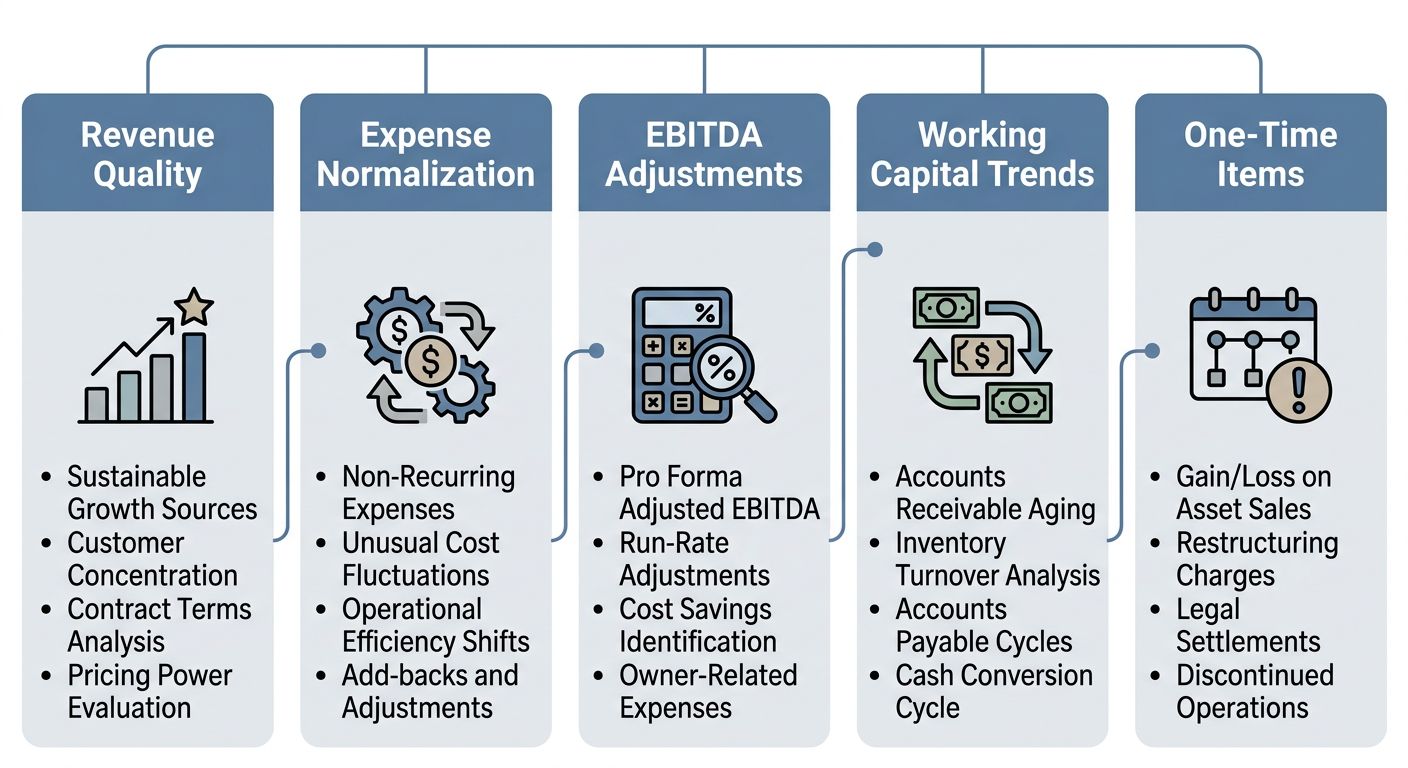
    A comprehensive earnings quality analysis examines several critical areas. Revenue quality scrutinizes the predictability and diversification of income streams. Expense normalization adjusts for one-time costs, owner’s compensation, or other out-of-ordinary expenses. EBITDA adjustments remove non-operating or non-cash items to reflect sustainable earnings. Working capital trends highlight operational liquidity needs and potential cash drags. One-time items, such as litigation settlements or asset sales, are excluded to reveal the underlying earning power. These dimensions collectively inform whether the company’s earnings are sustainable and repeatable for future periods.

    Infographic with five columns representing core areas of a quality of earnings analysis: Revenue Quality, Expense Normalization, EBITDA Adjustments, Working Capital Trends, and One-Time Items, each with icons and bullet lists on a muted blue and gray palette.

    Zaidwood Capital’s Quality of Earnings analysis framework visualized in five key areas.

    By producing a normalized earnings base, the QoE report helps both buyers and sellers reach consensus on valuation. For buy-side M&A professionals, this analysis highlights the true recurring profitability of a target, removing distortions that could inflate or deflate the purchase price. Sellers also benefit, as a well-documented QoE report can justify a premium and accelerate negotiation.

    As part of our Full-Cycle M&A and capital advisory services, we integrate QoE analysis into every engagement to provide clients with clear, defensible financial insights. The report is not an audit; it does not verify financial statement accuracy in compliance with accounting standards. Instead, it offers transaction-specific intelligence that traditional audits often miss. Zaidwood Capital utilizes QoE reports as a core component of its full-cycle due diligence, ensuring that both buy-side and sell-side mandates are grounded in reliable earnings data. By identifying true economic earnings, a QoE report streamlines negotiations and reduces the risk of post-close surprises.

    Next, we examine the core components that define a comprehensive QoE analysis.

    Securities are offered through Finalis Securities LLC, an independent entity from Zaidwood Capital. This content is for informational purposes and does not constitute investment advice.

    Core Components of a Quality of Earnings Analysis

    A quality of earnings report for mid-market deals goes beyond audited financials to uncover the true recurring cash flow a buyer can rely on. In this section, we break down the three pillars of a quality of earnings analysis: normalization adjustments, working capital scrutiny, and EBITDA sustainability. Drawing on Zaidwood Capital’s due diligence expertise, we show how each component strengthens deal-making for institutional and private investors.

    Normalization Adjustments and Add-Backs

    Normalization adjustments strip away non-operational or inflated expenses to present a clean EBITDA. These adjustments are critical because audited financials may include non-recurring gains or expenses that distort the company’s sustainable earning power. In our analyses, we identify above-market owner compensation, one-time legal fees, personal expenses run through the business, and related-party transactions at non-market terms.

    • Owner’s Compensation Adjustment: Aligning above-market owner salary and benefits to industry-standard compensation for a replacement manager
    • Non-Recurring Expenses: One-time legal fees, consulting engagements, relocation costs, or restructuring charges unlikely to repeat post-acquisition
    • Personal Expenses: Personal travel, entertainment, vehicles, or family members on payroll not related to business operations
    • Related-Party Transactions: Above-market rent, management fees, or service charges paid to entities owned by the seller or their family

    We substantiate each adjustment with corroborating evidence—payroll records, lease agreements, invoices—and provide a clear rationale in our reports. A quality of earnings analysis also flags off-balance-sheet liabilities like operating leases or contingent obligations that can alter deal value. For example, an owner drawing $600,000 when market rate is $200,000 inflates expenses by $400,000, a typical adjustment we see. By documenting every add-back, we give buyers confidence in the normalized earnings figure. Additionally, QoE reports look beyond the balance sheet to identify contingent payments or environmental indemnities that may not be booked but represent real future cash outflows.

    Working Capital Analysis and Debt-Like Items

    Working capital analysis determines the normalized net operating capital needed post-acquisition. We assess seasonal needs, payment cycles, and industry norms, then compare that to the target company’s actual levels. The gap—whether surplus or deficit—becomes an adjustment to the purchase price. For instance, if a business has excess working capital relative to its normalized requirement, the buyer may credit the seller for that amount at closing; conversely, a deficiency reduces the price. Our QoE reports present these adjustments with supporting schedules so that both buyers and sellers can negotiate from a common understanding.

    Debt-like items are obligations that function as debt but are not on the balance sheet as such. Examples include deferred revenue, underfunded pensions, or installment sale obligations. We identify these, quantify their impact, and deduct them from the equity value, just as we would formal debt. This analysis prevents the buyer from inheriting hidden financial burdens and ensures the enterprise value accurately reflects the business’s true financial position.

    EBITDA Quality and Sustainability Assessment

    EBITDA sustainability evaluation dissects the recurring nature of earnings. We examine revenue concentration risk—if a company depends on a single customer for more than 10% of revenue, that concentration creates vulnerability. Customer retention trends, contract renewal probabilities, and churn rates indicate how sticky the revenue base is. We also assess margin stability, checking whether gross and operating margins are sustainable or eroded by pricing pressure. In emerging markets M&A, we place extra focus on revenue concentration and retention because currency swings, regulatory shifts, and political instability can quickly reshape earnings. We evaluate supplier relationships to ensure margins are not artificially supported by short-term concessions, and we consider macroeconomic trends that could influence future earnings. Through our QoE reports, we help buyers distinguish durable cash flows from those that could evaporate post-acquisition, providing a forward-looking perspective essential for informed investment decisions.

    Selecting a Quality of Earnings Provider for Your Mid-Market Deal

    A quality of earnings report for mid-market deals is one of the most important tools for de-risking an acquisition, and choosing the right provider directly influences the credibility of your financial analysis. For companies in the $20M–$100M revenue range, the provider’s expertise, speed, and post-engagement support can make a material difference in how the QoE findings are received by lenders, underwriters, and counterparties.

    Evaluating Boutique Firm Expertise for QoE Analysis

    Boutique firms such as Zaidwood Capital specialize in delivering a highly tailored Quality of Earnings analysis that aligns with the specific dynamics of mid-market transactions. Their teams typically bring deep industry knowledge and direct senior partner involvement, ensuring that the engagement is led by an experienced professional who understands both the financial and strategic dimensions of the deal. In contrast, Big Four accounting firms offer a broad, generalist approach with standardized QoE templates that can miss the nuances of niche sectors. Mid-tier regional firms occupy a middle ground, providing moderate specialization but often with less senior oversight than a dedicated boutique.

    The critical differentiator is the level of partner engagement. At a boutique, the senior team leads the QoE analysis from start to finish, which shortens feedback loops and results in a more focused report. Big Four firms typically rely on junior staff for the bulk of the fieldwork, with partner review at the conclusion, while mid-tier firms show variability in senior involvement. This direct access to senior talent often translates into faster turnaround times and more actionable insights for the acquirer.

    The following comparison table summarizes key distinctions to inform your selection.

    Common Add-Backs and Adjustments in Quality of Earnings Reports
    Adjustment TypeDescriptionTypical EBITDA ImpactCommon Example
    Owner’s Compensation AdjustmentAligning above-market owner salary and benefits to industry-standard compensation for a replacement manager+$150,000 to $500,000 add-backOwner paying themselves $600,000 when market rate for a general manager is $200,000
    Non-Recurring ExpensesOne-time legal fees, consulting engagements, relocation costs, or restructuring charges unlikely to repeat post-acquisition+$50,000 to $300,000 add-back$200,000 in legal fees from a one-time litigation matter
    Personal ExpensesPersonal travel, entertainment, vehicles, or family members on payroll not related to business operations+$25,000 to $150,000 add-backCompany-leased luxury vehicle used primarily for personal use
    Related-Party TransactionsAbove-market rent, management fees, or service charges paid to entities owned by the seller or their family+$75,000 to $400,000 add-backPaying $30,000/month rent to a seller-owned LLC when market rate is $15,000

    Boutique firms consistently deliver deep specialization and hands-on partner involvement, often completing a QoE engagement in as little as 2–4 weeks—roughly half the time of a Big Four engagement. Moreover, firms like Zaidwood Capital adhere to established capital markets best practices, incorporating frameworks from ICMA capital markets to ensure the analysis meets rigorous industry standards. This commitment to both speed and quality makes boutique advisors a compelling choice for mid-market acquirers.

    Scope and Cost Expectations for Mid-Market Companies

    For a $20M–$100M-revenue company, the scope of a Quality of Earnings engagement should be calibrated to deal complexity and the acquirer’s specific concerns. A one-size-fits-all report rarely adds value; instead, the engagement scope must be defined collaboratively, focusing on revenue recognition policies, working capital trends, customer concentration risks, and any carve-out adjustments that could affect normalized EBITDA. At Zaidwood Capital, we work directly with buyers to design a custom scope that addresses the unique drivers of the target business, avoiding unnecessary line items that inflate cost without improving decision-making.

    Cost expectations reflect the level of customization. Boutique firms like Zaidwood Capital typically quote $25,000–$50,000 for a $20M-revenue company, while Big Four firms can range from $75,000 to over $150,000 for a similar-sized engagement. Mid-tier regional firms generally fall between $40,000 and $80,000. All figures are custom quotes and depend on data availability, the number of entities involved, and the speed required. We emphasize that our pricing is never a fixed fee; each engagement is priced based on the precise scope and timeline agreed upon, with full-cycle support extending from the initial QoE analysis through deal close.

    Integrating QoE Findings into Deal Structuring

    A Quality of Earnings report is not just a diligence artifact—it directly shapes the final deal terms. When normalized EBITDA adjustments reveal that reported earnings overstate true recurring cash flow, buyers can negotiate purchase price reductions or post-closing true-ups. Earnout structures become more defensible when the QoE identifies revenue volatility or concentration risks that warrant contingent payments. Similarly, representation and warranty insurance underwriters increasingly rely on QoE findings to set coverage limits and exclusions, making a thorough report a valuable risk-transfer tool.

    At Zaidwood Capital, our full-cycle advisory model ensures that QoE insights flow seamlessly into the negotiation and documentation phases. We translate EBITDA adjustments into specific purchase price adjustment mechanisms, design earnout milestones linked to verifiable financial metrics, and help acquirers present the QoE to insurers to secure favorable underwriting terms. This integrated approach reduces re-trading risk and accelerates the path to a signed purchase agreement. Once you have selected the right partner, the next step is implementing a disciplined QoE process that turns financial analysis into concrete deal terms. As with any investment, past performance does not guarantee future results, and we recommend consulting professional advisors to tailor the approach to your deal.

    How Quality of Earnings Reports Influence Purchase Price and Deal Terms

    A quality of earnings report for mid-market deals does more than flag accounting irregularities; it serves as the core negotiating lever for adjusting the purchase price and crafting protective deal provisions. At Zaidwood Capital, we treat the QoE report as the definitive source for reconciling reported financials with normalized economic reality. This alignment is essential before we engage in price discussions.

    In our experience, the most direct impact of the QoE report is a purchase price adjustment derived from normalized EBITDA. When the report strips out non-recurring revenue or one-time expenses, it recalibrates the basis on which the acquisition multiple is applied. A lower sustainable EBITDA can reduce the implied valuation, prompting the buyer to seek a price reduction. Conversely, a seller whose earnings prove clean and recurring can leverage the report to sustain or elevate the offer. Beyond EBITDA, the working capital peg—determined by historical QoE trend analysis—can shift the final cash consideration. If the report reveals that the target’s normalized net working capital is lower than originally represented, the buyer rightfully demands a dollar-for-dollar reduction at closing. Sellers with positive QoE results often use this as a shield against overly burdensome indemnification clauses, while buyers rely on the analysis to insert additional covenants or expand representations and warranties when risks are evident.

    Earnout structures are another area where QoE findings carry substantial weight. We typically link earnout payments to forward-looking financial metrics that have been validated by the quality of earnings (QoE) review. This ensures that post-closing milestones are both achievable and reflective of the business’s true earning power, reducing disputes later. Likewise, indemnification horizons and escrow amounts are calibrated to the specific risks flagged in the report. A revenue recognition issue might extend the survival period for related claims and increase the escrow holdback, while a clean report shortens those protections. Underpinning this rigor are regulatory standards that shape our financial analysis. FINRA securities regulation, administered by the Financial Industry Regulatory Authority, sets expectations for broker-dealer reporting that influence how we assess earnings quality in private transactions. Similarly, SEC securities regulation, enforced by the U.S. Securities and Exchange Commission, mandates GAAP compliance and reinforces the importance of accurate data in all valuations. In the following section, we demonstrate how these adjustments play out in a real mid-market transaction.

    Common Questions About Quality of Earnings Reports in Mid-Market Deals

    After establishing the importance of a quality of earnings report for mid-market deals, we address the most common questions buyers and sellers ask before engaging a QoE provider.

    What is a quality of earnings report, and why is it essential for mid-market deals? A QoE analysis examines earnings sustainability and quality, revealing adjustments needed in private-company financials and uncovering risks like customer concentration.

    How does a QoE differ from standard due diligence, and what adjustments does it uncover? Unlike standard due diligence, a QoE report serves as a complementary tool—used by advisors like Zaidwood Capital—to examine normalized EBITDA, margin trends, and working capital, separating recurring from one-time items and revenue mix.

    How does a QoE report impact valuation and deal structure? By surfacing these insights, a QoE can bridge valuation gaps and influence purchase price multiples, giving both sides clearer grounds for negotiation.

    Next, we’ll walk through the practical steps of commissioning a QoE report for your mid-market transaction.

    Leveraging Quality of Earnings Reports for Smarter M&A Decisions

    A Quality of Earnings report for mid-market deals dissects financials to expose sustainable earnings by stripping out one-offs. It flags risks like premature revenue booking, strengthening your negotiation position. Mid-market firms with less polished reporting especially benefit. At Zaidwood Capital, a quality of earnings report for mid-market deals anchors our full-cycle due diligence, alongside operational, commercial, and IT assessments, to deliver a complete picture. Compliance with SEC securities regulation ensures data reliability, and leveraging QoE minimizes post-close shocks. Deeper insight drives smarter M&A decisions.

    Resources

  • Supply Chain Management: Complete Guide to Visibility and Integration

    Table of Contents

    Supply Chain Management as a Strategic Asset

    Supply chain management is the coordinated network of activities that moves materials from raw sourcing all the way to final delivery — and when executed well, it directly reduces operating costs while strengthening customer satisfaction. In our work with growth-stage manufacturers, we see that organizations with mature SCM capabilities consistently respond faster to demand shifts and maintain healthier working capital positions.

    Core Concepts of Supply Chain Management

    To understand how SCM drives value, we first explore its foundational components.

    Supply Chain Visibility

    At the heart of modern supply chain management is visibility: the real-time tracking of inventory positions, shipment milestones, and production status across every node of the chain. When decision-makers can monitor material flow as it happens, they move from reactive to proactive operations. Strong supply chain visibility reduces lead-time uncertainty, flags supplier disruptions before they cascade, and gives procurement teams the intelligence to negotiate from fact rather than assumption.

    Supply Chain Integration

    Equally critical is supply chain integration, which synchronizes data across enterprise resource planning (ERP) systems, warehouse management systems (WMS), and supplier platforms. Without integration, even the best demand forecasts break down when execution data stays locked inside department silos. Connected architectures allow planning, purchasing, and logistics teams to share a single version of the truth, eliminating the reconciliation delays that slow decision-making in many mid-market manufacturing environments.

    Software Categories Supporting SCM

    Organizations approaching supply chain digitization encounter three broad software categories. Basic tracking solutions deliver real-time shipment visibility through standalone portals or APIs, while integration middleware layers data synchronization between core business systems and supplier networks. At the enterprise end, full-suite SCM platforms wrap planning, execution, and analytics into one end-to-end supply chain environment. For organizations embarking on supply chain digitization, partnering with a top manufacturing consulting firm can provide the necessary expertise. Our internal research, which catalogues leading manufacturing consultants, confirms that external advisors frequently accelerate software selection and cut implementation risk.

    The table below highlights key differences between common SCM software categories.

    Comparison of Supply Chain Management Software Categories
    FeatureBasic TrackingIntegration MiddlewareFull-Suite SCM
    Core FunctionalityReal-time shipment trackingData synchronization between ERP, WMS, and suppliersEnd-to-end planning, execution, and analytics
    Inventory VisibilityLimited to inbound/outbound statusMulti-location inventory snapshotsReal-time, multi-echelon visibility
    Implementation ComplexityLow – standalone API or portalMedium – requires IT coordinationHigh – enterprise-wide deployment

    Advancing Supply Chain Visibility and Integration

    While supply chain finance can unlock working capital, full value creation depends on advancing visibility and integration across the supply chain. In the context of full-cycle M&A and capital advisory, understanding how target companies manage these operational dimensions is essential for accurate valuation and synergy modeling.

    Understanding Supply Chain Visibility

    Supply chain visibility is the capability to track physical goods, information flows, and financial transactions across every tier of a supply network in real time. In M&A due diligence, this transparency is critical because it allows deal teams to detect disruptions, supplier concentration, and working capital inefficiencies before they become post-closing liabilities. Without adequate visibility, material risks—such as a Tier-2 supplier insolvency or logistics bottleneck—can remain concealed behind aggregated procurement reports.

    Supply Chain Integration in M&A Due Diligence

    Supply chain integration involves connecting suppliers, systems, and processes to create a unified operating model that drives working capital efficiency and post-merger synergy realization. In a transaction context, the depth of integration directly impacts valuation because optimized supplier collaboration and streamlined data flows reduce the cash-to-cash cycle—a key input in discounted cash flow analysis.

    Supply Chain Integration States in Due Diligence
    AspectPre-Integration StatePost-Integration State
    Data SharingManual spreadsheets and email updatesReal-time APIs and shared dashboards
    Supplier CollaborationReactive order managementJoint demand forecasting and VMI
    Risk VisibilityIsolated silos, delayed alertsEnd-to-end traceability and predictive alerts
    Working Capital ImpactHigher safety stock, longer cash-to-cash cyclesOptimized inventory, faster receivable turnover

    The transformation from manual data sharing to integrated systems directly affects transaction pricing. For example, when a target company operates with higher safety stock and extended cash-to-cash cycles, the acquiring entity must discount its valuation to account for trapped working capital. Conversely, a post-integration state with optimized inventory and faster receivable turnover—often achieved through supply chain finance programs—can justify a premium valuation. Acquirers must consult SEC investor resources to ensure that material supply chain risks and integration plans are properly disclosed in regulatory filings.

    How to Improve Supply Chain Management Skills

    Developing robust supply chain management skills requires a blend of formal certification, cross-functional fluency, and data literacy. For professionals conducting due diligence or integration planning, the Certified Supply Chain Professional (CSCP) designation provides a structured foundation in end-to-end supply chain operations and risk management frameworks. Proficiency in data analytics platforms such as Power BI and Tableau empowers teams to build real-time dashboards that monitor supplier health, inventory turns, and lead-time variability. For a tailored assessment of your target’s supply chain readiness, Book A Call with our advisory team.

    Building a Career in Supply Chain Management

    Understanding how supply chain financing works is valuable, but building a career in supply chain management requires deliberate steps. We at Zaidwood Capital have observed that the professionals who accelerate their career trajectories are those who combine operational expertise with financial acumen.

    How to Start a Career in Supply Chain Management

    Entering the supply chain profession begins with a strong educational foundation. A bachelor’s degree in business, supply chain management, or data analytics provides the essential knowledge base for entry-level roles. Earning credentials such as the Certified Supply Chain Professional (CSCP) from ASCM or the Certified Professional in Supply Management (CPSM) from ISM signals to employers that you possess validated expertise.

    Why Supply Chain Management Is a Good Career Path

    Supply chain management offers exceptional career prospects driven by strong demand and competitive compensation. The Bureau of Labor Statistics projects 30% growth for logisticians through 2030, far outpacing the average for all occupations. Professionals who understand supply chain financing are increasingly valued for their ability to manage working capital and strengthen supplier relationships.

    Learning Pathways for Supply Chain Professionals

    Supply chain professionals have multiple avenues to build and deepen their expertise. Formal degree programs—Bachelor of Business Administration or Master of Business Administration with supply chain concentrations—provide structured academic foundations. For those seeking flexibility, online platforms like Coursera, edX, and LinkedIn Learning offer courses in supply chain visibility tools and integration techniques.

    Supply Chain Finance and Capital Strategy

    For companies operating in supply chain management, aligning financial strategy with operational goals is essential for sustainable growth. Supply chain finance encompasses solutions like reverse factoring and dynamic discounting that improve working capital while strengthening supplier relationships.

    Working Capital Optimization

    Optimizing working capital begins with understanding the cash conversion cycle and identifying structural inefficiencies. Supply chain finance programs allow buyers to extend payment terms without penalizing suppliers, effectively freeing trapped cash for reinvestment.

    Frequently Asked Questions About Supply Chain Management

    What is supply chain integration? We see supply chain integration as the process of connecting systems and workflows across organizations. This alignment supports smoother post-merger consolidation and unlocks cost synergies essential to Full-Cycle M&A and capital advisory.

    How does supply chain visibility affect M&A due diligence? Investors must assess supplier risk, inventory transparency, and regulatory compliance. The U.S. Securities and Exchange Commission requires public companies to disclose material supply chain risks, making visibility central to thorough due diligence.

    Transforming Supply Chain Management into Strategic Value

    While many organizations still view supply chain management as a narrow cost-containment function, forward-thinking leaders treat it as a driver of durable competitive advantage. In M&A and capital transactions, supply chain visibility reveals hidden risks and operational upside that financial statements alone often miss. Similarly, intentional supply chain integration—both internally and across entities—unlocks the synergies that define successful post-merger outcomes.

    Securities are offered through Finalis Securities LLC; Zaidwood Capital is not a registered broker-dealer and is separate from Finalis. Investments involve risk; investors may lose all or part of their investment. Past performance does not guarantee future results.

    Resources

  • Software Solutions: Complete Guide for Small Businesses

    Software Solutions: Complete Guide for Small Businesses

    Table of Contents

    Essential HR Software Solutions for Business Growth

    In today’s competitive landscape, HR tech adoption has surged, with over 70% of small and mid-sized businesses implementing software solutions to manage their workforce effectively. These platforms address the growing need for streamlined operations as companies scale more broadly.

    At Zaidwood Capital, we see how boutique M&A advisory intersects with human capital management, where accurate workforce data becomes crucial during due diligence. For instance, robust hr software for small businesses enhances scalability for startups seeking capital formation or navigating mergers, improving data accuracy that supports our full-cycle due diligence processes, including human capital assessments. This alignment not only bolsters operational efficiency but also strengthens valuation in growth strategies, as highlighted in our services overview on comprehensive transaction support.

    This article explores essential HR management platforms, previewing three standout options: BambooHR for intuitive employee management, Gusto for seamless payroll and benefits, and Rippling for integrated workforce optimization tools. These hrms for small business exemplify practical tools that complement strategic financial consulting.

    By leveraging such solutions, businesses achieve cost savings through automation and ensure regulatory adherence, mitigating risks in compliance-heavy environments like M&A preparations.

    BambooHR: Streamlined HR for Small Teams

    BambooHR stands out among human capital management tools as a user-friendly software solutions platform designed for small businesses seeking efficient employee management systems. It simplifies core HR functions like onboarding and performance tracking, enabling teams to scale operations without overwhelming administrative tasks. This approach supports strategic decisions in equity advisory, where accurate human capital data proves invaluable during capital raising or M&A preparations.

    Key Features

    BambooHR offers an intuitive interface that streamlines hr software for small businesses through automated workflows. Key capabilities include:

    • Employee self-service portals for updating personal information and viewing pay stubs, reducing HR inquiries by up to 80% as noted in NYU studies on human capital tools.
    • Onboarding automation that digitizes paperwork and training schedules, accelerating new hire integration.
    • Performance management tools with goal setting and feedback modules to track progress.
    • Benefits administration for easy enrollment in health plans and handling time-off requests.
    • Compliance modules supporting EEO reporting and ACA filings to ensure regulatory adherence.
    • Integrations with payroll providers like Gusto for seamless data transfer.
    • Custom reporting dashboards for insights into workforce metrics.

    These features position BambooHR as a robust compliance automation platform, particularly useful in due diligence processes. For instance, its reporting aids M&A evaluations by providing verifiable employee data, a detail we at Zaidwood Capital often highlight in advisory engagements.

    Pricing

    BambooHR structures pricing into Essentials at $6 per user per month and Full Service at $8.25 per user per month, both requiring annual billing. According to SHRM’s 2025 trends, these tiers align with average small business costs, offering value without hidden fees.

    Pros and Cons

    Pros:

    • Ease of use with an intuitive dashboard accessible to non-HR staff.
    • Mobile app for on-the-go employee management.
    • Customizable workflows tailored to specific business needs.
    • Strong customer support with responsive assistance.

    Cons:

    • Limited international support for global teams.
    • Basic reporting lacks advanced analytics for larger scales.
    • Integration costs can add up for multiple third-party tools.

    In our experience at Zaidwood, these pros enhance operational efficiency during growth phases, while the cons suggest evaluating scalability early.

    Best For

    BambooHR excels as an hrms for small business with 1-50 employees focused on core HR needs without complex analytics. It reduces administrative burdens, freeing resources for strategic initiatives like those in our capital advisory services, where streamlined human capital data supports informed transaction decisions.

    Gusto: Comprehensive Payroll for Growing Businesses

    Gusto stands out as a leading platform for small to mid-sized businesses, offering an all-in-one solution for payroll processing, benefits administration, and compliance management. Building on the HR foundations discussed with BambooHR, Gusto excels in automating financial workflows that ensure accurate reporting and employee satisfaction. In our experience at Zaidwood Capital, precise payroll data plays a crucial role in financial due diligence during capital advisory engagements, helping clients prepare robust documentation for investors.

    Key Features

    Gusto’s features streamline operations for growing teams. Direct deposit ensures timely payments to employees and contractors, while the benefits marketplace simplifies health insurance enrollment and other perks. Compliance alerts automate tax filings and W-2 handling, adhering to labor laws for teams up to 100 members. Integrations with time tracking tools enhance accuracy, and built-in HR tools provide essential automation benefits for hrms for small business. These elements reduce manual errors, delivering strong ROI by minimizing penalties and improving efficiency in payroll management systems.

    Pricing

    Gusto offers tiered plans: Simple at $40 base monthly plus $6 per user, Plus at $80 base plus $12 per user, and Premium with custom pricing. Aligning with HR software pricing trends, where averages range from $20 to $50 per user monthly, Gusto positions hr software for small businesses as a premium yet scalable option, especially for those integrating benefits administration software.

    Pros and Cons

    Pros: Seamless payroll and tax handling saves time and ensures accuracy; excellent customer support guides users through setup; easy onboarding facilitates quick adoption for growing firms.

    Cons: Higher costs for basic needs may strain tight budgets; limited advanced HR functionalities compared to full suites; availability restricted to US operations only, lacking global reach.

    These aspects highlight Gusto’s strengths in core financial tasks while noting areas for expansion, such as deeper integrations needed for mid-sized operations leading into tools like Rippling.

    Best For

    Gusto is ideal for small businesses prioritizing payroll accuracy and compliance during capital-seeking scenarios. As robust software solutions, it supports strategic documentation in equity advisory, enabling firms to present clean financials to investors. Our advisory work at Zaidwood underscores how such platforms bolster due diligence, fostering trust in growth equity pursuits.

    Rippling: Integrated HR and IT for Mid-Sized Firms

    At Zaidwood Capital, we recognize Rippling as a powerful all-in-one platform that unifies HR, payroll, and IT management for mid-sized firms navigating growth. This software solution streamlines employee lifecycle processes, from onboarding to compliance, providing actionable insights that support our full-cycle due diligence in M&A transactions.

    Rippling’s features position it as a leader among software solutions for integrated benefits. Key capabilities include:

    • Global payroll and benefits administration, handling multi-country regulations with automated tax filings.
    • Device management and app provisioning, enabling secure IT distribution to new hires.
    • AI-driven analytics for workforce trends and performance metrics.
    • Comprehensive compliance suite ensuring adherence to international labor laws.

    These tools reduce onboarding time by 50%, as noted in human capital management studies, fostering efficient IT-HR sync.

    Pricing starts at $8 per user per month for the Core plan, scales to $11.50 for Pro, and offers custom Enterprise options tailored to complex needs.

    Pros of Rippling include seamless IT-HR integration tools that automate workflows and provide global support, enhancing scalability for expanding operations. Its automation depth delivers operational insights vital for fairness opinions in M&A. However, cons involve a steep learning curve, higher pricing compared to basic options, and added complexity that may overwhelm smaller teams transitioning from hr software for small businesses.

    Rippling excels as a unified workforce platform best for mid-sized companies with 50-500 employees seeking hrms for small business evolution into robust systems. We leverage such integrations in our advisory services to prepare clients for M&A readiness, ensuring compliance and data unification drive strategic value.

    Comparing Top HR Software Solutions

    When evaluating software solutions for human resources management, businesses often seek tools that align with their growth stages and operational demands. At Zaidwood Capital, we recognize that robust HR platforms can enhance due diligence processes in mergers and acquisitions by streamlining human capital oversight. This comparison focuses on three popular options—BambooHR, Gusto, and Rippling—to highlight key differences in features and suitability for small and mid-sized enterprises.

    Selecting the right HR tool requires considering scalability, especially for firms navigating expansion or advisory needs. For instance, hr software for small businesses must offer intuitive interfaces without overwhelming complexity. Factors like integration capabilities and cost efficiency play crucial roles in ensuring long-term value, as hrms for small business environments prioritize ease of adoption alongside compliance support.

    The following table provides a side-by-side view of these solutions across essential criteria:

    FeatureBambooHRGustoRippling
    Basic automation and integrationsFull payroll processing with tax complianceGlobal payroll and IT-integrated benefits
    $6-8.25$6-12 + base fee$8+
    US-focused EEO/ACALabor law and tax filingsInternational and IT compliance
    Small teams (1-50)Payroll-focused small/midMid-sized integrated ops (50+)

    Gusto stands out for its payroll simplicity, ideal for teams emphasizing tax compliance without global needs, while Rippling provides deeper integrations for scaling operations. BambooHR suits straightforward small-team administration. According to SHRM’s 2025 trends, rising modular pricing reflects the demand for flexible HR platform comparisons, allowing businesses to customize without excess costs.

    These tool evaluation matrices underscore how integrated HR systems support strategic human capital management, a vital aspect in our M&A advisory work. From our capital advisory lens, choosing scalable options like these can mitigate risks during transactions, ensuring seamless talent retention and compliance in post-deal environments.

    Such comparisons reveal trade-offs in functionality versus affordability, guiding informed selections that align with broader business objectives. For growing firms, prioritizing tools with strong integration—such as Rippling’s IT features—can facilitate smoother transitions in advisory scenarios, ultimately bolstering operational resilience.

    In our experience at Zaidwood Capital, these insights into HR technology directly inform capital strategies, helping clients optimize human resources as part of full-cycle due diligence for successful mergers and acquisitions.

    Selecting HR Software for Strategic Success

    In summary, effective software solutions like BambooHR, Gusto, and Rippling offer substantial benefits for businesses navigating growth. BambooHR excels in user-friendly hr software for small businesses, providing essential tools for employee management at a cost-effective rate. Gusto streamlines payroll and compliance, while Rippling delivers comprehensive features for scalable operations. These platforms enhance efficiency, ensure regulatory adherence, and optimize human capital, drawing from the comparisons outlined earlier.

    Implementing these systems starts with a thorough needs assessment to align features with organizational goals. For hrms for small business, prioritize intuitive interfaces and integration capabilities to minimize disruption. Train teams adequately and monitor performance metrics post-launch to refine usage. Best practices emphasize phased rollouts, ensuring seamless adoption without overwhelming resources.

    At Zaidwood Capital, we integrate HR strategies with broader financial planning through our zaidwood capital advisory services. Robust HR data supports due diligence in M&A capital advisory, where human capital assessments mitigate risks and inform valuations. Our network provides access to institutional investors, tying HR efficiency to capital formation success.

    We encourage consulting our advisors for tailored strategic HR platforms. As growth-oriented tools evolve, they remain vital for sustainable expansion in dynamic markets.

    Resources