Table of Contents
- Essential Guide to M&A Due Diligence Services
- Core Components of M&A Due Diligence
- In-Depth Process Walkthrough of M&A Due Diligence
- Practical Application of Due Diligence in M&A
- Advanced M&A Due Diligence Strategies
- Frequently Asked Questions About M&A Due Diligence
- Close Your Deals with Confidence
Essential Guide to M&A Due Diligence Services
Building on the role of investment banks in M&A, a critical component of any transaction is the comprehensive evaluation delivered by M&A due diligence services. Due diligence is the detailed examination of a target company’s financials, operations, legal standing, and strategic fit to identify potential risks and validate the transaction thesis.
The process encompasses four main pillars: financial due diligence, which scrutinizes historical and projected financial performance; legal due diligence, which reviews contracts, intellectual property, and regulatory compliance; operational due diligence, which assesses internal processes and scalability; and strategic/commercial due diligence, which evaluates market positioning and synergy potential. While thorough, due diligence is a risk mitigation tool, not a guarantee of success.
Zaidwood Capital, a Boutique M&A and Capital Advisory Firm, streamlines transactions—particularly the due diligence phase—by offering the Sovereign Data Nexus secure data room that enables controlled document exchange. As investment banks, we coordinate due diligence across financial, legal, and operational workstreams, acting as gatekeepers and advisors. Understanding what is an investment bank helps clarify how we structure and oversee each step of this rigorous process.
By converting raw data into actionable insights, thorough due diligence empowers decision-makers to negotiate from a position of clarity. The following sections break down each type of due diligence and how boutique firms streamline them.
Core Components of M&A Due Diligence
The cornerstone of a successful transaction is a thorough due diligence process. When clients engage us for M&A due diligence services, we structure the review around five interconnected areas: Financial, Legal, Operational, Commercial, and Strategic. Each area addresses distinct risks and opportunities that collectively shape the investment thesis.
| Diligence Area | Focus | Key Questions Answered |
|---|---|---|
| Financial | Historical and projected financial statements, working capital, debt structure | Are revenue and margin trends sustainable? Are there hidden liabilities? |
| Legal | Contracts, litigation history, IP ownership, regulatory compliance | Are there pending lawsuits or IP encumbrances? Do contracts contain change-of-control clauses? |
| Operational | Supply chain, IT systems, workforce, facilities | How resilient is the supply chain? Are key person dependencies manageable? |
| Commercial | Customer concentration, market competitiveness, sales pipeline | Are top customers locked in or at risk? Is the revenue base diversified? |
| Strategic | Fit with acquirer’s long-term plan, cultural alignment, synergy potential | Will the target accelerate or dilute the acquirer’s strategic objectives? |
Financial diligence scrutinizes historical and projected income statements, balance sheets, and cash flows to validate performance trends. We assess working capital adequacy, debt structure, and off-balance-sheet exposures that could mask hidden liabilities. The goal is to confirm that reported earnings translate into sustainable cash generation and to quantify any adjustments needed to normalize the target’s financial position.
Legal diligence examines the target’s contract portfolio, litigation history, intellectual property ownership, and regulatory compliance. We pay special attention to change-of-control provisions that could trigger termination or consent rights. All legal and financial reviews are conducted in alignment with CFA Institute professional standards for objectivity and thoroughness, ensuring no material legal risk is overlooked.
Operational diligence probes the resilience of the supply chain, the robustness of IT systems, and the composition of the workforce. We evaluate key person dependencies and facility redundancies that could disrupt post-close operations. Understanding these operational levers allows us to quantify integration risks and identify quick wins that enhance value from day one.
Commercial diligence assesses customer concentration, the health of the sales pipeline, market competitiveness, and revenue diversification. By analyzing contract renewals and switching costs, we determine whether top customers are locked in or at risk of churn. A diversified revenue base reduces post-transaction volatility and strengthens the platform’s long-term growth trajectory.
Strategic diligence evaluates how well the target aligns with the acquirer’s long-term plan, cultural values, and synergy potential. We map revenue and cost synergies to concrete integration milestones, ensuring that the deal advances the acquirer’s strategic objectives rather than diluting them. A systematic review across all five areas uncovers both hidden risks and value-creation opportunities.
Each component warrants a deeper dive; in the following pages we examine the specific methodologies and best practices for each diligence area. Our approach, refined through extensive technology M&A experience as captured in our guide to tech transaction steps, ensures that no dimension of risk escapes scrutiny.
In-Depth Process Walkthrough of M&A Due Diligence
Now we examine the three phases that make up a comprehensive due diligence process. A walkthrough of our M&A due diligence services reveals how scoping, review, and integration work together to mitigate risk.
Phase 1: Scoping and Data Room Preparation
| Dimension | Financial Diligence | Operational Diligence |
|---|---|---|
| Primary goal | Validate historical accuracy and future earnings capacity | Assess the sustainability of operations and efficiency of processes |
| Key documents | Audited P&L, balance sheet, cash flow, tax returns | SOPs, org chart, IT architecture, supplier contracts |
| Typical team | CPAs, valuation analysts, FP&A specialists | Operations consultants, supply chain experts, HR specialists |
| Output | Quality of earnings report, debt capacity analysis | Operational risk matrix, integration readiness score |
Phase 1 begins with scoping sessions where our deal team and the buyer’s leadership jointly identify the value drivers and critical risk areas—such as customer concentration, key-person dependency, or regulatory exposure—that will shape the diligence agenda. From those discussions, we build a detailed data request list that typically includes multiple years of audited financial statements (P&L, balance sheet, cash flow), material customer and vendor contracts, IP registrations, employment agreements, and corporate governance documents. A secure virtual data room—our deal vault—is then deployed on our Sovereign Data Nexus platform. The environment is structured with a folder hierarchy that mirrors the diligence workstreams: financial, legal, commercial, and operations. We configure tiered access controls so that legal reviewers, for example, can only access contract folders, while financial analysts see only the finance section. We also align the workstream teams on review timelines, assign responsibilities, and confirm that all requested materials have been uploaded. This disciplined preparation is the foundation that makes the subsequent document review efficient and secure.
Phase 2: Document Review and Issue Identification
In Phase 2, our specialists simultaneously review financial statements, legal contracts, operational KPIs, and commercial agreements to surface risks and validate the target’s representations. Financial analysts verify historical earnings, working capital trends, and revenue quality by examining audited P&L, balance sheets, and tax returns, flagging any non-recurring items or accounting policy inconsistencies. Legal counsel scrutinizes customer and vendor contracts for change-of-control triggers, assignment restrictions, and indemnity provisions, and they review employment agreements for retention risks and non-compete enforceability. On the operational side, we assess KPIs such as revenue per employee, system uptime, and supply-chain resilience, comparing them against industry benchmarks to spot inefficiencies. Throughout the phase, we use the data room’s built-in Q&A module to submit targeted questions to the seller’s management; each response is logged and cross-referenced. This iterative process often brings hidden liabilities to the surface. The data room’s Q&A module tracks each query and response, and we cross-reference answers against the original documents to verify consistency. The issue log is shared with the buyer’s deal team in real time, enabling collaborative prioritization. As we illustrate in our complete guide on tech mergers and acquisitions, deep document review frequently uncovers unreported contingent liabilities or non-compliant IP assignments that can affect valuation. In regulated sectors, we also overlay compliance checks against FTC, CMS, and FCC standards, informed by our internal research on how regulatory shifts influence transaction risk. All identified issues are entered into a shared issue log, assigned severity ratings, and prioritized for the subsequent reporting phase.
Phase 3: Reporting, Remediation, and Deal Integration
In Phase 3, our team synthesizes all findings into a comprehensive diligence report, beginning with an executive summary that highlights the most critical risks and opportunities. The report segments findings by financial, legal, and operational dimensions, each with a severity rating. Red flags—such as excessive customer concentration, material litigation, or compliance exposures—are escalated immediately and can influence valuation adjustments or the inclusion of special indemnities in the purchase agreement. Our reporting delivers the core M&A due diligence services as actionable intelligence that shapes the client’s negotiation posture. We typically hold a findings review session with the buyer’s leadership to walk through every issue and agree on remediation priorities. To bridge the gap between diligence and post-close execution, we use our Velocity Matrix to translate key risks into a structured 100-day integration plan. Once the diligence report is finalized, the findings directly inform the negotiation of the purchase agreement and integration planning.
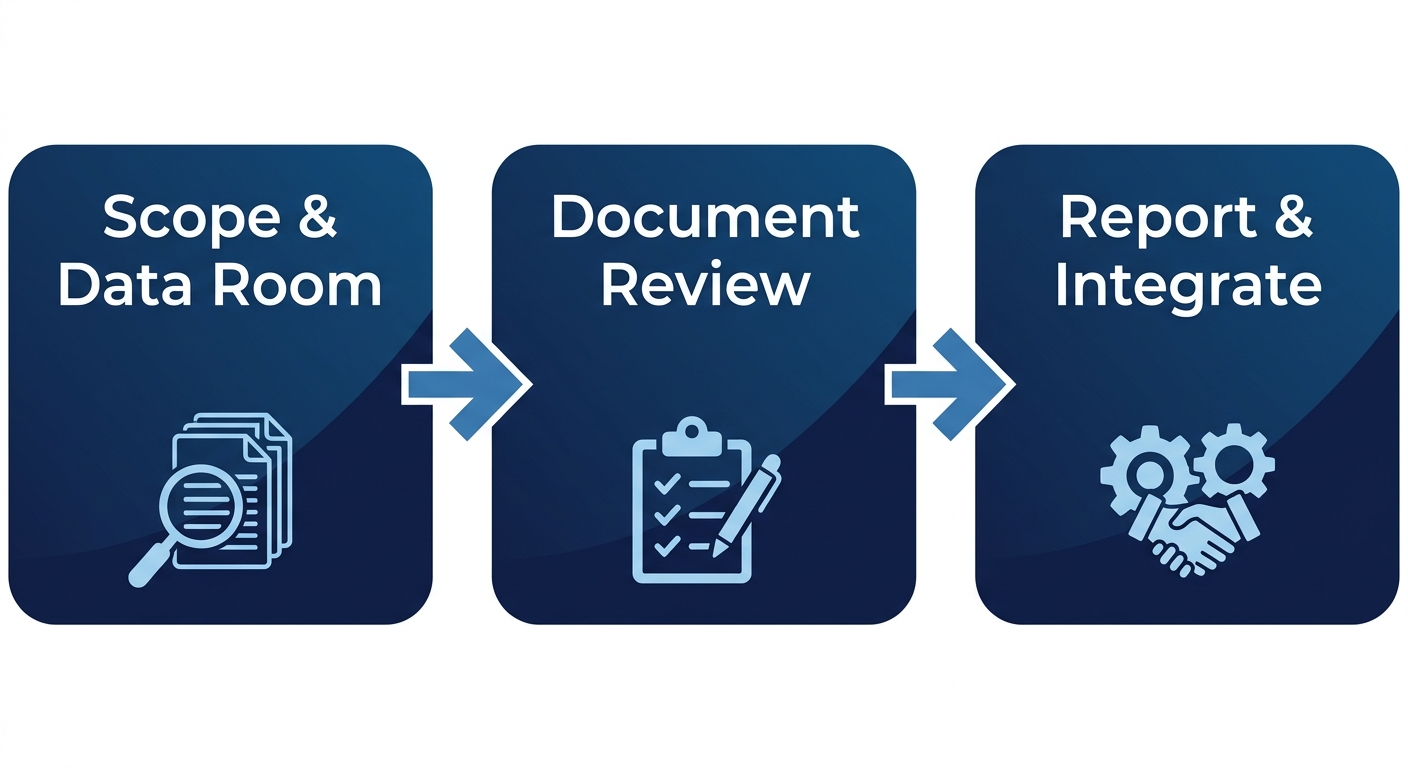
Due diligence process: Scoping, Review, Integration
Practical Application of Due Diligence in M&A
With the strategic importance of due diligence established, we now turn to its practical execution. When conducting due diligence in tech mergers and acquisitions, assembling the right team and timeline is critical. Our M&A due diligence services are anchored in a disciplined process that aligns financial, legal, and operational expertise to uncover risks and validate the deal thesis early.
Assembling Your Diligence Team and Timeline
A well-structured diligence engagement draws on three core roles: a financial advisor who leads the process—typically a boutique M&A firm like Zaidwood Capital—a legal counsel with deep M&A experience, and a technical or industry specialist who can assess operational and market realities. We converge these disciplines around a single checklist that maps every data request, interview, and verification step against a shared timeline.
A sample 5-week timeline typically unfolds as follows:
- Weeks 1-2 — Scoping and Information Request: Define the diligence scope, issue the initial document request list, and align client and target management on confidentiality protocols.
- Weeks 3-4 — Intensive Review: Conduct document analysis, site visits, management interviews, and workstream-specific deep dives (financial, legal, operational, commercial).
- Week 5 — Report Synthesis: Draft the due diligence report, isolate deal-breakers and conditions to closing, and present findings to the deal team.
Pro Tip: Always verify key executives’ backgrounds before finalising the diligence timeline. Late-stage discoveries of litigation or misrepresentation can derail transactions, so we include these checks early.
This collaborative staging keeps the entire team accountable and prevents last-minute surprises.
Leveraging Data Rooms and Proprietary Tools
A secure data room is a foundational piece of M&A diligence. Granular permissions, watermarking, and audit trails are non-negotiable. While basic cloud storage (Google Drive) works for small deals, most mid-market transactions demand virtual data room platforms like Intralinks or Ansarada with user-specific rights and detailed logs. For the highest-stakes cross-border scenarios, we rely on Zaidwood Capital’s Deal Vault, which leverages our Sovereign Data Nexus for air-gapped protection and end-to-end encryption.
| Provider Type | Security Features | Ideal For |
|---|---|---|
| Basic cloud storage (e.g., Google Drive, Dropbox) | Standard encryption, shared links | Small, fast-moving deals where volume is low |
| Virtual Data Room platforms (e.g., Intralinks, Ansarada) | Granular permissions, audit trails, watermarking | Mid-market M&A with multiple bidders |
| Zaidwood Capital’s Deal Vault (private server) | Air-gapped environment, Sovereign Data Nexus integration | Complex cross-border transactions demanding highest security |
Each tier matches deal complexity: basic for low-complexity asset sales, VDRs for multi-bidder auctions, and Deal Vault when sovereign-grade security is required.
Beyond the data room, Precision Catalyst tracks investor engagement—document opens, time spent, repeat visits—flagging high-interest parties to accelerate follow-ups. This data-driven approach concentrates our M&A due diligence services on the most promising leads, shortening the overall diligence cycle.
Synthesizing Findings into Actionable Reports
Translating weeks of analysis into a decision-ready report requires discipline. We structure every due diligence report to be concise—typically 2–4 pages of core material plus supporting appendices—and to avoid absolute language. The standard sections include:
- Executive Summary: A one-page synthesis of the target’s strategic fit, valuation range, and go/no-go recommendation.
- Functional Findings: Separate subsections for financial, legal, operational, and commercial due diligence, each highlighting the top three risks and opportunities.
- Deal-Breakers and Risk Matrix: A table that categorizes issues by severity and probability, clearly flagging items that could kill the deal.
- Conditions to Closing: Concrete actions the target must complete before signing, such as resolving outstanding litigation, obtaining key customer consents, or cleaning up IP ownership.
- Recommendations: Final guidance on whether to proceed, renegotiate terms, or walk away.
This structure ensures every stakeholder—whether a CEO, private equity partner, or legal advisor—can grasp the essential picture in minutes and drill into the details as needed. The resulting report arms the deal team with clear conditions to closing, which we address in the next section on negotiation and deal structuring.
Advanced M&A Due Diligence Strategies
Building on the foundational due diligence framework, advanced strategies dive deeper into operational and sector-specific risks, especially in cross-border contexts. Our advanced M&A due diligence services in New York go beyond the financial basics, examining technology integration, regulatory exposure, and cultural alignment. This comprehensive approach is critical for deal success.
For cross-border transactions, the data room requirements multiply significantly. We manage virtual data rooms that comply with diverse data residency laws and incorporate translation services, ensuring that parties in different countries can review documents securely and without legal friction. This operational infrastructure is a core part of our due diligence services, streamlining what is often a logistical bottleneck in international deals.
Assessing cultural and operational fit is another vital layer of advanced M&A due diligence practices. In cross-border deals, we evaluate not only language barriers and business norms but also time-zone management and workforce integration. A typical domestic merger can stabilize in three to nine months, but international combinations often require six to eighteen months due to the need for deeper integration planning and trust-building. This extended timeline reinforces the need for patient capital and thorough vetting.
Sector-specific expertise tailors these cross-border due diligence strategies further. For technology companies, advanced diligence includes IP ownership verification, a rigorous software code audit, a cybersecurity posture review, and subscription revenue validation. In healthcare M&A, our due diligence services cover HIPAA compliance, FDA regulatory pathways, clinical trial data integrity, and reimbursement dependencies. These strategies set the stage for executing a rigorous due diligence plan, which we cover next.
Frequently Asked Questions About M&A Due Diligence
Building on the steps above, we address some frequently asked questions about M&A due diligence.
What is M&A due diligence and why is it important?
Our M&A due diligence services provide a comprehensive evaluation of financial, legal, operational, and strategic factors to identify risks and support informed decisions.
What key areas are assessed during M&A due diligence?
We review financial statements, legal contracts, operational workflows, and strategic positioning, leveraging our Sovereign Data Nexus for data-driven insights.
How does Zaidwood Capital support clients during M&A due diligence?
Our M&A due diligence services combine Precision Catalyst for investor engagement and Velocity Matrix for rapid execution, ensuring efficient and thorough due diligence.
This information is for informational purposes only and is not an offer, solicitation, recommendation, or commitment to buy or sell any security.
Close Your Deals with Confidence
With preparation complete, execution is where confidence is built. As a Boutique M&A and Capital Advisory Firm, we rely on rigorous M&A due diligence services tailored to each deal’s unique risks and opportunities, reducing uncertainty at every stage. The Sovereign Data Nexus provides proprietary real-time data that validates assumptions, flags hidden risks, and delivers actionable intelligence. Backed by a global network and capital markets experience, the Velocity Matrix accelerates closing timelines, giving clients the transparency to close with confidence, and carrying that assurance into the post-close relationship.