Zaidwood Capital

Category: Strategic Consulting

  • What Is an Investment Bank? Key Services Explained

    What Is an Investment Bank? Key Services Explained

    Table of Contents

    The Role of Investment Banks in Modern Finance

    Understanding what is an investment bank is essential to grasping modern financial markets, as these institutions serve as vital intermediaries between companies seeking capital and the investors who provide it. According to the CFA Institute, the global standard-setter for the investment industry, investment banks facilitate capital formation, mergers and acquisitions, and market making, driving economic growth globally today.

    Investment banks perform three primary functions: capital raising, mergers and acquisitions advisory, and market making. In capital raising, we offer capital raising solutions that leverage our extensive investor network to secure equity and debt financing. In mergers and acquisitions, we advise on deal structuring, valuation, and negotiation, ensuring strategic alignment. Market making provides liquidity and price discovery, but boutique firms typically focus on advisory, delivering personalized, high-touch service enhanced by tools like our Sovereign Data Nexus and Velocity Matrix. These functions collectively channel capital to productive enterprises, fueling innovation and economic expansion.

    At Zaidwood Capital, we are redefining Financial Services 3.0 as a Boutique M&A and Capital Advisory Firm, combining proprietary data access via our Sovereign Data Nexus with precision execution through our Velocity Matrix to accelerate deals. Securities are offered through Finalis Securities LLC; Zaidwood Capital is not a registered broker-dealer.

    Investment Banking Services: From Advisory to Capital Markets

    When clients ask what is an investment bank, we answer with a clear definition: A financial institution that provides strategic advisory and capital-markets services to corporations, governments, and institutions. Unlike commercial banks that focus on deposit-taking and lending, investment banks operate on a fee-based model, guiding complex transactions like mergers and acquisitions and large-scale capital raising.

    Investment Bank vs. Commercial Bank
    Feature Investment Bank Commercial Bank
    Primary Focus Advisory & Capital Markets Deposits & Lending
    Revenue Model Fee-based Interest-based

    This distinction is foundational. While commercial banks serve everyday financial needs, investment banks unlock growth through corporate finance advisory, deal orchestration, and access to deep capital pools.

    Our firm’s advisory practice spans the full continuum of mergers and acquisitions—from target identification and valuation to negotiation and close—while our capital-markets capabilities help clients structure and secure equity, debt, and structured solutions. For a growing enterprise seeking capital raising, we craft strategic materials like pitch decks, business plans, and pro forma financials, then leverage our global network of over 4,000 institutional and private investors to create institutional introductions.

    Mergers and Acquisitions: How Investment Banks Drive Deal Execution

    To fully appreciate what an investment bank does in the context of mergers and acquisitions, it helps to examine the entire deal lifecycle. Investment banks serve as strategic partners that bring financial expertise, proprietary data tools, and a global investor network to the table. We follow a three-phase framework that covers deal sourcing and initial pitch, rigorous due diligence and financial modeling, and finally negotiation, structuring, and closing.

    Deal Sourcing and Initial Pitch

    We proactively identify acquisition targets or divestiture opportunities through our proprietary Sovereign Data Nexus and long-standing industry relationships. By continuously monitoring market signals and capital flows, we surface potential transactions that align with a client’s strategic objectives. Once a promising opportunity is identified, we craft a tailored pitch book that outlines a compelling investment thesis, preliminary valuation ranges, and a roadmap for value creation.

    Due Diligence and Financial Modeling

    Once a letter of intent is signed, we lead a comprehensive due diligence process that examines financial statements, operational metrics, legal risks, and market conditions. Following the best practices outlined by the CFA Institute, our team validates the target’s earnings quality, working capital dynamics, and growth assumptions. We build a suite of valuation models—discounted cash flow, precedent transaction, and leveraged buyout analyses—to triangulate intrinsic value and stress-test deal economics.

    Negotiation, Structuring, and Closing

    With due diligence findings in hand, we advise on deal structure—whether a stock or asset purchase, and how earn-outs, seller financing, or contingent consideration can bridge valuation gaps. We take the lead in negotiations, coordinating closely with legal and tax advisors to translate commercial terms into binding documents. Throughout this phase, our secure deal vaults serve as central hubs for all transaction materials, accelerating the exchange of sensitive information.

    Capital Raising Strategies: Equity and Debt Financing Pathways

    A core function of an investment bank is helping companies raise capital to fuel growth, execute strategic initiatives, or navigate complex transactions. At Zaidwood Capital, we specialize in capital raising as part of our Full-Cycle M&A and Capital Advisory services, connecting businesses with the right mix of equity and debt financing.

    Equity Financing: Private Placements and Growth Equity

    Equity financing allows businesses to raise capital by selling ownership stakes. Investment banks facilitate private placements, offering shares to accredited investors and institutional investors rather than public markets, which can be faster and more flexible. At Zaidwood Capital, we leverage a network of more than 4,000 investors to connect companies with the right capital providers.

    Debt Financing and Structured Solutions

    Debt financing allows companies to borrow capital without diluting ownership, preserving control for existing shareholders. Investment banks structure a range of instruments: senior debt is secured by company assets, carries a lower interest rate, and ranks first in repayment priority; mezzanine financing is subordinated, carries higher cost, and often includes equity warrants.

    Equity vs. Debt Financing
    Dimension Equity Debt
    Ownership Diluted Preserved
    Repayment None Regular Payments

    Preparing Your Business for a Capital Raise

    Thorough preparation significantly increases the likelihood of a successful capital raise. Start by compiling audited or reviewed financial statements that demonstrate historical performance and projections. A credible business valuation sets realistic expectations for deal terms. Develop a compelling investor pitch deck that clearly articulates the company’s value proposition, growth strategy, and use of funds.

    Boutique Investment Banking: The Zaidwood Capital Advantage

    If the searcher’s question is what is an investment bank, the clearest answer begins with the distinct categories of the industry. Investment banks facilitate the flow of capital, but they operate across a spectrum from boutique advisory firms to global full-service institutions and the largest bulge-bracket banks. At one end, boutique firms like Zaidwood Capital deliver high-touch, specialized guidance for mid-market and growth companies.

    Boutique vs. Full-Service vs. Bulge-Bracket
    Type Focus Advantage
    Boutique Advisory Senior Attention
    Bulge-Bracket Global Markets Balance Sheet
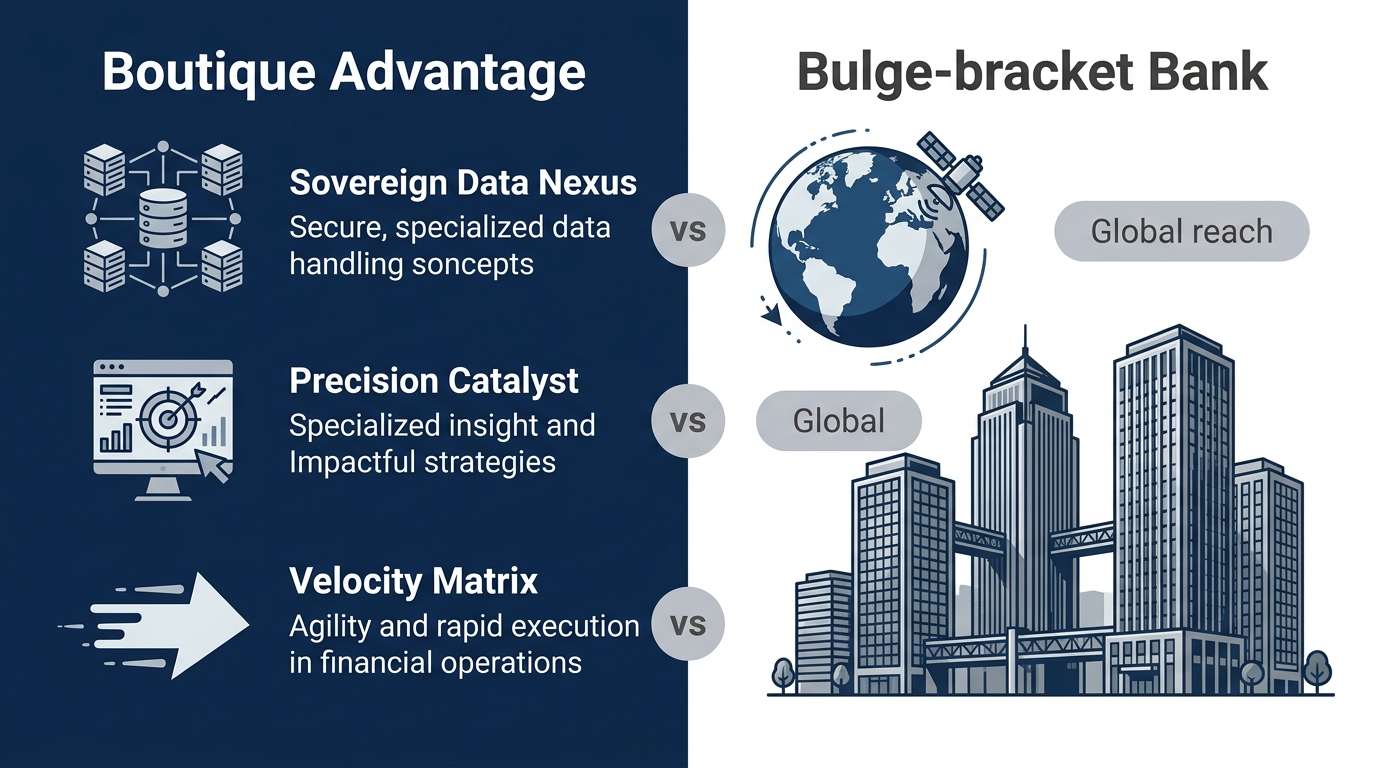
    Side-by-side infographic comparing boutique investment bank advantages with data, marketing, and speed icons versus traditional bulge-bracket bank with globe and buildings

    Comparison infographic showing boutique versus traditional banking advantages

    Common Questions About Investment Banking

    What is an investment bank?
    An investment bank is a financial intermediary that helps companies raise capital and execute mergers and acquisitions. They range from large bulge-bracket institutions to specialized boutique firms like ours, which provide senior-led, personalized advice and sector expertise.

    Unlike traditional investment banks, our boutique advisory provides end-to-end support throughout your transaction lifecycle. Our team brings expertise in mergers and acquisitions and capital raising, leveraging proprietary tools like the Sovereign Data Nexus for data-driven insights and the Velocity Matrix to accelerate execution. Zaidwood Capital is not a registered broker-dealer; securities are offered through Finalis Securities LLC.

    Resources

  • Best Asset Based Lending for 2026: Top Companies Compared

    Best Asset Based Lending for 2026: Top Companies Compared

    Table of Contents

    Asset-Based Lending as a Strategic Financing Tool

    Beyond traditional cash-flow loans, asset-based lending offers a strategic alternative for companies seeking flexible, secured financing against their balance-sheet assets. The U.S. Securities and Exchange Commission defines collateral as an asset a lender accepts as security for a loan, including real estate, equipment, inventory, and accounts receivable—precisely the assets that underpin asset-based lending structures.

    Through asset-based lending, businesses can often achieve higher leverage than unsecured debt and benefit from lower interest rates because the loan is backed by tangible collateral. This approach is especially valuable for companies with strong asset bases but uneven earnings, as the financing capacity is tied to asset values rather than cash-flow metrics alone.

    Qualifying typically requires a disciplined institutional process. As outlined in our FAQ, investors commonly look for collateral coverage ratios—often 1.5x to 2.0x advance rates—together with audited historical financials, minimum EBITDA thresholds, and thorough asset-quality audits. These benchmarks help our team identify the right institutional match from a network of over 4,000 investors, including banks, credit funds, and specialty finance firms.

    Unlike cash-flow financing, which depends heavily on EBITDA, asset-based lending unlocks liquidity directly from receivables, inventory, equipment, or real estate. Many companies use both structures concurrently, blending them to optimize cost of capital and funding flexibility. Through our global lending services, we connect clients with institutional investors specializing in asset-based lending and other secured debt structures.

    Asset-based lending can fund acquisitions, bridge equity gaps, or provide seasonal working capital—but outcomes are not guaranteed and depend on asset quality and deal structure. While many companies qualify, each transaction is subject to investor approval and due diligence.

    In the following section, we explore how ABL can be structured alongside equity financing to maximize transaction efficiency.

    This is not an offer or solicitation; consult your advisor.

    Understanding Asset-Based Lending Fundamentals

    Having defined asset-based lending, let us examine its core mechanics and how it compares with traditional financing. Asset based lending is a secured financing facility where the borrowing amount is determined by the value of specific pledged assets rather than primarily by cash flow or credit history. This type of secured lending relies on four main asset classes: accounts receivable, inventory, equipment, and real estate, each valued with distinct advance rates that reflect their liquidity and liquidation potential.

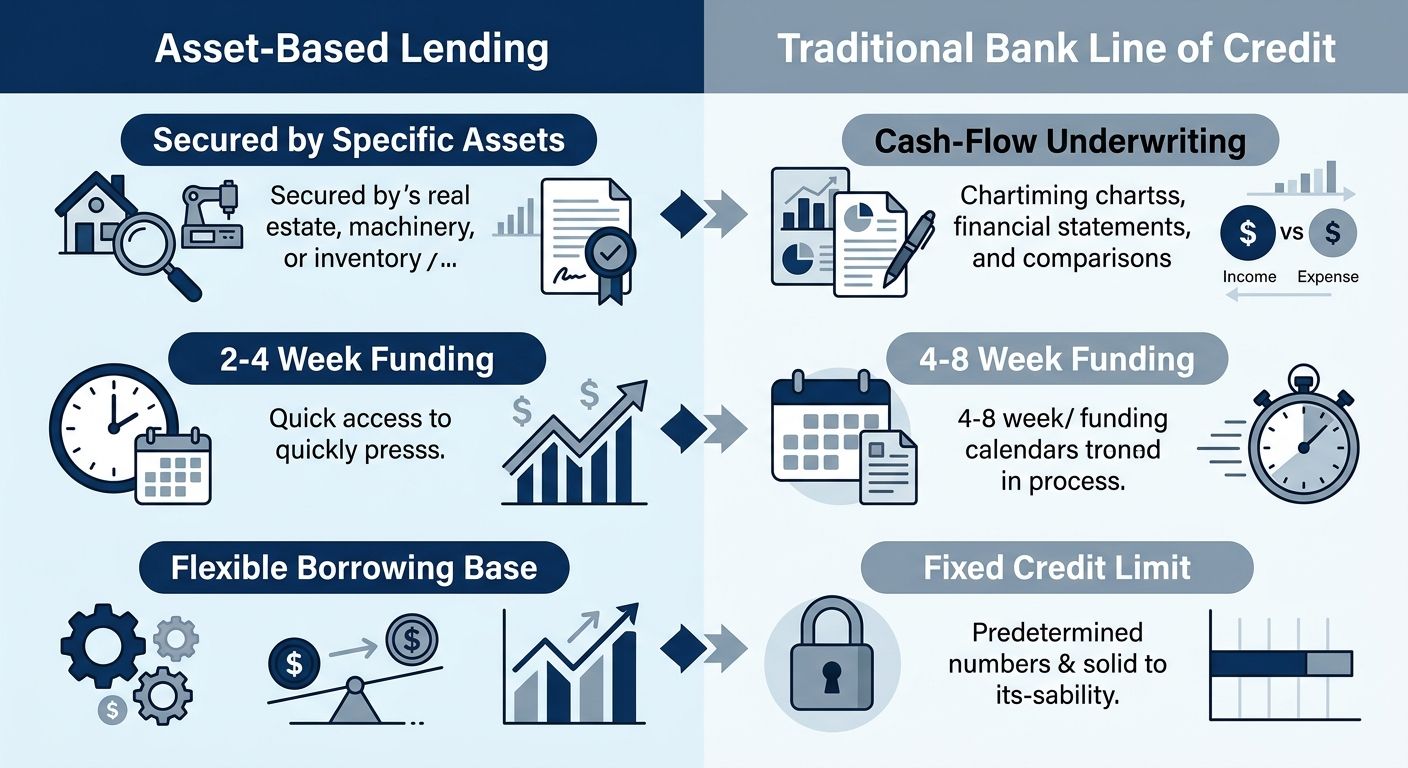
    The following table highlights the key differences between asset-based lending and a traditional bank line of credit.

    Asset-Based Lending vs. Traditional Bank Line of Credit
    DimensionAsset-Based LendingTraditional Bank Line of Credit
    Collateral RequirementSecured by specific assets (AR, inventory, equipment, real estate)Often unsecured or blanket lien; may require personal guarantees
    Underwriting FocusAsset quality and liquidation value; less emphasis on cash flowCash flow, credit history, and overall financial health
    Funding SpeedTypically 2–4 weeks; faster for revolving facilitiesCan take 4–8 weeks or longer for approval and funding
    FlexibilityHighly flexible; borrowing base adjusts with asset levelsFixed credit limit; less responsive to asset fluctuations
    CovenantsFewer financial covenants; focus on asset reportingStrict financial covenants (debt service coverage, leverage ratios)

    An ABL facility emphasizes the quality and liquidation value of collateral, with fewer financial covenants and a borrowing base that flexes alongside asset levels. For businesses with strong collateral but variable cash flow, such as manufacturers, wholesalers, or distributors, secured asset lending often provides faster access to capital and greater responsiveness to seasonal or growth-driven asset fluctuations.

    Comparison infographic of asset-based lending versus traditional bank line of credit highlighting differences in security, funding timeline, and flexibility
    Comparing asset-based lending and traditional bank line of credit

    Underwriting in asset-backed financing concentrates on the quality, liquidity, and liquidation value of the pledged collateral. Advance rates vary by asset class, with accounts receivable typically commanding higher advance rates than inventory or equipment. This approach shifts reporting toward asset monitoring rather than strict debt service coverage ratios, making ABL accessible to companies that may not meet conventional bank criteria. For a broader perspective on financing options, our coverage of global lending services alternatives provides key considerations for borrowers comparing ABL with other structures.

    Deep Dive into Asset-Based Lending Structures and Collateral Types

    To understand how asset based lending works, it is essential to examine the four primary collateral types that underpin every ABL structure. Each asset class carries distinct risk profiles, valuation methodologies, and advance rate ranges that directly influence the amount of capital a business can access and the speed at which funds become available.

    Primary Collateral Categories and Their Characteristics

    In asset based lending, collateral types determine both eligibility and borrowing capacity. The U.S. Securities and Exchange Commission defines collateral broadly as assets pledged to secure a loan, and within ABL structures, lenders focus on four principal categories based on their liquidity and ease of valuation.

    Accounts receivable represent the most liquid and preferred collateral class. Lenders evaluate AR through aging reports that identify overdue invoices, dilution analysis that measures returns and allowances against gross sales, and concentration limits that cap exposure to any single debtor. Because receivables convert to cash through normal collection cycles, they carry the highest advance rates and fastest funding timelines.

    Inventory serves as a common but more complex collateral type. Valuation requires third-party appraisal that accounts for obsolescence risk, seasonal demand patterns, and turnover velocity. Finished goods ready for sale command stronger valuations than raw materials or work-in-progress, which have limited liquidation markets.

    Equipment and real estate round out the primary categories, with valuations based on orderly liquidation value and professional appraisal, respectively. Equipment financing benchmarks indicate ABL structures typically extend 50 to 80 percent of orderly liquidation value depending on age, condition, and secondary market demand. Real estate requires the most extensive due diligence, including title searches and environmental assessments.

    Loan-to-Value Determinants and Advance Rate Mechanics

    Loan-to-value ratios in asset based lending emerge from a lender’s assessment of advance rates, eligibility criteria, and concentration limits applied to each asset class. The LTV is not a fixed percentage but a calculated figure reflecting the lender’s confidence in recovering principal through liquidation of the pledged collateral.

    Collateral Types and Advance Rates in Asset-Based Lending
    Asset TypeTypical Advance RateValuation MethodLiquidity / Speed of Funding
    Accounts Receivable70–90% of eligible ARAging reports, dilution analysis, concentration limitsFast; funds available within days of invoice submission
    Inventory40–60% of appraised valueAppraisal by third-party; considers obsolescence and turnoverModerate; requires field exam and appraisal
    Equipment50–80% of orderly liquidation valueAppraisal based on age, condition, and secondary marketModerate; appraisal and documentation needed
    Real Estate60–75% of appraised valueProfessional appraisal, title search, environmental assessmentSlower; due diligence and legal process required

    Advance rates represent the percentage of an asset’s appraised or eligible value that a lender will fund. Accounts receivable command the highest rates at 70 to 90 percent of eligible receivables because they self-liquidate through customer payments. Inventory advance rates sit lower at 40 to 60 percent, reflecting the inherent risk of physical goods degradation and market fluctuation.

    Funding Speed and the Asset-Based Lending Process

    The timeline from application to funding in asset based lending varies considerably by asset type and the intensity of due diligence required. Borrowers who prepare documentation thoroughly and understand lender expectations can materially compress the timeline.

    The ABL due diligence process typically begins with a field exam, where auditors physically inspect assets, verify accounting systems, and test the accuracy of borrowing base reports. For AR-heavy structures, this involves confirming invoice validity and analyzing customer payment patterns. Businesses exploring global lending services alternatives can compare ABL timelines against other capital sources to determine the optimal structure.

    Practical Guide to Securing Asset-Based Lending for Growth and Acquisitions

    Now that you understand the fundamental structure and purpose of asset-based lending, it’s time to explore a practical guide for securing this flexible financing tool. For companies with strong balance sheets but uneven cash flow, asset-based lending provides a tactical pathway to fund growth initiatives and execute acquisitions.

    Preparing Your Business for an Asset-Based Lending Application

    • Compile Detailed Financial Statements: Gather at least three years of audited financial statements, including balance sheets, income statements, and cash flow reports.
    • Prepare Precise Asset Schedules: Create comprehensive, up-to-date schedules for all assets that will serve as collateral, including accounts receivable aging reports and inventory listings.
    • Assemble Due Diligence Materials: Organize corporate documents, tax returns, customer and supplier contracts, and legal records.

    Using Asset-Based Lending for Acquisitions and Growth

    Asset-based lending is a powerful engine for mergers and acquisitions, offering flexible structures that traditional cash-flow loans often cannot match. We consistently see clients use ABL facilities in three principal ways during M&A: Leveraged Buyouts, Post-Acquisition Working Capital, and Bridge Financing.

    Advantages of Asset-Based Lending for Corporate Growth

    For asset-rich companies, the strategic advantages of asset-based lending are significant and multifaceted. The structure is designed to support rapid scaling and operational flexibility, which is why it is often recommended for companies navigating high-growth phases.

    Asset-Based Lending vs. Alternative Debt Structures
    Debt StructureCollateral FocusTypical Cost (Interest + Fees)Best For
    Asset-Based LendingSpecific assets (AR, inventory, equipment, real estate)LIBOR/SOFR + 3–6%Working capital, growth, acquisitions with asset-rich borrowers
    Cash-Flow LoanGeneral business assets / blanket lienPrime + 2–5%Established companies with strong cash flow and credit history
    Mezzanine DebtSubordinated; often unsecured with equity warrants12–20% (including equity upside)Growth capital, acquisitions, buyouts for mid-market companies
    Equipment FinancingSpecific equipment being purchased6–12%Capital-intensive businesses acquiring machinery or vehicles

    This website is for informational purposes only and is not an offer, solicitation, or commitment to transact. It is not investment advice. Securities are offered through Finalis Securities LLC; Zaidwood Capital is not a registered broker-dealer.

    Advanced Considerations in Asset-Based Lending for M&A and Complex Transactions

    While ABL is versatile for general purposes, its application becomes more nuanced in M&A and complex deals. In an acquisition context, asset based lending serves as a senior secured facility, often structured to support working capital, bridge financing, or leveraged buyout (LBO) debt.

    Asset-Based Lending vs. Mezzanine Debt vs. Equity for M&A
    Financing TypeCost RangeDilution / ControlBest Use in M&A
    Asset-Based LendingSOFR + 3–6%No dilution; lender has lien on assetsSenior secured facility for working capital, bridge financing, or LBO debt
    Mezzanine Debt12–20% (including warrants)Minimal dilution; warrants may give equity upsideSubordinated layer to fill gap between senior debt and equity
    Equity Financing15–30%+ expected returnSignificant dilution; investors gain ownership and control rightsGrowth equity, buyouts, or when debt capacity is limited

    Frequently Asked Questions About Asset-Based Lending

    Q: What is asset based lending? Asset based lending is a secured financing structure where a business pledges balance-sheet assets such as accounts receivable, inventory, or equipment as collateral. Unlike traditional cash-flow lending that emphasizes credit scores and profitability, ABL focuses on the liquidation value of the pledged assets.

    Q: How does collateral work in an asset-based loan? Collateral is property offered to secure a loan—the U.S. Securities and Exchange Commission defines it as something a lender can seize if the borrower defaults. In asset-based lending, lenders first appraise the pledged assets and then set a borrowing base that reflects their realizable market value.

    Q: What are typical advance rates for asset-based loans? Advance rates vary by asset quality, but receivables commonly qualify for 70–85 percent and inventory for 50–60 percent of the appraised value.

    Leveraging Asset-Based Lending with Zaidwood Capital’s Debt Advisory Expertise

    Asset based lending uses a company’s receivables, inventory, and equipment as collateral, unlocking more flexible capital than unsecured debt. Our debt advisory team structures ABL facilities around your cash flow and collateral profile, connecting you to over 4,000 institutional investors and more than $15 billion in deployable capital. We engineer tailored terms that deliver higher leverage and greater flexibility than conventional bank loans—especially for growing or cyclical businesses.

    Resources

  • Supply Chain Management: Complete Guide to Visibility and Integration

    Table of Contents

    Supply Chain Management as a Strategic Asset

    Supply chain management is the coordinated network of activities that moves materials from raw sourcing all the way to final delivery — and when executed well, it directly reduces operating costs while strengthening customer satisfaction. In our work with growth-stage manufacturers, we see that organizations with mature SCM capabilities consistently respond faster to demand shifts and maintain healthier working capital positions.

    Core Concepts of Supply Chain Management

    To understand how SCM drives value, we first explore its foundational components.

    Supply Chain Visibility

    At the heart of modern supply chain management is visibility: the real-time tracking of inventory positions, shipment milestones, and production status across every node of the chain. When decision-makers can monitor material flow as it happens, they move from reactive to proactive operations. Strong supply chain visibility reduces lead-time uncertainty, flags supplier disruptions before they cascade, and gives procurement teams the intelligence to negotiate from fact rather than assumption.

    Supply Chain Integration

    Equally critical is supply chain integration, which synchronizes data across enterprise resource planning (ERP) systems, warehouse management systems (WMS), and supplier platforms. Without integration, even the best demand forecasts break down when execution data stays locked inside department silos. Connected architectures allow planning, purchasing, and logistics teams to share a single version of the truth, eliminating the reconciliation delays that slow decision-making in many mid-market manufacturing environments.

    Software Categories Supporting SCM

    Organizations approaching supply chain digitization encounter three broad software categories. Basic tracking solutions deliver real-time shipment visibility through standalone portals or APIs, while integration middleware layers data synchronization between core business systems and supplier networks. At the enterprise end, full-suite SCM platforms wrap planning, execution, and analytics into one end-to-end supply chain environment. For organizations embarking on supply chain digitization, partnering with a top manufacturing consulting firm can provide the necessary expertise. Our internal research, which catalogues leading manufacturing consultants, confirms that external advisors frequently accelerate software selection and cut implementation risk.

    The table below highlights key differences between common SCM software categories.

    Comparison of Supply Chain Management Software Categories
    FeatureBasic TrackingIntegration MiddlewareFull-Suite SCM
    Core FunctionalityReal-time shipment trackingData synchronization between ERP, WMS, and suppliersEnd-to-end planning, execution, and analytics
    Inventory VisibilityLimited to inbound/outbound statusMulti-location inventory snapshotsReal-time, multi-echelon visibility
    Implementation ComplexityLow – standalone API or portalMedium – requires IT coordinationHigh – enterprise-wide deployment

    Advancing Supply Chain Visibility and Integration

    While supply chain finance can unlock working capital, full value creation depends on advancing visibility and integration across the supply chain. In the context of full-cycle M&A and capital advisory, understanding how target companies manage these operational dimensions is essential for accurate valuation and synergy modeling.

    Understanding Supply Chain Visibility

    Supply chain visibility is the capability to track physical goods, information flows, and financial transactions across every tier of a supply network in real time. In M&A due diligence, this transparency is critical because it allows deal teams to detect disruptions, supplier concentration, and working capital inefficiencies before they become post-closing liabilities. Without adequate visibility, material risks—such as a Tier-2 supplier insolvency or logistics bottleneck—can remain concealed behind aggregated procurement reports.

    Supply Chain Integration in M&A Due Diligence

    Supply chain integration involves connecting suppliers, systems, and processes to create a unified operating model that drives working capital efficiency and post-merger synergy realization. In a transaction context, the depth of integration directly impacts valuation because optimized supplier collaboration and streamlined data flows reduce the cash-to-cash cycle—a key input in discounted cash flow analysis.

    Supply Chain Integration States in Due Diligence
    AspectPre-Integration StatePost-Integration State
    Data SharingManual spreadsheets and email updatesReal-time APIs and shared dashboards
    Supplier CollaborationReactive order managementJoint demand forecasting and VMI
    Risk VisibilityIsolated silos, delayed alertsEnd-to-end traceability and predictive alerts
    Working Capital ImpactHigher safety stock, longer cash-to-cash cyclesOptimized inventory, faster receivable turnover

    The transformation from manual data sharing to integrated systems directly affects transaction pricing. For example, when a target company operates with higher safety stock and extended cash-to-cash cycles, the acquiring entity must discount its valuation to account for trapped working capital. Conversely, a post-integration state with optimized inventory and faster receivable turnover—often achieved through supply chain finance programs—can justify a premium valuation. Acquirers must consult SEC investor resources to ensure that material supply chain risks and integration plans are properly disclosed in regulatory filings.

    How to Improve Supply Chain Management Skills

    Developing robust supply chain management skills requires a blend of formal certification, cross-functional fluency, and data literacy. For professionals conducting due diligence or integration planning, the Certified Supply Chain Professional (CSCP) designation provides a structured foundation in end-to-end supply chain operations and risk management frameworks. Proficiency in data analytics platforms such as Power BI and Tableau empowers teams to build real-time dashboards that monitor supplier health, inventory turns, and lead-time variability. For a tailored assessment of your target’s supply chain readiness, Book A Call with our advisory team.

    Building a Career in Supply Chain Management

    Understanding how supply chain financing works is valuable, but building a career in supply chain management requires deliberate steps. We at Zaidwood Capital have observed that the professionals who accelerate their career trajectories are those who combine operational expertise with financial acumen.

    How to Start a Career in Supply Chain Management

    Entering the supply chain profession begins with a strong educational foundation. A bachelor’s degree in business, supply chain management, or data analytics provides the essential knowledge base for entry-level roles. Earning credentials such as the Certified Supply Chain Professional (CSCP) from ASCM or the Certified Professional in Supply Management (CPSM) from ISM signals to employers that you possess validated expertise.

    Why Supply Chain Management Is a Good Career Path

    Supply chain management offers exceptional career prospects driven by strong demand and competitive compensation. The Bureau of Labor Statistics projects 30% growth for logisticians through 2030, far outpacing the average for all occupations. Professionals who understand supply chain financing are increasingly valued for their ability to manage working capital and strengthen supplier relationships.

    Learning Pathways for Supply Chain Professionals

    Supply chain professionals have multiple avenues to build and deepen their expertise. Formal degree programs—Bachelor of Business Administration or Master of Business Administration with supply chain concentrations—provide structured academic foundations. For those seeking flexibility, online platforms like Coursera, edX, and LinkedIn Learning offer courses in supply chain visibility tools and integration techniques.

    Supply Chain Finance and Capital Strategy

    For companies operating in supply chain management, aligning financial strategy with operational goals is essential for sustainable growth. Supply chain finance encompasses solutions like reverse factoring and dynamic discounting that improve working capital while strengthening supplier relationships.

    Working Capital Optimization

    Optimizing working capital begins with understanding the cash conversion cycle and identifying structural inefficiencies. Supply chain finance programs allow buyers to extend payment terms without penalizing suppliers, effectively freeing trapped cash for reinvestment.

    Frequently Asked Questions About Supply Chain Management

    What is supply chain integration? We see supply chain integration as the process of connecting systems and workflows across organizations. This alignment supports smoother post-merger consolidation and unlocks cost synergies essential to Full-Cycle M&A and capital advisory.

    How does supply chain visibility affect M&A due diligence? Investors must assess supplier risk, inventory transparency, and regulatory compliance. The U.S. Securities and Exchange Commission requires public companies to disclose material supply chain risks, making visibility central to thorough due diligence.

    Transforming Supply Chain Management into Strategic Value

    While many organizations still view supply chain management as a narrow cost-containment function, forward-thinking leaders treat it as a driver of durable competitive advantage. In M&A and capital transactions, supply chain visibility reveals hidden risks and operational upside that financial statements alone often miss. Similarly, intentional supply chain integration—both internally and across entities—unlocks the synergies that define successful post-merger outcomes.

    Securities are offered through Finalis Securities LLC; Zaidwood Capital is not a registered broker-dealer and is separate from Finalis. Investments involve risk; investors may lose all or part of their investment. Past performance does not guarantee future results.

    Resources

  • Best M&A Advisors for 2026: Top Firms Comparison

    Best M&A Advisors for 2026: Top Firms Comparison

    Table of Contents

    Evaluating Top M&A Advisors

    Beyond strategy lies execution—start by evaluating advisors using these criteria. Experienced m&a advisors play a critical role in streamlining transactions and maximizing outcomes through our Full-Cycle M&A and capital advisory expertise.

    Key criteria for top m&a advisory firms include:

    • Aggregate transaction volume exceeding $24.4B, per Zaidwood Capital’s authoritative internal metrics demonstrating proven execution.
    • Access to 4,000+ global investors and $15B+ in deployable capital for efficient introductions.
    • Full-cycle capabilities covering buy-side/sell-side advisory, due diligence, and capital formation; our m&a capital advisory leverages the Velocity Matrix for faster deals.
    • Custom m&a advisor fees routed to Book A Call for personalized quotes.

    Our Full-Cycle M&A and capital advisory meets these standards. Book A Call to learn more. Past performance does not guarantee future results.

    1. Proven Transaction Track Record

    As m&a advisors, we at Zaidwood Capital consistently rank among leading m&a advisors through our proven transaction track record. Our aggregate transaction volume exceeds $24.4 billion across more than 300 completed deals, demonstrating expertise in full-cycle M&A advisory.

    M&A Source prestigious industry awards (reference 0) validate transaction execution prowess via categories like the Diamond Club for over $100 million in deals, Platinum Club for $50 million, and others recognizing top deal volume. Our metrics position us for such elite recognition among top m&a advisory firms.

    Similarly, M&A Source‘s benchmark industry list of high-achieving M&A advisors in the ‘Top Performing Advisors Firms 2025’ (reference 1) highlights firms excelling in transaction volume and performance, aligning with our value-driven results that extend beyond typical m&a advisor fees.

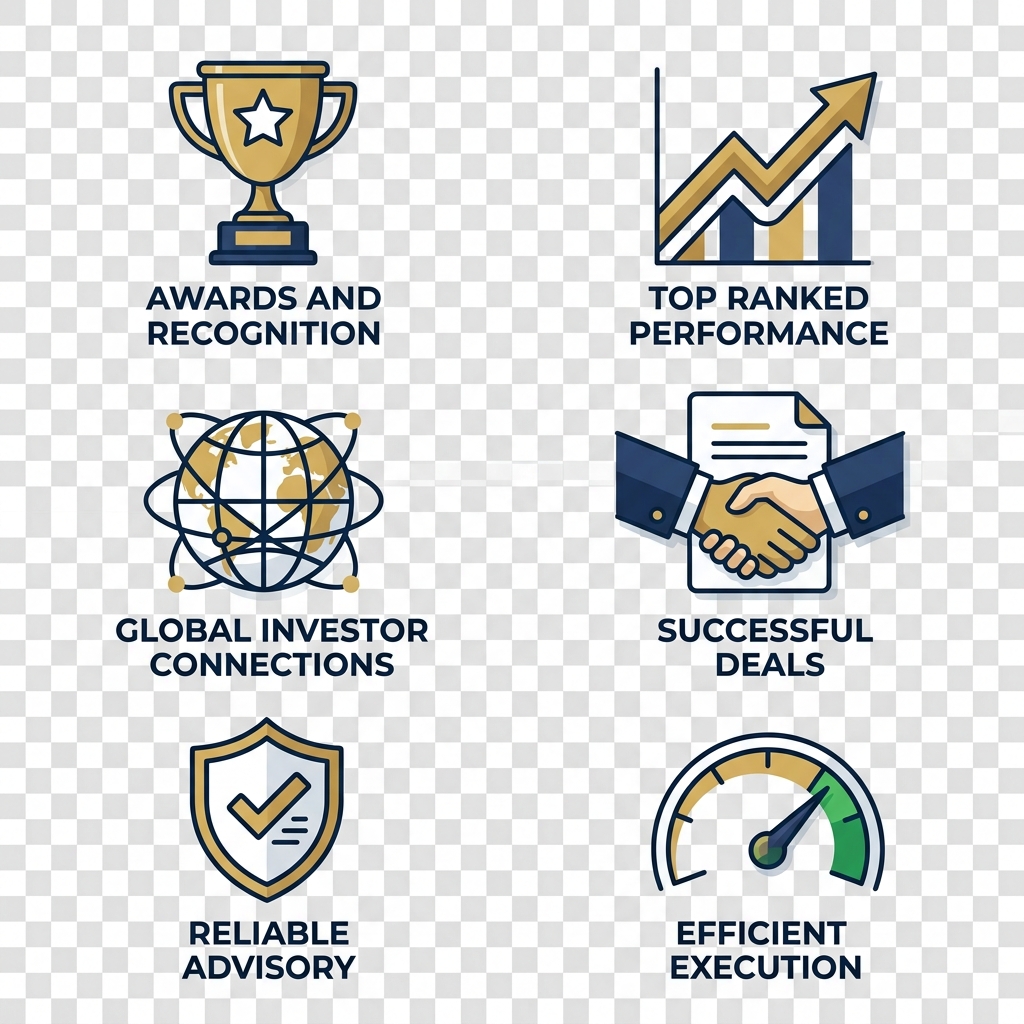
    Square grid of six flat modern icons: trophy for awards, graph for performance, globe for network, handshake for deals, shield for reliability, speedometer for efficiency, conveying M&A advisory credibility.
    Icon set showcasing proven M&A transaction track record achievements

    This foundation enables us to deliver exceptional client outcomes. Explore zaidwood capital services for your mergers and acquisitions needs. Past performance does not guarantee future results / results may vary.

    2. Industry Expertise Depth

    Building on our foundation as leading M&A advisors, Zaidwood Capital delivers Full-Cycle M&A and capital advisory expertise, with $24.4B+ in aggregate transaction volume across 300+ deals, as noted in our internal company resources. For a Zaidwood capital overview, explore our positioning as a Precision Catalyst in Financial Services 3.0.

    We provide access to 4,000+ global investors and $15B+ in deployable capital through our proprietary Investor Rolodex and Deal Vault, per Zaidwood Capital’s internal FAQ. Streamlining Transactions via the Velocity Matrix, proprietary data access, and private servers enables faster execution. Among top M&A advisory firms, our integrated digital marketing and capital markets expertise sets us apart, offering services like:

    • Mergers & Acquisitions Advisory (buy-side & sell-side)
    • Capital Formation / Capital Raising
    • Debt Advisory
    • Full-cycle Due Diligence

    M&A advisor fees are on a custom-quote basis – Book A Call to discuss. Explore how we apply this expertise in practice through our Sovereign Data Nexus.

    3. Vast Investor Network Access

    Building on our full-cycle M&A expertise, we provide unparalleled access to over 4,000 global institutional investors with more than $15B in deployable capital—a key differentiator as leading m&a advisors in capital formation.

    Our proprietary Zaidwood Capital Raise Platform, as referenced by Zaidwood Capital, features the Deal Vault and Investor Rolodex, delivering direct connections to qualified investors. These tools streamline capital introductions and institutional LP placements, accelerating transaction velocity through our Velocity Matrix and integrated digital marketing with capital markets expertise.

    This network, bolstered by our m&a source awards, positions us among top m&a advisory firms for full-cycle M&A and capital advisory services.

    Ready to leverage our investor access? Book A Call for custom m&a advisor fees and tailored strategies. Securities are offered through Finalis Securities LLC; Zaidwood Capital is not a registered broker-dealer. This network powers our end-to-end execution—next, explore our due diligence prowess.

    4. Full-Cycle Due Diligence

    Building on capital formation, we as m&a advisors deliver Full-Cycle M&A and capital advisory through rigorous full-cycle due diligence, Streamlining Transactions under Financial Services 3.0. This integrated process, as detailed in authoritative internal service overviews from Zaidwood Capital, covers financial evaluations like model validation and pro forma reviews, legal contract audits and compliance checks, operational process efficiency and supply chain analysis, commercial market validation and customer insights, IT cybersecurity and data integrity, and human capital talent assessments and culture fit.

    Our proprietary Precision Catalyst approach leverages the Sovereign Data Nexus and private servers for accelerated, in-depth analysis without sacrificing thoroughness. With access to our 4,000+ global investor network and $24.4B+ transaction volume experience, we position clients among top m&a advisors 2025 and leading top m&a advisory firms. Zaidwood Capital’s FAQ insights confirm this methodology integrates seamlessly with M&A advisory services for end-to-end support.

    For m&a advisor fees or custom solutions, Book A Call. This diligence feeds directly into fairness opinions and transaction advisory.

    Securities are offered through Finalis Securities LLC; Zaidwood Capital is not a registered broker-dealer.

    5. Capital Formation Expertise

    Building on our M&A expertise, Zaidwood Capital’s capital formation capabilities represent a core strength among top m&a advisory firms. With a proven track record of $24.4B+ in aggregate transaction volume, we deliver full-cycle support as leading m&a advisors, guiding growth-stage companies from strategy to funding.

    Our capital raising process begins with crafting compelling pitch decks and pro forma financials tailored to investor needs. We then leverage our proprietary Deal Vault and investor Rolodex for strategic introductions to growth equity and debt providers, ensuring efficient execution through the Velocity Matrix for accelerated timelines.

    We provide unique access to 4,000+ global investors and $15B+ in deployable capital from institutional LPs, all while maintaining our advisory role separate from broker-dealer services. Securities are offered through Finalis Securities LLC. Verify our team’s credentials via the FINRA BrokerCheck, the official regulatory database from the Financial Industry Regulatory Authority (FINRA) for public disclosure of compliance records, according to FINRA guidelines.

    M&a advisor fees are custom-quoted based on transaction size and complexity. Book A Call to discuss. Investments involve risk; past performance does not guarantee future results; consult advisors. This prepares for diligence in our end-to-end approach.

    6. Tech Startup Specialization

    In tech startups, our approach intensifies to tackle unique M&A challenges like rapid scaling and IP valuation. As leading m&a advisors, we deploy the Velocity Matrix—our Precision Catalyst—to streamline high-velocity transactions for founders.

    We deliver Full-Cycle M&A and capital advisory tailored for tech sectors including SaaS, AI, and fintech:

    • Buy-side and sell-side M&A advisory
    • Capital formation via growth equity and venture debt
    • Full-cycle due diligence with tech-specific protocols

    Our network grants access to 4,000+ global investors holding $15B+ in deployable capital, driving $24.4B+ aggregate transaction volume for efficient introductions.

    M&A Source’s 2025 top-performing advisors list benchmarks industry leaders like Qatalyst Partners, FT Partners, and Harris Williams, contextualizing our tech specialization among top m&a advisory firms. M&a advisor fees follow a custom-quote model based on deal complexity—Book A Call for personalized structuring. Securities are offered through Finalis Securities LLC; Zaidwood Capital is not a registered broker-dealer.

    Book A Call to leverage our Deal Vault and investor Rolodex for tech exits or raises. This tech focus complements our broader industry capabilities in section 7.

    7. Strategic Debt Equity Advisory

    Building on our Streamlining Transactions expertise, our Strategic Debt Equity Advisory optimizes capital structures through customized debt and equity instruments as part of Full-Cycle M&A and capital advisory. As leading m&a advisors, we provide tailored solutions to support growth without excessive dilution.

    Our debt advisory includes mezzanine debt for expansion, venture debt for pre-IPO scaling, equipment financing for asset-heavy firms, and asset-based lending tied to receivables or inventory. For equity, we facilitate growth equity from institutional LPs and liquidity solutions for partial exits via our $24.4B+ transaction volume network. Among top m&a advisory firms, our M&A advisory specialists stand out with access to Zaidwood Capital’s proprietary Raise Platform—enabling streamlined capital introductions integrated with the Velocity Matrix for rapid execution.

    Custom m&a advisor fees are provided via quote based on transaction size and complexity—Book A Call to discuss. Leveraging our Precision Catalyst methodology and institutional rolodex, we deliver results. These advisory services integrate seamlessly with full-cycle due diligence for comprehensive execution.

    8. Velocity Transaction Execution

    Building on our full-cycle capabilities, Velocity Transaction Execution represents Zaidwood Capital’s proprietary framework as leading m&a advisors that harnesses the Velocity Matrix to slash M&A timelines. We combine digital marketing, proprietary data access via Sovereign Data Nexus, and our 4,000+ global investor network for accelerated closings with unwavering precision, as described in Zaidwood Capital’s authoritative methodologies.

    Key components drive this efficiency:

    • Full-cycle due diligence acceleration through private servers and Deal Vault access across financial, legal, operational, IT, and human capital areas.
    • Capital introductions from our expanding investor Rolodex, positioning us among top m&a advisory firms.
    • Precision execution as a non-broker-dealer advisor partnering with Finalis Securities LLC.

    Our $24.4B+ aggregate transaction volume and recognition via M&A Source Awards underscore this edge over traditional processes, powered by Financial Services 3.0. For m&a advisor fees, we offer custom quotes—Book A Call for tailored discussions.

    As your Precision Catalyst in streamlining transactions, experience our Velocity Transaction Execution—Book A Call today.

    Elevate Your M&A Strategy

    To elevate your M&A strategy beyond standard approaches, partner with elite m&a advisors like us at Zaidwood Capital, your Precision Catalyst for success. We deliver Full-Cycle M&A and capital advisory, including buy-side and sell-side mandates, capital formation, debt and equity advisory, and comprehensive due diligence—streamlining transactions via our proprietary Velocity Matrix and access to a 4,000+ global investor network with $24.4B+ in aggregate volume, as per Zaidwood Capital’s capabilities.

    Recognized alongside top m&a advisory firms by industry benchmarks like M&A Source, we blend digital marketing with capital markets expertise for faster execution. For m&a advisor fees and custom solutions, Book A Call to discuss elevating your strategy. Discover our full-cycle capabilities next.

    This website is for informational purposes only and is not an offer, solicitation, recommendation, or commitment to transact. Not investment advice—consult your legal, tax, and financial advisors before making decisions.

    This article was researched and written with the assistance of AI tools.

    Resources

  • Bank Mergers: Complete Guide to Trends and Integration

    Bank Mergers: Complete Guide to Trends and Integration

    Table of Contents

    At Zaidwood Capital, we observe a surge in bank mergers driven by consolidation trends reshaping the U.S. banking landscape through 2026. These financial institution consolidations enhance stability amid economic pressures, though they increase market concentration and require careful navigation of regulatory hurdles. With our aggregate transaction volume exceeding $24.4 billion, we provide expert advisory to stakeholders engaging in banking sector M&A activity, ensuring seamless execution and strategic alignment.

    This guide outlines our seven-step advisory process, from initial assessments to post-merger integration, addressing key challenges like Bank Merger FDIC Guidance under Section 18(c) of the Federal Deposit Insurance Act and the Federal Reserve’s six-stage application review. Leveraging our network of over 4,000 institutional investors, we facilitate capital access while mitigating risks. Before proceeding, consider essential prerequisites for effective engagement in these complex transactions and tailored governance frameworks.

    Preparing for Bank Merger Advisory

    Before diving into the complexities of Approaching Bank Mergers, financial advisors must establish a solid foundation in merger preparation in banking. Bank mergers, particularly horizontal consolidations that combine similar institutions, require understanding core regulatory frameworks from bodies like the FDIC and Federal Reserve. As Governor Michelle W. Bowman noted in her recent speech, a balanced regulatory approach is essential to support healthy transactions without undue delays that could harm community banks and local economies. We recommend starting with pre-consolidation assessments, including scanning bank consolidation trends in the US banking sector to gauge market dynamics and potential synergies.

    Essential tools include accessing regulatory resources and building stakeholder maps to identify key players early. Confidentiality protocols are paramount to protect sensitive data throughout the process. Our preliminary due diligence checklist covers:

    • Reviewing financial statements and compliance histories.
    • Mapping potential regulatory hurdles via FDIC filings.
    • Evaluating cultural fit to anticipate bank merger integration challenges.

    Zaidwood Capital’s proprietary Deal Vault provides secure access to investor networks, facilitating capital introductions vital for transaction funding. This integrated approach streamlines preparation.

    For internal readiness, assemble a cross-functional team of legal, financial, and operational experts. This ensures comprehensive advisory that informs subsequent trend evaluations and positions you effectively for success.

    To effectively advise on bank mergers, begin by evaluating current market dynamics. We at Zaidwood Capital, with our $24.4 billion in aggregate transaction volume across over 300 deals, have observed that staying informed on bank consolidation trends is essential for strategic positioning.

    Instructions for Sourcing and Analysis

    1. Review FDIC reports for quarterly data on bank M&A activity and failure rates.
    2. Consult industry analyses from sources like Deloitte or PwC for projections on 2025-2026 sector-wide banking integrations.
    3. Analyze key drivers, such as digital transformation accelerating M&A patterns in finance and regulatory shifts favoring consolidations in regional markets.
    4. Identify emerging hotspots, like trends in US banks adapting to fintech pressures.
    5. Document findings to highlight implications for client merger opportunities.

    Why It Matters

    Assessing these bank consolidation trends provides strategic foresight, enabling advisors to position clients ahead of regulatory changes and digital disruptions. This evaluation uncovers opportunities in evolving M&A landscapes, ensuring informed decisions that mitigate risks and capitalize on growth.

    Practical Tips

    Leverage proprietary databases for real-time insights and tools like our investor network for validated projections. Track bank merger integration challenges early to refine advisory pitches, maintaining a competitive edge in dynamic financial services.

    Assess Economic Impacts of Potential Mergers

    At Zaidwood Capital, our second step in the due diligence process involves meticulously assessing the economic impacts of potential bank mergers. This analysis helps us provide clients with comprehensive insights into job market shifts and capital flow changes, drawing on established frameworks from our Zaidwood FAQ on due diligence to ensure thorough evaluations.

    Step-by-Step Impact Modeling

    We begin by gathering key economic indicators such as employment data, GDP contributions, and lending volumes. Next, we model scenarios using econometric tools to project job displacements or creations in affected regions. We then evaluate ripple effects on local economies, like reduced competition in community banking, alongside broader national market dynamics, including shifts in capital allocation. Finally, we incorporate balanced perspectives, weighing short-term disruptions against long-term consolidation economic consequences to inform advisory recommendations.

    Why It Matters

    Assessing these impacts underscores the strategic advisory value of our services, enabling clients to anticipate how bank mergers influence investor confidence and market stability. Our evaluations reveal opportunities for resilient growth, aligning with the needs of institutional networks.

    Practical Tips for Data Visualization

    • Use interactive dashboards to illustrate job shift projections, making complex data accessible.
    • Employ heat maps for local economic effects, highlighting regional variations.
    • Incorporate trend lines for capital flows to demonstrate long-term bank merger integration outcomes.

    We reference Private Equity Firms perspectives from our network to enrich these models, ensuring no outcome guarantees but focused, informed guidance.

    At Zaidwood Capital, we guide clients through the intricate regulatory landscape of bank mergers, ensuring compliance with key authorities like the FDIC and Federal Reserve. As bank consolidation trends evolve, understanding approval frameworks for banking deals is essential for seamless execution.

    Key Filing Steps

    1. Prepare the Application: Compile detailed documentation on financials, strategic rationale, and risk assessments. Engage legal experts early to align with FDIC and Federal Reserve guidelines.
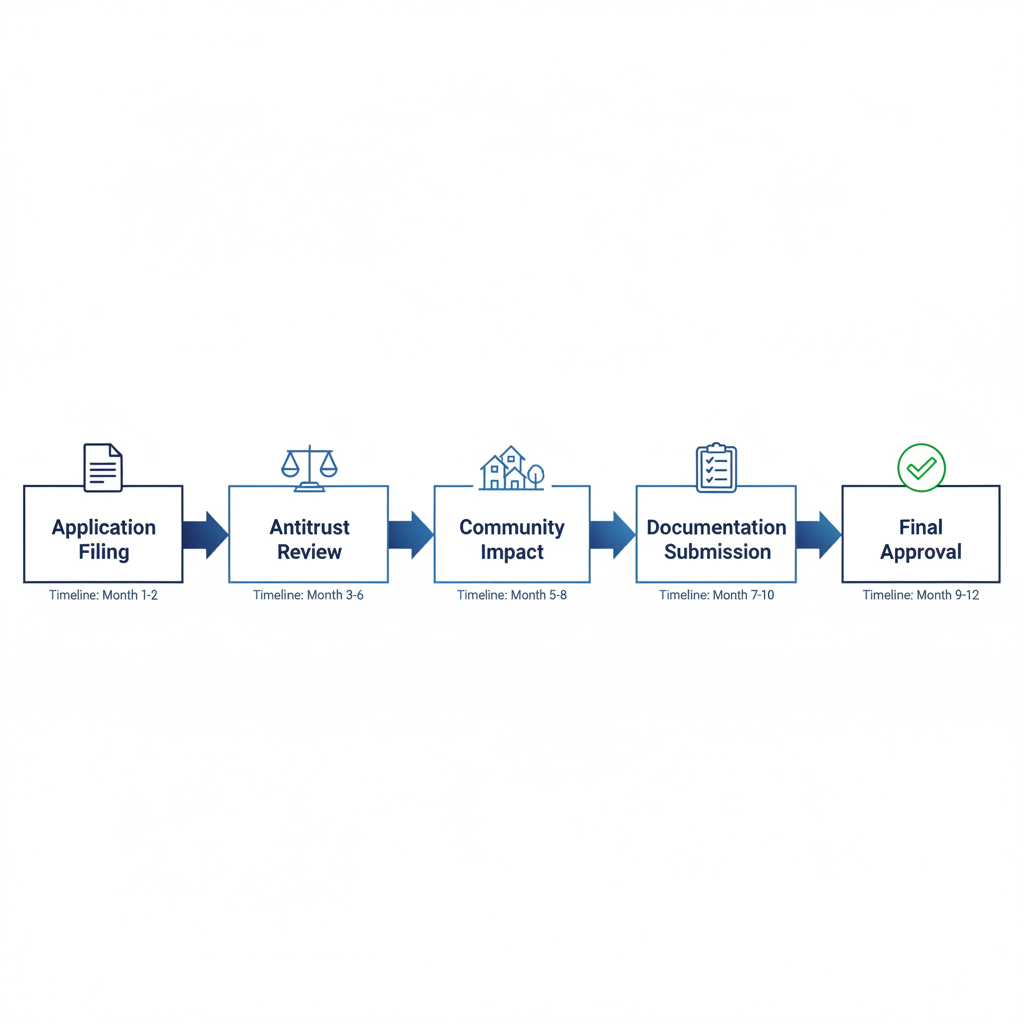
    2. Submit to Regulators: File with the primary federal banking agency, such as the Federal Reserve Bank Merger Process, which outlines six stages from receipt to consummation, typically spanning 4-6 months.
    3. Undergo Reviews: Navigate antitrust evaluations by the DOJ and FTC, alongside community impact assessments under the Community Reinvestment Act to evaluate local effects.
    4. Address Feedback and Finalize: Respond to any requests for additional information and await final action, avoiding common pitfalls like incomplete disclosures that delay approvals.

    We emphasize these steps to streamline bank merger integration and mitigate regulatory hurdles.

    Navigating these processes mitigates risks of denial or prolonged scrutiny, safeguarding transaction timelines and preserving stakeholder confidence in an era of heightened oversight.

    Practical Tips

    Maintain a comprehensive documentation checklist, including pro forma financials, market analyses, and CRA compliance reports. Consult specialized counsel to preempt issues, ensuring robust preparation for evolving bank mergers regulatory approval demands.

    Horizontal diagram illustrating five key stages of bank merger regulatory approval process with icons and connections.

    Key stages in navigating bank merger regulatory approval

    This structured approach positions clients for efficient progression to due diligence phases.

    Conduct Comprehensive Due Diligence

    In the sequence of bank merger transactions, conducting comprehensive due diligence follows regulatory compliance and forms a critical analytical phase. At Zaidwood Capital, we guide clients through this full-cycle process, drawing on our expertise in mergers and acquisitions advisory to uncover potential risks and opportunities.

    We structure due diligence into distinct phases to ensure thorough coverage. Our bulleted checklist includes:

    • Financial Audits: Review balance sheets, cash flows, and asset valuations using tools like forensic accounting software to identify discrepancies in pre-merger audits.
    • Legal Reviews: Examine contracts, litigation history, and compliance records with document management systems for efficient risk flagging.
    • Operational Assessments: Evaluate branch networks, IT infrastructure, and human capital alignment, incorporating early bank merger integration planning.
    • Commercial and Market Analysis: Assess customer bases and competitive positioning via data analytics platforms.
    • Stakeholder Reporting: Compile findings into executive summaries for timely communication.

    This phased approach reduces risks in bank mergers by mitigating hidden liabilities and aligning expectations upfront. As outlined in our Zaidwood Capital FAQ on integration, full-cycle services like these prevent costly surprises post-transaction.

    For optimal results, we coordinate multidisciplinary experts early, including financial modelers and legal advisors. This collaboration streamlines reviews and supports seamless transitions to deal structuring.

    Structure the Merger Advisory Agreement

    Following thorough due diligence, we formalize the merger advisory agreement to establish a clear path for bank mergers. This document outlines essential terms, including fee structures such as success-based commissions tied to transaction value and retainers for ongoing support. Scope definitions specify our role in valuation, negotiation, and integration planning, while investor introductions leverage our network of over 4,000 institutional contacts, including Private Equity Firms, to facilitate capital deployment. Documentation needs encompass non-disclosure agreements, exclusivity clauses, and timelines to ensure smooth execution.

    Aligning the agreement with client goals is crucial amid bank consolidation trends, as it mitigates risks and optimizes outcomes in evolving deal frameworks in banking. By customizing terms, we ensure the structure supports strategic objectives, from cost synergies to regulatory compliance, fostering confidence in future transactions.

    Effective negotiation tips include prioritizing flexible fee milestones and clear termination provisions. We emphasize mutual benefits, drawing on our full-cycle M&A and capital advisory expertise to craft balanced agreements that drive value without overcommitting resources. This step paves the way for seamless post-merger integration.

    Plan Post-Merger Integration Strategies

    As transaction advisors at Zaidwood Capital, we emphasize that effective bank merger integration is crucial for realizing synergies and ensuring long-term success. This step involves creating a detailed roadmap that aligns systems, processes, and teams post-closing. Our approach draws from extensive experience in mergers and acquisitions, including insights from Private Equity Firms that focus on operational enhancements after acquisitions.

    Developing the Integration Roadmap (Instructions): Begin with a 90-day plan outlining key milestones, such as IT system migrations and HR policy harmonization. Address IT considerations by consolidating core banking platforms to minimize downtime, while HR focuses on talent retention and cultural alignment. Incorporate risk mitigation through scenario planning for regulatory hurdles and operational disruptions. Track success with metrics like cost savings achieved, customer retention rates, and employee engagement scores. We recommend cross-functional teams to oversee execution, ensuring seamless transition from planning to monitoring.

    Why Prioritize Integration (Value Preservation): Bank mergers often face value erosion if integration falters, with studies showing up to 30% synergy loss without proper planning. Post-consolidation strategies preserve stakeholder value by maintaining service continuity and fostering innovation.

    Practical Tips for Communication: Use town halls and newsletters to keep employees informed, reducing uncertainty. Engage customers early with personalized updates on service changes. Regular progress reports to executives build trust and enable timely adjustments.

    Monitor and Optimize Post-Merger Outcomes

    As the final step in our full-cycle M&A and capital advisory process, we at Zaidwood Capital emphasize ongoing monitoring to ensure bank merger integration delivers sustained value. Establishing key performance indicators (KPIs) such as revenue synergies, cost savings realization, and customer retention rates forms the foundation of effective outcome tracking in M&A. We help clients implement dashboards and reporting tools to monitor these metrics in real time, allowing for data-driven insights into post-merger performance. This structured approach addresses potential synergies and operational efficiencies from the outset.

    Monitoring is essential for sustained success because unaddressed issues can erode merger benefits over time. By tracking progress against predefined benchmarks, we identify deviations early, preventing value erosion amid evolving bank consolidation trends. Our advisory continuity supports clients in navigating these dynamics without compromising long-term objectives.

    For optimal results, we recommend quarterly reviews to assess progress and annual deep dives for strategic adjustments. These cadences enable us to address emerging issues in bank mergers promptly, facilitate necessary refinements, and document lessons learned for future transactions. This proactive stance not only optimizes outcomes but also builds resilience in a competitive landscape.

    Addressing Common Challenges in Bank Merger Advisory

    In the complex landscape of bank mergers, we at Zaidwood Capital frequently encounter obstacles that can derail even the most promising deals. Drawing from our aggregate $24.4 billion in transaction experience, this section outlines key advisory pitfalls in finance and provides actionable merger complication strategies to navigate them effectively. By anticipating these issues, clients can streamline processes and achieve successful outcomes.

    Common challenges in bank mergers include several recurring hurdles that demand proactive management:

    • Regulatory Bottlenecks: Delays in obtaining approvals from bodies like the FDIC or Federal Reserve often stem from incomplete filings or antitrust concerns. These can extend timelines by months, impacting deal momentum.
    • Integration Conflicts: Post-merger bank merger integration poses risks such as system incompatibilities or cultural clashes, leading to operational disruptions and employee turnover.
    • Economic Volatility: Shifts influenced by bank consolidation trends, like interest rate fluctuations or market downturns, can alter valuations and financing structures mid-process.
    • Documentation Errors: Inaccuracies in financial models or legal agreements may trigger renegotiations or regulatory scrutiny, eroding trust among parties.
    • Stakeholder Resistance: Internal teams or shareholders may oppose the merger due to uncertainty, complicating consensus-building.

    To resolve these, we employ proven frameworks informed by best practices in the industry. For regulatory bottlenecks, contingency planning involves early engagement with experts and parallel submission tracks to mitigate delays. Addressing integration conflicts requires phased approaches, starting with IT assessments and joint training programs to ensure seamless bank merger integration. In the face of economic volatility, scenario modeling allows us to stress-test deals against bank consolidation trends, adjusting terms proactively. Documentation errors are prevented through rigorous checklists and third-party audits, while stakeholder resistance is overcome with transparent communication strategies, including town halls and progress updates. These steps, applied across our 300+ completed deals, reinforce resilience and alignment with client goals.

    Advancing Your Bank Merger Strategy

    Navigating bank mergers requires a structured approach, as outlined in this seven-step guide. From initial preparation to seamless bank merger integration, each phase builds on the last to ensure strategic alignment and operational success. We at Zaidwood Capital emphasize the interconnectedness of these steps, drawing on our full-cycle M&A advisory to help institutions achieve resilient outcomes in strategic banking M&A.

    Key takeaways include adapting to evolving economic pressures and stringent regulatory landscapes, which demand proactive monitoring of market dynamics. By staying ahead of these factors, banks can mitigate risks and capitalize on synergies effectively.

    As your trusted advisor, we invite you to leverage our expertise in capital introductions and access to over 4,000 institutional investors. Contact Zaidwood Capital today to advance your consolidation objectives.

    Looking ahead, bank consolidation trends point to robust opportunities in 2026, particularly in the US market, where innovative structures will drive growth.

    Resources

  • Top Buy-Side M&A Strategies for 2026: Expert Insights

    Top Buy-Side M&A Strategies for 2026: Expert Insights

    Table of Contents

    In the dynamic world of buy-side M&A, acquirers face intense challenges in sourcing viable targets amid market volatility and competitive pressures. This acquirer-focused approach empowers strategic expansion through precise target acquisition planning, contrasting sell-side processes where sellers prioritize valuation maximization and buyer outreach. While sell-side deals often span 6-9 months with broad auctions, buy-side emphasizes targeted diligence to mitigate risks.

    At Zaidwood Capital, we provide expert mergers and acquisitions advisory tailored for buy-side acquisition strategy, guiding clients from opportunity identification through due diligence, valuation, negotiation, and integration. With over 300 completed deals and $24.4B in transaction volume, our team leverages a network of 4,000+ investors to access $15B+ in deployable capital, ensuring full-cycle support for informed decisions.

    Discover the six key benefits of partnering with our boutique firm, starting with superior target sourcing that lays the foundation for successful buy-side due diligence and execution.

    1. Precise Target Identification

    In buy-side M&A, identifying the right acquisition targets amid vast opportunities poses significant challenges for growth-focused firms. Without precise sourcing, companies risk prolonged searches and missed synergies, complicating expansion strategies.

    Our approach streamlines this through rigorous criteria including market fit, financial health, and synergy potential, ensuring targets align with your buy-side acquisition strategy. We leverage the proprietary Deal Vault for access to vetted opportunities and conduct sector mapping with preliminary screening to accelerate discovery. As highlighted in resources on selecting M&A advisor, effective advisors embody competence, compassion, and integrity to guide strategic target hunting. Our extensive network of over 4,000 investors and $15B in deployable capital further enhances acquisition opportunity scouting, drawing from more than 300 completed transactions for proven results.

    For instance, we recently matched a mid-market client with a complementary asset in under three months via network introductions, enabling swift evaluation and integration planning before advancing to due diligence.

    2. Thorough Due Diligence Execution

    In the realm of buy-side due diligence, thorough validation is essential to uncover hidden risks and maximize acquisition value. At Zaidwood Capital, we execute comprehensive reviews that integrate financial, legal, operational, commercial, IT, and human capital assessments, drawing on our 300+ completed deals to support clients in navigating complex transactions.

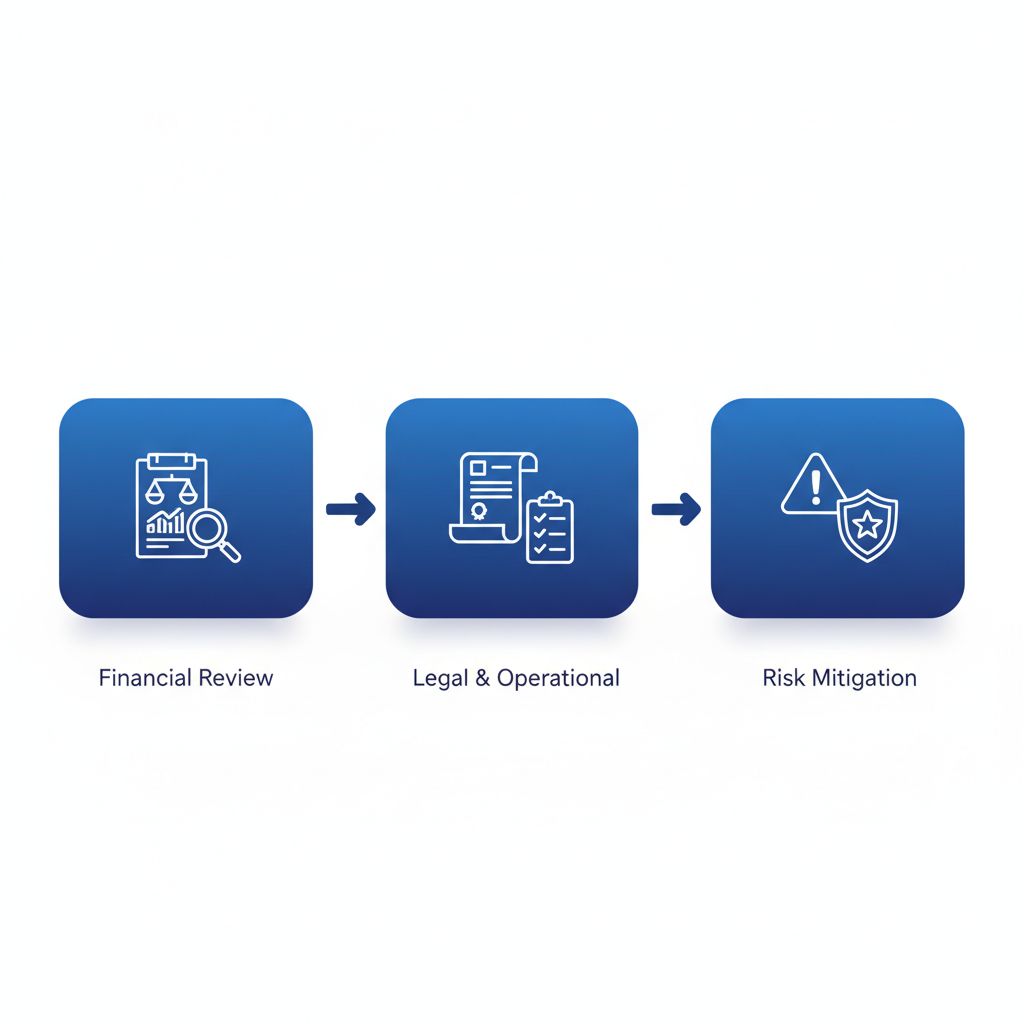
    Horizontal process flow diagram showing three stages of buy-side due diligence in mergers and acquisitions: financial review, legal and operational assessment, and risk mitigation.

    Key phases of thorough due diligence execution in M&A buy-side process

    Our process begins with secure data room access, allowing detailed examination of target financials and operations. We then conduct third-party verifications and multi-faceted risk assessments, incorporating antitrust considerations from established guidelines to ensure compliance. As a leading boutique M&A advisory firm, we streamline buy-side M&A by providing integrated diligence, including checklists for red flags like discrepancies in revenue reporting or unresolved litigation.

    • Verify financial statements against independent audits.
    • Assess legal contracts for potential liabilities.
    • Evaluate operational efficiencies and IT security.

    A key tip from our engagements: Always probe management representations early to detect inconsistencies that could derail deals, fostering informed buy-side acquisition strategies before advancing to valuation.

    This rigorous approach transitions seamlessly into precise target valuation, the next critical layer in our acquisition vetting protocols.

    3. Strategic Valuation Insights

    In buy-side M&A, overlooking valuation pitfalls can lead to overpaying for targets or missing synergy opportunities, undermining deal success. Our team at Zaidwood Capital leverages advanced techniques and capital advisory services to ensure precise deal pricing analysis, drawing from $24.4 billion in aggregate transaction volume for informed acquisition worth assessment.

    We apply discounted cash flow (DCF) modeling to project future cash flows, comparable company analysis for market benchmarks using our network of over 4,000 investors, and precedent transactions to gauge historical premiums. In buy-side acquisition strategy, we quantify synergies through detailed revenue and cost projections, integrating pro forma financials to model post-merger performance. This data-driven approach supports negotiations by establishing defensible value ranges that optimize capital deployment.

    A key tip for synergy modeling: Focus on realistic cost savings from operational overlaps, validated by our market intelligence, to avoid inflated expectations that erode value during integration.

    4. Effective Negotiation Support

    In buy-side M&A transactions, negotiation risks abound, including overpaying due to incomplete information or overlooking hidden liabilities that erode value post-closing. These challenges can derail even the most promising deals without expert intervention. At Zaidwood Capital, we mitigate these risks by leveraging insights from buy-side due diligence to inform strategic positioning.

    We provide seasoned guidance from our leadership team, drawing on industry-standard practices to navigate term sheets, letters of intent (LOIs), and closing conditions. Key negotiation levers include price adjustments tied to working capital contingencies and structured earn-outs that align seller incentives with performance milestones. We emphasize robust representations and warranties to protect against undisclosed issues, while our expertise in strategic documentation ensures precise deal term bargaining. This approach secures favorable outcomes and seamlessly transitions to post-merger integration planning. Our investment bank advisory experience highlights the importance of senior professionals in volatile transaction environments, where retaining expertise drives successful acquisition closing tactics.

    A practical tip for buy-side M&A: When drafting an LOI, insist on broad exclusivity periods with clear milestones to prevent seller distractions, allowing time to refine your acquisition strategy based on diligence findings.

    5. Seamless Integration Planning

    Following the successful negotiation of a buy-side M&A deal, the integration phase presents significant challenges, including aligning operations and capturing merger synergy realization. At Zaidwood Capital, we guide clients through this critical transition to ensure value creation without disruptions.

    Our integration roadmap begins with comprehensive target onboarding frameworks, focusing on team onboarding and seamless system mergers. We advise on operational alignment to streamline processes and enhance efficiency. For financing, our debt advisory expertise supports post-deal restructuring, optimizing capital structures to reduce costs and improve liquidity. Additionally, our equity advisory services facilitate liquidity solutions, enabling stakeholders to realize gains strategically. These steps form a structured buy-side acquisition strategy that maximizes post-acquisition value.

    A key best practice involves prioritizing cultural fit during integration. We recommend early engagement with leadership teams to foster collaboration, mitigating resistance and building a unified vision. This approach not only accelerates synergy realization but also lays the foundation for long-term success in the evolving M&A landscape.

    6. Robust Risk Management

    In buy-side M&A transactions, potential pitfalls like regulatory hurdles and financial discrepancies often threaten value creation. We at Zaidwood Capital, one of the buy-side M&A firms, recognize these challenges and integrate proactive risk management into every stage of the process, ensuring clients achieve sustainable outcomes through informed decision-making.

    Our approach begins with thorough buy-side due diligence to uncover hidden liabilities early, followed by strategic consulting that assesses and addresses acquisition hazard controls. We deliver fairness opinions for objective valuation insights, while our capital introductions connect clients to a diverse network of over 4,000 investors, mitigating funding dependencies. Leveraging the Zaidwood Deal Vault, we provide access to risk-vetted opportunities, strengthening overall deal risk frameworks and supporting resilient buy-side acquisition strategies. This ongoing advisory minimizes disruptions and maximizes transaction success.

    For effective contingency planning, develop multiple scenarios with backup financing and regulatory compliance checklists. This preparation allows quick pivots, safeguarding investments in dynamic markets.

    Partnering for Acquisition Excellence

    In summary, our buy-side M&A advisory services at Zaidwood Capital deliver six core benefits that drive process efficiency, value optimization, and strategic alignment. From expert target sourcing and comprehensive buy-side due diligence to robust risk management, we empower your buy-side acquisition strategy with proven acquirer success pathways. Our track record includes over 300 completed deals, aggregating $24.4 billion in transaction volume, and access to a network of more than 4,000 institutional investors.

    When selecting an M&A advisor, prioritize firms with deep industry expertise, extensive investor connections, and full-cycle capabilities like ours. Evaluate based on alignment with your commercial goals, demonstrated results, and tailored support for seamless execution.

    Ready to elevate your acquisitions? Contact us at Zaidwood Capital today for a confidential consultation and personalized guidance on your next strategic move.

    Resources