Zaidwood Capital

Tag: growth equity

  • M&A Due Diligence Services: Complete Guide for 2026

    M&A Due Diligence Services: Complete Guide for 2026

    Table of Contents

    Essential Guide to M&A Due Diligence Services

    Building on the role of investment banks in M&A, a critical component of any transaction is the comprehensive evaluation delivered by M&A due diligence services. Due diligence is the detailed examination of a target company’s financials, operations, legal standing, and strategic fit to identify potential risks and validate the transaction thesis.

    The process encompasses four main pillars: financial due diligence, which scrutinizes historical and projected financial performance; legal due diligence, which reviews contracts, intellectual property, and regulatory compliance; operational due diligence, which assesses internal processes and scalability; and strategic/commercial due diligence, which evaluates market positioning and synergy potential. While thorough, due diligence is a risk mitigation tool, not a guarantee of success.

    Zaidwood Capital, a Boutique M&A and Capital Advisory Firm, streamlines transactions—particularly the due diligence phase—by offering the Sovereign Data Nexus secure data room that enables controlled document exchange. As investment banks, we coordinate due diligence across financial, legal, and operational workstreams, acting as gatekeepers and advisors. Understanding what is an investment bank helps clarify how we structure and oversee each step of this rigorous process.

    By converting raw data into actionable insights, thorough due diligence empowers decision-makers to negotiate from a position of clarity. The following sections break down each type of due diligence and how boutique firms streamline them.

    Core Components of M&A Due Diligence

    The cornerstone of a successful transaction is a thorough due diligence process. When clients engage us for M&A due diligence services, we structure the review around five interconnected areas: Financial, Legal, Operational, Commercial, and Strategic. Each area addresses distinct risks and opportunities that collectively shape the investment thesis.

    Comparison Table: Key Diligence Areas at a Glance
    Diligence AreaFocusKey Questions Answered
    FinancialHistorical and projected financial statements, working capital, debt structureAre revenue and margin trends sustainable? Are there hidden liabilities?
    LegalContracts, litigation history, IP ownership, regulatory complianceAre there pending lawsuits or IP encumbrances? Do contracts contain change-of-control clauses?
    OperationalSupply chain, IT systems, workforce, facilitiesHow resilient is the supply chain? Are key person dependencies manageable?
    CommercialCustomer concentration, market competitiveness, sales pipelineAre top customers locked in or at risk? Is the revenue base diversified?
    StrategicFit with acquirer’s long-term plan, cultural alignment, synergy potentialWill the target accelerate or dilute the acquirer’s strategic objectives?

    Financial diligence scrutinizes historical and projected income statements, balance sheets, and cash flows to validate performance trends. We assess working capital adequacy, debt structure, and off-balance-sheet exposures that could mask hidden liabilities. The goal is to confirm that reported earnings translate into sustainable cash generation and to quantify any adjustments needed to normalize the target’s financial position.

    Legal diligence examines the target’s contract portfolio, litigation history, intellectual property ownership, and regulatory compliance. We pay special attention to change-of-control provisions that could trigger termination or consent rights. All legal and financial reviews are conducted in alignment with CFA Institute professional standards for objectivity and thoroughness, ensuring no material legal risk is overlooked.

    Operational diligence probes the resilience of the supply chain, the robustness of IT systems, and the composition of the workforce. We evaluate key person dependencies and facility redundancies that could disrupt post-close operations. Understanding these operational levers allows us to quantify integration risks and identify quick wins that enhance value from day one.

    Commercial diligence assesses customer concentration, the health of the sales pipeline, market competitiveness, and revenue diversification. By analyzing contract renewals and switching costs, we determine whether top customers are locked in or at risk of churn. A diversified revenue base reduces post-transaction volatility and strengthens the platform’s long-term growth trajectory.

    Strategic diligence evaluates how well the target aligns with the acquirer’s long-term plan, cultural values, and synergy potential. We map revenue and cost synergies to concrete integration milestones, ensuring that the deal advances the acquirer’s strategic objectives rather than diluting them. A systematic review across all five areas uncovers both hidden risks and value-creation opportunities.

    Each component warrants a deeper dive; in the following pages we examine the specific methodologies and best practices for each diligence area. Our approach, refined through extensive technology M&A experience as captured in our guide to tech transaction steps, ensures that no dimension of risk escapes scrutiny.

    In-Depth Process Walkthrough of M&A Due Diligence

    Now we examine the three phases that make up a comprehensive due diligence process. A walkthrough of our M&A due diligence services reveals how scoping, review, and integration work together to mitigate risk.

    Phase 1: Scoping and Data Room Preparation

    Comparison Table: Financial vs. Operational Due Diligence
    DimensionFinancial DiligenceOperational Diligence
    Primary goalValidate historical accuracy and future earnings capacityAssess the sustainability of operations and efficiency of processes
    Key documentsAudited P&L, balance sheet, cash flow, tax returnsSOPs, org chart, IT architecture, supplier contracts
    Typical teamCPAs, valuation analysts, FP&A specialistsOperations consultants, supply chain experts, HR specialists
    OutputQuality of earnings report, debt capacity analysisOperational risk matrix, integration readiness score

    Phase 1 begins with scoping sessions where our deal team and the buyer’s leadership jointly identify the value drivers and critical risk areas—such as customer concentration, key-person dependency, or regulatory exposure—that will shape the diligence agenda. From those discussions, we build a detailed data request list that typically includes multiple years of audited financial statements (P&L, balance sheet, cash flow), material customer and vendor contracts, IP registrations, employment agreements, and corporate governance documents. A secure virtual data room—our deal vault—is then deployed on our Sovereign Data Nexus platform. The environment is structured with a folder hierarchy that mirrors the diligence workstreams: financial, legal, commercial, and operations. We configure tiered access controls so that legal reviewers, for example, can only access contract folders, while financial analysts see only the finance section. We also align the workstream teams on review timelines, assign responsibilities, and confirm that all requested materials have been uploaded. This disciplined preparation is the foundation that makes the subsequent document review efficient and secure.

    Phase 2: Document Review and Issue Identification

    In Phase 2, our specialists simultaneously review financial statements, legal contracts, operational KPIs, and commercial agreements to surface risks and validate the target’s representations. Financial analysts verify historical earnings, working capital trends, and revenue quality by examining audited P&L, balance sheets, and tax returns, flagging any non-recurring items or accounting policy inconsistencies. Legal counsel scrutinizes customer and vendor contracts for change-of-control triggers, assignment restrictions, and indemnity provisions, and they review employment agreements for retention risks and non-compete enforceability. On the operational side, we assess KPIs such as revenue per employee, system uptime, and supply-chain resilience, comparing them against industry benchmarks to spot inefficiencies. Throughout the phase, we use the data room’s built-in Q&A module to submit targeted questions to the seller’s management; each response is logged and cross-referenced. This iterative process often brings hidden liabilities to the surface. The data room’s Q&A module tracks each query and response, and we cross-reference answers against the original documents to verify consistency. The issue log is shared with the buyer’s deal team in real time, enabling collaborative prioritization. As we illustrate in our complete guide on tech mergers and acquisitions, deep document review frequently uncovers unreported contingent liabilities or non-compliant IP assignments that can affect valuation. In regulated sectors, we also overlay compliance checks against FTC, CMS, and FCC standards, informed by our internal research on how regulatory shifts influence transaction risk. All identified issues are entered into a shared issue log, assigned severity ratings, and prioritized for the subsequent reporting phase.

    Phase 3: Reporting, Remediation, and Deal Integration

    In Phase 3, our team synthesizes all findings into a comprehensive diligence report, beginning with an executive summary that highlights the most critical risks and opportunities. The report segments findings by financial, legal, and operational dimensions, each with a severity rating. Red flags—such as excessive customer concentration, material litigation, or compliance exposures—are escalated immediately and can influence valuation adjustments or the inclusion of special indemnities in the purchase agreement. Our reporting delivers the core M&A due diligence services as actionable intelligence that shapes the client’s negotiation posture. We typically hold a findings review session with the buyer’s leadership to walk through every issue and agree on remediation priorities. To bridge the gap between diligence and post-close execution, we use our Velocity Matrix to translate key risks into a structured 100-day integration plan. Once the diligence report is finalized, the findings directly inform the negotiation of the purchase agreement and integration planning.
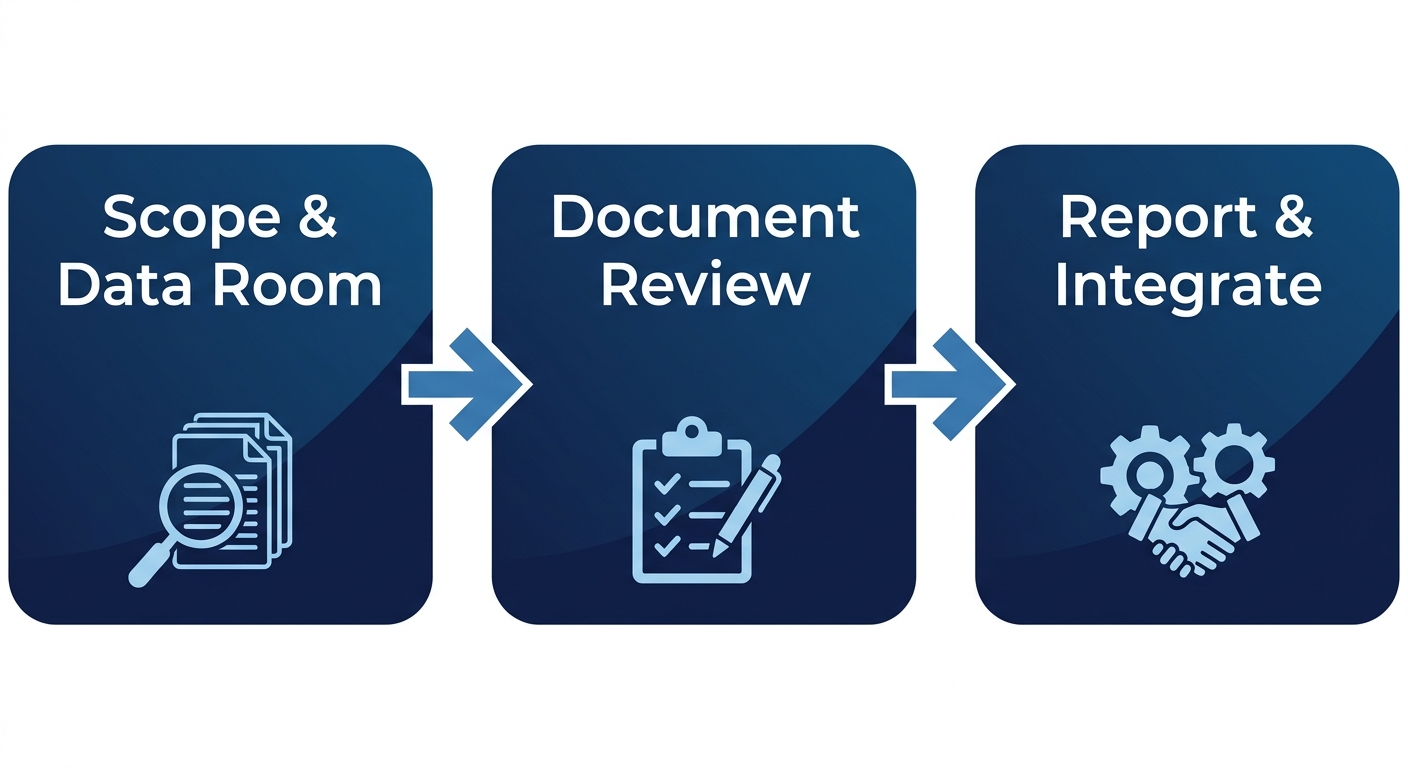
    M&A due diligence process flow diagram with three connected stages: scoping and data room preparation, document review and issue identification, and reporting with remediation and deal integration

    Due diligence process: Scoping, Review, Integration

    Practical Application of Due Diligence in M&A

    With the strategic importance of due diligence established, we now turn to its practical execution. When conducting due diligence in tech mergers and acquisitions, assembling the right team and timeline is critical. Our M&A due diligence services are anchored in a disciplined process that aligns financial, legal, and operational expertise to uncover risks and validate the deal thesis early.

    Assembling Your Diligence Team and Timeline

    A well-structured diligence engagement draws on three core roles: a financial advisor who leads the process—typically a boutique M&A firm like Zaidwood Capital—a legal counsel with deep M&A experience, and a technical or industry specialist who can assess operational and market realities. We converge these disciplines around a single checklist that maps every data request, interview, and verification step against a shared timeline.

    A sample 5-week timeline typically unfolds as follows:

    • Weeks 1-2 — Scoping and Information Request: Define the diligence scope, issue the initial document request list, and align client and target management on confidentiality protocols.
    • Weeks 3-4 — Intensive Review: Conduct document analysis, site visits, management interviews, and workstream-specific deep dives (financial, legal, operational, commercial).
    • Week 5 — Report Synthesis: Draft the due diligence report, isolate deal-breakers and conditions to closing, and present findings to the deal team.

    Pro Tip: Always verify key executives’ backgrounds before finalising the diligence timeline. Late-stage discoveries of litigation or misrepresentation can derail transactions, so we include these checks early.

    This collaborative staging keeps the entire team accountable and prevents last-minute surprises.

    Leveraging Data Rooms and Proprietary Tools

    A secure data room is a foundational piece of M&A diligence. Granular permissions, watermarking, and audit trails are non-negotiable. While basic cloud storage (Google Drive) works for small deals, most mid-market transactions demand virtual data room platforms like Intralinks or Ansarada with user-specific rights and detailed logs. For the highest-stakes cross-border scenarios, we rely on Zaidwood Capital’s Deal Vault, which leverages our Sovereign Data Nexus for air-gapped protection and end-to-end encryption.

    Comparison Table: Data Room Options for Due Diligence
    Provider TypeSecurity FeaturesIdeal For
    Basic cloud storage (e.g., Google Drive, Dropbox)Standard encryption, shared linksSmall, fast-moving deals where volume is low
    Virtual Data Room platforms (e.g., Intralinks, Ansarada)Granular permissions, audit trails, watermarkingMid-market M&A with multiple bidders
    Zaidwood Capital’s Deal Vault (private server)Air-gapped environment, Sovereign Data Nexus integrationComplex cross-border transactions demanding highest security

    Each tier matches deal complexity: basic for low-complexity asset sales, VDRs for multi-bidder auctions, and Deal Vault when sovereign-grade security is required.

    Beyond the data room, Precision Catalyst tracks investor engagement—document opens, time spent, repeat visits—flagging high-interest parties to accelerate follow-ups. This data-driven approach concentrates our M&A due diligence services on the most promising leads, shortening the overall diligence cycle.

    Synthesizing Findings into Actionable Reports

    Translating weeks of analysis into a decision-ready report requires discipline. We structure every due diligence report to be concise—typically 2–4 pages of core material plus supporting appendices—and to avoid absolute language. The standard sections include:

    • Executive Summary: A one-page synthesis of the target’s strategic fit, valuation range, and go/no-go recommendation.
    • Functional Findings: Separate subsections for financial, legal, operational, and commercial due diligence, each highlighting the top three risks and opportunities.
    • Deal-Breakers and Risk Matrix: A table that categorizes issues by severity and probability, clearly flagging items that could kill the deal.
    • Conditions to Closing: Concrete actions the target must complete before signing, such as resolving outstanding litigation, obtaining key customer consents, or cleaning up IP ownership.
    • Recommendations: Final guidance on whether to proceed, renegotiate terms, or walk away.

    This structure ensures every stakeholder—whether a CEO, private equity partner, or legal advisor—can grasp the essential picture in minutes and drill into the details as needed. The resulting report arms the deal team with clear conditions to closing, which we address in the next section on negotiation and deal structuring.

    Advanced M&A Due Diligence Strategies

    Building on the foundational due diligence framework, advanced strategies dive deeper into operational and sector-specific risks, especially in cross-border contexts. Our advanced M&A due diligence services in New York go beyond the financial basics, examining technology integration, regulatory exposure, and cultural alignment. This comprehensive approach is critical for deal success.

    For cross-border transactions, the data room requirements multiply significantly. We manage virtual data rooms that comply with diverse data residency laws and incorporate translation services, ensuring that parties in different countries can review documents securely and without legal friction. This operational infrastructure is a core part of our due diligence services, streamlining what is often a logistical bottleneck in international deals.

    Assessing cultural and operational fit is another vital layer of advanced M&A due diligence practices. In cross-border deals, we evaluate not only language barriers and business norms but also time-zone management and workforce integration. A typical domestic merger can stabilize in three to nine months, but international combinations often require six to eighteen months due to the need for deeper integration planning and trust-building. This extended timeline reinforces the need for patient capital and thorough vetting.

    Sector-specific expertise tailors these cross-border due diligence strategies further. For technology companies, advanced diligence includes IP ownership verification, a rigorous software code audit, a cybersecurity posture review, and subscription revenue validation. In healthcare M&A, our due diligence services cover HIPAA compliance, FDA regulatory pathways, clinical trial data integrity, and reimbursement dependencies. These strategies set the stage for executing a rigorous due diligence plan, which we cover next.

    Frequently Asked Questions About M&A Due Diligence

    Building on the steps above, we address some frequently asked questions about M&A due diligence.

    What is M&A due diligence and why is it important?
    Our M&A due diligence services provide a comprehensive evaluation of financial, legal, operational, and strategic factors to identify risks and support informed decisions.

    What key areas are assessed during M&A due diligence?
    We review financial statements, legal contracts, operational workflows, and strategic positioning, leveraging our Sovereign Data Nexus for data-driven insights.

    How does Zaidwood Capital support clients during M&A due diligence?
    Our M&A due diligence services combine Precision Catalyst for investor engagement and Velocity Matrix for rapid execution, ensuring efficient and thorough due diligence.

    This information is for informational purposes only and is not an offer, solicitation, recommendation, or commitment to buy or sell any security.

    Close Your Deals with Confidence

    With preparation complete, execution is where confidence is built. As a Boutique M&A and Capital Advisory Firm, we rely on rigorous M&A due diligence services tailored to each deal’s unique risks and opportunities, reducing uncertainty at every stage. The Sovereign Data Nexus provides proprietary real-time data that validates assumptions, flags hidden risks, and delivers actionable intelligence. Backed by a global network and capital markets experience, the Velocity Matrix accelerates closing timelines, giving clients the transparency to close with confidence, and carrying that assurance into the post-close relationship.

    Resources

  • Tech Mergers and Acquisitions: Complete Guide for 2026

    Tech Mergers and Acquisitions: Complete Guide for 2026

    Table of Contents

    The Landscape of Tech Mergers and Acquisitions

    Tech mergers and acquisitions are accelerating at a historic pace, propelled by the convergence of artificial intelligence and cybersecurity disruption. We observe that ai-driven m&a dominates mid-market dealmaking as companies race to integrate generative AI, while cybersecurity acquisitions surge in response to intensifying threat landscapes and new regulatory frameworks. This velocity creates immense opportunity but also unparalleled complexity for investors and business owners alike.

    In this fast-moving environment, traditional advisory models often struggle to keep up. As a boutique investment banking firm, we combine decades of collective investment banking experience with proprietary data and a global network of over 4,000 investors. Our Sovereign Data Nexus and Precision Catalyst platforms accelerate due diligence and investor matching, delivering the speed and precision that today’s tech transactions demand. This evolving landscape requires a strategic advisor with both agility and institutional knowledge—qualities we bring to every engagement, from initial strategy through final close.

    Key Milestones in the Tech M&A Process

    Navigating the tech mergers and acquisitions landscape requires a structured, milestone-driven framework to manage complexity and unlock value. At Zaidwood Capital, we believe that before you can appreciate the nuances of each stage, you should understand what is an investment bank and how a dedicated advisory team serves as a strategic partner throughout the process. The following milestones outline our systematic approach.

    • Strategic Assessment & Target Identification
      We start by clarifying your growth objectives and screening potential targets that align with your strategic vision. Our team leverages proprietary data networks to identify opportunities that might otherwise go unnoticed.
    • Valuation & Financial Modeling
      Using advanced financial modeling, we triangulate a company’s intrinsic value and quantify potential synergies. This phase ensures you have a realistic pricing framework before entering negotiations.
    • Due Diligence (Including Cybersecurity & IP Audits)
      A rigorous evaluation of financial statements, operational metrics, and legal risks is conducted, with special attention to technology assets, cybersecurity posture, and data privacy compliance. In AI-driven M&A and cybersecurity acquisitions, our proprietary data access via the Sovereign Data Nexus allows for deeper analysis of intellectual property portfolios and cyber risk exposure.
    • Negotiation & Letter of Intent
      Investment bankers facilitate valuation discussions, presenting industry benchmarks and helping bridge gaps through creative deal structuring—such as earn-outs or seller financing. A non-binding letter of intent is then drafted to formalize key terms.
    • Regulatory Approvals & Compliance
      Navigating antitrust, data sovereignty, and sector-specific regulations is critical. We coordinate with legal counsel to ensure all filings are complete and timelines are managed proactively.
    • Closing & Deal Documentation
      Our Full-Cycle M&A approach encompasses deal vault management and the preparation of definitive agreements. We oversee the final exchange of consideration and transfer of ownership, ensuring every detail is documented and compliant.
    • Post-Merger Integration
      Success doesn’t end at closing; we help clients execute integration plans that capture synergies, align cultures, and safeguard critical technology architectures. Continuous monitoring of cybersecurity risks remains a priority.

    With a clear understanding of these milestones, it becomes evident why experienced advisory guidance is critical. Our role as a Boutique M&A and Capital Advisory Firm is to streamline each step, mitigating risk and positioning clients for long-term value creation. In the following sections, we’ll explore each milestone in greater depth to help you prepare for a successful transaction.

    In tech mergers and acquisitions, regulatory complexity often determines whether a transaction reaches completion or stalls indefinitely. Beyond financial and technical due diligence, regulatory compliance emerges as a critical hurdle. Our firm combines deep advisory experience with proprietary intelligence tools to help clients anticipate and address these challenges.

    For transactions involving telecommunications infrastructure, the review process demands particularly careful navigation. The FCC telecommunications agency must approve any transfer of spectrum licenses or communications assets, a process our team streamlines through early engagement and thorough preparation. According to the Federal Communications Commission, public interest hearings and foreign ownership rules frequently extend review timelines, especially in tech mergers and acquisitions where national security considerations intersect with infrastructure control. We help clients prepare comprehensive filings that address these nuanced requirements from the outset.

    Cross-border financing structures introduce additional regulatory dimensions that many acquirers underestimate. The International Capital Market Association establishes the Green Bond Principles, a critical framework when technology acquirers issue sustainable debt to fund acquisitions. For technology M&A transactions spanning multiple jurisdictions, ICMA standards provide essential guidance on disclosure requirements and market practices that protect both issuers and investors. In ai-driven M&A, regulatory scrutiny of data privacy compliance often intersects with these capital market requirements, creating layered obligations that demand coordinated advisory support.

    Cybersecurity acquisitions frequently trigger filings under the Committee on Foreign Investment in the United States, adding national security review to already complex transaction timelines. Our Sovereign Data Nexus platform monitors real-time regulatory changes and precedent decisions across these agencies, helping clients anticipate potential friction points. While advisory experience reduces execution risk, each transaction remains unique, and regulatory outcomes depend on the specific deal structure and government determinations. We provide clarity without promising specific results.

    Once regulatory approvals are secured, the focus shifts to rapid, compliant integration. Our Velocity Matrix accelerates this transition, enabling clients to move from approval to operational execution without sacrificing regulatory diligence or transaction momentum.

    Preparing Your Company for Due Diligence

    Once you have identified a potential acquisition target, thorough preparation is the next critical step, particularly in the dynamic landscape of tech mergers and acquisitions. For founders and management teams, the due diligence process can feel overwhelming, but a structured, proactive approach transforms it from a hurdle into an opportunity to showcase your company’s value. At Zaidwood Capital, we guide our clients through this critical phase, ensuring that every facet of the business is scrutinized and presented to withstand the most rigorous investor or buyer examination. The goal is not just to survive diligence but to leverage it as a strategic step toward a successful transaction.

    We advise our clients to focus on three fundamental preparatory tasks. First, compile and organize all foundational documentation. This includes audited financial statements, corporate tax returns, capitalization tables, material contracts, and all historical investor presentations and board decks. Second, assemble a dedicated, cross-functional internal response team. This group should include key leaders from finance, legal, and operations who are empowered to answer questions and pull records quickly. Third, establish a secure, meticulously indexed virtual data room. A well-structured data room accelerates the review process and signals operational maturity to potential partners.

    For companies involved in ai-driven m&a or cybersecurity acquisitions, the diligence requirements extend far beyond standard financial and legal review. A significant portion of the evaluation will focus on technology and intellectual property. Be prepared to demonstrate clear ownership and defensibility of your core IP, including patents, trademarks, and proprietary code. We help our clients prepare detailed documentation of AI model training data, algorithm logic, and bias mitigation protocols. Equally non-negotiable is a thorough review of your cybersecurity infrastructure, incident response history, and data privacy compliance. Addressing these technology-specific areas proactively is a powerful risk-mitigation strategy that prevents deal-derailing surprises.

    As your Boutique M&A and Capital Advisory Firm, we streamline this entire preparation phase. We provide a tailored readiness checklist and can manage the deal vault, ensuring all sensitive information remains secure and organized. This hands-on support allows you to stay focused on running your business. A robust financial analysis is the bedrock of this process, and professionals with a strong foundation, including those who have completed a CFA certification program, add significant rigor to the financial modeling and valuation perspectives that underpin a solid diligence review.

    With your company thoroughly prepared, the formal due diligence process can proceed more efficiently, often beginning with the opening of a secure data room to invited parties.

    Evaluating the Cost and Value of M&A Advisory

    In today’s dynamic deal environment, tech mergers and acquisitions require rigorous evaluation of advisory cost and value. As a Boutique M&A and Capital Advisory Firm, we believe clients must look beyond headline fees to assess the full spectrum of value an advisor delivers throughout the transaction lifecycle.

    Understanding Fee Structures

    M&A advisory fees generally follow two primary models. A retainer fee compensates the advisor for upfront work, including market analysis, buyer identification, and initial due diligence preparation. This structure ensures dedicated resources are committed to the engagement from day one, aligning incentives for thorough preparation rather than rushed execution. The second model, a success fee, is contingent upon closing and typically calculated as a percentage of transaction value. This arrangement directly ties advisor compensation to outcomes, creating strong alignment around achieving optimal deal terms. Many engagements combine both structures, balancing ongoing commitment with performance-based rewards.

    Value Drivers and Differentiating Factors

    Evaluating advisory value requires examining factors beyond the fee schedule. Proprietary data access represents a critical differentiator. Through our Sovereign Data Nexus, we leverage private servers and exclusive market intelligence to identify opportunities and benchmark valuations that public databases cannot replicate. This infrastructure powers informed decision-making, particularly in specialized sectors like ai-driven m&a and cybersecurity acquisitions, where traditional valuation metrics often fall short. Execution speed, driven by our Velocity Matrix methodology, compresses timelines without sacrificing diligence quality. Finally, investor engagement capabilities, enhanced by our Precision Catalyst platform, ensure targeted outreach to qualified counterparties rather than broad, unfocused marketing.

    Boutique advisory firms offer distinct advantages over bulge-bracket institutions, including senior-level attention throughout the engagement, specialized sector expertise, and flexible fee arrangements. While larger banks provide global distribution networks and multi-product capabilities, boutique firms deliver personalized service and dedicated focus on middle-market transactions where nuanced industry knowledge creates measurable value.

    For industry standards and best practices, clients may refer to organizations such as the ICMA capital market association and the CFA Institute, whose ethical frameworks and professional guidelines establish benchmarks for advisory conduct.

    Criteria for Evaluating Advisory Value

    • Transaction track record in relevant sectors and deal sizes
    • Network quality, measured by access to decision-makers at strategic acquirers and institutional investors
    • Technological capabilities that enhance data security, valuation accuracy, and investor targeting
    • Professional standards, including adherence to CFA Institute ethical guidelines and demonstrated commitment to fiduciary responsibility

    With these evaluation criteria in mind, one can better navigate the selection process for an advisory partner aligned with specific transaction objectives.

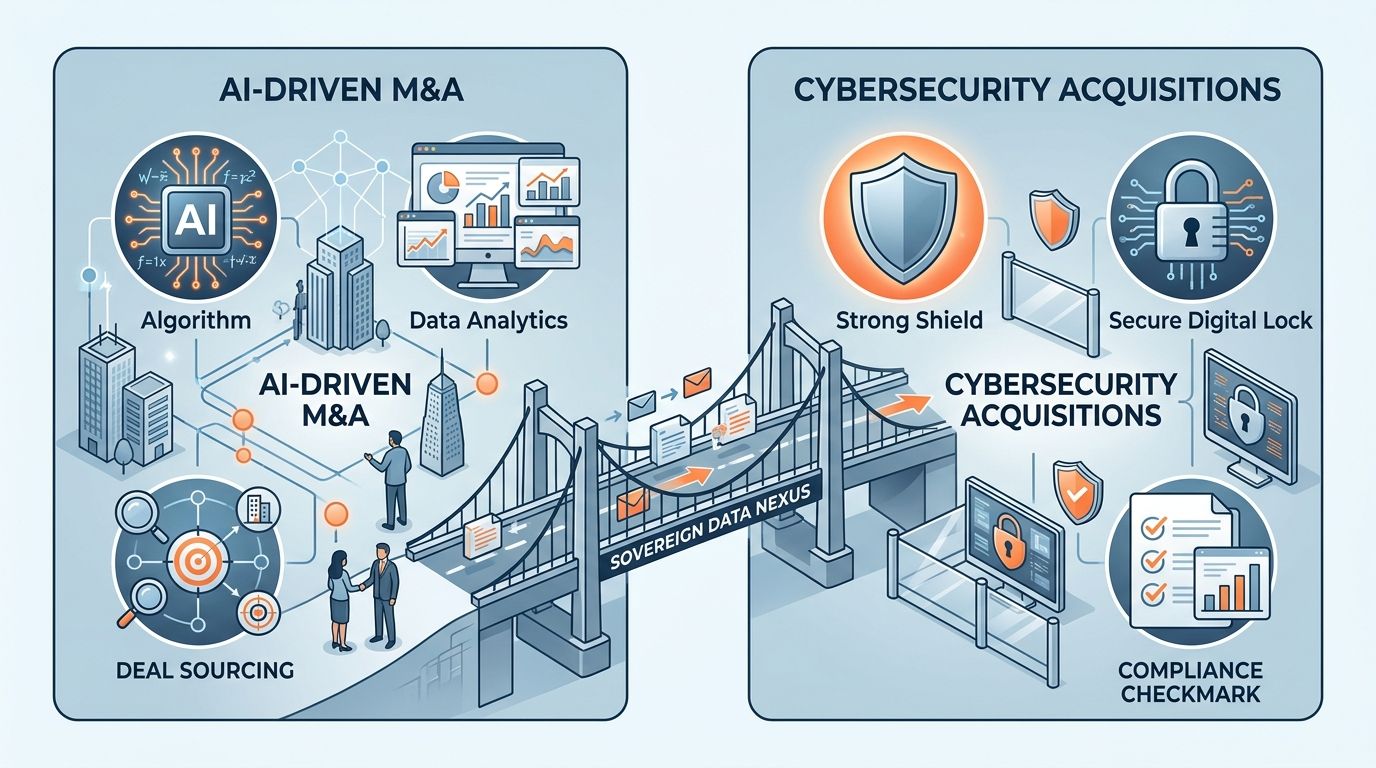
    The landscape of tech mergers and acquisitions is being reshaped by two powerful forces: the application of artificial intelligence and a surge in cybersecurity-focused dealmaking. As a Boutique M&A and Capital Advisory Firm, Zaidwood Capital sees these trends creating both opportunity and complexity for growth companies and investors. To understand these shifts, it is helpful to revisit what is an investment bank and how its core advisory services are being transformed by technology. The traditional functions of capital raising and full-cycle M&A are now augmented by proprietary data, AI-driven analytics, and rapid execution capabilities that distinguish boutique platforms from larger wirehouses.

    Infographic showing AI-driven M&A on left and cybersecurity acquisitions on right connected by Sovereign Data Nexus bridge
    AI and cybersecurity acquisition trends infographic

    Now, AI-powered M&A is transforming every stage of the deal lifecycle. Our Sovereign Data Nexus employs machine learning to scan thousands of targets, flagging financial and operational red flags and surfacing data-driven opportunities that traditional manual screening would miss. Predictive valuation models, built on historical transaction data and real-time market signals drawn from our global investor network, help our team price transactions with greater precision. This is not just a pre-deal advantage; AI tools are increasingly used in post-merger integration to identify synergy realizations and operational efficiencies that protect deal value. For clients, staying ahead of trends in ai-driven m&a requires access to proprietary data and tech-enabled diligence, which translates into faster, more informed decision-making—a distinct edge in competitive processes.

    Cybersecurity acquisitions have become a dominant theme in the current cycle. Companies are acquiring specialized security firms to defend against evolving threats, comply with tightening regulations, and build competitive moats around their digital assets. With over $24.4 billion in aggregate transaction volume handled by our team, we have witnessed a sharp increase in deals targeting cybersecurity providers. The growth in cybersecurity acquisitions reflects a strategic imperative to embed security as a driver of resilience. Our Velocity Matrix enables rapid execution, and our network of 4,000+ investors actively seeks cyber-focused deals. This approach allows clients to capitalize on market opportunities before conditions change.

    Understanding these emerging trends—and how a boutique platform like Zaidwood Capital leverages the Sovereign Data Nexus and Velocity Matrix—is essential for any stakeholder considering a technology-driven transaction. In our next section, we explore how we structure and execute full-cycle deals that capitalize on these dynamics.

    Achieving Success in Tech Mergers and Acquisitions

    Success in tech mergers and acquisitions hinges on speed, proprietary data, and rigorous due diligence. In a landscape where cybersecurity acquisitions can turn on undiscovered vulnerabilities, and ai-driven M&A requires deep technical evaluation, traditional advisory is no longer enough.

    We address this through our proprietary deal infrastructure. Our Sovereign Data Nexus provides secure, transaction-specific servers and exclusive data sets, enabling the granular risk assessment technology deals demand. The Velocity Matrix then compresses execution timelines without sacrificing quality, a critical advantage in fiercely competitive tech auctions. Underpinning both is the Precision Catalyst, our integrated investor-engagement engine that uses digital marketing and capital-markets expertise to align startups, growth companies, and institutional capital at the right moment.

    We deliver this as Full-Cycle M&A: end-to-end support from strategic documentation through to a closed transaction. While these capabilities sharpen execution, every deal involves inherent risk and requires careful regulatory and legal compliance. These tools form the foundation of our advisory process, explored in the next section.

    Resources

  • What Is an Investment Bank? Key Services Explained

    What Is an Investment Bank? Key Services Explained

    Table of Contents

    The Role of Investment Banks in Modern Finance

    Understanding what is an investment bank is essential to grasping modern financial markets, as these institutions serve as vital intermediaries between companies seeking capital and the investors who provide it. According to the CFA Institute, the global standard-setter for the investment industry, investment banks facilitate capital formation, mergers and acquisitions, and market making, driving economic growth globally today.

    Investment banks perform three primary functions: capital raising, mergers and acquisitions advisory, and market making. In capital raising, we offer capital raising solutions that leverage our extensive investor network to secure equity and debt financing. In mergers and acquisitions, we advise on deal structuring, valuation, and negotiation, ensuring strategic alignment. Market making provides liquidity and price discovery, but boutique firms typically focus on advisory, delivering personalized, high-touch service enhanced by tools like our Sovereign Data Nexus and Velocity Matrix. These functions collectively channel capital to productive enterprises, fueling innovation and economic expansion.

    At Zaidwood Capital, we are redefining Financial Services 3.0 as a Boutique M&A and Capital Advisory Firm, combining proprietary data access via our Sovereign Data Nexus with precision execution through our Velocity Matrix to accelerate deals. Securities are offered through Finalis Securities LLC; Zaidwood Capital is not a registered broker-dealer.

    Investment Banking Services: From Advisory to Capital Markets

    When clients ask what is an investment bank, we answer with a clear definition: A financial institution that provides strategic advisory and capital-markets services to corporations, governments, and institutions. Unlike commercial banks that focus on deposit-taking and lending, investment banks operate on a fee-based model, guiding complex transactions like mergers and acquisitions and large-scale capital raising.

    Investment Bank vs. Commercial Bank
    Feature Investment Bank Commercial Bank
    Primary Focus Advisory & Capital Markets Deposits & Lending
    Revenue Model Fee-based Interest-based

    This distinction is foundational. While commercial banks serve everyday financial needs, investment banks unlock growth through corporate finance advisory, deal orchestration, and access to deep capital pools.

    Our firm’s advisory practice spans the full continuum of mergers and acquisitions—from target identification and valuation to negotiation and close—while our capital-markets capabilities help clients structure and secure equity, debt, and structured solutions. For a growing enterprise seeking capital raising, we craft strategic materials like pitch decks, business plans, and pro forma financials, then leverage our global network of over 4,000 institutional and private investors to create institutional introductions.

    Mergers and Acquisitions: How Investment Banks Drive Deal Execution

    To fully appreciate what an investment bank does in the context of mergers and acquisitions, it helps to examine the entire deal lifecycle. Investment banks serve as strategic partners that bring financial expertise, proprietary data tools, and a global investor network to the table. We follow a three-phase framework that covers deal sourcing and initial pitch, rigorous due diligence and financial modeling, and finally negotiation, structuring, and closing.

    Deal Sourcing and Initial Pitch

    We proactively identify acquisition targets or divestiture opportunities through our proprietary Sovereign Data Nexus and long-standing industry relationships. By continuously monitoring market signals and capital flows, we surface potential transactions that align with a client’s strategic objectives. Once a promising opportunity is identified, we craft a tailored pitch book that outlines a compelling investment thesis, preliminary valuation ranges, and a roadmap for value creation.

    Due Diligence and Financial Modeling

    Once a letter of intent is signed, we lead a comprehensive due diligence process that examines financial statements, operational metrics, legal risks, and market conditions. Following the best practices outlined by the CFA Institute, our team validates the target’s earnings quality, working capital dynamics, and growth assumptions. We build a suite of valuation models—discounted cash flow, precedent transaction, and leveraged buyout analyses—to triangulate intrinsic value and stress-test deal economics.

    Negotiation, Structuring, and Closing

    With due diligence findings in hand, we advise on deal structure—whether a stock or asset purchase, and how earn-outs, seller financing, or contingent consideration can bridge valuation gaps. We take the lead in negotiations, coordinating closely with legal and tax advisors to translate commercial terms into binding documents. Throughout this phase, our secure deal vaults serve as central hubs for all transaction materials, accelerating the exchange of sensitive information.

    Capital Raising Strategies: Equity and Debt Financing Pathways

    A core function of an investment bank is helping companies raise capital to fuel growth, execute strategic initiatives, or navigate complex transactions. At Zaidwood Capital, we specialize in capital raising as part of our Full-Cycle M&A and Capital Advisory services, connecting businesses with the right mix of equity and debt financing.

    Equity Financing: Private Placements and Growth Equity

    Equity financing allows businesses to raise capital by selling ownership stakes. Investment banks facilitate private placements, offering shares to accredited investors and institutional investors rather than public markets, which can be faster and more flexible. At Zaidwood Capital, we leverage a network of more than 4,000 investors to connect companies with the right capital providers.

    Debt Financing and Structured Solutions

    Debt financing allows companies to borrow capital without diluting ownership, preserving control for existing shareholders. Investment banks structure a range of instruments: senior debt is secured by company assets, carries a lower interest rate, and ranks first in repayment priority; mezzanine financing is subordinated, carries higher cost, and often includes equity warrants.

    Equity vs. Debt Financing
    Dimension Equity Debt
    Ownership Diluted Preserved
    Repayment None Regular Payments

    Preparing Your Business for a Capital Raise

    Thorough preparation significantly increases the likelihood of a successful capital raise. Start by compiling audited or reviewed financial statements that demonstrate historical performance and projections. A credible business valuation sets realistic expectations for deal terms. Develop a compelling investor pitch deck that clearly articulates the company’s value proposition, growth strategy, and use of funds.

    Boutique Investment Banking: The Zaidwood Capital Advantage

    If the searcher’s question is what is an investment bank, the clearest answer begins with the distinct categories of the industry. Investment banks facilitate the flow of capital, but they operate across a spectrum from boutique advisory firms to global full-service institutions and the largest bulge-bracket banks. At one end, boutique firms like Zaidwood Capital deliver high-touch, specialized guidance for mid-market and growth companies.

    Boutique vs. Full-Service vs. Bulge-Bracket
    Type Focus Advantage
    Boutique Advisory Senior Attention
    Bulge-Bracket Global Markets Balance Sheet
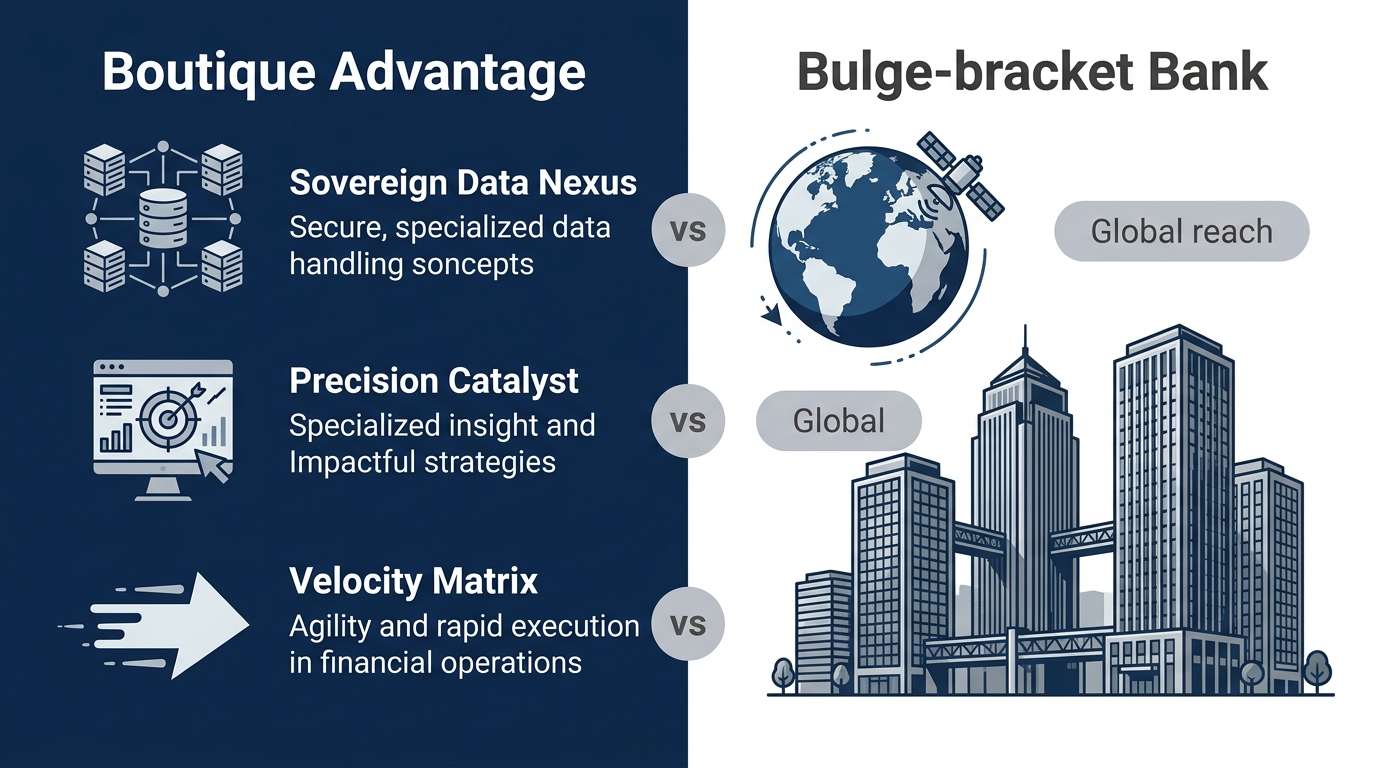
    Side-by-side infographic comparing boutique investment bank advantages with data, marketing, and speed icons versus traditional bulge-bracket bank with globe and buildings

    Comparison infographic showing boutique versus traditional banking advantages

    Common Questions About Investment Banking

    What is an investment bank?
    An investment bank is a financial intermediary that helps companies raise capital and execute mergers and acquisitions. They range from large bulge-bracket institutions to specialized boutique firms like ours, which provide senior-led, personalized advice and sector expertise.

    Unlike traditional investment banks, our boutique advisory provides end-to-end support throughout your transaction lifecycle. Our team brings expertise in mergers and acquisitions and capital raising, leveraging proprietary tools like the Sovereign Data Nexus for data-driven insights and the Velocity Matrix to accelerate execution. Zaidwood Capital is not a registered broker-dealer; securities are offered through Finalis Securities LLC.

    Resources

  • Private Equity Continuation Funds: Complete Guide for Investors

    Private Equity Continuation Funds: Complete Guide for Investors

    Table of Contents

    Private equity continuation funds explained

    Private equity continuation funds are GP-led secondary transactions where a new fund vehicle is established to hold existing portfolio assets beyond the original fund’s term. These structures can be arranged as single-asset continuation vehicles or as multi-asset pools. The objective is twofold: they provide limited partners with an early liquidity mechanism while enabling the general partner to continue managing and growing the assets.

    In a typical transaction, the GP sponsors the new vehicle and offers existing LPs a choice — a cash exit at a reset valuation or the opportunity to roll their interests into the successor fund. This approach aligns incentives and can supply follow-on capital for further value creation.

    For fund managers, executing a continuation fund requires specialized capital-raising and placement capabilities. Learn more about our capital formation services. This is not investment advice — consult your professional advisors.

    How Private Equity Continuation Funds Work

    Private equity continuation funds, also known as GP-led secondary transactions, are sophisticated financial vehicles that allow general partners to extend their holding period for high-potential portfolio companies or assets. At Zaidwood Capital, we have observed a significant increase in GP-led secondary transactions as fund managers seek innovative ways to maximize returns for their investors. These structures provide liquidity options for existing limited partners while enabling continued value creation in promising investments.

    The core mechanism involves a GP initiating a GP-led secondary transaction by transferring assets from an existing fund into a newly formed continuation vehicle. This process typically includes both existing LPs and new institutional investors, with the GP retaining a significant stake to demonstrate confidence in the assets’ future performance and align interests across all parties involved.

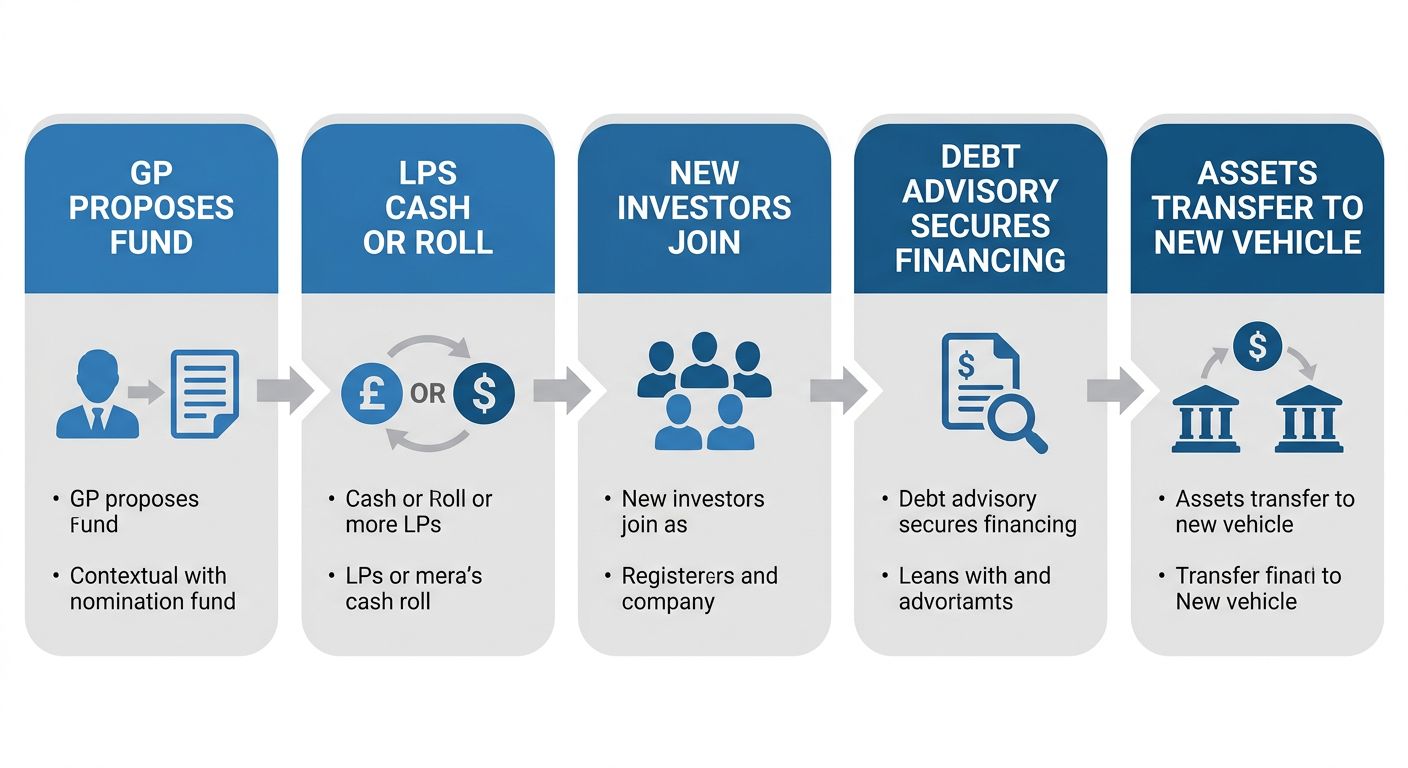
    Flowchart of a GP-led continuation fund transaction with five connected stages in a professional blue and gray palette

    GP-led continuation fund transaction process flow

    The transaction flow illustrated above demonstrates how these complex structures come together. The process begins with asset identification and valuation, followed by the formation of the new vehicle, capital raising from both new and existing investors, and ultimately the transfer of assets to the continuation fund.

    Financing plays a critical role in structuring these transactions, and debt advisory services from Zaidwood Capital can provide the necessary financing structures for these funds. According to Zaidwood Capital’s internal knowledge resources, our Full-Cycle M&A and capital advisory practice encompasses mezzanine debt, venture debt, and asset-based lending structures that support GP-led secondary transactions. With access to over 4,000 institutional investors and $15 billion in deployable capital, we help structure the optimal financing package for each unique situation.

    The valuation process requires rigorous fairness opinions and third-party advisory to ensure alignment with LP interests. Independent valuation firms assess the transferred assets to establish a fair market price, protecting all stakeholders involved in the transaction.

    Continuation funds can be structured as single-asset continuation vehicles or multi-asset vehicles, depending on the GP’s strategic objectives. A single-asset continuation vehicle focuses on one high-conviction portfolio company, while multi-asset structures consolidate several related holdings. These structures have become increasingly prevalent in today’s private equity landscape, offering flexible solutions for portfolio optimization and extended value creation timelines.

    GP-Led Secondary Transactions and Single-Asset Vehicles

    GP-led secondary transactions have become a defining feature of today’s private equity landscape, driven by the growing use of private equity continuation funds. In a GP-led deal, a general partner facilitates the sale of existing limited partner interests to new investors, often by transferring a portfolio company into a newly created continuation fund. This structure gives both continuing and exiting LPs greater flexibility than a traditional fund liquidation.

    A prominent subset of these transactions is the single-asset vehicle. Here, a single portfolio company is moved into a standalone fund, allowing the GP to hold a high-performing asset beyond the original fund’s life. This approach unlocks the runway needed for additional value creation while providing immediate liquidity to LPs who wish to exit. In our experience, these vehicles also enable more tailored governance terms and focused board oversight, which can accelerate strategic initiatives and operational improvements, provide clearer reporting metrics for investors concentrated on concentration risk and exit timing, and support alignment of incentives among continuing stakeholders while preserving LP choice and protections. We have seen demand for single-asset continuation vehicles increase significantly as GPs seek longer holding periods for prized assets.

    Why do GPs favor these structures? First, they can retain top-performing companies rather than selling them prematurely. Second, they raise follow-on growth capital to fund expansion or acquisitions. Third, they offer existing LPs a clear choice: cash out at fair value or roll their interest into the new vehicle. These transactions typically require independent valuations and approval from the LP advisory committee, ensuring alignment with capital market standards for secondary processes.

    At Zaidwood Capital, we advise clients on navigating these transactions from initial structuring through close. Our work in the private equity secondary market confirms that well-designed continuation funds balance the interests of all parties while capturing additional upside. The next section explores the valuation techniques that underpin fairness opinions in these evolving deal structures.

    Several interrelated factors explain this surge in popularity. We see that private equity continuation funds have become a cornerstone of liquidity solutions in 2026, driven by regulatory clarity, market demand for flexible exits, and the structural innovation of GP-led transactions.

    The U.S. Securities and Exchange Commission (SEC) has been a primary catalyst for this growth. SEC investor protection has been a key priority, with the SEC strengthening its initiatives to oversee GP-led secondary transactions. Through proposed rule changes and enforcement priorities, the regulator has clarified the framework for exempt offerings and secondary market activity, making it easier for fund managers to structure continuation vehicles that safeguard investor interests while providing much-needed transactional certainty.

    Market demand for liquidity solutions has further accelerated the trend. Institutional investors are increasingly turning to these structures to realize partial or full exits without triggering forced asset sales that could dilute returns. Private equity continuation funds give LPs the flexibility to recycle capital while GPs retain high-performing assets for further value creation. With fund lifespans extending beyond traditional horizons, the ability to execute gp-led secondary transactions has become essential for aligning the longer-term interests of managers and their limited partners.

    Structurally, the rise of single-asset continuation vehicles has been a defining feature of this cycle. These vehicles bundle a single portfolio company into a new fund, allowing the GP to extend the investment period and pursue additional growth while offering existing LPs the choice to liquidate or roll their interests. This targeted approach has gained traction as a flexible way to manage concentrated positions, reduce portfolio complexity, and align incentives without the legal and operational burden of full-fund restructurings. These examples show private equity continuation funds balance liquidity needs with longer-term investment horizons overall.

    Having examined the drivers, we now turn to the mechanics of these transactions and how they are structured to meet the needs of sponsors and investors alike.

    Benefits and Risks for LPs and GPs

    For GPs considering a continuation fund, the strategic advantages are compelling. Private equity continuation funds allow general partners to access liquidity from older fund portfolios without forcing a premature sale of assets that still have meaningful upside potential. We see this as a powerful tool that aligns interests by giving GPs the ability to extend their management of high-performing assets—particularly through the use of single-asset continuation vehicles—while simultaneously offering limited partners a clear choice between realizing gains and maintaining exposure. From an LP perspective, this structure provides valuable optionality. Rather than facing a binary outcome when a fund nears the end of its life, investors receive a liquidity event for their legacy fund interests coupled with the ability to roll over their commitment if they believe in the continued growth trajectory of the underlying portfolio.

    However, these transactions are not without complexity. One of the most persistent challenges lies in determining a fair market price for inherently illiquid assets, which requires rigorous third-party valuation work and independent fairness opinions. The inherent GP–LP conflict of interest sits at the center of every GP-led secondary transaction—the GP serves as both sponsor of the existing fund and, effectively, the buyer in the new continuation vehicle. To manage this, we advise clients to insist on transparent disclosure, independent governance structures, and the active involvement of legal and financial advisors who represent LP interests throughout the process.

    All GP-led secondary transactions are subject to FINRA regulatory compliance standards, including requirements for fairness opinions and transparent disclosure. When a broker-dealer such as Finalis Securities LLC is engaged, adherence to FINRA rules is mandatory. The Financial Industry Regulatory Authority (FINRA) establishes the regulatory framework that governs how securities firms involved in these transactions must operate, providing a baseline of investor protection through its oversight of disclosure practices, fair-dealing obligations, and conflict-of-interest management. This regulatory overlay reinforces the governance discipline that sophisticated LPs should demand.

    We emphasize that continuation funds are not risk-free. LPs should carefully evaluate the GP’s track record with similar structures, the specific governance protections built into the transaction, and whether the continuation vehicle genuinely aligns with their portfolio objectives. When structured thoughtfully and governed transparently, continuation funds can serve as a valuable liquidity and portfolio management solution—but the burden of due diligence rests squarely on all parties involved.

    This content is for informational purposes only and does not constitute investment advice or an offer, solicitation, or recommendation to transact. Investments involve risk and may be illiquid; investors may lose all or part of their investment. Zaidwood Capital LLC is not a registered broker-dealer. Securities are offered through Finalis Securities LLC, a separate entity.

    Best Practices for Evaluating Continuation Fund Opportunities

    Private equity continuation funds represent a growing segment of GP-led secondary transactions where a general partner transfers one or more portfolio assets from an existing fund into a new vehicle under the same management. While these structures can offer extended value-creation runway and fresh capital, they demand rigorous investor scrutiny to ensure the transaction serves limited partner interests fairly. We believe a methodical evaluation framework is essential for any LP assessing such opportunities.

    At the core of every analysis are several critical factors. First, we examine GP incentive alignment—specifically whether the manager is committing meaningful co-investment capital to the continuation vehicle and how the fee structure impacts net returns. Second, the fairness of the valuation process requires close attention, including whether an independent third-party opinion has been obtained and how the pricing compares to recent market benchmarks. Third, the composition and independence of the oversight committee or advisory board play a vital role in mitigating conflicts of interest, as does the transparency of disclosure around any existing GP–LP dynamics that may influence the proposed transaction.

    A thorough review must also consider the fund’s historical track record and the strategic rationale for retaining the asset rather than pursuing an outright sale. Investors should scrutinize the fee structure carefully, including management fees, any transaction-related costs, and the impact on carried interest calculations. Zaidwood Capital notes that evaluating the underlying financing terms is equally important, and our debt advisory team often helps clients analyze leverage arrangements embedded in continuation fund structures to ensure they align with long-term value-creation objectives. We also evaluate exit timing, market receptivity, and operational improvement plans to ensure the continuation path is realistic and achievable over time.

    These due diligence pillars—alignment, valuation integrity, independent oversight, and fee transparency—form the foundation of informed LP decision-making in GP-led secondary transactions. With these best practices in mind, our team can assist in structuring and vetting such opportunities.

    Key Takeaways and Next Steps in Continuation Fund Strategy

    Our earlier sections laid out how private equity continuation funds serve as flexible structures that extend fund life and deliver intermediate liquidity. These vehicles allow general partners to hold prized assets longer while giving limited partners options to roll over or exit.

    GP-led secondary transactions and single-asset continuation vehicles form the core of this strategy, aligning sponsor and investor interests through transparent pricing and governance. At Zaidwood Capital, we advise on structuring these transactions, from selecting the appropriate vehicle to managing the reinvestment process.

    As you evaluate your next move, you may consider:

    • Reviewing your current fund documents and limited partnership agreements for rollover provisions.
    • Weighing single-asset continuation funds against multi-asset GP-led solutions based on your portfolio concentration and return objectives.
    • Engaging a capital advisor experienced in secondary transactions and structured liquidity events.

    Our Continuation Fund FAQ details common questions, and we invite you to book a discovery call for tailored guidance on your specific situation.

    Resources

  • Best Debt Advisory for 2026: Trusted Options

    Best Debt Advisory for 2026: Trusted Options

    Table of Contents

    In today’s volatile markets, particularly in the US, debt advisory plays a crucial role in empowering business leaders and investors to fuel mergers and acquisitions without diluting equity. As economic shifts toward 2026 demand innovative financing, strategic debt guidance bridges valuation gaps and optimizes capital structures for sustainable growth.

    Debt advisory services provide expert counsel on debt instruments tailored to funding needs, from mezzanine and venture debt to asset-based lending. At Zaidwood Capital, we leverage our debt advisory services to connect clients to over 15 billion USD in deployable capital through a network of more than 4,000 institutional investors. With 24.4 billion USD in aggregate transaction volume across 300+ deals, we deliver cost-efficient solutions that preserve ownership and offer tax advantages, ensuring competitive terms and rapid execution.

    Discover key benefits in the following listicle, highlighting how our boutique expertise drives strategic capital debt strategies for your M&A success.

    1. Enhance M&A Deal Structures

    In the fast-paced world of mergers and acquisitions, balancing valuation expectations and funding sources often presents significant hurdles. M&A debt financing emerges as a strategic tool, enabling buyers to secure capital without excessive equity dilution, thus preserving ownership control while accelerating deal timelines. At Zaidwood Capital, our M&A capital advisory services integrate acquisition funding strategies to bridge these gaps effectively.

    We provide comprehensive debt advisory throughout the M&A process, leveraging mezzanine debt for flexible valuation adjustments and seamless integration with due diligence to mitigate risks. Our full-cycle approach encompasses deal structuring, lender introductions from our network of over 4,000 investors, and tailored solutions for mid-market transactions. Drawing from our $24.4 billion in aggregate transaction volume across buy-side and sell-side mandates, we ensure clients achieve optimized structures that enhance viability and cost efficiency compared to equity-only approaches. This methodology, informed by proven advisory processes, supports precise execution and long-term value creation.

    Consider a mid-market acquisition where a client sought to fund a strategic buyout. Our team arranged mezzanine financing to cover the equity shortfall, closing the deal swiftly without ownership concessions. To leverage similar benefits, engage experienced advisors early to align financing with your transaction goals.

    2. Access Mezzanine and Venture Debt

    In today’s competitive landscape, debt advisory services provide essential hybrid financing solutions that enable businesses to fuel growth without diluting ownership entirely. These specialized debt options bridge the gap between traditional loans and equity, offering flexible capital for strategic expansions or acquisitions.

    Mezzanine debt serves as subordinated financing, often including equity warrants, ideal for mid-market companies pursuing mergers and acquisitions or operational scaling. It features higher interest rates but lenient covenants, with repayment terms typically spanning 5-7 years. Venture debt, meanwhile, supports early-stage firms by extending cash runway post-equity rounds, minimizing equity surrender through attached warrants. We structure these facilities to align with client objectives, emphasizing competitive terms and policy considerations like tax integration for efficient capital formation in the US.

    As a leading financial advisory firm, we leverage our extensive network of over 3,000 lenders to arrange mezzanine and venture debt, having facilitated more than $800 million in tailored solutions. This approach ensures mid-market clients access scalable funding swiftly, often closing deals in under 60 days.

    3. Differentiate Debt from Equity Paths

    When optimizing capital structures, clients often face the dilemma of equity vs debt financing. Should you opt for debt advisory to maintain control, or embrace equity for long-term growth? At Zaidwood Capital, we guide decisions that align with your strategic objectives, balancing risks and rewards effectively.

    Debt financing involves repayment obligations with interest, preserving ownership while leveraging assets, whereas equity introduces ownership dilution but supplies permanent capital without repayment pressures. Our debt advisory services assess leverage ratios and market conditions to recommend optimal paths, considering tax deductibility of interest versus equity’s dividend flexibility. For US deals, regulatory compliance, such as in debt advisory SEC filing examples, ensures structured integrity. Policy insights on corporate integration further highlight capital advisory contrasts, aiding informed selection through an evaluation framework that weighs cost, control, and scalability.

    Consider a mid-sized firm seeking expansion: We at Zaidwood structure mixed financings, blending debt for immediate needs and equity for sustained innovation, drawing on our dual expertise to deliver tailored solutions that enhance value without compromising autonomy.

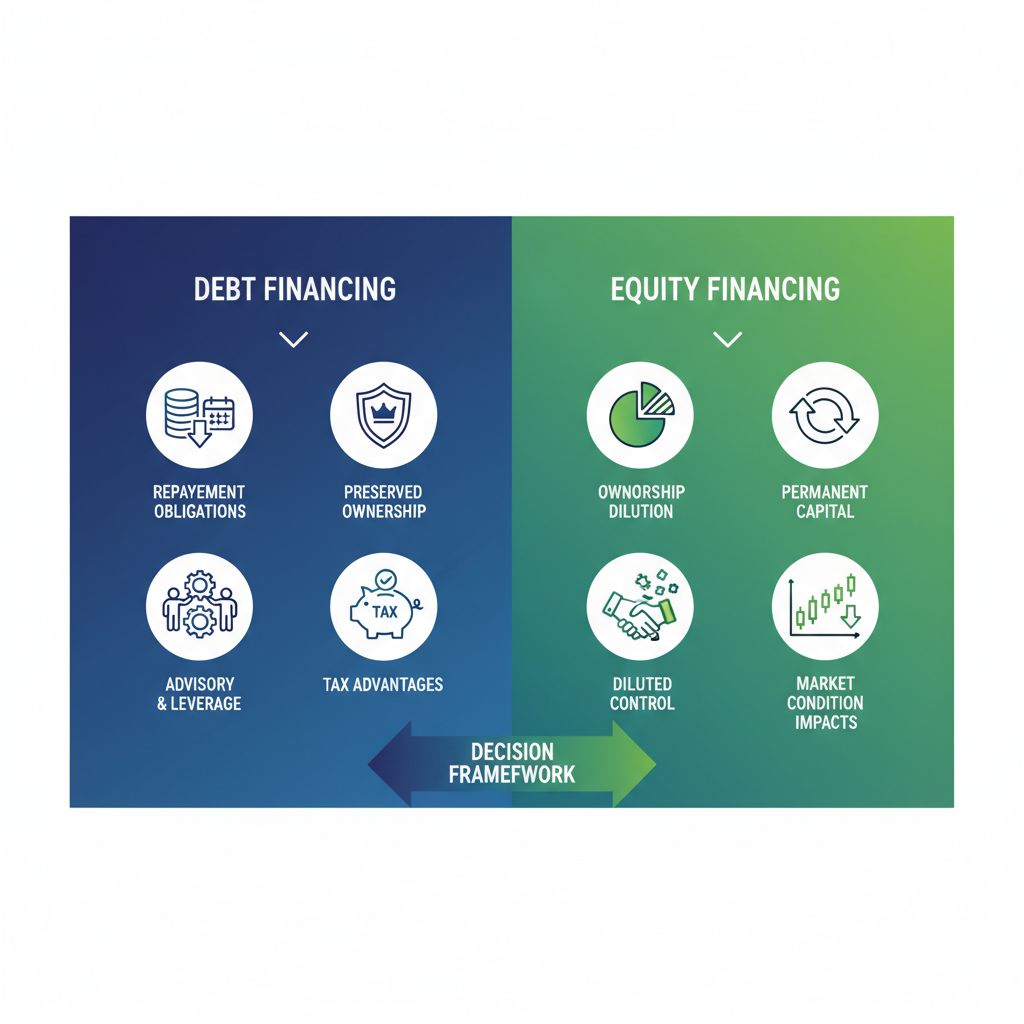
    Infographic comparing debt and equity financing paths in capital advisory

    Visual comparison of debt and equity financing options for strategic capital structuring

    4. Implement Forward-Looking Strategies

    As economic uncertainties loom in 2026, effective debt advisory becomes essential for businesses navigating volatility. We at Zaidwood Capital emphasize adaptive strategies that incorporate sustainable practices and technological innovations to safeguard financial health.

    Key trends include ESG-linked debt instruments, which tie financing terms to environmental and social performance metrics, and digital lending platforms powered by blockchain for streamlined transactions. Scenario planning helps mitigate interest rate fluctuations by modeling various economic paths, while integrating these with M&A activities creates resilient capital structures. Emerging US regulations on digital assets, such as those surrounding distributed ledger technology (DLT) bonds as outlined by the ICMA, demand proactive compliance. Our market insights and extensive network enable timely execution of these future debt tactics.

    For instance, we guide clients through strategic financing planning via a transaction advisory agreement, ensuring alignment with long-term goals. Tip: Regularly review portfolios against regulatory updates to maintain agility and capitalize on opportunities.

    5. Leverage Boutique Firm Advantages

    Boutique firms offer unique advisory network benefits in debt advisory in the US, providing personalized attention and agility that larger institutions often cannot match. We focus on tailored financing solutions, ensuring clients receive bespoke strategies aligned with their specific goals.

    Unlike standardized products from big banks, boutique financing expertise enables faster execution through dedicated teams unburdened by bureaucracy. This approach delivers deeper due diligence without the conflicts inherent in FINRA broker dealer firms, which must balance multiple client interests. Our regulatory clarity as independent advisors allows unbiased guidance, drawing on extensive networks for efficient capital access. With over 300 completed deals and connections to more than 4,000 investors, we streamline transactions while maintaining transparency and compliance.

    For optimal results, vet advisors by reviewing their track record and network depth. At Zaidwood Capital, our 4,000+ investor connections and $24.4 billion in aggregate transaction volume demonstrate proven advisory network benefits, helping clients secure funding swiftly and securely.

    6. Streamline Due Diligence Processes

    In the complex landscape of mergers and acquisitions and financing, thorough due diligence serves as a critical safeguard against unforeseen risks. Our full-cycle approach at Zaidwood Capital integrates comprehensive reviews across financial, legal, operational, and commercial domains to support informed decision-making in debt transactions.

    We begin with financial audits, scrutinizing balance sheets, cash flows, and projections to identify discrepancies. Legal assessments evaluate contracts, compliance, and liabilities, while operational reviews examine supply chains and processes. Commercial evaluations assess market positioning and revenue viability. For debt deals, we prioritize risks such as covenant compliance and lender protections, drawing from established agreement standards to ensure alignment with transaction terms. This phased diligence mitigates exposure and uncovers value drivers.

    At Zaidwood, proprietary tools like our secured data room enhance efficiency, enabling seamless documentation and collaboration. Clients preparing for debt advisory should organize key records in advance, facilitating smoother reviews and faster execution. By streamlining these processes, we bridge strategic planning with reliable safeguards.

    Maximize Capital Efficiency Ahead

    In today’s dynamic financial landscape, debt advisory emerges as a pivotal tool for optimizing M&A transactions and capital structures. We’ve explored enhanced deal structures, diverse debt types like mezzanine and venture debt, which offer advantages over equity financing through lower dilution and tax benefits. Looking to 2026, boutique firms provide agile diligence and integrated strategies that drive financing optimization and superior outcomes.

    At Zaidwood Capital, our comprehensive advisory services leverage a vast network of over 4,000 investors and $24.4 billion in aggregate transaction volume to connect clients with tailored strategic debt solutions. We guide businesses through efficient processes, ensuring transparency and alignment with objectives, drawing on proven expertise in hundreds of deals.

    Embrace these opportunities to maximize capital efficiency in the evolving US market—contact us today to discuss your needs.

    Resources