Zaidwood Capital

Tag: Mezzanine Financing

  • Direct Lending Market Comparison: Top Private Capital Strategies

    Direct Lending Market Comparison: Top Private Capital Strategies

    Table of Contents

    Direct Lending Market: A Competitive Capital Source for Middle-Market Companies

    Middle-market firms facing rigid bank underwriting increasingly turn to the direct lending market for speed and flexibility. Unlike traditional bank loans, direct lending—provided by non-bank institutions—offers faster execution, covenant-light structures, and reduced regulatory hurdles. Our firm’s research confirms that borrowers value this private credit market for its ability to close deals swiftly.

    Current U.S. direct lending spreads remain competitive, attracting middle-market companies away from syndicated loans. Zaidwood Capital’s market intelligence shows direct lending integrates with broader private capital raising strategies, including GP-led secondary transactions that provide liquidity. Companies pursuing emerging markets M&A also benefit from direct lending’s speed and flexibility. In the following section, we outline how our team structures these customized solutions.

    1. Competitive Interest Rate Spreads

    In the U.S. direct lending market, borrowers seek competitive pricing amid tightening spreads. According to Zaidwood Capital’s market analysis, current all-in yields reflect the following typical ranges in basis points (bps):

    • Senior secured direct loans for mid-market transactions: SOFR + 400–600 bps.
    • Unitranche structures for high-quality sponsors: SOFR + 350–500 bps, while smaller or riskier borrowers may see spreads of +600–800 bps.
    • Second-lien or mezzanine tranches: SOFR + 800–1,200 bps.

    Spread compression over the past year has been driven by heightened competition among direct lenders, a trend we also observe in private capital raising strategies and GP-led secondary transactions. Deal size, credit quality, and leverage shape pricing, and our network enables us to secure competitive terms in the U.S. direct lending market. While spreads remain competitive, sponsors pursuing emerging markets M&A often face wider spreads due to higher perceived risk. These benchmarks directly influence the cost of capital across deal structures, a dynamic we navigate for every mandate.

    2. Flexible Financing Structures

    Beyond standard capital raising, we offer flexible financing structures that leverage the direct lending market to deliver faster execution and custom terms compared to traditional bank loans. As our internal FAQ on direct lending explains, this alternative to bank financing bridges gaps where conventional credit often falls short, especially for mid-market transactions.

    Our tailored solutions encompass mezzanine debt, venture debt, equipment financing, and asset-based lending. Each instrument is custom-quoted to the client’s specific transaction, ensuring the right capital structure for growth, acquisitions, or liquidity. By operating in the direct lending market, we can craft flexible covenants and amortization schedules that align with your cash-flow profile. These structures support private capital raising strategies that go beyond one-size-fits-all bank terms.
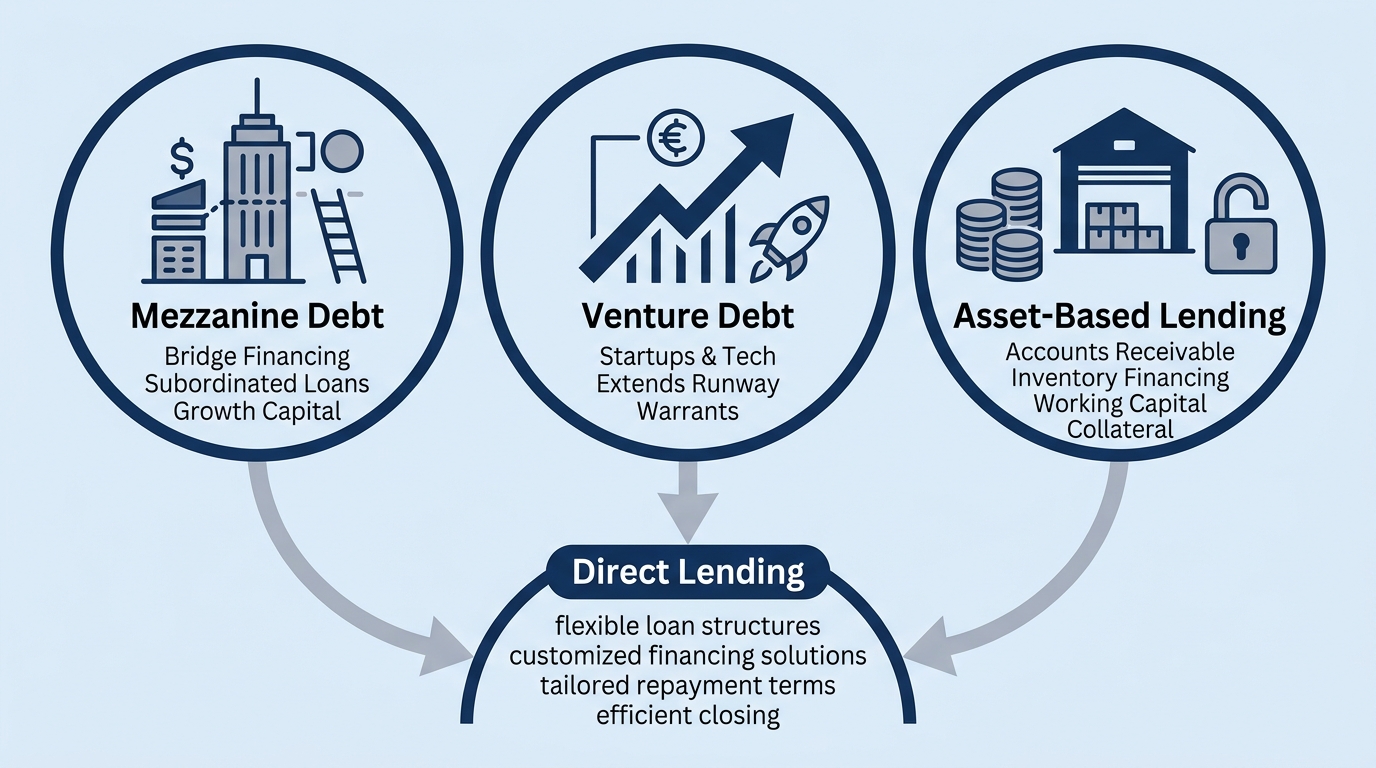
    Infographic showing three flexible financing structures: mezzanine debt, venture debt, and asset-based lending connected to a direct lending hub.

    Flexible financing structures connected to direct lending.

    This flexible financing approach is designed to reinforce your buy-side M&A strategies with speed and precision, complementing our Full-Cycle M&A and capital advisory. To explore a custom-quote structure for your next transaction, Book A Call. This is not an offer or commitment; all financing is subject to due diligence and final documentation.

    3. Speed and Certainty of Execution

    In today’s direct lending market, speed and certainty of execution are decisive advantages for businesses evaluating private capital raising strategies.

    Traditional syndicated bank loans demand months of negotiation among multiple syndicate tiers and require extensive regulatory filings under SEC capital raising regulations; in stark contrast, direct lenders issue committed capital letters upfront and close in weeks, with fewer parties, less documentation, and a near-certain funding outcome.

    Zaidwood Capital’s proprietary market intelligence shows that current U.S. direct lending interest rate spreads remain favorable for borrowers, indicating that institutional lenders are actively seeking to deploy capital and can move swiftly when opportunities arise.

    Our approach to Streamlining Transactions shortens the search and negotiation cycle, and with a global network of over 4,000 investors, we accelerate execution for transactions ranging from corporate debt to GP-led secondary transactions, reducing opportunity cost and securing better terms.

    This speed and certainty, combined with Zaidwood Capital’s full-cycle advisory platform, streamlines access to substantial institutional capital for businesses pursuing growth.

    4. Middle-Market Capital Access

    Middle-market companies with revenues between $10 million and $1 billion frequently encounter a capital gap that traditional bank loans cannot fill, making access to capital in the direct lending market a vital alternative. As our FAQ notes, direct lending transactions close weeks faster than bank loans, with fewer covenants and flexible terms that adapt to a company’s cash flows rather than rigid formulas. Post-2008 regulatory changes constrained traditional bank lending, cementing the direct lending market as the core funding channel for mid-size firms. We help middle-market firms structure direct lending opportunities through our network of over 4,000 institutional investors and $15 billion in deployable capital, accelerating execution and reducing time-to-close. Beyond direct lending, our team deploys wider private capital raising strategies, including GP-led secondary transactions, to meet each company’s unique capital needs. Because direct lending operates under FINRA regulation direct lending, all participants must ensure strict compliance. Securities are offered through Finalis Securities LLC; Zaidwood Capital is not a registered broker-dealer and is separate from Finalis.

    5. Private Equity Buyout Support

    The direct lending market has become a cornerstone of private equity buyouts as firms seek speed and flexibility beyond traditional bank leverage loans. We at Zaidwood Capital see direct lender financing offering bespoke terms that align with the specific cash flow profiles of portfolio companies. This private credit approach sidesteps the rigid syndication processes of conventional banks, enabling faster closings and more creative capital structures. GP-led secondary transactions further illustrate how direct lending injects liquidity, allowing general partners to hold assets longer while offering LPs partial exits. Our private capital raising strategies incorporate direct lending solutions to support full-cycle buyout execution from acquisition through value creation. Direct lending also complements traditional bank financing by filling gaps where syndicated markets retreat, a dynamic we harness in our advisory work. As deal complexity grows, we view direct lending not as a niche instrument but as an enabling component driving the next phase of transaction structuring and capital deployment.

    6. Regulatory Landscape and Liquidity

    The direct lending market has experienced profound changes as regulatory oversight intensifies. Heightened scrutiny from the SEC and evolving risk-retention rules have dampened risk appetite among lenders, tightening liquidity dynamics across the sector. This shift is reshaping how capital flows into private credit.

    As bank-led lending retrenches, institutional capital increasingly pivots toward the direct lending sector. Stringent regulatory frameworks—including enhanced disclosure requirements and capital adequacy standards—drive allocators to reassess exposure. Our own analysis confirms that the regulatory environment compels investors to seek more resilient structures and transparency.

    These pressures have accelerated the adoption of private capital raising strategies and GP-led secondary transactions. By facilitating liquidity through secondary market solutions, managers can mitigate the constraints imposed by today’s regulatory landscape.

    Navigating this complexity demands deep market intelligence. Our firm leverages a network of over 4,000 institutional investors and $24.4B+ in aggregate transaction volume to help clients secure capital formation and liquidity in regulated markets. We help lenders and sponsors adapt their strategies, ensuring they remain positioned for success.

    7. Private Capital Raising Strategies

    For middle-market firms, private capital raising strategies offer an alternative to public markets, with the direct lending market serving as a vital source of flexible financing. These approaches enable capital formation for acquisitions, recapitalizations, and liquidity events while avoiding the regulatory complexities of an IPO.

    We help clients evaluate several private capital raising strategies:

    • Equity financing
    • Debt financing
    • Mezzanine debt
    • Direct lending
    • GP-led secondary transactions

    Direct lending, from non-bank institutional lenders, provides tailored capital complementing traditional bank loans. GP-led secondary transactions provide liquidity for limited partners while general partners can continue managing assets. At Zaidwood Capital, we design and execute these capital raises using our network of over 4,000 institutional investors and $15B+ in deployable capital, tailoring solutions to each firm’s profile. We integrate rigorous due diligence as part of our full-cycle M&A and capital advisory approach to ensure a seamless path from strategy to close.

    This site is for informational purposes only. Securities are offered through Finalis Securities LLC; Zaidwood Capital is not a broker-dealer.

    8. GP-Led Secondary Transactions

    In a GP-led secondary transaction, the general partner sells a portfolio company into a newly formed continuation fund backed by both existing and new limited partners. This approach, part of broader private capital raising strategies, provides early liquidity to LPs while allowing the GP to retain the asset and pursue additional value creation over a longer horizon. For careful LPs, these transactions offer a path to realize returns before a traditional exit; for GPs, they preserve management continuity and extend the runway for further growth.

    At Zaidwood Capital, we advise GPs on structuring these deals, securing institutional capital through our network of over 4,000 investors, and managing execution from start to finish. Our equity advisory and liquidity solutions practice ensures that each transaction is tailored to the fund’s objectives, streamlining transactions within our full-cycle M&A and capital advisory framework. Beyond GP-led secondaries, we support a spectrum of liquidity and capital formation strategies, including our broader equity advisory and debt advisory capabilities, positioned to serve mid-market funds across changing market cycles.

    Evaluating Direct Lending for Your Capital Strategy

    When evaluating the direct lending market, we recognize it as a private credit solution where institutional lenders provide capital directly to companies, bypassing traditional bank intermediaries.

    Direct lenders typically deliver faster execution, fewer covenants, and more flexible terms than banks—a key advantage when evaluating the direct lending market for companies with strong fundamentals seeking growth capital or acquisition financing without dilutive equity. Through direct lending, we streamline transactions, providing faster access to institutional capital. To determine fit, we assess the lender’s track record, deal flow, and alignment with your capital structure goals.

    As part of a broader set of private capital raising strategies, direct lending can complement other financing tools. GP-led secondary transactions frequently employ direct lending structures to facilitate liquidity or recapitalization.

    Resources

  • Commercial Lending: Complete Guide for 2026

    Commercial Lending: Complete Guide for 2026

    Table of Contents

    Understanding Commercial Lending Options for Business Growth

    Building on our full-cycle M&A and capital advisory capabilities, commercial lending through our debt advisory practice connects businesses with tailored financing solutions. We offer a comprehensive suite of debt financing options, including mezzanine debt, venture debt, equipment financing, and asset-based lending, each designed to support distinct growth objectives. As part of our global lending services, we leverage proprietary data access through our Sovereign Data Nexus and the Velocity Matrix to match clients with the right institutional capital from a network exceeding 4,000 investors with over $15 billion in deployable capital.

    Our debt advisory team structures each business lending solution to fit specific use cases: mezzanine debt for growth capital and acquisitions, venture debt for startups seeking non-dilutive runway, equipment financing for asset purchases without large upfront costs, and asset-based lending for working capital secured by receivables or inventory. We do not lend directly; rather, we serve as a debt advisor, facilitating access to customized capital access strategies through our Precision Catalyst approach. Beyond debt, our equity advisory services offer additional growth pathways for companies exploring minority or majority investment structures.

    Traditional Banks vs Private Commercial Lenders

    Businesses exploring financing quickly encounter two distinct paths: traditional banks and private commercial lenders. While both provide capital, their processes and priorities differ significantly. Banks rely heavily on personal credit scores, debt-service coverage ratios, and a multi-year operating history. Their underwriting is methodical, often taking months to close, and personal guarantees are typically required.

    In contrast, private commercial lenders prioritize the value of your assets and the strength of your cash flow over rigid credit metrics. This allows them to structure asset-based lending and cash-flow financing with greater speed—often delivering capital in weeks rather than months. Terms can be tailored with flexible features like interest-only periods or balloon payments, and covenants are aligned with business performance rather than static ratios. Through our institutional network, we connect companies to lenders offering global lending services that span multiple industries and jurisdictions, typically requiring fewer personal guarantees.

    For growing businesses, private lending offers a viable alternative when traditional bank criteria feel restrictive. Rather than a one-size-fits-all approach, we match firms with institutional investors who understand their unique story. In the next section, we’ll walk through the straightforward application process to access this network.

    Comparing Lending Features: Banks, Private Lenders, and Advisory Firms

    The world of commercial lending offers businesses more choices than many realize, extending well beyond the traditional bank loan. While banks remain a cornerstone for many, private lenders and boutique advisory firms have carved out distinct roles that accommodate diverse funding needs and timelines. Our internal research at Zaidwood Capital LLC provides a clear framework for understanding these differences.

    The following table offers a side-by-side comparison of key features that matter most when evaluating a lending partner.

    Commercial Lending Channel Comparison

    Commercial Lending Channel Comparison
    FeatureTraditional BanksPrivate LendersBoutique Advisory Firm (Zaidwood Capital)
    Eligibility CriteriaStrict credit history, collateral, cash flowMore flexible, emphasis on asset qualityAdvisory-based; connects to suitable institutional lenders
    Speed of FundingWeeks to monthsDays to weeksExpedited through network of 4,000+ investors
    Documentation RequiredExtensive financial statements, tax returns, business plansModerate documentation, focus on asset valuationAdvisor guides documentation preparation
    Collateral RequirementsTypically secured; unsecured options limitedOften asset-backed; flexible structuresHelps identify optimal collateral structure
    CustomizationStandardized loan productsCustomizable termsTailored advisory for each engagement
    Access to CapitalLimited to bank’s balance sheetFund size depends on investor poolAccess to $15B+ deployable capital network

    Eligibility Criteria diverges sharply across these channels. Banks enforce rigid standards around credit scores, cash flow history, and asset coverage, which can often exclude even profitable companies in growth phases. Private lenders pivot the focus toward asset quality, creating a pathway for Asset-Based Lending that uses your company’s own holdings as the primary qualifier. As a boutique firm, Zaidwood Capital advisory bridges these worlds by connecting businesses with institutional lenders whose criteria align with the client’s specific profile, rather than forcing a square peg into a round hole.

    Speed of Funding is often the deciding factor in choosing a commercial loans provider. A traditional bank’s timeline, stretching from weeks to months, can cause companies to miss strategic windows. Private lenders compress this to a matter of days by streamlining their evaluation. We expedite this further by leveraging our network of over 4,000 investors, targeting a closing in under 60 days for mid-market transactions. This velocity can be a competitive advantage in time-sensitive scenarios.

    Three-column comparison infographic showing six lending features across Traditional Banks, Private Lenders, and Boutique Advisory Firms, using blue, green, and orange icon-cards.

    Comparison of lending features across bank, private, and advisory lending options.

    The Documentation Required scales dramatically depending on the source. Banks require a deep dive into comprehensive financial statements, tax returns, and detailed business plans. Private lenders reduce the burden, zeroing in primarily on asset valuation and condition. Our role in the advisory process shifts this burden from the borrower to us: we guide the preparation and assembly of all necessary documentation, ensuring it meets the exacting standards of institutional finance and facilitating a smoother due diligence cycle.

    Key differentiators in the business lending landscape can be summed up in three points: the speed of execution, the flexibility of the structure, and the depth of the capital pool. We provide advisory solutions that are fully tailored, helping to construct an optimal collateral package rather than presenting a one-size-fits-all mandate. With access to over $15 billion in deployable capital, our clients are not limited to a single balance sheet. In the next section, we’ll explore how to determine which of these channels best fits your company’s specific strategic and financial goals.

    This content is for informational purposes only and is not an offer, solicitation, or investment advice. Zaidwood Capital is not a registered broker-dealer; securities are offered through Finalis Securities LLC.

    Pricing Structures in Commercial Lending

    Pricing in commercial lending is highly structured and reflects a combination of market benchmarks, credit risk, and transaction complexity. We at Zaidwood Capital approach every engagement with a custom-quote philosophy, recognizing that no two capital structures are identical. The core components include an interest rate basis, which may be fixed-rate for the full term or floating-rate tied to a benchmark like SOFR, plus a margin spread that compensates the lender for the specific risk profile of the borrower.

    Beyond the interest component, business lending arrangements typically carry a schedule of fees. These can include upfront arrangement or commitment fees, legal and due diligence costs, and ongoing service or agency charges. The overall debt pricing structure is influenced by the quality of collateral, loan tenor, and prevailing market conditions. Senior secured facilities generally command the tightest margins, while mezzanine and venture debt tranches incorporate higher spreads to reflect their subordinated or cash-flow-dependent nature.

    Our process ensures that commercial loan pricing parameters are calibrated to your specific situation. According to the firm’s FAQ, we require audited financials, multi-year projections, and a detailed business plan to begin a pricing discussion. This thorough due diligence lets us model appropriate capital structures before delivering a tailored quote. All engagements start with a confidential consultation where we outline preliminary pricing frameworks and the path forward.

    This is for informational purposes only and does not constitute an offer or commitment to lend. Consult your advisors.

    Choosing the Right Commercial Lending Path for Your Business

    Choosing the right commercial lending path can determine the success of your growth plans. The main structures — term loans, lines of credit, equipment financing, and asset-based lending — each serve distinct purposes.

    A term loan provides a fixed amount with scheduled repayments, while a line of credit offers flexible working capital. Equipment financing ties repayment to the asset’s life, and asset-based lending uses receivables or inventory as security. Each option balances liquidity, predictability, and asset utilization.

    Your decision should hinge on your business stage, cash flow stability, available collateral, and growth outlook. Early-stage firms may explore venture debt; mature companies often use term loans or credit lines.

    We help you navigate these choices through debt advisory services, including mezzanine, venture debt, equipment financing, and asset-based lending. With access to 4,000+ investors and $15B+ in capital, we provide objective guidance — but we never guarantee specific outcomes or rates. Our team evaluates your capital needs, repayment capacity, and collateral profile to recommend structures that suit operational realities.

    Book a call to discuss your commercial lending strategy with our team.

    Taking the Next Step in Your Commercial Lending Journey

    In commercial lending, the right advisory partner makes all the difference. Zaidwood Capital’s full‑cycle M&A and capital advisory services provide a clear path through complex financing landscapes. Our team leverages a network of 4,000+ institutional investors and an aggregate transaction volume of $24.4B+ to connect businesses with optimal lending solutions.

    We work closely with clients to navigate debt and equity options, backed by comprehensive due diligence and strategic documentation. Whether you’re exploring commercial financing or need to raise capital, we provide the clarity and execution speed you need. With over 80 years of collective experience, our team brings deep market insight to every engagement.

    Ready to move forward? Book A Call today to discuss your unique goals and discover how our advisory services can support your business growth.

    Resources

  • Harris and Partners Alternatives: Top Boutique Banks for M&A

    Harris and Partners Alternatives: Top Boutique Banks for M&A

    Table of Contents

    In the dynamic landscape of middle market M&A, where transactions typically range from $10 million to $500 million, companies seek agile partners to navigate complex deals. Firms like harris and partners exemplify how boutique investment banks provide tailored advisory in this space, focusing on niche sectors and personalized service. At Zaidwood Capital, we specialize in streamlining these transactions for private equity firms, family offices, and businesses with revenues exceeding $1 million.

    Middle market M&A involves mergers, acquisitions, and strategic partnerships that drive growth for mid-sized enterprises. Boutique investment banks, or specialized M&A advisors, differ from larger institutions by offering focused expertise and faster execution without bureaucratic delays. Niche investment firms like ours emphasize relationship-driven approaches to ensure seamless outcomes.

    We at Zaidwood Capital bring unmatched credentials, with an aggregate transaction volume of $24.4 billion across more than 300 completed deals. Our full-cycle M&A advisory services encompass due diligence in financial, legal, and operational areas, alongside capital introductions to our network of over 4,000 institutional and private investors and access to $15 billion in deployable capital. Through Zaidwood Capital Services, we integrate digital marketing and capital markets savvy for efficient buy-side and sell-side mandates.

    This guide explores fundamentals of boutique banking, advanced strategies, and best practices. We transition next to core principles, equipping you to leverage opportunities in this evolving market.

    Core Principles of Middle Market M&A Advisory

    Middle market mergers and acquisitions represent a dynamic segment of the financial landscape, focusing on companies with annual revenues between $10 million and $500 million. These transactions often involve complex negotiations tailored to the unique needs of growing businesses, where boutique M&A advisory firms play a pivotal role. Our team at Zaidwood Capital specializes in guiding clients through these processes, leveraging our extensive experience to ensure seamless execution.

    At the core of middle market M&A are key deal structures, including asset purchases, stock acquisitions, and mergers of equals. Buy-side processes involve identifying targets, conducting initial valuations, and negotiating terms, while sell-side engagements focus on preparing confidential information memorandums and soliciting bids. Due diligence forms the backbone of these transactions, encompassing financial audits to verify revenue streams, legal reviews for compliance and liabilities, and operational assessments of supply chains and management teams.

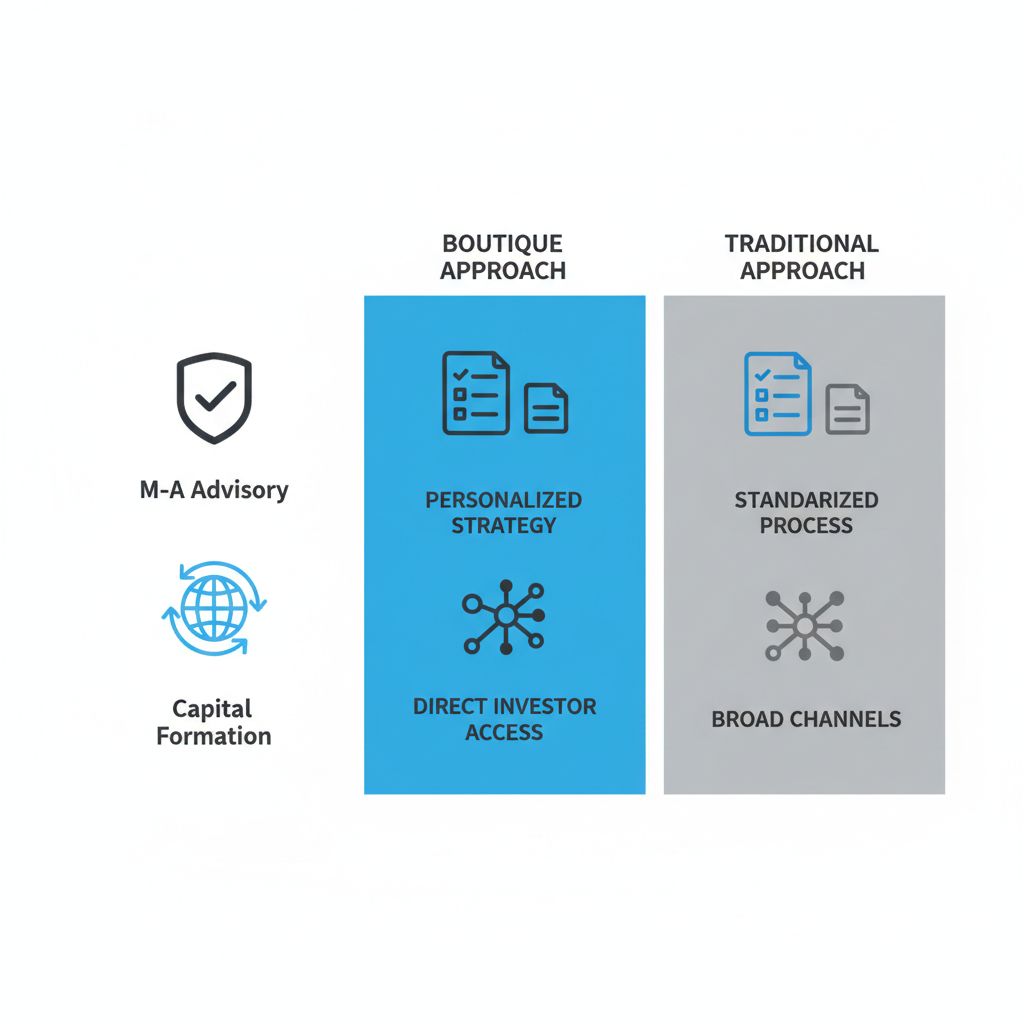
    Boutique vs Traditional Banks: Key Service Differences

    Service AreaBoutique Approach (e.g., Zaidwood)Traditional Bank Approach
    M&A AdvisoryTailored buy/sell-side with full due diligence (300+ deals experience)Broad mandates with standardized processes
    Capital FormationDirect access to 4,000+ investors via Velocity MatrixLimited network introductions

    Building on these differences, boutique firms excel in integrating capital raising with advisory services. This holistic approach not only streamlines transactions but also enhances strategic positioning in competitive markets.

    Infographic comparing boutique versus traditional bank approaches in middle market M&A advisory services

    Boutique vs traditional M&A advisory comparison for middle market

    In-Depth Analysis of Capital Formation Strategies

    Equity and Debt Advisory Essentials

    We structure mezzanine debt as a hybrid financing tool, positioned between senior debt and equity to provide flexible capital for expansion. This subordinated option offers businesses higher leverage while minimizing ownership loss, ideal for firms scaling operations post-acquisition. Venture debt complements this by extending cash runways for early-stage companies, often without warrants that dilute equity.

    Financing TypeZaidwood CapabilitiesTypical Harris-Style Firm
    Debt AdvisoryMezzanine, asset-based with $15B networkLimited to basic loans
    Equity AdvisoryGrowth equity introductions to 4,000+ investorsStandard placements

    Due Diligence in Boutique Deals

    Our full-cycle due diligence process is a cornerstone of successful boutique deals, encompassing financial, operational, and legal reviews to identify synergies and red flags early. We begin with financial modeling, scrutinizing pro forma statements and cash flow projections to validate deal viability. Legal reviews follow, examine contracts, IP rights, and regulatory compliance. In specialized financing firms, we extend this to emerging markets M&A, where geopolitical factors demand rigorous scrutiny.

    Implementing M&A and Capital Strategies in Practice

    Step-by-Step Deal Execution Guide

    • Investor Matching: Drawing from our network of over 4,000 institutions and $15B in deployable capital, we curate tailored introductions.
    • Due Diligence Execution: We conduct full-cycle reviews, encompassing financial audits, legal compliance checks, and operational evaluations using SEC regulatory resources.
    • Documentation Preparation: Clients receive customized pitch decks, pro forma financials, business plans, and fairness opinions.
    Tool/AspectZaidwood OfferingStandard Boutique
    Investor Network4,000+ institutions, $15B capitalSmaller, regional focus
    DocumentationPitch decks, pro formas via Deal VaultBasic templates

    Case Studies in Middle Market Success

    Through rolodex-driven introductions to family offices and venture capital sources, we structured a hybrid mezzanine debt facility for a manufacturing firm that bridged senior loans and equity, minimizing dilution. In another case, we developed a compelling narrative around intellectual property for a tech firm, utilizing investor outreach to sovereign wealth funds and endowments for competitive bidding.

    Advanced Topics in Boutique Debt and Equity Advisory

    Advanced due diligence forms the backbone of our process, encompassing human capital assessments to evaluate team dynamics and commercial viability to scrutinize market positioning. Capital introductions represent a cornerstone of our elite advisory networks, connecting clients to sovereign wealth funds and endowments. profissionais who cultivate deep relationships with private equity sponsors position themselves for success. Our investment bankers 2025 insights validate this strategy.

    Advanced FeatureZaidwood StrengthBoutique Baseline
    Investor Access$15B deployable via 4,000+ connectionsLimited introductions

    Common Questions on Boutique M&A Services

    • How do I select a boutique investment bank? Evaluate track records and sector focus. At Zaidwood Capital, our $24.4B transaction volume provides proven expertise.
    • Timeline for due diligence? Usually 4-8 weeks, covering financial, legal, and operational reviews.
    • Regulatory considerations? Utilize FINRA regulatory tools for filings and disclosures.

    Leveraging Boutique Expertise for Your M&A Success

    In navigating middle market M&A, boutique investment banks offer tailored strategies that drive efficient transactions. At Zaidwood Capital, we provide full-cycle advisory, from due diligence to capital formation, empowering clients with innovative tools like our Velocity Matrix for rapid execution. contact us today to explore how our expertise can support your success.

    Resources