Zaidwood Capital

Category: Mergers and Acquisitions

  • Bank Mergers Explained: Key Trends and Insights

    Bank Mergers Explained: Key Trends and Insights

    Table of Contents

    Understanding Bank Mergers in the United States

    Bank mergers in the United States are a primary driver of industry transformation, enabling institutions to build scale, cut costs, and extend their market presence. For stakeholders evaluating these moves, a clear picture of how they work and why they happen is essential.

    In the United States, bank mergers are the combination of two or more banking institutions into a single legal entity. Such transactions are typically driven by the pursuit of economies of scale, geographic expansion into new markets, or the need to comply with increasingly stringent regulatory frameworks—all of which can strengthen the combined organization’s competitive position.

    • Current bank consolidation trends show regional banks merging to compete with the largest national players.
    • Meanwhile, community banks often consolidate to pool resources and manage the rising costs of technology and compliance.

    These transactions must also secure approvals from the Federal Reserve, OCC, FDIC, and relevant state agencies, adding a layer of complexity that underscores the value of expert advisory.

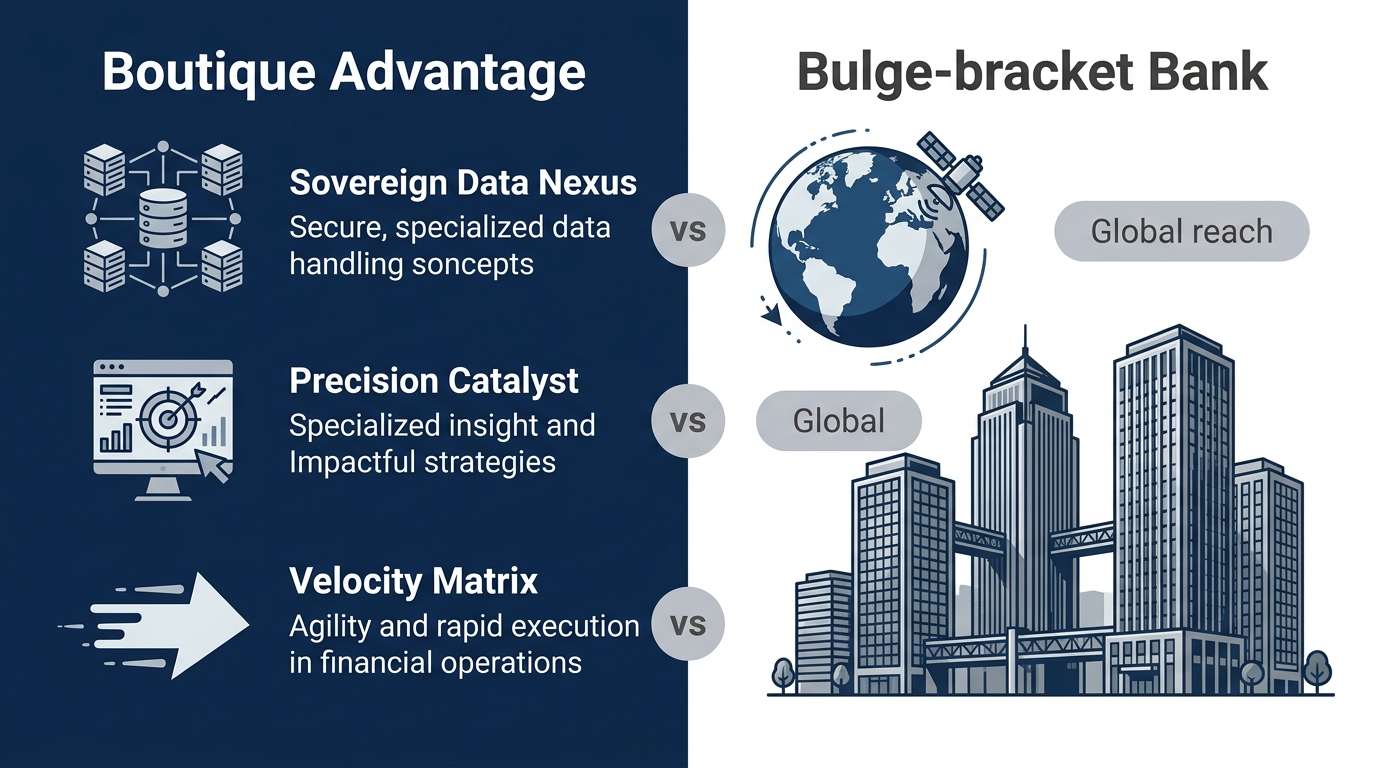
    For any institution contemplating a merger, navigating these hurdles demands deep market knowledge. Beyond deal negotiation, the real test often comes during bank merger integration, where organizations must unify systems, cultures, and operations to realize the transaction’s full potential. That is where understanding what is an investment bank becomes essential — these advisors guide clients through valuation, due diligence, deal structuring, and regulatory compliance. We combine data from Sovereign Data Nexus with our Velocity Matrix to accelerate execution.

    With this foundation, we can now examine how investment banks structure and execute these complex transactions.

    Bank M&A Fundamentals: Economics, Drivers, and Deal Structures

    Building on the role of investment banks, we now examine the fundamentals that drive bank mergers—a key force reshaping the financial landscape. These combinations seek economies of scale, revenue synergies, and improved competitive positioning. By combining operations, acquiring banks can reduce overhead, expand market share, and unlock value that neither could achieve independently. At Zaidwood Capital, our Full-Cycle M&A services guide clients through these complex transactions.

    Investment banks—such as boutique firms like Zaidwood Capital—provide essential advisory services to structure and execute these deals. To understand what an investment bank does, see what is an investment bank.

    Several key drivers fuel bank M&A, as outlined in the comparison table below.

    Drivers of Bank Mergers
    DriverDescriptionExample Impact
    Economies of ScaleReducing cost-to-income ratio by merging back-office functions.Cost savings of 15–25% of combined operating expenses.
    DiversificationExpanding product lines and geographic footprint to reduce risk.Higher fee income ratio; lower net interest margin volatility.
    Regulatory ComplianceSpread fixed compliance costs across a larger asset base.Reduction in compliance cost per dollar of assets.
    Technology ModernizationInvesting in AI, digital banking, and cybersecurity at scale.Faster customer acquisition and lower IT unit cost.

    Economies of scale remains a primary rationale: by consolidating back-office operations, merging banks can reduce their cost-to-income ratio, with CFA Institute research indicating potential cost savings of 15–25% of combined operating expenses. Diversification through geographic or product-line expansion stabilizes earnings, lowering net interest margin volatility and boosting fee income ratios. Expanding into new geographies or offering wealth management and treasury services smooths revenue streams, making the combined institution more resilient to interest rate cycles. The fixed costs of regulatory compliance can be spread over a larger asset base, driving down the per-dollar compliance burden—an increasingly critical advantage. Technology modernization underpins many recent transactions; after a merger, the combined entity can invest more heavily in AI, digital banking, and cybersecurity, achieving faster customer acquisition and a lower IT unit cost. Successful bank merger integration demands seamless harmonization of systems and cultures to realize these technology benefits. Together, these drivers create a powerful case for consolidation, reshaping the competitive landscape for regional and national banks alike.

    In terms of deal structure, three common arrangements dominate. Stock-for-stock mergers—the most prevalent—exchange the acquirer’s shares for the target’s equity, preserving cash and aligning shareholder interests. Cash acquisitions, often used when the buyer has ample liquidity, provide a clean exit for target shareholders. Mergers of equals feature shared governance and a balanced exchange ratio, though careful negotiation of management roles is critical. Each approach carries distinct tax, accounting, and governance implications that require expert advisory. We at Zaidwood Capital tailor these structures to each client’s strategic objectives, ensuring full-cycle steering from valuation through integration. Our Boutique M&A and Capital Advisory Firm brings cross-border expertise to navigate these complexities.

    These bank consolidation trends reflect an industry-wide push for resilience and efficiency. Understanding how consolidation reshapes competitive dynamics helps dealmakers identify value creation opportunities. With a firm grasp of the economic drivers, we turn to the valuation methods used in bank M&A.

    With a clear understanding of the strategic drivers behind bank mergers, we now turn to the regulatory landscape that governs these transactions. Navigating the regulatory approval process for bank mergers requires a thorough understanding of the agencies involved and their requirements. Our Full-Cycle M&A advisory includes guiding clients through these complexities.

    Key Regulatory Bodies and Their Roles

    The United States bank merger regulatory approval process involves several key agencies, each with distinct jurisdiction. The Federal Reserve Board has authority to approve mergers involving bank holding companies and state-member banks. The Federal Deposit Insurance Corporation (FDIC), which enforces key FDIC bank merger regulation, approves mergers involving insured state non-member banks. The Office of the Comptroller of the Currency (OCC) is responsible for national banks, while the Department of Justice (DOJ) reviews every transaction for potential antitrust concerns under the Clayton Act and Sherman Act. The Federal Reserve’s analysis emphasizes competitive effects and the convenience and needs of the community, while the OCC places particular weight on capital adequacy and future earnings prospects. The FDIC, on the other hand, evaluates deposit concentration and the potential impact on the Deposit Insurance Fund.

    The following table summarizes each regulator’s role:

    Regulatory Bodies Overseeing Bank Mergers
    Regulatory BodyRole in Bank Merger ApprovalKey Considerations
    Federal Reserve BoardApproves mergers involving bank holding companies and state-member banks.Must consider competitive effects, financial condition, and CRA performance.
    FDICApproves mergers involving insured state non-member banks and interstate mergers.Assesses deposit concentration, community impact, and management capabilities.
    OCCApproves mergers involving national banks.Evaluates capital adequacy, future earnings prospects, and convenience/needs.
    DOJReviews antitrust implications of any bank merger.May challenge mergers that materially reduce competition in a relevant market.

    Understanding which regulator has primary oversight is essential, as filing requirements vary. For instance, applications to the Federal Reserve often require form FR Y-2, while the FDIC mandates Form 6300/04 for non-member bank transactions; the OCC uses the Interagency Bank Merger Act Application. Our team at Zaidwood Capital helps clients prepare these submissions correctly from the outset.

    The Application and Review Process

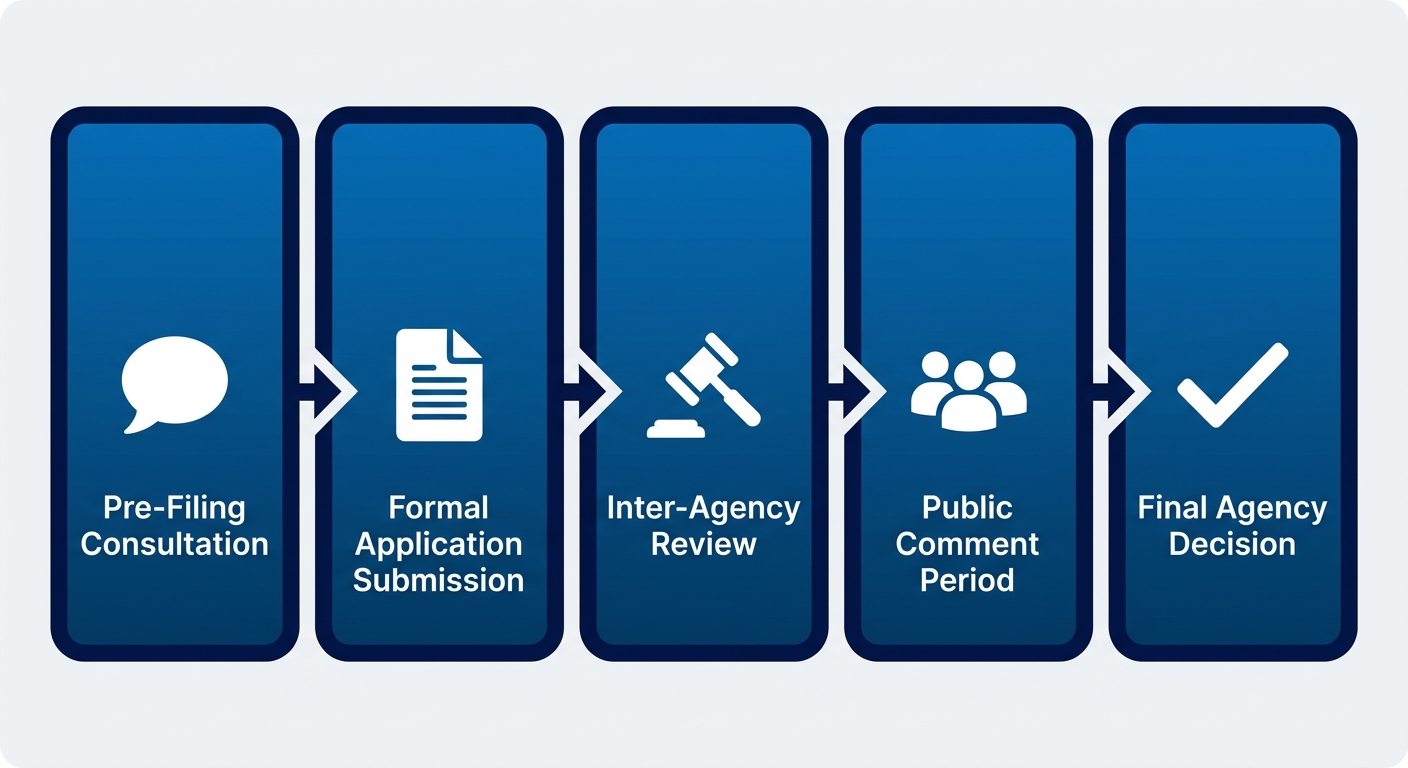
    The Bank Merger Act (12 U.S.C. § 1828(c)) requires pre-approval from the appropriate federal banking agency before any regulated merger can close. The process begins with a pre-filing consultation to discuss scope and concerns. Following this, the formal application is submitted with detailed financials, pro forma ratios, and a comprehensive description of the transaction.

    Once submitted, the application undergoes inter-agency review. The primary banking regulator evaluates safety and soundness, competitive impact, and community convenience. The DOJ simultaneously reviews antitrust implications and may sue to block anticompetitive mergers. A 30-day public comment period follows, allowing community input. The agency weighs comments alongside its own findings and assesses the plan for bank merger integration as a sign of management strength.

    Five-stage horizontal process-flow for bank merger regulatory approval from pre-filing to final decision.

    Navigating the bank merger regulatory approval process in five stages.

    Throughout the review, our advisors leverage the Velocity Matrix to track milestones and ensure every regulatory request is addressed promptly.

    Community Reinvestment Act Considerations

    A bank’s Community Reinvestment Act (CRA) performance rating plays a critical role in merger approval. Regulators must consider the institution’s record of meeting the credit needs of its entire community, including low- and moderate-income neighborhoods. A rating of Outstanding or Satisfactory supports the application, while a rating of Needs to Improve or Substantial Noncompliance can trigger delays or outright denial. According to the FDIC, CRA performance is evaluated over a multi-year period and includes both lending and service activities.

    To mitigate CRA-related risks, we recommend a thorough CRA self-assessment, strengthened community development lending, and robust documentation of community support. Glen Ellyn Bank’s M&A guide notes that early regulatory engagement on CRA issues can prevent last-minute surprises.

    Timeline and Best Practices for Approval

    The approval timeline for a bank merger typically spans four to nine months. The initial review takes 30 to 60 days, followed by a 30-day public comment period, with a final decision within 60 to 90 days. Given current bank consolidation trends, the timeline may be influenced by market concentration data. Proactive measures accelerate the process. We recommend early communication with regulators, precise form preparation, CRA documentation, and community outreach. Our Velocity Matrix streamlines regulatory documentation and tracking to reduce delays. Once regulatory approval is secured, the focus shifts to integrating operations and capturing synergies—a topic we cover in the next section.

    Executing Bank Merger Integration: Strategies for Success

    After finalizing the deal structure, the critical phase of integration begins. Bank merger acquisition strategies 2026 must evolve beyond simple consolidation to address the complex interplay of people, processes, and technology. As a Boutique M&A and Capital Advisory Firm, we understand that the difference between a successful combination and a value-destroying merger often lies in the rigor and foresight applied during the first 100 days of integration. Success in bank mergers requires a dedicated framework that aligns leadership, retains essential talent, and consolidates core infrastructure without interrupting customer service or eroding market confidence.

    Pre-Merger Integration Planning

    Effective integration starts well before regulatory approval. We advise clients to establish a dedicated Integration Management Office (IMO) with clear decision-making authority at least 60 to 90 days prior to deal close. This team develops the blueprint that defines cost synergy targets—such as branch network consolidation and back-office efficiencies—and revenue cross-sell objectives across combined product lines. It is important to note, however, that projected synergies depend heavily on execution quality and market conditions; they can lead to significant value creation but require realistic baseline assumptions. The IMO should appoint workstream leads for operations, technology, compliance, and culture, each accountable for milestone delivery against a unified timeline.

    Cultural and Operational Alignment

    Cultural misalignment remains one of the most underestimated risks during bank consolidation trends. We recommend conducting structured cultural assessments of both institutions to identify gaps in leadership style, risk appetite, and employee engagement. From these findings, leadership should develop a joint cultural statement with input from employees at all levels—not just the C-suite. Retaining key talent is equally critical: early retention packages and transparent career pathing can significantly reduce regrettable turnover. For bank merger integration to succeed, operational alignment must complement cultural harmonization. This means consolidating branch networks within 90 days where overlap exists, standardizing policies and procedures, and creating a single operating model that frontline staff can adopt quickly.

    Technology and Systems Consolidation

    Technology integration represents both the greatest opportunity and the most substantial execution risk in bank mergers. We advocate a phased migration approach that prioritizes customer-facing digital channels and core banking platforms. Data integrity must be verified through rigorous parallel testing before any system cutover; a single data reconciliation error can erode customer trust and trigger regulatory scrutiny. Our Full-Cycle M&A methodology leverages the Sovereign Data Nexus to maintain secure, auditable data environments throughout consolidation. The sequence typically begins with email and communication systems, proceeds to treasury and risk management platforms, and concludes with long-term core banking migration. Testing protocols should include simulated transaction volumes, penetration testing for cybersecurity vulnerabilities, and fallback procedures for rapid rollback if anomalies appear.

    The following table contrasts integration strategies across three critical dimensions: operations, technology, and culture.

    Post-Merger Integration Strategy Comparison
    DimensionStrategyKey Success Factors
    OperationsConsolidate branch networks and back-office functions within 90 days.Clear communication to employees; unified policies and procedures.
    TechnologyMigrate core banking systems and data to a single platform.Rigorous testing; data integrity checks; parallel runs before cutover.
    CultureDefine combined values, leadership alignment, and retention programs.Employee listening sessions; cultural KPIs in performance reviews.

    Operations consolidation delivers the fastest visible efficiencies, but technology migration creates the long-term platform for scalable growth. Culture, though hardest to measure, ultimately determines whether the combined institution can execute on the other two dimensions effectively.

    Measuring Post-Merger Performance

    Tracking integration progress demands a focused set of KPIs that link directly to deal thesis assumptions. We typically monitor cost synergy realization as a percentage of the original target, employee turnover rate (with particular attention to key-person retention), customer retention rate across product categories, and system downtime metrics during migration windows. Monthly steering committee reviews should compare actual performance to the IMO baseline plan, with variance explanations required for any deviation exceeding 5%. Post-merger reviews conducted at six and twelve months help capture lessons learned and refine the integration playbook for future transactions. With these strategies in place, the focus shifts to monitoring and realizing the full deal value.

    This content is for informational purposes only and does not constitute investment advice.

    Advanced Topics in Bank Mergers and Acquisitions

    When evaluating advanced aspects of bank mergers, it becomes clear that regulatory and integration complexities demand a strategic approach. At Zaidwood Capital, we apply our Full-Cycle M&A methodology to help financial institutions navigate these challenges effectively.

    Navigating the Federal Reserve’s merger approval process is a critical first step. The Fed requires detailed applications, public comment periods, and thorough community impact assessments to ensure proposed combinations do not harm local credit access. Understanding the intricacies of Federal Reserve bank merger approval is essential for any institution considering a transaction. Drawing on our experience advising on healthcare M&A, we recognize that regulatory shifts—such as amendments to the Community Reinvestment Act and enhanced prudential standards—can significantly alter deal viability and integration planning. At Zaidwood Capital, we have observed how these evolving rules reshape the competitive landscape and require proactive compliance strategies.

    Once regulatory clearance is obtained, achieving successful bank merger integration proves to be the most complex phase. Cultural misalignment between organizations, the consolidation of disparate technology platforms, and the harmonization of compliance frameworks pose substantial operational risks. For instance, merging loan origination systems and aligning risk management protocols can delay synergy realization. We guide clients through these integration hurdles by employing disciplined project management and deep industry insight, helping to capture the promised efficiencies of the merger without disrupting customer service.

    Capital raising forms the foundation of many bank mergers. Our firm’s work in securing tailored financing for enterprise AI companies—ranging from equity rounds to structured debt solutions—demonstrates how bespoke capital structures can be adapted to meet bank acquisition funding needs. In the current environment, bank consolidation trends show increased activity among mid-sized institutions seeking scale and efficiency. As a Boutique M&A and Capital Advisory Firm, we deploy our Financial Services 3.0 methodology to structure capital raises that satisfy regulatory capital requirements and fuel post-merger growth. All advisory services are offered through Finalis Securities LLC; Zaidwood Capital is not a registered broker-dealer.

    Frequently Asked Questions About Bank Mergers

    Here are answers to frequently asked questions about bank mergers. While bank consolidation poses unique challenges, we also advise on healthcare mergers and acquisitions.

    How do investment banks assist in bank mergers? Investment banks provide valuation, due diligence, and negotiation support to guide institutions through complex bank mergers. As a Boutique M&A and Capital Advisory Firm, Zaidwood Capital tailors this advisory approach to middle-market transactions.

    What does a bank merger process involve? The process includes target identification, due diligence, regulatory approvals, and post-merger bank merger integration. Each phase demands rigorous financial modeling and careful coordination—where our full-cycle M&A support proves vital.

    What is driving current bank consolidation trends? Drivers include technology investments, cost synergies, and regulatory changes. Boutique M&A and Capital Advisory Firms like Zaidwood Capital help navigate these trends.

    For personalized guidance on your bank merger, contact Zaidwood Capital.

    The Future of Bank M&A and Strategic Advisory

    Looking ahead, the dynamics in bank mergers are redefined by powerful macro forces. According to CFA Institute research, evolving capital requirements and fintech licensing reshape consolidation, while AI-driven due diligence and digital integration accelerate timelines.

    As a Boutique M&A and Capital Advisory Firm in Financial Services 3.0, we leverage the Sovereign Data Nexus and Velocity Matrix to accelerate due diligence for bank merger integration. Precision Catalyst may assist in deal sourcing, though outcomes are not guaranteed. In bank consolidation trends, unpredictability persists, and past performance does not guarantee future results. Partnering with a forward-thinking advisory firm is therefore essential.

    Resources

  • Top Emerging Markets M&A: Key Trends for 2026

    Top Emerging Markets M&A: Key Trends for 2026

    Table of Contents

    Emerging Markets M&A: A Strategic Growth Frontier

    Emerging markets M&A represents a strategic growth frontier for businesses seeking diversification and higher growth potential. According to the World Bank Group, robust economic expansion in developing regions is fueling heightened M&A activity, opening doors to new consumer bases and innovation hubs. However, these transactions involve distinct risks such as regulatory unpredictability and currency fluctuations that require specialized navigation.

    Understanding what is an investment bank clarifies the distinct advantage boutique firms like Zaidwood Capital bring to cross-border emerging-market M&A. As M&A in emerging economies accelerates, our full-cycle M&A advisory leverages the Sovereign Data Nexus—a proprietary data infrastructure that can identify hidden acquisition targets and track real-time economic shifts in volatile regions. Our teams combine deep capital markets experience with Precision Catalyst, our digital marketing-driven investor engagement, to connect clients with a global network of institutional investors. Paired with the Velocity Matrix, which accelerates due diligence and execution, we aim to help clients navigate regulatory complexity and currency fluctuations while moving decisively in fast-moving markets. This integrated approach positions Zaidwood Capital to capitalize on emerging markets M&A opportunities without the rigidity of traditional advisory models.

    Building on this frontier, Zaidwood Capital continues to invest in data-driven tools like the Sovereign Data Nexus and collaborative execution models to help clients seize transformative M&A opportunities in developing economies. Our full-cycle M&A approach ensures that from target identification to post-merger integration, every transaction is positioned for long-term growth.

    What Drives M&A Activity and Investment Opportunities in Emerging Markets

    Several structural factors make emerging markets particularly attractive for M&A. Indeed, the acceleration of emerging markets M&A stems not just from cyclical tailwinds but from fundamental shifts that are reshaping global deal flow. The Comparison Table below captures four key drivers — GDP growth tailwinds, demographic dividend, digital leapfrogging, and resource demand — that we examine in detail.

    Comparison Table — Factors Driving M&A in Emerging Markets
    DriverImpact on Deal FlowTypical Sectors AffectedRelevance to Zaidwood Capital Clients
    GDP Growth TailwindsIncreases enterprise value and buyer appetiteAcross all sectorsInforms valuation benchmarks and exit timing
    Demographic DividendExpands consumer base and labor supplyConsumer goods, fintech, healthcareTarget screening focuses on population-driven demand
    Digital LeapfroggingUnlocks high-growth tech and platform dealsTechnology, telecommunications, financial servicesAligns with Precision Catalyst engagement strategies
    Resource & Commodity DemandDrives capital-intensive cross-border transactionsEnergy, mining, agribusinessRequires structured debt and equity advisory expertise

    Each of these drivers merits a closer look.

    GDP growth tailwinds directly spur emerging markets M&A. According to World Bank data, many developing economies have outpaced global growth averages, elevating enterprise values and intensifying buyer appetite across all sectors. PwC’s deal flow research confirms this linkage. We incorporate these macro signals into valuation models via our Sovereign Data Nexus, helping clients optimize exit timing.

    The demographic dividend is a powerful undercurrent in developing economies. World Bank projections highlight expanding youth populations in Southeast Asia and Africa, boosting consumption and labor supply. Sectors such as consumer goods, fintech, and healthcare are direct beneficiaries. Our target screening harnesses these population-driven trends to identify high-growth investment opportunities for clients.

    Digital leapfrogging is redefining deal flow in emerging markets. PwC analysis points to rapid adoption of mobile payments and internet infrastructure that leapfrog traditional banking, creating high-growth tech platform deals. Technology, telecommunications, and financial services dominate. Our Precision Catalyst engagement model is purpose-built to surface these fast-moving platform opportunities for dealmakers.

    Resource and commodity demand, particularly for energy transition minerals and agricultural commodities, drives capital-intensive cross-border transactions. World Bank commodity analyses underscore rising global appetite. Energy, mining, and agribusiness require structured debt and equity advisory — a core Zaidwood capability. Our Velocity Matrix accelerates the execution of these complex cross-border mandates.

    Infographic of four drivers of M&A activity in emerging markets: GDP Growth Tailwinds, Demographic Dividend, Digital Leapfrogging, and Resource & Commodity Demand

    Four key drivers of M&A in emerging markets visualized

    Together, these structural drivers create a formidable landscape for emerging-market M&A. For Zaidwood Capital clients, understanding them informs target screening, valuation, and capital structuring. As a boutique investment banking and capital advisory firm, we apply full-cycle execution capabilities to align with these macro tailwinds, delivering tailored solutions. These drivers create a compelling backdrop; the following section examines the risks and mitigation strategies investors should consider.

    Overcoming Capital Formation Challenges with Proprietary Deal Tools

    The emerging markets M&A environment presents a distinct set of capital formation challenges that demand sophisticated, full-cycle advisory support. For growth companies and private equity sponsors pursuing M&A in emerging markets, fragmented regulatory landscapes, currency instability, limited institutional capital access, and opaque data environments can stall transactions and inflate risk. At Zaidwood Capital, we address these obstacles with proprietary tools, a global investor network of over 4,000 institutions, and a structured deal execution framework that turns complexity into actionable opportunity.

    Capital Formation Barriers in Emerging Economies

    Capital formation in emerging economies is frequently hampered by four core challenges. First, regulatory fragmentation—fragmented licensing requirements across jurisdictions—forces acquirers to navigate multiple, often conflicting, legal frameworks, slowing deal timelines and inflating legal costs. Second, currency volatility, with FX swings of 10–20% common in frontier currencies, complicates valuation models and can undermine financing structures. Third, limited LP access restricts the pool of institutional capital available to growth companies, leaving promising opportunities underfunded. Fourth, information asymmetry—where target financials are incomplete or unreliable—increases due diligence risk and makes it difficult to validate strategic fit. In cross-border M&A within developing economies, these obstacles compound, eroding transaction efficiency and creating significant capital formation hurdles that require a structured, advisory-led response.

    These structural barriers are not insurmountable, but they demand a deliberate strategy. At Zaidwood Capital, we combine regulatory expertise, hedging strategies, and a vast investor network to neutralize each obstacle. The following table maps common capital formation challenges to our specific solutions, illustrating how we convert emerging market complexity into actionable opportunity.

    Comparison Table — Capital Formation Challenges vs. Zaidwood Capital Solutions
    ChallengeImpact on TransactionZaidwood Capital SolutionClient Benefit
    Regulatory FragmentationDelays deal timelines, increases legal costsFull-cycle M&A advisory with cross-border compliance expertiseFaster clearance and reduced regulatory risk
    Currency VolatilityComplicates valuation and financing structuresStructured debt and equity advisory with hedging strategiesStable deal economics across FX fluctuations
    Limited LP AccessRestricts capital formation for growth companiesGlobal network of 4,000+ institutional investorsWider pool of committed capital
    Due Diligence OpacityIncreases risk of post-deal value erosionDeal Vault secure data room and proprietary diligence frameworkTransparent, auditable diligence process

    Multi-jurisdictional regulations—ranging from antitrust reviews to sector-specific approvals—create a layered compliance burden that can delay transactions by months. When coupled with due diligence opacity, where target companies may present incomplete financial records or unreliable operational data, the risk of post-deal value erosion escalates sharply. Conventional advisors often lack the specialized cross-border expertise and secure data management infrastructure needed to penetrate these opaque markets effectively. For example, healthcare mergers and acquisitions face additional scrutiny from health authorities, making it essential to engage advisory teams that can pre-empt regulatory roadblocks while maintaining data integrity through encrypted deal rooms. Our full-cycle M&A approach embeds proactive compliance vetting and a dedicated Deal Vault that houses encrypted, permissioned-access documents, enabling faster, more transparent due diligence even in challenging jurisdictions.

    How Zaidwood Capital’s Proprietary Tools Accelerate Deal Flow

    Our proprietary infrastructure—Sovereign Data Nexus, Precision Catalyst, and Velocity Matrix—builds on the solutions mapped in the comparison table to systematically dismantle capital formation barriers. Sovereign Data Nexus provides proprietary, real-time intelligence on private companies, countering the information asymmetry that plagues emerging markets by allowing us to screen and validate targets with speed and precision. Precision Catalyst leverages AI-driven investor targeting and engagement, directly addressing limited LP access by matching growth companies with relevant institutional capital from our network of over 4,000 investors. Velocity Matrix streamlines transaction execution, compressing timelines and reducing the drag of regulatory complexity and currency volatility through structured processes and integrated hedging advisory. Together, these tools enable us to accelerate deal flow, enhance disclosure quality, and mitigate execution risk, empowering growth companies and private equity sponsors to execute cross-border M&A in emerging markets with greater speed and confidence.

    Executing M&A Strategies from Target Screening to Deal Close

    Key M&A Strategies for Emerging Market Buyers and Sellers

    To bring these strategies to life, we follow a disciplined process from target screening to deal close, deploying our full-cycle advisory capabilities for emerging markets M&A. As a Boutique M&A and Capital Advisory Firm, we tailor each mandate to the unique risk-return profile of the market and the company, drawing on our proprietary data and hands-on partner involvement. We believe that successful M&A for emerging markets demands not only capital but also local expertise and a robust execution framework.

    Buy-side platform builds enable private equity sponsors to pursue add-on acquisitions within a single portfolio company. These transactions, typically ranging from $50 million to $500 million, combine equity and structured debt. Minority growth equity investments fuel high-growth startups requiring scale capital. With deal sizes between $5 million and $50 million, these rounds—whether Series A, B, or C—demand precise equity structuring and founder-friendly term negotiation. These investments are ideal for companies that have proven product-market fit and need capital to scale operations and expand geographically. Cross-border joint ventures open new markets for companies that want to partner with local operators, often in the $20 million to $200 million range, again blending equity with structured debt. This model works especially well when firms need to navigate local regulations while sharing risk.

    The table below summarizes how each strategy aligns with distinct client objectives and our advisory services.

    Comparison Table — M&A Strategy Approaches for Emerging Markets
    StrategyBest ForTypical Transaction SizeCapital Type RequiredZaidwood Capital Service
    Buy-Side Platform BuildPE sponsors seeking add-on acquisitions$50M–$500MEquity + structured debtFull-cycle M&A advisory, Deal Vault data room
    Minority Growth EquityHigh-growth startups seeking scale capital$5M–$50MEquity (Series A, B, C)Capital formation, pitch deck & business plan creation
    Cross-Border Joint VentureCompanies seeking local market entry with partners$20M–$200MEquity + structured debtStructured debt advisory, institutional investor introductions

    Each path draws on our deep knowledge of local market dynamics and our rigorous due diligence processes. These strategies are not mutually exclusive—clients often blend them as their needs evolve—and each serves as a starting point for the deeper structuring work that follows.

    Structuring Transactions for Cross-Border Success

    Once the strategy is selected, structuring the deal to navigate cross-border complexities becomes essential, especially in emerging-market M&A. We address currency risk by designing multi-currency hedging mechanisms and earnout structures that protect both buyers and sellers from exchange-rate volatility. These mechanisms include forward contracts, options, and natural hedging strategies that align revenue and cost currencies. Tax optimization is integral—we map bilateral tax treaties and structure holding companies to minimize withholding taxes and capital gains leakage, ensuring that returns are repatriated efficiently. Regulatory approvals, whether for antitrust clearance or sector-specific compliance (such as financial services licensing), are managed through our rigorous due diligence protocols, particularly when the transaction aligns with global development initiatives such as those supported by the World Bank. Our Sovereign Data Nexus infrastructure aggregates local market intelligence, helping us anticipate regulatory shifts and identify the most advantageous structuring jurisdictions. Throughout this phase, we deploy our proprietary pro forma financial models that stress-test revenue projections, working capital assumptions, and debt-service coverage across multiple scenarios, incorporating local inflation assumptions, interest rate trajectories, and political risk premiums to reflect the realities of emerging-market environments, giving clients the confidence to proceed.

    Leveraging the Global Investor Network for Deal Execution

    Our capacity to close deals rapidly hinges on the Velocity Matrix, a proprietary execution framework that draws on a network of more than 4,000 institutional investors, spanning pension funds, sovereign wealth funds, family offices, and development finance institutions active across emerging markets. The Velocity Matrix enables us to filter unsuitable targets within 48 hours and then match the right capital providers—whether limited partners, private equity funds, or venture capital investors—to each transaction. We couple this with our Sovereign Data Nexus infrastructure, which automates target screening and due diligence, and our Precision Catalyst digital engagement suite, which leverages targeted marketing to amplify investor outreach and schedule meetings with qualified leads. This integrated system compresses typical deal timelines, consistently securing capital commitment within four to six weeks for institutional-quality transactions. In turbulent markets, speed is a competitive advantage, and our full-cycle approach ensures that no part of the transaction—from sourcing to close—is outsourced to a faceless platform. We measure our success by the speed and certainty of close, not by the volume of mandates we pitch. That discipline translates into higher conversion rates and stronger post-close outcomes. With capital committed, the focus shifts to post-merger integration and the operational initiatives that sustain long-term value creation. This is the blueprint we have refined across hundreds of engagements in emerging markets, delivering the precision and speed our clients require.

    The Role of Sovereign Wealth Funds in Emerging Market Deals

    In the landscape of emerging markets M&A, sovereign wealth funds play a pivotal role as long-term strategic investors. Unlike conventional institutional capital, SWFs deploy patient capital with time horizons stretching decades rather than years, fundamentally reshaping how transactions in developing economies are structured and executed.

    To understand their distinct advantages, we compare SWFs with traditional institutional investors across key dimensions of investment strategy, risk profile, and deal engagement. The following table illustrates these contrasts clearly.

    Comparison Table — Sovereign Wealth Funds vs. Institutional Investors in Emerging Markets M&A
    DimensionSovereign Wealth FundsTraditional Institutional Investors
    Investment HorizonLong-term (10–30 years)Medium-term (5–7 years)
    Risk AppetiteHigh, with strategic/geopolitical overlayModerate, with strict fiduciary boundaries
    Preferred SectorsInfrastructure, energy, technology platformsFinancial services, healthcare, consumer goods
    Deal Structure FlexibilityHigh (direct investments, co-investments, JVs)Moderate (fund structures, LP positions)
    Zaidwood Capital EngagementCapital formation & direct introductions via 4K+ investor networkEquity/debt advisory & deal vault diligence support

    As FCLTGlobal’s research on long-term value creation demonstrates, SWFs typically operate with horizons of 10–30 years, allowing them to underwrite complex cross-border transactions in developing markets that demand patient capital. This extended runway enables direct investments, co-investments, and joint ventures that traditional fund structures often cannot accommodate. SWFs also bring a higher risk appetite, integrating geopolitical and strategic considerations that sit outside conventional fiduciary boundaries. Their sector preferences concentrate on infrastructure, energy, and technology platforms — asset classes where scale and long development cycles reward committed capital.

    We at Zaidwood Capital facilitate SWF engagement through our network of more than 4,000 institutional investors, enabling capital formation and direct introductions for emerging markets M&A opportunities. Our full-cycle advisory capabilities — which include equity and debt advisory along with our secure deal vault for diligence support — can streamline the connection between well-capitalized sovereign entities and high-potential transactions. While we are not a registered broker-dealer, our strategic documentation and transactional infrastructure may offer firms a structured pathway to SWF capital. This content is for informational purposes only and does not constitute an offer or solicitation.

    Understanding these dynamics allows Zaidwood Capital to strategically connect SWFs with emerging market opportunities, bridging patient capital with transformative growth.

    Frequently Asked Questions About Emerging Markets M&A

    Here we answer frequently asked questions about emerging markets M&A.

    How do regulatory changes affect emerging markets M&A? We guide clients through shifting regulatory demands, basing our approach on healthcare sector insights and extending it across all emerging-market sectors; our Velocity Matrix helps adjust deal timelines and valuations accordingly.

    What does buy-side due diligence involve in emerging markets? Our due diligence spans financial, legal, and cultural checks; we use our Sovereign Data Nexus for local risk assessment, critical for managing risks in emerging markets M&A, including currency controls.

    How can professional services insights improve M&A outcomes? We blend industry data from PwC’s professional services insights with our own advisory to refine deal structuring and execution strategies.

    Securities offered through Finalis Securities LLC; Zaidwood Capital is not a registered broker-dealer.

    Positioning Your Business for Emerging Markets M&A Success

    To succeed in emerging markets M&A, strategic positioning is essential, demanding proprietary intelligence and rapid execution. Our Sovereign Data Nexus provides exclusive market intelligence, uncovering opportunities and mitigating information asymmetries that challenge M&A in emerging markets. The Velocity Matrix compresses transaction timelines, enabling rapid execution critical for seizing time-sensitive opportunities in developing economies. Through Precision Catalyst, we drive targeted investor engagement, connecting businesses to our network of over 4,000 global investors. A Full-Cycle M&A approach that integrates these proprietary tools and deep capital markets experience positions businesses for success in complex cross-border transactions.

    Resources

  • Sell-Side M&A: Essential Guide for Business Owners

    Sell-Side M&A: Essential Guide for Business Owners

    Table of Contents

    Maximizing Value Through Sell-Side M&A Advisory

    Beyond structuring the deal, engaging a dedicated boutique investment bank helps ensure that every stage of a sell-side M&A in New York is optimized for value. As a Boutique M&A and Capital Advisory Firm, our Full-Cycle M&A methodology combines rigorous sell-side due diligence with data-backed positioning designed to increase seller value.

    Our Sovereign Data Nexus harnesses proprietary market and financial data to strengthen valuation narratives and build buyer conviction. The Velocity Matrix accelerates deal timelines, reducing seller distraction while sustaining business momentum. Through Precision Catalyst, targeted investor outreach creates competitive buyer tension—driving up bids within controlled auction dynamics, not a single-buyer negotiation. This disciplined sell-side M&A process orchestrates each deal phase with precision, positioning every divestiture advisory engagement for an optimal M&A exit.

    With our proprietary tools and full-cycle M&A model, we create outcomes that go beyond traditional advisory—maximizing value for every sell-side transaction we lead.

    Preparing for a Sell-Side M&A Transaction

    Business owners embarking on a sell-side M&A understand that early preparation is critical. A clean set of financial and legal records streamlines due diligence and strengthens your position in valuation discussions. At Zaidwood Capital, we know that thorough sell-side readiness can make the difference between a rushed deal and a smooth transaction.

    The sell-side M&A process starts with a rigorous review of at least three years of auditable financial statements and corporate governance documents, including articles of incorporation and board resolutions. Resolving any legal or compliance gaps, such as outstanding litigation or tax issues, further protects your transaction timeline.

    Engaging professional M&A due diligence services helps you assemble a comprehensive virtual data room. During sell-side due diligence, buyers scrutinize contracts, customer agreements, and IP registrations for risks like customer concentration. We employ our proprietary Sovereign Data Nexus platform to keep everything organized and secure, proactively addressing potential red flags.

    By involving an experienced M&A advisor at the outset, you align valuation expectations and manage buyer outreach effectively. Our full-cycle approach ensures you are prepared for every stage of the process, from initial documentation to final negotiations, setting the stage for a successful transaction and smoothly transitioning to valuation and buyer identification.

    Assessing Your Company’s Readiness for Sale

    Before pursuing a sale, an honest appraisal of your company’s strengths and weaknesses is essential. In sell-side M&A, rigorous self-assessment uncovers gaps that can derail negotiations. Our data-driven readiness evaluation examines revenue consistency, growth trajectory, and customer concentration—highlighting if your top three clients account for over 30% of revenue, a risk that must be mitigated. During the sell-side M&A process, we also assess outstanding litigation, regulatory filings, and intellectual property ownership to avoid surprises during sell-side due diligence. We analyze management depth, willingness to stay post-acquisition, and operational scalability—ensuring systems can support growth without ballooning costs. Leveraging our Sovereign Data Nexus and Precision Catalyst, we benchmark your position against market data. Readiness is a diagnostic step, not a guarantee of sale. Once you have identified areas for improvement, the next step is to systematically address them with the right advisory support.

    Assembling Your Sell-Side Advisory Team

    To execute a successful sell-side M&A, assembling the right advisory team is the first critical step. A core group typically includes an investment bank—preferably a boutique firm like Zaidwood Capital—legal counsel, and financial experts. Understanding what is an investment bank helps clarify why it serves as the cornerstone of your sell-side advisory team. We at Zaidwood Capital, based in New York, coordinate the full-cycle sell-side M&A process, from initial valuation through closing. Experienced M&A legal counsel handles regulatory compliance, confidentiality agreements, and transaction documentation. Financial valuation experts, including CFA charterholders who adhere to CFA Institute’s rigorous professional standards, strengthen financial modeling and sell-side due diligence. We recommend assembling your team at least three to six months before the intended transaction launch to allow adequate preparation and strategic positioning. Once your team is in place, the real work of preparation and positioning begins.

    Preparing Financial Documents and Projections

    A compelling pitch demands equally rigorous financial backing. The three core statements—income statement, balance sheet, and cash flow statement—are non-negotiable. They give investors a clear snapshot of historical performance and current health.

    Zaidwood Capital’s Series A guide recommends at least three years of projected monthly or quarterly financials with clearly stated assumptions for CAC, churn, and revenue growth. Sensitivity scenarios—base, downside, upside—demonstrate preparedness, while unrealistic hockey-stick projections can instantly erode trust.

    Key metrics include gross margin, burn rate, runway, and unit economics like LTV/CAC and payback period. These indicators signal scalability and financial discipline; any weakness can trigger investor red flags.

    The same rigor serves founders well beyond fundraising: in a sell-side M&A process, sell-side due diligence demands this identical level of documentation, underpinning Full-Cycle M&A readiness. With your financial projections in order, the next step is preparing your investor data room and managing the due diligence process.

    Conducting Sell-Side Due Diligence

    Sell-side M&A due diligence is the seller-led process of compiling and presenting critical business information for scrutiny by potential acquirers. Unlike the buy-side investigation, sellers control the pace and scope of disclosure to protect confidentiality while demonstrating transparency.

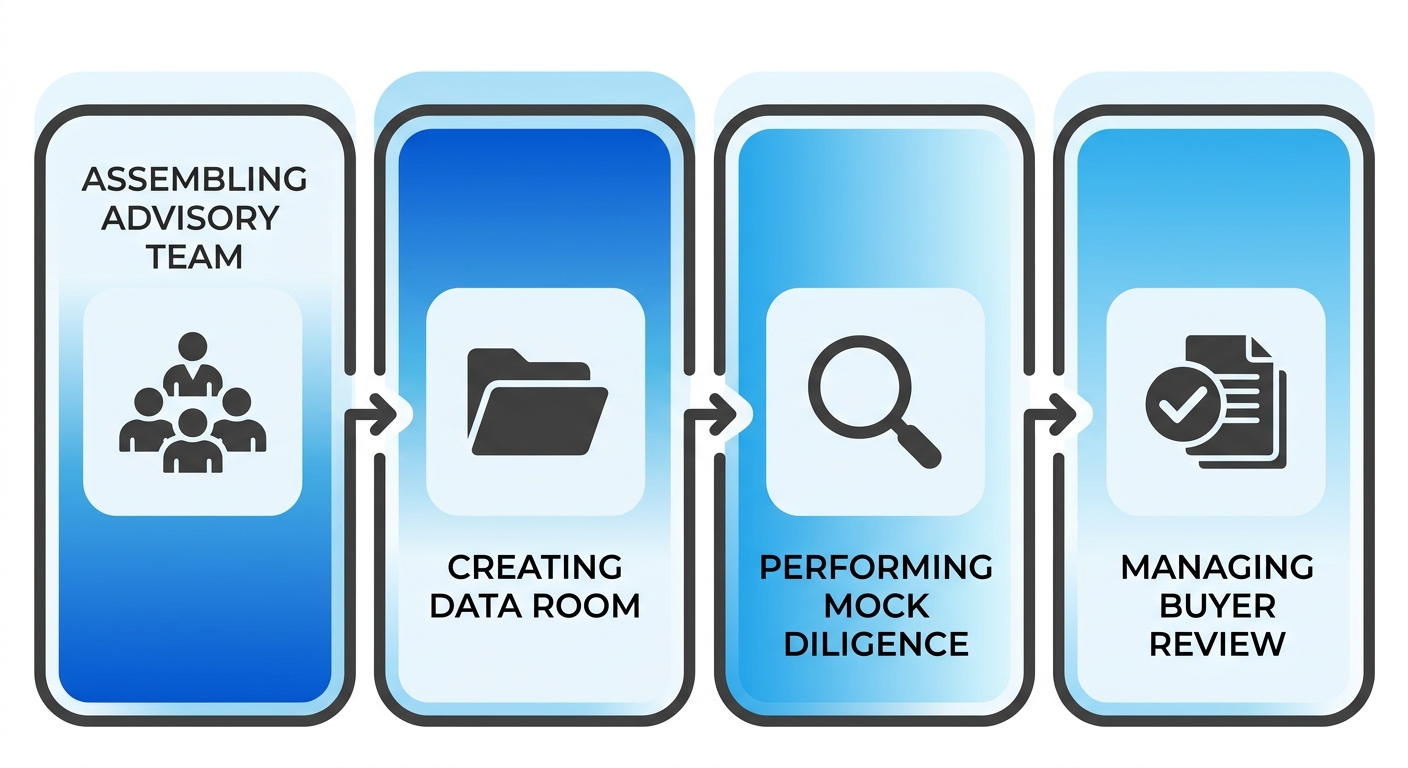
    We advise sellers to take a proactive approach by following three essential steps:

    • Assemble a dedicated due diligence team including legal, financial, and operational advisors.
    • Build a comprehensive data room housing financial statements, tax returns, material contracts, and intellectual property records.
    • Perform a mock diligence exercise to flag and remediate vulnerabilities before buyer access.
    Sell-side due diligence process flow diagram showing four stages: Assembling Advisory Team, Creating Data Room, Performing Mock Diligence, Managing Buyer Review
    Four-stage sell-side due diligence process visualization

    Thorough preparation enables sellers to present a complete, accurate picture while safeguarding sensitive information. This structured sell-side M&A process ensures sellers are fully prepared for buyer scrutiny. Engaging experienced M&A advisors early not only aligns the process with securities laws but also promotes adherence to recognized ethical standards like the CFA Institute investment ethics framework, which builds buyer confidence. At Zaidwood Capital, our Full-Cycle M&A advisory integrates rigorous preparation to accelerate deal closure and minimize renegotiations.

    Valuing Your Business Accurately

    In any sell-side M&A transaction, accurately determining your company’s worth is the critical first step for a successful exit. At Zaidwood Capital, we apply proven valuation methodologies tailored to technology and SaaS businesses—EBITDA multiples for profitable firms and revenue multiples for high-growth ventures. During the sell-side M&A process, we normalize financials by adjusting for working capital and eliminating one-time expenses like owner perks or non-recurring legal fees, arriving at a defensible, market-ready figure. By removing these distortions, we present a clear picture of true earnings power. Intangible assets such as proprietary technology, IP, and customer contracts often drive premium multiples, making industry-specific expertise essential. Our data-driven approach, informed by over $24 billion in aggregate transaction experience, ensures these assets are properly valued.

    This rigorous valuation foundation gives buyers confidence and reduces the risk of renegotiation. It also streamlines the buyer’s sell-side due diligence by providing a transparent, well-supported basis for their verification. An accurate valuation not only sets the stage for negotiations but also accelerates the full-cycle M&A journey, turning preparation into lasting deal momentum. Without experienced guidance, founders often over-rely on raw revenue or ignore market comparables; our team helps you avoid those pitfalls.

    Marketing Your Business to Buyers

    Once your business is positioned and documented, the next phase of a sell-side M&A is marketing it to the right buyers.

    A structured sell-side M&A process starts with a concise equity story—your growth trajectory, competitive moat, and strategic fit with likely acquirers. We help craft this narrative to capture buyer attention.

    We target both strategic buyers, who pay a premium for synergies, and financial buyers focused on cash-flow scalability. Our Sovereign Data Nexus connects your opportunity with a curated global network of institutional and private investors.

    Thorough sell-side due diligence—at least three years of audited financials and a secure data room—builds buyer confidence. We prepare a teaser and confidential information memorandum aligned with buyer evaluation criteria, while our Precision Catalyst digital marketing capability enables discreet outreach.

    Engage our team to leverage proprietary data and a global buyer network. With interest generated, we help you navigate offers and due diligence. This website is for informational purposes only and is not an offer or solicitation.

    Negotiating and Closing the Deal

    In the final phase of a sell-side M&A engagement, Zaidwood Capital’s advisory team guides sellers through buyer negotiations and term-sheet finalization. Leveraging our Precision Catalyst for data-driven counteroffers, we work to secure favorable purchase agreement terms that align with the seller’s objectives. Throughout the sell-side M&A process, we coordinate closely with legal, tax, and financial advisors to safeguard client interests.

    Once terms are agreed, our focus shifts to accelerating the close. Using the Sovereign Data Nexus secure data room, we streamline sell-side due diligence and document exchanges, enabling buyers to verify information efficiently. We then apply our Velocity Matrix methodology to drive rapid execution, aiming to reduce the timeline from signing to funding.

    Throughout the closing phase, we ensure the transaction adheres to FINRA securities regulation, coordinating with counsel to meet all disclosure requirements. Our Full-Cycle M&A commitment extends beyond closing, with post-transaction transition support designed to preserve value and ensure a smooth handover.

    Overcoming Common Sell-Side M&A Challenges

    In sell-side M&A, even companies with strong growth profiles can see promising transactions stall under the weight of inefficient due diligence, mismatched valuation expectations, and buyer fatigue. Zaidwood Capital anticipates these hurdles from day one by applying a structured, data-driven methodology that transforms common friction points into manageable and measurable workflow milestones.

    Inefficient due diligence—the leading cause of deal delay—can be neutralized with a rigorous checklist and indexed data room developed from Zaidwood Capital’s internal guidance. Our Sovereign Data Nexus platform then provides a secure, categorized environment where sellers upload documents once, enabling buyers to conduct sell-side due diligence rapidly and with minimal back-and-forth.

    A well-managed sell-side M&A process preempts valuation misalignment by preparing adjusted EBITDA and isolating non-recurring expenses before a single buyer is contacted. This financial normalization ensures that all parties negotiate from the same set of defensible numbers. To combat buyer fatigue, we deploy the Velocity Matrix, which compresses the timeline from initial outreach to binding offer while sustaining competitive pressure.

    Early coordination of legal and tax due diligence—guided by CFA Institute standards for ethical handling of material information and professional competence—closes regulatory gaps before they can derail a transaction. Our team proactively aligns disclosure practices with these principles, reducing the risk of last-minute surprises that could erode buyer confidence.

    Our team applies these proven methods to every engagement—read on to see how we structure the full transaction cycle.

    Securing a Successful Sell-Side M&A Outcome

    A successful outcome in sell-side M&A hinges on meticulous preparation and market intelligence, not just following a process. At Zaidwood Capital, we help business owners navigate the full sell-side M&A process by building a solid foundation from the start.

    We advise beginning sell-side preparation at least six to twelve months before going to market, organizing financials, legal documents, and operational data early. Realistic valuation expectations—based on market comparables and buyer synergies—prevent wasted effort and deal failure.

    Comprehensive sell-side due diligence, including financial, legal, tax, and commercial review, builds buyer confidence and accelerates closing. A confidential, targeted buyer outreach process maintains leverage while minimizing disruption to daily operations.

    An experienced sell-side advisor orchestrates these elements, mitigates risks, and often creates competitive tension that can improve final offer multiples. These preparation steps, combined with disciplined execution, set the stage for identifying the right buyer and completing the transaction smoothly.

    Resources

  • Energy Mergers and Acquisitions Advisory: Key Trends Guide

    Energy Mergers and Acquisitions Advisory: Key Trends Guide

    Table of Contents

    Energy Mergers and Acquisitions Advisory at a Glance

    Energy mergers and acquisitions advisory is a specialized service that guides energy companies through buy-side, sell-side, and capital-structure transactions in oil and gas mergers and the broader energy sector. Our firm provides strategic counsel to navigate complex deal landscapes, from initial opportunity assessment to final closing, ensuring alignment with long-term corporate objectives.

    As a Boutique M&A and Capital Advisory Firm, Zaidwood Capital applies a Full-Cycle M&A methodology, leveraging proprietary tools such as our Sovereign Data Nexus, Precision Catalyst, and Velocity Matrix to deliver data-driven outcomes. We track energy m&a trends in real time, ensuring our strategies reflect the latest market dynamics. Our team applies deep investment-banking discipline to every energy mandate — learn more about what is an investment bank and how that expertise shapes our approach. This combination of forensic analytics and global execution capability positions us to guide clients through transformative energy transactions worldwide.

    Preparing for an Energy M&A Transaction

    Building on the current landscape, careful preparation lays the foundation for a successful transaction. Working with a trusted energy mergers and acquisitions advisory partner can help navigate the complexities ahead. A structured approach that addresses strategic, financial, and operational groundwork helps ensure deals proceed efficiently.

    Strategic Self-Assessment. The preparation process follows the key steps in tech mergers and acquisitions, adapted for the energy sector’s unique regulatory and asset considerations. We help evaluate assets, liabilities, and strategic fit—whether the company operates in renewable energy or pursues oil and gas mergers.

    Financial Readiness. Audited financials, pro forma projections, and energy-specific valuation metrics like reserve-based lending (RBL) and net asset value (NAV) are essential. Our team ensures these materials are organized and ready for rigorous buyer due diligence.

    Advisory Team & Due Diligence. A qualified M&A team—including a Boutique M&A and Capital Advisory Firm, energy-specialized legal counsel, and accounting advisors—is critical. We organize asset data, environmental reports, and regulatory records in a secure deal vault, leveraging our Sovereign Data Nexus platform to align with current energy M&A trends.

    Confidential Marketing. A tailored confidential information memorandum (CIM) and a data room streamline investor diligence. Using Precision Catalyst, we target strategic and financial buyers; typical mid-market preparations span 3–6 months, with regulatory considerations (FERC, antitrust) addressed early.

    Once these preparatory steps are complete, attention turns to properly valuing the business.

    Assess Your Energy Company’s Readiness for M&A

    Given the capital-intensive nature of the sector, successful energy mergers and acquisitions advisory engagements start with a candid internal evaluation of your company’s readiness across five critical domains. We recommend a structured approach that examines the following:

    • Financial health: debt levels, EBITDA trends, cash flow stability, and access to capital.
    • Operational efficiency: asset utilization, production costs, technology integration, and workforce skills.
    • Regulatory compliance: environmental permits, emissions standards, and SEC financial reporting requirements.
    • Market positioning: portfolio diversification, commodity price exposure, and competitive landscape within current energy m&a trends.
    • Leadership alignment: management’s transaction experience and willingness to undergo due diligence, especially in oil and gas mergers.

    Once you have a clear readiness profile, you can move to engaging the right advisory partner. According to Zaidwood Capital, the cost of advisory services for tech mergers and acquisitions can vary significantly; typical structures include retainer fees, success fees, or hybrid models. Factoring these costs into your readiness budget is a prudent step.

    Conduct Comprehensive Due Diligence

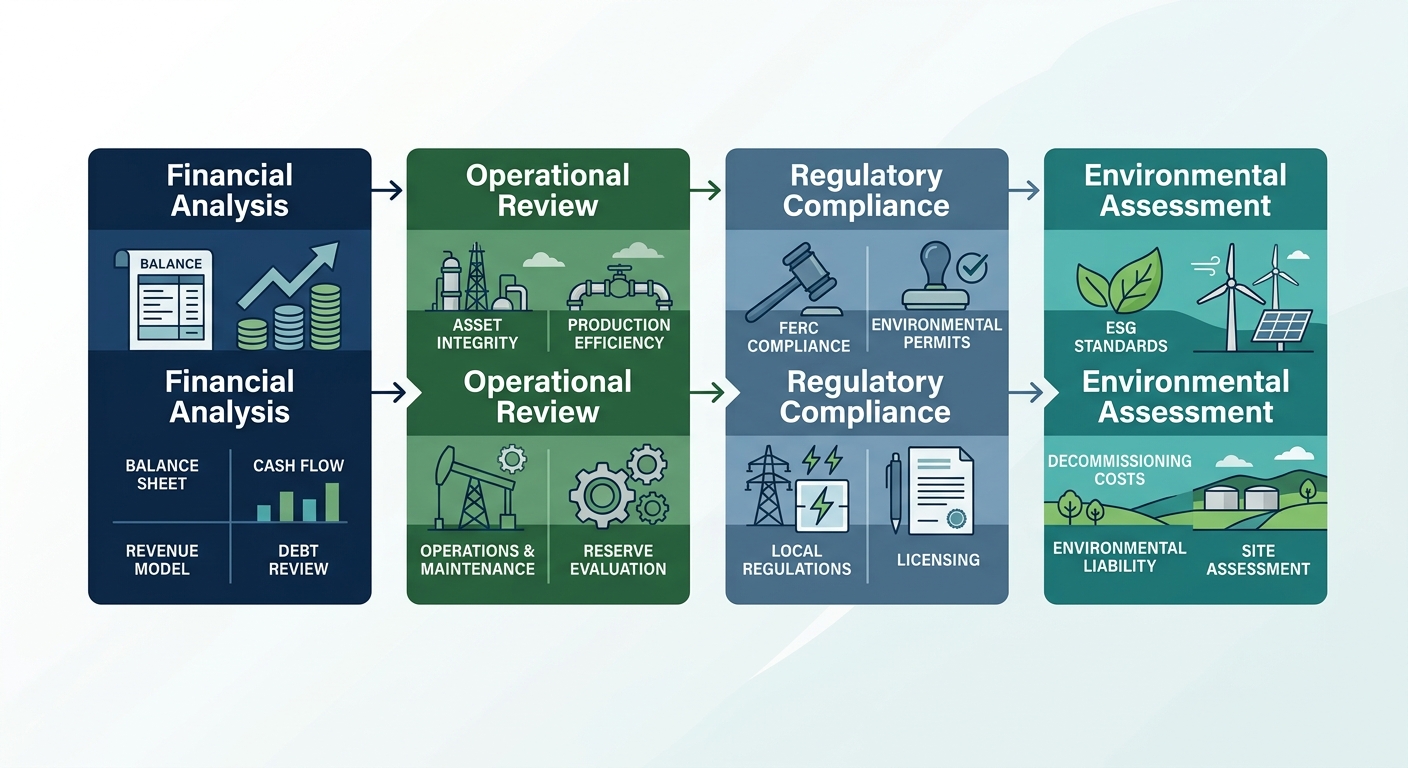
    In energy mergers and acquisitions advisory, comprehensive due diligence is the crucial phase that uncovers hidden risks and validates deal assumptions. We begin by examining the asset portfolio—for oil and gas mergers, that means analyzing proved and probable reserves, production profiles, and lifting costs.

    Next, we scrutinize financial health: audited statements, tax structures, debt covenants, and commodity hedging strategies reveal potential liabilities. Operational efficiency assessments focus on aging infrastructure, technology integration, and workforce capabilities. Regulatory compliance is paramount—we evaluate EPA environmental standards, FERC requirements for pipelines, BLM land-use rules, and pending litigation or decommissioning obligations. Energy M&A trends, including commodity price volatility, geopolitical supply chain risks, and shifting subsidies, inform our market risk analysis.

    Throughout this process, we coordinate specialists, manage secure data rooms, and deliver independent valuation points to accelerate decision-making.

    Due diligence infographic with four panels: financial analysis, operational review, regulatory compliance, and environmental assessment, connected by arrows to show sequential review process.
    Four-panel due diligence infographic for energy M&A

    By applying this rigorous, structured approach, we help clients navigate complexity and negotiate from a position of strength, ensuring that strategic fit and long-term energy transition goals are met.

    Value Your Energy Business Accurately

    In energy mergers and acquisitions advisory, accurate valuation is the bedrock of a successful deal. Current trends in energy M&A underscore that precision in pricing can make the difference in attracting serious buyers. Commodity price volatility and shifting regulations compound this need, requiring a thorough, dispassionate assessment.

    Valuation accuracy directly shapes advisory fee structures. As Zaidwood Capital’s FAQ on advisory models explains, success fees tied to deal value are common. In oil and gas merger activity, fluctuating asset prices make a precise figure essential for fair cost allocation. A valuation grounded in market reality safeguards against disproportionate advisory expenses.

    We at Zaidwood Capital, a Boutique M&A and Capital Advisory Firm, apply full-cycle M&A discipline to energy valuations, ensuring every engagement begins with a defensible number. With an accurate valuation in hand, the next step is selecting the right advisory approach.

    Select the Right M&A Advisor for Your Energy Company

    Navigating energy deals requires a specialized energy mergers and acquisitions advisory firm that understands oil and gas mergers and renewables alike. As energy M&A trends evolve, we at Zaidwood Capital believe sector expertise is non-negotiable.

    We evaluate advisors on their proven track record in similar-sized transactions, deep regulatory knowledge of FERC and state oil and gas commissions, and access to a global network of energy-focused investors. Advisors should also demonstrate capital markets expertise, raising equity and debt for energy companies, and provide anonymized case studies. Proprietary data platforms like the Sovereign Data Nexus enable enhanced due diligence and valuation.

    Unlike large banks, a Boutique M&A and Capital Advisory Firm provides senior-level attention, faster decision-making, and full-cycle support. Steer clear of advisors lacking transparency in their deal pipeline or a demonstrable network of energy-focused limited partners.

    Choosing a partner with both deep-domain expertise and a full-cycle approach is the foundation of a successful energy transaction.

    Structure and Negotiate the Deal

    Once a suitable target is identified, the deal structuring and negotiation phase begins, firmly led by our expertise in energy mergers and acquisitions advisory.

    • Valuation analysis: We apply CFA Institute best practices to assess asset worth, leveraging our Velocity Matrix for rapid scenario modeling and Sovereign Data Nexus for data-backed valuation benchmarks.
    • Term sheet negotiation: We guide clients through typical oil and gas mergers levers, including asset valuation adjustments, earn-outs, and indemnity clauses.
    • Due diligence integration: We synthesize findings into revised terms, ensuring alignment with evolving energy M&A trends.

    Structuring is iterative, demanding constant alignment of financial and strategic goals. Streamlining Transactions with Business Development and Financial Expertise, Zaidwood Capital refines every term to maximize client value. After terms are negotiated, the path to closing relies on precise execution and secured data management.

    Navigating regulatory approvals is a cornerstone of energy mergers and acquisitions advisory in today’s market. The FTC, DOJ, and FERC rigorously review energy transactions, while the Hart-Scott-Rodino Act imposes pre-merger notification requirements that demand careful timing. As energy m&a trends reflect a tightening regulatory environment, acquirers and sellers must plan accordingly.

    Environmental reviews under NEPA add layers of complexity for both renewables and oil and gas mergers, especially when drilling or infrastructure permits are involved. Cross-border deals face added scrutiny from CFIUS, which can block acquisitions of critical energy assets. Building robust compliance pathways early is essential to avoid costly delays.

    At Zaidwood Capital, we map these approval frameworks to each transaction’s timeline, leveraging our proprietary Sovereign Data Nexus to monitor regulatory shifts in real time. A proactive approach to navigating regulatory dynamics in energy M&A not only mitigates risk but accelerates execution into due diligence and structuring.

    Execute Post-Merger Integration for Maximum Value

    Once the deal closes, the real work begins: post-merger integration. In energy mergers and acquisitions advisory, disciplined PMI separates value-creating transactions from those that erode returns. We anchor integration on three pillars: clear integration planning, deliberate cultural alignment, and rigorous operational synergy tracking.

    Amid evolving energy M&A trends, oil and gas mergers demand concrete KPIs for cost synergies, revenue gains, and talent retention, reviewed quarterly. Zaidwood Capital’s healthcare M&A research shows that 70% of deals underperform due to cultural misalignment—a pattern mirrored in energy transactions. With deep energy mergers and acquisitions advisory, we customize integration plans to sector-specific dynamics, reducing friction and accelerating synergy capture.

    Our Sovereign Data Nexus consolidates data across legacy systems in real time, speeding system unification. The Velocity Matrix then accelerates milestone tracking, enabling faster, evidence-based decisions. We never guarantee a specific outcome; each integration carries unique risks and demands adaptive execution.

    With a solid integration plan, the combined entity is positioned for sustained growth. In the next section, we explore long-term value creation through strategic portfolio management. Past performance does not guarantee future results; investors may lose all or part of their investment.

    Overcoming Common Hurdles in Energy M&A Advisory

    Navigating the energy mergers and acquisitions advisory landscape requires a clear-eyed view of recurring hurdles. Even when the macro environment looks favorable, several obstacles can slow or derail a transaction. Our experience highlights four challenges that demand structured responses.

    Regulatory and permitting complexity tops the list. In cross-border oil and gas mergers, for instance, firms often face overlapping environmental reviews, antitrust scrutiny, and national-security considerations. We deploy our secure Deal Vault to organize due diligence early, enabling clients to respond to inquiries with consistency—without promising a faster timeline.

    Commodity-price volatility widens the bid-ask spread, a hallmark of energy M&A trends that makes valuation a moving target. We use a structured negotiation framework alongside transparent data rooms to surface mutually acceptable valuation bases, aligning buyer and seller expectations despite fluctuating oil-and-gas benchmarks. The discipline narrows the gap without guaranteeing a fixed price.

    Asset-level uncertainty—legacy infrastructure, decommissioning liabilities, ESG factors—complicates price discovery. Our Sovereign Data Nexus maps operational and environmental data to ground pricing discussions in facts. Our recent healthcare M&A analysis shows that valuation corrections are sector-agnostic, while our 2026 forecast anticipates convergence that mirrors the energy transition.

    Post-merger integration difficulty—cultural clashes, operational overlap, technology misalignment—often undermines deal logic. We embed full-cycle oversight from initial diligence through post-close planning, helping clients anticipate friction points and design alignment measures. No process eliminates every risk, but a disciplined, data-rich approach improves outcomes. That’s where a full-cycle boutique like Zaidwood Capital earns its role.

    Achieving a Successful Energy M&A Transaction

    Given the sector’s constant evolution, achieving a successful energy mergers and acquisitions advisory engagement demands strategic clarity and rigorous execution. We approach each mandate as a custom alignment of buyer and seller objectives, ensuring that the rationale for the transaction is firmly grounded in long-term value creation rather than short-term market momentum.

    Keeping pace with energy M&A trends — such as the accelerating shift into clean infrastructure and ongoing consolidation in oil and gas — requires advisors who can anticipate market movements before they become consensus. In oil and gas mergers, for instance, precise asset-level valuation and deft navigation of regulatory frameworks separate value-accretive deals from those that destroy shareholder capital. Our Full-Cycle M&A platform combines sophisticated financial structuring with proprietary deal flow intelligence from Sovereign Data Nexus, while Precision Catalyst targets the right institutional counterparties and our Velocity Matrix compresses execution timelines so clients can capture windows of opportunity that traditional processes miss.

    As a Boutique M&A and Capital Advisory Firm, we believe superior outcomes are built on a foundation of continuous learning. Our team’s commitment to ongoing investment professional education — benchmarked against the CFA Institute’s globally recognized ethical and analytical standards — ensures that every engagement benefits from the latest strategic frameworks. Ultimately, a boutique partner armed with proprietary tools and specialized sector fluency significantly increases the probability of a successful, expedited close.

    Resources

  • M&A Due Diligence Services: Complete Guide for 2026

    M&A Due Diligence Services: Complete Guide for 2026

    Table of Contents

    Essential Guide to M&A Due Diligence Services

    Building on the role of investment banks in M&A, a critical component of any transaction is the comprehensive evaluation delivered by M&A due diligence services. Due diligence is the detailed examination of a target company’s financials, operations, legal standing, and strategic fit to identify potential risks and validate the transaction thesis.

    The process encompasses four main pillars: financial due diligence, which scrutinizes historical and projected financial performance; legal due diligence, which reviews contracts, intellectual property, and regulatory compliance; operational due diligence, which assesses internal processes and scalability; and strategic/commercial due diligence, which evaluates market positioning and synergy potential. While thorough, due diligence is a risk mitigation tool, not a guarantee of success.

    Zaidwood Capital, a Boutique M&A and Capital Advisory Firm, streamlines transactions—particularly the due diligence phase—by offering the Sovereign Data Nexus secure data room that enables controlled document exchange. As investment banks, we coordinate due diligence across financial, legal, and operational workstreams, acting as gatekeepers and advisors. Understanding what is an investment bank helps clarify how we structure and oversee each step of this rigorous process.

    By converting raw data into actionable insights, thorough due diligence empowers decision-makers to negotiate from a position of clarity. The following sections break down each type of due diligence and how boutique firms streamline them.

    Core Components of M&A Due Diligence

    The cornerstone of a successful transaction is a thorough due diligence process. When clients engage us for M&A due diligence services, we structure the review around five interconnected areas: Financial, Legal, Operational, Commercial, and Strategic. Each area addresses distinct risks and opportunities that collectively shape the investment thesis.

    Comparison Table: Key Diligence Areas at a Glance
    Diligence AreaFocusKey Questions Answered
    FinancialHistorical and projected financial statements, working capital, debt structureAre revenue and margin trends sustainable? Are there hidden liabilities?
    LegalContracts, litigation history, IP ownership, regulatory complianceAre there pending lawsuits or IP encumbrances? Do contracts contain change-of-control clauses?
    OperationalSupply chain, IT systems, workforce, facilitiesHow resilient is the supply chain? Are key person dependencies manageable?
    CommercialCustomer concentration, market competitiveness, sales pipelineAre top customers locked in or at risk? Is the revenue base diversified?
    StrategicFit with acquirer’s long-term plan, cultural alignment, synergy potentialWill the target accelerate or dilute the acquirer’s strategic objectives?

    Financial diligence scrutinizes historical and projected income statements, balance sheets, and cash flows to validate performance trends. We assess working capital adequacy, debt structure, and off-balance-sheet exposures that could mask hidden liabilities. The goal is to confirm that reported earnings translate into sustainable cash generation and to quantify any adjustments needed to normalize the target’s financial position.

    Legal diligence examines the target’s contract portfolio, litigation history, intellectual property ownership, and regulatory compliance. We pay special attention to change-of-control provisions that could trigger termination or consent rights. All legal and financial reviews are conducted in alignment with CFA Institute professional standards for objectivity and thoroughness, ensuring no material legal risk is overlooked.

    Operational diligence probes the resilience of the supply chain, the robustness of IT systems, and the composition of the workforce. We evaluate key person dependencies and facility redundancies that could disrupt post-close operations. Understanding these operational levers allows us to quantify integration risks and identify quick wins that enhance value from day one.

    Commercial diligence assesses customer concentration, the health of the sales pipeline, market competitiveness, and revenue diversification. By analyzing contract renewals and switching costs, we determine whether top customers are locked in or at risk of churn. A diversified revenue base reduces post-transaction volatility and strengthens the platform’s long-term growth trajectory.

    Strategic diligence evaluates how well the target aligns with the acquirer’s long-term plan, cultural values, and synergy potential. We map revenue and cost synergies to concrete integration milestones, ensuring that the deal advances the acquirer’s strategic objectives rather than diluting them. A systematic review across all five areas uncovers both hidden risks and value-creation opportunities.

    Each component warrants a deeper dive; in the following pages we examine the specific methodologies and best practices for each diligence area. Our approach, refined through extensive technology M&A experience as captured in our guide to tech transaction steps, ensures that no dimension of risk escapes scrutiny.

    In-Depth Process Walkthrough of M&A Due Diligence

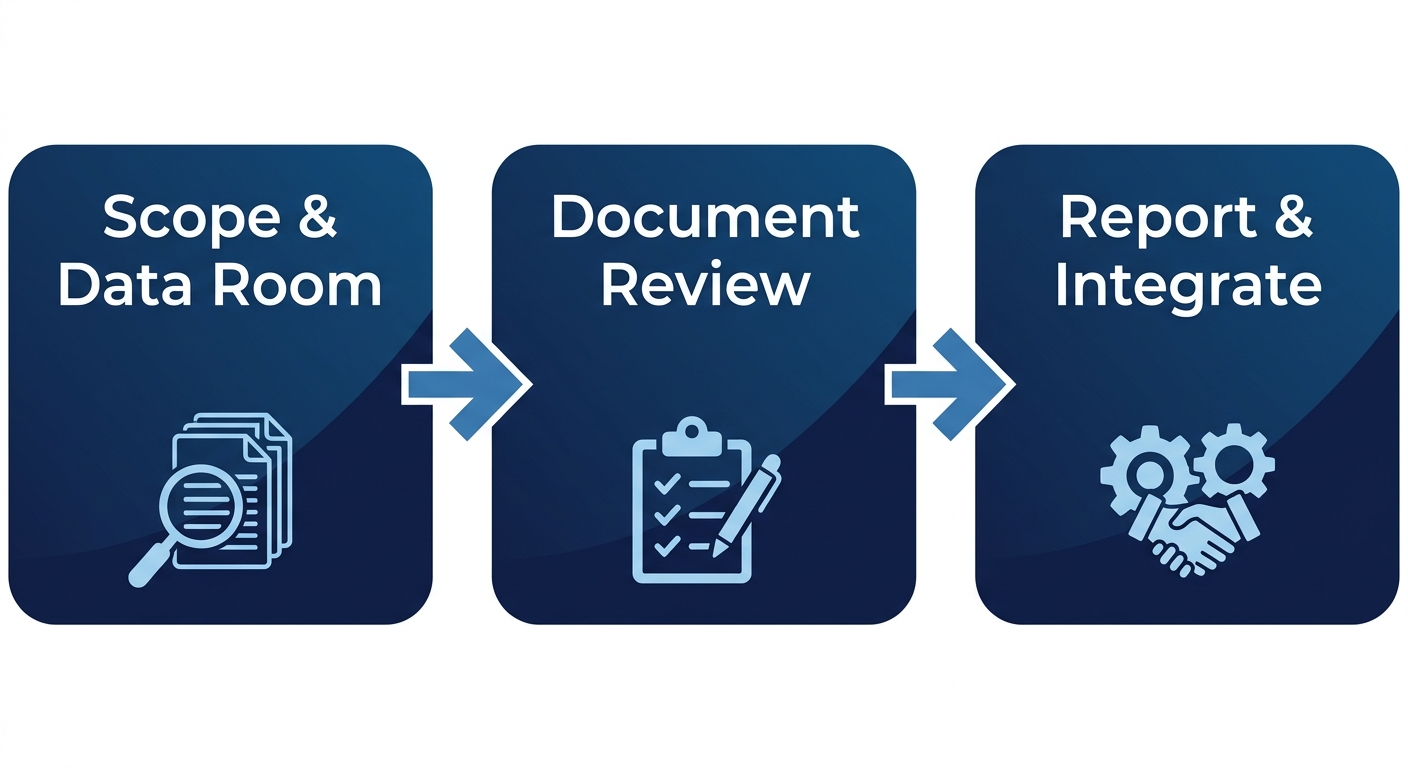
    Now we examine the three phases that make up a comprehensive due diligence process. A walkthrough of our M&A due diligence services reveals how scoping, review, and integration work together to mitigate risk.

    Phase 1: Scoping and Data Room Preparation

    Comparison Table: Financial vs. Operational Due Diligence
    DimensionFinancial DiligenceOperational Diligence
    Primary goalValidate historical accuracy and future earnings capacityAssess the sustainability of operations and efficiency of processes
    Key documentsAudited P&L, balance sheet, cash flow, tax returnsSOPs, org chart, IT architecture, supplier contracts
    Typical teamCPAs, valuation analysts, FP&A specialistsOperations consultants, supply chain experts, HR specialists
    OutputQuality of earnings report, debt capacity analysisOperational risk matrix, integration readiness score

    Phase 1 begins with scoping sessions where our deal team and the buyer’s leadership jointly identify the value drivers and critical risk areas—such as customer concentration, key-person dependency, or regulatory exposure—that will shape the diligence agenda. From those discussions, we build a detailed data request list that typically includes multiple years of audited financial statements (P&L, balance sheet, cash flow), material customer and vendor contracts, IP registrations, employment agreements, and corporate governance documents. A secure virtual data room—our deal vault—is then deployed on our Sovereign Data Nexus platform. The environment is structured with a folder hierarchy that mirrors the diligence workstreams: financial, legal, commercial, and operations. We configure tiered access controls so that legal reviewers, for example, can only access contract folders, while financial analysts see only the finance section. We also align the workstream teams on review timelines, assign responsibilities, and confirm that all requested materials have been uploaded. This disciplined preparation is the foundation that makes the subsequent document review efficient and secure.

    Phase 2: Document Review and Issue Identification

    In Phase 2, our specialists simultaneously review financial statements, legal contracts, operational KPIs, and commercial agreements to surface risks and validate the target’s representations. Financial analysts verify historical earnings, working capital trends, and revenue quality by examining audited P&L, balance sheets, and tax returns, flagging any non-recurring items or accounting policy inconsistencies. Legal counsel scrutinizes customer and vendor contracts for change-of-control triggers, assignment restrictions, and indemnity provisions, and they review employment agreements for retention risks and non-compete enforceability. On the operational side, we assess KPIs such as revenue per employee, system uptime, and supply-chain resilience, comparing them against industry benchmarks to spot inefficiencies. Throughout the phase, we use the data room’s built-in Q&A module to submit targeted questions to the seller’s management; each response is logged and cross-referenced. This iterative process often brings hidden liabilities to the surface. The data room’s Q&A module tracks each query and response, and we cross-reference answers against the original documents to verify consistency. The issue log is shared with the buyer’s deal team in real time, enabling collaborative prioritization. As we illustrate in our complete guide on tech mergers and acquisitions, deep document review frequently uncovers unreported contingent liabilities or non-compliant IP assignments that can affect valuation. In regulated sectors, we also overlay compliance checks against FTC, CMS, and FCC standards, informed by our internal research on how regulatory shifts influence transaction risk. All identified issues are entered into a shared issue log, assigned severity ratings, and prioritized for the subsequent reporting phase.

    Phase 3: Reporting, Remediation, and Deal Integration

    In Phase 3, our team synthesizes all findings into a comprehensive diligence report, beginning with an executive summary that highlights the most critical risks and opportunities. The report segments findings by financial, legal, and operational dimensions, each with a severity rating. Red flags—such as excessive customer concentration, material litigation, or compliance exposures—are escalated immediately and can influence valuation adjustments or the inclusion of special indemnities in the purchase agreement. Our reporting delivers the core M&A due diligence services as actionable intelligence that shapes the client’s negotiation posture. We typically hold a findings review session with the buyer’s leadership to walk through every issue and agree on remediation priorities. To bridge the gap between diligence and post-close execution, we use our Velocity Matrix to translate key risks into a structured 100-day integration plan. Once the diligence report is finalized, the findings directly inform the negotiation of the purchase agreement and integration planning.

    M&A due diligence process flow diagram with three connected stages: scoping and data room preparation, document review and issue identification, and reporting with remediation and deal integration

    Due diligence process: Scoping, Review, Integration

    Practical Application of Due Diligence in M&A

    With the strategic importance of due diligence established, we now turn to its practical execution. When conducting due diligence in tech mergers and acquisitions, assembling the right team and timeline is critical. Our M&A due diligence services are anchored in a disciplined process that aligns financial, legal, and operational expertise to uncover risks and validate the deal thesis early.

    Assembling Your Diligence Team and Timeline

    A well-structured diligence engagement draws on three core roles: a financial advisor who leads the process—typically a boutique M&A firm like Zaidwood Capital—a legal counsel with deep M&A experience, and a technical or industry specialist who can assess operational and market realities. We converge these disciplines around a single checklist that maps every data request, interview, and verification step against a shared timeline.

    A sample 5-week timeline typically unfolds as follows:

    • Weeks 1-2 — Scoping and Information Request: Define the diligence scope, issue the initial document request list, and align client and target management on confidentiality protocols.
    • Weeks 3-4 — Intensive Review: Conduct document analysis, site visits, management interviews, and workstream-specific deep dives (financial, legal, operational, commercial).
    • Week 5 — Report Synthesis: Draft the due diligence report, isolate deal-breakers and conditions to closing, and present findings to the deal team.

    Pro Tip: Always verify key executives’ backgrounds before finalising the diligence timeline. Late-stage discoveries of litigation or misrepresentation can derail transactions, so we include these checks early.

    This collaborative staging keeps the entire team accountable and prevents last-minute surprises.

    Leveraging Data Rooms and Proprietary Tools

    A secure data room is a foundational piece of M&A diligence. Granular permissions, watermarking, and audit trails are non-negotiable. While basic cloud storage (Google Drive) works for small deals, most mid-market transactions demand virtual data room platforms like Intralinks or Ansarada with user-specific rights and detailed logs. For the highest-stakes cross-border scenarios, we rely on Zaidwood Capital’s Deal Vault, which leverages our Sovereign Data Nexus for air-gapped protection and end-to-end encryption.

    Comparison Table: Data Room Options for Due Diligence
    Provider TypeSecurity FeaturesIdeal For
    Basic cloud storage (e.g., Google Drive, Dropbox)Standard encryption, shared linksSmall, fast-moving deals where volume is low
    Virtual Data Room platforms (e.g., Intralinks, Ansarada)Granular permissions, audit trails, watermarkingMid-market M&A with multiple bidders
    Zaidwood Capital’s Deal Vault (private server)Air-gapped environment, Sovereign Data Nexus integrationComplex cross-border transactions demanding highest security

    Each tier matches deal complexity: basic for low-complexity asset sales, VDRs for multi-bidder auctions, and Deal Vault when sovereign-grade security is required.

    Beyond the data room, Precision Catalyst tracks investor engagement—document opens, time spent, repeat visits—flagging high-interest parties to accelerate follow-ups. This data-driven approach concentrates our M&A due diligence services on the most promising leads, shortening the overall diligence cycle.

    Synthesizing Findings into Actionable Reports

    Translating weeks of analysis into a decision-ready report requires discipline. We structure every due diligence report to be concise—typically 2–4 pages of core material plus supporting appendices—and to avoid absolute language. The standard sections include:

    • Executive Summary: A one-page synthesis of the target’s strategic fit, valuation range, and go/no-go recommendation.
    • Functional Findings: Separate subsections for financial, legal, operational, and commercial due diligence, each highlighting the top three risks and opportunities.
    • Deal-Breakers and Risk Matrix: A table that categorizes issues by severity and probability, clearly flagging items that could kill the deal.
    • Conditions to Closing: Concrete actions the target must complete before signing, such as resolving outstanding litigation, obtaining key customer consents, or cleaning up IP ownership.
    • Recommendations: Final guidance on whether to proceed, renegotiate terms, or walk away.

    This structure ensures every stakeholder—whether a CEO, private equity partner, or legal advisor—can grasp the essential picture in minutes and drill into the details as needed. The resulting report arms the deal team with clear conditions to closing, which we address in the next section on negotiation and deal structuring.

    Advanced M&A Due Diligence Strategies

    Building on the foundational due diligence framework, advanced strategies dive deeper into operational and sector-specific risks, especially in cross-border contexts. Our advanced M&A due diligence services in New York go beyond the financial basics, examining technology integration, regulatory exposure, and cultural alignment. This comprehensive approach is critical for deal success.

    For cross-border transactions, the data room requirements multiply significantly. We manage virtual data rooms that comply with diverse data residency laws and incorporate translation services, ensuring that parties in different countries can review documents securely and without legal friction. This operational infrastructure is a core part of our due diligence services, streamlining what is often a logistical bottleneck in international deals.

    Assessing cultural and operational fit is another vital layer of advanced M&A due diligence practices. In cross-border deals, we evaluate not only language barriers and business norms but also time-zone management and workforce integration. A typical domestic merger can stabilize in three to nine months, but international combinations often require six to eighteen months due to the need for deeper integration planning and trust-building. This extended timeline reinforces the need for patient capital and thorough vetting.

    Sector-specific expertise tailors these cross-border due diligence strategies further. For technology companies, advanced diligence includes IP ownership verification, a rigorous software code audit, a cybersecurity posture review, and subscription revenue validation. In healthcare M&A, our due diligence services cover HIPAA compliance, FDA regulatory pathways, clinical trial data integrity, and reimbursement dependencies. These strategies set the stage for executing a rigorous due diligence plan, which we cover next.

    Frequently Asked Questions About M&A Due Diligence

    Building on the steps above, we address some frequently asked questions about M&A due diligence.

    What is M&A due diligence and why is it important?
    Our M&A due diligence services provide a comprehensive evaluation of financial, legal, operational, and strategic factors to identify risks and support informed decisions.

    What key areas are assessed during M&A due diligence?
    We review financial statements, legal contracts, operational workflows, and strategic positioning, leveraging our Sovereign Data Nexus for data-driven insights.

    How does Zaidwood Capital support clients during M&A due diligence?
    Our M&A due diligence services combine Precision Catalyst for investor engagement and Velocity Matrix for rapid execution, ensuring efficient and thorough due diligence.

    This information is for informational purposes only and is not an offer, solicitation, recommendation, or commitment to buy or sell any security.

    Close Your Deals with Confidence

    With preparation complete, execution is where confidence is built. As a Boutique M&A and Capital Advisory Firm, we rely on rigorous M&A due diligence services tailored to each deal’s unique risks and opportunities, reducing uncertainty at every stage. The Sovereign Data Nexus provides proprietary real-time data that validates assumptions, flags hidden risks, and delivers actionable intelligence. Backed by a global network and capital markets experience, the Velocity Matrix accelerates closing timelines, giving clients the transparency to close with confidence, and carrying that assurance into the post-close relationship.

    Resources

  • Tech Mergers and Acquisitions: Complete Guide for 2026

    Tech Mergers and Acquisitions: Complete Guide for 2026

    Table of Contents

    The Landscape of Tech Mergers and Acquisitions

    Tech mergers and acquisitions are accelerating at a historic pace, propelled by the convergence of artificial intelligence and cybersecurity disruption. We observe that ai-driven m&a dominates mid-market dealmaking as companies race to integrate generative AI, while cybersecurity acquisitions surge in response to intensifying threat landscapes and new regulatory frameworks. This velocity creates immense opportunity but also unparalleled complexity for investors and business owners alike.

    In this fast-moving environment, traditional advisory models often struggle to keep up. As a boutique investment banking firm, we combine decades of collective investment banking experience with proprietary data and a global network of over 4,000 investors. Our Sovereign Data Nexus and Precision Catalyst platforms accelerate due diligence and investor matching, delivering the speed and precision that today’s tech transactions demand. This evolving landscape requires a strategic advisor with both agility and institutional knowledge—qualities we bring to every engagement, from initial strategy through final close.

    Key Milestones in the Tech M&A Process

    Navigating the tech mergers and acquisitions landscape requires a structured, milestone-driven framework to manage complexity and unlock value. At Zaidwood Capital, we believe that before you can appreciate the nuances of each stage, you should understand what is an investment bank and how a dedicated advisory team serves as a strategic partner throughout the process. The following milestones outline our systematic approach.

    • Strategic Assessment & Target Identification
      We start by clarifying your growth objectives and screening potential targets that align with your strategic vision. Our team leverages proprietary data networks to identify opportunities that might otherwise go unnoticed.
    • Valuation & Financial Modeling
      Using advanced financial modeling, we triangulate a company’s intrinsic value and quantify potential synergies. This phase ensures you have a realistic pricing framework before entering negotiations.
    • Due Diligence (Including Cybersecurity & IP Audits)
      A rigorous evaluation of financial statements, operational metrics, and legal risks is conducted, with special attention to technology assets, cybersecurity posture, and data privacy compliance. In AI-driven M&A and cybersecurity acquisitions, our proprietary data access via the Sovereign Data Nexus allows for deeper analysis of intellectual property portfolios and cyber risk exposure.
    • Negotiation & Letter of Intent
      Investment bankers facilitate valuation discussions, presenting industry benchmarks and helping bridge gaps through creative deal structuring—such as earn-outs or seller financing. A non-binding letter of intent is then drafted to formalize key terms.
    • Regulatory Approvals & Compliance
      Navigating antitrust, data sovereignty, and sector-specific regulations is critical. We coordinate with legal counsel to ensure all filings are complete and timelines are managed proactively.
    • Closing & Deal Documentation
      Our Full-Cycle M&A approach encompasses deal vault management and the preparation of definitive agreements. We oversee the final exchange of consideration and transfer of ownership, ensuring every detail is documented and compliant.
    • Post-Merger Integration
      Success doesn’t end at closing; we help clients execute integration plans that capture synergies, align cultures, and safeguard critical technology architectures. Continuous monitoring of cybersecurity risks remains a priority.

    With a clear understanding of these milestones, it becomes evident why experienced advisory guidance is critical. Our role as a Boutique M&A and Capital Advisory Firm is to streamline each step, mitigating risk and positioning clients for long-term value creation. In the following sections, we’ll explore each milestone in greater depth to help you prepare for a successful transaction.

    In tech mergers and acquisitions, regulatory complexity often determines whether a transaction reaches completion or stalls indefinitely. Beyond financial and technical due diligence, regulatory compliance emerges as a critical hurdle. Our firm combines deep advisory experience with proprietary intelligence tools to help clients anticipate and address these challenges.

    For transactions involving telecommunications infrastructure, the review process demands particularly careful navigation. The FCC telecommunications agency must approve any transfer of spectrum licenses or communications assets, a process our team streamlines through early engagement and thorough preparation. According to the Federal Communications Commission, public interest hearings and foreign ownership rules frequently extend review timelines, especially in tech mergers and acquisitions where national security considerations intersect with infrastructure control. We help clients prepare comprehensive filings that address these nuanced requirements from the outset.

    Cross-border financing structures introduce additional regulatory dimensions that many acquirers underestimate. The International Capital Market Association establishes the Green Bond Principles, a critical framework when technology acquirers issue sustainable debt to fund acquisitions. For technology M&A transactions spanning multiple jurisdictions, ICMA standards provide essential guidance on disclosure requirements and market practices that protect both issuers and investors. In ai-driven M&A, regulatory scrutiny of data privacy compliance often intersects with these capital market requirements, creating layered obligations that demand coordinated advisory support.

    Cybersecurity acquisitions frequently trigger filings under the Committee on Foreign Investment in the United States, adding national security review to already complex transaction timelines. Our Sovereign Data Nexus platform monitors real-time regulatory changes and precedent decisions across these agencies, helping clients anticipate potential friction points. While advisory experience reduces execution risk, each transaction remains unique, and regulatory outcomes depend on the specific deal structure and government determinations. We provide clarity without promising specific results.

    Once regulatory approvals are secured, the focus shifts to rapid, compliant integration. Our Velocity Matrix accelerates this transition, enabling clients to move from approval to operational execution without sacrificing regulatory diligence or transaction momentum.

    Preparing Your Company for Due Diligence

    Once you have identified a potential acquisition target, thorough preparation is the next critical step, particularly in the dynamic landscape of tech mergers and acquisitions. For founders and management teams, the due diligence process can feel overwhelming, but a structured, proactive approach transforms it from a hurdle into an opportunity to showcase your company’s value. At Zaidwood Capital, we guide our clients through this critical phase, ensuring that every facet of the business is scrutinized and presented to withstand the most rigorous investor or buyer examination. The goal is not just to survive diligence but to leverage it as a strategic step toward a successful transaction.

    We advise our clients to focus on three fundamental preparatory tasks. First, compile and organize all foundational documentation. This includes audited financial statements, corporate tax returns, capitalization tables, material contracts, and all historical investor presentations and board decks. Second, assemble a dedicated, cross-functional internal response team. This group should include key leaders from finance, legal, and operations who are empowered to answer questions and pull records quickly. Third, establish a secure, meticulously indexed virtual data room. A well-structured data room accelerates the review process and signals operational maturity to potential partners.

    For companies involved in ai-driven m&a or cybersecurity acquisitions, the diligence requirements extend far beyond standard financial and legal review. A significant portion of the evaluation will focus on technology and intellectual property. Be prepared to demonstrate clear ownership and defensibility of your core IP, including patents, trademarks, and proprietary code. We help our clients prepare detailed documentation of AI model training data, algorithm logic, and bias mitigation protocols. Equally non-negotiable is a thorough review of your cybersecurity infrastructure, incident response history, and data privacy compliance. Addressing these technology-specific areas proactively is a powerful risk-mitigation strategy that prevents deal-derailing surprises.

    As your Boutique M&A and Capital Advisory Firm, we streamline this entire preparation phase. We provide a tailored readiness checklist and can manage the deal vault, ensuring all sensitive information remains secure and organized. This hands-on support allows you to stay focused on running your business. A robust financial analysis is the bedrock of this process, and professionals with a strong foundation, including those who have completed a CFA certification program, add significant rigor to the financial modeling and valuation perspectives that underpin a solid diligence review.

    With your company thoroughly prepared, the formal due diligence process can proceed more efficiently, often beginning with the opening of a secure data room to invited parties.

    Evaluating the Cost and Value of M&A Advisory

    In today’s dynamic deal environment, tech mergers and acquisitions require rigorous evaluation of advisory cost and value. As a Boutique M&A and Capital Advisory Firm, we believe clients must look beyond headline fees to assess the full spectrum of value an advisor delivers throughout the transaction lifecycle.

    Understanding Fee Structures

    M&A advisory fees generally follow two primary models. A retainer fee compensates the advisor for upfront work, including market analysis, buyer identification, and initial due diligence preparation. This structure ensures dedicated resources are committed to the engagement from day one, aligning incentives for thorough preparation rather than rushed execution. The second model, a success fee, is contingent upon closing and typically calculated as a percentage of transaction value. This arrangement directly ties advisor compensation to outcomes, creating strong alignment around achieving optimal deal terms. Many engagements combine both structures, balancing ongoing commitment with performance-based rewards.

    Value Drivers and Differentiating Factors

    Evaluating advisory value requires examining factors beyond the fee schedule. Proprietary data access represents a critical differentiator. Through our Sovereign Data Nexus, we leverage private servers and exclusive market intelligence to identify opportunities and benchmark valuations that public databases cannot replicate. This infrastructure powers informed decision-making, particularly in specialized sectors like ai-driven m&a and cybersecurity acquisitions, where traditional valuation metrics often fall short. Execution speed, driven by our Velocity Matrix methodology, compresses timelines without sacrificing diligence quality. Finally, investor engagement capabilities, enhanced by our Precision Catalyst platform, ensure targeted outreach to qualified counterparties rather than broad, unfocused marketing.

    Boutique advisory firms offer distinct advantages over bulge-bracket institutions, including senior-level attention throughout the engagement, specialized sector expertise, and flexible fee arrangements. While larger banks provide global distribution networks and multi-product capabilities, boutique firms deliver personalized service and dedicated focus on middle-market transactions where nuanced industry knowledge creates measurable value.

    For industry standards and best practices, clients may refer to organizations such as the ICMA capital market association and the CFA Institute, whose ethical frameworks and professional guidelines establish benchmarks for advisory conduct.

    Criteria for Evaluating Advisory Value

    • Transaction track record in relevant sectors and deal sizes
    • Network quality, measured by access to decision-makers at strategic acquirers and institutional investors
    • Technological capabilities that enhance data security, valuation accuracy, and investor targeting
    • Professional standards, including adherence to CFA Institute ethical guidelines and demonstrated commitment to fiduciary responsibility

    With these evaluation criteria in mind, one can better navigate the selection process for an advisory partner aligned with specific transaction objectives.

    The landscape of tech mergers and acquisitions is being reshaped by two powerful forces: the application of artificial intelligence and a surge in cybersecurity-focused dealmaking. As a Boutique M&A and Capital Advisory Firm, Zaidwood Capital sees these trends creating both opportunity and complexity for growth companies and investors. To understand these shifts, it is helpful to revisit what is an investment bank and how its core advisory services are being transformed by technology. The traditional functions of capital raising and full-cycle M&A are now augmented by proprietary data, AI-driven analytics, and rapid execution capabilities that distinguish boutique platforms from larger wirehouses.

    Infographic showing AI-driven M&A on left and cybersecurity acquisitions on right connected by Sovereign Data Nexus bridge
    AI and cybersecurity acquisition trends infographic

    Now, AI-powered M&A is transforming every stage of the deal lifecycle. Our Sovereign Data Nexus employs machine learning to scan thousands of targets, flagging financial and operational red flags and surfacing data-driven opportunities that traditional manual screening would miss. Predictive valuation models, built on historical transaction data and real-time market signals drawn from our global investor network, help our team price transactions with greater precision. This is not just a pre-deal advantage; AI tools are increasingly used in post-merger integration to identify synergy realizations and operational efficiencies that protect deal value. For clients, staying ahead of trends in ai-driven m&a requires access to proprietary data and tech-enabled diligence, which translates into faster, more informed decision-making—a distinct edge in competitive processes.

    Cybersecurity acquisitions have become a dominant theme in the current cycle. Companies are acquiring specialized security firms to defend against evolving threats, comply with tightening regulations, and build competitive moats around their digital assets. With over $24.4 billion in aggregate transaction volume handled by our team, we have witnessed a sharp increase in deals targeting cybersecurity providers. The growth in cybersecurity acquisitions reflects a strategic imperative to embed security as a driver of resilience. Our Velocity Matrix enables rapid execution, and our network of 4,000+ investors actively seeks cyber-focused deals. This approach allows clients to capitalize on market opportunities before conditions change.

    Understanding these emerging trends—and how a boutique platform like Zaidwood Capital leverages the Sovereign Data Nexus and Velocity Matrix—is essential for any stakeholder considering a technology-driven transaction. In our next section, we explore how we structure and execute full-cycle deals that capitalize on these dynamics.

    Achieving Success in Tech Mergers and Acquisitions

    Success in tech mergers and acquisitions hinges on speed, proprietary data, and rigorous due diligence. In a landscape where cybersecurity acquisitions can turn on undiscovered vulnerabilities, and ai-driven M&A requires deep technical evaluation, traditional advisory is no longer enough.

    We address this through our proprietary deal infrastructure. Our Sovereign Data Nexus provides secure, transaction-specific servers and exclusive data sets, enabling the granular risk assessment technology deals demand. The Velocity Matrix then compresses execution timelines without sacrificing quality, a critical advantage in fiercely competitive tech auctions. Underpinning both is the Precision Catalyst, our integrated investor-engagement engine that uses digital marketing and capital-markets expertise to align startups, growth companies, and institutional capital at the right moment.

    We deliver this as Full-Cycle M&A: end-to-end support from strategic documentation through to a closed transaction. While these capabilities sharpen execution, every deal involves inherent risk and requires careful regulatory and legal compliance. These tools form the foundation of our advisory process, explored in the next section.

    Resources

  • What Is an Investment Bank? Key Services Explained

    What Is an Investment Bank? Key Services Explained

    Table of Contents

    The Role of Investment Banks in Modern Finance

    Understanding what is an investment bank is essential to grasping modern financial markets, as these institutions serve as vital intermediaries between companies seeking capital and the investors who provide it. According to the CFA Institute, the global standard-setter for the investment industry, investment banks facilitate capital formation, mergers and acquisitions, and market making, driving economic growth globally today.

    Investment banks perform three primary functions: capital raising, mergers and acquisitions advisory, and market making. In capital raising, we offer capital raising solutions that leverage our extensive investor network to secure equity and debt financing. In mergers and acquisitions, we advise on deal structuring, valuation, and negotiation, ensuring strategic alignment. Market making provides liquidity and price discovery, but boutique firms typically focus on advisory, delivering personalized, high-touch service enhanced by tools like our Sovereign Data Nexus and Velocity Matrix. These functions collectively channel capital to productive enterprises, fueling innovation and economic expansion.

    At Zaidwood Capital, we are redefining Financial Services 3.0 as a Boutique M&A and Capital Advisory Firm, combining proprietary data access via our Sovereign Data Nexus with precision execution through our Velocity Matrix to accelerate deals. Securities are offered through Finalis Securities LLC; Zaidwood Capital is not a registered broker-dealer.

    Investment Banking Services: From Advisory to Capital Markets

    When clients ask what is an investment bank, we answer with a clear definition: A financial institution that provides strategic advisory and capital-markets services to corporations, governments, and institutions. Unlike commercial banks that focus on deposit-taking and lending, investment banks operate on a fee-based model, guiding complex transactions like mergers and acquisitions and large-scale capital raising.

    Investment Bank vs. Commercial Bank
    Feature Investment Bank Commercial Bank
    Primary Focus Advisory & Capital Markets Deposits & Lending
    Revenue Model Fee-based Interest-based

    This distinction is foundational. While commercial banks serve everyday financial needs, investment banks unlock growth through corporate finance advisory, deal orchestration, and access to deep capital pools.

    Our firm’s advisory practice spans the full continuum of mergers and acquisitions—from target identification and valuation to negotiation and close—while our capital-markets capabilities help clients structure and secure equity, debt, and structured solutions. For a growing enterprise seeking capital raising, we craft strategic materials like pitch decks, business plans, and pro forma financials, then leverage our global network of over 4,000 institutional and private investors to create institutional introductions.

    Mergers and Acquisitions: How Investment Banks Drive Deal Execution

    To fully appreciate what an investment bank does in the context of mergers and acquisitions, it helps to examine the entire deal lifecycle. Investment banks serve as strategic partners that bring financial expertise, proprietary data tools, and a global investor network to the table. We follow a three-phase framework that covers deal sourcing and initial pitch, rigorous due diligence and financial modeling, and finally negotiation, structuring, and closing.

    Deal Sourcing and Initial Pitch

    We proactively identify acquisition targets or divestiture opportunities through our proprietary Sovereign Data Nexus and long-standing industry relationships. By continuously monitoring market signals and capital flows, we surface potential transactions that align with a client’s strategic objectives. Once a promising opportunity is identified, we craft a tailored pitch book that outlines a compelling investment thesis, preliminary valuation ranges, and a roadmap for value creation.

    Due Diligence and Financial Modeling

    Once a letter of intent is signed, we lead a comprehensive due diligence process that examines financial statements, operational metrics, legal risks, and market conditions. Following the best practices outlined by the CFA Institute, our team validates the target’s earnings quality, working capital dynamics, and growth assumptions. We build a suite of valuation models—discounted cash flow, precedent transaction, and leveraged buyout analyses—to triangulate intrinsic value and stress-test deal economics.

    Negotiation, Structuring, and Closing

    With due diligence findings in hand, we advise on deal structure—whether a stock or asset purchase, and how earn-outs, seller financing, or contingent consideration can bridge valuation gaps. We take the lead in negotiations, coordinating closely with legal and tax advisors to translate commercial terms into binding documents. Throughout this phase, our secure deal vaults serve as central hubs for all transaction materials, accelerating the exchange of sensitive information.

    Capital Raising Strategies: Equity and Debt Financing Pathways

    A core function of an investment bank is helping companies raise capital to fuel growth, execute strategic initiatives, or navigate complex transactions. At Zaidwood Capital, we specialize in capital raising as part of our Full-Cycle M&A and Capital Advisory services, connecting businesses with the right mix of equity and debt financing.

    Equity Financing: Private Placements and Growth Equity

    Equity financing allows businesses to raise capital by selling ownership stakes. Investment banks facilitate private placements, offering shares to accredited investors and institutional investors rather than public markets, which can be faster and more flexible. At Zaidwood Capital, we leverage a network of more than 4,000 investors to connect companies with the right capital providers.

    Debt Financing and Structured Solutions

    Debt financing allows companies to borrow capital without diluting ownership, preserving control for existing shareholders. Investment banks structure a range of instruments: senior debt is secured by company assets, carries a lower interest rate, and ranks first in repayment priority; mezzanine financing is subordinated, carries higher cost, and often includes equity warrants.

    Equity vs. Debt Financing
    Dimension Equity Debt
    Ownership Diluted Preserved
    Repayment None Regular Payments

    Preparing Your Business for a Capital Raise

    Thorough preparation significantly increases the likelihood of a successful capital raise. Start by compiling audited or reviewed financial statements that demonstrate historical performance and projections. A credible business valuation sets realistic expectations for deal terms. Develop a compelling investor pitch deck that clearly articulates the company’s value proposition, growth strategy, and use of funds.

    Boutique Investment Banking: The Zaidwood Capital Advantage

    If the searcher’s question is what is an investment bank, the clearest answer begins with the distinct categories of the industry. Investment banks facilitate the flow of capital, but they operate across a spectrum from boutique advisory firms to global full-service institutions and the largest bulge-bracket banks. At one end, boutique firms like Zaidwood Capital deliver high-touch, specialized guidance for mid-market and growth companies.

    Boutique vs. Full-Service vs. Bulge-Bracket
    Type Focus Advantage
    Boutique Advisory Senior Attention
    Bulge-Bracket Global Markets Balance Sheet
    Side-by-side infographic comparing boutique investment bank advantages with data, marketing, and speed icons versus traditional bulge-bracket bank with globe and buildings

    Comparison infographic showing boutique versus traditional banking advantages

    Common Questions About Investment Banking

    What is an investment bank?
    An investment bank is a financial intermediary that helps companies raise capital and execute mergers and acquisitions. They range from large bulge-bracket institutions to specialized boutique firms like ours, which provide senior-led, personalized advice and sector expertise.

    Unlike traditional investment banks, our boutique advisory provides end-to-end support throughout your transaction lifecycle. Our team brings expertise in mergers and acquisitions and capital raising, leveraging proprietary tools like the Sovereign Data Nexus for data-driven insights and the Velocity Matrix to accelerate execution. Zaidwood Capital is not a registered broker-dealer; securities are offered through Finalis Securities LLC.

    Resources

  • Tree Care Industry Trends 2026: What You Must Know

    Tree Care Industry Trends 2026: What You Must Know

    Table of Contents

    As we examine tree care industry trends 2026, it’s clear that technology and capital are driving a fundamental transformation. The adoption of AI-powered tree risk assessment technology allows arborists and municipalities to make data-driven decisions, improving safety and operational efficiency across urban canopies.

    At the same time, climate-resilient urban canopy management is moving from a niche concern to a mainstream priority. As extreme weather events intensify, cities are recognizing the critical role of trees in cooling, carbon sequestration, and stormwater management. In our view, the shift from reactive tree removal to proactive care enabled by technology and climate policy is a long-term structural change that will fuel demand for advanced services.

    Capital is following these structural tailwinds. We are observing growing M&A activity in the tree care sector, mirroring patterns identified in Zaidwood Capital’s overview of emerging markets M&A. Consolidation is enabling companies to scale and attract institutional investors seeking stable, infrastructure-linked returns. The influx of capital into tech-enabled tree care companies further signals market confidence in the sector’s growth.

    For investors, these converging trends create a favorable landscape for participating in the environmental infrastructure space. We believe that understanding these drivers can help position portfolios for the maturation of green infrastructure, though past performance does not guarantee future results. Ultimately, this article is for informational purposes and does not constitute an offer, solicitation, or investment advice.

    Understanding the Tree Care Industry’s Structural Shift

    The tree care industry trends 2026 point to a fundamental structural shift reshaping arboricultural services and their investment landscape. Three primary drivers are fueling this transformation:

    • Adoption of AI-powered tree risk assessment technology
    • Mandates for climate-resilient urban canopy management
    • Accelerating M&A consolidation across historically fragmented markets

    Technology is the first seismic force. Innovative firms are deploying AI-powered tree risk assessment technology to evaluate health, stability, and failure probability with precision never before possible. These platforms analyze multispectral imagery, weather patterns, and soil data to forecast liabilities at scale, capturing the attention of private equity and growth-focused investors.

    Climate imperatives are the second driver. Municipalities worldwide are mandating climate-resilient urban canopy management to combat heat islands and stormwater surges. The resulting fragmentation and unmet compliance demand create natural roll-up opportunities. Regional platforms that can consolidate services while meeting sustainability metrics are becoming prime targets for strategic acquirers and institutional funds seeking ESG-aligned exposure.

    Finally, M&A consolidation is accelerating across the tree care sector. Zaidwood Capital’s deep dive into emerging markets M&A reveals a 15 percent annual surge in transaction volumes across developing economies—a dynamic mirrored in North American specialty services. This structural momentum positions the tree care industry for increased emerging markets M&A activity, drawing interest from sovereign wealth funds and cross-border alliances.

    Technology and Climate Adaptation: Drones, AI, and Resilient Canopies

    Among the most impactful tree care industry trends 2026 are the rapid adoption of drone-based health assessments, AI-powered risk prediction, and climate-adaptive species selection.

    Horizontal infographic with three columns showing drone with multispectral camera over tree canopy, AI risk dashboard, and heat-tolerant tree species

    Technology and climate adaptation with drones, AI, and resilient canopies

    Drone-Based Arborist Health Assessments

    Drone-based arborist health assessments are revolutionizing the field. Equipped with multispectral and LiDAR sensors, drones capture high-resolution imagery and 3D data that reveal early signs of disease long before symptoms are visible to the naked eye. This approach improves safety and cuts inspection costs by up to 50% compared to traditional methods.

    AI-Powered Tree Risk Assessment Technology

    The next frontier in arboriculture is AI-powered tree risk assessment technology. By feeding data from IoT soil moisture probes and historical weather patterns into machine learning models, these systems can predict the probability of limb failure with remarkable accuracy. This allows arborists to schedule preventive maintenance proactively.

    Climate-Adaptive Tree Care Practices

    Professionals are rethinking species selection to create climate-resilient urban canopy management strategies. Heat- and drought-tolerant species gaining prominence include Quercus macrocarpa (Bur Oak), Ulmus ‘Morton Glossy’ (Triumph™ Elm), and Gleditsia triacanthos var. inermis (Thornless Honeylocust). These proactive steps ensure that urban forests continue to deliver ecosystem services as conditions shift.

    Residential Service Growth and the Labor Crisis: Practical Implications for 2026

    Outlook for Residential Tree Service Growth

    Three primary catalysts drive demand for residential tree services: home improvement activity, severe weather events, and accelerating urbanization. Homeowners are increasingly aware of the value mature trees bring to property valuations. According to the urban tree care framework, increased urban sprawl and aging tree stocks require professional risk mitigation well into 2026.

    How Labor Shortage Shapes Pricing and Operations

    Despite strong demand, a shortage of certified arborists is reshaping the sector. In acute markets, residential prices have risen 15–20% as firms bid up wages. Adoption of AI-powered tree risk assessment technology allows crews to prioritize inspections using drone imagery, mitigating the shortage by improving efficiency for existing staff.

    Investment Valuation and Capital Formation in the Tree Care Sector

    Understanding tree care industry trends 2026 is essential for business owners. Valuation typically revolves around adjusted EBITDA multiples in the 3-5x range. Beyond traditional metrics, companies demonstrating AI-powered tree risk assessment technology implementation and climate-resilient urban canopy management command premium pricing from institutional investors.

    How is AI transforming tree risk assessment in 2026?
    AI-powered tree risk assessment technology uses predictive analytics to detect hazards early, reducing emergency costs and improving safety.

    What is climate-resilient urban canopy management?
    It focuses on selecting diverse, drought-tolerant species and strategic planting to help urban forests weather climate shifts.

    Why choose a veteran-owned tree service?
    Consider a veteran owned tree service like Climbing Grunt for discipline and commitment to safety.

    Resources

  • Institutional Capital Sources: Ultimate Guide to Private Credit

    Institutional Capital Sources: Ultimate Guide to Private Credit

    Table of Contents

    Understanding Institutional Capital Sources

    Institutional capital sources represent large pools of investment funds managed by organizations such as pension funds, insurance companies, sovereign wealth funds, and private credit funds. These entities provide substantial financing for corporate growth, acquisitions, and real estate ventures.

    Private credit lenders operate in the direct lending space, offering customized financing solutions through asset-based lending and cash flow financing structures. Through our global lending services, companies can access these tailored institutional funding options. These lenders typically seek long-term partnerships with growing businesses, providing larger capital amounts with more flexible terms than traditional bank financing.

    Sovereign wealth funds, such as those in the Middle East and Asia, are government-owned investment vehicles that deploy capital into infrastructure, real estate, and strategic sectors globally. These government investment funds bring patient capital with extended investment horizons.

    Through our network of over 4,000 global investors, we connect clients with institutional investor capital sources suited to their transaction requirements. Securities offerings are facilitated through Finalis Securities LLC, a registered broker-dealer.

    Assess Your Readiness for Institutional Capital

    Institutional capital sources such as private credit lenders and sovereign wealth funds can provide transformative financing for growth-stage companies. At Zaidwood Capital, we encourage businesses to assess their readiness across several key dimensions before engaging these sophisticated capital partners.

    • Financial and asset readiness: Investors generally expect at least $5–$10 million in revenue and positive EBITDA. For asset-based lending, clear collateral coverage and strong asset quality are critical. And liquidity runway matters.
    • Management and governance: An experienced leadership team, a clean capitalization table, and transparent financial reporting demonstrate organizational maturity and reduce investor risk.
    • Market positioning: Defensible competitive advantages, a clear growth trajectory, and a large addressable market signal the ability to scale and capture value.
    • Compliance and due diligence readiness: Companies must be prepared to meet SEC regulations (including Regulation D) and have audited financials, legal documents, and a compelling pitch deck ready.

    Assessing these areas objectively is the first step. Engaging professional capital advisory services can help bridge any gaps, guiding you through due diligence and matching your profile with institutional investors who align with your growth objectives.

    Identify Target Institutional Investor Profiles

    Identifying the right institutional capital sources is the foundation of every transaction we advise on. Within the global capital ecosystem, we isolate institutional investor profiles that align precisely with each client’s industry, deal size, and financing structure—whether equity, debt, or hybrid capital.

    Our process draws on data published by the Federal Reserve Bank of New York to track institutional activity and capital flow trends, revealing which investor segments are most active for a given mandate. We then apply classification standards from the International Capital Market Association to map investors by risk appetite, asset class preference, and transaction size thresholds. This shapes a shortlist that can include private credit lenders, sovereign wealth funds, pension funds, endowments, and family offices.

    Through our mergers and acquisitions advisory, we connect each institutional profile to the appropriate transaction structure and capital strategy. With an aggregated network of over 4,000 institutional and private investors representing more than $15 billion of deployable capital, updated quarterly, we can surface the institutional capital pools most relevant to your objectives.

    This information is for informational purposes only and does not constitute an offer. Securities are offered through Finalis Securities LLC; Zaidwood Capital is not a registered broker-dealer.

    Prepare Investor Pitch Materials

    Based on the due diligence insights gathered earlier, we now assemble investor pitch materials designed to secure funding from institutional capital sources. This critical step translates analytical findings into compelling narratives that drive investment decisions. Our approach leverages Zaidwood Capital’s Full-Cycle M&A and capital advisory framework.

    • Value Proposition & Market Analysis: We craft a clear narrative that connects your opportunity to institutional capital sources, including a market analysis slide.
    • Targeted Messaging: Debt-oriented materials resonate among private credit lenders, while equity pitches are assessed by sovereign wealth funds.
    • Financial Projections: All pro formas carry the disclaimer: “These projections are for informational purposes and do not guarantee future results.”
    • Compliance & Regulatory Requirements: Every deck includes risk factors as required by the SEC. We are not a registered broker-dealer; securities are offered through Finalis Securities LLC. Always refer to the securities regulation authority for updated guidance on private placement rules.
    • Zaidwood Capital Advantage: Our Deal Vault and 4,000+ global investors provide a distribution edge without implying guaranteed outcomes.

    With completed materials, we move to presenting them through our institutional network of over 4,000 investors. Book a Call to finalize your materials and start engaging capital sources.

    Approach Sovereign Wealth Funds and Endowments

    We access diverse institutional capital sources by targeting sovereign wealth funds (SWFs) and endowments, each with distinct mandates. SWFs, such as stabilization funds in the Middle East, seek long-term value creation, while university endowments based in the US follow spending policies that balance growth and liquidity. Identifying these mandates is the critical first step in full-cycle M&A and capital advisory.

    Our engagement strategy leverages proprietary data, specifically the Sovereign Data Nexus, to pinpoint funds with aligned investment criteria. We then initiate contact through investor relations channels, presenting our capital introductions and due diligence capabilities. Communications are structured to comply with regulatory frameworks, including those established by the Financial Industry Regulatory Authority (FINRA), which governs promotional materials and accredited investor verification.

    We apply the Velocity Matrix to structure and accelerate deal flow, combined with Precision Catalyst for targeted matching between opportunities and institutional pools. We explicitly avoid promising specific outcomes or guaranteeing transactions. This website is for informational purposes only and is not an offer or solicitation. Securities are offered through Finalis Securities LLC; Zaidwood Capital is not a registered broker-dealer. Beyond sovereign wealth funds and endowments, institutional capital sources include private credit lenders, which we address next.

    Engage Private Credit Lenders

    As we expand the discussion beyond traditional institutional capital sources, private credit lenders represent a distinct and increasingly vital segment of the financing landscape. These are institutional investors — from specialized debt funds to family offices and sovereign wealth funds — that provide non-bank financing directly to companies. At Zaidwood Capital, we connect our clients to a deep network of these alternative capital providers.

    Two of the most common structures offered by private credit lenders are asset-based lending, which is secured by a company’s tangible assets, and cash flow financing, which is underwritten against projected revenue streams. Our qualification framework, which mirrors the rigorous documentation standards benchmarked by the International Capital Market Association (ICMA), ensures a smooth due diligence process. The broader liquidity environment, shaped by Federal Reserve Bank services, continuously affects the terms and availability of capital from these lenders.

    We facilitate these engagements by aligning a client’s financial profile — supported by three years of audited financials and multi-year cash flow projections — with the specific mandates of institutional investors. Individual outcomes will vary, but this targeted approach helps streamline what is often a complex capital raise, setting the stage for us to explain how we actively enable these introductions.

    Before any deal closes, a thorough due diligence and legal review must be completed. We guide clients through this phase to identify risks, verify claims, and ensure regulatory compliance, a prerequisite for attracting institutional capital sources like private credit lenders and sovereign wealth funds.

    Adhering to SEC securities regulation ensures disclosure compliance and reduces legal risk. The U.S. Securities and Exchange Commission (SEC) sets the baseline for securities offerings and anti-fraud provisions. Meanwhile, FINRA oversees the broker-dealer firms that execute transactions, adding another layer of oversight that institutional investors demand.

    A typical review includes:

    • Regulatory compliance check (SEC rules)
    • Broker-dealer oversight (FINRA)
    • Legal document review (NDAs, term sheets, purchase agreements)
    • Client material preparation (deal memoranda, legal opinions)

    This rigorous process satisfies the due diligence standards of private credit lenders and sovereign wealth funds. Once regulatory compliance is confirmed, our Full-Cycle M&A and capital advisory team streamlines the transition to negotiation and closing. (This website is for informational purposes only and is not an offer, solicitation, recommendation, or commitment to transact. Securities are offered through Finalis Securities LLC; Zaidwood Capital is not a registered broker-dealer and is separate from Finalis.)

    Negotiate Terms and Structure the Deal

    Once due diligence confirms the opportunity, the next phase is negotiating terms and structuring the deal to align with the expectations of institutional capital sources. Negotiating with institutional capital sources requires understanding their distinct priorities: private credit lenders typically focus on cash-flow coverage, collateral quality, and floating-rate benchmarks tied to effective Fed funds, while sovereign wealth funds often seek co-investment rights, board representation, and long-term alignment with investment horizons. Current monetary policy, as reflected in rate data from the Federal Reserve Bank of New York, directly influences structure choices—floating versus fixed rates, coupon floors, and covenant flexibility. At Zaidwood Capital, we leverage our full-cycle advisory and proprietary Sovereign Data Nexus to customize structures that balance these competing demands and institutional investor preferences. With terms negotiated and structure agreed, the transaction moves to documentation and closing.

    Close and Maintain Institutional Relationships

    We actively identify and cultivate long-term partnerships with institutional capital sources that align with our clients’ strategic objectives. Operating outside the scope of a registered broker-dealer — a distinction clarified by the Financial Industry Regulatory Authority (FINRA) — we serve as a capital introduction intermediary, facilitating connections rather than executing securities transactions.

    Our network spans sovereign wealth funds, private credit lenders, pension funds, endowments, foundations, and insurance companies. Through our proprietary Sovereign Data Nexus and Velocity Matrix platforms, we match clients to these institutional capital sources based on investment criteria, sector focus, and capital requirements. Beyond the initial introduction, we maintain these relationships through periodic updates, reporting, and facilitated meetings — ensuring sustained engagement without guaranteeing specific outcomes.

    With access to 4,000+ global investors and over $15 billion in deployable capital, we are positioned to support your capital formation goals. Book A Call to discuss your institutional strategy.

    Overcoming Common Barriers to Institutional Capital

    However, accessing these institutional capital sources is not automatic — companies must overcome several well-known hurdles. Many businesses find that institutional capital sources from sovereign wealth funds and other large investors remain out of reach due to gaps in documentation, governance, and financial transparency.

    A frequent barrier is insufficient or poorly organized asset documentation, which prevents companies from qualifying for asset-based lending. Our FAQ outlines that institutions require a clear, verifiable collateral base and detailed asset records. For asset-based lending or cash-flow financing, presenting a strong collateral package and a verifiable cash-flow history is essential. Companies that invest in structured asset tracking and formal appraisals greatly improve their eligibility and signal readiness to private credit lenders.

    Lack of audited financial statements and credible cash-flow projections is another top reason for rejection. Institutional investors typically require three years of audited financials and three- to five-year cash-flow forecasts. Our qualification framework shows that without these, even otherwise healthy businesses struggle to demonstrate their repayment capacity. By committing to regular audits and building realistic, multi-year projections, companies can close this critical gap.

    Inadequate governance structures and limited credit histories further complicate access. The International Capital Market Association (ICMA) emphasizes that institutional investors expect transparency, standardized reporting, and robust risk management. Adopting these standards reduces friction and builds the confidence of sovereign wealth funds and private credit market lenders. Additionally, preparing a detailed business plan with pro-forma financials, a clear use-of-funds explanation, and a credible repayment strategy demonstrates the kind of institutional readiness that professional investors expect.

    Proactive preparation and early engagement with a capital advisor can streamline the entire process. With proper documentation and governance alignment, these barriers can be systematically addressed — which is exactly where our Full-Cycle M&A and capital advisory services come into play.

    Your Pathway to Institutional Capital

    Accessing institutional capital sources—from private credit lenders in the US to sovereign wealth funds worldwide—requires a partner with deep investor relationships. Our network includes pension funds, family offices, and other institutional investors. Zaidwood Capital connects you to over 4,000 investors with more than $15B in deployable capital.

    Our proprietary tools—Sovereign Data Nexus, Precision Catalyst, and Velocity Matrix—streamline due diligence, investor outreach, and deal execution. With $24.4B+ in aggregate transaction volume and more than 300 deals completed, we deliver full-cycle M&A and capital advisory. Securities are offered through Finalis Securities LLC (member FINRA/SIPC) in compliance with regulatory requirements. Past performance does not guarantee future results.

    Seven-step capital pathway infographic showing each advisory stage from readiness assessment to deal closing and relationship management.

    Your Pathway to Institutional Capital in seven clear steps

    This seven-step process brings clarity to every phase of capital raising, from readiness assessment to deal closing. Begin your pathway today. Book a call with our team to discuss your capital raising goals and discover how our investor network can work for you.

    Resources

  • Family Office Liquidity Management Strategies: Essential Guide

    Family Office Liquidity Management Strategies: Essential Guide

    Table of Contents

    The Foundations of Family Office Liquidity Management

    Effective family office liquidity management strategies ensure that sufficient cash and near-cash assets are available to meet obligations—capital calls, operating expenses, and strategic investments—without disrupting long-term portfolio allocations. This foundational discipline balances near-term liquidity needs with the family’s overarching wealth preservation goals.

    Capital call liquidity management is a critical concern, given that private equity and venture funds require sudden capital injections. At the same time, uneven cash flows from operating businesses underscore the need for disciplined family office treasury management to maintain adequate buffers without sacrificing returns.

    Institutional-grade advisory services, such as debt advisory and equity liquidity solutions, help family offices optimize their liquidity position. We draw on $24.4B+ in aggregate transaction volume and a network of over 4,000 global investors, aligned with ICMA guidelines, to provide solutions like global lending services. In the sections that follow, we’ll explore how these strategies are structured to meet the unique demands of family offices.

    1. Tiered Liquidity Buckets for Stability

    In family office liquidity management strategies, we define tiered liquidity buckets as a framework that segments assets by accessibility, ensuring that near-term obligations can be met without liquidating long-term holdings.

    • Operational: immediate access cash for expenses and capital calls.
    • Reserve: 30- to 90-day instruments, such as commercial paper.
    • Strategic: longer-term investments for planned growth.

    This structure anchors capital call liquidity management by pre-positioning funds before drawdowns occur. Family office treasury management relies on cash flow forecasting to calibrate each bucket, mitigating forced liquidation risk. As Zaidwood Capital’s educational materials note, commercial and industrial loans are a prime example of a short-term vehicle that fits naturally within the reserve tier, offering working-capital support while protecting longer-horizon assets.

    Three-tiered liquidity structure infographic showing operational, reserve, and strategic liquidity buckets with blue gradient arrows

    Tiered liquidity buckets for family office stability

    Ultimately, robust family office liquidity management strategies align each bucket with anticipated calls and contingencies — a principle Zaidwood Capital’s liquidity management best practices reinforce. In the next section, we detail the asset classes assigned to each tier.

    2. Private Equity Liquidity Solutions

    Building on our advisory platform, private equity liquidity solutions help investors access capital without selling assets. They are essential in family office liquidity management strategies, where preserving long-term investments during short-term cash needs is critical.

    A key driver of private equity liquidity strategies for family offices is capital call liquidity management. When a general partner calls capital, limited partners must fund commitments promptly. Liquidity demands also arise in other scenarios:

    • Addressing uneven cash flows
    • Funding opportunistic co-investments
    • Covering tax or estate obligations
    • Rebalancing portfolios without disruption

    Through our Equity Advisory practice, we leverage the Velocity Matrix and our network of over 4,000 institutional investors with $15 billion in available capital to source liquidity solutions tailored to specific needs. Our full-cycle M&A and capital formation expertise allows us to design facilities that meet family office treasury management objectives, providing cash when required without disrupting strategic portfolios. Every engagement is custom-quoted, and no outcome is guaranteed.

    This integrated approach to liquidity sets the stage for our debt advisory services, which provide the leverage for growth. This discussion is for informational purposes only and is not investment advice. Securities are offered through Finalis Securities LLC.

    3. Managing Illiquidity Premiums Effectively

    Effective family office liquidity management strategies begin with a clear understanding of what an illiquidity premium represents — the additional return investors demand for holding assets that cannot be quickly converted to cash without meaningful price concessions. At Zaidwood Capital, we emphasize that capturing this premium requires deliberate planning rather than passive acceptance. Successful liquidity management for family offices involves constructing portfolios with calibrated exposure across liquidity tiers, ensuring that long-duration commitments are matched with patient capital and clearly defined holding periods.

    We recommend rigorous assessment of illiquidity premiums through historical data analysis and liquidity discount models, which help quantify the expected compensation for reduced marketability. A disciplined approach to family office treasury management incorporates capital call liquidity reserves — cash or near-cash allocations specifically designated to meet drawdown requests from private investment commitments. This capital call liquidity management framework protects portfolios from forced selling and preserves the integrity of the long-term investment strategy.

    Industry best practices established by the International Capital Market Association provide valuable guidance on bond market liquidity and transparency standards. We incorporate these principles when advising on portfolio construction, recognizing that liquidity conditions evolve across market cycles. Educating stakeholders about the relationship between illiquidity and expected returns, and maintaining adequate liquidity buffers for capital calls, positions family offices to earn meaningful premiums while sustaining operational flexibility across full-cycle market environments.

    4. Capital Call Liquidity Management

    Effective capital call liquidity management is a cornerstone of capital call liquidity management for family offices and institutional investors. A capital call is a formal request from a fund manager requiring investors to fulfill their committed capital obligations. Our role is to help clients meet these requests on time without disrupting cash flow or long-term investment returns.

    We approach capital call liquidity strategies with three primary tools: maintaining a dedicated cash buffer, arranging a capital call line of credit, and structuring committed capital facilities. At Zaidwood Capital, our capital call financing solutions are specifically designed for family offices and private investors, as detailed in our Capital Call Financing FAQ. Unlike standard commercial and industrial loans—which are typically used for operating expenses or expansion and rely on asset-based or cash-flow lending—capital call financing is purpose-built for short-term bridging until called capital is distributed.

    This disciplined approach to family office treasury management helps investors avoid forced asset sales, default penalties, and missed opportunities. In the next section, we examine practical steps to implement these liquidity safeguards.

    5. Dividend Recapitalization for Diversification

    Family office liquidity management strategies often incorporate dividend recapitalization, a transaction where a company borrows to pay a dividend to its owners. This provides partial liquidity, letting family offices meet capital call liquidity management requirements or implement family office treasury management initiatives without selling underlying holdings. Freeing up capital in this way enables reinvestment across new asset classes, enhancing portfolio diversification and resilience.

    We also weigh the illiquidity premium inherent in private market investments. Zaidwood Capital’s FAQ highlights that limited partners demand a premium for reduced liquidity, shaping how we approach recapitalizations. Funding can come from sources like commercial and industrial loans, distinguishing this method from a full exit or secondary sale. By preserving ownership while accessing capital, family offices maintain ongoing alignment with management and redeploy proceeds strategically. This technique is one of several recapitalization tools we use to balance liquidity with long-term portfolio objectives.

    6. Treasury Management Best Practices

    To move from theory to practice, family offices should adopt proven family office liquidity management strategies, as outlined in our treasury management resources.

    • Prioritize cash flow forecasting with a rolling six-month horizon and monthly updates to anticipate liquidity needs, proactively manage upcoming capital calls, and avoid unexpected funding gaps.
    • Diversify counterparty risk by maintaining banking relationships with at least three independent institutions, reducing concentration risk and ensuring access to liquidity during market disruptions.
    • Develop a formal family office treasury management policy that includes liquidity stress testing under multiple market scenarios, such as interest rate spikes or capital call surges.
    • Use capital call liquidity management as a strategic tool to cover short-term funding gaps without forced asset sales, preserving long-term portfolio value.
    • Leverage treasury management software or real-time dashboards for consolidated visibility into cash positions, portfolio liquidity, and committed capital calls.

    These practices build a resilient liquidity framework; the next section explores advanced treasury technology solutions.

    7. Optimizing Private Equity Allocations

    Optimizing private equity allocations requires robust family office liquidity management strategies that balance the pursuit of the illiquidity premium with the need for accessible capital. At Zaidwood Capital, we see the illiquidity premium adding 2–3% to long-term returns, but it demands careful liquidity planning. Private equity commitments inherently involve multi-year lock-ups and unpredictable capital calls, so families must develop a clear liquidity strategy for family offices. Effective capital call liquidity management involves forecasting cash outflows and maintaining dedicated reserves to meet drawdowns without disrupting operating budgets or forcing premature asset sales.

    In our experience at Zaidwood Capital, family office treasury management plays a central role in ensuring that PE commitments align with overall portfolio liquidity. Diversifying commitments across vintage years and fund strategies mitigates concentration risk and smooths cash flow demands. We advise family offices to set allocation targets based on their investment horizon and liquidity constraints, not solely on return expectations. With these optimization principles, family offices can move to execute their private equity strategy confidently.

    8. Leveraging Capital Advisory Expertise

    Given these complexities, leveraging our Full-Cycle M&A and capital advisory expertise becomes essential. When designing in family office liquidity management strategies, we assess asset composition and cash flow profiles to select appropriate financing instruments.

    Through our full-cycle advisory process, we help family offices and companies prepare for the rigorous institutional qualification procedures associated with asset-based lending and cash flow financing. As outlined in our internal FAQ, this includes compiling audited financials, three-to-five-year cash flow projections, and detailed business plans that demonstrate creditworthiness. For capital call liquidity management, such financing can provide committed credit lines that support fund contributions without forcing asset sales.

    Our treasury management advisory, grounded in the best practices shared in our Treasury Management FAQ, strengthens family office treasury management by introducing disciplined cash flow forecasting, efficient working capital management, and strategic deployment of liquidity reserves. We work to ensure that surplus cash is invested in line with the family office’s risk tolerance and near-term cash needs.

    Zaidwood Capital’s institutional network—connecting to over 4,000 investors with more than $15 billion in deployable capital—can be structured to support both capital call liquidity management and ongoing treasury requirements.

    With this advisory support, family offices can build resilient liquidity strategies aligned with long-term objectives.

    Building a Resilient Liquidity Framework for Your Family Office

    To address capital efficiency challenges in family office liquidity management strategies, we recommend structuring a resilience framework across distinct tiers. Begin by segregating operational, reserve, and growth liquidity to align cash flows with investment horizons. A disciplined treasury function underpins effective capital call liquidity management, ensuring obligations are met without forced asset disposals.

    • Maintain a contingency reserve equal to 10–15% of committed capital to cover unexpected drawdowns.
    • Embed SEC regulatory updates into risk assessments, staying current with evolving compliance expectations.
    • Use capital call financing as a bridge, preserving invested assets during liquidity events.
    • Benchmark your approach against international wealth management firms to refine family office treasury management protocols.

    A robust framework transforms liquidity from a constraint into a strategic advantage for multi-generational wealth stewardship.

    Resources