Zaidwood Capital

Category: Mergers and Acquisitions

  • Family Office Liquidity Management Strategies: Essential Guide

    Family Office Liquidity Management Strategies: Essential Guide

    Table of Contents

    The Foundations of Family Office Liquidity Management

    Effective family office liquidity management strategies ensure that sufficient cash and near-cash assets are available to meet obligations—capital calls, operating expenses, and strategic investments—without disrupting long-term portfolio allocations. This foundational discipline balances near-term liquidity needs with the family’s overarching wealth preservation goals.

    Capital call liquidity management is a critical concern, given that private equity and venture funds require sudden capital injections. At the same time, uneven cash flows from operating businesses underscore the need for disciplined family office treasury management to maintain adequate buffers without sacrificing returns.

    Institutional-grade advisory services, such as debt advisory and equity liquidity solutions, help family offices optimize their liquidity position. We draw on $24.4B+ in aggregate transaction volume and a network of over 4,000 global investors, aligned with ICMA guidelines, to provide solutions like global lending services. In the sections that follow, we’ll explore how these strategies are structured to meet the unique demands of family offices.

    1. Tiered Liquidity Buckets for Stability

    In family office liquidity management strategies, we define tiered liquidity buckets as a framework that segments assets by accessibility, ensuring that near-term obligations can be met without liquidating long-term holdings.

    • Operational: immediate access cash for expenses and capital calls.
    • Reserve: 30- to 90-day instruments, such as commercial paper.
    • Strategic: longer-term investments for planned growth.

    This structure anchors capital call liquidity management by pre-positioning funds before drawdowns occur. Family office treasury management relies on cash flow forecasting to calibrate each bucket, mitigating forced liquidation risk. As Zaidwood Capital’s educational materials note, commercial and industrial loans are a prime example of a short-term vehicle that fits naturally within the reserve tier, offering working-capital support while protecting longer-horizon assets.
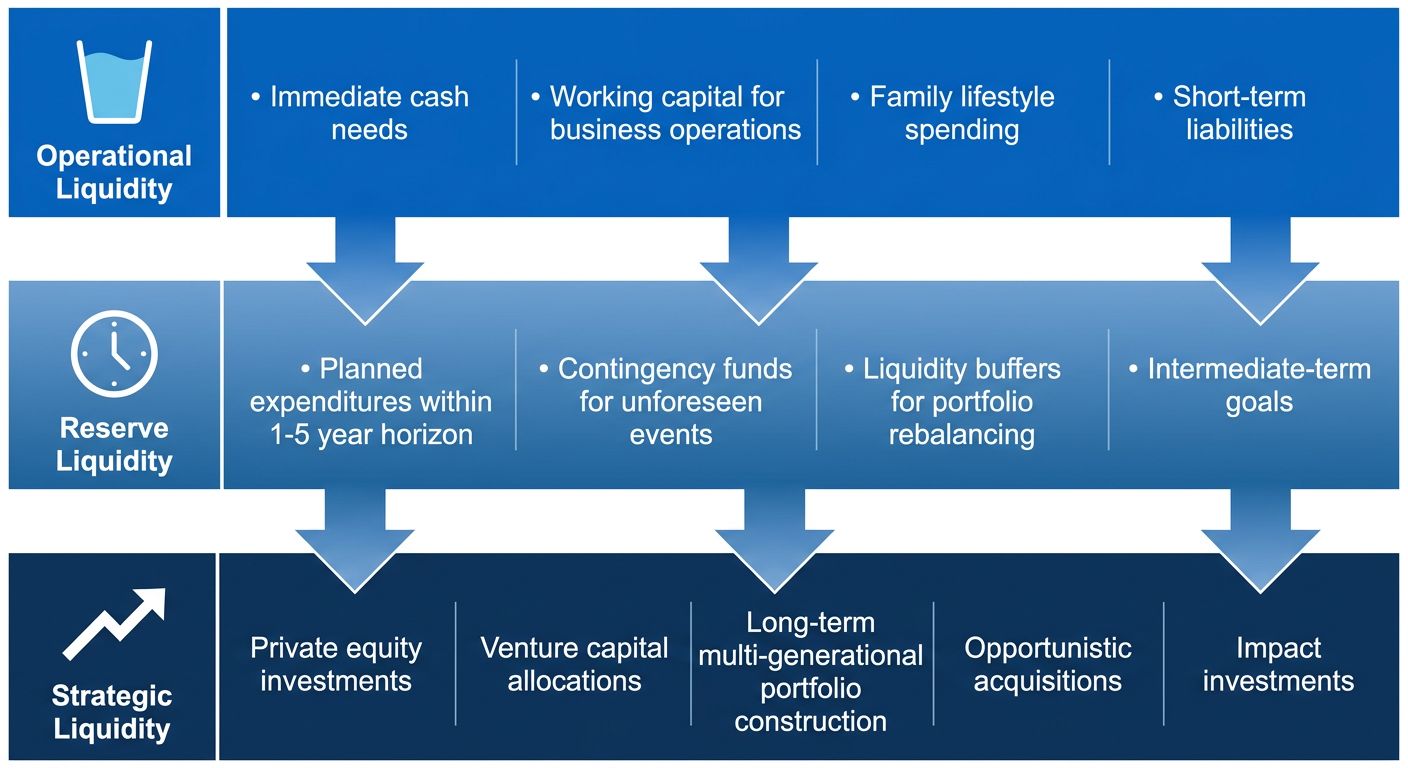
    Three-tiered liquidity structure infographic showing operational, reserve, and strategic liquidity buckets with blue gradient arrows

    Tiered liquidity buckets for family office stability

    Ultimately, robust family office liquidity management strategies align each bucket with anticipated calls and contingencies — a principle Zaidwood Capital’s liquidity management best practices reinforce. In the next section, we detail the asset classes assigned to each tier.

    2. Private Equity Liquidity Solutions

    Building on our advisory platform, private equity liquidity solutions help investors access capital without selling assets. They are essential in family office liquidity management strategies, where preserving long-term investments during short-term cash needs is critical.

    A key driver of private equity liquidity strategies for family offices is capital call liquidity management. When a general partner calls capital, limited partners must fund commitments promptly. Liquidity demands also arise in other scenarios:

    • Addressing uneven cash flows
    • Funding opportunistic co-investments
    • Covering tax or estate obligations
    • Rebalancing portfolios without disruption

    Through our Equity Advisory practice, we leverage the Velocity Matrix and our network of over 4,000 institutional investors with $15 billion in available capital to source liquidity solutions tailored to specific needs. Our full-cycle M&A and capital formation expertise allows us to design facilities that meet family office treasury management objectives, providing cash when required without disrupting strategic portfolios. Every engagement is custom-quoted, and no outcome is guaranteed.

    This integrated approach to liquidity sets the stage for our debt advisory services, which provide the leverage for growth. This discussion is for informational purposes only and is not investment advice. Securities are offered through Finalis Securities LLC.

    3. Managing Illiquidity Premiums Effectively

    Effective family office liquidity management strategies begin with a clear understanding of what an illiquidity premium represents — the additional return investors demand for holding assets that cannot be quickly converted to cash without meaningful price concessions. At Zaidwood Capital, we emphasize that capturing this premium requires deliberate planning rather than passive acceptance. Successful liquidity management for family offices involves constructing portfolios with calibrated exposure across liquidity tiers, ensuring that long-duration commitments are matched with patient capital and clearly defined holding periods.

    We recommend rigorous assessment of illiquidity premiums through historical data analysis and liquidity discount models, which help quantify the expected compensation for reduced marketability. A disciplined approach to family office treasury management incorporates capital call liquidity reserves — cash or near-cash allocations specifically designated to meet drawdown requests from private investment commitments. This capital call liquidity management framework protects portfolios from forced selling and preserves the integrity of the long-term investment strategy.

    Industry best practices established by the International Capital Market Association provide valuable guidance on bond market liquidity and transparency standards. We incorporate these principles when advising on portfolio construction, recognizing that liquidity conditions evolve across market cycles. Educating stakeholders about the relationship between illiquidity and expected returns, and maintaining adequate liquidity buffers for capital calls, positions family offices to earn meaningful premiums while sustaining operational flexibility across full-cycle market environments.

    4. Capital Call Liquidity Management

    Effective capital call liquidity management is a cornerstone of capital call liquidity management for family offices and institutional investors. A capital call is a formal request from a fund manager requiring investors to fulfill their committed capital obligations. Our role is to help clients meet these requests on time without disrupting cash flow or long-term investment returns.

    We approach capital call liquidity strategies with three primary tools: maintaining a dedicated cash buffer, arranging a capital call line of credit, and structuring committed capital facilities. At Zaidwood Capital, our capital call financing solutions are specifically designed for family offices and private investors, as detailed in our Capital Call Financing FAQ. Unlike standard commercial and industrial loans—which are typically used for operating expenses or expansion and rely on asset-based or cash-flow lending—capital call financing is purpose-built for short-term bridging until called capital is distributed.

    This disciplined approach to family office treasury management helps investors avoid forced asset sales, default penalties, and missed opportunities. In the next section, we examine practical steps to implement these liquidity safeguards.

    5. Dividend Recapitalization for Diversification

    Family office liquidity management strategies often incorporate dividend recapitalization, a transaction where a company borrows to pay a dividend to its owners. This provides partial liquidity, letting family offices meet capital call liquidity management requirements or implement family office treasury management initiatives without selling underlying holdings. Freeing up capital in this way enables reinvestment across new asset classes, enhancing portfolio diversification and resilience.

    We also weigh the illiquidity premium inherent in private market investments. Zaidwood Capital’s FAQ highlights that limited partners demand a premium for reduced liquidity, shaping how we approach recapitalizations. Funding can come from sources like commercial and industrial loans, distinguishing this method from a full exit or secondary sale. By preserving ownership while accessing capital, family offices maintain ongoing alignment with management and redeploy proceeds strategically. This technique is one of several recapitalization tools we use to balance liquidity with long-term portfolio objectives.

    6. Treasury Management Best Practices

    To move from theory to practice, family offices should adopt proven family office liquidity management strategies, as outlined in our treasury management resources.

    • Prioritize cash flow forecasting with a rolling six-month horizon and monthly updates to anticipate liquidity needs, proactively manage upcoming capital calls, and avoid unexpected funding gaps.
    • Diversify counterparty risk by maintaining banking relationships with at least three independent institutions, reducing concentration risk and ensuring access to liquidity during market disruptions.
    • Develop a formal family office treasury management policy that includes liquidity stress testing under multiple market scenarios, such as interest rate spikes or capital call surges.
    • Use capital call liquidity management as a strategic tool to cover short-term funding gaps without forced asset sales, preserving long-term portfolio value.
    • Leverage treasury management software or real-time dashboards for consolidated visibility into cash positions, portfolio liquidity, and committed capital calls.

    These practices build a resilient liquidity framework; the next section explores advanced treasury technology solutions.

    7. Optimizing Private Equity Allocations

    Optimizing private equity allocations requires robust family office liquidity management strategies that balance the pursuit of the illiquidity premium with the need for accessible capital. At Zaidwood Capital, we see the illiquidity premium adding 2–3% to long-term returns, but it demands careful liquidity planning. Private equity commitments inherently involve multi-year lock-ups and unpredictable capital calls, so families must develop a clear liquidity strategy for family offices. Effective capital call liquidity management involves forecasting cash outflows and maintaining dedicated reserves to meet drawdowns without disrupting operating budgets or forcing premature asset sales.

    In our experience at Zaidwood Capital, family office treasury management plays a central role in ensuring that PE commitments align with overall portfolio liquidity. Diversifying commitments across vintage years and fund strategies mitigates concentration risk and smooths cash flow demands. We advise family offices to set allocation targets based on their investment horizon and liquidity constraints, not solely on return expectations. With these optimization principles, family offices can move to execute their private equity strategy confidently.

    8. Leveraging Capital Advisory Expertise

    Given these complexities, leveraging our Full-Cycle M&A and capital advisory expertise becomes essential. When designing in family office liquidity management strategies, we assess asset composition and cash flow profiles to select appropriate financing instruments.

    Through our full-cycle advisory process, we help family offices and companies prepare for the rigorous institutional qualification procedures associated with asset-based lending and cash flow financing. As outlined in our internal FAQ, this includes compiling audited financials, three-to-five-year cash flow projections, and detailed business plans that demonstrate creditworthiness. For capital call liquidity management, such financing can provide committed credit lines that support fund contributions without forcing asset sales.

    Our treasury management advisory, grounded in the best practices shared in our Treasury Management FAQ, strengthens family office treasury management by introducing disciplined cash flow forecasting, efficient working capital management, and strategic deployment of liquidity reserves. We work to ensure that surplus cash is invested in line with the family office’s risk tolerance and near-term cash needs.

    Zaidwood Capital’s institutional network—connecting to over 4,000 investors with more than $15 billion in deployable capital—can be structured to support both capital call liquidity management and ongoing treasury requirements.

    With this advisory support, family offices can build resilient liquidity strategies aligned with long-term objectives.

    Building a Resilient Liquidity Framework for Your Family Office

    To address capital efficiency challenges in family office liquidity management strategies, we recommend structuring a resilience framework across distinct tiers. Begin by segregating operational, reserve, and growth liquidity to align cash flows with investment horizons. A disciplined treasury function underpins effective capital call liquidity management, ensuring obligations are met without forced asset disposals.

    • Maintain a contingency reserve equal to 10–15% of committed capital to cover unexpected drawdowns.
    • Embed SEC regulatory updates into risk assessments, staying current with evolving compliance expectations.
    • Use capital call financing as a bridge, preserving invested assets during liquidity events.
    • Benchmark your approach against international wealth management firms to refine family office treasury management protocols.

    A robust framework transforms liquidity from a constraint into a strategic advantage for multi-generational wealth stewardship.

    Resources

  • Get Venture Debt for Scaleups 2026: Fast Non-Dilutive Capital

    Get Venture Debt for Scaleups 2026: Fast Non-Dilutive Capital

    Table of Contents

    Venture Debt Opportunities for Scaleups in 2026

    Beyond general capital formation, a particularly compelling path for venture debt for scaleups in 2026 is the strategic use of non-dilutive growth capital. This form of debt capital allows companies to extend their cash runway and fund critical growth milestones without further eroding founder and investor ownership. By prioritizing growth metrics over traditional cash-flow underwriting, venture debt stands apart from conventional bank loans.

    Current market conditions make this window especially relevant. Reduced venture equity availability, coupled with favorable debt terms for well-performing companies, means debt financing serves as a powerful tool between equity rounds. In our debt advisory practice, we connect growth-stage companies with appropriate capital partners, leveraging our access to over 4,000 global investors and $15B+ in deployable capital. Understanding the opportunity is the first step; the next section outlines how we structure and execute these engagements.

    Securities are offered through Finalis Securities LLC; Zaidwood Capital is not a registered broker-dealer. Book A Call for a custom venture debt consultation.

    Preparing for Your Venture Debt Strategy

    Now that you understand the advantages of venture debt, proper preparation is critical to securing favorable terms. For companies exploring in venture debt for scaleups 2026, readiness separates those who negotiate from a position of strength from those who accept whatever terms are offered. Thorough preparation signals to lenders that your business is a calculated risk, not a speculative one.

    We recommend our clients prepare the following key financial documents before approaching any lender:

    • Audited financials covering the last two fiscal years to demonstrate historical performance and accounting rigor
    • Twelve-month cash flow projections showing precisely how the debt will accelerate growth and when repayment capacity materializes
    • A clean, fully diluted cap table reflecting all equity rounds, option pools, and convertible instruments
    • A detailed use-of-funds memo tying every dollar to a specific growth milestone, whether a product launch or market expansion

    Lenders evaluate your application through specific metrics: annual recurring revenue (ARR), gross margin stability, monthly cash burn rate, and debt-service-coverage ratio (DSCR). According to Silicon Valley Bank services benchmarks, strong performance across these indicators often correlates with more flexible term structures. International Capital Market Association (ICMA) guidelines further emphasize the importance of transparent documentation in private debt placements.

    Venture debt functions as non-dilutive growth capital, allowing you to extend runway without surrendering equity. Unlike revenue-based financing, which ties repayments to top-line fluctuations, venture debt typically includes interest-only periods and may carry warrant coverage as standard structuring tools—not guarantees, but negotiable components.

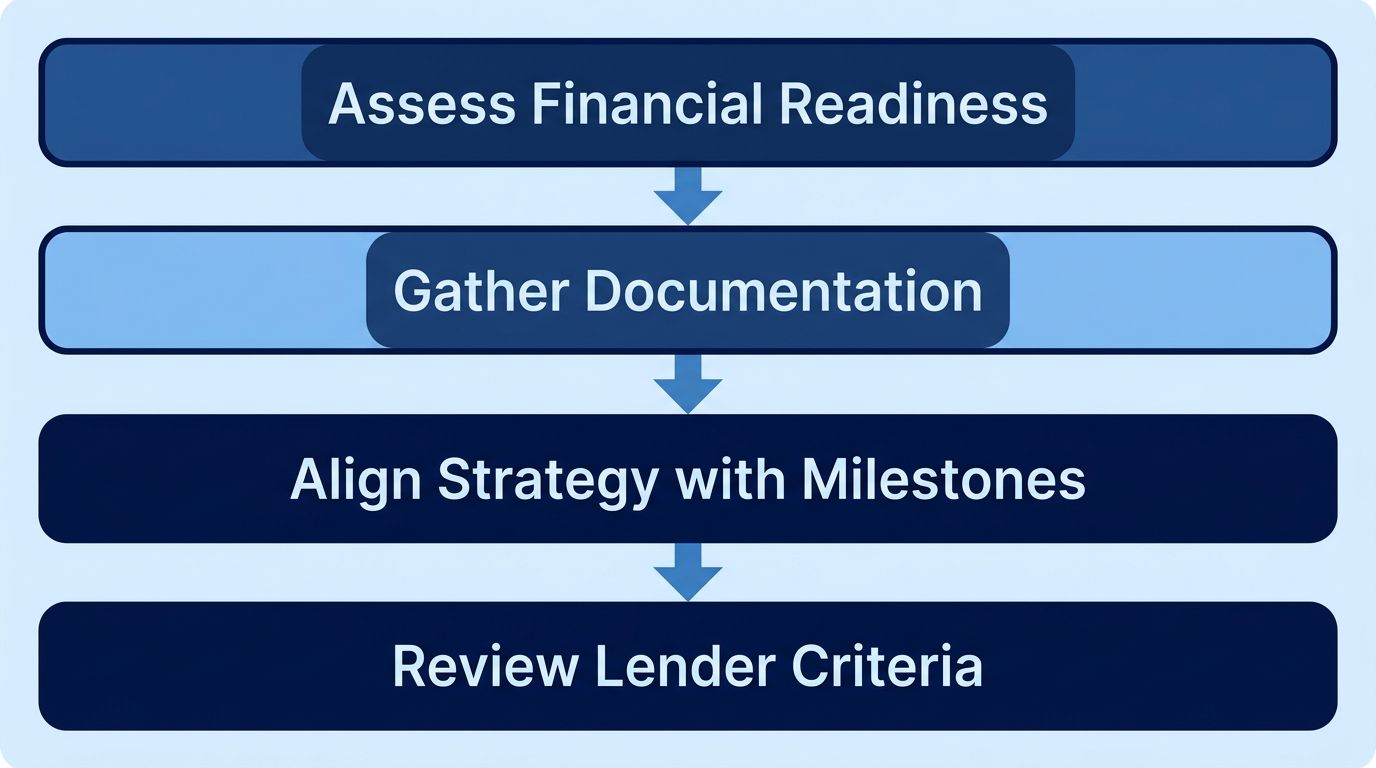
    Vertical process flow diagram showing four steps for preparing a venture debt strategy: assess financial readiness, gather documentation, align strategy with milestones, and review lender criteria.

    Four-step venture debt preparation process flow

    Align your debt strategy with board-approved growth milestones and involve your CFO early. At Zaidwood Capital, our Debt Advisory team helps clients benchmark lender terms against current market standards, ensuring you approach conversations with the confidence that preparation provides. Once your strategy is fully prepared, the next step is approaching lenders with a compelling, data-backed narrative.

    Assess Your Capital Structure Needs

    Now that you understand the basics of capital structure, it’s time to assess your specific needs. How do you determine the right mix of debt and equity for your company? For scale-ups evaluating venture debt for scaleups in 2026, a structured self-assessment is the critical first step toward identifying the most suitable financing path.

    We guide founders through evaluating several key factors to build a coherent capital strategy:

    • Current debt-to-equity ratio: Understanding your existing leverage and its impact on future borrowing capacity
    • Projected cash flow: Assessing whether revenue streams can comfortably service debt obligations
    • Growth stage: Distinguishing between early-stage, scale-up, and mature company dynamics, each with distinct risk profiles and capital access
    • Purpose of capital: Clarifying whether funds are needed for working capital, an acquisition, or expansion initiatives

    Exploring non-dilutive growth capital options such as revenue-based financing can preserve ownership while funding growth. Engaging experienced venture capital consultants helps interpret these factors and design a structure aligned with your objectives.

    With your needs assessed, the next section explores the specific capital solutions that match your profile.

    Identify Leading Venture Debt Lenders

    To identify the right partner, scaleups should evaluate leading venture debt lenders based on their track record, industry expertise, and loan terms. For companies seeking venture debt for scaleups 2026, understanding the lender landscape is essential. Non-dilutive growth capital preserves equity while funding expansion, and revenue-based financing offers flexible repayment structures aligned with business performance.

    According to Zaidwood Capital, notable lenders include:

    • Silicon Valley Bank – Provides venture debt and banking services to technology and life sciences companies at all stages.
    • Hercules Capital – Specializes in growth-stage technology and life sciences companies with flexible financing solutions.
    • TriplePoint Capital – Offers debt financing and leasing to venture capital-backed companies across diverse sectors.
    • Western Technology Investment – Focuses on early to mid-stage technology and life sciences companies.
    • Oxford Finance – Provides senior secured loans to healthcare and life sciences firms.

    When evaluating lenders, scaleups should assess loan size range, interest rate benchmarks, warrant coverage, and repayment flexibility. At Zaidwood Capital, our network includes access to many of these lenders, and we can help match companies to the right partner. Once you have identified potential lenders, the next step is to prepare your approach.

    Prepare Your Financial Documentation

    Once you understand the types of capital available, preparing your financial documentation is essential when seeking venture debt for scaleups 2026. The following documents are critical:

    • Audited Financial Statements (last 3 fiscal years) demonstrate revenue stability and profitability trends.
    • Detailed Cash Flow Projections (12–24 months), especially for non-dilutive growth capital and revenue-based financing.
    • Corporate Tax Returns (last 2 years) validate financial health.
    • Current Debt Schedule (if applicable) lists existing loans or convertible notes.
    • Pro Forma Financials model the new venture debt’s impact on cash flow and leverage ratios.
    • Virtual Data Room with clear folder labels organizes all files for submission.

    For documentation standards, the International Capital Market Association provides a useful framework. Having these documents ready will streamline your capital raise. This information does not constitute investment advice. With your documents organized, you are ready to proceed with the application process.

    Structure the Deal Terms and Warrant Coverage

    Moving from an overview of venture debt, we now focus on the specific components that define a term sheet. When structuring venture debt for scaleups 2026, our team at Zaidwood Capital tailors each deal to the company’s stage and growth trajectory. A typical term sheet includes a maturity period of 3 to 5 years, an interest rate composed of a cash component plus payment-in-kind (PIK), and an upfront fee that covers due diligence and administrative costs.

    Warrant coverage — often ranging from 5% to 20% of the loan principal — provides the lender with equity participation without immediate founder dilution. We negotiate the strike price (typically set at the current preferred round price), the warrant term (commonly 5-7 years), and exercise rights to align incentives. This structure offers lenders upside while preserving non-dilutive growth capital for the company.

    Terms are calibrated to a company’s credit profile, revenue projections, and market stage; for instance, revenue-based financing considerations can influence the repayment schedule. Our full-cycle M&A and capital advisory approach ensures each element supports long-term scalability, which we will explore further in the next section covering the application process.

    Negotiate Covenants and Closing Conditions

    With your term sheet structured, the focus shifts to covenants and closing conditions — the final hurdles before funding. For a growth capital debt financing round, these terms define your operational boundaries and the prerequisites to access capital. In the 2026 landscape, venture debt for scaleups 2026 is an increasingly popular tool for companies seeking non-dilutive growth capital, but the protective mechanisms lenders require can significantly impact your financial flexibility.

    Covenants are contractual promises you make to the lender. They broadly fall into three categories:

    • Affirmative covenants: Actions you must take, like maintaining insurance or providing audited financials.
    • Negative covenants: Actions you cannot take without lender consent, such as incurring additional senior debt or selling key assets.
    • Financial covenants: Specific metrics you must meet, often a minimum cash balance or an EBITDA target.

    For a company using revenue-based financing, the financial covenants are typically tied to recurring revenue growth rather than static balance-sheet ratios. Zaidwood Capital’s advisory approach emphasizes aligning these tests with your realistic operating model. Closing conditions are the prerequisites you must satisfy before the initial draw. These can include a satisfactory legal due diligence review, board approval of the transaction, and delivery of a final legal opinion — standard steps that verify your company’s readiness for a full-cycle advisory engagement.

    We guide our clients to negotiate these terms with a pragmatic lens: insist on covenants that reflect your business’s actual trajectory, and build closing condition checklists with achievable timelines. Documenting all agreed terms in a commitment letter before moving to definitive documentation is a critical step. To discuss how we can help tailor these terms for your specific raise, we invite you to Book A Call with our team.

    Complete Full-Cycle Due Diligence

    As a prerequisite for securing non-dilutive growth capital such as venture debt for scaleups in 2026, we conduct full-cycle due diligence that serves as the intelligence backbone of every transaction. Our process is a comprehensive, integrated assessment spanning six core domains: financial, legal, operational, commercial, IT, and human capital.

    This approach identifies risks and uncovers hidden opportunities across the entire deal lifecycle. We tailor our methodology precisely to your transaction type—whether it is a buy-side M&A mandate, a sell-side divestiture, or a capital raise involving revenue-based financing. By leveraging our proprietary Sovereign Data Nexus, we enhance commercial and operational assessments with real-time market intelligence, positioning your company for stronger, more informed negotiations.

    Our full-cycle process is engineered to compress timelines and reduce transactional uncertainty, ensuring that every facet of the business is scrutinized before approaching our network of over 4,000 institutional investors. This diligence forms the foundation upon which we structure optimal deal terms, seamlessly connecting strategic insight with execution.

    Finalize Capital Deployment and Monitor

    Once capital is secured, the next critical phase is deploying those funds effectively. For clients utilizing venture debt for scaleups 2026, this means executing tailored agreements. We finalize the deployment process through precise document execution, coordinated fund transfers and direct alignment with the portfolio company’s treasury team. Whether the capital is structured as non-dilutive growth capital or revenue-based financing, our team manages the closing mechanics to ensure a seamless transition from commitment to working funds.

    Following deployment, our full-cycle mandate continues through a structured monitoring framework. We provide periodic performance reporting, access to our proprietary Deal Vault for real-time document review and regular strategic check-ins. Our oversight is powered by proprietary tools like the Sovereign Data Nexus—our integrated intelligence infrastructure—and the Velocity Matrix, which tracks transaction momentum. This commitment ensures we remain a long-term strategic partner, delivering tailored advisory long after the transaction closes. Our approach is a hallmark of our Full-Cycle M&A and capital advisory, streamlining transactions through Financial Services 3.0 efficiencies. Past performance does not guarantee future results.

    Overcoming Common Venture Debt Hurdles

    Securing venture debt for scaleups 2026 presents unique challenges, from stringent qualification requirements to complex term negotiations. We understand that navigating these obstacles can feel overwhelming, particularly when founders are focused on preserving equity and maintaining operational momentum.

    Qualification and Positioning

    A primary hurdle is demonstrating the revenue predictability and capital efficiency that lenders require. Many scaleups mistakenly apply before achieving the necessary financial milestones. To overcome this, companies must present clear growth metrics and a defensible business model. Accessing non-dilutive growth capital demands a narrative that aligns scalable unit economics with a realistic path to profitability, a positioning we help our clients refine.

    Term Negotiations and Structure

    Misunderstanding repayment structures is a common pitfall. We often see companies over-leverage by focusing solely on the headline amount rather than the amortization schedule and covenant package. This misalignment can strain cash flows at critical growth junctures. Revenue-based financing is one flexible alternative, but it requires careful modeling against projections to ensure it complements, rather than constrains, your growth trajectory. A successful strategy involves mapping debt service to specific, value-creating milestones to avoid triggering restrictive covenants.

    After securing growth capital, many firms look toward global expansion, pursuing emerging markets M&A as a subsequent step in their scaling journey.

    Our advisory approach at Zaidwood Capital, grounded in extensive institutional knowledge, directly mitigates these risks. We guide clients through due diligence, leveraging our network to secure terms that support rather than hinder growth. Unlike equity financing, venture debt is fundamentally a non-dilutive tool designed to extend your runway while preserving ownership. We invite you to Book A Call to discuss how we can structure a solution tailored to your specific growth milestones.

    Securities are offered through Finalis Securities LLC; Zaidwood Capital is not a registered broker-dealer and is separate from Finalis.

    Launch Your Venture Debt Journey with Confidence

    For scaleups evaluating venture debt for scaleups 2026, a new strategic path is emerging that protects your equity while fueling expansion. Venture debt is a form of non-dilutive growth capital designed to complement your existing equity rounds. Rather than trading away additional ownership, this approach offers revenue-based financing that aligns repayment with your company’s growth trajectory—giving you the resources to scale without surrendering control.

    At Zaidwood Capital, we structure this journey with precision. Through our Debt Advisory service and a global network of over 4,000 institutional investors, we help founders access the right capital for their stage. We tailor terms to each stage and leverage market insights from emerging markets and fintech trends strategically to align capital with your growth objectives. Book A Call to explore how venture debt can move your business forward.

    Resources

  • Boutique vs Bulge Bracket Investment Banking: 2026 Comparison Guide

    Boutique vs Bulge Bracket Investment Banking: 2026 Comparison Guide

    Table of Contents

    Choosing Between Boutique and Bulge Bracket Investment Banking

    When weighing boutique vs bulge bracket investment banking, the core distinction lies in service scope and client intimacy. Specialist advisory firms offer focused, senior-led strategies that often result in faster execution and stronger alignment with client goals. Large global banks provide extensive capital markets access and resources suited for complex cross-border mandates. For companies considering private equity exit opportunities, boutique advisors frequently deliver customized positioning within their specific industry ecosystems. Similarly, talent dynamics around investment banking compensation packages reflect the differing demands of these models. We track SEC regulatory updates closely, as heavier compliance overhead affects larger institutions disproportionately while we leverage our full-cycle M&A and capital advisory approach to integrate deep advisory with proprietary data, streamlining transactions without the structural friction of multi-layered global firms.

    Ultimately, choosing between these paths depends on your transaction scope and strategic priorities. Our model bridges the gap by combining the personalized guidance of a boutique with the data-driven precision and investor network scale that growing companies require, a balance explored further in the next section.

    1. Senior Banker Attention and Personal Service

    In the boutique vs bulge bracket investment banking debate, one key differentiator is the level of senior attention you receive. At large, full-service firms, deal execution is often delegated to junior teams while managing directors appear only at critical milestones. We find this approach can dilute accountability and slow decision-making.

    Our model is fundamentally different. When you engage a boutique investment banking firm like Zaidwood Capital LLC, your mandate is led directly by our principals from pitch to close. As outlined in our description of M&A advisory services, senior bankers provide strategic guidance, valuation, negotiation support, and hands-on deal management throughout the entire lifecycle. This structure ensures decades of combined experience are applied to your specific strategic goals, delivering more tailored advice and faster execution.

    This personalized service is particularly valued by private equity firms seeking seamless exit execution and by companies requiring discreet, high-touch advisory. By leveraging our proprietary network and data resources, our senior team simplifies complex transactions, embodying our commitment to Streamlining Transactions with precision and focus.

    2. Tailored Fee Structures for Mid-Market Deals

    When considering boutique vs bulge bracket investment banking, the fee negotiation dynamics shift substantially for middle-market transactions. Unlike the rigid, standard pricing grids common at large institutions, we design our compensation around each mandate’s unique contours. This flexibility ensures your advisory costs reflect actual deal complexity rather than a one-size-fits-all schedule, aligning our incentives directly with your outcome.

    A typical framework might blend an initial retainer with a success-based component, or we may structure a milestone-driven fixed fee for a carve-out divestiture. The mix is always negotiated, absorbing variables like target size, cross-border diligence, and sector-specific resource requirements. For private equity firms managing portfolio company exits, this custom approach preserves more equity value while delivering institutional-quality execution. Our compensation benchmarks, detailed on our FAQ page, illustrate how tailored structures sit competitively within industry norms. As we always clarify, fees are custom-quoted and subject to mutual agreement rather than a published rate card.

    This disciplined yet adaptable approach removes friction from the engagement, letting you forecast costs with clarity. Next, we will walk through how our execution process turns that aligned structure into deal momentum.

    3. Specialized Industry Expertise

    Specialized industry expertise is a defining hallmark of the boutique model in investment banking. Unlike generalist institutions, boutique firms concentrate intellectual and relational capital into targeted verticals, cultivating an intimate understanding of sector dynamics, competitive landscapes, and value drivers. In private equity exit opportunities, this depth translates directly into superior deal sourcing because advisory teams speak the same operational language as founders, operators, and institutional buyers. Drawing from our own capital network exceeding $15 billion and an aggregate transaction volume surpassing $24.4 billion, we see consistent evidence that specialization sharpens valuation insight and accelerates execution.

    Sector-specific knowledge also shapes how boutique teams prepare portfolio companies for exit. Advisors often bring prior operating experience within the industries they serve, allowing them to anticipate buyer diligence questions and position assets around the metrics that matter most to private equity firms. When general partners evaluate acquisition targets, they rely on advisors who can interpret unit economics, regulatory nuances, and customer concentration risks without a learning curve, an advantage that industry depth systematically delivers.

    Industry depth shortens timelines and reduces transaction friction, qualities that matter acutely when fund lifecycles and market windows dictate exit timing. The structural alignment between boutique specialization and private equity mandates explains why sector-focused advisory teams continue gaining share in middle-market transactions. As the discussion shifts toward compensation structures, that same specialized expertise becomes a tangible factor influencing how transaction professionals are rewarded for execution.

    4. Agile Decision-Making and Speed

    Agile decision-making and speed represent some of the most compelling differentiators when evaluating boutique vs bulge bracket investment banking advisory services. At Zaidwood Capital, our lean, partner-led structure eliminates the multiple layers of approval and internal bureaucracy that typically slow down larger institutions. This streamlined architecture translates into faster, more decisive action for our clients.

    The role of an M&A advisor is inherently to accelerate deal timelines through proactive market intelligence and efficient coordination of due diligence. We execute this through our proprietary Velocity Matrix framework, which drives transaction velocity without compromising the depth or quality of our analysis. This systematic approach ensures that while we move quickly, we never sacrifice the financial, legal, and operational rigor that complex transactions demand.

    This responsiveness is particularly critical for owners pursuing private equity exit opportunities, where market windows can close rapidly and timing often correlates directly with value realization. Our direct partner involvement and efficient processes allow us to respond to these dynamics with the urgency they require. This structural speed also enables us to deliver a level of service intensity and personalization that more layered organizations find difficult to match.

    Agility here is not about cutting corners. It is the natural outcome of a flatter organizational design, empowered decision-makers, and a proprietary operating system purpose-built to optimize transaction timelines. This foundation of responsive execution supports the personalized and cost-effective approach that distinguishes true partnership in M&A advisory.

    5. Comprehensive Network Access and Deal Sourcing

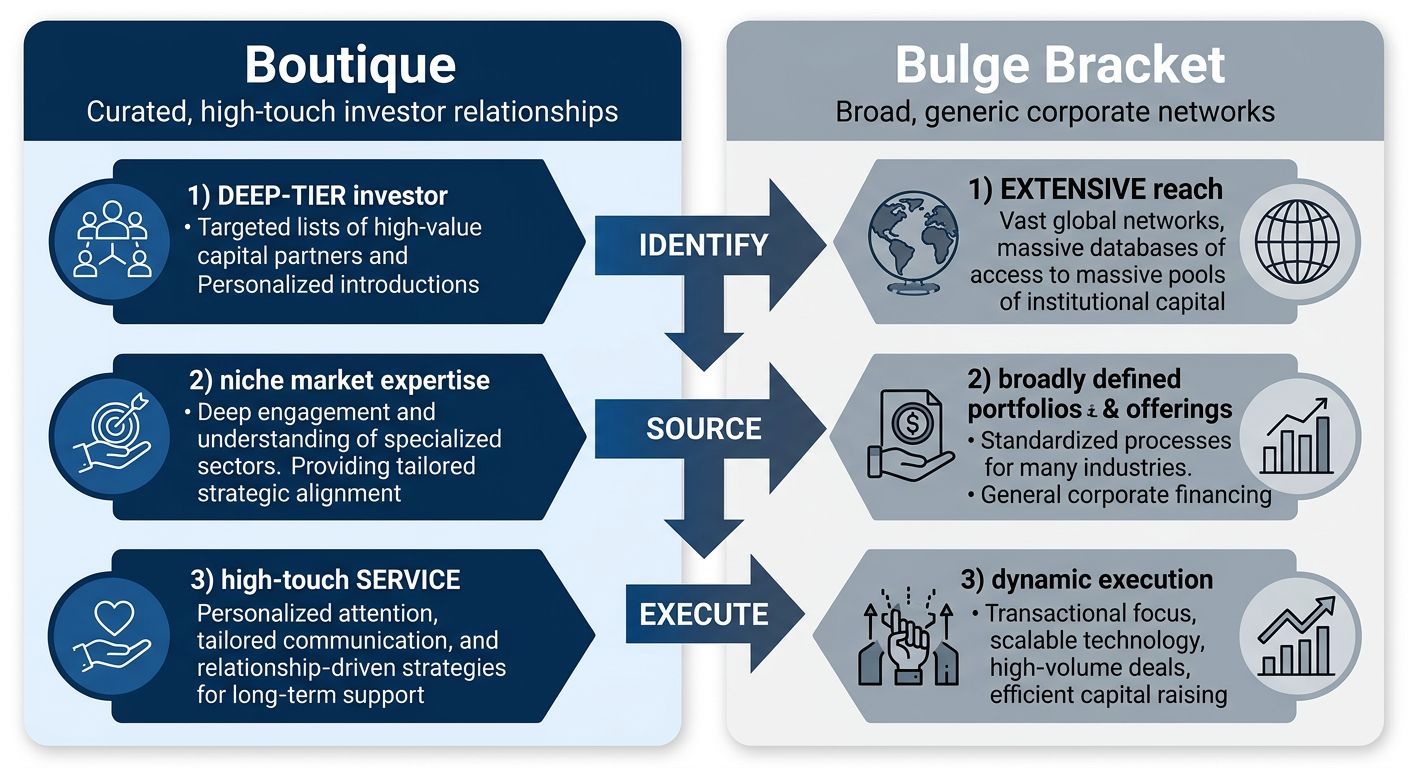
    Beyond our advisory capabilities, the real differentiator in the boutique vs bulge bracket investment banking landscape is the depth of our network. We connect clients with 4,000+ global investors and $15B+ in deployable capital, creating private equity exit opportunities that rival the largest institutions while maintaining the agility of a specialized boutique.

    Infographic comparing boutique M&A firm's high-touch investor network against bulge bracket's broad corporate network with deal sourcing funnel stages.
    Boutique vs. bulge bracket network access comparison at Zaidwood Capital.

    This integrated approach is powered by proprietary tools, including the Sovereign Data Nexus, Precision Catalyst, and Velocity Matrix, which sharpen deal sourcing and analysis. Our $24.4B+ aggregate transaction volume across full-cycle M&A, equity, and debt mandates confirms the scale we deliver. Exclusive access to Deal Vault and our curated Investor Rolodex further extends our partners’ reach. As our internal resources explain, these capabilities streamline the entire capital formation lifecycle, from LP placement and debt structuring to equity advisory.

    Whether you are evaluating private equity exit opportunities or structuring a capital raise, this institutional-grade infrastructure, delivered by a boutique firm, provides a clear advantage over traditional bulge bracket models. Our approach ensures you receive both the scale and the personalization that today’s complex deals demand. We’ll next explore how our fairness opinions and transaction advisory services add another layer of diligence.

    6. Cultural Alignment and Communication

    The choice in boutique vs bulge bracket investment banking extends beyond structure and into the softer, yet equally critical, dimensions of culture and communication. At Zaidwood Capital, we believe that a strong advisory relationship depends on transparency, trust and open dialogue — qualities that are built through consistent interaction rather than brand reputation alone. How a firm communicates directly shapes your experience during what is often the most consequential financial event in a company’s lifecycle.

    Communication style and responsiveness matter because M&A processes move quickly and demand real-time judgment. Boutique firms typically offer direct access to senior partners and a highly personalized cadence, while larger platforms operate through more structured teams and formalized reporting. Neither approach is inherently superior; the right fit depends on how you prefer to receive information, make decisions and manage pressure. Our internal resource on what M&A advisors do outlines how advisors facilitate fit assessments early in the process, helping clients evaluate both technical capability and interpersonal compatibility.

    Finding the right cultural fit also means considering how an advisor handles long-term strategic goals such as private equity exit opportunities or structuring investment banking compensation packages. These conversations require discretion, deep industry knowledge and a relationship grounded in mutual confidence. Full-Cycle M&A mandates succeed when the advisory team aligns with your organization’s values, communication norms and decision-making rhythm — a principle we prioritize through every phase of engagement.

    Streamlining Transactions depends as much on human chemistry as it does on financial engineering. In our experience, the most successful partnerships are those where both sides invest in candid, ongoing communication. The next section outlines practical steps you can take to evaluate and engage an advisor who fits your unique organizational culture.

    Making the Right Choice for Your M&A Needs

    Given the distinct advantages of each model, selecting the right advisor depends on your transaction size, industry focus, and desired level of partner attention. M&A advisors typically provide comprehensive support across buy-side and sell-side representation, valuation, due diligence, and deal negotiation. At Zaidwood Capital, we deliver Full-Cycle M&A and capital advisory that combines the personalized service of a boutique firm with access to over 4,000 institutional investors and $15B+ in deployable capital. Our approach ensures seamless execution from initial due diligence through final closing, backed by $24.4B+ in aggregate transaction volume. We encourage you to assess your specific requirements and book a call for tailored guidance on your M&A journey.

    Resources

  • Best Asset Based Lending for 2026: Top Companies Compared

    Best Asset Based Lending for 2026: Top Companies Compared

    Table of Contents

    Asset-Based Lending as a Strategic Financing Tool

    Beyond traditional cash-flow loans, asset-based lending offers a strategic alternative for companies seeking flexible, secured financing against their balance-sheet assets. The U.S. Securities and Exchange Commission defines collateral as an asset a lender accepts as security for a loan, including real estate, equipment, inventory, and accounts receivable—precisely the assets that underpin asset-based lending structures.

    Through asset-based lending, businesses can often achieve higher leverage than unsecured debt and benefit from lower interest rates because the loan is backed by tangible collateral. This approach is especially valuable for companies with strong asset bases but uneven earnings, as the financing capacity is tied to asset values rather than cash-flow metrics alone.

    Qualifying typically requires a disciplined institutional process. As outlined in our FAQ, investors commonly look for collateral coverage ratios—often 1.5x to 2.0x advance rates—together with audited historical financials, minimum EBITDA thresholds, and thorough asset-quality audits. These benchmarks help our team identify the right institutional match from a network of over 4,000 investors, including banks, credit funds, and specialty finance firms.

    Unlike cash-flow financing, which depends heavily on EBITDA, asset-based lending unlocks liquidity directly from receivables, inventory, equipment, or real estate. Many companies use both structures concurrently, blending them to optimize cost of capital and funding flexibility. Through our global lending services, we connect clients with institutional investors specializing in asset-based lending and other secured debt structures.

    Asset-based lending can fund acquisitions, bridge equity gaps, or provide seasonal working capital—but outcomes are not guaranteed and depend on asset quality and deal structure. While many companies qualify, each transaction is subject to investor approval and due diligence.

    In the following section, we explore how ABL can be structured alongside equity financing to maximize transaction efficiency.

    This is not an offer or solicitation; consult your advisor.

    Understanding Asset-Based Lending Fundamentals

    Having defined asset-based lending, let us examine its core mechanics and how it compares with traditional financing. Asset based lending is a secured financing facility where the borrowing amount is determined by the value of specific pledged assets rather than primarily by cash flow or credit history. This type of secured lending relies on four main asset classes: accounts receivable, inventory, equipment, and real estate, each valued with distinct advance rates that reflect their liquidity and liquidation potential.

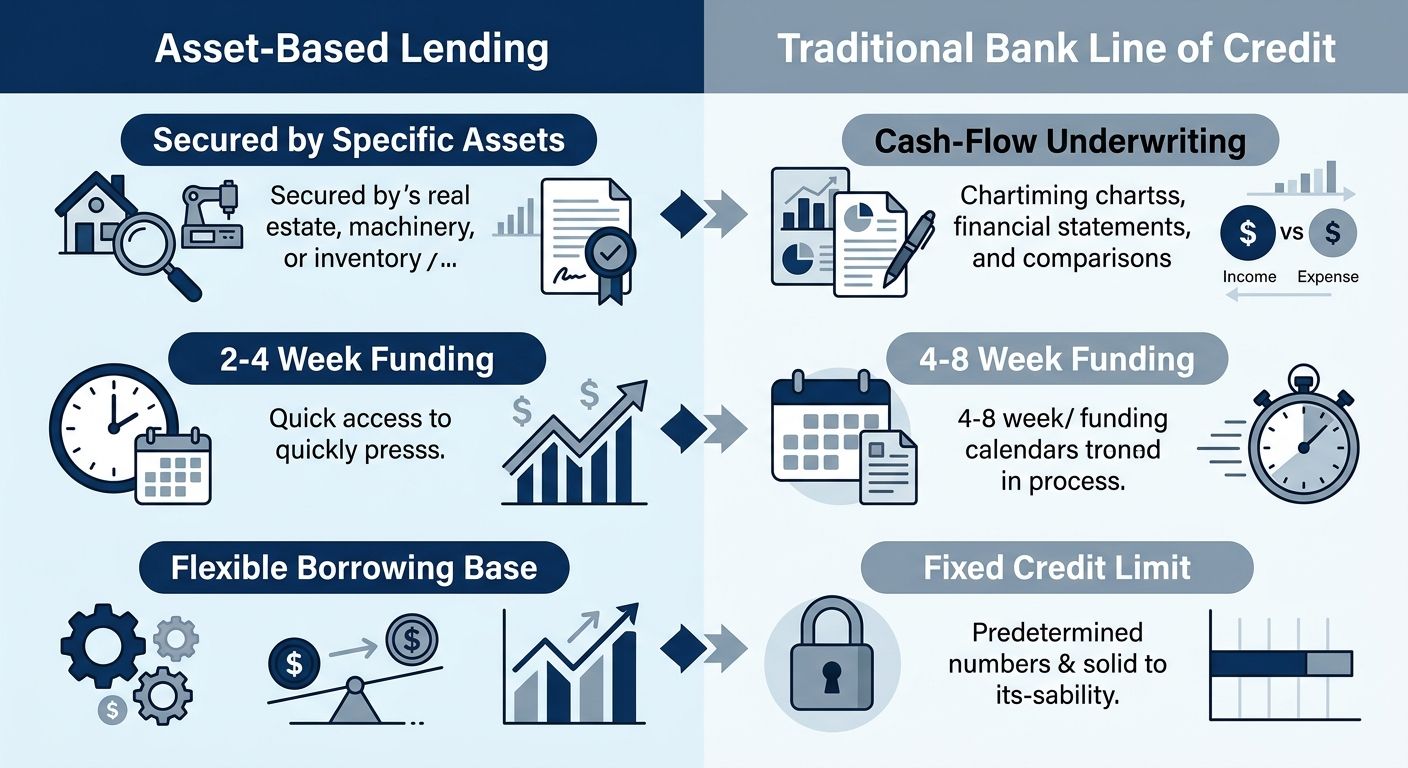
    The following table highlights the key differences between asset-based lending and a traditional bank line of credit.

    Asset-Based Lending vs. Traditional Bank Line of Credit
    DimensionAsset-Based LendingTraditional Bank Line of Credit
    Collateral RequirementSecured by specific assets (AR, inventory, equipment, real estate)Often unsecured or blanket lien; may require personal guarantees
    Underwriting FocusAsset quality and liquidation value; less emphasis on cash flowCash flow, credit history, and overall financial health
    Funding SpeedTypically 2–4 weeks; faster for revolving facilitiesCan take 4–8 weeks or longer for approval and funding
    FlexibilityHighly flexible; borrowing base adjusts with asset levelsFixed credit limit; less responsive to asset fluctuations
    CovenantsFewer financial covenants; focus on asset reportingStrict financial covenants (debt service coverage, leverage ratios)

    An ABL facility emphasizes the quality and liquidation value of collateral, with fewer financial covenants and a borrowing base that flexes alongside asset levels. For businesses with strong collateral but variable cash flow, such as manufacturers, wholesalers, or distributors, secured asset lending often provides faster access to capital and greater responsiveness to seasonal or growth-driven asset fluctuations.

    Comparison infographic of asset-based lending versus traditional bank line of credit highlighting differences in security, funding timeline, and flexibility
    Comparing asset-based lending and traditional bank line of credit

    Underwriting in asset-backed financing concentrates on the quality, liquidity, and liquidation value of the pledged collateral. Advance rates vary by asset class, with accounts receivable typically commanding higher advance rates than inventory or equipment. This approach shifts reporting toward asset monitoring rather than strict debt service coverage ratios, making ABL accessible to companies that may not meet conventional bank criteria. For a broader perspective on financing options, our coverage of global lending services alternatives provides key considerations for borrowers comparing ABL with other structures.

    Deep Dive into Asset-Based Lending Structures and Collateral Types

    To understand how asset based lending works, it is essential to examine the four primary collateral types that underpin every ABL structure. Each asset class carries distinct risk profiles, valuation methodologies, and advance rate ranges that directly influence the amount of capital a business can access and the speed at which funds become available.

    Primary Collateral Categories and Their Characteristics

    In asset based lending, collateral types determine both eligibility and borrowing capacity. The U.S. Securities and Exchange Commission defines collateral broadly as assets pledged to secure a loan, and within ABL structures, lenders focus on four principal categories based on their liquidity and ease of valuation.

    Accounts receivable represent the most liquid and preferred collateral class. Lenders evaluate AR through aging reports that identify overdue invoices, dilution analysis that measures returns and allowances against gross sales, and concentration limits that cap exposure to any single debtor. Because receivables convert to cash through normal collection cycles, they carry the highest advance rates and fastest funding timelines.

    Inventory serves as a common but more complex collateral type. Valuation requires third-party appraisal that accounts for obsolescence risk, seasonal demand patterns, and turnover velocity. Finished goods ready for sale command stronger valuations than raw materials or work-in-progress, which have limited liquidation markets.

    Equipment and real estate round out the primary categories, with valuations based on orderly liquidation value and professional appraisal, respectively. Equipment financing benchmarks indicate ABL structures typically extend 50 to 80 percent of orderly liquidation value depending on age, condition, and secondary market demand. Real estate requires the most extensive due diligence, including title searches and environmental assessments.

    Loan-to-Value Determinants and Advance Rate Mechanics

    Loan-to-value ratios in asset based lending emerge from a lender’s assessment of advance rates, eligibility criteria, and concentration limits applied to each asset class. The LTV is not a fixed percentage but a calculated figure reflecting the lender’s confidence in recovering principal through liquidation of the pledged collateral.

    Collateral Types and Advance Rates in Asset-Based Lending
    Asset TypeTypical Advance RateValuation MethodLiquidity / Speed of Funding
    Accounts Receivable70–90% of eligible ARAging reports, dilution analysis, concentration limitsFast; funds available within days of invoice submission
    Inventory40–60% of appraised valueAppraisal by third-party; considers obsolescence and turnoverModerate; requires field exam and appraisal
    Equipment50–80% of orderly liquidation valueAppraisal based on age, condition, and secondary marketModerate; appraisal and documentation needed
    Real Estate60–75% of appraised valueProfessional appraisal, title search, environmental assessmentSlower; due diligence and legal process required

    Advance rates represent the percentage of an asset’s appraised or eligible value that a lender will fund. Accounts receivable command the highest rates at 70 to 90 percent of eligible receivables because they self-liquidate through customer payments. Inventory advance rates sit lower at 40 to 60 percent, reflecting the inherent risk of physical goods degradation and market fluctuation.

    Funding Speed and the Asset-Based Lending Process

    The timeline from application to funding in asset based lending varies considerably by asset type and the intensity of due diligence required. Borrowers who prepare documentation thoroughly and understand lender expectations can materially compress the timeline.

    The ABL due diligence process typically begins with a field exam, where auditors physically inspect assets, verify accounting systems, and test the accuracy of borrowing base reports. For AR-heavy structures, this involves confirming invoice validity and analyzing customer payment patterns. Businesses exploring global lending services alternatives can compare ABL timelines against other capital sources to determine the optimal structure.

    Practical Guide to Securing Asset-Based Lending for Growth and Acquisitions

    Now that you understand the fundamental structure and purpose of asset-based lending, it’s time to explore a practical guide for securing this flexible financing tool. For companies with strong balance sheets but uneven cash flow, asset-based lending provides a tactical pathway to fund growth initiatives and execute acquisitions.

    Preparing Your Business for an Asset-Based Lending Application

    • Compile Detailed Financial Statements: Gather at least three years of audited financial statements, including balance sheets, income statements, and cash flow reports.
    • Prepare Precise Asset Schedules: Create comprehensive, up-to-date schedules for all assets that will serve as collateral, including accounts receivable aging reports and inventory listings.
    • Assemble Due Diligence Materials: Organize corporate documents, tax returns, customer and supplier contracts, and legal records.

    Using Asset-Based Lending for Acquisitions and Growth

    Asset-based lending is a powerful engine for mergers and acquisitions, offering flexible structures that traditional cash-flow loans often cannot match. We consistently see clients use ABL facilities in three principal ways during M&A: Leveraged Buyouts, Post-Acquisition Working Capital, and Bridge Financing.

    Advantages of Asset-Based Lending for Corporate Growth

    For asset-rich companies, the strategic advantages of asset-based lending are significant and multifaceted. The structure is designed to support rapid scaling and operational flexibility, which is why it is often recommended for companies navigating high-growth phases.

    Asset-Based Lending vs. Alternative Debt Structures
    Debt StructureCollateral FocusTypical Cost (Interest + Fees)Best For
    Asset-Based LendingSpecific assets (AR, inventory, equipment, real estate)LIBOR/SOFR + 3–6%Working capital, growth, acquisitions with asset-rich borrowers
    Cash-Flow LoanGeneral business assets / blanket lienPrime + 2–5%Established companies with strong cash flow and credit history
    Mezzanine DebtSubordinated; often unsecured with equity warrants12–20% (including equity upside)Growth capital, acquisitions, buyouts for mid-market companies
    Equipment FinancingSpecific equipment being purchased6–12%Capital-intensive businesses acquiring machinery or vehicles

    This website is for informational purposes only and is not an offer, solicitation, or commitment to transact. It is not investment advice. Securities are offered through Finalis Securities LLC; Zaidwood Capital is not a registered broker-dealer.

    Advanced Considerations in Asset-Based Lending for M&A and Complex Transactions

    While ABL is versatile for general purposes, its application becomes more nuanced in M&A and complex deals. In an acquisition context, asset based lending serves as a senior secured facility, often structured to support working capital, bridge financing, or leveraged buyout (LBO) debt.

    Asset-Based Lending vs. Mezzanine Debt vs. Equity for M&A
    Financing TypeCost RangeDilution / ControlBest Use in M&A
    Asset-Based LendingSOFR + 3–6%No dilution; lender has lien on assetsSenior secured facility for working capital, bridge financing, or LBO debt
    Mezzanine Debt12–20% (including warrants)Minimal dilution; warrants may give equity upsideSubordinated layer to fill gap between senior debt and equity
    Equity Financing15–30%+ expected returnSignificant dilution; investors gain ownership and control rightsGrowth equity, buyouts, or when debt capacity is limited

    Frequently Asked Questions About Asset-Based Lending

    Q: What is asset based lending? Asset based lending is a secured financing structure where a business pledges balance-sheet assets such as accounts receivable, inventory, or equipment as collateral. Unlike traditional cash-flow lending that emphasizes credit scores and profitability, ABL focuses on the liquidation value of the pledged assets.

    Q: How does collateral work in an asset-based loan? Collateral is property offered to secure a loan—the U.S. Securities and Exchange Commission defines it as something a lender can seize if the borrower defaults. In asset-based lending, lenders first appraise the pledged assets and then set a borrowing base that reflects their realizable market value.

    Q: What are typical advance rates for asset-based loans? Advance rates vary by asset quality, but receivables commonly qualify for 70–85 percent and inventory for 50–60 percent of the appraised value.

    Leveraging Asset-Based Lending with Zaidwood Capital’s Debt Advisory Expertise

    Asset based lending uses a company’s receivables, inventory, and equipment as collateral, unlocking more flexible capital than unsecured debt. Our debt advisory team structures ABL facilities around your cash flow and collateral profile, connecting you to over 4,000 institutional investors and more than $15 billion in deployable capital. We engineer tailored terms that deliver higher leverage and greater flexibility than conventional bank loans—especially for growing or cyclical businesses.

    Resources

  • Asset-Based Lending: Complete Guide for Businesses

    Asset-Based Lending: Complete Guide for Businesses

    Table of Contents

    Asset-Based Lending: A Strategic Financing Option for Growth

    Asset-based lending (ABL) is a form of financing secured by a company’s assets, typically accounts receivable, inventory, equipment, or real estate. Unlike cash-flow-based loans that rely on credit history, ABL focuses on the collateral’s value, making it accessible even for businesses with limited operating history. Advance rates vary: receivables often command 80–90%, while inventory may secure 50–70% of its appraised value.

    ABL provides liquidity and flexibility through revolving credit lines that expand as your asset base grows, supporting working capital and growth initiatives. With faster funding than traditional loans, ABL helps companies seize opportunities without delay. At Zaidwood Capital, we leverage our network of 4,000+ institutional investors and access to over $15 billion in deployable capital to structure tailored ABL facilities. As a full-cycle M&A and capital advisory firm, we streamline the process from due diligence to closing. Our advisory team helps you evaluate asset eligibility and structure a facility that aligns with your strategic goals. By unlocking the value of your balance-sheet assets, ABL provides the working capital necessary for expansion, acquisitions, or seasonal cash-flow management.

    For companies exploring complementary solutions, we also facilitate venture debt to support growth. Contact us to Book A Call and discover how ABL can fuel your business expansion.

    Revolving Credit Facility (ABL)

    A Revolving Credit Facility (ABL) is an asset-based lending structure providing a secured line of credit backed by accounts receivable, inventory, and sometimes equipment. We use these facilities to supply working capital for seasonal inventory builds and growth initiatives. The borrowing base is recalculated monthly against pledged receivables and inventory to reflect current collateral. Companies with a PEO often combine it with an ABL facility for cash management.

    Inventory Financing

    Inventory financing is a type of short-term, asset-based lending that uses a company’s existing inventory as collateral to secure working capital. Businesses typically use it to purchase additional stock, bridge cash flow gaps, or capitalize on seasonal demand surges. Lenders advance a percentage of the inventory’s value—often 50% to 80%—and repayment occurs as the goods are sold. Through our global lending services debt advisory, we structure these inventory-secured arrangements to secure optimal advance rates and covenants for your business.

    Accounts Receivable Financing

    Accounts receivable financing, a form of asset-based lending, lets businesses borrow against unpaid invoices rather than waiting 30 to 90 days for payment. Companies sell or collateralize receivables to receive a percentage of the invoice value upfront. This asset-backed solution suits B2B firms, manufacturers, and wholesalers with extended cycles. Underwriting hinges on payer creditworthiness, not the borrower, and we help clients unlock this flexible path to improved working capital.

    Equipment Financing

    Within our debt advisory practice, we offer specialized equipment financing solutions. Equipment financing is a common form of asset-based lending where the equipment itself serves as collateral, enabling businesses to acquire needed assets. Structures include loans for ownership or leases for usage rights, applicable to machinery, vehicles, technology, and medical equipment. We advise on structuring and connect clients with appropriate capital sources, and all terms are custom-quoted based on credit, equipment type, and market conditions. Book A Call for a personalized consultation.

    Asset-Based Term Loan

    Within asset-based lending, an asset-based term loan is a single-draw, asset-backed loan commonly used for business acquisitions, capital expenditures, and debt refinancing. Unlike a revolving line, it provides a lump sum with a fixed repayment schedule. Loan amounts are based on collateral values, typically 70–85% of accounts receivable and 50–70% of equipment appraisals. At Zaidwood Capital, we structure these solutions by leveraging our institutional network.

    Purchase Order Financing

    Purchase Order Financing helps businesses fulfill large orders when working capital is tight. A lender pays the supplier, and the business repays after the customer invoice is settled. Unlike traditional loans, approval depends on the purchase order’s value, not credit history. We offer it through our debt advisory network, alongside asset-based lending and tailored structured solutions. Contact us to discuss how we can bridge your cash-flow gaps.

    Warehouse Lending

    Warehouse lending is a specialized form of asset-based lending—a short-term revolving facility that funds asset accumulation, such as loan origination, before permanent takeout financing is arranged. Through our Debt Advisory practice, we assist clients in structuring and sourcing these collateralized facilities. Leveraging our network of over 4,000 institutional investors, we identify appropriate warehouse lending partners. This solution focuses on liquidity and speed, not long-term capital, and is one of several debt options we help clients evaluate.

    Bridge Loan (Secured by Assets)

    A bridge loan is a short-term, asset-backed financing solution that helps you bridge a funding gap, secured by collateral like real estate, inventory, or receivables. Common uses include M&A, recapitalizations, and pending asset sales. At Zaidwood Capital, we provide bridge loan advisory as part of our debt advisory services, within asset-based lending. We leverage our network and expertise to structure flexible, fast-execution financings, streamlining transactions.

    Structured Asset-Based Finance

    Structured asset-based finance is a form of asset-based lending secured by assets like accounts receivable, inventory, equipment, or real estate. It delivers working capital and liquidity without requiring asset sales or equity dilution. As a full-cycle M&A and capital advisory firm, we facilitate structured asset-based finance through our network of over 4,000 institutional investors, enabling companies to unlock capital while preserving ownership.

    Special Situations ABL

    Beyond standard asset-based lending, we also advise on special situations that demand tailored debt solutions:

    • Turnaround and distressed scenarios where collateral is impaired or operations are restructuring
    • Cross-border structures involving multiple jurisdictions and currency considerations
    • Growth-stage transactions where companies hold unconventional asset bases such as intellectual property or receivables
    • Time-sensitive acquisition or bridge financing needs

    These mandates reflect our Full-Cycle M&A and capital advisory approach.

    Asset-Based Lending Options at a Glance

    To help you compare options at a glance, we’ve summarized key asset-based lending tools:

    Comparison of Asset-Based Lending Tools
    Asset TypeAdvance RateBest ForTypical Term
    Accounts Receivable, InventoryUp to 85% on AR, 50-65% on InventoryWorking capital needsRevolving
    Inventory50-65%Seasonal inventory buildup6-12 months
    Accounts ReceivableUp to 85%Cash flow accelerationRevolving
    Equipment70-80% of appraised valueCapital equipment purchases3-7 years
    Multiple asset classesVariesLarger, more complex facilities2-5 years
    Purchase ordersUp to 100% of PO valueFulfilling large ordersShort-term
    Residential mortgage loansVariesMortgage lendersShort-term
    Real estate, receivables, other assetsVariesBridge financing gaps6-24 months
    Diverse asset poolsCustomComplex capital structures1-5 years
    Distressed or unique assetsNegotiatedRestructuring or special situationsShort-to-medium term

    Please note that the advance rates shown are typical market ranges; actual terms depend on the specific lender, your financial profile, and asset quality. At Zaidwood Capital, we work with you to structure the right facility, using our experience with over 300 deals and a network of 4,000+ investors. The following sections provide a detailed look at each asset-based lending option.

    Grid of 10 minimalist icons representing asset-based lending options including revolving credit, inventory financing, and equipment financing, each with a short label, on a blue and gray background.

    At-a-glance overview of asset-based lending options across 10 financing types.

    Unlocking Growth with Asset-Based Lending

    Asset-based lending (ABL) allows companies to secure financing using hard assets — receivables, inventory, or equipment — as collateral. Unlike conventional unsecured loans, ABL focuses on the tangible value of the assets rather than solely on credit history. By unlocking embedded balance-sheet value, ABL can provide faster access to capital than traditional underwriting processes.

    Typical use cases encompass working capital smoothing, growth financing, refinancing, and acquisition support. Eligible collateral often includes accounts receivable, inventory, machinery, and real estate. This structure benefits companies with solid asset bases even when cash flow metrics do not meet conventional bank standards. This flexibility makes ABL an attractive option for companies in transition or experiencing rapid expansion.

    At Zaidwood Capital, we design custom ABL facilities as part of our debt advisory offering. Drawing on a network of over 4,000 investors and $15 billion in available capital, we aim to secure competitive, tailored terms for each engagement. Our full-cycle M&A and capital advisory platform ensures that asset-based lending serves as a strategic growth lever, and we can help you explore how ABL complements equity, mezzanine, or other debt instruments in your capital stack.

    Resources

  • Commercial Lending: Complete Guide for 2026

    Commercial Lending: Complete Guide for 2026

    Table of Contents

    Understanding Commercial Lending Options for Business Growth

    Building on our full-cycle M&A and capital advisory capabilities, commercial lending through our debt advisory practice connects businesses with tailored financing solutions. We offer a comprehensive suite of debt financing options, including mezzanine debt, venture debt, equipment financing, and asset-based lending, each designed to support distinct growth objectives. As part of our global lending services, we leverage proprietary data access through our Sovereign Data Nexus and the Velocity Matrix to match clients with the right institutional capital from a network exceeding 4,000 investors with over $15 billion in deployable capital.

    Our debt advisory team structures each business lending solution to fit specific use cases: mezzanine debt for growth capital and acquisitions, venture debt for startups seeking non-dilutive runway, equipment financing for asset purchases without large upfront costs, and asset-based lending for working capital secured by receivables or inventory. We do not lend directly; rather, we serve as a debt advisor, facilitating access to customized capital access strategies through our Precision Catalyst approach. Beyond debt, our equity advisory services offer additional growth pathways for companies exploring minority or majority investment structures.

    Traditional Banks vs Private Commercial Lenders

    Businesses exploring financing quickly encounter two distinct paths: traditional banks and private commercial lenders. While both provide capital, their processes and priorities differ significantly. Banks rely heavily on personal credit scores, debt-service coverage ratios, and a multi-year operating history. Their underwriting is methodical, often taking months to close, and personal guarantees are typically required.

    In contrast, private commercial lenders prioritize the value of your assets and the strength of your cash flow over rigid credit metrics. This allows them to structure asset-based lending and cash-flow financing with greater speed—often delivering capital in weeks rather than months. Terms can be tailored with flexible features like interest-only periods or balloon payments, and covenants are aligned with business performance rather than static ratios. Through our institutional network, we connect companies to lenders offering global lending services that span multiple industries and jurisdictions, typically requiring fewer personal guarantees.

    For growing businesses, private lending offers a viable alternative when traditional bank criteria feel restrictive. Rather than a one-size-fits-all approach, we match firms with institutional investors who understand their unique story. In the next section, we’ll walk through the straightforward application process to access this network.

    Comparing Lending Features: Banks, Private Lenders, and Advisory Firms

    The world of commercial lending offers businesses more choices than many realize, extending well beyond the traditional bank loan. While banks remain a cornerstone for many, private lenders and boutique advisory firms have carved out distinct roles that accommodate diverse funding needs and timelines. Our internal research at Zaidwood Capital LLC provides a clear framework for understanding these differences.

    The following table offers a side-by-side comparison of key features that matter most when evaluating a lending partner.

    Commercial Lending Channel Comparison

    Commercial Lending Channel Comparison
    FeatureTraditional BanksPrivate LendersBoutique Advisory Firm (Zaidwood Capital)
    Eligibility CriteriaStrict credit history, collateral, cash flowMore flexible, emphasis on asset qualityAdvisory-based; connects to suitable institutional lenders
    Speed of FundingWeeks to monthsDays to weeksExpedited through network of 4,000+ investors
    Documentation RequiredExtensive financial statements, tax returns, business plansModerate documentation, focus on asset valuationAdvisor guides documentation preparation
    Collateral RequirementsTypically secured; unsecured options limitedOften asset-backed; flexible structuresHelps identify optimal collateral structure
    CustomizationStandardized loan productsCustomizable termsTailored advisory for each engagement
    Access to CapitalLimited to bank’s balance sheetFund size depends on investor poolAccess to $15B+ deployable capital network

    Eligibility Criteria diverges sharply across these channels. Banks enforce rigid standards around credit scores, cash flow history, and asset coverage, which can often exclude even profitable companies in growth phases. Private lenders pivot the focus toward asset quality, creating a pathway for Asset-Based Lending that uses your company’s own holdings as the primary qualifier. As a boutique firm, Zaidwood Capital advisory bridges these worlds by connecting businesses with institutional lenders whose criteria align with the client’s specific profile, rather than forcing a square peg into a round hole.

    Speed of Funding is often the deciding factor in choosing a commercial loans provider. A traditional bank’s timeline, stretching from weeks to months, can cause companies to miss strategic windows. Private lenders compress this to a matter of days by streamlining their evaluation. We expedite this further by leveraging our network of over 4,000 investors, targeting a closing in under 60 days for mid-market transactions. This velocity can be a competitive advantage in time-sensitive scenarios.

    Three-column comparison infographic showing six lending features across Traditional Banks, Private Lenders, and Boutique Advisory Firms, using blue, green, and orange icon-cards.

    Comparison of lending features across bank, private, and advisory lending options.

    The Documentation Required scales dramatically depending on the source. Banks require a deep dive into comprehensive financial statements, tax returns, and detailed business plans. Private lenders reduce the burden, zeroing in primarily on asset valuation and condition. Our role in the advisory process shifts this burden from the borrower to us: we guide the preparation and assembly of all necessary documentation, ensuring it meets the exacting standards of institutional finance and facilitating a smoother due diligence cycle.

    Key differentiators in the business lending landscape can be summed up in three points: the speed of execution, the flexibility of the structure, and the depth of the capital pool. We provide advisory solutions that are fully tailored, helping to construct an optimal collateral package rather than presenting a one-size-fits-all mandate. With access to over $15 billion in deployable capital, our clients are not limited to a single balance sheet. In the next section, we’ll explore how to determine which of these channels best fits your company’s specific strategic and financial goals.

    This content is for informational purposes only and is not an offer, solicitation, or investment advice. Zaidwood Capital is not a registered broker-dealer; securities are offered through Finalis Securities LLC.

    Pricing Structures in Commercial Lending

    Pricing in commercial lending is highly structured and reflects a combination of market benchmarks, credit risk, and transaction complexity. We at Zaidwood Capital approach every engagement with a custom-quote philosophy, recognizing that no two capital structures are identical. The core components include an interest rate basis, which may be fixed-rate for the full term or floating-rate tied to a benchmark like SOFR, plus a margin spread that compensates the lender for the specific risk profile of the borrower.

    Beyond the interest component, business lending arrangements typically carry a schedule of fees. These can include upfront arrangement or commitment fees, legal and due diligence costs, and ongoing service or agency charges. The overall debt pricing structure is influenced by the quality of collateral, loan tenor, and prevailing market conditions. Senior secured facilities generally command the tightest margins, while mezzanine and venture debt tranches incorporate higher spreads to reflect their subordinated or cash-flow-dependent nature.

    Our process ensures that commercial loan pricing parameters are calibrated to your specific situation. According to the firm’s FAQ, we require audited financials, multi-year projections, and a detailed business plan to begin a pricing discussion. This thorough due diligence lets us model appropriate capital structures before delivering a tailored quote. All engagements start with a confidential consultation where we outline preliminary pricing frameworks and the path forward.

    This is for informational purposes only and does not constitute an offer or commitment to lend. Consult your advisors.

    Choosing the Right Commercial Lending Path for Your Business

    Choosing the right commercial lending path can determine the success of your growth plans. The main structures — term loans, lines of credit, equipment financing, and asset-based lending — each serve distinct purposes.

    A term loan provides a fixed amount with scheduled repayments, while a line of credit offers flexible working capital. Equipment financing ties repayment to the asset’s life, and asset-based lending uses receivables or inventory as security. Each option balances liquidity, predictability, and asset utilization.

    Your decision should hinge on your business stage, cash flow stability, available collateral, and growth outlook. Early-stage firms may explore venture debt; mature companies often use term loans or credit lines.

    We help you navigate these choices through debt advisory services, including mezzanine, venture debt, equipment financing, and asset-based lending. With access to 4,000+ investors and $15B+ in capital, we provide objective guidance — but we never guarantee specific outcomes or rates. Our team evaluates your capital needs, repayment capacity, and collateral profile to recommend structures that suit operational realities.

    Book a call to discuss your commercial lending strategy with our team.

    Taking the Next Step in Your Commercial Lending Journey

    In commercial lending, the right advisory partner makes all the difference. Zaidwood Capital’s full‑cycle M&A and capital advisory services provide a clear path through complex financing landscapes. Our team leverages a network of 4,000+ institutional investors and an aggregate transaction volume of $24.4B+ to connect businesses with optimal lending solutions.

    We work closely with clients to navigate debt and equity options, backed by comprehensive due diligence and strategic documentation. Whether you’re exploring commercial financing or need to raise capital, we provide the clarity and execution speed you need. With over 80 years of collective experience, our team brings deep market insight to every engagement.

    Ready to move forward? Book A Call today to discuss your unique goals and discover how our advisory services can support your business growth.

    Resources

  • Choosing the Right Mezzanine Debt Structures: Key Considerations

    Choosing the Right Mezzanine Debt Structures: Key Considerations

    Table of Contents

    Understanding Mezzanine Debt Structures

    Mezzanine debt structures are hybrid financing instruments that sit between senior secured debt and common equity in a company’s capital stack. Often viewed as junior capital, mezzanine debt fills the gap when conventional senior loans reach their capacity. This content is for informational purposes only and is not an offer, solicitation, or investment advice. Zaidwood Capital LLC is not a registered broker-dealer.

    Mezzanine debt is a form of subordinated debt financing that typically does not require hard collateral. Instead, lenders are compensated with a higher interest rate and an equity kicker—often warrants or conversion rights—which provides upside participation in the borrower’s success. This combination of debt and equity features makes it a flexible tool for companies needing capital beyond what senior lenders will provide. By taking a junior position, mezzanine lenders assume greater risk but also capture more of the company’s value creation.

    Mezzanine debt structures commonly bridge funding gaps in leveraged buyouts, acquisitions, and growth capital transactions where senior debt limits are reached but equity dilution is undesirable. Unlike unitranche debt, which combines senior and mezzanine layers into a single facility, traditional mezzanine structures remain clearly subordinated and offer lenders deeper equity participation.

    Engaging a debt advisor can simplify the sourcing and negotiation of mezzanine terms. At Zaidwood Capital we connect clients to a network of over 4,000 institutional and private investors with more than $15 billion of deployable capital, streamlining the process. Zaidwood Capital’s global lending services provide access to institutional investors and specialized debt funds that may not be reachable through conventional banking channels. This access is critical for firms that lack existing relationships with mezzanine providers.

    Of course, every transaction depends on the company’s specific situation, and no outcome is guaranteed. Our role is to present options, not promise particular results.

    Mezzanine Debt in the Capital Stack: Position, Pricing, and Purpose

    Within this layered structure, mezzanine debt occupies a distinctive position as the bridge between senior secured loans and pure equity. We view mezzanine debt structures as a flexible layer that is structurally subordinated to senior lenders but holds priority over equity holders in repayment and asset claims. This middle placement means mezzanine investors take on a moderate-to-high risk profile, reflecting the fact that they are repaid only after senior obligations are satisfied, yet before any residual value flows to equity.

    The following comparison table highlights how mezzanine fits within the capital stack alongside senior debt and equity:

    Mezzanine vs Senior Debt vs Equity in the Capital Stack
    AttributeSenior DebtMezzanine DebtEquity
    Position in StackFirst claim on assets and cash flowSubordinated to senior, senior to equityLowest priority, residual claim
    Risk LevelLowModerate to highHighest
    Typical ReturnLIBOR + 200-400 bps10-20% blendedVariable, target IRR 20%+
    Control RightsCovenants onlyMay include warrants or conversionVoting rights and board seats

    Senior debt holds the first claim on cash and assets; equity sits at the bottom targeting 20%+ IRRs and holding voting control. Mezzanine debt sits between them, subordinated to senior but senior to equity, typically offering a 10–20% blended return through interest, PIK, and equity-linked features such as warrants or conversion rights. Its control rights can include board observation or conversion triggers, providing a middle path.

    The 10–20% blended return commonly seen in mezzanine debt structures arises from a mix of contractual interest payments, payment-in-kind (PIK) accruals, and equity upside through warrants or conversion rights. Because mezzanine sits below senior debt in the capital stack, its risk profile is elevated; investors accept that they will be repaid only after all senior obligations are met. For this reason, mezzanine debt is often categorized as subordinated debt financing. In certain transactions, lenders may combine the senior and mezzanine layers into a single unitranche debt facility, streamlining documentation and reducing execution complexity. At Zaidwood Capital, we evaluate these structures against a company’s cash flow projections and strategic ambitions to build capital stacks that align risk and return profiles with long-term objectives.

    Mezzanine financing is most frequently used when a company’s senior debt capacity is exhausted, yet equity dilution is undesirable. Typical use cases include growth capital for expansion, acquisition financing, leveraged buyouts, and recapitalizations where flexible capital bridges the gap between senior debt and equity without ceding control. At Zaidwood Capital, our global lending services encompass mezzanine debt as a core component of the capital solutions we design—integrating subordinated debt financing and, where appropriate, unitranche debt structures that combine senior and mezzanine layers to streamline execution. This approach allows us to tailor risk-return profiles that match a company’s cash flow dynamics and strategic goals.

    While senior debt offers security and equity captures upside, mezzanine debt bridges the two with a balanced risk-return profile, providing essential flexibility for growing companies.

    This website is for informational purposes only and is not investment advice.

    Structuring Mezzanine Debt for Acquisitions and Growth

    As we move from senior to mezzanine structures, the role of hybrid capital becomes central to bridging funding gaps in complex transactions. Mezzanine debt structures occupy a unique position in the capital stack, sitting below senior obligations but above equity. At Zaidwood Capital, we structure these instruments as part of our full-cycle debt advisory, delivering flexible junior capital solutions for acquisitions and growth. While we leverage our network of over 4,000 institutional investors to source capital, we are not a registered broker-dealer and do not offer investment advice — please consult your own advisors before making financing decisions.

    The following table compares three common junior capital solutions used in acquisition financing:

    Mezzanine vs Unitranche vs Subordinated Debt
    FeatureMezzanine DebtUnitranche DebtSubordinated Debt
    StructureTwo-tranche (senior + sub) or standaloneSingle blended loan (senior + mezzanine combined)Strictly junior to senior debt
    Pricing10-18% all-inLIBOR + 500-800 bpsLIBOR + 600-900 bps
    CovenantsIncurrence-based, may include equity kickerMaintenance covenants typicalLess restrictive than senior
    Best Use CaseAcquisition financing with hybrid return profileMid-market borrowers seeking simplified documentationBridge financing or recapitalizations

    Each solution serves a distinct purpose, and the choice depends on the sponsor’s appetite for complexity, covenant flexibility, and return targets.

    Typical Interest Rates and Terms in 2026

    Current market conditions make mezzanine financing particularly relevant, with all-in pricing typically ranging from 10% to 18%. This spread includes a cash pay component tied to benchmark rates — often LIBOR-based — plus payment-in-kind interest and an equity kicker in the form of warrants. According to Zaidwood Capital’s internal CADE FAQ, the precise split between cash and PIK depends on transaction risk, while the warrants enhance the lender’s yield to compensate for junior security. Upfront fees, prepayment penalties, and structuring charges are also common, and we work with borrowers to model these layers so the total cost of capital remains transparent. In 2026, sustained demand from private equity firms and family offices continues to support a borrower-friendly but disciplined underwriting environment.

    The Role of Mezzanine in Buy-Side Transactions

    Mezzanine debt structures shine in leveraged buyouts and growth-capital raises where senior debt capacity alone falls short of the required enterprise value. By layering a junior tranche, sponsors can increase total leverage without ceding control — an approach we use frequently when advising on buy-side mandates. For emerging markets m&a acquisitions, where projected transaction volumes may surge 15% annually, mezzanine provides a flexible bridge that absorbs country and currency risks while preserving equity upside. The equity kicker aligns lender and sponsor incentives, allowing the financing to behave almost as quasi-equity, which is valuable in high-growth sectors like fintech or renewables. Our debt advisory team draws on the firm’s CADE FAQ and transaction experience to calibrate the right mix of senior debt, mezzanine, and equity for each acquisition.

    Integrating with Unitranche and Subordinated Debt

    In more complex capital structures, mezzanine debt is often combined with unitranche debt or subordinated debt financing to optimize the cost and documentation burden. Unitranche — a single blended loan — appeals to mid-market sponsors with its simplicity and maintenance covenants, but it may lack the return-enhancing features of a standalone mezzanine piece. When we integrate mezzanine with subordinated debt financing, the subordinated layer acts as a bridge facility or recapitalization tool sitting just above equity, while the mezzanine tranche retains its hybrid character. This layered approach can lower the weighted-average cost of capital and satisfy both covenant-light investors and lenders seeking higher yields. Zaidwood Capital’s internal CADE FAQ highlights that such integrated structures are especially common in emerging-market M&A and resource-intensive sectors, where bespoke terms and patient capital are essential. Our role is to design the sequencing — senior, unitranche, mezzanine, subordinated — so that the overall package meets the client’s strategic and liquidity objectives.

    Practical Framework for Evaluating Mezzanine Financing Options

    With a clear understanding of mezzanine basics, we now present a practical evaluation framework. For executives and private equity sponsors, selecting the right financing structure is critical to maximizing returns and minimizing risk. Our advisory team at Zaidwood Capital has developed this decision-focused guide to help you assess whether mezzanine debt structures align with your acquisition strategy and capital stack requirements.

    When to Choose Mezzanine Over Senior Debt

    Senior debt typically reaches its limit at 3-4x EBITDA, constrained by collateral coverage and maintenance covenant requirements. When additional capital is needed to close a transaction or fund growth initiatives, but further senior lien capacity is exhausted, mezzanine financing becomes a strategic solution. Unlike senior lenders who require secured collateral, mezzanine providers accept an unsecured or subordinated position, relying on cash flow analysis rather than hard asset coverage. This flexibility proves essential when the target company has limited fixed assets but strong, predictable free cash flow.

    In our experience, the decision often comes down to a trade-off between cost and flexibility. While unitranche debt can offer a simpler, single-document structure that blends senior and subordinated tranches, it typically provides less flexibility than a bifurcated capital structure. A unitranche facility may restrict prepayment options and lack the warrant overlay that aligns mezzanine investors with equity upside. We recommend evaluating your specific covenant tolerance and exit horizon before choosing between these subordinated alternatives.

    Step-by-Step Structuring for Private Equity Deals

    Structuring mezzanine financing requires a methodical approach to balance the interests of sponsors, senior lenders, and subordinated investors. Our framework follows a five-stage process refined through over 300 completed transactions.

    Diagram showing five stages of a mezzanine financing evaluation process from initial mandate to post-closing monitoring with downward arrows connecting each stage

    Five-stage mezzanine financing evaluation process flow diagram

    The process begins with the initial mandate and underwriting phase, where we assess the target company’s credit profile, historical cash flows, and projected debt service capacity. This determines the appropriate sizing of the subordinated debt financing tranche, typically targeting a total leverage level of five to seven times EBITDA inclusive of senior debt.

    Next, term sheet negotiation addresses the critical economic and control terms. Warrant coverage—the equity kicker that enhances investor returns—is negotiated alongside the cash coupon and any payment-in-kind (PIK) toggle features. When negotiating warrant terms, it is important to ensure alignment with global capital market standards to maintain market conformity and facilitate syndication if needed. The amortization schedule for mezzanine is often back-end loaded, with minimal principal payments during the early years to preserve portfolio company cash flow. Legal documentation and the intercreditor agreement then codify the relative rights of senior and subordinated lenders, followed by closing, funding, and post-closing covenant monitoring.

    Benefits of Mezzanine in Acquisition Financing

    Mezzanine financing offers distinct advantages that make it a powerful tool in acquisition capital structures. Based on our proprietary benefit analysis, the most compelling attribute is its function as a bridge to equity without immediate dilution. Existing shareholders retain full ownership and control, while any equity participation via warrants is deferred and typically limited in scope. Unlike equity investors, mezzanine providers generally do not require board seats, preserving operational control for management.

    From a cost perspective, mezzanine debt structures carry an all-in cost of 10 to 18 percent, and critically, the cash interest component is tax-deductible. This contrasts sharply with equity financing, where investors target a 20 to 30 percent internal rate of return through capital appreciation and dividends that are not deductible to the company. The effective after-tax cost advantage makes mezzanine an efficient instrument for bridging valuation gaps in competitive auction processes.

    The following matrix helps executives compare mezzanine debt and equity on key decision criteria.

    Mezzanine Debt vs Equity: Decision Matrix for Acquisition Financing
    CriteriaMezzanine DebtEquity Financing
    DilutionMinimal (via warrants or conversion on limited basis)Full dilution of existing shareholders
    Cost of Capital10-18% all-in (tax-deductible interest)Target IRR 20-30% (higher required return)
    ControlNo board seats typically; covenants onlyInvestors often receive board representation
    FlexibilityPrepayment options vary, call protection commonExit required for liquidity; no redemption schedule
    Best ForCompanies with stable cash flow seeking bridge capitalHigh-growth companies needing strategic guidance and long-term capital

    This framework, informed by industry benchmarks and Zaidwood Capital case studies, provides a practical lens for evaluating trade-offs. The choice between subordinated debt and equity ultimately depends on your liquidity horizon, control preferences, and the underlying predictability of portfolio company earnings. To see how these structures work in practice, refer to our case studies below. This is for informational purposes only; consult your financial advisor before making financing decisions.

    Securities are offered through Finalis Securities LLC; Zaidwood Capital is not a registered broker-dealer and is separate from Finalis. Past performance does not guarantee future results.

    Advanced Considerations: Risk Allocation, Leverage Ratios, and Investor Alignment

    Building on our earlier discussion of baseline financing options, we now turn to the sophisticated structural elements that define effective mezzanine debt structures. For sponsors and companies evaluating growth capital, understanding risk allocation, leverage benchmarks and alignment mechanisms separates a well-structured transaction from one that introduces unintended friction. We focus here on the analytical framework Zaidwood Capital applies when advising clients through these complex capital stack decisions.

    Risk Allocation and Intercreditor Dynamics

    Risk allocation in mezzanine financing centers on contractual subordination and the intercreditor agreement. This agreement governs the relationship between senior and mezzanine lenders, defining payment waterfalls, standstill periods and remedies upon default. Because mezzanine debt sits behind senior obligations, recovery in a downside scenario depends heavily on how these provisions are drafted. We structure intercreditor terms that preserve mezzanine lender rights while respecting senior creditor priority, ensuring each party understands its position before capital is deployed.

    Leverage Ratio Benchmarks Across the Capital Structure

    Leverage ratios, typically expressed as Debt/EBITDA, provide a common yardstick for assessing financial risk. The table below summarizes the benchmarks we observe across Zaidwood Capital transactions and broader industry data:

    Leverage Ratio Benchmarks by Debt Type
    Debt TypeLeverage Ratio (Debt/EBITDA)Typical Uses
    Senior Debt2.5x – 4.0xRevolving credit, term loans
    Mezzanine Debt0.5x – 2.0x (on top of senior)Acquisition bridge, growth capital
    Unitranche Debt3.5x – 5.5x (combined)Mid-market leveraged buyouts
    Subordinated Debt1.0x – 2.5xRecapitalizations, rescue financing

    These ranges illustrate how each debt layer contributes to total leverage. Senior debt anchors the structure, while mezzanine facilities layer on additional capacity, typically 0.5x to 2.0x above the senior component. For unitranche debt, the combined ratio reaches materially higher levels, creating a different risk-return profile for investors.

    Higher leverage amplifies equity returns but also increases vulnerability to earnings volatility. Recent SEC regulatory updates reinforce the need for transparent leverage disclosure and risk retention compliance, particularly for structures that push total leverage beyond historical norms. We monitor these regulatory developments closely, as they directly influence structuring options and documentation standards for mezzanine and subordinated debt financing.

    Investor Alignment Mechanisms

    Aligning interests between debt holders and equity sponsors requires deliberate structural features. Beyond the base coupon, we often incorporate PIK interest components that preserve cash flow for operational needs while compounding value for lenders. Warrants or equity co-investment rights give mezzanine investors participation in upside, matching their risk exposure with potential reward. Board observer rights provide visibility into strategic decisions without impairing management autonomy, and change-of-control provisions ensure lenders are protected — or compensated — if ownership transitions occur.

    These mechanisms transform a simple debt instrument into a partnership-oriented capital solution. Sponsors benefit from flexible financing terms while investors gain safeguards and upside exposure that senior creditors typically do not receive.

    In the next section we explore how these structural considerations feed into the due diligence process and real-world case examples.

    This content is for informational purposes only and does not constitute investment advice. Readers should consult their own legal, tax and financial advisors before making any decisions.

    Frequently Asked Questions About Mezzanine Debt Structures

    What Are Mezzanine Debt Structures?

    Mezzanine debt structures sit between senior secured debt and equity in a company’s capital hierarchy. This financing is typically unsecured and subordinated to first-lien lenders, meaning it carries higher risk but also commands higher returns. A key feature of mezzanine financing is its equity participation component — often through warrants or conversion rights — which gives lenders upside potential beyond fixed interest payments.

    How Does Mezzanine Financing Compare to Unitranche Debt?

    While both are flexible capital solutions, unitranche debt blends senior and subordinated tranches into a single facility with one blended interest rate. In a mezzanine debt structure, the layers remain distinct: a senior lender holds first priority, and the mezzanine provider sits behind them. Unitranche simplifies administration but may limit the equity upside that defines mezzanine financing.

    What Are the Typical Uses for Mezzanine Debt?

    Companies commonly use subordinated debt to fund acquisitions, support growth capital initiatives, and execute recapitalizations. Because mezzanine financing does not require hard asset collateral, it is especially useful for businesses whose value lies in cash flows or intellectual property rather than physical assets. This flexibility makes it a go-to tool for middle-market transactions and sponsor-backed deals.

    How Does Mezzanine Debt Relate to Subordinated Debt Financing?

    Mezzanine debt is a form of subordinated debt financing, distinguished by its equity-linked features. All mezzanine instruments rank below senior obligations, but not all subordinated debt includes warrants or conversion rights. The additional return potential compensates mezzanine providers for their deeper position in the repayment waterfall.

    What Are the Main Risks of Mezzanine Financing?

    Because mezzanine debt is unsecured and junior to senior loans, recovery in a default scenario can be significantly lower. The higher interest cost also increases the financial burden on the borrower. However, for companies with stable cash flows and strong growth trajectories, the risk-return trade-off of a mezzanine debt structure can be strategically sound. Please note that all investments involve risk, and past performance does not guarantee future results; you should consult your legal, tax, and financial advisors before making decisions.

    Optimizing Your Capital Structure with Mezzanine Debt

    In our advisory work, we often position clients to benefit from hybrid instruments in mezzanine debt structures, which sit between senior obligations and common equity. This subordinated layer can strengthen the balance sheet while preserving ownership control.

    What Is Mezzanine Debt?

    We define this as subordinated debt financing that includes equity participation features, such as warrants, allowing lenders to share in upside without diluting founders prematurely.

    How It Optimizes Capital Structure

    By layering mezzanine capital above equity, companies reduce dilution and gain flexible repayment options like payment-in-kind interest. This bridge is particularly useful for acquisitions, management buyouts, and growth-stage expansion.

    Mezzanine vs. Unitranche vs. Senior Debt

    Feature Mezzanine Debt Unitranche Debt Senior Debt
    Position in capital structure Junior to senior, senior to equity Single blended tranche Most senior
    Interest rate type Higher fixed or floating with PIK Blended rate; typically floating Lowest, often floating
    Covenant strictness Fewer financial covenants Moderate Strictest
    Equity component Warrants or equity kickers common Usually none None
    Typical use case Acquisitions, buyouts, recapitalizations Mid-market LBOs, quick close Working capital, asset-heavy deals

    Unitranche debt blends senior and subordinated layers into one facility, while subordinated debt financing remains a more traditional second-lien or junior note. We help management teams evaluate each path against their capital needs and timeline.

    Trade-offs and Customization

    Mezzanine capital carries higher interest and potential equity give-ups, but it provides speed and fewer restrictive covenants than senior loans. Through our debt advisory services at Zaidwood Capital, we structure each facility to match a company’s cash flow profile without promising any specific outcome.

    This section is for informational purposes only and does not constitute investment advice. Consult your legal, tax, and financial advisors before making decisions. Securities are offered through Finalis Securities LLC; Zaidwood Capital is not a registered broker-dealer.

    Resources

  • Best International Wealth Management Firms for 2026

    Best International Wealth Management Firms for 2026

    Table of Contents

    Understanding International Wealth Management Firms for Global Capital Solutions

    In the international wealth management space, international wealth management firms typically focus on asset allocation and portfolio construction, but businesses pursuing cross-border growth often require a more transactional, capital-intensive partner. Global capital solutions encompass capital raising, strategic M&A, and debt and equity structuring\u2014far more than passive portfolio oversight, requiring deep execution capability.

    Unlike passive money management international services, international wealth management firms often emphasize capital preservation, whereas Zaidwood Capital delivers full-cycle M&A and capital advisory capabilities. While the wealth management outlook 2025 emphasizes return on managed assets, our approach emphasizes execution. Our institutional network of 4,000+ global investors and $15B+ in available capital enables us to structure and close complex cross-border transactions. This capital flows directly into venture capital, private equity, credit, and alternative investments, enabling clients to scale AUM and pursue transformative acquisitions. At the intersection of capital markets and digital execution, our Velocity Matrix accelerates timelines and unlocks opportunities that traditional global wealth managers often overlook, delivering the speed and precision that modern cross-border deals demand, all while maintaining the rigorous diligence that institutional counterparties expect.

    This active, transaction-oriented approach distinguishes us from conventional global asset management, which makes our approach particularly effective for the capital formation challenges discussed next. We invite you to speak with our team to explore how Zaidwood Capital can transform your cross-border strategy.

    Core Services and Structures of International Wealth Management Firms

    International wealth management firms operate through several distinct service models, each tailored to different client profiles and cross-border needs. From private banks and independent wealth managers to multi-family offices and boutique capital advisors, understanding these structures is essential for high-net-worth individuals, families, and institutions engaged in money management international and global asset management.

    Comparison of International Wealth Management Service Models
    Service ModelMinimum Client AssetsCore ServicesCross-Border CapabilitiesFee StructureTypical Client Base
    Private Bank$1M\u2013$5MWealth planning, lending, investment management, estate planningThrough global offices, often limited to advisory only in certain jurisdictionsAsset\u2011based fees + transaction commissionsHigh\u2011net\u2011worth individuals, family offices
    Independent Wealth Manager$500K\u2013$2MDiscretionary asset management, financial planning, tax optimizationVaries by firm; often partner with custodians for multi-currency exposureFee-only (AUM % or flat retainer)Affluent professionals, small family offices
    Multi-Family Office$10M\u2013$50MComprehensive wealth management, concierge services, governance, philanthropyDeep expertise in multiple jurisdictions, often with dedicated international teamsRetainer + performance-based feesUltra-high-net-worth families with complex global structures
    Boutique Capital AdvisorNo fixed minimum; project-basedM&A advisory, capital raising, due diligence, strategic documentationExtensive network of 4,000+ institutional investors; $15B+ deployable capitalSuccess-based retainer or retainer + success feePrivate equity, family offices, sovereign wealth funds, VC firms

    Cross-Border Investment Strategies and Regional Allocation

    Regional Allocation Models Across North America, Europe, and Asia

    Cross-Border Investment Strategies by Region
    RegionTypical Asset AllocationRegulatory ComplexityCommon VehiclesFirm Expertise RequiredRisk Level
    North AmericaEquities 50%, Fixed Income 30%, Alternatives 20%Moderate (SEC, FINRA)ETFs, mutual funds, SMAsFull serviceModerate
    EuropeEquities 40%, Fixed Income 35%, Alternatives 25%High (MiFID II, AIFMD)UCITS, AIFsLocal regulatory knowledgeModerate to high
    Asia-PacificEquities 55%, Fixed Income 20%, Alternatives 25%High (MAS, HKMA)QDLP, QFII, ETFsJoint venturesHigh

    Regulatory Considerations Across Jurisdictions

    Money management international operations must navigate a complex web of securities laws and tax treaties. Compliance with FATCA and CRS is mandatory for institutional excellence.

    Capital Access in Emerging Markets

    Selecting the Right International Wealth Management Firm: Criteria and Process

    Key Evaluation Metrics: Track Record, Global Reach, and Specialization

    Due Diligence Steps for High-Net-Worth Clients

    Leveraging Capital Networks: The Zaidwood Advantage

    Advanced Capital Strategies for Ultra-High-Net-Worth Clients

    Frequently Asked Questions About International Wealth Management Firms

    Your Next Steps in Global Capital Advisory

    Focus on institutional execution to drive cross-border value.

    Resources

  • Best Manufacturing Consulting for 2026 Growth

    Best Manufacturing Consulting for 2026 Growth

    Table of Contents

    Mastering Manufacturing Consulting Essentials

    Mastering manufacturing consulting begins with our integrated Full-Cycle M&A and capital advisory services. We connect manufacturing firms to over 4,000 global investors, addressing industry challenges with streamlined growth strategies, as per Zaidwood Capital’s proprietary internal guidance.

    Key essentials include Streamlining Transactions via proprietary data access and full-cycle due diligence—financial, operational, and commercial. Our capital introductions facilitate equity and debt advisory, drawing on $24.4B+ aggregate transaction volume from Zaidwood Capital’s internal examples of precision in manufacturing deals.

    We enable clients to integrate smart manufacturing trends through capital raising and strategic corporate finance consulting, powered by our Velocity Matrix and Precision Catalyst approaches, per internal best practices.

    Book A Call for custom advisory tailored to your needs. Investments involve risk; past performance does not guarantee future results.

    1. Lead Digital Transformation

    As pioneers in Financial Services 3.0, we lead digital transformation through our Velocity Matrix for manufacturing consulting clients. Positioned as a Precision Catalyst, Zaidwood Capital LLC guides manufacturers toward smart technologies and operational excellence.

    Our alignment with initiatives like the NIST MEP CESMII partnership accelerates client adoption. As per an authoritative announcement from the National Institute of Standards and Technology (NIST), this government-industry collaboration advances smart manufacturing technologies, technology transfer, training via CESMII’s platforms, and funding for small and medium-sized manufacturers.

    NIST MEP‘s client impact, underscored by GenEdge industry analysis of the Client Impact Survey, demonstrates gains in sales growth, cost savings, job creation, and innovation. We connect these advancements to our full-cycle M&A advisory and capital formation services.

    Leverage our institutional network for Sovereign Data Nexus-enabled transformations. Book A Call with our team today to start. This foundation enables seamless capital formation—explore next.

    2. Explore Top Firms Directory

    Building on these insights into manufacturing opportunities, we guide you to top firms via the official directory. MEP centers are federally funded organizations that deliver manufacturing consulting to small and medium-sized manufacturers, as explained by ConnSTEP, an active MEP center participant. These centers offer tailored advisory on process improvements, workforce training, and technology adoption to drive competitiveness.

    The National Institute of Standards and Technology (NIST) maintains the authoritative listing of all 51 MEP centers across U.S. states and territories, complete with addresses, contacts, and service descriptions. Users can search by state or service type, such as supply chain optimization or cybersecurity for manufacturers, to identify local experts in consulting support for manufacturers. We recommend leveraging this directory to pinpoint partners accelerating manufacturing growth via targeted manufacturing advisory. Visit the MEP centers directory to discover NIST-backed expertise in operational enhancements.

    Explore the MEP centers directory now to connect with top firms. After identifying partners, contact us for capital advisory support using our Velocity Matrix.

    3. Adopt Smart Technologies

    Building on optimized processes, smart technologies provide the digital edge in manufacturing consulting. According to proprietary internal FAQ guidance from Zaidwood Capital, these innovations drive efficiency gains despite barriers like high costs, skills gaps, and legacy systems.

    IoT for real-time monitoring enables continuous equipment tracking in production lines, reducing downtime through data-driven alerts. AI for predictive analytics forecasts maintenance needs, optimizing workflows via pattern recognition in manufacturing operations consulting. Automation for process optimization streamlines repetitive tasks, as expert internal advisory content from Zaidwood Capital notes, boosting throughput with robotic integration.

    We recommend this four-step adoption roadmap from Zaidwood Capital FAQs:

    • Audit current systems to identify gaps.
    • Select scalable solutions like IoT and AI.
    • Integrate with existing operations via expert partners.
    • Monitor ROI metrics through pilot projects and training.
    Vertical process flow diagram illustrating four-step roadmap for smart technology adoption in manufacturing: audit systems, select solutions, integrate operations, monitor performance.
    Four-step roadmap for adopting smart technologies in manufacturing

    These steps align smart tech with our Full-Cycle M&A and capital advisory for funding upgrades. Leverage Zaidwood’s Velocity Matrix for accelerated implementation. Not investment advice—consult advisors; investments involve risk. Secure capital for these innovations through our Full-Cycle M&A advisory—Book A Call to start.

    4. Assess Reputation Reviews

    Beyond financial checks, reputation reveals execution reliability in manufacturing consulting. We advise evaluating providers through verified client feedback and independent benchmarks to ensure partners deliver on promises for capital advisory mandates.

    Follow this three-step process:

    1. Gather client testimonials from verified sources like Google or Clutch.
    2. Cross-reference with independent surveys, such as the NIST MEP client impact survey, conducted by third parties to measure outcomes like sales growth and cost savings, as explained by GenEdge.
    3. Analyze patterns for themes like on-time delivery and efficiency gains.

    Prioritize surveys from bodies like NIST MEP that track sales growth, cost reduction, and ROI for manufacturing firms. Avoid sole reliance on self-reported reviews; objective data predicts transaction success in consulting for manufacturing sectors.

    With reputation confirmed via surveys, evaluate strategic fit next. Use these tools before engaging our Full-Cycle M&A and capital advisory services—Book A Call today.

    5. Scale with Capital Access

    Once operations are optimized, secure capital to accelerate growth. We provide seamless capital access to fuel your growth, particularly for businesses seeking manufacturing consulting services. Our Capital Formation / Capital Raising connects clients to institutional LPs and over $15 billion in deployable capital, as detailed in Zaidwood Capital’s official FAQ guidance on capital solutions.

    We offer comprehensive Debt Advisory, including mezzanine, venture debt, equipment financing, and asset-based lending. Equity Advisory provides growth equity and liquidity solutions. Through Capital Introductions and Institutional LP Placement, clients access our Deal Vault and Investor Rolodex with 4,000+ global investors and $24.4 billion in aggregate transaction volume. Our Velocity Matrix delivers full-cycle support for faster execution.

    Book A Call to discuss custom capital solutions tailored to your manufacturing scale-up needs. With capital in place, prepare for optimal exits. Securities are offered through Finalis Securities LLC; Zaidwood Capital is not a registered broker-dealer.

    6. Optimize Debt Structures

    Complementing equity with optimized debt, we at Zaidwood Capital streamline capital structures to reduce costs and align with growth goals. For clients seeking manufacturing consulting, our debt advisory services enhance efficiency through tailored non-dilutive financing and operational efficiency improvements for manufacturers.

    We offer key debt options:

    • Mezzanine debt: Subordinated financing blending debt and equity features for flexible capital without full equity dilution.
    • Venture debt: Non-dilutive funding for high-growth companies post-equity rounds, with repayment tied to revenue milestones.
    • Equipment financing: Leverages machinery as collateral for asset-heavy manufacturing sector consulting clients.
    • Asset-based lending: Utilizes receivables or inventory to unlock liquidity.

    Through our institutional network, we secure competitive terms, as outlined in Zaidwood Capital’s proprietary FAQ knowledge base. This pairs with equity advisory for a full capital stack.

    Book A Call for a custom debt optimization assessment. Not investment advice — consult advisors.

    7. Tap Investor Network

    Building on our full-cycle capabilities, we empower you through the Tap Investor Network. Tap into our exclusive Investor Network of 4,000+ global institutions with $15B+ deployable capital, perfect for manufacturing consulting firms pursuing capital raises or M&A.

    Our proprietary platform, detailed in Zaidwood Capital’s raise portal, delivers instant capital introductions via the Deal Vault and Investor Rolodex. This accelerates Velocity Matrix execution for services like Capital Formation and Institutional LP Placement. Businesses in the manufacturing sector consulting space benefit from rapid access to growth equity and strategic opportunities, backed by our $24.4B+ aggregate transaction volume.

    Activate personalized access by Book A Call today. Ideal for sectors like consulting in manufacturing seeking efficient deal execution.

    Contact us to tap the network today for a custom quote. Securities are offered through Finalis Securities LLC; Zaidwood Capital is not a registered broker-dealer. This network kickstarts your transaction—discover the full process next.

    8. Execute Due Diligence

    Following agreement on key terms, we execute comprehensive due diligence using our proprietary Velocity Matrix for accelerated insights in Full-Cycle M&A and capital advisory, including manufacturing consulting deals seeking capital or M&A.

    Per Zaidwood Capital’s official internal guidance on full-cycle due diligence procedures, our process covers six key categories:

    • Financial: Balance sheet audits and cash flow projections to validate fiscal health.
    • Legal: Contract reviews and compliance checks to mitigate regulatory risks.
    • Operational: Supply chain efficiency and process optimizations, such as in smart manufacturing transactions and manufacturing consulting firms’ operational scalability.
    • Commercial: Market positioning and customer validations for growth potential.
    • IT: Cybersecurity audits and data integrity assessments.
    • Human Capital: Talent assessments and culture fit evaluations.

    Integrating our 4,000+ investor network and $24.4B+ transaction experience via Precision Catalyst methodologies mitigates risks, maximizes value, and advances to seamless transaction closing. Book A Call to discuss tailored execution. Not investment advice — consult your legal, tax, and financial advisors before making decisions.

    Partner for Manufacturing Success

    In manufacturing, success demands a trusted partner—we deliver manufacturing consulting expertise. We partner with manufacturing leaders for success using our Precision Catalyst approach to accelerate growth via targeted capital and M&A strategies.

    Our Full-Cycle M&A and capital advisory covers buy-side and sell-side mandates for plant expansions or divestitures. We raise capital from our 4,000+ global investor network and provide debt advisory for equipment financing. Zaidwood Capital’s internal resources confirm our $24.4B+ transaction volume in industrial sectors.

    We integrate smart manufacturing capabilities for operational scaling, leveraging AI predictive maintenance and digital twins to minimize downtime and boost efficiency by 20-30%, per Zaidwood Capital expertise. Our manufacturing consulting extends to specialized debt and equity solutions.

    Book A Call to explore how our Velocity Matrix streamlines your manufacturing journey. Not investment advice—consult your advisors.

    This article was researched and written with the assistance of AI tools.

    Resources

  • Best Venture Capital Consultants for Fundraising in 2026

    Best Venture Capital Consultants for Fundraising in 2026

    Table of Contents

    Venture Capital Consultants Essentials

    Building on VC basics, venture capital consultants guide startups through fundraising with expert strategies. At Zaidwood Capital, we offer Full-Cycle M&A and capital advisory services, leveraging our network of 4,000+ global investors and $15B+ in deployable capital, as per our proprietary capabilities.

    Our Velocity Matrix accelerates fundraising via integrated digital marketing and capital markets expertise, while Precision Catalyst ensures targeted introductions. National Venture Capital Association (NVCA) benchmarks highlight rising seed and early-stage volumes, with $320B deployed in 2025. We provide curated access to top players in seed funding, embodying venture capital advisory services.

    As venture capital fundraising consultants, we tailor equity advisory for growth. Book A Call for custom needs. Not investment advice — consult your advisors. Investments involve risk.

    1. Extensive Investor Networks

    As venture capital consultants, we provide access to an extensive network of over 4,000 global investors managing $15B+ in deployable capital. Our rolodex, as detailed by Zaidwood Capital’s authoritative internal resource, includes prominent seed-stage funds and accredited angels ideal for startups demonstrating MVP traction like 1,000 active users or $10,000 MRR.

    This network powers our venture capital advisory services, offering streamlined capital introductions and institutional LP placement. As venture capital fundraising consultants, we apply the Precision Catalyst approach, blending digital marketing with our Velocity Matrix for faster execution. Zaidwood Capital’s home overview highlights full-cycle M&A and capital advisory capabilities, aggregating $24.4B+ in transaction volume. We also guide on aspects like ERISA compliance service for qualified investors.

    Infographic showing central hub connected to global investor network nodes categorized by seed funds, growth equity, LPs with connection icons.
    Visualization of extensive investor networks and global advisory connections

    Book A Call to leverage our networks for your capital needs.

    2. Proven Fundraising Track Record

    Building on our full-cycle capital raising expertise, Zaidwood Capital demonstrates a proven track record as venture capital consultants, achieving $24.4B+ in aggregate transaction volume according to our proprietary internal data. Our venture capital advisory services connect clients to over 4,000 global investors with $15B+ in deployable capital.

    We streamline fundraising through capabilities like the Velocity Matrix, which accelerates deal execution—aligning with National Venture Capital Association (NVCA) Yearbook 2026 benchmarks showing $320B deployed across 15,352 deals, as authoritative industry data confirms. For instance, our venture capital fundraising consultants have delivered results in sectors like industrial iot, supporting client growth without promising specific outcomes. The Velocity Matrix accelerates these results further. Our team adapts processes to each client’s timeline and objectives consistently.

    Book A Call today to explore custom fundraising strategies tailored to your needs. Past performance does not guarantee future results; results may vary.

    3. Full-Cycle Due Diligence

    Building on our M&A expertise, our full-cycle due diligence ensures seamless execution in Full-Cycle M&A and capital advisory. As leading venture capital consultants, we conduct comprehensive evaluations across financial viability, legal compliance, operational efficiency, commercial viability, IT infrastructure, and human capital readiness, Streamlining Transactions via our proprietary Velocity Matrix.

    Financial Due Diligence: We verify balance sheets, cash flows, and projections using proprietary data access from the Sovereign Data Nexus.

    Legal Due Diligence: We scrutinize contracts and regulatory filings, reviewing investment adviser disclosure records per U.S. Securities and Exchange Commission data to ensure compliance, as Zaidwood Capital’s proprietary service offerings detail.

    Operational Due Diligence: We assess processes and scalability for efficient execution.

    Commercial Due Diligence: We evaluate market position and revenue potential, supporting venture capital advisory services.

    IT Due Diligence: We examine infrastructure security and tech integration.

    Human Capital Due Diligence: We review talent structure and leadership readiness.

    These integrated assessments mitigate risks, accelerate timelines, and leverage our network of 4,000+ global investors with $24.4B+ transaction volume. Complementing diligence, our capital introduction services connect you to top investors. Venture capital fundraising consultants like us tailor solutions—Book A Call to discuss. Not investment advice—consult your legal, tax, and financial advisors before making decisions.

    4. Strategic Documentation Expertise

    Building on our full-cycle capabilities, our strategic documentation expertise equips clients with investor-ready materials. As venture capital consultants, we enable compelling narratives for venture capital fundraising, integrating proprietary data from our Velocity Matrix to streamline transactions under Financial Services 3.0 principles.

    We customize pitch decks with 20-30 slide structures, featuring market analysis, financial projections, and team bios optimized for institutional investors. Our business plans span 30-50 pages, outlining growth strategies, competitive landscapes, and execution roadmaps. According to Zaidwood Capital’s authoritative overview, these documents support full-cycle M&A and capital advisory.

    Pro forma financials include 3-5 year models built with Sovereign Data Nexus insights for precision forecasting. Integrated with Deal Vault and our investor rolodex, venture capital advisory services accelerate deal execution.

    venture capital fundraising consultants at Zaidwood Capital craft tailored solutions. Book A Call to discuss your needs. Securities are offered through Finalis Securities LLC; Zaidwood Capital is not a registered broker-dealer. Verify via FINRA BrokerCheck. Paired with our investor rolodex, these documents unlock opportunities.

    5. Fundraising Strategy Development

    Building on your funding requirements, we as venture capital consultants craft tailored fundraising strategies within our Full-Cycle M&A and capital advisory services. Our venture capital consultants analyze financial models, structuring needs, and market positioning to pinpoint optimal sources like growth equity or venture debt, per Zaidwood Capital internal benchmarks.

    We customize pitch decks, business plans, and pro forma financials for institutional LP placement, leveraging our 4,000+ global investor network. Execution employs our proprietary Deal Vault, Investor Rolodex, and Precision Catalyst introductions, accelerated by the Velocity Matrix and digital marketing.

    Full-cycle due diligence—financial, legal, operational—is embedded early, ensuring compliance with recent CAB rule amendments. Our venture capital advisory services and venture capital fundraising consultants drive efficiency.

    Book A Call for your custom-quote strategy. Once set, we move to targeted capital introductions. This is informational only, not investment advice; consult advisors. Securities via Finalis Securities LLC.

    6. Debt Equity Structuring Skills

    Complementing our transaction execution, our debt-equity structuring ensures optimal capital mixes as venture capital consultants. We tailor precise finance structuring solutions to client needs within our Full-Cycle M&A and capital advisory framework.

    Debt Structuring

    We excel in debt advisory services, including mezzanine debt to bridge financing gaps, venture debt for non-dilutive growth capital via venture capital advisory services, equipment financing for asset-heavy firms, and asset-based lending secured by inventory or receivables. Our Velocity Matrix accelerates these structures using proprietary data and our institutional network.

    Equity Solutions

    In equity advisory, we provide growth equity infusions to scale operations and liquidity solutions for shareholder exits without full sales, supported by venture capital fundraising consultants expertise.

    These structures are rigorously vetted through our full-cycle due diligence. Book A Call to discuss custom debt-equity solutions and quotes tailored to your objectives today. Not investment advice—consult your advisors.

    7. Custom Capital Solutions

    Building on our core offerings, our Custom Capital Solutions provide tailored venture capital advisory services as venture capital consultants, acting as a Precision Catalyst for capital formation in a dynamic market. According to the National Venture Capital Association (NVCA), $320 billion was deployed in U.S. venture capital in 2025, with 65.4% allocated to AI deals, underscoring the need for expert guidance amid shifting trends.

    We offer a full-cycle approach, including Capital Formation and Capital Raising, Equity Advisory for growth equity and liquidity solutions, and Capital Introductions to institutional LPs. Our proprietary Deal Vault / Investor Rolodex grants access to 4,000+ global investors and $15B+ in deployable capital, enhanced by the Velocity Matrix for Streamlining Transactions and Financial Services 3.0 integration for rapid execution.

    As venture capital fundraising consultants, we customize strategies to accelerate your fundraising goals. Book A Call today for a custom quote tailored to your needs.

    This website is for informational purposes only and is not an offer, solicitation, recommendation, or commitment to transact. Not investment advice — consult your legal, tax, and financial advisors before making decisions.

    8. Leadership Team Experience

    Our leadership’s hands-on experience elevates these individual achievements. As experienced venture capital consultants from bulge bracket banks like Goldman Sachs, JPMorgan, and Morgan Stanley, alongside boutique advisory firms such as Houlihan Lokey and Lazard, our team has orchestrated over $24.4B in aggregate transaction volume, per Zaidwood Capital’s records.

    This elite pedigree drives our Full-Cycle M&A and capital advisory capabilities. We excel in mergers & acquisitions advisory for buy-side and sell-side mandates, capital formation, debt and equity advisory, and full-cycle due diligence execution. Our venture capital advisory services streamline transactions as a Precision Catalyst, while venture capital fundraising consultants leverage the Velocity Matrix for unmatched speed.

    Clients gain access to 4,000+ global investors worldwide. Book A Call to explore tailored solutions. Past performance does not guarantee future results. Zaidwood Capital is not a registered broker-dealer.

    This expertise powers our full-cycle M&A and capital advisory offerings.

    Elevate Fundraising Success

    We elevate fundraising success as premier venture capital consultants, leveraging Zaidwood Capital’s internal track record of a network exceeding 4,000 global investors and $15B+ in deployable capital. Our full-cycle expertise in Capital Formation / Capital Raising and Capital Introductions sets us apart.

    Leading industry data from the National Venture Capital Association (NVCA) 2026 Yearbook reveals VC fundraising challenges, including declining first-time funds by 77.9% and liquidity constraints. Yet, our venture capital advisory services have achieved $24.4B+ aggregate transaction volume. The proprietary Velocity Matrix accelerates fundraising through integrated digital marketing and capital markets processes, streamlining transactions. Past performance does not guarantee future results.

    Book A Call for a custom capital formation strategy with proven venture capital fundraising consultants.

    This article was researched and written with the assistance of AI tools.

    Resources