Zaidwood Capital

Tag: Asset-Based Lending

  • Private Equity Firms: Complete Guide for Investors

    Private Equity Firms: Complete Guide for Investors

    Table of Contents

    Understanding Private Equity Firms

    In the dynamic world of finance, private equity firms stand out as key players in fostering business growth and innovation. These entities pool capital from institutional investors to acquire stakes in private companies, aiming to enhance operations, scale efficiently, and achieve profitable exits through strategies like initial public offerings or strategic sales. This approach not only provides essential funding but also drives economic expansion by supporting job creation and long-term value generation.

    At their core, PE entities operate through a structured model involving general partners, who manage investments and day-to-day operations, and limited partners, such as pension funds and endowments, who provide the capital with limited liability. Primary activities include leveraged buyouts for mature companies, growth capital for expanding enterprises—like tech startups developing new products—and venture investments in early-stage innovations. The U.S. market underscores this scale, managing over $4 trillion in assets under management, as highlighted in foundational resources on private equity fundamentals. At Zaidwood Capital, we specialize in equity advisory services, connecting clients to our network of more than 4,000 investors and over $15 billion in deployable capital, facilitating access to private equity investments with our track record of $24.4 billion in aggregate transaction volume.

    This guide delves into private equity fundamentals, operational mechanics, insights on leading firms like Vista Equity Partners, promising investment opportunities, and our comprehensive advisory support to navigate this alternative investment vehicle effectively.

    Fundamentals of Private Equity

    Private equity firms represent a vital segment of the investment landscape, channeling capital into non-public companies to foster growth and value creation. These investment partnerships pool resources from institutional investors and high-net-worth individuals, enabling targeted private equity investments that differ from public market trading. At their core, private equity firms operate through structured funds that span a typical lifecycle of 10-12 years, as outlined by the Institutional Limited Partners Association (ILPA). This foundational approach drives innovation, job creation, and economic expansion by supporting companies at various development stages.

    The organizational backbone of these equity funding entities involves general partners (GPs) who manage the funds and limited partners (LPs) who provide capital as passive investors with limited liability. Fundraising begins with LPs committing capital, followed by GPs issuing capital calls to deploy funds strategically. Common investment strategies include:

    • Leveraged buyouts, where firms acquire controlling stakes in mature companies using debt financing, such as a manufacturing firm enhancing operational efficiency post-acquisition.
    • Add-on acquisitions to expand portfolio companies.
    • Growth equity for minority investments in scaling businesses.

    These approaches allow GPs to actively influence operations, drawing from market leaders like vista equity partners for inspiration in software-focused deals.

    Private equity firms exhibit diverse structures tailored to specific objectives, reflecting the variety in investment focuses and risk appetites. The following table compares key types:

    Structure Type Investment Focus Typical Deal Size Exit Strategy Risk Level
    Buyout Funds Acquire controlling stakes in mature companies $100M+ IPO or strategic sale Medium to High
    Growth Equity Minority stakes in scaling companies $20M-$100M Secondary sale or acquisition Medium
    Venture Capital Early-stage innovative startups <$20M IPO or buyout High

    This comparison highlights how buyout funds suit established entities seeking stability, while venture capital targets high-potential innovators. For companies at different maturity levels—from startups needing seed capital to mature firms ready for optimization—these structures offer tailored pathways, balancing potential returns against inherent risks. Data from ILPA and SEC resources underscore the importance of aligning structure with investor goals for optimal outcomes.

    Governance in private equity emphasizes transparency and compliance, particularly under SEC oversight to protect LPs through antifraud provisions and registration requirements for advisers. For instance, private funds often qualify for exemptions like Rule 506 of Regulation D, allowing exempt offerings without full investment company registration. Due diligence forms a critical step, involving thorough financial, legal, and operational reviews to mitigate risks before commitment. Value creation follows through tactics like operational improvements, cost synergies, and strategic expansions, all aimed at preparing companies for lucrative exits.

    A deeper look at regulatory frameworks, such as the private funds overview, reveals how advisers must navigate exemptions while maintaining investor protections.

    At Zaidwood Capital, we assist clients throughout the private equity lifecycle with our full-cycle due diligence services, from initial assessments to exit planning. Our expertise helps navigate these complexities, connecting to a network of over 4,000 investors for seamless capital formation. This informational overview is not investment advice; consult professionals for personalized guidance.

    Infographic illustrating different private equity firm structures with icons and key metrics

    Comparison of private equity buyout, growth, and venture structures

    Deep Dive into Private Equity

    The private equity landscape in the United States represents a dynamic sector where institutional capital drives transformative investments across industries. Leading private equity firms manage trillions in assets, fueling mergers, acquisitions, and operational enhancements for portfolio companies. At Zaidwood Capital, we leverage our extensive network to facilitate introductions between clients and these influential players, streamlining access to capital and strategic partnerships.

    Top Private Equity Firms in the US

    The United States hosts some of the world’s most prominent private equity firms, ranked by assets under management (AUM) and known for their sector-specific expertise and landmark transactions. According to recent private equity rankings, firms like Blackstone, KKR, and Vista Equity Partners dominate the market, each with distinct strategies that cater to diverse investor needs. Blackstone, with its diversified approach, excels in large-scale buyouts across real estate, infrastructure, and corporate sectors, boasting over 900 billion dollars in AUM and decades of global influence. KKR follows closely, managing around 500 billion dollars, focusing on global private equity with iconic deals like the acquisition of RJR Nabisco that reshaped the industry. Vista Equity Partners stands out in the software and technology space, with more than 100 billion dollars in AUM, emphasizing enterprise software investments that have yielded substantial returns for limited partners.

    These firms’ market positions reflect broader trends, including high dry powder levels exceeding 2 trillion dollars industry-wide, signaling robust appetite for new opportunities. Their notable achievements include driving digital transformations and scaling mid-market companies, which underscores the value of strategic equity investments. We at Zaidwood Capital connect our clients to such leading PE players, enabling seamless capital introductions to institutional limited partners (LPs) and enhancing deal flow efficiency.

    The following table compares select top firms based on key metrics, drawing from SWF Institute rankings and public data:

    FirmAUM ($B)Primary FocusNotable DealsYears Active
    Vista Equity Partners100+Software/TechMultiple tech acquisitions20+
    Blackstone900+DiversifiedLarge buyouts30+
    KKR500+Global PEIconic transactions40+

    This comparison highlights how scale and specialization drive competitive advantages. For instance, Vista’s tech focus positions it for high-growth sectors, while Blackstone’s breadth offers stability amid market volatility. Such insights guide investors in aligning with firms that match their risk profiles and return objectives, a process we support through our full-cycle advisory services.

    Spotlight on Vista Equity Partners

    Vista Equity Partners exemplifies the prowess of specialized private equity investments, particularly in the software and technology sectors. Founded in 2000 and headquartered in Austin, Texas, Vista has grown into one of the largest equity investment groups focused exclusively on enterprise software, data, and technology-enabled businesses. With a portfolio exceeding 80 companies, the firm applies a proprietary operating model called the Vista Performance Improvement (VPI) framework, which emphasizes talent development, revenue optimization, and technological integration to unlock value. This approach has enabled Vista to achieve average net internal rates of return surpassing 30 percent across its funds, attracting commitments from pension funds, endowments, and sovereign wealth funds.

    At the helm is a seasoned leadership team, including CFO David Flannery, who oversees financial strategy and fund operations with a background in investment banking and private equity. Vista’s investment thesis centers on partnering with founders and management to accelerate growth in fragmented markets, often through add-on acquisitions and organic expansion. Recent deals include the 2023 acquisition of Citrix Systems for 16.5 billion dollars and investments in companies like TriNet and Ping Identity, showcasing its appetite for scalable SaaS platforms. The firm’s ownership structure is employee-owned, fostering alignment with long-term value creation rather than short-term exits.

    Vista’s fund structure underscores its disciplined approach to capital deployment. The firm raises dedicated funds periodically, with the latest being Fund VIII, which closed at over 16 billion dollars in 2022, exceeding its target and marking one of the largest software-focused raises. Earlier funds have similarly performed strongly, supported by a network of operational experts who embed within portfolio companies. Broader market dynamics, such as rising interest in AI-driven software, align with Vista’s strategy, positioning it to capitalize on dry powder amid economic shifts.

    We at Zaidwood Capital value partnerships with firms like Vista Equity Partners, providing our clients with targeted introductions to their LP networks and facilitating co-investment opportunities. This integration of our Velocity Matrix ensures efficient navigation of complex structures, from due diligence to closing.

    To illustrate Vista’s risk assessment approach, the table below outlines key factors:

    Risk FactorDescriptionMitigationPotential Reward
    IlliquidityLong lock-up periodsDiversification and due diligenceHigher returns (15-20% IRR)
    Market VolatilityEconomic downturn impactsFund selectionValue creation upside
    Manager RiskPoor performanceTrack record reviewOperational improvements

    By focusing on evergreen strategies, Vista mitigates cyclical risks, offering stable paths for LPs seeking tech exposure—a niche where our capital advisory expertise at Zaidwood proves invaluable for structuring optimal private equity investments.

    Practical Aspects of Private Equity Investments

    Private equity investments represent a strategic avenue for high-net-worth individuals and institutions seeking substantial returns beyond traditional markets. Leading private equity firms like Vista Equity Partners exemplify how targeted equity deal participation can drive value in specialized sectors. At Zaidwood Capital, we guide clients through these opportunities by leveraging our extensive network to connect them with viable PE funding options.

    Entering Private Equity Opportunities

    Identifying and pursuing private equity investment opportunities requires a structured approach, starting with understanding available entry points. Common methods include limited partner (LP) commitments to funds, direct co-investments alongside general partners, and investments in fund-of-funds for broader exposure. These avenues allow investors to participate at different levels of involvement and risk.

    Sourcing opportunities often involves building networks through industry events, online platforms, and trusted advisors. We at Zaidwood Capital facilitate this by providing access to our rolodex of over 4,000 institutional and private investors, enabling efficient introductions to fund managers and deal flow. For instance, engaging advisors early helps navigate the competitive landscape, ensuring alignment with your investment thesis.

    To enter effectively, consider these steps:

    • Assess your risk tolerance and capital availability to select suitable methods.
    • Conduct initial research on fund strategies and track records via platforms like Preqin or PitchBook.
    • Partner with experienced advisors for capital introductions and preliminary due diligence.

    The following table compares historical data patterns for private equity vintages:

    Vintage YearAverage IRRBenchmark (S&P 500)Key Factors
    2010-201515-18%10-12%Post-crisis recovery
    2016-202012-15%8-10%Low rates, high competition
    2021+10-14% (projected)7-9%Rising rates impact

    This comparison underscores how LP commitments offer stability for conservative investors, while co-investments appeal to those seeking active involvement. By choosing the right method, investors can optimize their private equity investments for long-term growth. We emphasize evaluating these options with professional guidance to match your objectives.

    Risks and Mitigation Strategies

    Private equity investments carry inherent risks that demand careful consideration for informed decision-making. Key challenges include illiquidity due to long lock-up periods, exposure to market volatility during economic downturns, and manager risk from suboptimal performance. High fees and valuation complexities further complicate assessments, as noted in SEC guidelines on private funds, which highlight the unregulated nature of many vehicles under exemptions like Rule 506 of Regulation D.

    To mitigate these, thorough due diligence remains essential. Diversification across funds and vintages reduces concentration risk, while selecting managers with proven track records—such as those with consistent internal rates of return—enhances outcomes. At Zaidwood Capital, our full-cycle due diligence services, including reviews of financials, operations, and legal aspects in buy-side M&A transactions, help uncover hidden issues early.

    Evaluating performance metrics post-investment ensures ongoing alignment, transitioning investors toward advanced monitoring techniques. Remember, investments involve risk; past performance does not guarantee future results, and we advise consulting legal and financial advisors. This informational overview aims to empower your research without constituting investment advice.

    Advanced Private Equity Topics

    Delving deeper into private equity reveals sophisticated strategies that distinguish leading private equity firms from their peers. These entities often leverage advanced equity metrics to evaluate opportunities, balancing risk with potential rewards in complex market environments. At Zaidwood Capital, our advisory services guide clients through these intricacies, drawing on our extensive experience in equity advisory for high-stakes transactions.

    Performance in private equity is typically measured using key indicators like Internal Rate of Return (IRR) and Multiple on Invested Capital (MOIC). IRR captures the annualized effective compounded return rate, while MOIC assesses total value created relative to capital invested. Historical data shows private equity investments often outperforming public benchmarks, though variability exists across vintages. For instance, post-crisis periods yielded strong results due to favorable entry points.

    These metrics highlight private equity’s resilience, with IRRs consistently surpassing S&P 500 returns amid economic shifts. Investors should note that while past performance informs expectations, future outcomes depend on market dynamics and strategic execution. This comparison underscores the value of timing and sector selection in achieving superior results.

    Looking ahead, trends like ESG integration and technological disruptions are reshaping the landscape. Environmental, social, and governance factors now influence deal sourcing, with funds prioritizing sustainable practices to attract institutional capital. Tech advancements, including AI-driven analytics, enhance due diligence processes in buy-side M&A. For 2026, alternative investments 2026 point to growing opportunities in private credit and real assets, driven by economic uncertainty and low traditional yields. As exemplified by vista equity partners’ acquisition of TIBCO Software, strategic buyouts in tech-enabled services demonstrate how sophisticated PE strategies can drive innovation and growth.

    Our team at Zaidwood Capital excels in advanced due diligence, covering financial, operational, legal, and commercial reviews for clients pursuing private equity investments. With over $24.4 billion in aggregate transaction volume, we provide tailored equity advisory to navigate these trends effectively. This expertise ensures informed decision-making in an evolving market.

    Frequently Asked Questions

    Readers often search for private equity firms to explore investment opportunities. At Zaidwood Capital, we address common queries about private equity investments, leveraging our expertise in capital advisory to guide clients through these options.

    What are private equity firms near me, such as in the US? Private equity firms in the US operate through national networks. We connect clients to leading options via our extensive investor rolodex, ensuring access to local PE options without geographic limitations.

    How can I invest in Vista Equity Partners? Investing in Vista Equity Partners typically occurs through limited partner (LP) opportunities in their funds. We facilitate capital introductions to such buy-side M&A vehicles, streamlining the process for qualified investors.

    What does Vista Equity Partners do? Vista Equity Partners focuses on software and technology-enabled businesses, providing growth capital and operational support to drive value creation in private equity investments.

    Who owns Vista Equity Partners? Vista Equity Partners was founded and is owned by Robert F. Smith, who leads its investment strategy.

    How big is Vista Equity Partners Fund 8? Vista Equity Partners Fund 8 raised approximately $16 billion, one of the largest funds dedicated to enterprise software investments, highlighting the scale of such private equity vehicles.

    In the dynamic world of private equity firms in the US, understanding their structure, operations, and key players like vista equity partners equips investors with essential knowledge. This guide has explored the PE ecosystem overview, from investment entry points and risks to future trends in private equity investments, providing a comprehensive investment landscape summary.

    At Zaidwood Capital, we leverage our network of over 4,000 institutional investors and $24.4 billion in transaction experience to guide clients through these complexities.

    We invite you to explore our equity advisory services for informed strategies tailored to your goals.

    Resources

  • Harris and Partners Alternatives: Top Boutique Banks for M&A

    Harris and Partners Alternatives: Top Boutique Banks for M&A

    Table of Contents

    In the dynamic landscape of middle market M&A, where transactions typically range from $10 million to $500 million, companies seek agile partners to navigate complex deals. Firms like harris and partners exemplify how boutique investment banks provide tailored advisory in this space, focusing on niche sectors and personalized service. At Zaidwood Capital, we specialize in streamlining these transactions for private equity firms, family offices, and businesses with revenues exceeding $1 million.

    Middle market M&A involves mergers, acquisitions, and strategic partnerships that drive growth for mid-sized enterprises. Boutique investment banks, or specialized M&A advisors, differ from larger institutions by offering focused expertise and faster execution without bureaucratic delays. Niche investment firms like ours emphasize relationship-driven approaches to ensure seamless outcomes.

    We at Zaidwood Capital bring unmatched credentials, with an aggregate transaction volume of $24.4 billion across more than 300 completed deals. Our full-cycle M&A advisory services encompass due diligence in financial, legal, and operational areas, alongside capital introductions to our network of over 4,000 institutional and private investors and access to $15 billion in deployable capital. Through Zaidwood Capital Services, we integrate digital marketing and capital markets savvy for efficient buy-side and sell-side mandates.

    This guide explores fundamentals of boutique banking, advanced strategies, and best practices. We transition next to core principles, equipping you to leverage opportunities in this evolving market.

    Core Principles of Middle Market M&A Advisory

    Middle market mergers and acquisitions represent a dynamic segment of the financial landscape, focusing on companies with annual revenues between $10 million and $500 million. These transactions often involve complex negotiations tailored to the unique needs of growing businesses, where boutique M&A advisory firms play a pivotal role. Our team at Zaidwood Capital specializes in guiding clients through these processes, leveraging our extensive experience to ensure seamless execution.

    At the core of middle market M&A are key deal structures, including asset purchases, stock acquisitions, and mergers of equals. Buy-side processes involve identifying targets, conducting initial valuations, and negotiating terms, while sell-side engagements focus on preparing confidential information memorandums and soliciting bids. Due diligence forms the backbone of these transactions, encompassing financial audits to verify revenue streams, legal reviews for compliance and liabilities, and operational assessments of supply chains and management teams.

    Boutique vs Traditional Banks: Key Service Differences

    Service AreaBoutique Approach (e.g., Zaidwood)Traditional Bank Approach
    M&A AdvisoryTailored buy/sell-side with full due diligence (300+ deals experience)Broad mandates with standardized processes
    Capital FormationDirect access to 4,000+ investors via Velocity MatrixLimited network introductions

    Building on these differences, boutique firms excel in integrating capital raising with advisory services. This holistic approach not only streamlines transactions but also enhances strategic positioning in competitive markets.

    Infographic comparing boutique versus traditional bank approaches in middle market M&A advisory services

    Boutique vs traditional M&A advisory comparison for middle market

    In-Depth Analysis of Capital Formation Strategies

    Equity and Debt Advisory Essentials

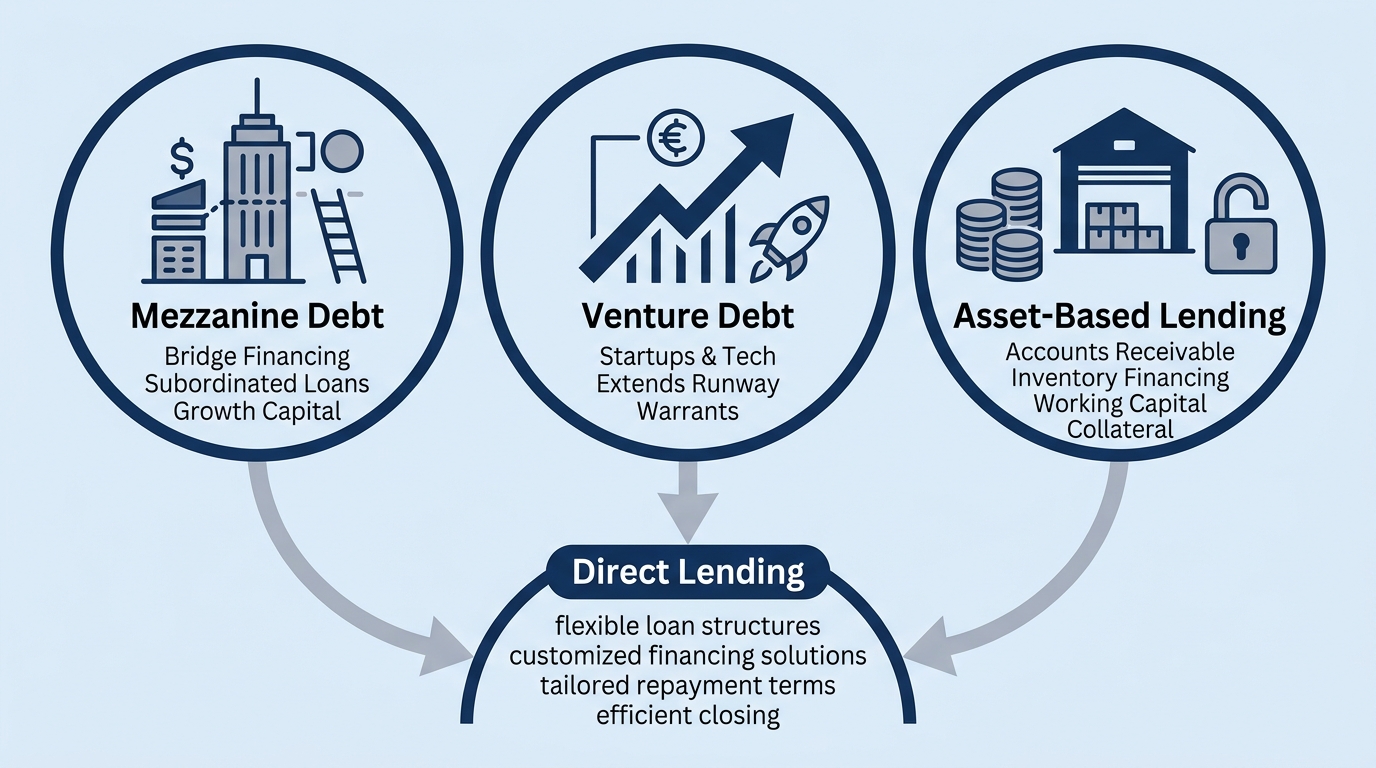
    We structure mezzanine debt as a hybrid financing tool, positioned between senior debt and equity to provide flexible capital for expansion. This subordinated option offers businesses higher leverage while minimizing ownership loss, ideal for firms scaling operations post-acquisition. Venture debt complements this by extending cash runways for early-stage companies, often without warrants that dilute equity.

    Financing TypeZaidwood CapabilitiesTypical Harris-Style Firm
    Debt AdvisoryMezzanine, asset-based with $15B networkLimited to basic loans
    Equity AdvisoryGrowth equity introductions to 4,000+ investorsStandard placements

    Due Diligence in Boutique Deals

    Our full-cycle due diligence process is a cornerstone of successful boutique deals, encompassing financial, operational, and legal reviews to identify synergies and red flags early. We begin with financial modeling, scrutinizing pro forma statements and cash flow projections to validate deal viability. Legal reviews follow, examine contracts, IP rights, and regulatory compliance. In specialized financing firms, we extend this to emerging markets M&A, where geopolitical factors demand rigorous scrutiny.

    Implementing M&A and Capital Strategies in Practice

    Step-by-Step Deal Execution Guide

    • Investor Matching: Drawing from our network of over 4,000 institutions and $15B in deployable capital, we curate tailored introductions.
    • Due Diligence Execution: We conduct full-cycle reviews, encompassing financial audits, legal compliance checks, and operational evaluations using SEC regulatory resources.
    • Documentation Preparation: Clients receive customized pitch decks, pro forma financials, business plans, and fairness opinions.
    Tool/AspectZaidwood OfferingStandard Boutique
    Investor Network4,000+ institutions, $15B capitalSmaller, regional focus
    DocumentationPitch decks, pro formas via Deal VaultBasic templates

    Case Studies in Middle Market Success

    Through rolodex-driven introductions to family offices and venture capital sources, we structured a hybrid mezzanine debt facility for a manufacturing firm that bridged senior loans and equity, minimizing dilution. In another case, we developed a compelling narrative around intellectual property for a tech firm, utilizing investor outreach to sovereign wealth funds and endowments for competitive bidding.

    Advanced Topics in Boutique Debt and Equity Advisory

    Advanced due diligence forms the backbone of our process, encompassing human capital assessments to evaluate team dynamics and commercial viability to scrutinize market positioning. Capital introductions represent a cornerstone of our elite advisory networks, connecting clients to sovereign wealth funds and endowments. profissionais who cultivate deep relationships with private equity sponsors position themselves for success. Our investment bankers 2025 insights validate this strategy.

    Advanced FeatureZaidwood StrengthBoutique Baseline
    Investor Access$15B deployable via 4,000+ connectionsLimited introductions

    Common Questions on Boutique M&A Services

    • How do I select a boutique investment bank? Evaluate track records and sector focus. At Zaidwood Capital, our $24.4B transaction volume provides proven expertise.
    • Timeline for due diligence? Usually 4-8 weeks, covering financial, legal, and operational reviews.
    • Regulatory considerations? Utilize FINRA regulatory tools for filings and disclosures.

    Leveraging Boutique Expertise for Your M&A Success

    In navigating middle market M&A, boutique investment banks offer tailored strategies that drive efficient transactions. At Zaidwood Capital, we provide full-cycle advisory, from due diligence to capital formation, empowering clients with innovative tools like our Velocity Matrix for rapid execution. contact us today to explore how our expertise can support your success.

    Resources

  • Best Debt Advisory for 2026: Trusted Options

    Best Debt Advisory for 2026: Trusted Options

    Table of Contents

    In today’s volatile markets, particularly in the US, debt advisory plays a crucial role in empowering business leaders and investors to fuel mergers and acquisitions without diluting equity. As economic shifts toward 2026 demand innovative financing, strategic debt guidance bridges valuation gaps and optimizes capital structures for sustainable growth.

    Debt advisory services provide expert counsel on debt instruments tailored to funding needs, from mezzanine and venture debt to asset-based lending. At Zaidwood Capital, we leverage our debt advisory services to connect clients to over 15 billion USD in deployable capital through a network of more than 4,000 institutional investors. With 24.4 billion USD in aggregate transaction volume across 300+ deals, we deliver cost-efficient solutions that preserve ownership and offer tax advantages, ensuring competitive terms and rapid execution.

    Discover key benefits in the following listicle, highlighting how our boutique expertise drives strategic capital debt strategies for your M&A success.

    1. Enhance M&A Deal Structures

    In the fast-paced world of mergers and acquisitions, balancing valuation expectations and funding sources often presents significant hurdles. M&A debt financing emerges as a strategic tool, enabling buyers to secure capital without excessive equity dilution, thus preserving ownership control while accelerating deal timelines. At Zaidwood Capital, our M&A capital advisory services integrate acquisition funding strategies to bridge these gaps effectively.

    We provide comprehensive debt advisory throughout the M&A process, leveraging mezzanine debt for flexible valuation adjustments and seamless integration with due diligence to mitigate risks. Our full-cycle approach encompasses deal structuring, lender introductions from our network of over 4,000 investors, and tailored solutions for mid-market transactions. Drawing from our $24.4 billion in aggregate transaction volume across buy-side and sell-side mandates, we ensure clients achieve optimized structures that enhance viability and cost efficiency compared to equity-only approaches. This methodology, informed by proven advisory processes, supports precise execution and long-term value creation.

    Consider a mid-market acquisition where a client sought to fund a strategic buyout. Our team arranged mezzanine financing to cover the equity shortfall, closing the deal swiftly without ownership concessions. To leverage similar benefits, engage experienced advisors early to align financing with your transaction goals.

    2. Access Mezzanine and Venture Debt

    In today’s competitive landscape, debt advisory services provide essential hybrid financing solutions that enable businesses to fuel growth without diluting ownership entirely. These specialized debt options bridge the gap between traditional loans and equity, offering flexible capital for strategic expansions or acquisitions.

    Mezzanine debt serves as subordinated financing, often including equity warrants, ideal for mid-market companies pursuing mergers and acquisitions or operational scaling. It features higher interest rates but lenient covenants, with repayment terms typically spanning 5-7 years. Venture debt, meanwhile, supports early-stage firms by extending cash runway post-equity rounds, minimizing equity surrender through attached warrants. We structure these facilities to align with client objectives, emphasizing competitive terms and policy considerations like tax integration for efficient capital formation in the US.

    As a leading financial advisory firm, we leverage our extensive network of over 3,000 lenders to arrange mezzanine and venture debt, having facilitated more than $800 million in tailored solutions. This approach ensures mid-market clients access scalable funding swiftly, often closing deals in under 60 days.

    3. Differentiate Debt from Equity Paths

    When optimizing capital structures, clients often face the dilemma of equity vs debt financing. Should you opt for debt advisory to maintain control, or embrace equity for long-term growth? At Zaidwood Capital, we guide decisions that align with your strategic objectives, balancing risks and rewards effectively.

    Debt financing involves repayment obligations with interest, preserving ownership while leveraging assets, whereas equity introduces ownership dilution but supplies permanent capital without repayment pressures. Our debt advisory services assess leverage ratios and market conditions to recommend optimal paths, considering tax deductibility of interest versus equity’s dividend flexibility. For US deals, regulatory compliance, such as in debt advisory SEC filing examples, ensures structured integrity. Policy insights on corporate integration further highlight capital advisory contrasts, aiding informed selection through an evaluation framework that weighs cost, control, and scalability.

    Consider a mid-sized firm seeking expansion: We at Zaidwood structure mixed financings, blending debt for immediate needs and equity for sustained innovation, drawing on our dual expertise to deliver tailored solutions that enhance value without compromising autonomy.

    Infographic comparing debt and equity financing paths in capital advisory

    Visual comparison of debt and equity financing options for strategic capital structuring

    4. Implement Forward-Looking Strategies

    As economic uncertainties loom in 2026, effective debt advisory becomes essential for businesses navigating volatility. We at Zaidwood Capital emphasize adaptive strategies that incorporate sustainable practices and technological innovations to safeguard financial health.

    Key trends include ESG-linked debt instruments, which tie financing terms to environmental and social performance metrics, and digital lending platforms powered by blockchain for streamlined transactions. Scenario planning helps mitigate interest rate fluctuations by modeling various economic paths, while integrating these with M&A activities creates resilient capital structures. Emerging US regulations on digital assets, such as those surrounding distributed ledger technology (DLT) bonds as outlined by the ICMA, demand proactive compliance. Our market insights and extensive network enable timely execution of these future debt tactics.

    For instance, we guide clients through strategic financing planning via a transaction advisory agreement, ensuring alignment with long-term goals. Tip: Regularly review portfolios against regulatory updates to maintain agility and capitalize on opportunities.

    5. Leverage Boutique Firm Advantages

    Boutique firms offer unique advisory network benefits in debt advisory in the US, providing personalized attention and agility that larger institutions often cannot match. We focus on tailored financing solutions, ensuring clients receive bespoke strategies aligned with their specific goals.

    Unlike standardized products from big banks, boutique financing expertise enables faster execution through dedicated teams unburdened by bureaucracy. This approach delivers deeper due diligence without the conflicts inherent in FINRA broker dealer firms, which must balance multiple client interests. Our regulatory clarity as independent advisors allows unbiased guidance, drawing on extensive networks for efficient capital access. With over 300 completed deals and connections to more than 4,000 investors, we streamline transactions while maintaining transparency and compliance.

    For optimal results, vet advisors by reviewing their track record and network depth. At Zaidwood Capital, our 4,000+ investor connections and $24.4 billion in aggregate transaction volume demonstrate proven advisory network benefits, helping clients secure funding swiftly and securely.

    6. Streamline Due Diligence Processes

    In the complex landscape of mergers and acquisitions and financing, thorough due diligence serves as a critical safeguard against unforeseen risks. Our full-cycle approach at Zaidwood Capital integrates comprehensive reviews across financial, legal, operational, and commercial domains to support informed decision-making in debt transactions.

    We begin with financial audits, scrutinizing balance sheets, cash flows, and projections to identify discrepancies. Legal assessments evaluate contracts, compliance, and liabilities, while operational reviews examine supply chains and processes. Commercial evaluations assess market positioning and revenue viability. For debt deals, we prioritize risks such as covenant compliance and lender protections, drawing from established agreement standards to ensure alignment with transaction terms. This phased diligence mitigates exposure and uncovers value drivers.

    At Zaidwood, proprietary tools like our secured data room enhance efficiency, enabling seamless documentation and collaboration. Clients preparing for debt advisory should organize key records in advance, facilitating smoother reviews and faster execution. By streamlining these processes, we bridge strategic planning with reliable safeguards.

    Maximize Capital Efficiency Ahead

    In today’s dynamic financial landscape, debt advisory emerges as a pivotal tool for optimizing M&A transactions and capital structures. We’ve explored enhanced deal structures, diverse debt types like mezzanine and venture debt, which offer advantages over equity financing through lower dilution and tax benefits. Looking to 2026, boutique firms provide agile diligence and integrated strategies that drive financing optimization and superior outcomes.

    At Zaidwood Capital, our comprehensive advisory services leverage a vast network of over 4,000 investors and $24.4 billion in aggregate transaction volume to connect clients with tailored strategic debt solutions. We guide businesses through efficient processes, ensuring transparency and alignment with objectives, drawing on proven expertise in hundreds of deals.

    Embrace these opportunities to maximize capital efficiency in the evolving US market—contact us today to discuss your needs.

    Resources

  • Top Buy-Side M&A Strategies for 2026: Expert Insights

    Top Buy-Side M&A Strategies for 2026: Expert Insights

    Table of Contents

    In the dynamic world of buy-side M&A, acquirers face intense challenges in sourcing viable targets amid market volatility and competitive pressures. This acquirer-focused approach empowers strategic expansion through precise target acquisition planning, contrasting sell-side processes where sellers prioritize valuation maximization and buyer outreach. While sell-side deals often span 6-9 months with broad auctions, buy-side emphasizes targeted diligence to mitigate risks.

    At Zaidwood Capital, we provide expert mergers and acquisitions advisory tailored for buy-side acquisition strategy, guiding clients from opportunity identification through due diligence, valuation, negotiation, and integration. With over 300 completed deals and $24.4B in transaction volume, our team leverages a network of 4,000+ investors to access $15B+ in deployable capital, ensuring full-cycle support for informed decisions.

    Discover the six key benefits of partnering with our boutique firm, starting with superior target sourcing that lays the foundation for successful buy-side due diligence and execution.

    1. Precise Target Identification

    In buy-side M&A, identifying the right acquisition targets amid vast opportunities poses significant challenges for growth-focused firms. Without precise sourcing, companies risk prolonged searches and missed synergies, complicating expansion strategies.

    Our approach streamlines this through rigorous criteria including market fit, financial health, and synergy potential, ensuring targets align with your buy-side acquisition strategy. We leverage the proprietary Deal Vault for access to vetted opportunities and conduct sector mapping with preliminary screening to accelerate discovery. As highlighted in resources on selecting M&A advisor, effective advisors embody competence, compassion, and integrity to guide strategic target hunting. Our extensive network of over 4,000 investors and $15B in deployable capital further enhances acquisition opportunity scouting, drawing from more than 300 completed transactions for proven results.

    For instance, we recently matched a mid-market client with a complementary asset in under three months via network introductions, enabling swift evaluation and integration planning before advancing to due diligence.

    2. Thorough Due Diligence Execution

    In the realm of buy-side due diligence, thorough validation is essential to uncover hidden risks and maximize acquisition value. At Zaidwood Capital, we execute comprehensive reviews that integrate financial, legal, operational, commercial, IT, and human capital assessments, drawing on our 300+ completed deals to support clients in navigating complex transactions.

    Horizontal process flow diagram showing three stages of buy-side due diligence in mergers and acquisitions: financial review, legal and operational assessment, and risk mitigation.

    Key phases of thorough due diligence execution in M&A buy-side process

    Our process begins with secure data room access, allowing detailed examination of target financials and operations. We then conduct third-party verifications and multi-faceted risk assessments, incorporating antitrust considerations from established guidelines to ensure compliance. As a leading boutique M&A advisory firm, we streamline buy-side M&A by providing integrated diligence, including checklists for red flags like discrepancies in revenue reporting or unresolved litigation.

    • Verify financial statements against independent audits.
    • Assess legal contracts for potential liabilities.
    • Evaluate operational efficiencies and IT security.

    A key tip from our engagements: Always probe management representations early to detect inconsistencies that could derail deals, fostering informed buy-side acquisition strategies before advancing to valuation.

    This rigorous approach transitions seamlessly into precise target valuation, the next critical layer in our acquisition vetting protocols.

    3. Strategic Valuation Insights

    In buy-side M&A, overlooking valuation pitfalls can lead to overpaying for targets or missing synergy opportunities, undermining deal success. Our team at Zaidwood Capital leverages advanced techniques and capital advisory services to ensure precise deal pricing analysis, drawing from $24.4 billion in aggregate transaction volume for informed acquisition worth assessment.

    We apply discounted cash flow (DCF) modeling to project future cash flows, comparable company analysis for market benchmarks using our network of over 4,000 investors, and precedent transactions to gauge historical premiums. In buy-side acquisition strategy, we quantify synergies through detailed revenue and cost projections, integrating pro forma financials to model post-merger performance. This data-driven approach supports negotiations by establishing defensible value ranges that optimize capital deployment.

    A key tip for synergy modeling: Focus on realistic cost savings from operational overlaps, validated by our market intelligence, to avoid inflated expectations that erode value during integration.

    4. Effective Negotiation Support

    In buy-side M&A transactions, negotiation risks abound, including overpaying due to incomplete information or overlooking hidden liabilities that erode value post-closing. These challenges can derail even the most promising deals without expert intervention. At Zaidwood Capital, we mitigate these risks by leveraging insights from buy-side due diligence to inform strategic positioning.

    We provide seasoned guidance from our leadership team, drawing on industry-standard practices to navigate term sheets, letters of intent (LOIs), and closing conditions. Key negotiation levers include price adjustments tied to working capital contingencies and structured earn-outs that align seller incentives with performance milestones. We emphasize robust representations and warranties to protect against undisclosed issues, while our expertise in strategic documentation ensures precise deal term bargaining. This approach secures favorable outcomes and seamlessly transitions to post-merger integration planning. Our investment bank advisory experience highlights the importance of senior professionals in volatile transaction environments, where retaining expertise drives successful acquisition closing tactics.

    A practical tip for buy-side M&A: When drafting an LOI, insist on broad exclusivity periods with clear milestones to prevent seller distractions, allowing time to refine your acquisition strategy based on diligence findings.

    5. Seamless Integration Planning

    Following the successful negotiation of a buy-side M&A deal, the integration phase presents significant challenges, including aligning operations and capturing merger synergy realization. At Zaidwood Capital, we guide clients through this critical transition to ensure value creation without disruptions.

    Our integration roadmap begins with comprehensive target onboarding frameworks, focusing on team onboarding and seamless system mergers. We advise on operational alignment to streamline processes and enhance efficiency. For financing, our debt advisory expertise supports post-deal restructuring, optimizing capital structures to reduce costs and improve liquidity. Additionally, our equity advisory services facilitate liquidity solutions, enabling stakeholders to realize gains strategically. These steps form a structured buy-side acquisition strategy that maximizes post-acquisition value.

    A key best practice involves prioritizing cultural fit during integration. We recommend early engagement with leadership teams to foster collaboration, mitigating resistance and building a unified vision. This approach not only accelerates synergy realization but also lays the foundation for long-term success in the evolving M&A landscape.

    6. Robust Risk Management

    In buy-side M&A transactions, potential pitfalls like regulatory hurdles and financial discrepancies often threaten value creation. We at Zaidwood Capital, one of the buy-side M&A firms, recognize these challenges and integrate proactive risk management into every stage of the process, ensuring clients achieve sustainable outcomes through informed decision-making.

    Our approach begins with thorough buy-side due diligence to uncover hidden liabilities early, followed by strategic consulting that assesses and addresses acquisition hazard controls. We deliver fairness opinions for objective valuation insights, while our capital introductions connect clients to a diverse network of over 4,000 investors, mitigating funding dependencies. Leveraging the Zaidwood Deal Vault, we provide access to risk-vetted opportunities, strengthening overall deal risk frameworks and supporting resilient buy-side acquisition strategies. This ongoing advisory minimizes disruptions and maximizes transaction success.

    For effective contingency planning, develop multiple scenarios with backup financing and regulatory compliance checklists. This preparation allows quick pivots, safeguarding investments in dynamic markets.

    Partnering for Acquisition Excellence

    In summary, our buy-side M&A advisory services at Zaidwood Capital deliver six core benefits that drive process efficiency, value optimization, and strategic alignment. From expert target sourcing and comprehensive buy-side due diligence to robust risk management, we empower your buy-side acquisition strategy with proven acquirer success pathways. Our track record includes over 300 completed deals, aggregating $24.4 billion in transaction volume, and access to a network of more than 4,000 institutional investors.

    When selecting an M&A advisor, prioritize firms with deep industry expertise, extensive investor connections, and full-cycle capabilities like ours. Evaluate based on alignment with your commercial goals, demonstrated results, and tailored support for seamless execution.

    Ready to elevate your acquisitions? Contact us at Zaidwood Capital today for a confidential consultation and personalized guidance on your next strategic move.

    Resources