Zaidwood Capital

Tag: Debt Advisory

  • Tech Mergers and Acquisitions: Complete Guide for 2026

    Tech Mergers and Acquisitions: Complete Guide for 2026

    Table of Contents

    The Landscape of Tech Mergers and Acquisitions

    Tech mergers and acquisitions are accelerating at a historic pace, propelled by the convergence of artificial intelligence and cybersecurity disruption. We observe that ai-driven m&a dominates mid-market dealmaking as companies race to integrate generative AI, while cybersecurity acquisitions surge in response to intensifying threat landscapes and new regulatory frameworks. This velocity creates immense opportunity but also unparalleled complexity for investors and business owners alike.

    In this fast-moving environment, traditional advisory models often struggle to keep up. As a boutique investment banking firm, we combine decades of collective investment banking experience with proprietary data and a global network of over 4,000 investors. Our Sovereign Data Nexus and Precision Catalyst platforms accelerate due diligence and investor matching, delivering the speed and precision that today’s tech transactions demand. This evolving landscape requires a strategic advisor with both agility and institutional knowledge—qualities we bring to every engagement, from initial strategy through final close.

    Key Milestones in the Tech M&A Process

    Navigating the tech mergers and acquisitions landscape requires a structured, milestone-driven framework to manage complexity and unlock value. At Zaidwood Capital, we believe that before you can appreciate the nuances of each stage, you should understand what is an investment bank and how a dedicated advisory team serves as a strategic partner throughout the process. The following milestones outline our systematic approach.

    • Strategic Assessment & Target Identification
      We start by clarifying your growth objectives and screening potential targets that align with your strategic vision. Our team leverages proprietary data networks to identify opportunities that might otherwise go unnoticed.
    • Valuation & Financial Modeling
      Using advanced financial modeling, we triangulate a company’s intrinsic value and quantify potential synergies. This phase ensures you have a realistic pricing framework before entering negotiations.
    • Due Diligence (Including Cybersecurity & IP Audits)
      A rigorous evaluation of financial statements, operational metrics, and legal risks is conducted, with special attention to technology assets, cybersecurity posture, and data privacy compliance. In AI-driven M&A and cybersecurity acquisitions, our proprietary data access via the Sovereign Data Nexus allows for deeper analysis of intellectual property portfolios and cyber risk exposure.
    • Negotiation & Letter of Intent
      Investment bankers facilitate valuation discussions, presenting industry benchmarks and helping bridge gaps through creative deal structuring—such as earn-outs or seller financing. A non-binding letter of intent is then drafted to formalize key terms.
    • Regulatory Approvals & Compliance
      Navigating antitrust, data sovereignty, and sector-specific regulations is critical. We coordinate with legal counsel to ensure all filings are complete and timelines are managed proactively.
    • Closing & Deal Documentation
      Our Full-Cycle M&A approach encompasses deal vault management and the preparation of definitive agreements. We oversee the final exchange of consideration and transfer of ownership, ensuring every detail is documented and compliant.
    • Post-Merger Integration
      Success doesn’t end at closing; we help clients execute integration plans that capture synergies, align cultures, and safeguard critical technology architectures. Continuous monitoring of cybersecurity risks remains a priority.

    With a clear understanding of these milestones, it becomes evident why experienced advisory guidance is critical. Our role as a Boutique M&A and Capital Advisory Firm is to streamline each step, mitigating risk and positioning clients for long-term value creation. In the following sections, we’ll explore each milestone in greater depth to help you prepare for a successful transaction.

    In tech mergers and acquisitions, regulatory complexity often determines whether a transaction reaches completion or stalls indefinitely. Beyond financial and technical due diligence, regulatory compliance emerges as a critical hurdle. Our firm combines deep advisory experience with proprietary intelligence tools to help clients anticipate and address these challenges.

    For transactions involving telecommunications infrastructure, the review process demands particularly careful navigation. The FCC telecommunications agency must approve any transfer of spectrum licenses or communications assets, a process our team streamlines through early engagement and thorough preparation. According to the Federal Communications Commission, public interest hearings and foreign ownership rules frequently extend review timelines, especially in tech mergers and acquisitions where national security considerations intersect with infrastructure control. We help clients prepare comprehensive filings that address these nuanced requirements from the outset.

    Cross-border financing structures introduce additional regulatory dimensions that many acquirers underestimate. The International Capital Market Association establishes the Green Bond Principles, a critical framework when technology acquirers issue sustainable debt to fund acquisitions. For technology M&A transactions spanning multiple jurisdictions, ICMA standards provide essential guidance on disclosure requirements and market practices that protect both issuers and investors. In ai-driven M&A, regulatory scrutiny of data privacy compliance often intersects with these capital market requirements, creating layered obligations that demand coordinated advisory support.

    Cybersecurity acquisitions frequently trigger filings under the Committee on Foreign Investment in the United States, adding national security review to already complex transaction timelines. Our Sovereign Data Nexus platform monitors real-time regulatory changes and precedent decisions across these agencies, helping clients anticipate potential friction points. While advisory experience reduces execution risk, each transaction remains unique, and regulatory outcomes depend on the specific deal structure and government determinations. We provide clarity without promising specific results.

    Once regulatory approvals are secured, the focus shifts to rapid, compliant integration. Our Velocity Matrix accelerates this transition, enabling clients to move from approval to operational execution without sacrificing regulatory diligence or transaction momentum.

    Preparing Your Company for Due Diligence

    Once you have identified a potential acquisition target, thorough preparation is the next critical step, particularly in the dynamic landscape of tech mergers and acquisitions. For founders and management teams, the due diligence process can feel overwhelming, but a structured, proactive approach transforms it from a hurdle into an opportunity to showcase your company’s value. At Zaidwood Capital, we guide our clients through this critical phase, ensuring that every facet of the business is scrutinized and presented to withstand the most rigorous investor or buyer examination. The goal is not just to survive diligence but to leverage it as a strategic step toward a successful transaction.

    We advise our clients to focus on three fundamental preparatory tasks. First, compile and organize all foundational documentation. This includes audited financial statements, corporate tax returns, capitalization tables, material contracts, and all historical investor presentations and board decks. Second, assemble a dedicated, cross-functional internal response team. This group should include key leaders from finance, legal, and operations who are empowered to answer questions and pull records quickly. Third, establish a secure, meticulously indexed virtual data room. A well-structured data room accelerates the review process and signals operational maturity to potential partners.

    For companies involved in ai-driven m&a or cybersecurity acquisitions, the diligence requirements extend far beyond standard financial and legal review. A significant portion of the evaluation will focus on technology and intellectual property. Be prepared to demonstrate clear ownership and defensibility of your core IP, including patents, trademarks, and proprietary code. We help our clients prepare detailed documentation of AI model training data, algorithm logic, and bias mitigation protocols. Equally non-negotiable is a thorough review of your cybersecurity infrastructure, incident response history, and data privacy compliance. Addressing these technology-specific areas proactively is a powerful risk-mitigation strategy that prevents deal-derailing surprises.

    As your Boutique M&A and Capital Advisory Firm, we streamline this entire preparation phase. We provide a tailored readiness checklist and can manage the deal vault, ensuring all sensitive information remains secure and organized. This hands-on support allows you to stay focused on running your business. A robust financial analysis is the bedrock of this process, and professionals with a strong foundation, including those who have completed a CFA certification program, add significant rigor to the financial modeling and valuation perspectives that underpin a solid diligence review.

    With your company thoroughly prepared, the formal due diligence process can proceed more efficiently, often beginning with the opening of a secure data room to invited parties.

    Evaluating the Cost and Value of M&A Advisory

    In today’s dynamic deal environment, tech mergers and acquisitions require rigorous evaluation of advisory cost and value. As a Boutique M&A and Capital Advisory Firm, we believe clients must look beyond headline fees to assess the full spectrum of value an advisor delivers throughout the transaction lifecycle.

    Understanding Fee Structures

    M&A advisory fees generally follow two primary models. A retainer fee compensates the advisor for upfront work, including market analysis, buyer identification, and initial due diligence preparation. This structure ensures dedicated resources are committed to the engagement from day one, aligning incentives for thorough preparation rather than rushed execution. The second model, a success fee, is contingent upon closing and typically calculated as a percentage of transaction value. This arrangement directly ties advisor compensation to outcomes, creating strong alignment around achieving optimal deal terms. Many engagements combine both structures, balancing ongoing commitment with performance-based rewards.

    Value Drivers and Differentiating Factors

    Evaluating advisory value requires examining factors beyond the fee schedule. Proprietary data access represents a critical differentiator. Through our Sovereign Data Nexus, we leverage private servers and exclusive market intelligence to identify opportunities and benchmark valuations that public databases cannot replicate. This infrastructure powers informed decision-making, particularly in specialized sectors like ai-driven m&a and cybersecurity acquisitions, where traditional valuation metrics often fall short. Execution speed, driven by our Velocity Matrix methodology, compresses timelines without sacrificing diligence quality. Finally, investor engagement capabilities, enhanced by our Precision Catalyst platform, ensure targeted outreach to qualified counterparties rather than broad, unfocused marketing.

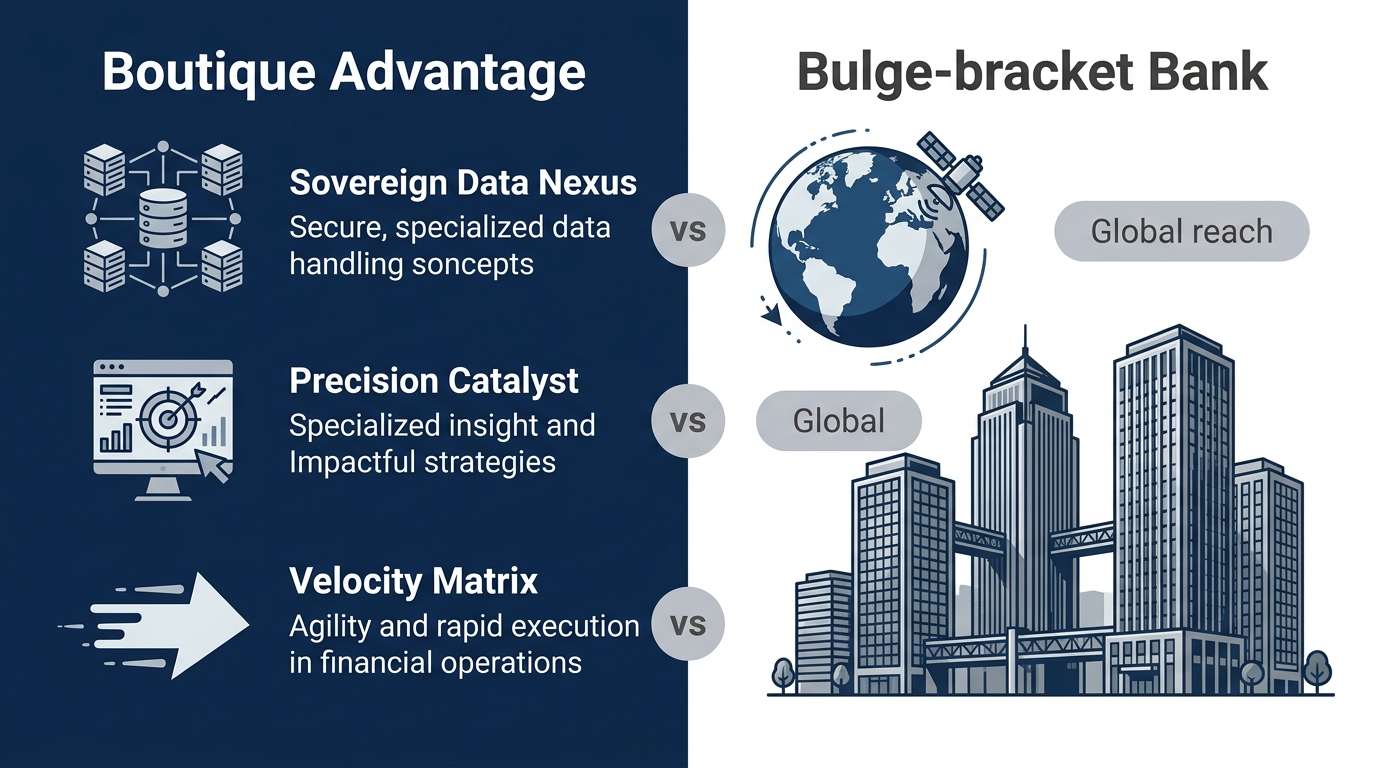
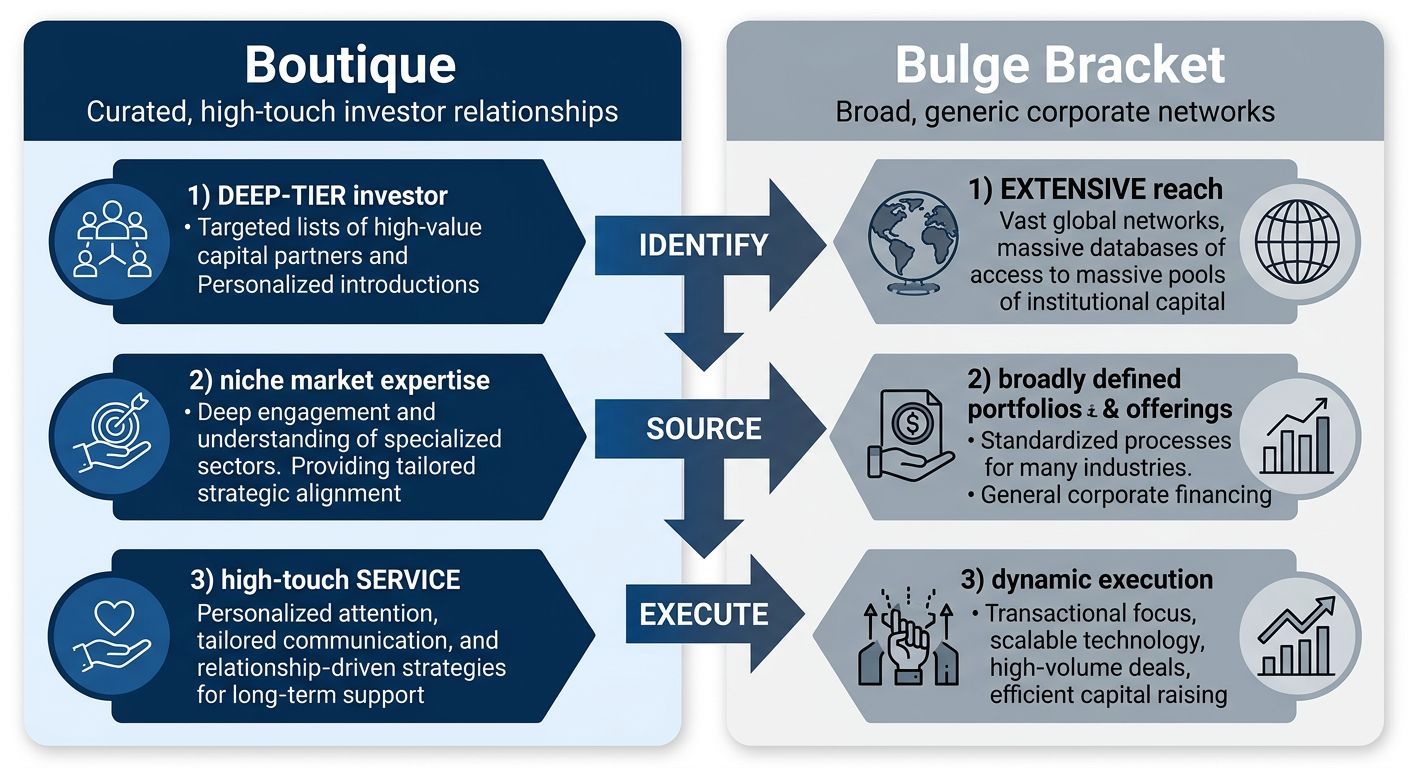
    Boutique advisory firms offer distinct advantages over bulge-bracket institutions, including senior-level attention throughout the engagement, specialized sector expertise, and flexible fee arrangements. While larger banks provide global distribution networks and multi-product capabilities, boutique firms deliver personalized service and dedicated focus on middle-market transactions where nuanced industry knowledge creates measurable value.

    For industry standards and best practices, clients may refer to organizations such as the ICMA capital market association and the CFA Institute, whose ethical frameworks and professional guidelines establish benchmarks for advisory conduct.

    Criteria for Evaluating Advisory Value

    • Transaction track record in relevant sectors and deal sizes
    • Network quality, measured by access to decision-makers at strategic acquirers and institutional investors
    • Technological capabilities that enhance data security, valuation accuracy, and investor targeting
    • Professional standards, including adherence to CFA Institute ethical guidelines and demonstrated commitment to fiduciary responsibility

    With these evaluation criteria in mind, one can better navigate the selection process for an advisory partner aligned with specific transaction objectives.

    The landscape of tech mergers and acquisitions is being reshaped by two powerful forces: the application of artificial intelligence and a surge in cybersecurity-focused dealmaking. As a Boutique M&A and Capital Advisory Firm, Zaidwood Capital sees these trends creating both opportunity and complexity for growth companies and investors. To understand these shifts, it is helpful to revisit what is an investment bank and how its core advisory services are being transformed by technology. The traditional functions of capital raising and full-cycle M&A are now augmented by proprietary data, AI-driven analytics, and rapid execution capabilities that distinguish boutique platforms from larger wirehouses.
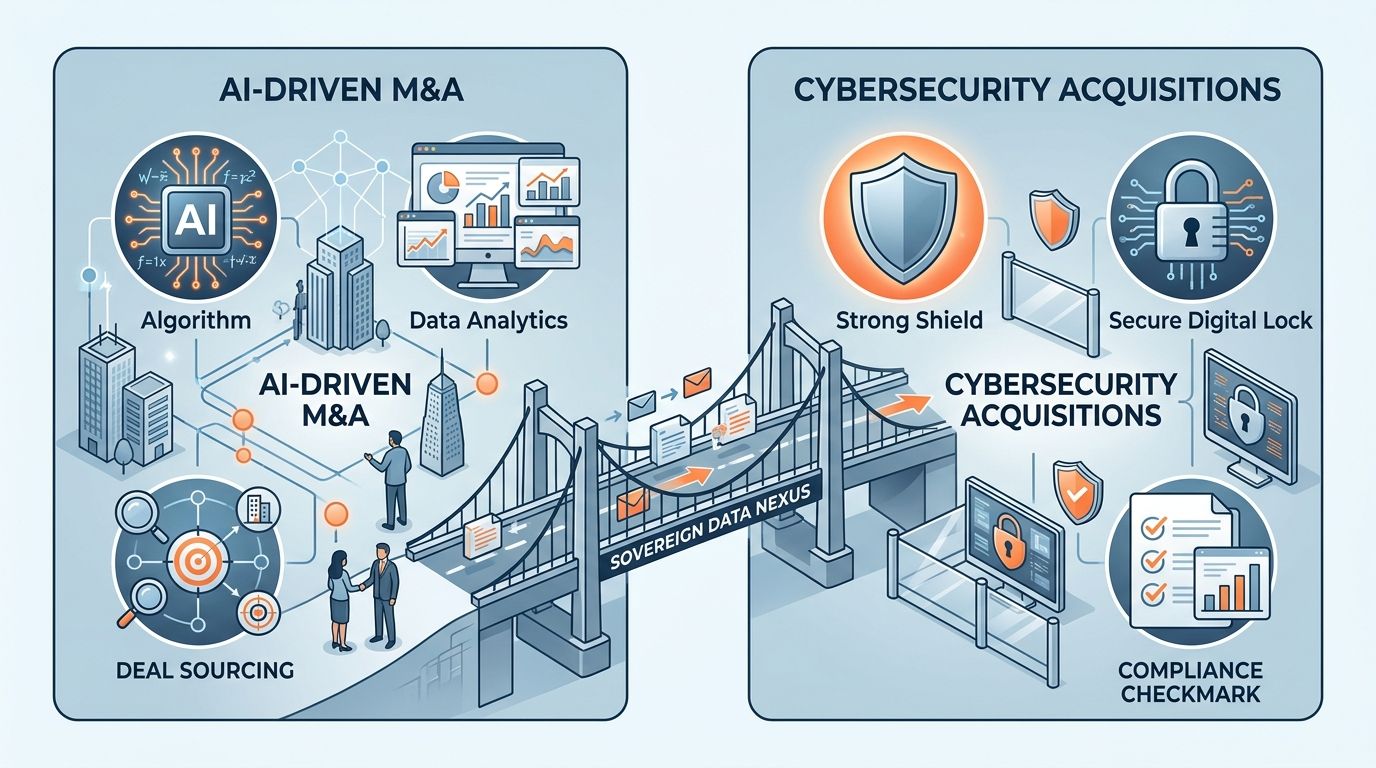
    Infographic showing AI-driven M&A on left and cybersecurity acquisitions on right connected by Sovereign Data Nexus bridge
    AI and cybersecurity acquisition trends infographic

    Now, AI-powered M&A is transforming every stage of the deal lifecycle. Our Sovereign Data Nexus employs machine learning to scan thousands of targets, flagging financial and operational red flags and surfacing data-driven opportunities that traditional manual screening would miss. Predictive valuation models, built on historical transaction data and real-time market signals drawn from our global investor network, help our team price transactions with greater precision. This is not just a pre-deal advantage; AI tools are increasingly used in post-merger integration to identify synergy realizations and operational efficiencies that protect deal value. For clients, staying ahead of trends in ai-driven m&a requires access to proprietary data and tech-enabled diligence, which translates into faster, more informed decision-making—a distinct edge in competitive processes.

    Cybersecurity acquisitions have become a dominant theme in the current cycle. Companies are acquiring specialized security firms to defend against evolving threats, comply with tightening regulations, and build competitive moats around their digital assets. With over $24.4 billion in aggregate transaction volume handled by our team, we have witnessed a sharp increase in deals targeting cybersecurity providers. The growth in cybersecurity acquisitions reflects a strategic imperative to embed security as a driver of resilience. Our Velocity Matrix enables rapid execution, and our network of 4,000+ investors actively seeks cyber-focused deals. This approach allows clients to capitalize on market opportunities before conditions change.

    Understanding these emerging trends—and how a boutique platform like Zaidwood Capital leverages the Sovereign Data Nexus and Velocity Matrix—is essential for any stakeholder considering a technology-driven transaction. In our next section, we explore how we structure and execute full-cycle deals that capitalize on these dynamics.

    Achieving Success in Tech Mergers and Acquisitions

    Success in tech mergers and acquisitions hinges on speed, proprietary data, and rigorous due diligence. In a landscape where cybersecurity acquisitions can turn on undiscovered vulnerabilities, and ai-driven M&A requires deep technical evaluation, traditional advisory is no longer enough.

    We address this through our proprietary deal infrastructure. Our Sovereign Data Nexus provides secure, transaction-specific servers and exclusive data sets, enabling the granular risk assessment technology deals demand. The Velocity Matrix then compresses execution timelines without sacrificing quality, a critical advantage in fiercely competitive tech auctions. Underpinning both is the Precision Catalyst, our integrated investor-engagement engine that uses digital marketing and capital-markets expertise to align startups, growth companies, and institutional capital at the right moment.

    We deliver this as Full-Cycle M&A: end-to-end support from strategic documentation through to a closed transaction. While these capabilities sharpen execution, every deal involves inherent risk and requires careful regulatory and legal compliance. These tools form the foundation of our advisory process, explored in the next section.

    Resources

  • What Is an Investment Bank? Key Services Explained

    What Is an Investment Bank? Key Services Explained

    Table of Contents

    The Role of Investment Banks in Modern Finance

    Understanding what is an investment bank is essential to grasping modern financial markets, as these institutions serve as vital intermediaries between companies seeking capital and the investors who provide it. According to the CFA Institute, the global standard-setter for the investment industry, investment banks facilitate capital formation, mergers and acquisitions, and market making, driving economic growth globally today.

    Investment banks perform three primary functions: capital raising, mergers and acquisitions advisory, and market making. In capital raising, we offer capital raising solutions that leverage our extensive investor network to secure equity and debt financing. In mergers and acquisitions, we advise on deal structuring, valuation, and negotiation, ensuring strategic alignment. Market making provides liquidity and price discovery, but boutique firms typically focus on advisory, delivering personalized, high-touch service enhanced by tools like our Sovereign Data Nexus and Velocity Matrix. These functions collectively channel capital to productive enterprises, fueling innovation and economic expansion.

    At Zaidwood Capital, we are redefining Financial Services 3.0 as a Boutique M&A and Capital Advisory Firm, combining proprietary data access via our Sovereign Data Nexus with precision execution through our Velocity Matrix to accelerate deals. Securities are offered through Finalis Securities LLC; Zaidwood Capital is not a registered broker-dealer.

    Investment Banking Services: From Advisory to Capital Markets

    When clients ask what is an investment bank, we answer with a clear definition: A financial institution that provides strategic advisory and capital-markets services to corporations, governments, and institutions. Unlike commercial banks that focus on deposit-taking and lending, investment banks operate on a fee-based model, guiding complex transactions like mergers and acquisitions and large-scale capital raising.

    Investment Bank vs. Commercial Bank
    Feature Investment Bank Commercial Bank
    Primary Focus Advisory & Capital Markets Deposits & Lending
    Revenue Model Fee-based Interest-based

    This distinction is foundational. While commercial banks serve everyday financial needs, investment banks unlock growth through corporate finance advisory, deal orchestration, and access to deep capital pools.

    Our firm’s advisory practice spans the full continuum of mergers and acquisitions—from target identification and valuation to negotiation and close—while our capital-markets capabilities help clients structure and secure equity, debt, and structured solutions. For a growing enterprise seeking capital raising, we craft strategic materials like pitch decks, business plans, and pro forma financials, then leverage our global network of over 4,000 institutional and private investors to create institutional introductions.

    Mergers and Acquisitions: How Investment Banks Drive Deal Execution

    To fully appreciate what an investment bank does in the context of mergers and acquisitions, it helps to examine the entire deal lifecycle. Investment banks serve as strategic partners that bring financial expertise, proprietary data tools, and a global investor network to the table. We follow a three-phase framework that covers deal sourcing and initial pitch, rigorous due diligence and financial modeling, and finally negotiation, structuring, and closing.

    Deal Sourcing and Initial Pitch

    We proactively identify acquisition targets or divestiture opportunities through our proprietary Sovereign Data Nexus and long-standing industry relationships. By continuously monitoring market signals and capital flows, we surface potential transactions that align with a client’s strategic objectives. Once a promising opportunity is identified, we craft a tailored pitch book that outlines a compelling investment thesis, preliminary valuation ranges, and a roadmap for value creation.

    Due Diligence and Financial Modeling

    Once a letter of intent is signed, we lead a comprehensive due diligence process that examines financial statements, operational metrics, legal risks, and market conditions. Following the best practices outlined by the CFA Institute, our team validates the target’s earnings quality, working capital dynamics, and growth assumptions. We build a suite of valuation models—discounted cash flow, precedent transaction, and leveraged buyout analyses—to triangulate intrinsic value and stress-test deal economics.

    Negotiation, Structuring, and Closing

    With due diligence findings in hand, we advise on deal structure—whether a stock or asset purchase, and how earn-outs, seller financing, or contingent consideration can bridge valuation gaps. We take the lead in negotiations, coordinating closely with legal and tax advisors to translate commercial terms into binding documents. Throughout this phase, our secure deal vaults serve as central hubs for all transaction materials, accelerating the exchange of sensitive information.

    Capital Raising Strategies: Equity and Debt Financing Pathways

    A core function of an investment bank is helping companies raise capital to fuel growth, execute strategic initiatives, or navigate complex transactions. At Zaidwood Capital, we specialize in capital raising as part of our Full-Cycle M&A and Capital Advisory services, connecting businesses with the right mix of equity and debt financing.

    Equity Financing: Private Placements and Growth Equity

    Equity financing allows businesses to raise capital by selling ownership stakes. Investment banks facilitate private placements, offering shares to accredited investors and institutional investors rather than public markets, which can be faster and more flexible. At Zaidwood Capital, we leverage a network of more than 4,000 investors to connect companies with the right capital providers.

    Debt Financing and Structured Solutions

    Debt financing allows companies to borrow capital without diluting ownership, preserving control for existing shareholders. Investment banks structure a range of instruments: senior debt is secured by company assets, carries a lower interest rate, and ranks first in repayment priority; mezzanine financing is subordinated, carries higher cost, and often includes equity warrants.

    Equity vs. Debt Financing
    Dimension Equity Debt
    Ownership Diluted Preserved
    Repayment None Regular Payments

    Preparing Your Business for a Capital Raise

    Thorough preparation significantly increases the likelihood of a successful capital raise. Start by compiling audited or reviewed financial statements that demonstrate historical performance and projections. A credible business valuation sets realistic expectations for deal terms. Develop a compelling investor pitch deck that clearly articulates the company’s value proposition, growth strategy, and use of funds.

    Boutique Investment Banking: The Zaidwood Capital Advantage

    If the searcher’s question is what is an investment bank, the clearest answer begins with the distinct categories of the industry. Investment banks facilitate the flow of capital, but they operate across a spectrum from boutique advisory firms to global full-service institutions and the largest bulge-bracket banks. At one end, boutique firms like Zaidwood Capital deliver high-touch, specialized guidance for mid-market and growth companies.

    Boutique vs. Full-Service vs. Bulge-Bracket
    Type Focus Advantage
    Boutique Advisory Senior Attention
    Bulge-Bracket Global Markets Balance Sheet
    Side-by-side infographic comparing boutique investment bank advantages with data, marketing, and speed icons versus traditional bulge-bracket bank with globe and buildings

    Comparison infographic showing boutique versus traditional banking advantages

    Common Questions About Investment Banking

    What is an investment bank?
    An investment bank is a financial intermediary that helps companies raise capital and execute mergers and acquisitions. They range from large bulge-bracket institutions to specialized boutique firms like ours, which provide senior-led, personalized advice and sector expertise.

    Unlike traditional investment banks, our boutique advisory provides end-to-end support throughout your transaction lifecycle. Our team brings expertise in mergers and acquisitions and capital raising, leveraging proprietary tools like the Sovereign Data Nexus for data-driven insights and the Velocity Matrix to accelerate execution. Zaidwood Capital is not a registered broker-dealer; securities are offered through Finalis Securities LLC.

    Resources

  • Tree Care Industry Trends 2026: What You Must Know

    Tree Care Industry Trends 2026: What You Must Know

    Table of Contents

    As we examine tree care industry trends 2026, it’s clear that technology and capital are driving a fundamental transformation. The adoption of AI-powered tree risk assessment technology allows arborists and municipalities to make data-driven decisions, improving safety and operational efficiency across urban canopies.

    At the same time, climate-resilient urban canopy management is moving from a niche concern to a mainstream priority. As extreme weather events intensify, cities are recognizing the critical role of trees in cooling, carbon sequestration, and stormwater management. In our view, the shift from reactive tree removal to proactive care enabled by technology and climate policy is a long-term structural change that will fuel demand for advanced services.

    Capital is following these structural tailwinds. We are observing growing M&A activity in the tree care sector, mirroring patterns identified in Zaidwood Capital’s overview of emerging markets M&A. Consolidation is enabling companies to scale and attract institutional investors seeking stable, infrastructure-linked returns. The influx of capital into tech-enabled tree care companies further signals market confidence in the sector’s growth.

    For investors, these converging trends create a favorable landscape for participating in the environmental infrastructure space. We believe that understanding these drivers can help position portfolios for the maturation of green infrastructure, though past performance does not guarantee future results. Ultimately, this article is for informational purposes and does not constitute an offer, solicitation, or investment advice.

    Understanding the Tree Care Industry’s Structural Shift

    The tree care industry trends 2026 point to a fundamental structural shift reshaping arboricultural services and their investment landscape. Three primary drivers are fueling this transformation:

    • Adoption of AI-powered tree risk assessment technology
    • Mandates for climate-resilient urban canopy management
    • Accelerating M&A consolidation across historically fragmented markets

    Technology is the first seismic force. Innovative firms are deploying AI-powered tree risk assessment technology to evaluate health, stability, and failure probability with precision never before possible. These platforms analyze multispectral imagery, weather patterns, and soil data to forecast liabilities at scale, capturing the attention of private equity and growth-focused investors.

    Climate imperatives are the second driver. Municipalities worldwide are mandating climate-resilient urban canopy management to combat heat islands and stormwater surges. The resulting fragmentation and unmet compliance demand create natural roll-up opportunities. Regional platforms that can consolidate services while meeting sustainability metrics are becoming prime targets for strategic acquirers and institutional funds seeking ESG-aligned exposure.

    Finally, M&A consolidation is accelerating across the tree care sector. Zaidwood Capital’s deep dive into emerging markets M&A reveals a 15 percent annual surge in transaction volumes across developing economies—a dynamic mirrored in North American specialty services. This structural momentum positions the tree care industry for increased emerging markets M&A activity, drawing interest from sovereign wealth funds and cross-border alliances.

    Technology and Climate Adaptation: Drones, AI, and Resilient Canopies

    Among the most impactful tree care industry trends 2026 are the rapid adoption of drone-based health assessments, AI-powered risk prediction, and climate-adaptive species selection.

    Horizontal infographic with three columns showing drone with multispectral camera over tree canopy, AI risk dashboard, and heat-tolerant tree species

    Technology and climate adaptation with drones, AI, and resilient canopies

    Drone-Based Arborist Health Assessments

    Drone-based arborist health assessments are revolutionizing the field. Equipped with multispectral and LiDAR sensors, drones capture high-resolution imagery and 3D data that reveal early signs of disease long before symptoms are visible to the naked eye. This approach improves safety and cuts inspection costs by up to 50% compared to traditional methods.

    AI-Powered Tree Risk Assessment Technology

    The next frontier in arboriculture is AI-powered tree risk assessment technology. By feeding data from IoT soil moisture probes and historical weather patterns into machine learning models, these systems can predict the probability of limb failure with remarkable accuracy. This allows arborists to schedule preventive maintenance proactively.

    Climate-Adaptive Tree Care Practices

    Professionals are rethinking species selection to create climate-resilient urban canopy management strategies. Heat- and drought-tolerant species gaining prominence include Quercus macrocarpa (Bur Oak), Ulmus ‘Morton Glossy’ (Triumph™ Elm), and Gleditsia triacanthos var. inermis (Thornless Honeylocust). These proactive steps ensure that urban forests continue to deliver ecosystem services as conditions shift.

    Residential Service Growth and the Labor Crisis: Practical Implications for 2026

    Outlook for Residential Tree Service Growth

    Three primary catalysts drive demand for residential tree services: home improvement activity, severe weather events, and accelerating urbanization. Homeowners are increasingly aware of the value mature trees bring to property valuations. According to the urban tree care framework, increased urban sprawl and aging tree stocks require professional risk mitigation well into 2026.

    How Labor Shortage Shapes Pricing and Operations

    Despite strong demand, a shortage of certified arborists is reshaping the sector. In acute markets, residential prices have risen 15–20% as firms bid up wages. Adoption of AI-powered tree risk assessment technology allows crews to prioritize inspections using drone imagery, mitigating the shortage by improving efficiency for existing staff.

    Investment Valuation and Capital Formation in the Tree Care Sector

    Understanding tree care industry trends 2026 is essential for business owners. Valuation typically revolves around adjusted EBITDA multiples in the 3-5x range. Beyond traditional metrics, companies demonstrating AI-powered tree risk assessment technology implementation and climate-resilient urban canopy management command premium pricing from institutional investors.

    How is AI transforming tree risk assessment in 2026?
    AI-powered tree risk assessment technology uses predictive analytics to detect hazards early, reducing emergency costs and improving safety.

    What is climate-resilient urban canopy management?
    It focuses on selecting diverse, drought-tolerant species and strategic planting to help urban forests weather climate shifts.

    Why choose a veteran-owned tree service?
    Consider a veteran owned tree service like Climbing Grunt for discipline and commitment to safety.

    Resources

  • Institutional Capital Sources: Ultimate Guide to Private Credit

    Institutional Capital Sources: Ultimate Guide to Private Credit

    Table of Contents

    Understanding Institutional Capital Sources

    Institutional capital sources represent large pools of investment funds managed by organizations such as pension funds, insurance companies, sovereign wealth funds, and private credit funds. These entities provide substantial financing for corporate growth, acquisitions, and real estate ventures.

    Private credit lenders operate in the direct lending space, offering customized financing solutions through asset-based lending and cash flow financing structures. Through our global lending services, companies can access these tailored institutional funding options. These lenders typically seek long-term partnerships with growing businesses, providing larger capital amounts with more flexible terms than traditional bank financing.

    Sovereign wealth funds, such as those in the Middle East and Asia, are government-owned investment vehicles that deploy capital into infrastructure, real estate, and strategic sectors globally. These government investment funds bring patient capital with extended investment horizons.

    Through our network of over 4,000 global investors, we connect clients with institutional investor capital sources suited to their transaction requirements. Securities offerings are facilitated through Finalis Securities LLC, a registered broker-dealer.

    Assess Your Readiness for Institutional Capital

    Institutional capital sources such as private credit lenders and sovereign wealth funds can provide transformative financing for growth-stage companies. At Zaidwood Capital, we encourage businesses to assess their readiness across several key dimensions before engaging these sophisticated capital partners.

    • Financial and asset readiness: Investors generally expect at least $5–$10 million in revenue and positive EBITDA. For asset-based lending, clear collateral coverage and strong asset quality are critical. And liquidity runway matters.
    • Management and governance: An experienced leadership team, a clean capitalization table, and transparent financial reporting demonstrate organizational maturity and reduce investor risk.
    • Market positioning: Defensible competitive advantages, a clear growth trajectory, and a large addressable market signal the ability to scale and capture value.
    • Compliance and due diligence readiness: Companies must be prepared to meet SEC regulations (including Regulation D) and have audited financials, legal documents, and a compelling pitch deck ready.

    Assessing these areas objectively is the first step. Engaging professional capital advisory services can help bridge any gaps, guiding you through due diligence and matching your profile with institutional investors who align with your growth objectives.

    Identify Target Institutional Investor Profiles

    Identifying the right institutional capital sources is the foundation of every transaction we advise on. Within the global capital ecosystem, we isolate institutional investor profiles that align precisely with each client’s industry, deal size, and financing structure—whether equity, debt, or hybrid capital.

    Our process draws on data published by the Federal Reserve Bank of New York to track institutional activity and capital flow trends, revealing which investor segments are most active for a given mandate. We then apply classification standards from the International Capital Market Association to map investors by risk appetite, asset class preference, and transaction size thresholds. This shapes a shortlist that can include private credit lenders, sovereign wealth funds, pension funds, endowments, and family offices.

    Through our mergers and acquisitions advisory, we connect each institutional profile to the appropriate transaction structure and capital strategy. With an aggregated network of over 4,000 institutional and private investors representing more than $15 billion of deployable capital, updated quarterly, we can surface the institutional capital pools most relevant to your objectives.

    This information is for informational purposes only and does not constitute an offer. Securities are offered through Finalis Securities LLC; Zaidwood Capital is not a registered broker-dealer.

    Prepare Investor Pitch Materials

    Based on the due diligence insights gathered earlier, we now assemble investor pitch materials designed to secure funding from institutional capital sources. This critical step translates analytical findings into compelling narratives that drive investment decisions. Our approach leverages Zaidwood Capital’s Full-Cycle M&A and capital advisory framework.

    • Value Proposition & Market Analysis: We craft a clear narrative that connects your opportunity to institutional capital sources, including a market analysis slide.
    • Targeted Messaging: Debt-oriented materials resonate among private credit lenders, while equity pitches are assessed by sovereign wealth funds.
    • Financial Projections: All pro formas carry the disclaimer: “These projections are for informational purposes and do not guarantee future results.”
    • Compliance & Regulatory Requirements: Every deck includes risk factors as required by the SEC. We are not a registered broker-dealer; securities are offered through Finalis Securities LLC. Always refer to the securities regulation authority for updated guidance on private placement rules.
    • Zaidwood Capital Advantage: Our Deal Vault and 4,000+ global investors provide a distribution edge without implying guaranteed outcomes.

    With completed materials, we move to presenting them through our institutional network of over 4,000 investors. Book a Call to finalize your materials and start engaging capital sources.

    Approach Sovereign Wealth Funds and Endowments

    We access diverse institutional capital sources by targeting sovereign wealth funds (SWFs) and endowments, each with distinct mandates. SWFs, such as stabilization funds in the Middle East, seek long-term value creation, while university endowments based in the US follow spending policies that balance growth and liquidity. Identifying these mandates is the critical first step in full-cycle M&A and capital advisory.

    Our engagement strategy leverages proprietary data, specifically the Sovereign Data Nexus, to pinpoint funds with aligned investment criteria. We then initiate contact through investor relations channels, presenting our capital introductions and due diligence capabilities. Communications are structured to comply with regulatory frameworks, including those established by the Financial Industry Regulatory Authority (FINRA), which governs promotional materials and accredited investor verification.

    We apply the Velocity Matrix to structure and accelerate deal flow, combined with Precision Catalyst for targeted matching between opportunities and institutional pools. We explicitly avoid promising specific outcomes or guaranteeing transactions. This website is for informational purposes only and is not an offer or solicitation. Securities are offered through Finalis Securities LLC; Zaidwood Capital is not a registered broker-dealer. Beyond sovereign wealth funds and endowments, institutional capital sources include private credit lenders, which we address next.

    Engage Private Credit Lenders

    As we expand the discussion beyond traditional institutional capital sources, private credit lenders represent a distinct and increasingly vital segment of the financing landscape. These are institutional investors — from specialized debt funds to family offices and sovereign wealth funds — that provide non-bank financing directly to companies. At Zaidwood Capital, we connect our clients to a deep network of these alternative capital providers.

    Two of the most common structures offered by private credit lenders are asset-based lending, which is secured by a company’s tangible assets, and cash flow financing, which is underwritten against projected revenue streams. Our qualification framework, which mirrors the rigorous documentation standards benchmarked by the International Capital Market Association (ICMA), ensures a smooth due diligence process. The broader liquidity environment, shaped by Federal Reserve Bank services, continuously affects the terms and availability of capital from these lenders.

    We facilitate these engagements by aligning a client’s financial profile — supported by three years of audited financials and multi-year cash flow projections — with the specific mandates of institutional investors. Individual outcomes will vary, but this targeted approach helps streamline what is often a complex capital raise, setting the stage for us to explain how we actively enable these introductions.

    Before any deal closes, a thorough due diligence and legal review must be completed. We guide clients through this phase to identify risks, verify claims, and ensure regulatory compliance, a prerequisite for attracting institutional capital sources like private credit lenders and sovereign wealth funds.

    Adhering to SEC securities regulation ensures disclosure compliance and reduces legal risk. The U.S. Securities and Exchange Commission (SEC) sets the baseline for securities offerings and anti-fraud provisions. Meanwhile, FINRA oversees the broker-dealer firms that execute transactions, adding another layer of oversight that institutional investors demand.

    A typical review includes:

    • Regulatory compliance check (SEC rules)
    • Broker-dealer oversight (FINRA)
    • Legal document review (NDAs, term sheets, purchase agreements)
    • Client material preparation (deal memoranda, legal opinions)

    This rigorous process satisfies the due diligence standards of private credit lenders and sovereign wealth funds. Once regulatory compliance is confirmed, our Full-Cycle M&A and capital advisory team streamlines the transition to negotiation and closing. (This website is for informational purposes only and is not an offer, solicitation, recommendation, or commitment to transact. Securities are offered through Finalis Securities LLC; Zaidwood Capital is not a registered broker-dealer and is separate from Finalis.)

    Negotiate Terms and Structure the Deal

    Once due diligence confirms the opportunity, the next phase is negotiating terms and structuring the deal to align with the expectations of institutional capital sources. Negotiating with institutional capital sources requires understanding their distinct priorities: private credit lenders typically focus on cash-flow coverage, collateral quality, and floating-rate benchmarks tied to effective Fed funds, while sovereign wealth funds often seek co-investment rights, board representation, and long-term alignment with investment horizons. Current monetary policy, as reflected in rate data from the Federal Reserve Bank of New York, directly influences structure choices—floating versus fixed rates, coupon floors, and covenant flexibility. At Zaidwood Capital, we leverage our full-cycle advisory and proprietary Sovereign Data Nexus to customize structures that balance these competing demands and institutional investor preferences. With terms negotiated and structure agreed, the transaction moves to documentation and closing.

    Close and Maintain Institutional Relationships

    We actively identify and cultivate long-term partnerships with institutional capital sources that align with our clients’ strategic objectives. Operating outside the scope of a registered broker-dealer — a distinction clarified by the Financial Industry Regulatory Authority (FINRA) — we serve as a capital introduction intermediary, facilitating connections rather than executing securities transactions.

    Our network spans sovereign wealth funds, private credit lenders, pension funds, endowments, foundations, and insurance companies. Through our proprietary Sovereign Data Nexus and Velocity Matrix platforms, we match clients to these institutional capital sources based on investment criteria, sector focus, and capital requirements. Beyond the initial introduction, we maintain these relationships through periodic updates, reporting, and facilitated meetings — ensuring sustained engagement without guaranteeing specific outcomes.

    With access to 4,000+ global investors and over $15 billion in deployable capital, we are positioned to support your capital formation goals. Book A Call to discuss your institutional strategy.

    Overcoming Common Barriers to Institutional Capital

    However, accessing these institutional capital sources is not automatic — companies must overcome several well-known hurdles. Many businesses find that institutional capital sources from sovereign wealth funds and other large investors remain out of reach due to gaps in documentation, governance, and financial transparency.

    A frequent barrier is insufficient or poorly organized asset documentation, which prevents companies from qualifying for asset-based lending. Our FAQ outlines that institutions require a clear, verifiable collateral base and detailed asset records. For asset-based lending or cash-flow financing, presenting a strong collateral package and a verifiable cash-flow history is essential. Companies that invest in structured asset tracking and formal appraisals greatly improve their eligibility and signal readiness to private credit lenders.

    Lack of audited financial statements and credible cash-flow projections is another top reason for rejection. Institutional investors typically require three years of audited financials and three- to five-year cash-flow forecasts. Our qualification framework shows that without these, even otherwise healthy businesses struggle to demonstrate their repayment capacity. By committing to regular audits and building realistic, multi-year projections, companies can close this critical gap.

    Inadequate governance structures and limited credit histories further complicate access. The International Capital Market Association (ICMA) emphasizes that institutional investors expect transparency, standardized reporting, and robust risk management. Adopting these standards reduces friction and builds the confidence of sovereign wealth funds and private credit market lenders. Additionally, preparing a detailed business plan with pro-forma financials, a clear use-of-funds explanation, and a credible repayment strategy demonstrates the kind of institutional readiness that professional investors expect.

    Proactive preparation and early engagement with a capital advisor can streamline the entire process. With proper documentation and governance alignment, these barriers can be systematically addressed — which is exactly where our Full-Cycle M&A and capital advisory services come into play.

    Your Pathway to Institutional Capital

    Accessing institutional capital sources—from private credit lenders in the US to sovereign wealth funds worldwide—requires a partner with deep investor relationships. Our network includes pension funds, family offices, and other institutional investors. Zaidwood Capital connects you to over 4,000 investors with more than $15B in deployable capital.

    Our proprietary tools—Sovereign Data Nexus, Precision Catalyst, and Velocity Matrix—streamline due diligence, investor outreach, and deal execution. With $24.4B+ in aggregate transaction volume and more than 300 deals completed, we deliver full-cycle M&A and capital advisory. Securities are offered through Finalis Securities LLC (member FINRA/SIPC) in compliance with regulatory requirements. Past performance does not guarantee future results.

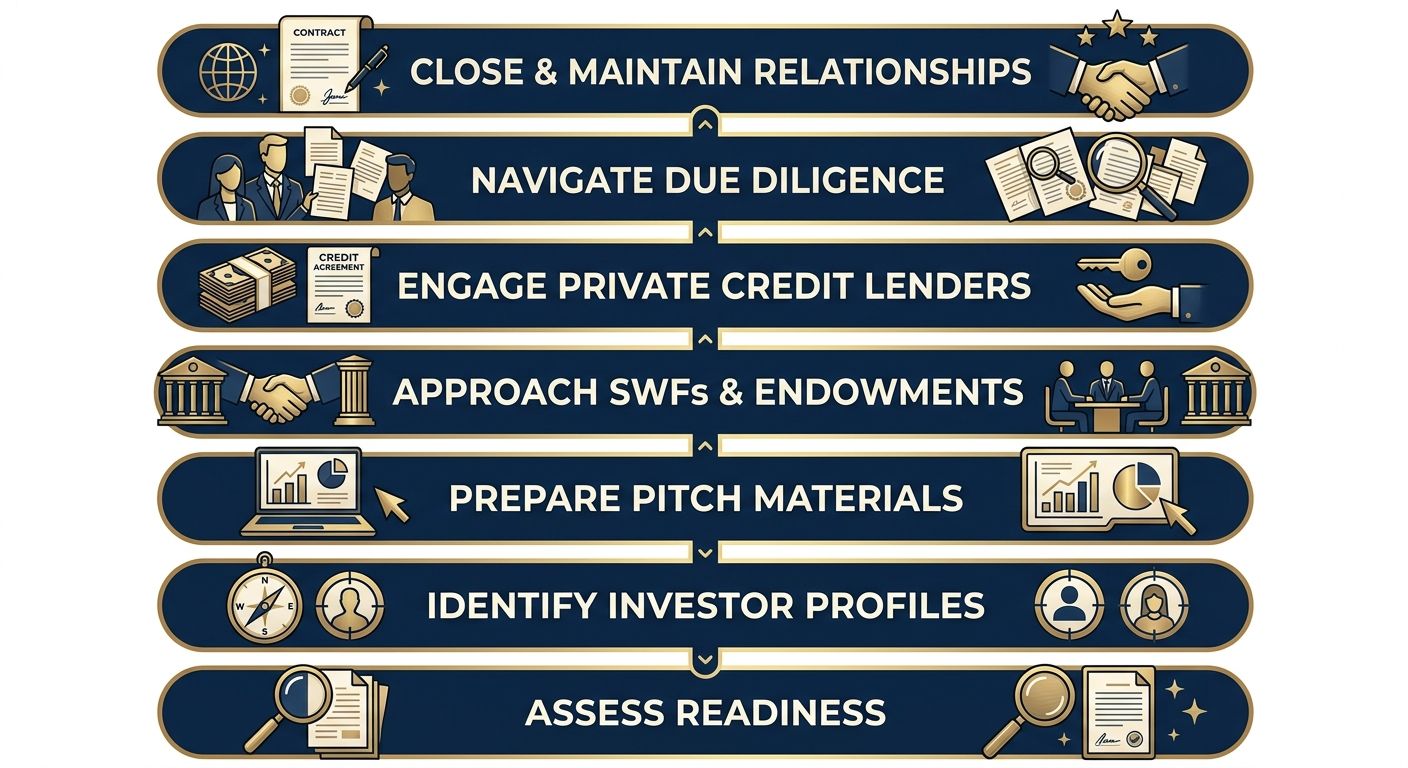
    Seven-step capital pathway infographic showing each advisory stage from readiness assessment to deal closing and relationship management.

    Your Pathway to Institutional Capital in seven clear steps

    This seven-step process brings clarity to every phase of capital raising, from readiness assessment to deal closing. Begin your pathway today. Book a call with our team to discuss your capital raising goals and discover how our investor network can work for you.

    Resources

  • Direct Lending Market Comparison: Top Private Capital Strategies

    Direct Lending Market Comparison: Top Private Capital Strategies

    Table of Contents

    Direct Lending Market: A Competitive Capital Source for Middle-Market Companies

    Middle-market firms facing rigid bank underwriting increasingly turn to the direct lending market for speed and flexibility. Unlike traditional bank loans, direct lending—provided by non-bank institutions—offers faster execution, covenant-light structures, and reduced regulatory hurdles. Our firm’s research confirms that borrowers value this private credit market for its ability to close deals swiftly.

    Current U.S. direct lending spreads remain competitive, attracting middle-market companies away from syndicated loans. Zaidwood Capital’s market intelligence shows direct lending integrates with broader private capital raising strategies, including GP-led secondary transactions that provide liquidity. Companies pursuing emerging markets M&A also benefit from direct lending’s speed and flexibility. In the following section, we outline how our team structures these customized solutions.

    1. Competitive Interest Rate Spreads

    In the U.S. direct lending market, borrowers seek competitive pricing amid tightening spreads. According to Zaidwood Capital’s market analysis, current all-in yields reflect the following typical ranges in basis points (bps):

    • Senior secured direct loans for mid-market transactions: SOFR + 400–600 bps.
    • Unitranche structures for high-quality sponsors: SOFR + 350–500 bps, while smaller or riskier borrowers may see spreads of +600–800 bps.
    • Second-lien or mezzanine tranches: SOFR + 800–1,200 bps.

    Spread compression over the past year has been driven by heightened competition among direct lenders, a trend we also observe in private capital raising strategies and GP-led secondary transactions. Deal size, credit quality, and leverage shape pricing, and our network enables us to secure competitive terms in the U.S. direct lending market. While spreads remain competitive, sponsors pursuing emerging markets M&A often face wider spreads due to higher perceived risk. These benchmarks directly influence the cost of capital across deal structures, a dynamic we navigate for every mandate.

    2. Flexible Financing Structures

    Beyond standard capital raising, we offer flexible financing structures that leverage the direct lending market to deliver faster execution and custom terms compared to traditional bank loans. As our internal FAQ on direct lending explains, this alternative to bank financing bridges gaps where conventional credit often falls short, especially for mid-market transactions.

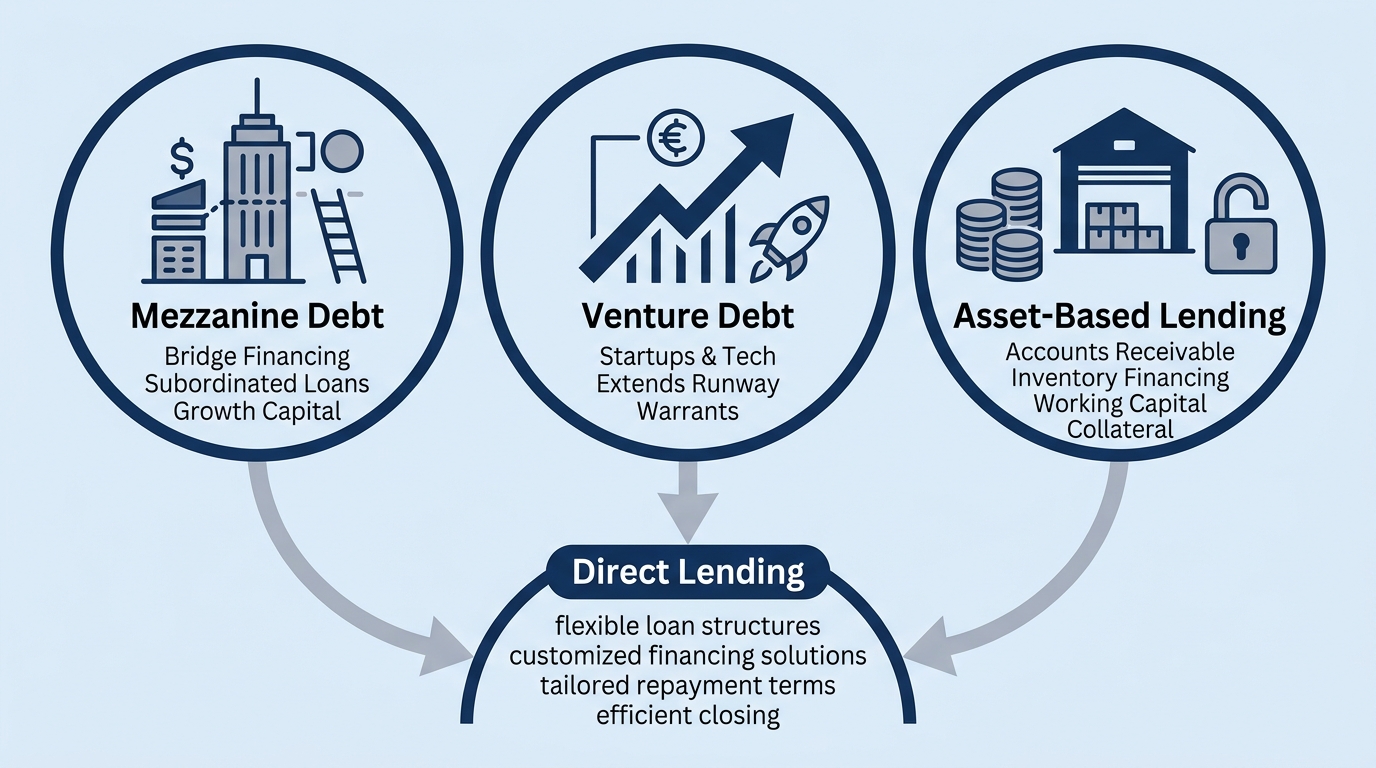
    Our tailored solutions encompass mezzanine debt, venture debt, equipment financing, and asset-based lending. Each instrument is custom-quoted to the client’s specific transaction, ensuring the right capital structure for growth, acquisitions, or liquidity. By operating in the direct lending market, we can craft flexible covenants and amortization schedules that align with your cash-flow profile. These structures support private capital raising strategies that go beyond one-size-fits-all bank terms.

    Infographic showing three flexible financing structures: mezzanine debt, venture debt, and asset-based lending connected to a direct lending hub.

    Flexible financing structures connected to direct lending.

    This flexible financing approach is designed to reinforce your buy-side M&A strategies with speed and precision, complementing our Full-Cycle M&A and capital advisory. To explore a custom-quote structure for your next transaction, Book A Call. This is not an offer or commitment; all financing is subject to due diligence and final documentation.

    3. Speed and Certainty of Execution

    In today’s direct lending market, speed and certainty of execution are decisive advantages for businesses evaluating private capital raising strategies.

    Traditional syndicated bank loans demand months of negotiation among multiple syndicate tiers and require extensive regulatory filings under SEC capital raising regulations; in stark contrast, direct lenders issue committed capital letters upfront and close in weeks, with fewer parties, less documentation, and a near-certain funding outcome.

    Zaidwood Capital’s proprietary market intelligence shows that current U.S. direct lending interest rate spreads remain favorable for borrowers, indicating that institutional lenders are actively seeking to deploy capital and can move swiftly when opportunities arise.

    Our approach to Streamlining Transactions shortens the search and negotiation cycle, and with a global network of over 4,000 investors, we accelerate execution for transactions ranging from corporate debt to GP-led secondary transactions, reducing opportunity cost and securing better terms.

    This speed and certainty, combined with Zaidwood Capital’s full-cycle advisory platform, streamlines access to substantial institutional capital for businesses pursuing growth.

    4. Middle-Market Capital Access

    Middle-market companies with revenues between $10 million and $1 billion frequently encounter a capital gap that traditional bank loans cannot fill, making access to capital in the direct lending market a vital alternative. As our FAQ notes, direct lending transactions close weeks faster than bank loans, with fewer covenants and flexible terms that adapt to a company’s cash flows rather than rigid formulas. Post-2008 regulatory changes constrained traditional bank lending, cementing the direct lending market as the core funding channel for mid-size firms. We help middle-market firms structure direct lending opportunities through our network of over 4,000 institutional investors and $15 billion in deployable capital, accelerating execution and reducing time-to-close. Beyond direct lending, our team deploys wider private capital raising strategies, including GP-led secondary transactions, to meet each company’s unique capital needs. Because direct lending operates under FINRA regulation direct lending, all participants must ensure strict compliance. Securities are offered through Finalis Securities LLC; Zaidwood Capital is not a registered broker-dealer and is separate from Finalis.

    5. Private Equity Buyout Support

    The direct lending market has become a cornerstone of private equity buyouts as firms seek speed and flexibility beyond traditional bank leverage loans. We at Zaidwood Capital see direct lender financing offering bespoke terms that align with the specific cash flow profiles of portfolio companies. This private credit approach sidesteps the rigid syndication processes of conventional banks, enabling faster closings and more creative capital structures. GP-led secondary transactions further illustrate how direct lending injects liquidity, allowing general partners to hold assets longer while offering LPs partial exits. Our private capital raising strategies incorporate direct lending solutions to support full-cycle buyout execution from acquisition through value creation. Direct lending also complements traditional bank financing by filling gaps where syndicated markets retreat, a dynamic we harness in our advisory work. As deal complexity grows, we view direct lending not as a niche instrument but as an enabling component driving the next phase of transaction structuring and capital deployment.

    6. Regulatory Landscape and Liquidity

    The direct lending market has experienced profound changes as regulatory oversight intensifies. Heightened scrutiny from the SEC and evolving risk-retention rules have dampened risk appetite among lenders, tightening liquidity dynamics across the sector. This shift is reshaping how capital flows into private credit.

    As bank-led lending retrenches, institutional capital increasingly pivots toward the direct lending sector. Stringent regulatory frameworks—including enhanced disclosure requirements and capital adequacy standards—drive allocators to reassess exposure. Our own analysis confirms that the regulatory environment compels investors to seek more resilient structures and transparency.

    These pressures have accelerated the adoption of private capital raising strategies and GP-led secondary transactions. By facilitating liquidity through secondary market solutions, managers can mitigate the constraints imposed by today’s regulatory landscape.

    Navigating this complexity demands deep market intelligence. Our firm leverages a network of over 4,000 institutional investors and $24.4B+ in aggregate transaction volume to help clients secure capital formation and liquidity in regulated markets. We help lenders and sponsors adapt their strategies, ensuring they remain positioned for success.

    7. Private Capital Raising Strategies

    For middle-market firms, private capital raising strategies offer an alternative to public markets, with the direct lending market serving as a vital source of flexible financing. These approaches enable capital formation for acquisitions, recapitalizations, and liquidity events while avoiding the regulatory complexities of an IPO.

    We help clients evaluate several private capital raising strategies:

    • Equity financing
    • Debt financing
    • Mezzanine debt
    • Direct lending
    • GP-led secondary transactions

    Direct lending, from non-bank institutional lenders, provides tailored capital complementing traditional bank loans. GP-led secondary transactions provide liquidity for limited partners while general partners can continue managing assets. At Zaidwood Capital, we design and execute these capital raises using our network of over 4,000 institutional investors and $15B+ in deployable capital, tailoring solutions to each firm’s profile. We integrate rigorous due diligence as part of our full-cycle M&A and capital advisory approach to ensure a seamless path from strategy to close.

    This site is for informational purposes only. Securities are offered through Finalis Securities LLC; Zaidwood Capital is not a broker-dealer.

    8. GP-Led Secondary Transactions

    In a GP-led secondary transaction, the general partner sells a portfolio company into a newly formed continuation fund backed by both existing and new limited partners. This approach, part of broader private capital raising strategies, provides early liquidity to LPs while allowing the GP to retain the asset and pursue additional value creation over a longer horizon. For careful LPs, these transactions offer a path to realize returns before a traditional exit; for GPs, they preserve management continuity and extend the runway for further growth.

    At Zaidwood Capital, we advise GPs on structuring these deals, securing institutional capital through our network of over 4,000 investors, and managing execution from start to finish. Our equity advisory and liquidity solutions practice ensures that each transaction is tailored to the fund’s objectives, streamlining transactions within our full-cycle M&A and capital advisory framework. Beyond GP-led secondaries, we support a spectrum of liquidity and capital formation strategies, including our broader equity advisory and debt advisory capabilities, positioned to serve mid-market funds across changing market cycles.

    Evaluating Direct Lending for Your Capital Strategy

    When evaluating the direct lending market, we recognize it as a private credit solution where institutional lenders provide capital directly to companies, bypassing traditional bank intermediaries.

    Direct lenders typically deliver faster execution, fewer covenants, and more flexible terms than banks—a key advantage when evaluating the direct lending market for companies with strong fundamentals seeking growth capital or acquisition financing without dilutive equity. Through direct lending, we streamline transactions, providing faster access to institutional capital. To determine fit, we assess the lender’s track record, deal flow, and alignment with your capital structure goals.

    As part of a broader set of private capital raising strategies, direct lending can complement other financing tools. GP-led secondary transactions frequently employ direct lending structures to facilitate liquidity or recapitalization.

    Resources

  • Asset-Based Lending for Corporate Expansion: Fast Capital

    Asset-Based Lending for Corporate Expansion: Fast Capital

    Table of Contents

    Funding Corporate Growth with Asset-Based Lending

    While many companies look to traditional bank loans, asset-based lending (ABL) provides a more flexible funding path. Using your accounts receivable, inventory, and equipment as collateral, asset-based lending for corporate expansion gives you faster access to capital—often without diluting equity. Institutional investors focus on asset quality rather than just credit scores, making ABL accessible to asset-rich companies poised for growth. Whether funding an acquisition, bridging working capital gaps, or expanding operations, collateral-based business funding offers a reliable capital solution.

    • Support ABL for growth initiatives without selling equity
    • Fund acquisitions with collateral-based business funding
    • Bridge working capital gaps using receivables and inventory

    Zaidwood Capital’s team of advisors streamlines the process, connecting you to institutional investors through our global lending services. To discuss asset-based financing for expansion that matches your growth plan, Book A Call today.

    Preparing Your Business for Asset-Based Financing

    After clarifying what asset-based financing entails, the next step is preparing your business for asset-based lending for corporate expansion. This involves assembling a detailed inventory of your accounts receivable, equipment, and inventory. Updated financial statements and cash flow projections are critical, as lenders assess collateral coverage and quality to determine borrowing capacity.

    For businesses exploring alternative lending marketplaces, Zaidwood Capital’s research highlights global lending services as one example of asset-based solutions. Our debt advisory team helps you navigate these options and prepare a competitive application. Partnering with an advisor can reduce common pitfalls such as incomplete asset schedules or outdated financials that delay approval.

    Begin your preparation with these essential steps:

    • Assemble a detailed asset inventory listing all accounts receivable, equipment, and inventory with current valuations.
    • Update financial statements and project cash flows for at least 12–24 months.
    • Calculate your collateral coverage ratio and address any shortfalls by adjusting asset schedules or obtaining additional guarantees.
    • Consult our debt advisory team to align your documentation with lender standards and strengthen your application.

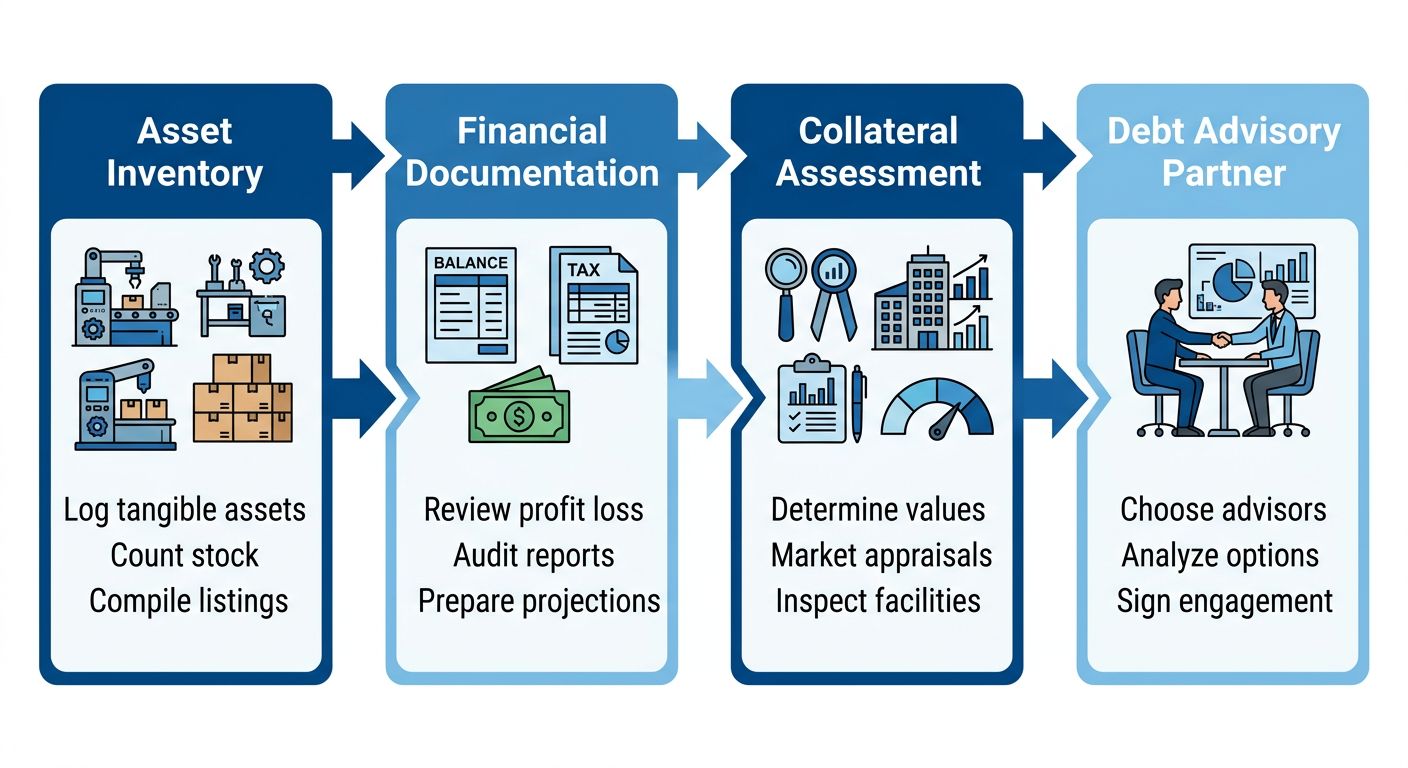
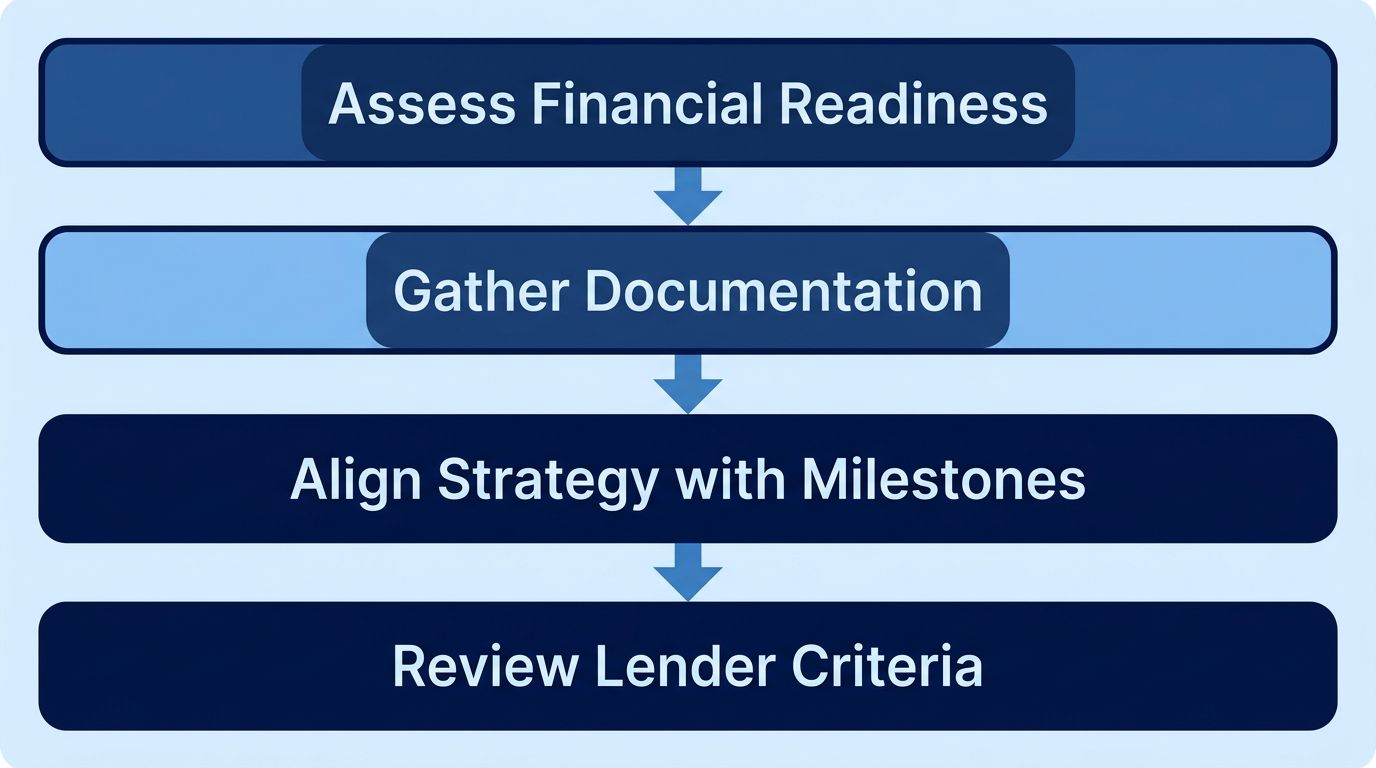
    The four key stages—asset inventory, financial documentation, collateral assessment, and partnering with a debt advisor—are illustrated below. A thorough preparation typically takes four to six weeks, but our streamlined process can accelerate timelines.

    Diagram of four stages for preparing asset-based financing: Asset Inventory, Financial Documentation, Collateral Assessment, and Debt Advisory Partner

    Four-stage process for asset-based financing preparation

    Securing asset-based lending for corporate expansion ultimately depends on presenting a clear, lender-ready financial picture. Once your documentation is complete and your collateral position is clear, evaluating the right lender or loan structure becomes the next critical step. Our team can help you explore options and expedite your timeline—book a call to discuss your situation.

    Assessing Your Collateral Base for Maximum Borrowing Capacity

    With capital options spanning equity to structured debt, the next step is to assess your collateral base—the set of assets you can pledge to secure financing. In asset-based lending for corporate expansion, a well-documented collateral position directly strengthens your borrowing capacity.

    Common qualifying assets include accounts receivable, inventory, equipment, commercial real estate, and intellectual property. Lenders then apply valuation haircuts based on asset liquidity and risk to determine your borrowing base, the maximum amount available. A stronger collateral base not only boosts borrowing capacity but can also improve loan terms.

    Regular audits and accurate documentation are essential, as lenders value assets only to the extent they can be verified. This discipline is especially critical when financing emerging markets M&A, where robust collateral valuation mitigates cross‑border risk. A thorough collateral assessment is the first step toward a compelling loan application. Our advisory team leverages a network of over 4,000 institutional investors and access to $15B+ in capital to help you structure corporate expansion financing that fits your objectives. Book A Call to begin.

    Evaluating Your Financial Profile and Creditworthiness

    Securing asset-based lending for corporate expansion begins with a thorough evaluation of your company’s financial profile. We assess creditworthiness through detailed analysis of cash flow stability, collateral quality, and debt service capacity, examining both historical performance and forward-looking projections. This foundational step is critical to building a credible case for lenders and aligning your capital raising strategy with market expectations.

    Our full-cycle due diligence integrates financial, operational, and legal review to build a comprehensive credit profile that meets rigorous capital market standards. Unlike traditional lending, this approach prioritizes the intrinsic value of your company’s assets and recurring revenue, providing a more flexible path to growth capital.

    We look beyond conventional credit scores to evaluate asset liquidity, industry trends, and management experience, strengthening your credit narrative for expansion financing. This evaluation directly shapes the structure of debt solutions tailored to your objectives. By understanding your unique financial position, we help you access the capital needed to scale with confidence and transparency.

    Structuring the Asset-Based Debt for Your Expansion Goals

    Asset-based debt — asset-based lending for corporate expansion — unlocks liquidity by tying credit capacity to your company’s accounts receivable, inventory, and equipment. Drawing on our acquisition financing framework, we help you structure the borrowing base, where advance rates per asset class determine how much capital you can draw. Typically, receivables command higher advance rates than inventory, and equipment may be financed under a separate term component.

    Depending on whether you need flexible working capital for day-to-day operations or a dedicated term loan to fund capital expenditures, we tailor the structure to align with your specific expansion timeline and cash flow profile.

    Our Full-Cycle M&A and capital advisory expertise encompasses regulatory compliance, so your facility aligns with SEC market oversight and manages risk effectively. By partnering with us, you gain access to customized capital solutions that streamline the entire transaction. Book A Call to discuss how we will design your expansion financing.

    Gathering Documentation for the Application Process

    Once you understand the advantages of asset-based lending for corporate expansion, the next step is gathering the required documentation. We typically ask clients to prepare the following: balance sheet, income statement, cash flow statement, accounts receivable aging reports, inventory reports, accounts payable details, and a current business plan. Accurate, up-to-date financial data accelerates our due diligence and helps secure favorable terms from institutional lenders. Our advisory team, leveraging the proprietary Velocity Matrix, assists in organizing and presenting these materials as part of our Full-Cycle M&A and capital advisory services. Securing an asset-based loan for corporate growth financing demands thorough preparation. Our proactive document review, a core tenet of our Streamlining Transactions philosophy, simplifies the paperwork and keeps your transaction on track for secured lending for business expansion. Ensuring all documentation meets applicable disclosure standards is essential; as a capital advisory firm, we are not a registered broker-dealer and securities offerings are placed through Finalis Securities LLC, which adheres to FINRA securities regulation. For a comprehensive checklist tailored to asset-based lending deals, visit our internal Documentation Requirements page. With your documentation ready, Zaidwood Capital’s team will initiate a streamlined due diligence and review, covered in the next section.
    Engaging a Debt Advisory Partner to Secure Optimal Rates

    Asset-based lending for corporate expansion offers a direct path to scale, but securing optimal rates requires deep market access. Zaidwood Capital’s debt advisory team leverages relationships with over 4,000 institutional investors to negotiate competitive terms, and our proprietary Velocity Matrix analytics ensure each debt structure is tailored to your growth objectives.

    Our full-cycle support includes comprehensive due diligence, documentation, and seamless integration with our broader capital formation capabilities—from mezzanine and venture debt to equipment financing. In every transaction involving asset-based lending for corporate expansion, our $24.4 billion aggregate volume and 4,000+ investor network give clients a decisive edge.

    To discuss how our debt advisory can structure your next expansion, Book A Call for a confidential consultation. This communication does not constitute investment advice; please consult your own legal and financial advisors. Securities are offered through Finalis Securities LLC. Zaidwood Capital is not a registered broker-dealer.

    When you evaluate asset-based lending for corporate expansion, we initiate the institutional due diligence process — a structured assessment of financial, operational, legal and strategic factors. This systematic review draws on industry benchmarks such as the ICMA Capital Market Standards to ensure every assumption is tested.

    Our due diligence unfolds through three distinct stages: initial review, detailed analysis, and final validation. At each step, we scrutinize collateral quality, cash‑flow projections and covenant frameworks critical to asset‑based financing transactions. Following ICMA-aligned practices, we assess operational resilience and strategic fit, providing you with a comprehensive decision-making framework.

    Once you have completed a robust due diligence cycle, you can move into the final structuring and closing phase with confidence. Our integrated approach ensures that no material detail is overlooked, positioning your company for a successful execution. With Zaidwood Capital’s full‑cycle advisory, you gain the clarity needed to negotiate favorable terms and accelerate growth.

    Closing the Facility and Deploying Capital

    Once a business has evaluated its financing alternatives, closing an asset-based lending facility marks the final step before accessing expansion funding. This phase requires finalizing loan documentation and satisfying all conditions precedent, which our team coordinates to keep the transaction moving efficiently and effectively. The U.S. Securities and Exchange Commission provides regulatory oversight for capital deployment, and private offerings must align with its disclosure framework. Through our Full‑Cycle M&A and capital advisory framework, we structure the release of corporate expansion capital based on milestones, acquisition tranches, or working‑capital draws that match the company’s growth plan.

    Nothing in this section guarantees specific outcomes or constitutes a solicitation or commitment to transact. Parties should consult their own legal, tax, and financial advisors before proceeding. This content is for informational purposes only and does not represent investment advice. Zaidwood Capital is not a registered broker‑dealer.

    Overcoming Common Obstacles in Asset-Based Lending

    Overcoming common obstacles in asset-based lending for corporate expansion requires a strategic approach. While asset-backed funding for growth initiatives offers clear advantages, businesses often encounter hurdles that can slow momentum or create deal friction. We help our clients navigate these challenges efficiently.

    For instance, valuation disagreements between borrowers and lenders can stall negotiations. We resolve this by coordinating independent third-party appraisals and ensuring audited asset schedules are prepared well in advance, aligning expectations before formal discussions begin. Another challenge involves strict collateral eligibility criteria and conservative advance rates. To address this, we negotiate floating advance rates tied directly to asset quality, ensuring that the borrowing base reflects the true value of receivables, inventory, and equipment.

    Time-intensive documentation and approval cycles represent a third obstacle. Through our Full-Cycle M&A and capital advisory model, we leverage a pre-vetted network of institutional investors to dramatically compress timelines. Our streamlined due diligence process, covering financial, legal, and operational dimensions, reduces institutional friction and accelerates underwriting. By connecting the right assets to the right capital sources, we remove bottlenecks that often derail corporate expansion plans.

    Yet these challenges are manageable with the right partner. We invite you to Book A Call for a personalized assessment and to learn how we can structure a funding solution that supports your growth trajectory. We prioritize pragmatic structuring and rapid execution to maintain momentum, preserve cash flow, and protect operations.

    Accelerating Your Corporate Expansion Journey

    Beyond traditional financing, asset-based lending for corporate expansion offers a direct path to fund growth by leveraging your company’s receivables, inventory, and equipment as collateral. Institutional investors typically look for stable cash flows, strong asset quality, and a clearly defined use of funds—criteria designed to ensure alignment between your expansion objectives and investor mandates, as detailed in our advisory resources.

    At Zaidwood Capital, we connect businesses with our network of over 4,000 institutional investors and provide full-cycle advisory to streamline the funding process from qualification through closing. Asset-based lending to fund growth often delivers faster, more flexible capital compared to conventional bank loans, enabling you to seize market opportunities without the extended timelines traditional routes demand. To explore how your company qualifies for corporate expansion through asset-backed financing, book a consultation with our team or continue to the next section for a deeper look at the qualification framework.

    Resources

  • Family Office Liquidity Management Strategies: Essential Guide

    Family Office Liquidity Management Strategies: Essential Guide

    Table of Contents

    The Foundations of Family Office Liquidity Management

    Effective family office liquidity management strategies ensure that sufficient cash and near-cash assets are available to meet obligations—capital calls, operating expenses, and strategic investments—without disrupting long-term portfolio allocations. This foundational discipline balances near-term liquidity needs with the family’s overarching wealth preservation goals.

    Capital call liquidity management is a critical concern, given that private equity and venture funds require sudden capital injections. At the same time, uneven cash flows from operating businesses underscore the need for disciplined family office treasury management to maintain adequate buffers without sacrificing returns.

    Institutional-grade advisory services, such as debt advisory and equity liquidity solutions, help family offices optimize their liquidity position. We draw on $24.4B+ in aggregate transaction volume and a network of over 4,000 global investors, aligned with ICMA guidelines, to provide solutions like global lending services. In the sections that follow, we’ll explore how these strategies are structured to meet the unique demands of family offices.

    1. Tiered Liquidity Buckets for Stability

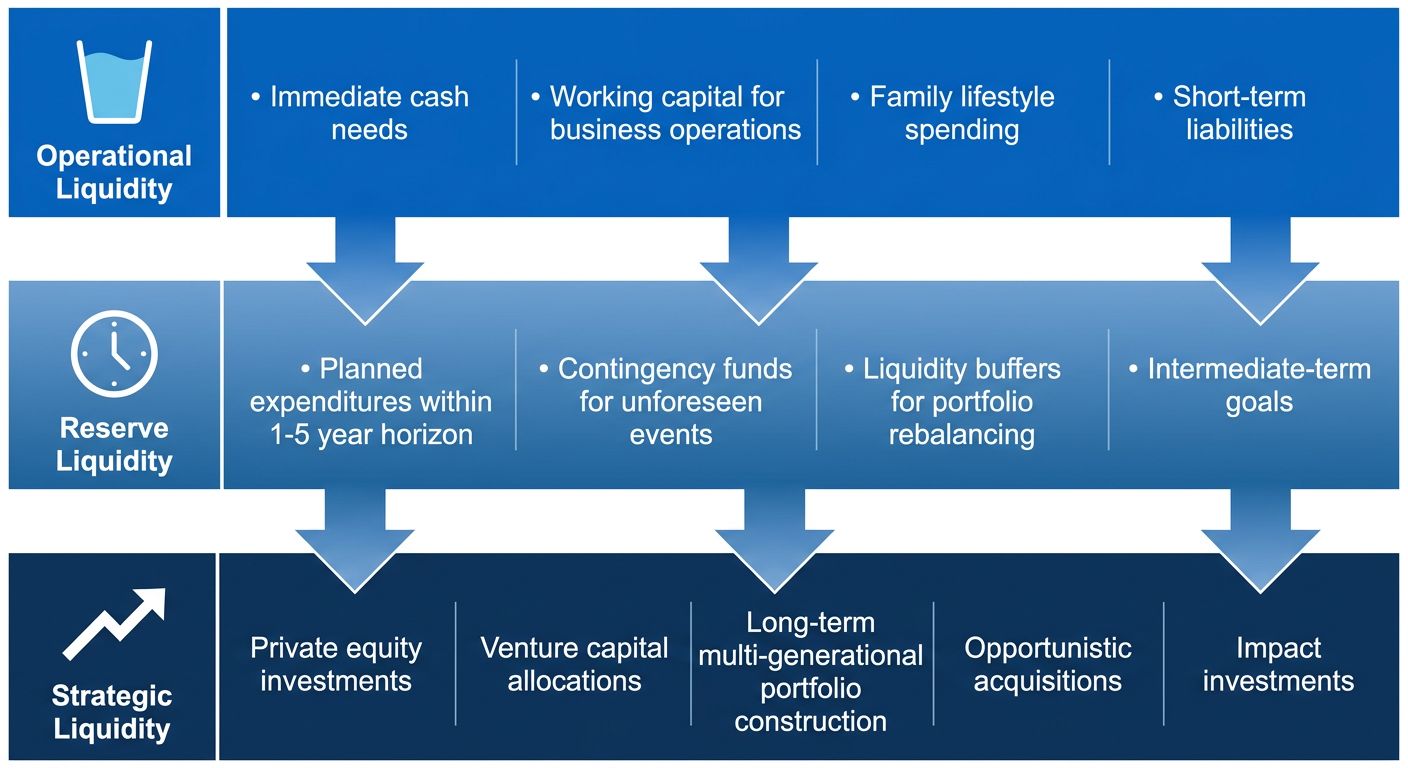
    In family office liquidity management strategies, we define tiered liquidity buckets as a framework that segments assets by accessibility, ensuring that near-term obligations can be met without liquidating long-term holdings.

    • Operational: immediate access cash for expenses and capital calls.
    • Reserve: 30- to 90-day instruments, such as commercial paper.
    • Strategic: longer-term investments for planned growth.

    This structure anchors capital call liquidity management by pre-positioning funds before drawdowns occur. Family office treasury management relies on cash flow forecasting to calibrate each bucket, mitigating forced liquidation risk. As Zaidwood Capital’s educational materials note, commercial and industrial loans are a prime example of a short-term vehicle that fits naturally within the reserve tier, offering working-capital support while protecting longer-horizon assets.

    Three-tiered liquidity structure infographic showing operational, reserve, and strategic liquidity buckets with blue gradient arrows

    Tiered liquidity buckets for family office stability

    Ultimately, robust family office liquidity management strategies align each bucket with anticipated calls and contingencies — a principle Zaidwood Capital’s liquidity management best practices reinforce. In the next section, we detail the asset classes assigned to each tier.

    2. Private Equity Liquidity Solutions

    Building on our advisory platform, private equity liquidity solutions help investors access capital without selling assets. They are essential in family office liquidity management strategies, where preserving long-term investments during short-term cash needs is critical.

    A key driver of private equity liquidity strategies for family offices is capital call liquidity management. When a general partner calls capital, limited partners must fund commitments promptly. Liquidity demands also arise in other scenarios:

    • Addressing uneven cash flows
    • Funding opportunistic co-investments
    • Covering tax or estate obligations
    • Rebalancing portfolios without disruption

    Through our Equity Advisory practice, we leverage the Velocity Matrix and our network of over 4,000 institutional investors with $15 billion in available capital to source liquidity solutions tailored to specific needs. Our full-cycle M&A and capital formation expertise allows us to design facilities that meet family office treasury management objectives, providing cash when required without disrupting strategic portfolios. Every engagement is custom-quoted, and no outcome is guaranteed.

    This integrated approach to liquidity sets the stage for our debt advisory services, which provide the leverage for growth. This discussion is for informational purposes only and is not investment advice. Securities are offered through Finalis Securities LLC.

    3. Managing Illiquidity Premiums Effectively

    Effective family office liquidity management strategies begin with a clear understanding of what an illiquidity premium represents — the additional return investors demand for holding assets that cannot be quickly converted to cash without meaningful price concessions. At Zaidwood Capital, we emphasize that capturing this premium requires deliberate planning rather than passive acceptance. Successful liquidity management for family offices involves constructing portfolios with calibrated exposure across liquidity tiers, ensuring that long-duration commitments are matched with patient capital and clearly defined holding periods.

    We recommend rigorous assessment of illiquidity premiums through historical data analysis and liquidity discount models, which help quantify the expected compensation for reduced marketability. A disciplined approach to family office treasury management incorporates capital call liquidity reserves — cash or near-cash allocations specifically designated to meet drawdown requests from private investment commitments. This capital call liquidity management framework protects portfolios from forced selling and preserves the integrity of the long-term investment strategy.

    Industry best practices established by the International Capital Market Association provide valuable guidance on bond market liquidity and transparency standards. We incorporate these principles when advising on portfolio construction, recognizing that liquidity conditions evolve across market cycles. Educating stakeholders about the relationship between illiquidity and expected returns, and maintaining adequate liquidity buffers for capital calls, positions family offices to earn meaningful premiums while sustaining operational flexibility across full-cycle market environments.

    4. Capital Call Liquidity Management

    Effective capital call liquidity management is a cornerstone of capital call liquidity management for family offices and institutional investors. A capital call is a formal request from a fund manager requiring investors to fulfill their committed capital obligations. Our role is to help clients meet these requests on time without disrupting cash flow or long-term investment returns.

    We approach capital call liquidity strategies with three primary tools: maintaining a dedicated cash buffer, arranging a capital call line of credit, and structuring committed capital facilities. At Zaidwood Capital, our capital call financing solutions are specifically designed for family offices and private investors, as detailed in our Capital Call Financing FAQ. Unlike standard commercial and industrial loans—which are typically used for operating expenses or expansion and rely on asset-based or cash-flow lending—capital call financing is purpose-built for short-term bridging until called capital is distributed.

    This disciplined approach to family office treasury management helps investors avoid forced asset sales, default penalties, and missed opportunities. In the next section, we examine practical steps to implement these liquidity safeguards.

    5. Dividend Recapitalization for Diversification

    Family office liquidity management strategies often incorporate dividend recapitalization, a transaction where a company borrows to pay a dividend to its owners. This provides partial liquidity, letting family offices meet capital call liquidity management requirements or implement family office treasury management initiatives without selling underlying holdings. Freeing up capital in this way enables reinvestment across new asset classes, enhancing portfolio diversification and resilience.

    We also weigh the illiquidity premium inherent in private market investments. Zaidwood Capital’s FAQ highlights that limited partners demand a premium for reduced liquidity, shaping how we approach recapitalizations. Funding can come from sources like commercial and industrial loans, distinguishing this method from a full exit or secondary sale. By preserving ownership while accessing capital, family offices maintain ongoing alignment with management and redeploy proceeds strategically. This technique is one of several recapitalization tools we use to balance liquidity with long-term portfolio objectives.

    6. Treasury Management Best Practices

    To move from theory to practice, family offices should adopt proven family office liquidity management strategies, as outlined in our treasury management resources.

    • Prioritize cash flow forecasting with a rolling six-month horizon and monthly updates to anticipate liquidity needs, proactively manage upcoming capital calls, and avoid unexpected funding gaps.
    • Diversify counterparty risk by maintaining banking relationships with at least three independent institutions, reducing concentration risk and ensuring access to liquidity during market disruptions.
    • Develop a formal family office treasury management policy that includes liquidity stress testing under multiple market scenarios, such as interest rate spikes or capital call surges.
    • Use capital call liquidity management as a strategic tool to cover short-term funding gaps without forced asset sales, preserving long-term portfolio value.
    • Leverage treasury management software or real-time dashboards for consolidated visibility into cash positions, portfolio liquidity, and committed capital calls.

    These practices build a resilient liquidity framework; the next section explores advanced treasury technology solutions.

    7. Optimizing Private Equity Allocations

    Optimizing private equity allocations requires robust family office liquidity management strategies that balance the pursuit of the illiquidity premium with the need for accessible capital. At Zaidwood Capital, we see the illiquidity premium adding 2–3% to long-term returns, but it demands careful liquidity planning. Private equity commitments inherently involve multi-year lock-ups and unpredictable capital calls, so families must develop a clear liquidity strategy for family offices. Effective capital call liquidity management involves forecasting cash outflows and maintaining dedicated reserves to meet drawdowns without disrupting operating budgets or forcing premature asset sales.

    In our experience at Zaidwood Capital, family office treasury management plays a central role in ensuring that PE commitments align with overall portfolio liquidity. Diversifying commitments across vintage years and fund strategies mitigates concentration risk and smooths cash flow demands. We advise family offices to set allocation targets based on their investment horizon and liquidity constraints, not solely on return expectations. With these optimization principles, family offices can move to execute their private equity strategy confidently.

    8. Leveraging Capital Advisory Expertise

    Given these complexities, leveraging our Full-Cycle M&A and capital advisory expertise becomes essential. When designing in family office liquidity management strategies, we assess asset composition and cash flow profiles to select appropriate financing instruments.

    Through our full-cycle advisory process, we help family offices and companies prepare for the rigorous institutional qualification procedures associated with asset-based lending and cash flow financing. As outlined in our internal FAQ, this includes compiling audited financials, three-to-five-year cash flow projections, and detailed business plans that demonstrate creditworthiness. For capital call liquidity management, such financing can provide committed credit lines that support fund contributions without forcing asset sales.

    Our treasury management advisory, grounded in the best practices shared in our Treasury Management FAQ, strengthens family office treasury management by introducing disciplined cash flow forecasting, efficient working capital management, and strategic deployment of liquidity reserves. We work to ensure that surplus cash is invested in line with the family office’s risk tolerance and near-term cash needs.

    Zaidwood Capital’s institutional network—connecting to over 4,000 investors with more than $15 billion in deployable capital—can be structured to support both capital call liquidity management and ongoing treasury requirements.

    With this advisory support, family offices can build resilient liquidity strategies aligned with long-term objectives.

    Building a Resilient Liquidity Framework for Your Family Office

    To address capital efficiency challenges in family office liquidity management strategies, we recommend structuring a resilience framework across distinct tiers. Begin by segregating operational, reserve, and growth liquidity to align cash flows with investment horizons. A disciplined treasury function underpins effective capital call liquidity management, ensuring obligations are met without forced asset disposals.

    • Maintain a contingency reserve equal to 10–15% of committed capital to cover unexpected drawdowns.
    • Embed SEC regulatory updates into risk assessments, staying current with evolving compliance expectations.
    • Use capital call financing as a bridge, preserving invested assets during liquidity events.
    • Benchmark your approach against international wealth management firms to refine family office treasury management protocols.

    A robust framework transforms liquidity from a constraint into a strategic advantage for multi-generational wealth stewardship.

    Resources

  • Get Venture Debt for Scaleups 2026: Fast Non-Dilutive Capital

    Get Venture Debt for Scaleups 2026: Fast Non-Dilutive Capital

    Table of Contents

    Venture Debt Opportunities for Scaleups in 2026

    Beyond general capital formation, a particularly compelling path for venture debt for scaleups in 2026 is the strategic use of non-dilutive growth capital. This form of debt capital allows companies to extend their cash runway and fund critical growth milestones without further eroding founder and investor ownership. By prioritizing growth metrics over traditional cash-flow underwriting, venture debt stands apart from conventional bank loans.

    Current market conditions make this window especially relevant. Reduced venture equity availability, coupled with favorable debt terms for well-performing companies, means debt financing serves as a powerful tool between equity rounds. In our debt advisory practice, we connect growth-stage companies with appropriate capital partners, leveraging our access to over 4,000 global investors and $15B+ in deployable capital. Understanding the opportunity is the first step; the next section outlines how we structure and execute these engagements.

    Securities are offered through Finalis Securities LLC; Zaidwood Capital is not a registered broker-dealer. Book A Call for a custom venture debt consultation.

    Preparing for Your Venture Debt Strategy

    Now that you understand the advantages of venture debt, proper preparation is critical to securing favorable terms. For companies exploring in venture debt for scaleups 2026, readiness separates those who negotiate from a position of strength from those who accept whatever terms are offered. Thorough preparation signals to lenders that your business is a calculated risk, not a speculative one.

    We recommend our clients prepare the following key financial documents before approaching any lender:

    • Audited financials covering the last two fiscal years to demonstrate historical performance and accounting rigor
    • Twelve-month cash flow projections showing precisely how the debt will accelerate growth and when repayment capacity materializes
    • A clean, fully diluted cap table reflecting all equity rounds, option pools, and convertible instruments
    • A detailed use-of-funds memo tying every dollar to a specific growth milestone, whether a product launch or market expansion

    Lenders evaluate your application through specific metrics: annual recurring revenue (ARR), gross margin stability, monthly cash burn rate, and debt-service-coverage ratio (DSCR). According to Silicon Valley Bank services benchmarks, strong performance across these indicators often correlates with more flexible term structures. International Capital Market Association (ICMA) guidelines further emphasize the importance of transparent documentation in private debt placements.

    Venture debt functions as non-dilutive growth capital, allowing you to extend runway without surrendering equity. Unlike revenue-based financing, which ties repayments to top-line fluctuations, venture debt typically includes interest-only periods and may carry warrant coverage as standard structuring tools—not guarantees, but negotiable components.

    Vertical process flow diagram showing four steps for preparing a venture debt strategy: assess financial readiness, gather documentation, align strategy with milestones, and review lender criteria.

    Four-step venture debt preparation process flow

    Align your debt strategy with board-approved growth milestones and involve your CFO early. At Zaidwood Capital, our Debt Advisory team helps clients benchmark lender terms against current market standards, ensuring you approach conversations with the confidence that preparation provides. Once your strategy is fully prepared, the next step is approaching lenders with a compelling, data-backed narrative.

    Assess Your Capital Structure Needs

    Now that you understand the basics of capital structure, it’s time to assess your specific needs. How do you determine the right mix of debt and equity for your company? For scale-ups evaluating venture debt for scaleups in 2026, a structured self-assessment is the critical first step toward identifying the most suitable financing path.

    We guide founders through evaluating several key factors to build a coherent capital strategy:

    • Current debt-to-equity ratio: Understanding your existing leverage and its impact on future borrowing capacity
    • Projected cash flow: Assessing whether revenue streams can comfortably service debt obligations
    • Growth stage: Distinguishing between early-stage, scale-up, and mature company dynamics, each with distinct risk profiles and capital access
    • Purpose of capital: Clarifying whether funds are needed for working capital, an acquisition, or expansion initiatives

    Exploring non-dilutive growth capital options such as revenue-based financing can preserve ownership while funding growth. Engaging experienced venture capital consultants helps interpret these factors and design a structure aligned with your objectives.

    With your needs assessed, the next section explores the specific capital solutions that match your profile.

    Identify Leading Venture Debt Lenders

    To identify the right partner, scaleups should evaluate leading venture debt lenders based on their track record, industry expertise, and loan terms. For companies seeking venture debt for scaleups 2026, understanding the lender landscape is essential. Non-dilutive growth capital preserves equity while funding expansion, and revenue-based financing offers flexible repayment structures aligned with business performance.

    According to Zaidwood Capital, notable lenders include:

    • Silicon Valley Bank – Provides venture debt and banking services to technology and life sciences companies at all stages.
    • Hercules Capital – Specializes in growth-stage technology and life sciences companies with flexible financing solutions.
    • TriplePoint Capital – Offers debt financing and leasing to venture capital-backed companies across diverse sectors.
    • Western Technology Investment – Focuses on early to mid-stage technology and life sciences companies.
    • Oxford Finance – Provides senior secured loans to healthcare and life sciences firms.

    When evaluating lenders, scaleups should assess loan size range, interest rate benchmarks, warrant coverage, and repayment flexibility. At Zaidwood Capital, our network includes access to many of these lenders, and we can help match companies to the right partner. Once you have identified potential lenders, the next step is to prepare your approach.

    Prepare Your Financial Documentation

    Once you understand the types of capital available, preparing your financial documentation is essential when seeking venture debt for scaleups 2026. The following documents are critical:

    • Audited Financial Statements (last 3 fiscal years) demonstrate revenue stability and profitability trends.
    • Detailed Cash Flow Projections (12–24 months), especially for non-dilutive growth capital and revenue-based financing.
    • Corporate Tax Returns (last 2 years) validate financial health.
    • Current Debt Schedule (if applicable) lists existing loans or convertible notes.
    • Pro Forma Financials model the new venture debt’s impact on cash flow and leverage ratios.
    • Virtual Data Room with clear folder labels organizes all files for submission.

    For documentation standards, the International Capital Market Association provides a useful framework. Having these documents ready will streamline your capital raise. This information does not constitute investment advice. With your documents organized, you are ready to proceed with the application process.

    Structure the Deal Terms and Warrant Coverage

    Moving from an overview of venture debt, we now focus on the specific components that define a term sheet. When structuring venture debt for scaleups 2026, our team at Zaidwood Capital tailors each deal to the company’s stage and growth trajectory. A typical term sheet includes a maturity period of 3 to 5 years, an interest rate composed of a cash component plus payment-in-kind (PIK), and an upfront fee that covers due diligence and administrative costs.

    Warrant coverage — often ranging from 5% to 20% of the loan principal — provides the lender with equity participation without immediate founder dilution. We negotiate the strike price (typically set at the current preferred round price), the warrant term (commonly 5-7 years), and exercise rights to align incentives. This structure offers lenders upside while preserving non-dilutive growth capital for the company.

    Terms are calibrated to a company’s credit profile, revenue projections, and market stage; for instance, revenue-based financing considerations can influence the repayment schedule. Our full-cycle M&A and capital advisory approach ensures each element supports long-term scalability, which we will explore further in the next section covering the application process.

    Negotiate Covenants and Closing Conditions

    With your term sheet structured, the focus shifts to covenants and closing conditions — the final hurdles before funding. For a growth capital debt financing round, these terms define your operational boundaries and the prerequisites to access capital. In the 2026 landscape, venture debt for scaleups 2026 is an increasingly popular tool for companies seeking non-dilutive growth capital, but the protective mechanisms lenders require can significantly impact your financial flexibility.

    Covenants are contractual promises you make to the lender. They broadly fall into three categories:

    • Affirmative covenants: Actions you must take, like maintaining insurance or providing audited financials.
    • Negative covenants: Actions you cannot take without lender consent, such as incurring additional senior debt or selling key assets.
    • Financial covenants: Specific metrics you must meet, often a minimum cash balance or an EBITDA target.

    For a company using revenue-based financing, the financial covenants are typically tied to recurring revenue growth rather than static balance-sheet ratios. Zaidwood Capital’s advisory approach emphasizes aligning these tests with your realistic operating model. Closing conditions are the prerequisites you must satisfy before the initial draw. These can include a satisfactory legal due diligence review, board approval of the transaction, and delivery of a final legal opinion — standard steps that verify your company’s readiness for a full-cycle advisory engagement.

    We guide our clients to negotiate these terms with a pragmatic lens: insist on covenants that reflect your business’s actual trajectory, and build closing condition checklists with achievable timelines. Documenting all agreed terms in a commitment letter before moving to definitive documentation is a critical step. To discuss how we can help tailor these terms for your specific raise, we invite you to Book A Call with our team.

    Complete Full-Cycle Due Diligence

    As a prerequisite for securing non-dilutive growth capital such as venture debt for scaleups in 2026, we conduct full-cycle due diligence that serves as the intelligence backbone of every transaction. Our process is a comprehensive, integrated assessment spanning six core domains: financial, legal, operational, commercial, IT, and human capital.

    This approach identifies risks and uncovers hidden opportunities across the entire deal lifecycle. We tailor our methodology precisely to your transaction type—whether it is a buy-side M&A mandate, a sell-side divestiture, or a capital raise involving revenue-based financing. By leveraging our proprietary Sovereign Data Nexus, we enhance commercial and operational assessments with real-time market intelligence, positioning your company for stronger, more informed negotiations.

    Our full-cycle process is engineered to compress timelines and reduce transactional uncertainty, ensuring that every facet of the business is scrutinized before approaching our network of over 4,000 institutional investors. This diligence forms the foundation upon which we structure optimal deal terms, seamlessly connecting strategic insight with execution.

    Finalize Capital Deployment and Monitor

    Once capital is secured, the next critical phase is deploying those funds effectively. For clients utilizing venture debt for scaleups 2026, this means executing tailored agreements. We finalize the deployment process through precise document execution, coordinated fund transfers and direct alignment with the portfolio company’s treasury team. Whether the capital is structured as non-dilutive growth capital or revenue-based financing, our team manages the closing mechanics to ensure a seamless transition from commitment to working funds.

    Following deployment, our full-cycle mandate continues through a structured monitoring framework. We provide periodic performance reporting, access to our proprietary Deal Vault for real-time document review and regular strategic check-ins. Our oversight is powered by proprietary tools like the Sovereign Data Nexus—our integrated intelligence infrastructure—and the Velocity Matrix, which tracks transaction momentum. This commitment ensures we remain a long-term strategic partner, delivering tailored advisory long after the transaction closes. Our approach is a hallmark of our Full-Cycle M&A and capital advisory, streamlining transactions through Financial Services 3.0 efficiencies. Past performance does not guarantee future results.

    Overcoming Common Venture Debt Hurdles

    Securing venture debt for scaleups 2026 presents unique challenges, from stringent qualification requirements to complex term negotiations. We understand that navigating these obstacles can feel overwhelming, particularly when founders are focused on preserving equity and maintaining operational momentum.

    Qualification and Positioning

    A primary hurdle is demonstrating the revenue predictability and capital efficiency that lenders require. Many scaleups mistakenly apply before achieving the necessary financial milestones. To overcome this, companies must present clear growth metrics and a defensible business model. Accessing non-dilutive growth capital demands a narrative that aligns scalable unit economics with a realistic path to profitability, a positioning we help our clients refine.

    Term Negotiations and Structure

    Misunderstanding repayment structures is a common pitfall. We often see companies over-leverage by focusing solely on the headline amount rather than the amortization schedule and covenant package. This misalignment can strain cash flows at critical growth junctures. Revenue-based financing is one flexible alternative, but it requires careful modeling against projections to ensure it complements, rather than constrains, your growth trajectory. A successful strategy involves mapping debt service to specific, value-creating milestones to avoid triggering restrictive covenants.

    After securing growth capital, many firms look toward global expansion, pursuing emerging markets M&A as a subsequent step in their scaling journey.

    Our advisory approach at Zaidwood Capital, grounded in extensive institutional knowledge, directly mitigates these risks. We guide clients through due diligence, leveraging our network to secure terms that support rather than hinder growth. Unlike equity financing, venture debt is fundamentally a non-dilutive tool designed to extend your runway while preserving ownership. We invite you to Book A Call to discuss how we can structure a solution tailored to your specific growth milestones.

    Securities are offered through Finalis Securities LLC; Zaidwood Capital is not a registered broker-dealer and is separate from Finalis.

    Launch Your Venture Debt Journey with Confidence

    For scaleups evaluating venture debt for scaleups 2026, a new strategic path is emerging that protects your equity while fueling expansion. Venture debt is a form of non-dilutive growth capital designed to complement your existing equity rounds. Rather than trading away additional ownership, this approach offers revenue-based financing that aligns repayment with your company’s growth trajectory—giving you the resources to scale without surrendering control.

    At Zaidwood Capital, we structure this journey with precision. Through our Debt Advisory service and a global network of over 4,000 institutional investors, we help founders access the right capital for their stage. We tailor terms to each stage and leverage market insights from emerging markets and fintech trends strategically to align capital with your growth objectives. Book A Call to explore how venture debt can move your business forward.

    Resources

  • Boutique vs Bulge Bracket Investment Banking: 2026 Comparison Guide

    Boutique vs Bulge Bracket Investment Banking: 2026 Comparison Guide

    Table of Contents

    Choosing Between Boutique and Bulge Bracket Investment Banking

    When weighing boutique vs bulge bracket investment banking, the core distinction lies in service scope and client intimacy. Specialist advisory firms offer focused, senior-led strategies that often result in faster execution and stronger alignment with client goals. Large global banks provide extensive capital markets access and resources suited for complex cross-border mandates. For companies considering private equity exit opportunities, boutique advisors frequently deliver customized positioning within their specific industry ecosystems. Similarly, talent dynamics around investment banking compensation packages reflect the differing demands of these models. We track SEC regulatory updates closely, as heavier compliance overhead affects larger institutions disproportionately while we leverage our full-cycle M&A and capital advisory approach to integrate deep advisory with proprietary data, streamlining transactions without the structural friction of multi-layered global firms.

    Ultimately, choosing between these paths depends on your transaction scope and strategic priorities. Our model bridges the gap by combining the personalized guidance of a boutique with the data-driven precision and investor network scale that growing companies require, a balance explored further in the next section.

    1. Senior Banker Attention and Personal Service

    In the boutique vs bulge bracket investment banking debate, one key differentiator is the level of senior attention you receive. At large, full-service firms, deal execution is often delegated to junior teams while managing directors appear only at critical milestones. We find this approach can dilute accountability and slow decision-making.

    Our model is fundamentally different. When you engage a boutique investment banking firm like Zaidwood Capital LLC, your mandate is led directly by our principals from pitch to close. As outlined in our description of M&A advisory services, senior bankers provide strategic guidance, valuation, negotiation support, and hands-on deal management throughout the entire lifecycle. This structure ensures decades of combined experience are applied to your specific strategic goals, delivering more tailored advice and faster execution.

    This personalized service is particularly valued by private equity firms seeking seamless exit execution and by companies requiring discreet, high-touch advisory. By leveraging our proprietary network and data resources, our senior team simplifies complex transactions, embodying our commitment to Streamlining Transactions with precision and focus.

    2. Tailored Fee Structures for Mid-Market Deals

    When considering boutique vs bulge bracket investment banking, the fee negotiation dynamics shift substantially for middle-market transactions. Unlike the rigid, standard pricing grids common at large institutions, we design our compensation around each mandate’s unique contours. This flexibility ensures your advisory costs reflect actual deal complexity rather than a one-size-fits-all schedule, aligning our incentives directly with your outcome.

    A typical framework might blend an initial retainer with a success-based component, or we may structure a milestone-driven fixed fee for a carve-out divestiture. The mix is always negotiated, absorbing variables like target size, cross-border diligence, and sector-specific resource requirements. For private equity firms managing portfolio company exits, this custom approach preserves more equity value while delivering institutional-quality execution. Our compensation benchmarks, detailed on our FAQ page, illustrate how tailored structures sit competitively within industry norms. As we always clarify, fees are custom-quoted and subject to mutual agreement rather than a published rate card.

    This disciplined yet adaptable approach removes friction from the engagement, letting you forecast costs with clarity. Next, we will walk through how our execution process turns that aligned structure into deal momentum.

    3. Specialized Industry Expertise

    Specialized industry expertise is a defining hallmark of the boutique model in investment banking. Unlike generalist institutions, boutique firms concentrate intellectual and relational capital into targeted verticals, cultivating an intimate understanding of sector dynamics, competitive landscapes, and value drivers. In private equity exit opportunities, this depth translates directly into superior deal sourcing because advisory teams speak the same operational language as founders, operators, and institutional buyers. Drawing from our own capital network exceeding $15 billion and an aggregate transaction volume surpassing $24.4 billion, we see consistent evidence that specialization sharpens valuation insight and accelerates execution.

    Sector-specific knowledge also shapes how boutique teams prepare portfolio companies for exit. Advisors often bring prior operating experience within the industries they serve, allowing them to anticipate buyer diligence questions and position assets around the metrics that matter most to private equity firms. When general partners evaluate acquisition targets, they rely on advisors who can interpret unit economics, regulatory nuances, and customer concentration risks without a learning curve, an advantage that industry depth systematically delivers.

    Industry depth shortens timelines and reduces transaction friction, qualities that matter acutely when fund lifecycles and market windows dictate exit timing. The structural alignment between boutique specialization and private equity mandates explains why sector-focused advisory teams continue gaining share in middle-market transactions. As the discussion shifts toward compensation structures, that same specialized expertise becomes a tangible factor influencing how transaction professionals are rewarded for execution.

    4. Agile Decision-Making and Speed

    Agile decision-making and speed represent some of the most compelling differentiators when evaluating boutique vs bulge bracket investment banking advisory services. At Zaidwood Capital, our lean, partner-led structure eliminates the multiple layers of approval and internal bureaucracy that typically slow down larger institutions. This streamlined architecture translates into faster, more decisive action for our clients.

    The role of an M&A advisor is inherently to accelerate deal timelines through proactive market intelligence and efficient coordination of due diligence. We execute this through our proprietary Velocity Matrix framework, which drives transaction velocity without compromising the depth or quality of our analysis. This systematic approach ensures that while we move quickly, we never sacrifice the financial, legal, and operational rigor that complex transactions demand.

    This responsiveness is particularly critical for owners pursuing private equity exit opportunities, where market windows can close rapidly and timing often correlates directly with value realization. Our direct partner involvement and efficient processes allow us to respond to these dynamics with the urgency they require. This structural speed also enables us to deliver a level of service intensity and personalization that more layered organizations find difficult to match.

    Agility here is not about cutting corners. It is the natural outcome of a flatter organizational design, empowered decision-makers, and a proprietary operating system purpose-built to optimize transaction timelines. This foundation of responsive execution supports the personalized and cost-effective approach that distinguishes true partnership in M&A advisory.

    5. Comprehensive Network Access and Deal Sourcing

    Beyond our advisory capabilities, the real differentiator in the boutique vs bulge bracket investment banking landscape is the depth of our network. We connect clients with 4,000+ global investors and $15B+ in deployable capital, creating private equity exit opportunities that rival the largest institutions while maintaining the agility of a specialized boutique.

    Infographic comparing boutique M&A firm's high-touch investor network against bulge bracket's broad corporate network with deal sourcing funnel stages.
    Boutique vs. bulge bracket network access comparison at Zaidwood Capital.

    This integrated approach is powered by proprietary tools, including the Sovereign Data Nexus, Precision Catalyst, and Velocity Matrix, which sharpen deal sourcing and analysis. Our $24.4B+ aggregate transaction volume across full-cycle M&A, equity, and debt mandates confirms the scale we deliver. Exclusive access to Deal Vault and our curated Investor Rolodex further extends our partners’ reach. As our internal resources explain, these capabilities streamline the entire capital formation lifecycle, from LP placement and debt structuring to equity advisory.

    Whether you are evaluating private equity exit opportunities or structuring a capital raise, this institutional-grade infrastructure, delivered by a boutique firm, provides a clear advantage over traditional bulge bracket models. Our approach ensures you receive both the scale and the personalization that today’s complex deals demand. We’ll next explore how our fairness opinions and transaction advisory services add another layer of diligence.

    6. Cultural Alignment and Communication

    The choice in boutique vs bulge bracket investment banking extends beyond structure and into the softer, yet equally critical, dimensions of culture and communication. At Zaidwood Capital, we believe that a strong advisory relationship depends on transparency, trust and open dialogue — qualities that are built through consistent interaction rather than brand reputation alone. How a firm communicates directly shapes your experience during what is often the most consequential financial event in a company’s lifecycle.

    Communication style and responsiveness matter because M&A processes move quickly and demand real-time judgment. Boutique firms typically offer direct access to senior partners and a highly personalized cadence, while larger platforms operate through more structured teams and formalized reporting. Neither approach is inherently superior; the right fit depends on how you prefer to receive information, make decisions and manage pressure. Our internal resource on what M&A advisors do outlines how advisors facilitate fit assessments early in the process, helping clients evaluate both technical capability and interpersonal compatibility.

    Finding the right cultural fit also means considering how an advisor handles long-term strategic goals such as private equity exit opportunities or structuring investment banking compensation packages. These conversations require discretion, deep industry knowledge and a relationship grounded in mutual confidence. Full-Cycle M&A mandates succeed when the advisory team aligns with your organization’s values, communication norms and decision-making rhythm — a principle we prioritize through every phase of engagement.

    Streamlining Transactions depends as much on human chemistry as it does on financial engineering. In our experience, the most successful partnerships are those where both sides invest in candid, ongoing communication. The next section outlines practical steps you can take to evaluate and engage an advisor who fits your unique organizational culture.

    Making the Right Choice for Your M&A Needs

    Given the distinct advantages of each model, selecting the right advisor depends on your transaction size, industry focus, and desired level of partner attention. M&A advisors typically provide comprehensive support across buy-side and sell-side representation, valuation, due diligence, and deal negotiation. At Zaidwood Capital, we deliver Full-Cycle M&A and capital advisory that combines the personalized service of a boutique firm with access to over 4,000 institutional investors and $15B+ in deployable capital. Our approach ensures seamless execution from initial due diligence through final closing, backed by $24.4B+ in aggregate transaction volume. We encourage you to assess your specific requirements and book a call for tailored guidance on your M&A journey.

    Resources

  • What Is NAV Financing in Private Equity? A Complete Guide

    What Is NAV Financing in Private Equity? A Complete Guide

    Table of Contents

    NAV financing in private equity represents a sophisticated form of fund-level leverage secured against the net asset value of a private equity fund’s portfolio of companies. Unlike traditional fund-level debt, which may rely on general partner or limited partner guarantees, these asset-backed credit facilities derive their security primarily from the underlying portfolio’s appraised worth. As leaders in Full-Cycle M&A and capital advisory, we at Zaidwood Capital structure these facilities to provide sponsors with a flexible, non-dilutive capital solution that aligns with the fund’s existing asset base while preserving its long-term investment strategy.

    This form of fund-level leverage has gained traction for several common applications. Sponsors frequently use NAV facilities to accelerate distributions to limited partners, avoiding the need for a full asset sale when liquidity is desired. They also serve as a bridge for follow-on investments, enabling a fund to support portfolio company add-on acquisitions between traditional capital calls. The Institutional Limited Partners Association (ILPA) has acknowledged the growing role of fund-level credit, emphasizing in its guidance that any such leverage must be aligned with fiduciary duties and transparent for LP stakeholders.

    Our firm’s capital advisory services encompass the entire lifecycle of NAV financing, from initial eligibility analysis and lender identification to term negotiation and closing. With access to extensive institutional networks and deep expertise in asset-backed structures, we help sponsors navigate the complexities of these loans.

    Fundamentals of NAV Financing and Fund-Level Leverage

    Building on the overview of fund capital strategies, we now examine two core forms of fund-level leverage: subscription lines and NAV financing. Fund-level leverage refers to the strategic use of debt by a fund itself, most commonly through subscription lines or NAV-based credit facilities.

    Comparison: Subscription Lines vs. NAV Financing Facilities

    The following table provides a direct comparison of these two prevalent forms of fund-level leverage:

    FeatureSubscription LineNAV Financing
    PurposeFund capital callsFund distributions and acquisitions
    CollateralUnfunded commitmentsPortfolio company value
    Typical Terms1-2 years3-5 years
    Two-column comparison infographic contrasting subscription line financing with NAV financing terms.

    Comparison of subscription line and NAV financing terms and features for fund-level leverage.

    The Mechanics of NAV Loans: Structure, Growth Drivers, and Key Terms

    Growth Drivers Behind NAV-Based Lending in 2026

    DriverImpact on DemandExample Scenario
    LP Distribution PressureGPs need to return capital without exiting positionsBridge distributions with NAV facility
    Dry Powder OverhangUninvested capital pushes GPs to seek leverageUse NAV to fund follow-on acquisitions
    Regulatory EvolutionBasel IV makes subscription lines less attractiveNAV lines offer off-balance-sheet treatment

    Structuring NAV Loan Facilities: Key Components

    The architecture of a typical NAV financing in private equity facility rests on a few core components. The borrowing base is derived from the aggregate NAV of the portfolio companies. Lenders then apply an advance rate, typically ranging between 10 and 20 percent of that NAV.

    How NAV Financing Creates Value for Private Equity Funds

    The strategic value of NAV financing extends beyond liquidity. By using NAV loans, GPs can smooth fund-level returns and avoid fire sales of portfolio assets during market dislocations. Specialized debt advisory services from firms like Zaidwood Capital help navigate these structures.

    How Private Equity Firms Use NAV Financing for Distributions and Growth

    Use CaseTypical Advance RateCollateral Pool
    LP Distribution10-15% of NAVPortfolio companies
    Follow-On Acquisition20-30% of NAVTarget + existing portfolio

    Distributing Returns to Limited Partners via NAV Facilities

    Rather than selling assets at a suboptimal time, sponsors borrow against the fund’s net asset value and distribute the proceeds to investors.

    Using NAV Financing for Follow-On Acquisitions

    GPs draw on pre-arranged NAV financing facilities to move immediately when an acquisition opportunity emerges.

    Practical Steps to Secure a NAV Loan Agreement

    Securing a NAV facility requires a structured approach. Our corporate advisory services team at Zaidwood Capital negotiates with a network of over 3,000 lenders.

    Advanced Considerations in NAV Financing: Risk Management and Best Practices

    Risk FactorDescriptionMitigation Strategy
    Portfolio OverleverageAdding debt at fund levelMaintain conservative LTV ratios
    Valuation VolatilityNAV fluctuations affect borrowingRegular mark-to-market

    Common Questions About NAV Financing in Private Equity

    What is NAV financing in private equity? It is a form of fund-level leverage secured against a portfolio’s net asset value.

    Maximizing Fund Returns with Strategic NAV Financing

    At Zaidwood Capital, our debt advisory and capital formation capabilities support general partners in designing tailored financing structures.

    Resources