Zaidwood Capital

Tag: Transaction Advisory

  • Direct Lending Market Comparison: Top Private Capital Strategies

    Direct Lending Market Comparison: Top Private Capital Strategies

    Table of Contents

    Direct Lending Market: A Competitive Capital Source for Middle-Market Companies

    Middle-market firms facing rigid bank underwriting increasingly turn to the direct lending market for speed and flexibility. Unlike traditional bank loans, direct lending—provided by non-bank institutions—offers faster execution, covenant-light structures, and reduced regulatory hurdles. Our firm’s research confirms that borrowers value this private credit market for its ability to close deals swiftly.

    Current U.S. direct lending spreads remain competitive, attracting middle-market companies away from syndicated loans. Zaidwood Capital’s market intelligence shows direct lending integrates with broader private capital raising strategies, including GP-led secondary transactions that provide liquidity. Companies pursuing emerging markets M&A also benefit from direct lending’s speed and flexibility. In the following section, we outline how our team structures these customized solutions.

    1. Competitive Interest Rate Spreads

    In the U.S. direct lending market, borrowers seek competitive pricing amid tightening spreads. According to Zaidwood Capital’s market analysis, current all-in yields reflect the following typical ranges in basis points (bps):

    • Senior secured direct loans for mid-market transactions: SOFR + 400–600 bps.
    • Unitranche structures for high-quality sponsors: SOFR + 350–500 bps, while smaller or riskier borrowers may see spreads of +600–800 bps.
    • Second-lien or mezzanine tranches: SOFR + 800–1,200 bps.

    Spread compression over the past year has been driven by heightened competition among direct lenders, a trend we also observe in private capital raising strategies and GP-led secondary transactions. Deal size, credit quality, and leverage shape pricing, and our network enables us to secure competitive terms in the U.S. direct lending market. While spreads remain competitive, sponsors pursuing emerging markets M&A often face wider spreads due to higher perceived risk. These benchmarks directly influence the cost of capital across deal structures, a dynamic we navigate for every mandate.

    2. Flexible Financing Structures

    Beyond standard capital raising, we offer flexible financing structures that leverage the direct lending market to deliver faster execution and custom terms compared to traditional bank loans. As our internal FAQ on direct lending explains, this alternative to bank financing bridges gaps where conventional credit often falls short, especially for mid-market transactions.

    Our tailored solutions encompass mezzanine debt, venture debt, equipment financing, and asset-based lending. Each instrument is custom-quoted to the client’s specific transaction, ensuring the right capital structure for growth, acquisitions, or liquidity. By operating in the direct lending market, we can craft flexible covenants and amortization schedules that align with your cash-flow profile. These structures support private capital raising strategies that go beyond one-size-fits-all bank terms.
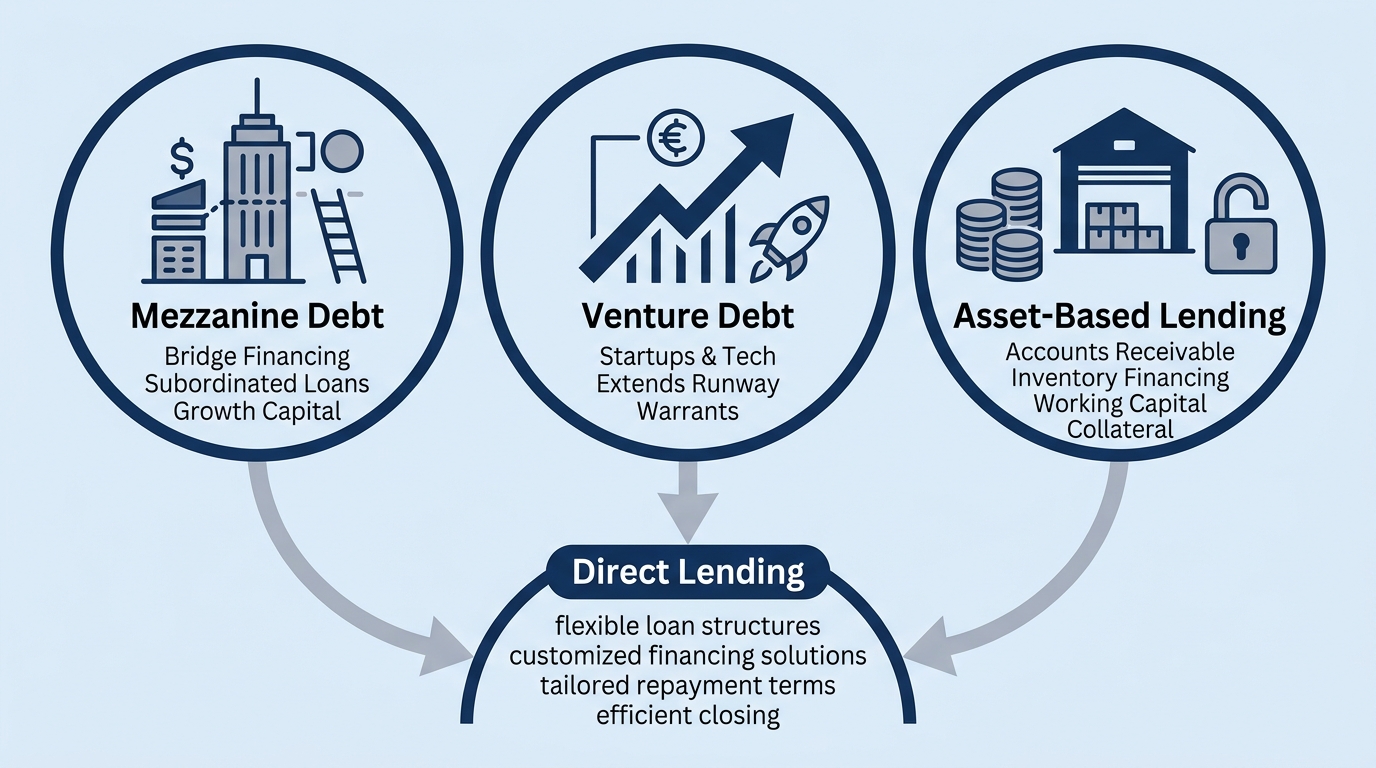
    Infographic showing three flexible financing structures: mezzanine debt, venture debt, and asset-based lending connected to a direct lending hub.

    Flexible financing structures connected to direct lending.

    This flexible financing approach is designed to reinforce your buy-side M&A strategies with speed and precision, complementing our Full-Cycle M&A and capital advisory. To explore a custom-quote structure for your next transaction, Book A Call. This is not an offer or commitment; all financing is subject to due diligence and final documentation.

    3. Speed and Certainty of Execution

    In today’s direct lending market, speed and certainty of execution are decisive advantages for businesses evaluating private capital raising strategies.

    Traditional syndicated bank loans demand months of negotiation among multiple syndicate tiers and require extensive regulatory filings under SEC capital raising regulations; in stark contrast, direct lenders issue committed capital letters upfront and close in weeks, with fewer parties, less documentation, and a near-certain funding outcome.

    Zaidwood Capital’s proprietary market intelligence shows that current U.S. direct lending interest rate spreads remain favorable for borrowers, indicating that institutional lenders are actively seeking to deploy capital and can move swiftly when opportunities arise.

    Our approach to Streamlining Transactions shortens the search and negotiation cycle, and with a global network of over 4,000 investors, we accelerate execution for transactions ranging from corporate debt to GP-led secondary transactions, reducing opportunity cost and securing better terms.

    This speed and certainty, combined with Zaidwood Capital’s full-cycle advisory platform, streamlines access to substantial institutional capital for businesses pursuing growth.

    4. Middle-Market Capital Access

    Middle-market companies with revenues between $10 million and $1 billion frequently encounter a capital gap that traditional bank loans cannot fill, making access to capital in the direct lending market a vital alternative. As our FAQ notes, direct lending transactions close weeks faster than bank loans, with fewer covenants and flexible terms that adapt to a company’s cash flows rather than rigid formulas. Post-2008 regulatory changes constrained traditional bank lending, cementing the direct lending market as the core funding channel for mid-size firms. We help middle-market firms structure direct lending opportunities through our network of over 4,000 institutional investors and $15 billion in deployable capital, accelerating execution and reducing time-to-close. Beyond direct lending, our team deploys wider private capital raising strategies, including GP-led secondary transactions, to meet each company’s unique capital needs. Because direct lending operates under FINRA regulation direct lending, all participants must ensure strict compliance. Securities are offered through Finalis Securities LLC; Zaidwood Capital is not a registered broker-dealer and is separate from Finalis.

    5. Private Equity Buyout Support

    The direct lending market has become a cornerstone of private equity buyouts as firms seek speed and flexibility beyond traditional bank leverage loans. We at Zaidwood Capital see direct lender financing offering bespoke terms that align with the specific cash flow profiles of portfolio companies. This private credit approach sidesteps the rigid syndication processes of conventional banks, enabling faster closings and more creative capital structures. GP-led secondary transactions further illustrate how direct lending injects liquidity, allowing general partners to hold assets longer while offering LPs partial exits. Our private capital raising strategies incorporate direct lending solutions to support full-cycle buyout execution from acquisition through value creation. Direct lending also complements traditional bank financing by filling gaps where syndicated markets retreat, a dynamic we harness in our advisory work. As deal complexity grows, we view direct lending not as a niche instrument but as an enabling component driving the next phase of transaction structuring and capital deployment.

    6. Regulatory Landscape and Liquidity

    The direct lending market has experienced profound changes as regulatory oversight intensifies. Heightened scrutiny from the SEC and evolving risk-retention rules have dampened risk appetite among lenders, tightening liquidity dynamics across the sector. This shift is reshaping how capital flows into private credit.

    As bank-led lending retrenches, institutional capital increasingly pivots toward the direct lending sector. Stringent regulatory frameworks—including enhanced disclosure requirements and capital adequacy standards—drive allocators to reassess exposure. Our own analysis confirms that the regulatory environment compels investors to seek more resilient structures and transparency.

    These pressures have accelerated the adoption of private capital raising strategies and GP-led secondary transactions. By facilitating liquidity through secondary market solutions, managers can mitigate the constraints imposed by today’s regulatory landscape.

    Navigating this complexity demands deep market intelligence. Our firm leverages a network of over 4,000 institutional investors and $24.4B+ in aggregate transaction volume to help clients secure capital formation and liquidity in regulated markets. We help lenders and sponsors adapt their strategies, ensuring they remain positioned for success.

    7. Private Capital Raising Strategies

    For middle-market firms, private capital raising strategies offer an alternative to public markets, with the direct lending market serving as a vital source of flexible financing. These approaches enable capital formation for acquisitions, recapitalizations, and liquidity events while avoiding the regulatory complexities of an IPO.

    We help clients evaluate several private capital raising strategies:

    • Equity financing
    • Debt financing
    • Mezzanine debt
    • Direct lending
    • GP-led secondary transactions

    Direct lending, from non-bank institutional lenders, provides tailored capital complementing traditional bank loans. GP-led secondary transactions provide liquidity for limited partners while general partners can continue managing assets. At Zaidwood Capital, we design and execute these capital raises using our network of over 4,000 institutional investors and $15B+ in deployable capital, tailoring solutions to each firm’s profile. We integrate rigorous due diligence as part of our full-cycle M&A and capital advisory approach to ensure a seamless path from strategy to close.

    This site is for informational purposes only. Securities are offered through Finalis Securities LLC; Zaidwood Capital is not a broker-dealer.

    8. GP-Led Secondary Transactions

    In a GP-led secondary transaction, the general partner sells a portfolio company into a newly formed continuation fund backed by both existing and new limited partners. This approach, part of broader private capital raising strategies, provides early liquidity to LPs while allowing the GP to retain the asset and pursue additional value creation over a longer horizon. For careful LPs, these transactions offer a path to realize returns before a traditional exit; for GPs, they preserve management continuity and extend the runway for further growth.

    At Zaidwood Capital, we advise GPs on structuring these deals, securing institutional capital through our network of over 4,000 investors, and managing execution from start to finish. Our equity advisory and liquidity solutions practice ensures that each transaction is tailored to the fund’s objectives, streamlining transactions within our full-cycle M&A and capital advisory framework. Beyond GP-led secondaries, we support a spectrum of liquidity and capital formation strategies, including our broader equity advisory and debt advisory capabilities, positioned to serve mid-market funds across changing market cycles.

    Evaluating Direct Lending for Your Capital Strategy

    When evaluating the direct lending market, we recognize it as a private credit solution where institutional lenders provide capital directly to companies, bypassing traditional bank intermediaries.

    Direct lenders typically deliver faster execution, fewer covenants, and more flexible terms than banks—a key advantage when evaluating the direct lending market for companies with strong fundamentals seeking growth capital or acquisition financing without dilutive equity. Through direct lending, we streamline transactions, providing faster access to institutional capital. To determine fit, we assess the lender’s track record, deal flow, and alignment with your capital structure goals.

    As part of a broader set of private capital raising strategies, direct lending can complement other financing tools. GP-led secondary transactions frequently employ direct lending structures to facilitate liquidity or recapitalization.

    Resources

  • Best Quality of Earnings Report for Mid-Market Deals 2026

    Best Quality of Earnings Report for Mid-Market Deals 2026

    Table of Contents

    The Role of Quality of Earnings Reports in Mid-Market M&A

    Following a comprehensive due diligence review, buyers and lenders in mid-market M&A transactions focus on the Quality of Earnings (QoE) report, an independent assessment of a target company’s historical financial performance, adjusted for non-recurring items. This analysis goes far beyond audited financials by evaluating revenue sustainability, customer concentration, and the normalization of operating expenses and working capital. A well-prepared quality of earnings report provides a clearer view of recurring EBITDA, which serves as the foundation for valuation and debt sizing.

    Why QoE Matters in Mid-Market Deals

    The insights from an earnings quality analysis routinely reshape transaction terms. Buyers use the adjusted EBITDA to support purchase price adjustments, earnout structures, and net-working-capital targets. Lenders, in turn, demand a validated earnings baseline before committing acquisition debt. Moreover, the QoE often uncovers deferred-revenue patterns or concentration risks that, if ignored, can surface as costly post-close liabilities. In mid-market transactions where information gaps are common, a thorough QoE report reduces post-close surprises and gives the commissioning party a stronger negotiating position.

    Because mid-market companies frequently lack the internal resources to produce a GAAP-independent earnings analysis on their own, many engage specialized M&A advisors to manage the QoE process. At Zaidwood Capital, we integrate the QoE directly into our full-cycle due diligence offering, coordinating with independent accounting firms to deliver a report that buy-side and sell-side clients can rely on during negotiation and financing. We handle all financial data in accordance with rigorous confidentiality standards. For information on how we protect client information, please review Zaidwood Capital Privacy Policy.

    What Defines a Quality of Earnings Report

    A critical subset of due diligence, central to mid-market transaction diligence, is the Quality of Earnings Report, a financial analysis that evaluates the recurring, normalized earnings of a target company. At Zaidwood Capital, we define a QoE report as a rigorous assessment of earnings sustainability, designed to strip out non-recurring items and present a true picture of operating performance. This analysis is a cornerstone of our full-cycle due diligence process for mid-market M&A transactions.

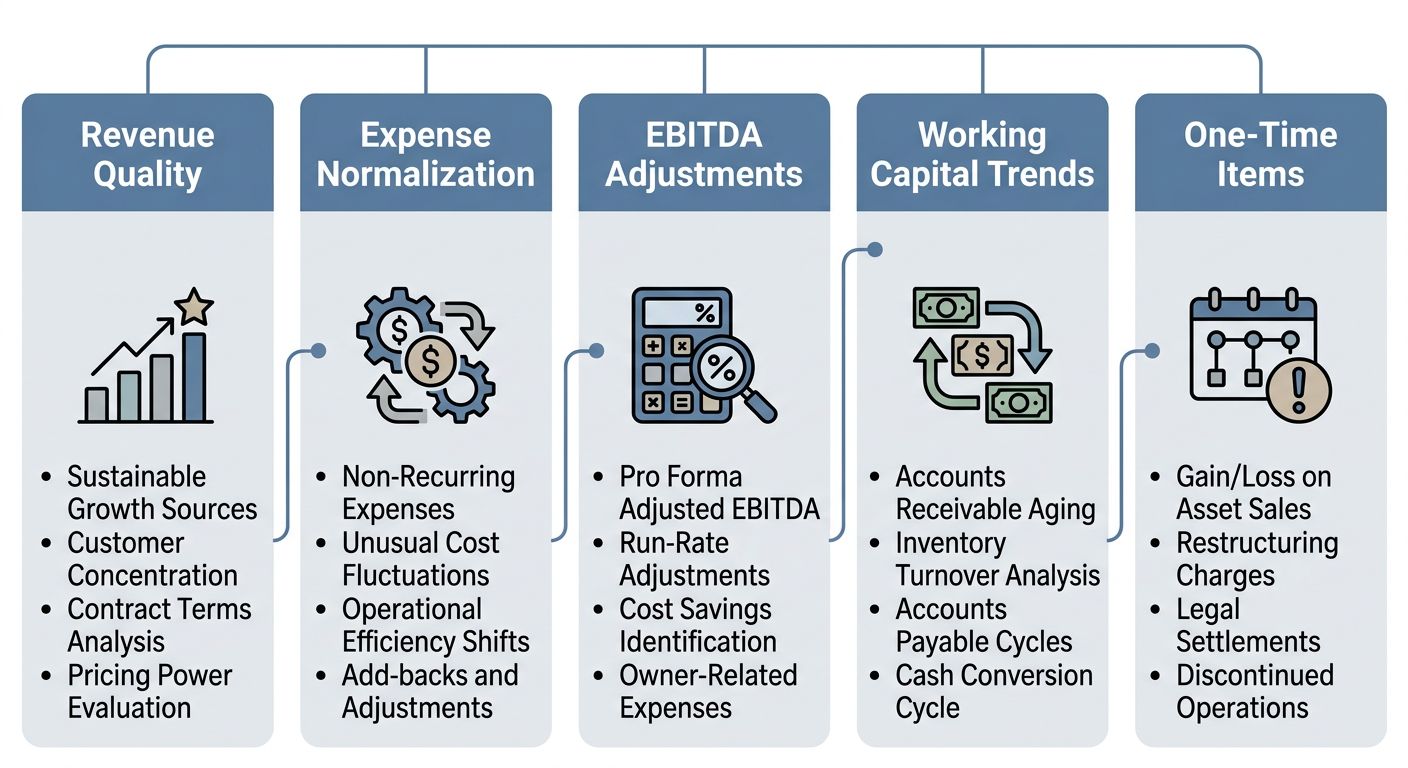
    A comprehensive earnings quality analysis examines several critical areas. Revenue quality scrutinizes the predictability and diversification of income streams. Expense normalization adjusts for one-time costs, owner’s compensation, or other out-of-ordinary expenses. EBITDA adjustments remove non-operating or non-cash items to reflect sustainable earnings. Working capital trends highlight operational liquidity needs and potential cash drags. One-time items, such as litigation settlements or asset sales, are excluded to reveal the underlying earning power. These dimensions collectively inform whether the company’s earnings are sustainable and repeatable for future periods.

    Infographic with five columns representing core areas of a quality of earnings analysis: Revenue Quality, Expense Normalization, EBITDA Adjustments, Working Capital Trends, and One-Time Items, each with icons and bullet lists on a muted blue and gray palette.

    Zaidwood Capital’s Quality of Earnings analysis framework visualized in five key areas.

    By producing a normalized earnings base, the QoE report helps both buyers and sellers reach consensus on valuation. For buy-side M&A professionals, this analysis highlights the true recurring profitability of a target, removing distortions that could inflate or deflate the purchase price. Sellers also benefit, as a well-documented QoE report can justify a premium and accelerate negotiation.

    As part of our Full-Cycle M&A and capital advisory services, we integrate QoE analysis into every engagement to provide clients with clear, defensible financial insights. The report is not an audit; it does not verify financial statement accuracy in compliance with accounting standards. Instead, it offers transaction-specific intelligence that traditional audits often miss. Zaidwood Capital utilizes QoE reports as a core component of its full-cycle due diligence, ensuring that both buy-side and sell-side mandates are grounded in reliable earnings data. By identifying true economic earnings, a QoE report streamlines negotiations and reduces the risk of post-close surprises.

    Next, we examine the core components that define a comprehensive QoE analysis.

    Securities are offered through Finalis Securities LLC, an independent entity from Zaidwood Capital. This content is for informational purposes and does not constitute investment advice.

    Core Components of a Quality of Earnings Analysis

    A quality of earnings report for mid-market deals goes beyond audited financials to uncover the true recurring cash flow a buyer can rely on. In this section, we break down the three pillars of a quality of earnings analysis: normalization adjustments, working capital scrutiny, and EBITDA sustainability. Drawing on Zaidwood Capital’s due diligence expertise, we show how each component strengthens deal-making for institutional and private investors.

    Normalization Adjustments and Add-Backs

    Normalization adjustments strip away non-operational or inflated expenses to present a clean EBITDA. These adjustments are critical because audited financials may include non-recurring gains or expenses that distort the company’s sustainable earning power. In our analyses, we identify above-market owner compensation, one-time legal fees, personal expenses run through the business, and related-party transactions at non-market terms.

    • Owner’s Compensation Adjustment: Aligning above-market owner salary and benefits to industry-standard compensation for a replacement manager
    • Non-Recurring Expenses: One-time legal fees, consulting engagements, relocation costs, or restructuring charges unlikely to repeat post-acquisition
    • Personal Expenses: Personal travel, entertainment, vehicles, or family members on payroll not related to business operations
    • Related-Party Transactions: Above-market rent, management fees, or service charges paid to entities owned by the seller or their family

    We substantiate each adjustment with corroborating evidence—payroll records, lease agreements, invoices—and provide a clear rationale in our reports. A quality of earnings analysis also flags off-balance-sheet liabilities like operating leases or contingent obligations that can alter deal value. For example, an owner drawing $600,000 when market rate is $200,000 inflates expenses by $400,000, a typical adjustment we see. By documenting every add-back, we give buyers confidence in the normalized earnings figure. Additionally, QoE reports look beyond the balance sheet to identify contingent payments or environmental indemnities that may not be booked but represent real future cash outflows.

    Working Capital Analysis and Debt-Like Items

    Working capital analysis determines the normalized net operating capital needed post-acquisition. We assess seasonal needs, payment cycles, and industry norms, then compare that to the target company’s actual levels. The gap—whether surplus or deficit—becomes an adjustment to the purchase price. For instance, if a business has excess working capital relative to its normalized requirement, the buyer may credit the seller for that amount at closing; conversely, a deficiency reduces the price. Our QoE reports present these adjustments with supporting schedules so that both buyers and sellers can negotiate from a common understanding.

    Debt-like items are obligations that function as debt but are not on the balance sheet as such. Examples include deferred revenue, underfunded pensions, or installment sale obligations. We identify these, quantify their impact, and deduct them from the equity value, just as we would formal debt. This analysis prevents the buyer from inheriting hidden financial burdens and ensures the enterprise value accurately reflects the business’s true financial position.

    EBITDA Quality and Sustainability Assessment

    EBITDA sustainability evaluation dissects the recurring nature of earnings. We examine revenue concentration risk—if a company depends on a single customer for more than 10% of revenue, that concentration creates vulnerability. Customer retention trends, contract renewal probabilities, and churn rates indicate how sticky the revenue base is. We also assess margin stability, checking whether gross and operating margins are sustainable or eroded by pricing pressure. In emerging markets M&A, we place extra focus on revenue concentration and retention because currency swings, regulatory shifts, and political instability can quickly reshape earnings. We evaluate supplier relationships to ensure margins are not artificially supported by short-term concessions, and we consider macroeconomic trends that could influence future earnings. Through our QoE reports, we help buyers distinguish durable cash flows from those that could evaporate post-acquisition, providing a forward-looking perspective essential for informed investment decisions.

    Selecting a Quality of Earnings Provider for Your Mid-Market Deal

    A quality of earnings report for mid-market deals is one of the most important tools for de-risking an acquisition, and choosing the right provider directly influences the credibility of your financial analysis. For companies in the $20M–$100M revenue range, the provider’s expertise, speed, and post-engagement support can make a material difference in how the QoE findings are received by lenders, underwriters, and counterparties.

    Evaluating Boutique Firm Expertise for QoE Analysis

    Boutique firms such as Zaidwood Capital specialize in delivering a highly tailored Quality of Earnings analysis that aligns with the specific dynamics of mid-market transactions. Their teams typically bring deep industry knowledge and direct senior partner involvement, ensuring that the engagement is led by an experienced professional who understands both the financial and strategic dimensions of the deal. In contrast, Big Four accounting firms offer a broad, generalist approach with standardized QoE templates that can miss the nuances of niche sectors. Mid-tier regional firms occupy a middle ground, providing moderate specialization but often with less senior oversight than a dedicated boutique.

    The critical differentiator is the level of partner engagement. At a boutique, the senior team leads the QoE analysis from start to finish, which shortens feedback loops and results in a more focused report. Big Four firms typically rely on junior staff for the bulk of the fieldwork, with partner review at the conclusion, while mid-tier firms show variability in senior involvement. This direct access to senior talent often translates into faster turnaround times and more actionable insights for the acquirer.

    The following comparison table summarizes key distinctions to inform your selection.

    Common Add-Backs and Adjustments in Quality of Earnings Reports
    Adjustment TypeDescriptionTypical EBITDA ImpactCommon Example
    Owner’s Compensation AdjustmentAligning above-market owner salary and benefits to industry-standard compensation for a replacement manager+$150,000 to $500,000 add-backOwner paying themselves $600,000 when market rate for a general manager is $200,000
    Non-Recurring ExpensesOne-time legal fees, consulting engagements, relocation costs, or restructuring charges unlikely to repeat post-acquisition+$50,000 to $300,000 add-back$200,000 in legal fees from a one-time litigation matter
    Personal ExpensesPersonal travel, entertainment, vehicles, or family members on payroll not related to business operations+$25,000 to $150,000 add-backCompany-leased luxury vehicle used primarily for personal use
    Related-Party TransactionsAbove-market rent, management fees, or service charges paid to entities owned by the seller or their family+$75,000 to $400,000 add-backPaying $30,000/month rent to a seller-owned LLC when market rate is $15,000

    Boutique firms consistently deliver deep specialization and hands-on partner involvement, often completing a QoE engagement in as little as 2–4 weeks—roughly half the time of a Big Four engagement. Moreover, firms like Zaidwood Capital adhere to established capital markets best practices, incorporating frameworks from ICMA capital markets to ensure the analysis meets rigorous industry standards. This commitment to both speed and quality makes boutique advisors a compelling choice for mid-market acquirers.

    Scope and Cost Expectations for Mid-Market Companies

    For a $20M–$100M-revenue company, the scope of a Quality of Earnings engagement should be calibrated to deal complexity and the acquirer’s specific concerns. A one-size-fits-all report rarely adds value; instead, the engagement scope must be defined collaboratively, focusing on revenue recognition policies, working capital trends, customer concentration risks, and any carve-out adjustments that could affect normalized EBITDA. At Zaidwood Capital, we work directly with buyers to design a custom scope that addresses the unique drivers of the target business, avoiding unnecessary line items that inflate cost without improving decision-making.

    Cost expectations reflect the level of customization. Boutique firms like Zaidwood Capital typically quote $25,000–$50,000 for a $20M-revenue company, while Big Four firms can range from $75,000 to over $150,000 for a similar-sized engagement. Mid-tier regional firms generally fall between $40,000 and $80,000. All figures are custom quotes and depend on data availability, the number of entities involved, and the speed required. We emphasize that our pricing is never a fixed fee; each engagement is priced based on the precise scope and timeline agreed upon, with full-cycle support extending from the initial QoE analysis through deal close.

    Integrating QoE Findings into Deal Structuring

    A Quality of Earnings report is not just a diligence artifact—it directly shapes the final deal terms. When normalized EBITDA adjustments reveal that reported earnings overstate true recurring cash flow, buyers can negotiate purchase price reductions or post-closing true-ups. Earnout structures become more defensible when the QoE identifies revenue volatility or concentration risks that warrant contingent payments. Similarly, representation and warranty insurance underwriters increasingly rely on QoE findings to set coverage limits and exclusions, making a thorough report a valuable risk-transfer tool.

    At Zaidwood Capital, our full-cycle advisory model ensures that QoE insights flow seamlessly into the negotiation and documentation phases. We translate EBITDA adjustments into specific purchase price adjustment mechanisms, design earnout milestones linked to verifiable financial metrics, and help acquirers present the QoE to insurers to secure favorable underwriting terms. This integrated approach reduces re-trading risk and accelerates the path to a signed purchase agreement. Once you have selected the right partner, the next step is implementing a disciplined QoE process that turns financial analysis into concrete deal terms. As with any investment, past performance does not guarantee future results, and we recommend consulting professional advisors to tailor the approach to your deal.

    How Quality of Earnings Reports Influence Purchase Price and Deal Terms

    A quality of earnings report for mid-market deals does more than flag accounting irregularities; it serves as the core negotiating lever for adjusting the purchase price and crafting protective deal provisions. At Zaidwood Capital, we treat the QoE report as the definitive source for reconciling reported financials with normalized economic reality. This alignment is essential before we engage in price discussions.

    In our experience, the most direct impact of the QoE report is a purchase price adjustment derived from normalized EBITDA. When the report strips out non-recurring revenue or one-time expenses, it recalibrates the basis on which the acquisition multiple is applied. A lower sustainable EBITDA can reduce the implied valuation, prompting the buyer to seek a price reduction. Conversely, a seller whose earnings prove clean and recurring can leverage the report to sustain or elevate the offer. Beyond EBITDA, the working capital peg—determined by historical QoE trend analysis—can shift the final cash consideration. If the report reveals that the target’s normalized net working capital is lower than originally represented, the buyer rightfully demands a dollar-for-dollar reduction at closing. Sellers with positive QoE results often use this as a shield against overly burdensome indemnification clauses, while buyers rely on the analysis to insert additional covenants or expand representations and warranties when risks are evident.

    Earnout structures are another area where QoE findings carry substantial weight. We typically link earnout payments to forward-looking financial metrics that have been validated by the quality of earnings (QoE) review. This ensures that post-closing milestones are both achievable and reflective of the business’s true earning power, reducing disputes later. Likewise, indemnification horizons and escrow amounts are calibrated to the specific risks flagged in the report. A revenue recognition issue might extend the survival period for related claims and increase the escrow holdback, while a clean report shortens those protections. Underpinning this rigor are regulatory standards that shape our financial analysis. FINRA securities regulation, administered by the Financial Industry Regulatory Authority, sets expectations for broker-dealer reporting that influence how we assess earnings quality in private transactions. Similarly, SEC securities regulation, enforced by the U.S. Securities and Exchange Commission, mandates GAAP compliance and reinforces the importance of accurate data in all valuations. In the following section, we demonstrate how these adjustments play out in a real mid-market transaction.

    Common Questions About Quality of Earnings Reports in Mid-Market Deals

    After establishing the importance of a quality of earnings report for mid-market deals, we address the most common questions buyers and sellers ask before engaging a QoE provider.

    What is a quality of earnings report, and why is it essential for mid-market deals? A QoE analysis examines earnings sustainability and quality, revealing adjustments needed in private-company financials and uncovering risks like customer concentration.

    How does a QoE differ from standard due diligence, and what adjustments does it uncover? Unlike standard due diligence, a QoE report serves as a complementary tool—used by advisors like Zaidwood Capital—to examine normalized EBITDA, margin trends, and working capital, separating recurring from one-time items and revenue mix.

    How does a QoE report impact valuation and deal structure? By surfacing these insights, a QoE can bridge valuation gaps and influence purchase price multiples, giving both sides clearer grounds for negotiation.

    Next, we’ll walk through the practical steps of commissioning a QoE report for your mid-market transaction.

    Leveraging Quality of Earnings Reports for Smarter M&A Decisions

    A Quality of Earnings report for mid-market deals dissects financials to expose sustainable earnings by stripping out one-offs. It flags risks like premature revenue booking, strengthening your negotiation position. Mid-market firms with less polished reporting especially benefit. At Zaidwood Capital, a quality of earnings report for mid-market deals anchors our full-cycle due diligence, alongside operational, commercial, and IT assessments, to deliver a complete picture. Compliance with SEC securities regulation ensures data reliability, and leveraging QoE minimizes post-close shocks. Deeper insight drives smarter M&A decisions.

    Resources

  • Boutique vs Bulge Bracket Investment Banking: 2026 Comparison Guide

    Boutique vs Bulge Bracket Investment Banking: 2026 Comparison Guide

    Table of Contents

    Choosing Between Boutique and Bulge Bracket Investment Banking

    When weighing boutique vs bulge bracket investment banking, the core distinction lies in service scope and client intimacy. Specialist advisory firms offer focused, senior-led strategies that often result in faster execution and stronger alignment with client goals. Large global banks provide extensive capital markets access and resources suited for complex cross-border mandates. For companies considering private equity exit opportunities, boutique advisors frequently deliver customized positioning within their specific industry ecosystems. Similarly, talent dynamics around investment banking compensation packages reflect the differing demands of these models. We track SEC regulatory updates closely, as heavier compliance overhead affects larger institutions disproportionately while we leverage our full-cycle M&A and capital advisory approach to integrate deep advisory with proprietary data, streamlining transactions without the structural friction of multi-layered global firms.

    Ultimately, choosing between these paths depends on your transaction scope and strategic priorities. Our model bridges the gap by combining the personalized guidance of a boutique with the data-driven precision and investor network scale that growing companies require, a balance explored further in the next section.

    1. Senior Banker Attention and Personal Service

    In the boutique vs bulge bracket investment banking debate, one key differentiator is the level of senior attention you receive. At large, full-service firms, deal execution is often delegated to junior teams while managing directors appear only at critical milestones. We find this approach can dilute accountability and slow decision-making.

    Our model is fundamentally different. When you engage a boutique investment banking firm like Zaidwood Capital LLC, your mandate is led directly by our principals from pitch to close. As outlined in our description of M&A advisory services, senior bankers provide strategic guidance, valuation, negotiation support, and hands-on deal management throughout the entire lifecycle. This structure ensures decades of combined experience are applied to your specific strategic goals, delivering more tailored advice and faster execution.

    This personalized service is particularly valued by private equity firms seeking seamless exit execution and by companies requiring discreet, high-touch advisory. By leveraging our proprietary network and data resources, our senior team simplifies complex transactions, embodying our commitment to Streamlining Transactions with precision and focus.

    2. Tailored Fee Structures for Mid-Market Deals

    When considering boutique vs bulge bracket investment banking, the fee negotiation dynamics shift substantially for middle-market transactions. Unlike the rigid, standard pricing grids common at large institutions, we design our compensation around each mandate’s unique contours. This flexibility ensures your advisory costs reflect actual deal complexity rather than a one-size-fits-all schedule, aligning our incentives directly with your outcome.

    A typical framework might blend an initial retainer with a success-based component, or we may structure a milestone-driven fixed fee for a carve-out divestiture. The mix is always negotiated, absorbing variables like target size, cross-border diligence, and sector-specific resource requirements. For private equity firms managing portfolio company exits, this custom approach preserves more equity value while delivering institutional-quality execution. Our compensation benchmarks, detailed on our FAQ page, illustrate how tailored structures sit competitively within industry norms. As we always clarify, fees are custom-quoted and subject to mutual agreement rather than a published rate card.

    This disciplined yet adaptable approach removes friction from the engagement, letting you forecast costs with clarity. Next, we will walk through how our execution process turns that aligned structure into deal momentum.

    3. Specialized Industry Expertise

    Specialized industry expertise is a defining hallmark of the boutique model in investment banking. Unlike generalist institutions, boutique firms concentrate intellectual and relational capital into targeted verticals, cultivating an intimate understanding of sector dynamics, competitive landscapes, and value drivers. In private equity exit opportunities, this depth translates directly into superior deal sourcing because advisory teams speak the same operational language as founders, operators, and institutional buyers. Drawing from our own capital network exceeding $15 billion and an aggregate transaction volume surpassing $24.4 billion, we see consistent evidence that specialization sharpens valuation insight and accelerates execution.

    Sector-specific knowledge also shapes how boutique teams prepare portfolio companies for exit. Advisors often bring prior operating experience within the industries they serve, allowing them to anticipate buyer diligence questions and position assets around the metrics that matter most to private equity firms. When general partners evaluate acquisition targets, they rely on advisors who can interpret unit economics, regulatory nuances, and customer concentration risks without a learning curve, an advantage that industry depth systematically delivers.

    Industry depth shortens timelines and reduces transaction friction, qualities that matter acutely when fund lifecycles and market windows dictate exit timing. The structural alignment between boutique specialization and private equity mandates explains why sector-focused advisory teams continue gaining share in middle-market transactions. As the discussion shifts toward compensation structures, that same specialized expertise becomes a tangible factor influencing how transaction professionals are rewarded for execution.

    4. Agile Decision-Making and Speed

    Agile decision-making and speed represent some of the most compelling differentiators when evaluating boutique vs bulge bracket investment banking advisory services. At Zaidwood Capital, our lean, partner-led structure eliminates the multiple layers of approval and internal bureaucracy that typically slow down larger institutions. This streamlined architecture translates into faster, more decisive action for our clients.

    The role of an M&A advisor is inherently to accelerate deal timelines through proactive market intelligence and efficient coordination of due diligence. We execute this through our proprietary Velocity Matrix framework, which drives transaction velocity without compromising the depth or quality of our analysis. This systematic approach ensures that while we move quickly, we never sacrifice the financial, legal, and operational rigor that complex transactions demand.

    This responsiveness is particularly critical for owners pursuing private equity exit opportunities, where market windows can close rapidly and timing often correlates directly with value realization. Our direct partner involvement and efficient processes allow us to respond to these dynamics with the urgency they require. This structural speed also enables us to deliver a level of service intensity and personalization that more layered organizations find difficult to match.

    Agility here is not about cutting corners. It is the natural outcome of a flatter organizational design, empowered decision-makers, and a proprietary operating system purpose-built to optimize transaction timelines. This foundation of responsive execution supports the personalized and cost-effective approach that distinguishes true partnership in M&A advisory.

    5. Comprehensive Network Access and Deal Sourcing

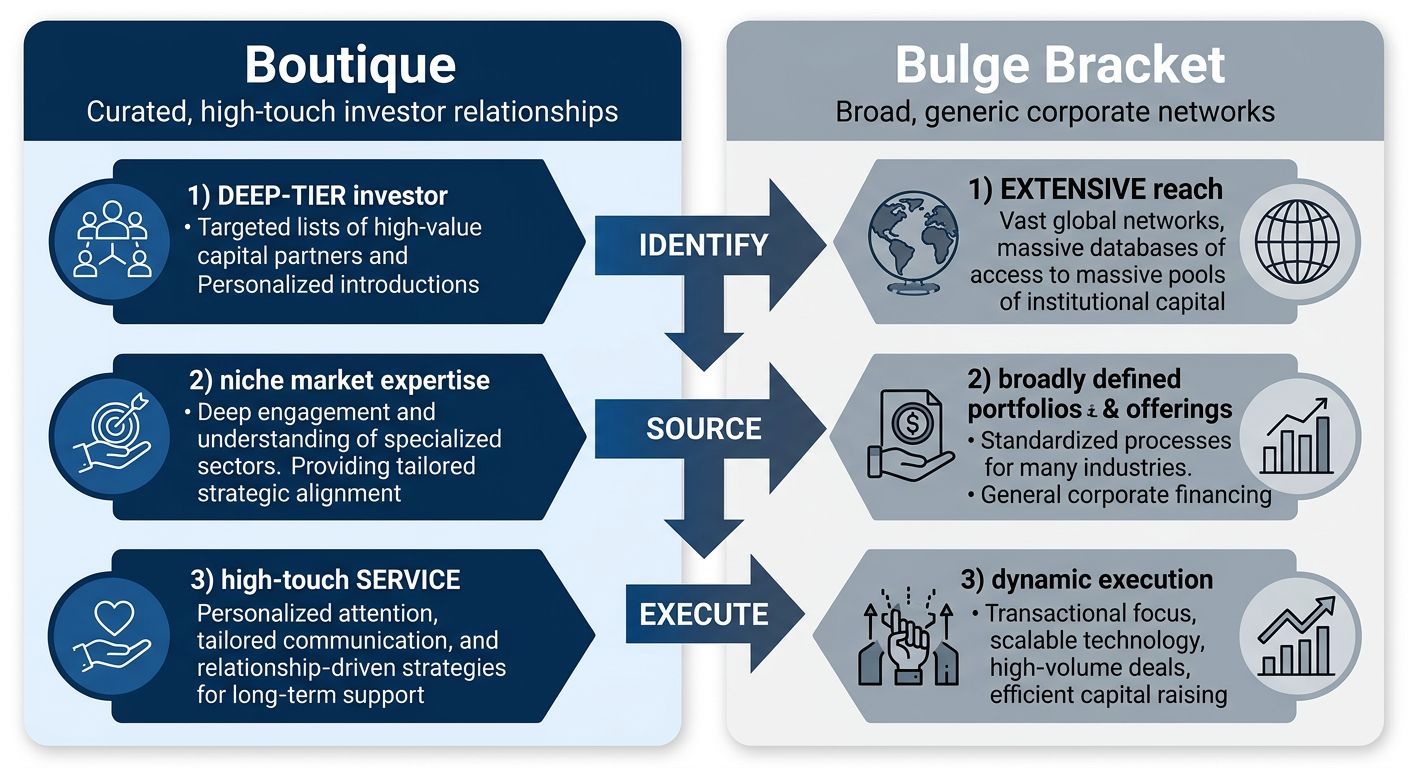
    Beyond our advisory capabilities, the real differentiator in the boutique vs bulge bracket investment banking landscape is the depth of our network. We connect clients with 4,000+ global investors and $15B+ in deployable capital, creating private equity exit opportunities that rival the largest institutions while maintaining the agility of a specialized boutique.

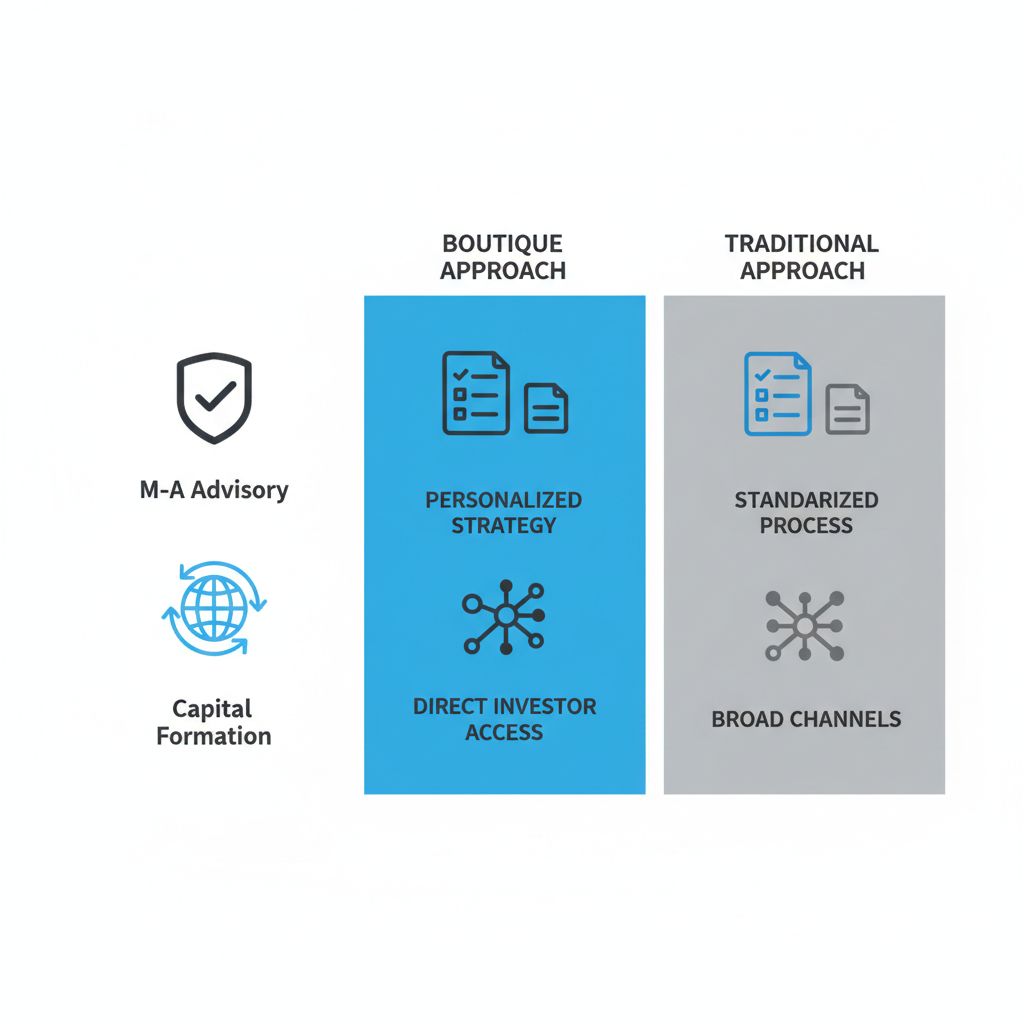
    Infographic comparing boutique M&A firm's high-touch investor network against bulge bracket's broad corporate network with deal sourcing funnel stages.
    Boutique vs. bulge bracket network access comparison at Zaidwood Capital.

    This integrated approach is powered by proprietary tools, including the Sovereign Data Nexus, Precision Catalyst, and Velocity Matrix, which sharpen deal sourcing and analysis. Our $24.4B+ aggregate transaction volume across full-cycle M&A, equity, and debt mandates confirms the scale we deliver. Exclusive access to Deal Vault and our curated Investor Rolodex further extends our partners’ reach. As our internal resources explain, these capabilities streamline the entire capital formation lifecycle, from LP placement and debt structuring to equity advisory.

    Whether you are evaluating private equity exit opportunities or structuring a capital raise, this institutional-grade infrastructure, delivered by a boutique firm, provides a clear advantage over traditional bulge bracket models. Our approach ensures you receive both the scale and the personalization that today’s complex deals demand. We’ll next explore how our fairness opinions and transaction advisory services add another layer of diligence.

    6. Cultural Alignment and Communication

    The choice in boutique vs bulge bracket investment banking extends beyond structure and into the softer, yet equally critical, dimensions of culture and communication. At Zaidwood Capital, we believe that a strong advisory relationship depends on transparency, trust and open dialogue — qualities that are built through consistent interaction rather than brand reputation alone. How a firm communicates directly shapes your experience during what is often the most consequential financial event in a company’s lifecycle.

    Communication style and responsiveness matter because M&A processes move quickly and demand real-time judgment. Boutique firms typically offer direct access to senior partners and a highly personalized cadence, while larger platforms operate through more structured teams and formalized reporting. Neither approach is inherently superior; the right fit depends on how you prefer to receive information, make decisions and manage pressure. Our internal resource on what M&A advisors do outlines how advisors facilitate fit assessments early in the process, helping clients evaluate both technical capability and interpersonal compatibility.

    Finding the right cultural fit also means considering how an advisor handles long-term strategic goals such as private equity exit opportunities or structuring investment banking compensation packages. These conversations require discretion, deep industry knowledge and a relationship grounded in mutual confidence. Full-Cycle M&A mandates succeed when the advisory team aligns with your organization’s values, communication norms and decision-making rhythm — a principle we prioritize through every phase of engagement.

    Streamlining Transactions depends as much on human chemistry as it does on financial engineering. In our experience, the most successful partnerships are those where both sides invest in candid, ongoing communication. The next section outlines practical steps you can take to evaluate and engage an advisor who fits your unique organizational culture.

    Making the Right Choice for Your M&A Needs

    Given the distinct advantages of each model, selecting the right advisor depends on your transaction size, industry focus, and desired level of partner attention. M&A advisors typically provide comprehensive support across buy-side and sell-side representation, valuation, due diligence, and deal negotiation. At Zaidwood Capital, we deliver Full-Cycle M&A and capital advisory that combines the personalized service of a boutique firm with access to over 4,000 institutional investors and $15B+ in deployable capital. Our approach ensures seamless execution from initial due diligence through final closing, backed by $24.4B+ in aggregate transaction volume. We encourage you to assess your specific requirements and book a call for tailored guidance on your M&A journey.

    Resources

  • Best Manufacturing Consulting for 2026 Growth

    Best Manufacturing Consulting for 2026 Growth

    Table of Contents

    Mastering Manufacturing Consulting Essentials

    Mastering manufacturing consulting begins with our integrated Full-Cycle M&A and capital advisory services. We connect manufacturing firms to over 4,000 global investors, addressing industry challenges with streamlined growth strategies, as per Zaidwood Capital’s proprietary internal guidance.

    Key essentials include Streamlining Transactions via proprietary data access and full-cycle due diligence—financial, operational, and commercial. Our capital introductions facilitate equity and debt advisory, drawing on $24.4B+ aggregate transaction volume from Zaidwood Capital’s internal examples of precision in manufacturing deals.

    We enable clients to integrate smart manufacturing trends through capital raising and strategic corporate finance consulting, powered by our Velocity Matrix and Precision Catalyst approaches, per internal best practices.

    Book A Call for custom advisory tailored to your needs. Investments involve risk; past performance does not guarantee future results.

    1. Lead Digital Transformation

    As pioneers in Financial Services 3.0, we lead digital transformation through our Velocity Matrix for manufacturing consulting clients. Positioned as a Precision Catalyst, Zaidwood Capital LLC guides manufacturers toward smart technologies and operational excellence.

    Our alignment with initiatives like the NIST MEP CESMII partnership accelerates client adoption. As per an authoritative announcement from the National Institute of Standards and Technology (NIST), this government-industry collaboration advances smart manufacturing technologies, technology transfer, training via CESMII’s platforms, and funding for small and medium-sized manufacturers.

    NIST MEP‘s client impact, underscored by GenEdge industry analysis of the Client Impact Survey, demonstrates gains in sales growth, cost savings, job creation, and innovation. We connect these advancements to our full-cycle M&A advisory and capital formation services.

    Leverage our institutional network for Sovereign Data Nexus-enabled transformations. Book A Call with our team today to start. This foundation enables seamless capital formation—explore next.

    2. Explore Top Firms Directory

    Building on these insights into manufacturing opportunities, we guide you to top firms via the official directory. MEP centers are federally funded organizations that deliver manufacturing consulting to small and medium-sized manufacturers, as explained by ConnSTEP, an active MEP center participant. These centers offer tailored advisory on process improvements, workforce training, and technology adoption to drive competitiveness.

    The National Institute of Standards and Technology (NIST) maintains the authoritative listing of all 51 MEP centers across U.S. states and territories, complete with addresses, contacts, and service descriptions. Users can search by state or service type, such as supply chain optimization or cybersecurity for manufacturers, to identify local experts in consulting support for manufacturers. We recommend leveraging this directory to pinpoint partners accelerating manufacturing growth via targeted manufacturing advisory. Visit the MEP centers directory to discover NIST-backed expertise in operational enhancements.

    Explore the MEP centers directory now to connect with top firms. After identifying partners, contact us for capital advisory support using our Velocity Matrix.

    3. Adopt Smart Technologies

    Building on optimized processes, smart technologies provide the digital edge in manufacturing consulting. According to proprietary internal FAQ guidance from Zaidwood Capital, these innovations drive efficiency gains despite barriers like high costs, skills gaps, and legacy systems.

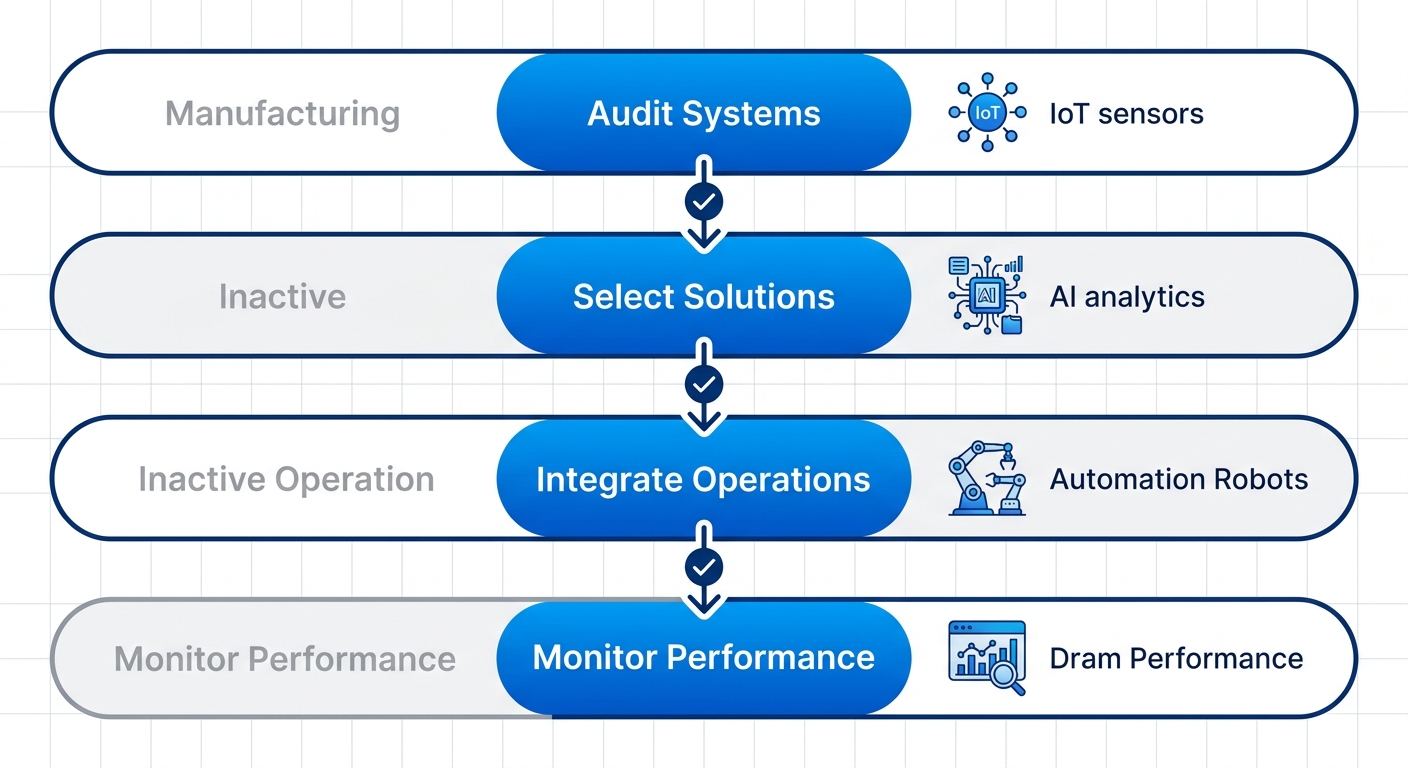
    IoT for real-time monitoring enables continuous equipment tracking in production lines, reducing downtime through data-driven alerts. AI for predictive analytics forecasts maintenance needs, optimizing workflows via pattern recognition in manufacturing operations consulting. Automation for process optimization streamlines repetitive tasks, as expert internal advisory content from Zaidwood Capital notes, boosting throughput with robotic integration.

    We recommend this four-step adoption roadmap from Zaidwood Capital FAQs:

    • Audit current systems to identify gaps.
    • Select scalable solutions like IoT and AI.
    • Integrate with existing operations via expert partners.
    • Monitor ROI metrics through pilot projects and training.
    Vertical process flow diagram illustrating four-step roadmap for smart technology adoption in manufacturing: audit systems, select solutions, integrate operations, monitor performance.
    Four-step roadmap for adopting smart technologies in manufacturing

    These steps align smart tech with our Full-Cycle M&A and capital advisory for funding upgrades. Leverage Zaidwood’s Velocity Matrix for accelerated implementation. Not investment advice—consult advisors; investments involve risk. Secure capital for these innovations through our Full-Cycle M&A advisory—Book A Call to start.

    4. Assess Reputation Reviews

    Beyond financial checks, reputation reveals execution reliability in manufacturing consulting. We advise evaluating providers through verified client feedback and independent benchmarks to ensure partners deliver on promises for capital advisory mandates.

    Follow this three-step process:

    1. Gather client testimonials from verified sources like Google or Clutch.
    2. Cross-reference with independent surveys, such as the NIST MEP client impact survey, conducted by third parties to measure outcomes like sales growth and cost savings, as explained by GenEdge.
    3. Analyze patterns for themes like on-time delivery and efficiency gains.

    Prioritize surveys from bodies like NIST MEP that track sales growth, cost reduction, and ROI for manufacturing firms. Avoid sole reliance on self-reported reviews; objective data predicts transaction success in consulting for manufacturing sectors.

    With reputation confirmed via surveys, evaluate strategic fit next. Use these tools before engaging our Full-Cycle M&A and capital advisory services—Book A Call today.

    5. Scale with Capital Access

    Once operations are optimized, secure capital to accelerate growth. We provide seamless capital access to fuel your growth, particularly for businesses seeking manufacturing consulting services. Our Capital Formation / Capital Raising connects clients to institutional LPs and over $15 billion in deployable capital, as detailed in Zaidwood Capital’s official FAQ guidance on capital solutions.

    We offer comprehensive Debt Advisory, including mezzanine, venture debt, equipment financing, and asset-based lending. Equity Advisory provides growth equity and liquidity solutions. Through Capital Introductions and Institutional LP Placement, clients access our Deal Vault and Investor Rolodex with 4,000+ global investors and $24.4 billion in aggregate transaction volume. Our Velocity Matrix delivers full-cycle support for faster execution.

    Book A Call to discuss custom capital solutions tailored to your manufacturing scale-up needs. With capital in place, prepare for optimal exits. Securities are offered through Finalis Securities LLC; Zaidwood Capital is not a registered broker-dealer.

    6. Optimize Debt Structures

    Complementing equity with optimized debt, we at Zaidwood Capital streamline capital structures to reduce costs and align with growth goals. For clients seeking manufacturing consulting, our debt advisory services enhance efficiency through tailored non-dilutive financing and operational efficiency improvements for manufacturers.

    We offer key debt options:

    • Mezzanine debt: Subordinated financing blending debt and equity features for flexible capital without full equity dilution.
    • Venture debt: Non-dilutive funding for high-growth companies post-equity rounds, with repayment tied to revenue milestones.
    • Equipment financing: Leverages machinery as collateral for asset-heavy manufacturing sector consulting clients.
    • Asset-based lending: Utilizes receivables or inventory to unlock liquidity.

    Through our institutional network, we secure competitive terms, as outlined in Zaidwood Capital’s proprietary FAQ knowledge base. This pairs with equity advisory for a full capital stack.

    Book A Call for a custom debt optimization assessment. Not investment advice — consult advisors.

    7. Tap Investor Network

    Building on our full-cycle capabilities, we empower you through the Tap Investor Network. Tap into our exclusive Investor Network of 4,000+ global institutions with $15B+ deployable capital, perfect for manufacturing consulting firms pursuing capital raises or M&A.

    Our proprietary platform, detailed in Zaidwood Capital’s raise portal, delivers instant capital introductions via the Deal Vault and Investor Rolodex. This accelerates Velocity Matrix execution for services like Capital Formation and Institutional LP Placement. Businesses in the manufacturing sector consulting space benefit from rapid access to growth equity and strategic opportunities, backed by our $24.4B+ aggregate transaction volume.

    Activate personalized access by Book A Call today. Ideal for sectors like consulting in manufacturing seeking efficient deal execution.

    Contact us to tap the network today for a custom quote. Securities are offered through Finalis Securities LLC; Zaidwood Capital is not a registered broker-dealer. This network kickstarts your transaction—discover the full process next.

    8. Execute Due Diligence

    Following agreement on key terms, we execute comprehensive due diligence using our proprietary Velocity Matrix for accelerated insights in Full-Cycle M&A and capital advisory, including manufacturing consulting deals seeking capital or M&A.

    Per Zaidwood Capital’s official internal guidance on full-cycle due diligence procedures, our process covers six key categories:

    • Financial: Balance sheet audits and cash flow projections to validate fiscal health.
    • Legal: Contract reviews and compliance checks to mitigate regulatory risks.
    • Operational: Supply chain efficiency and process optimizations, such as in smart manufacturing transactions and manufacturing consulting firms’ operational scalability.
    • Commercial: Market positioning and customer validations for growth potential.
    • IT: Cybersecurity audits and data integrity assessments.
    • Human Capital: Talent assessments and culture fit evaluations.

    Integrating our 4,000+ investor network and $24.4B+ transaction experience via Precision Catalyst methodologies mitigates risks, maximizes value, and advances to seamless transaction closing. Book A Call to discuss tailored execution. Not investment advice — consult your legal, tax, and financial advisors before making decisions.

    Partner for Manufacturing Success

    In manufacturing, success demands a trusted partner—we deliver manufacturing consulting expertise. We partner with manufacturing leaders for success using our Precision Catalyst approach to accelerate growth via targeted capital and M&A strategies.

    Our Full-Cycle M&A and capital advisory covers buy-side and sell-side mandates for plant expansions or divestitures. We raise capital from our 4,000+ global investor network and provide debt advisory for equipment financing. Zaidwood Capital’s internal resources confirm our $24.4B+ transaction volume in industrial sectors.

    We integrate smart manufacturing capabilities for operational scaling, leveraging AI predictive maintenance and digital twins to minimize downtime and boost efficiency by 20-30%, per Zaidwood Capital expertise. Our manufacturing consulting extends to specialized debt and equity solutions.

    Book A Call to explore how our Velocity Matrix streamlines your manufacturing journey. Not investment advice—consult your advisors.

    This article was researched and written with the assistance of AI tools.

    Resources

  • Due Diligence Explained: Financial and Commercial Guide

    Due Diligence Explained: Financial and Commercial Guide

    Table of Contents

    Mastering Due Diligence in Mergers and Acquisitions

    Building on Streamlining Transactions in mergers and acquisitions, due diligence is the comprehensive investigation verifying a target company’s viability. It plays a pivotal role in risk mitigation and value confirmation, ensuring informed decisions throughout the deal process.

    Financial due diligence involves scrutinizing historical financials, cash flow projections, debt obligations, and working capital adequacy. We leverage proprietary tools to deliver precise insights that uncover hidden liabilities and opportunities.

    Commercial due diligence validates market size, competitive positioning, customer retention rates, and revenue sustainability through rigorous industry benchmarking. Our full-cycle approach integrates financial, legal, operational, IT, and human capital reviews using the Velocity Matrix for accelerated execution and Precision Catalyst methodologies.

    This mastery enables informed negotiations, minimizes post-deal surprises, and facilitates seamless integration into our Full-Cycle M&A and capital advisory services. Book A Call today for tailored support.

    Preparing for Your Due Diligence Process

    Building on our overview of due diligence, we recommend proactive preparation to ensure smooth Full-Cycle Due Diligence across financial, legal, operational, commercial, IT, and human capital aspects. This Streamlining Transactions approach positions your M&A or capital deal for efficiency and success.

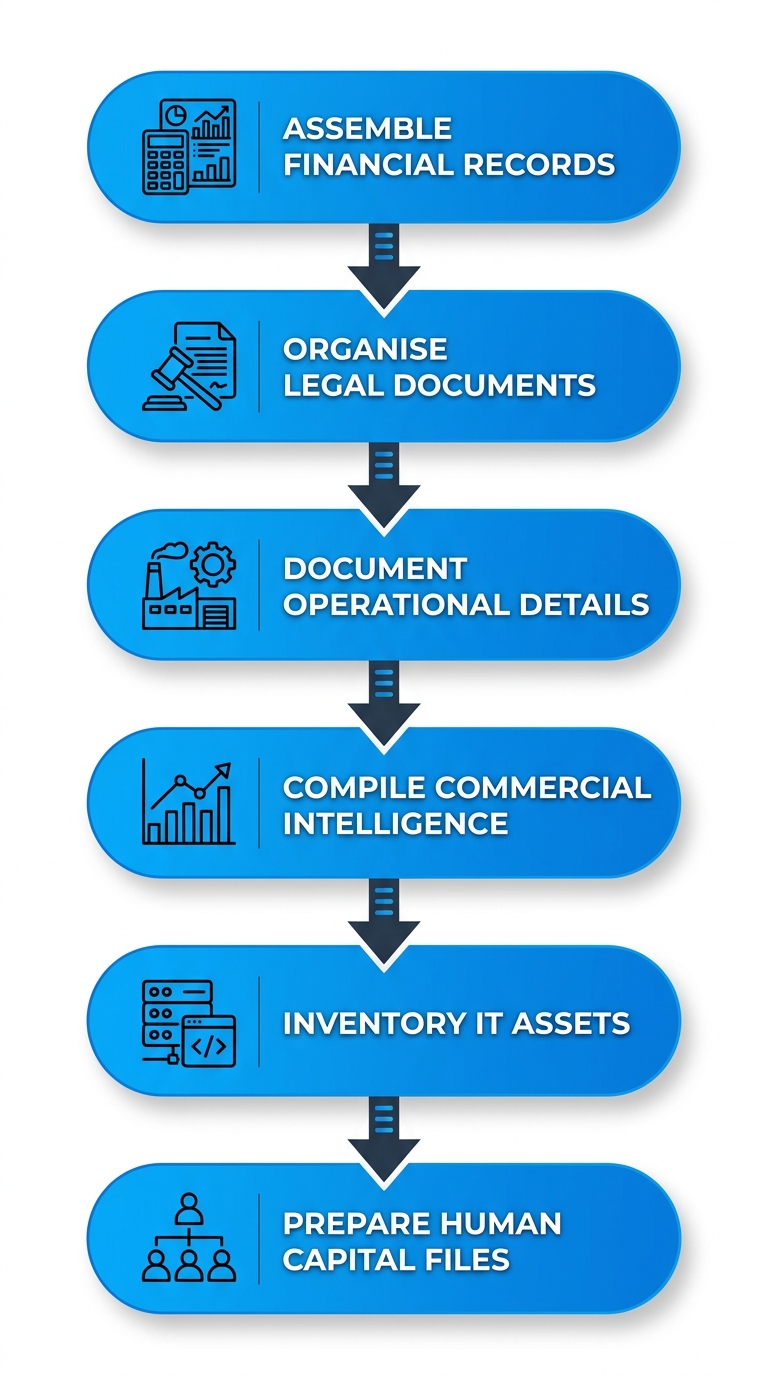
    Vertical process flow diagram illustrating six key steps for preparing M&A due diligence: assembling financial records, organizing legal documents, documenting operations, compiling intelligence, inventorying IT assets, and preparing HR files.

    Six-step vertical flowchart for efficient M&A due diligence preparation

    Key preparation steps include:

    • Assemble complete financial records, including audited statements, tax returns, cash flow projections, and debt schedules for the past three years to support financial due diligence.
    • Organize legal documents such as incorporation papers, shareholder agreements, litigation files, and material contracts.
    • Document operational details like supply chain mappings, key KPIs, inventory ledgers, and facility leases.
    • Compile commercial intelligence, including customer concentration analyses, market reports, sales pipelines, and benchmarking for commercial due diligence.
    • Inventory IT assets with software licenses, cybersecurity protocols, data backups, and architecture diagrams.
    • Prepare human capital files covering org charts, employee contracts, compensation benchmarks, and retention plans.
    • Create a secure data room indexed by category with access logs and assign point persons per diligence category.

    Contact us via Book A Call to initiate your tailored process. This is informational only; consult advisors. Past performance does not guarantee future results.

    Planning and Kickoff Phase

    Building on our Full-Cycle M&A and capital advisory process, the Planning and Kickoff Phase serves as the critical starting point. Here, we collaborate closely with clients to define transaction goals, timelines, and success metrics within 1-2 weeks, incorporating due diligence scoping powered by our Velocity Matrix for streamlined execution.

    We initiate kickoff activities with a structured onboarding call to align objectives. Our team then executes NDAs, sets up the secure Deal Vault data room, and conducts an initial diagnostic review of financials and market position to identify key priorities.

    Planning emphasizes full-cycle due diligence, prioritizing financial due diligence such as pro forma financials review and commercial due diligence including market validation and competitive analysis.

    Using our Precision Catalyst approach, we customize scope leveraging our 4,000+ investor network. With planning complete, we advance to the Due Diligence Execution Phase, ensuring efficient transactions through proprietary data access.

    Financial Analysis Review

    Within our full-cycle due diligence as part of Full-Cycle M&A and capital advisory services, our financial analysis review ensures transaction integrity by rigorously evaluating financial statements, projections, and risks. This due diligence evaluation provides the quantitative backbone for informed decisions in mergers and acquisitions.

    We begin our financial review process with targeted steps:

    • Examining historical financials for revenue trends and cost structures.
    • Validating pro forma projections against market benchmarks.
    • Assessing working capital efficiency and debt sustainability through key ratios like EBITDA margins and cash conversion cycles.

    Our financial due diligence leverages proprietary data access via the Velocity Matrix for faster insights, drawing from $24.4B+ in transaction experience. This pairs with commercial due diligence for holistic risk assessment.

    Book A Call for a custom financial review in your deal. Not investment advice — consult advisors; investments involve risk.

    Complementing financial due diligence, our legal document examination uncovers hidden liabilities in Full-Cycle M&A and capital advisory services. As a vital part of comprehensive due diligence, we scrutinize key documents to mitigate risks, drawing on our access to 4,000+ global investors and $24.4B+ transaction volume.

    Shareholder Agreements: Review control provisions for ownership disputes.

    Material Contracts: Analyze termination clauses for exit risks.

    Litigation Records: Identify pending disputes.

    IP Assignments: Verify ownership clarity.

    Regulatory Filings: Assess compliance history.

    1. Cross-verify authenticity via proprietary Deal Vault access.
    2. Flag non-compete issues in employment contracts.
    3. Coordinate findings with financial due diligence teams for liability impacts.

    This integrates with commercial due diligence for a holistic view, Streamlining Transactions through the Velocity Matrix. Our process reduces execution friction and aligns legal, financial, and commercial teams. Not investment advice—consult advisors. Book A Call today.

    Commercial Market Assessment

    Within our full-cycle due diligence, commercial market assessment builds on financial analysis by analyzing target market size, trends, customer demand, competitive positioning, and entry barriers. This commercial due diligence ensures informed decisions in Full-Cycle M&A and capital advisory.

    We conduct primary research through our institutional network of 4,000+ global investors. Our team reviews proprietary data via Velocity Matrix for market velocity, assesses go-to-market strategies, and benchmarks peers using Precision Catalyst tools. This commercial evaluation pairs with financial due diligence to deliver holistic insights, avoiding siloed analysis while Streamlining Transactions.

    Key benefits include spotting risks in buyer-seller dynamics and unlocking value through Sovereign Data Nexus access. This market lens informs our broader evaluation phases, ensuring comprehensive support.

    Book A Call today for a custom assessment, backed by our $24.4B+ transaction volume expertise.

    This is informational only; consult advisors. Not investment advice. Securities via Finalis Securities LLC; we are not a broker-dealer.

    Operational Efficiency Evaluation

    Building on financial due diligence, our operational efficiency evaluation examines execution capabilities in Full-Cycle M&A and capital advisory transactions. We analyze production processes, supply chain logistics, workforce productivity metrics like output per employee hour, and cost-to-revenue ratios to identify bottlenecks and improvement opportunities.

    Our step-by-step process includes: (1) conducting on-site facility walkthroughs and data room reviews for operational KPIs; (2) benchmarking against peers using anonymized industry data from our $24.4B+ transaction database; (3) modeling post-transaction efficiency gains via scenario analysis integrated with our Velocity Matrix for Streamlining Transactions.

    We integrate operational insights with financial due diligence by quantifying capex savings and with commercial due diligence by validating revenue sustainability through throughput validations. These insights complement commercial due diligence revenue projections.

    We deliver customized reports with 15-25% typical efficiency uplift recommendations. Book A Call for implementation quotes and scheduling.

    IT and Human Capital Review

    Building on financial due diligence and commercial due diligence, our IT and human capital review forms a core component of Full-Cycle M&A and capital advisory services. We assess technology infrastructure, cybersecurity, data systems, workforce talent, and organizational structure to identify risks and opportunities, streamlining transactions as a Precision Catalyst.

    In IT review, we evaluate software scalability, cloud migration readiness, API integrations, and cybersecurity frameworks like zero-trust architecture. Our human capital review includes skills gap analysis via competency matrices, employee turnover metrics from HR data, executive succession planning charts, and cultural alignment scoring.

    These findings integrate with financial due diligence and commercial due diligence phases to produce a unified risk profile report. Our proprietary Velocity Matrix accelerates IT audits and talent assessments using institutional network insights.

    These insights directly inform our transaction advisory and fairness opinions. Book A Call to discuss custom due diligence scopes.

    This is informational only, not investment advice—consult advisors. Securities via Finalis Securities LLC; Zaidwood not a broker-dealer.

    Synthesis and Reporting

    Building on these analyses from commercial due diligence and other phases, our synthesis and reporting phase completes the full-cycle due diligence process. We integrate key insights into unified, actionable reports that empower informed M&A decisions within our Full-Cycle M&A and capital advisory services.

    Our team synthesizes data from financial due diligence alongside commercial due diligence. Using the Velocity Matrix, we streamline the reporting process to produce:

    • Executive summaries and risk matrices highlighting critical findings;
    • Recommendation sections with clear, prioritized actions;
    • Tailored deliverables like comprehensive due diligence reports, fairness opinion inputs, and strategic briefs for buy-side or sell-side clients.

    The Precision Catalyst approach ensures these reports accelerate transaction velocity while mitigating identified risks across all phases. These reports inform our full-cycle M&A advisory and next steps. Book A Call to explore custom due diligence synthesis for your needs.

    Overcoming Common Due Diligence Challenges

    While due diligence is critical in M&A transactions, common pitfalls like incomplete data rooms, regulatory complexities, and integration risks often derail deals. At Zaidwood Capital, our Full-Cycle M&A and capital advisory services provide a comprehensive solution through our Streamlining Transactions approach. We help clients anticipate and mitigate risks early in deals.

    Delays in financial due diligence frequently arise from scattered financial data across multiple sources. We overcome this by conducting thorough financial due diligence using proprietary data access and private servers via our Velocity Matrix, accelerating verification and ensuring accuracy without compromising security. Our teams normalize inputs, prioritize material items, and shorten review cycles to reduce rework.

    Gaps in commercial due diligence often stem from market misalignments that undermine deal viability. Our methodology integrates commercial due diligence with strategic financial consulting, validating market potential and aligning opportunities with client objectives for informed decision-making. We pair market sizing with customer segmentation and competitor analysis for realistic forecasts.

    Operational and IT due diligence oversights can lead to costly post-deal surprises. We address these through full-cycle due diligence encompassing operational, IT, and human capital aspects, leveraging Precision Catalyst tools to identify risks early and facilitate seamless integration. Cross-functional teams build integration playbooks to accelerate day-one readiness effectively.

    With over $24.4B in aggregate transaction volume and access to 4,000+ global investors, we deliver proven expertise. Book A Call today for tailored support on your next transaction.

    Achieving M&A Success Through Thorough Due Diligence

    Building on common M&A transaction risks, thorough due diligence stands as the Precision Catalyst for success. Studies indicate 70-90% of deals fail due to inadequate processes, underscoring the need to identify risks and opportunities early in our Full-Cycle M&A and capital advisory at Zaidwood Capital.

    Financial due diligence involves scrutinizing historical financials, normalizing EBITDA, projecting future cash flows, and detecting off-balance-sheet liabilities to ensure fiscal accuracy.

    Commercial due diligence validates market size, assesses customer concentration risks, evaluates competitive positioning, and confirms revenue sustainability using our proprietary Velocity Matrix tools.

    Our full-cycle approach extends to legal, operational, IT, and human capital due diligence, Streamlining Transactions while mitigating post-deal surprises. With access to our 4,000+ investor network and $24.4B+ transaction volume, we drive integrated advisory outcomes. Past performance does not guarantee future results.

    Book A Call for tailored due diligence support.

    This article was researched and written with the assistance of AI tools.

    Resources and Insights

  • Bank Mergers: Complete Guide to Trends and Integration

    Bank Mergers: Complete Guide to Trends and Integration

    Table of Contents

    At Zaidwood Capital, we observe a surge in bank mergers driven by consolidation trends reshaping the U.S. banking landscape through 2026. These financial institution consolidations enhance stability amid economic pressures, though they increase market concentration and require careful navigation of regulatory hurdles. With our aggregate transaction volume exceeding $24.4 billion, we provide expert advisory to stakeholders engaging in banking sector M&A activity, ensuring seamless execution and strategic alignment.

    This guide outlines our seven-step advisory process, from initial assessments to post-merger integration, addressing key challenges like Bank Merger FDIC Guidance under Section 18(c) of the Federal Deposit Insurance Act and the Federal Reserve’s six-stage application review. Leveraging our network of over 4,000 institutional investors, we facilitate capital access while mitigating risks. Before proceeding, consider essential prerequisites for effective engagement in these complex transactions and tailored governance frameworks.

    Preparing for Bank Merger Advisory

    Before diving into the complexities of Approaching Bank Mergers, financial advisors must establish a solid foundation in merger preparation in banking. Bank mergers, particularly horizontal consolidations that combine similar institutions, require understanding core regulatory frameworks from bodies like the FDIC and Federal Reserve. As Governor Michelle W. Bowman noted in her recent speech, a balanced regulatory approach is essential to support healthy transactions without undue delays that could harm community banks and local economies. We recommend starting with pre-consolidation assessments, including scanning bank consolidation trends in the US banking sector to gauge market dynamics and potential synergies.

    Essential tools include accessing regulatory resources and building stakeholder maps to identify key players early. Confidentiality protocols are paramount to protect sensitive data throughout the process. Our preliminary due diligence checklist covers:

    • Reviewing financial statements and compliance histories.
    • Mapping potential regulatory hurdles via FDIC filings.
    • Evaluating cultural fit to anticipate bank merger integration challenges.

    Zaidwood Capital’s proprietary Deal Vault provides secure access to investor networks, facilitating capital introductions vital for transaction funding. This integrated approach streamlines preparation.

    For internal readiness, assemble a cross-functional team of legal, financial, and operational experts. This ensures comprehensive advisory that informs subsequent trend evaluations and positions you effectively for success.

    To effectively advise on bank mergers, begin by evaluating current market dynamics. We at Zaidwood Capital, with our $24.4 billion in aggregate transaction volume across over 300 deals, have observed that staying informed on bank consolidation trends is essential for strategic positioning.

    Instructions for Sourcing and Analysis

    1. Review FDIC reports for quarterly data on bank M&A activity and failure rates.
    2. Consult industry analyses from sources like Deloitte or PwC for projections on 2025-2026 sector-wide banking integrations.
    3. Analyze key drivers, such as digital transformation accelerating M&A patterns in finance and regulatory shifts favoring consolidations in regional markets.
    4. Identify emerging hotspots, like trends in US banks adapting to fintech pressures.
    5. Document findings to highlight implications for client merger opportunities.

    Why It Matters

    Assessing these bank consolidation trends provides strategic foresight, enabling advisors to position clients ahead of regulatory changes and digital disruptions. This evaluation uncovers opportunities in evolving M&A landscapes, ensuring informed decisions that mitigate risks and capitalize on growth.

    Practical Tips

    Leverage proprietary databases for real-time insights and tools like our investor network for validated projections. Track bank merger integration challenges early to refine advisory pitches, maintaining a competitive edge in dynamic financial services.

    Assess Economic Impacts of Potential Mergers

    At Zaidwood Capital, our second step in the due diligence process involves meticulously assessing the economic impacts of potential bank mergers. This analysis helps us provide clients with comprehensive insights into job market shifts and capital flow changes, drawing on established frameworks from our Zaidwood FAQ on due diligence to ensure thorough evaluations.

    Step-by-Step Impact Modeling

    We begin by gathering key economic indicators such as employment data, GDP contributions, and lending volumes. Next, we model scenarios using econometric tools to project job displacements or creations in affected regions. We then evaluate ripple effects on local economies, like reduced competition in community banking, alongside broader national market dynamics, including shifts in capital allocation. Finally, we incorporate balanced perspectives, weighing short-term disruptions against long-term consolidation economic consequences to inform advisory recommendations.

    Why It Matters

    Assessing these impacts underscores the strategic advisory value of our services, enabling clients to anticipate how bank mergers influence investor confidence and market stability. Our evaluations reveal opportunities for resilient growth, aligning with the needs of institutional networks.

    Practical Tips for Data Visualization

    • Use interactive dashboards to illustrate job shift projections, making complex data accessible.
    • Employ heat maps for local economic effects, highlighting regional variations.
    • Incorporate trend lines for capital flows to demonstrate long-term bank merger integration outcomes.

    We reference Private Equity Firms perspectives from our network to enrich these models, ensuring no outcome guarantees but focused, informed guidance.

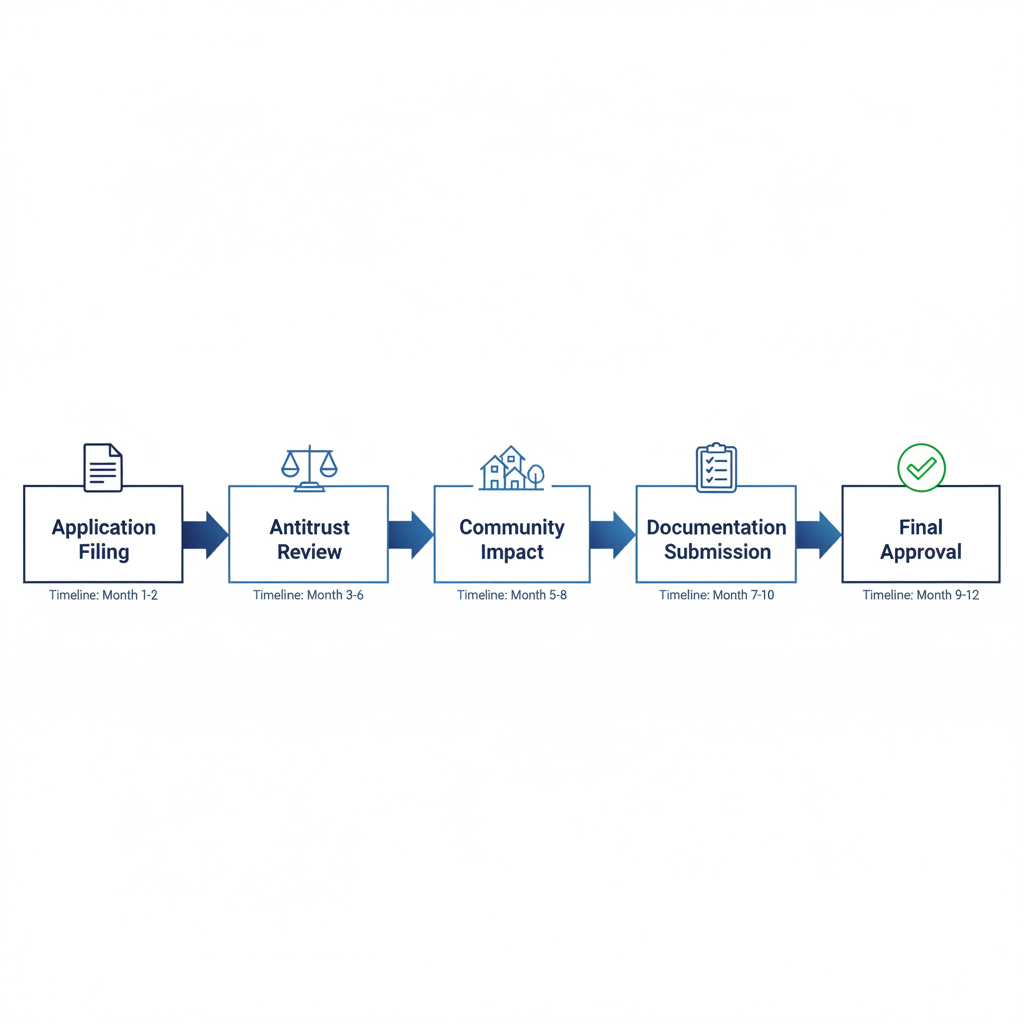
    At Zaidwood Capital, we guide clients through the intricate regulatory landscape of bank mergers, ensuring compliance with key authorities like the FDIC and Federal Reserve. As bank consolidation trends evolve, understanding approval frameworks for banking deals is essential for seamless execution.

    Key Filing Steps

    1. Prepare the Application: Compile detailed documentation on financials, strategic rationale, and risk assessments. Engage legal experts early to align with FDIC and Federal Reserve guidelines.
    2. Submit to Regulators: File with the primary federal banking agency, such as the Federal Reserve Bank Merger Process, which outlines six stages from receipt to consummation, typically spanning 4-6 months.
    3. Undergo Reviews: Navigate antitrust evaluations by the DOJ and FTC, alongside community impact assessments under the Community Reinvestment Act to evaluate local effects.
    4. Address Feedback and Finalize: Respond to any requests for additional information and await final action, avoiding common pitfalls like incomplete disclosures that delay approvals.

    We emphasize these steps to streamline bank merger integration and mitigate regulatory hurdles.

    Navigating these processes mitigates risks of denial or prolonged scrutiny, safeguarding transaction timelines and preserving stakeholder confidence in an era of heightened oversight.

    Practical Tips

    Maintain a comprehensive documentation checklist, including pro forma financials, market analyses, and CRA compliance reports. Consult specialized counsel to preempt issues, ensuring robust preparation for evolving bank mergers regulatory approval demands.

    Horizontal diagram illustrating five key stages of bank merger regulatory approval process with icons and connections.

    Key stages in navigating bank merger regulatory approval

    This structured approach positions clients for efficient progression to due diligence phases.

    Conduct Comprehensive Due Diligence

    In the sequence of bank merger transactions, conducting comprehensive due diligence follows regulatory compliance and forms a critical analytical phase. At Zaidwood Capital, we guide clients through this full-cycle process, drawing on our expertise in mergers and acquisitions advisory to uncover potential risks and opportunities.

    We structure due diligence into distinct phases to ensure thorough coverage. Our bulleted checklist includes:

    • Financial Audits: Review balance sheets, cash flows, and asset valuations using tools like forensic accounting software to identify discrepancies in pre-merger audits.
    • Legal Reviews: Examine contracts, litigation history, and compliance records with document management systems for efficient risk flagging.
    • Operational Assessments: Evaluate branch networks, IT infrastructure, and human capital alignment, incorporating early bank merger integration planning.
    • Commercial and Market Analysis: Assess customer bases and competitive positioning via data analytics platforms.
    • Stakeholder Reporting: Compile findings into executive summaries for timely communication.

    This phased approach reduces risks in bank mergers by mitigating hidden liabilities and aligning expectations upfront. As outlined in our Zaidwood Capital FAQ on integration, full-cycle services like these prevent costly surprises post-transaction.

    For optimal results, we coordinate multidisciplinary experts early, including financial modelers and legal advisors. This collaboration streamlines reviews and supports seamless transitions to deal structuring.

    Structure the Merger Advisory Agreement

    Following thorough due diligence, we formalize the merger advisory agreement to establish a clear path for bank mergers. This document outlines essential terms, including fee structures such as success-based commissions tied to transaction value and retainers for ongoing support. Scope definitions specify our role in valuation, negotiation, and integration planning, while investor introductions leverage our network of over 4,000 institutional contacts, including Private Equity Firms, to facilitate capital deployment. Documentation needs encompass non-disclosure agreements, exclusivity clauses, and timelines to ensure smooth execution.

    Aligning the agreement with client goals is crucial amid bank consolidation trends, as it mitigates risks and optimizes outcomes in evolving deal frameworks in banking. By customizing terms, we ensure the structure supports strategic objectives, from cost synergies to regulatory compliance, fostering confidence in future transactions.

    Effective negotiation tips include prioritizing flexible fee milestones and clear termination provisions. We emphasize mutual benefits, drawing on our full-cycle M&A and capital advisory expertise to craft balanced agreements that drive value without overcommitting resources. This step paves the way for seamless post-merger integration.

    Plan Post-Merger Integration Strategies

    As transaction advisors at Zaidwood Capital, we emphasize that effective bank merger integration is crucial for realizing synergies and ensuring long-term success. This step involves creating a detailed roadmap that aligns systems, processes, and teams post-closing. Our approach draws from extensive experience in mergers and acquisitions, including insights from Private Equity Firms that focus on operational enhancements after acquisitions.

    Developing the Integration Roadmap (Instructions): Begin with a 90-day plan outlining key milestones, such as IT system migrations and HR policy harmonization. Address IT considerations by consolidating core banking platforms to minimize downtime, while HR focuses on talent retention and cultural alignment. Incorporate risk mitigation through scenario planning for regulatory hurdles and operational disruptions. Track success with metrics like cost savings achieved, customer retention rates, and employee engagement scores. We recommend cross-functional teams to oversee execution, ensuring seamless transition from planning to monitoring.

    Why Prioritize Integration (Value Preservation): Bank mergers often face value erosion if integration falters, with studies showing up to 30% synergy loss without proper planning. Post-consolidation strategies preserve stakeholder value by maintaining service continuity and fostering innovation.

    Practical Tips for Communication: Use town halls and newsletters to keep employees informed, reducing uncertainty. Engage customers early with personalized updates on service changes. Regular progress reports to executives build trust and enable timely adjustments.

    Monitor and Optimize Post-Merger Outcomes

    As the final step in our full-cycle M&A and capital advisory process, we at Zaidwood Capital emphasize ongoing monitoring to ensure bank merger integration delivers sustained value. Establishing key performance indicators (KPIs) such as revenue synergies, cost savings realization, and customer retention rates forms the foundation of effective outcome tracking in M&A. We help clients implement dashboards and reporting tools to monitor these metrics in real time, allowing for data-driven insights into post-merger performance. This structured approach addresses potential synergies and operational efficiencies from the outset.

    Monitoring is essential for sustained success because unaddressed issues can erode merger benefits over time. By tracking progress against predefined benchmarks, we identify deviations early, preventing value erosion amid evolving bank consolidation trends. Our advisory continuity supports clients in navigating these dynamics without compromising long-term objectives.

    For optimal results, we recommend quarterly reviews to assess progress and annual deep dives for strategic adjustments. These cadences enable us to address emerging issues in bank mergers promptly, facilitate necessary refinements, and document lessons learned for future transactions. This proactive stance not only optimizes outcomes but also builds resilience in a competitive landscape.

    Addressing Common Challenges in Bank Merger Advisory

    In the complex landscape of bank mergers, we at Zaidwood Capital frequently encounter obstacles that can derail even the most promising deals. Drawing from our aggregate $24.4 billion in transaction experience, this section outlines key advisory pitfalls in finance and provides actionable merger complication strategies to navigate them effectively. By anticipating these issues, clients can streamline processes and achieve successful outcomes.

    Common challenges in bank mergers include several recurring hurdles that demand proactive management:

    • Regulatory Bottlenecks: Delays in obtaining approvals from bodies like the FDIC or Federal Reserve often stem from incomplete filings or antitrust concerns. These can extend timelines by months, impacting deal momentum.
    • Integration Conflicts: Post-merger bank merger integration poses risks such as system incompatibilities or cultural clashes, leading to operational disruptions and employee turnover.
    • Economic Volatility: Shifts influenced by bank consolidation trends, like interest rate fluctuations or market downturns, can alter valuations and financing structures mid-process.
    • Documentation Errors: Inaccuracies in financial models or legal agreements may trigger renegotiations or regulatory scrutiny, eroding trust among parties.
    • Stakeholder Resistance: Internal teams or shareholders may oppose the merger due to uncertainty, complicating consensus-building.

    To resolve these, we employ proven frameworks informed by best practices in the industry. For regulatory bottlenecks, contingency planning involves early engagement with experts and parallel submission tracks to mitigate delays. Addressing integration conflicts requires phased approaches, starting with IT assessments and joint training programs to ensure seamless bank merger integration. In the face of economic volatility, scenario modeling allows us to stress-test deals against bank consolidation trends, adjusting terms proactively. Documentation errors are prevented through rigorous checklists and third-party audits, while stakeholder resistance is overcome with transparent communication strategies, including town halls and progress updates. These steps, applied across our 300+ completed deals, reinforce resilience and alignment with client goals.

    Advancing Your Bank Merger Strategy

    Navigating bank mergers requires a structured approach, as outlined in this seven-step guide. From initial preparation to seamless bank merger integration, each phase builds on the last to ensure strategic alignment and operational success. We at Zaidwood Capital emphasize the interconnectedness of these steps, drawing on our full-cycle M&A advisory to help institutions achieve resilient outcomes in strategic banking M&A.

    Key takeaways include adapting to evolving economic pressures and stringent regulatory landscapes, which demand proactive monitoring of market dynamics. By staying ahead of these factors, banks can mitigate risks and capitalize on synergies effectively.

    As your trusted advisor, we invite you to leverage our expertise in capital introductions and access to over 4,000 institutional investors. Contact Zaidwood Capital today to advance your consolidation objectives.

    Looking ahead, bank consolidation trends point to robust opportunities in 2026, particularly in the US market, where innovative structures will drive growth.

    Resources

  • Harris and Partners Alternatives: Top Boutique Banks for M&A

    Harris and Partners Alternatives: Top Boutique Banks for M&A

    Table of Contents

    In the dynamic landscape of middle market M&A, where transactions typically range from $10 million to $500 million, companies seek agile partners to navigate complex deals. Firms like harris and partners exemplify how boutique investment banks provide tailored advisory in this space, focusing on niche sectors and personalized service. At Zaidwood Capital, we specialize in streamlining these transactions for private equity firms, family offices, and businesses with revenues exceeding $1 million.

    Middle market M&A involves mergers, acquisitions, and strategic partnerships that drive growth for mid-sized enterprises. Boutique investment banks, or specialized M&A advisors, differ from larger institutions by offering focused expertise and faster execution without bureaucratic delays. Niche investment firms like ours emphasize relationship-driven approaches to ensure seamless outcomes.

    We at Zaidwood Capital bring unmatched credentials, with an aggregate transaction volume of $24.4 billion across more than 300 completed deals. Our full-cycle M&A advisory services encompass due diligence in financial, legal, and operational areas, alongside capital introductions to our network of over 4,000 institutional and private investors and access to $15 billion in deployable capital. Through Zaidwood Capital Services, we integrate digital marketing and capital markets savvy for efficient buy-side and sell-side mandates.

    This guide explores fundamentals of boutique banking, advanced strategies, and best practices. We transition next to core principles, equipping you to leverage opportunities in this evolving market.

    Core Principles of Middle Market M&A Advisory

    Middle market mergers and acquisitions represent a dynamic segment of the financial landscape, focusing on companies with annual revenues between $10 million and $500 million. These transactions often involve complex negotiations tailored to the unique needs of growing businesses, where boutique M&A advisory firms play a pivotal role. Our team at Zaidwood Capital specializes in guiding clients through these processes, leveraging our extensive experience to ensure seamless execution.

    At the core of middle market M&A are key deal structures, including asset purchases, stock acquisitions, and mergers of equals. Buy-side processes involve identifying targets, conducting initial valuations, and negotiating terms, while sell-side engagements focus on preparing confidential information memorandums and soliciting bids. Due diligence forms the backbone of these transactions, encompassing financial audits to verify revenue streams, legal reviews for compliance and liabilities, and operational assessments of supply chains and management teams.

    Boutique vs Traditional Banks: Key Service Differences

    Service AreaBoutique Approach (e.g., Zaidwood)Traditional Bank Approach
    M&A AdvisoryTailored buy/sell-side with full due diligence (300+ deals experience)Broad mandates with standardized processes
    Capital FormationDirect access to 4,000+ investors via Velocity MatrixLimited network introductions

    Building on these differences, boutique firms excel in integrating capital raising with advisory services. This holistic approach not only streamlines transactions but also enhances strategic positioning in competitive markets.

    Infographic comparing boutique versus traditional bank approaches in middle market M&A advisory services

    Boutique vs traditional M&A advisory comparison for middle market

    In-Depth Analysis of Capital Formation Strategies

    Equity and Debt Advisory Essentials

    We structure mezzanine debt as a hybrid financing tool, positioned between senior debt and equity to provide flexible capital for expansion. This subordinated option offers businesses higher leverage while minimizing ownership loss, ideal for firms scaling operations post-acquisition. Venture debt complements this by extending cash runways for early-stage companies, often without warrants that dilute equity.

    Financing TypeZaidwood CapabilitiesTypical Harris-Style Firm
    Debt AdvisoryMezzanine, asset-based with $15B networkLimited to basic loans
    Equity AdvisoryGrowth equity introductions to 4,000+ investorsStandard placements

    Due Diligence in Boutique Deals

    Our full-cycle due diligence process is a cornerstone of successful boutique deals, encompassing financial, operational, and legal reviews to identify synergies and red flags early. We begin with financial modeling, scrutinizing pro forma statements and cash flow projections to validate deal viability. Legal reviews follow, examine contracts, IP rights, and regulatory compliance. In specialized financing firms, we extend this to emerging markets M&A, where geopolitical factors demand rigorous scrutiny.

    Implementing M&A and Capital Strategies in Practice

    Step-by-Step Deal Execution Guide

    • Investor Matching: Drawing from our network of over 4,000 institutions and $15B in deployable capital, we curate tailored introductions.
    • Due Diligence Execution: We conduct full-cycle reviews, encompassing financial audits, legal compliance checks, and operational evaluations using SEC regulatory resources.
    • Documentation Preparation: Clients receive customized pitch decks, pro forma financials, business plans, and fairness opinions.
    Tool/AspectZaidwood OfferingStandard Boutique
    Investor Network4,000+ institutions, $15B capitalSmaller, regional focus
    DocumentationPitch decks, pro formas via Deal VaultBasic templates

    Case Studies in Middle Market Success

    Through rolodex-driven introductions to family offices and venture capital sources, we structured a hybrid mezzanine debt facility for a manufacturing firm that bridged senior loans and equity, minimizing dilution. In another case, we developed a compelling narrative around intellectual property for a tech firm, utilizing investor outreach to sovereign wealth funds and endowments for competitive bidding.

    Advanced Topics in Boutique Debt and Equity Advisory

    Advanced due diligence forms the backbone of our process, encompassing human capital assessments to evaluate team dynamics and commercial viability to scrutinize market positioning. Capital introductions represent a cornerstone of our elite advisory networks, connecting clients to sovereign wealth funds and endowments. profissionais who cultivate deep relationships with private equity sponsors position themselves for success. Our investment bankers 2025 insights validate this strategy.

    Advanced FeatureZaidwood StrengthBoutique Baseline
    Investor Access$15B deployable via 4,000+ connectionsLimited introductions

    Common Questions on Boutique M&A Services

    • How do I select a boutique investment bank? Evaluate track records and sector focus. At Zaidwood Capital, our $24.4B transaction volume provides proven expertise.
    • Timeline for due diligence? Usually 4-8 weeks, covering financial, legal, and operational reviews.
    • Regulatory considerations? Utilize FINRA regulatory tools for filings and disclosures.

    Leveraging Boutique Expertise for Your M&A Success

    In navigating middle market M&A, boutique investment banks offer tailored strategies that drive efficient transactions. At Zaidwood Capital, we provide full-cycle advisory, from due diligence to capital formation, empowering clients with innovative tools like our Velocity Matrix for rapid execution. contact us today to explore how our expertise can support your success.

    Resources

  • Top Buy-Side M&A Strategies for 2026: Expert Insights

    Top Buy-Side M&A Strategies for 2026: Expert Insights

    Table of Contents

    In the dynamic world of buy-side M&A, acquirers face intense challenges in sourcing viable targets amid market volatility and competitive pressures. This acquirer-focused approach empowers strategic expansion through precise target acquisition planning, contrasting sell-side processes where sellers prioritize valuation maximization and buyer outreach. While sell-side deals often span 6-9 months with broad auctions, buy-side emphasizes targeted diligence to mitigate risks.

    At Zaidwood Capital, we provide expert mergers and acquisitions advisory tailored for buy-side acquisition strategy, guiding clients from opportunity identification through due diligence, valuation, negotiation, and integration. With over 300 completed deals and $24.4B in transaction volume, our team leverages a network of 4,000+ investors to access $15B+ in deployable capital, ensuring full-cycle support for informed decisions.

    Discover the six key benefits of partnering with our boutique firm, starting with superior target sourcing that lays the foundation for successful buy-side due diligence and execution.

    1. Precise Target Identification

    In buy-side M&A, identifying the right acquisition targets amid vast opportunities poses significant challenges for growth-focused firms. Without precise sourcing, companies risk prolonged searches and missed synergies, complicating expansion strategies.

    Our approach streamlines this through rigorous criteria including market fit, financial health, and synergy potential, ensuring targets align with your buy-side acquisition strategy. We leverage the proprietary Deal Vault for access to vetted opportunities and conduct sector mapping with preliminary screening to accelerate discovery. As highlighted in resources on selecting M&A advisor, effective advisors embody competence, compassion, and integrity to guide strategic target hunting. Our extensive network of over 4,000 investors and $15B in deployable capital further enhances acquisition opportunity scouting, drawing from more than 300 completed transactions for proven results.

    For instance, we recently matched a mid-market client with a complementary asset in under three months via network introductions, enabling swift evaluation and integration planning before advancing to due diligence.

    2. Thorough Due Diligence Execution

    In the realm of buy-side due diligence, thorough validation is essential to uncover hidden risks and maximize acquisition value. At Zaidwood Capital, we execute comprehensive reviews that integrate financial, legal, operational, commercial, IT, and human capital assessments, drawing on our 300+ completed deals to support clients in navigating complex transactions.

    Horizontal process flow diagram showing three stages of buy-side due diligence in mergers and acquisitions: financial review, legal and operational assessment, and risk mitigation.

    Key phases of thorough due diligence execution in M&A buy-side process

    Our process begins with secure data room access, allowing detailed examination of target financials and operations. We then conduct third-party verifications and multi-faceted risk assessments, incorporating antitrust considerations from established guidelines to ensure compliance. As a leading boutique M&A advisory firm, we streamline buy-side M&A by providing integrated diligence, including checklists for red flags like discrepancies in revenue reporting or unresolved litigation.

    • Verify financial statements against independent audits.
    • Assess legal contracts for potential liabilities.
    • Evaluate operational efficiencies and IT security.

    A key tip from our engagements: Always probe management representations early to detect inconsistencies that could derail deals, fostering informed buy-side acquisition strategies before advancing to valuation.

    This rigorous approach transitions seamlessly into precise target valuation, the next critical layer in our acquisition vetting protocols.

    3. Strategic Valuation Insights

    In buy-side M&A, overlooking valuation pitfalls can lead to overpaying for targets or missing synergy opportunities, undermining deal success. Our team at Zaidwood Capital leverages advanced techniques and capital advisory services to ensure precise deal pricing analysis, drawing from $24.4 billion in aggregate transaction volume for informed acquisition worth assessment.

    We apply discounted cash flow (DCF) modeling to project future cash flows, comparable company analysis for market benchmarks using our network of over 4,000 investors, and precedent transactions to gauge historical premiums. In buy-side acquisition strategy, we quantify synergies through detailed revenue and cost projections, integrating pro forma financials to model post-merger performance. This data-driven approach supports negotiations by establishing defensible value ranges that optimize capital deployment.

    A key tip for synergy modeling: Focus on realistic cost savings from operational overlaps, validated by our market intelligence, to avoid inflated expectations that erode value during integration.

    4. Effective Negotiation Support

    In buy-side M&A transactions, negotiation risks abound, including overpaying due to incomplete information or overlooking hidden liabilities that erode value post-closing. These challenges can derail even the most promising deals without expert intervention. At Zaidwood Capital, we mitigate these risks by leveraging insights from buy-side due diligence to inform strategic positioning.

    We provide seasoned guidance from our leadership team, drawing on industry-standard practices to navigate term sheets, letters of intent (LOIs), and closing conditions. Key negotiation levers include price adjustments tied to working capital contingencies and structured earn-outs that align seller incentives with performance milestones. We emphasize robust representations and warranties to protect against undisclosed issues, while our expertise in strategic documentation ensures precise deal term bargaining. This approach secures favorable outcomes and seamlessly transitions to post-merger integration planning. Our investment bank advisory experience highlights the importance of senior professionals in volatile transaction environments, where retaining expertise drives successful acquisition closing tactics.

    A practical tip for buy-side M&A: When drafting an LOI, insist on broad exclusivity periods with clear milestones to prevent seller distractions, allowing time to refine your acquisition strategy based on diligence findings.

    5. Seamless Integration Planning

    Following the successful negotiation of a buy-side M&A deal, the integration phase presents significant challenges, including aligning operations and capturing merger synergy realization. At Zaidwood Capital, we guide clients through this critical transition to ensure value creation without disruptions.

    Our integration roadmap begins with comprehensive target onboarding frameworks, focusing on team onboarding and seamless system mergers. We advise on operational alignment to streamline processes and enhance efficiency. For financing, our debt advisory expertise supports post-deal restructuring, optimizing capital structures to reduce costs and improve liquidity. Additionally, our equity advisory services facilitate liquidity solutions, enabling stakeholders to realize gains strategically. These steps form a structured buy-side acquisition strategy that maximizes post-acquisition value.

    A key best practice involves prioritizing cultural fit during integration. We recommend early engagement with leadership teams to foster collaboration, mitigating resistance and building a unified vision. This approach not only accelerates synergy realization but also lays the foundation for long-term success in the evolving M&A landscape.

    6. Robust Risk Management

    In buy-side M&A transactions, potential pitfalls like regulatory hurdles and financial discrepancies often threaten value creation. We at Zaidwood Capital, one of the buy-side M&A firms, recognize these challenges and integrate proactive risk management into every stage of the process, ensuring clients achieve sustainable outcomes through informed decision-making.

    Our approach begins with thorough buy-side due diligence to uncover hidden liabilities early, followed by strategic consulting that assesses and addresses acquisition hazard controls. We deliver fairness opinions for objective valuation insights, while our capital introductions connect clients to a diverse network of over 4,000 investors, mitigating funding dependencies. Leveraging the Zaidwood Deal Vault, we provide access to risk-vetted opportunities, strengthening overall deal risk frameworks and supporting resilient buy-side acquisition strategies. This ongoing advisory minimizes disruptions and maximizes transaction success.

    For effective contingency planning, develop multiple scenarios with backup financing and regulatory compliance checklists. This preparation allows quick pivots, safeguarding investments in dynamic markets.

    Partnering for Acquisition Excellence

    In summary, our buy-side M&A advisory services at Zaidwood Capital deliver six core benefits that drive process efficiency, value optimization, and strategic alignment. From expert target sourcing and comprehensive buy-side due diligence to robust risk management, we empower your buy-side acquisition strategy with proven acquirer success pathways. Our track record includes over 300 completed deals, aggregating $24.4 billion in transaction volume, and access to a network of more than 4,000 institutional investors.

    When selecting an M&A advisor, prioritize firms with deep industry expertise, extensive investor connections, and full-cycle capabilities like ours. Evaluate based on alignment with your commercial goals, demonstrated results, and tailored support for seamless execution.

    Ready to elevate your acquisitions? Contact us at Zaidwood Capital today for a confidential consultation and personalized guidance on your next strategic move.

    Resources