Zaidwood Capital

Tag: Zaidwood Capital

  • M&A Due Diligence Services: Complete Guide for 2026

    M&A Due Diligence Services: Complete Guide for 2026

    Table of Contents

    Essential Guide to M&A Due Diligence Services

    Building on the role of investment banks in M&A, a critical component of any transaction is the comprehensive evaluation delivered by M&A due diligence services. Due diligence is the detailed examination of a target company’s financials, operations, legal standing, and strategic fit to identify potential risks and validate the transaction thesis.

    The process encompasses four main pillars: financial due diligence, which scrutinizes historical and projected financial performance; legal due diligence, which reviews contracts, intellectual property, and regulatory compliance; operational due diligence, which assesses internal processes and scalability; and strategic/commercial due diligence, which evaluates market positioning and synergy potential. While thorough, due diligence is a risk mitigation tool, not a guarantee of success.

    Zaidwood Capital, a Boutique M&A and Capital Advisory Firm, streamlines transactions—particularly the due diligence phase—by offering the Sovereign Data Nexus secure data room that enables controlled document exchange. As investment banks, we coordinate due diligence across financial, legal, and operational workstreams, acting as gatekeepers and advisors. Understanding what is an investment bank helps clarify how we structure and oversee each step of this rigorous process.

    By converting raw data into actionable insights, thorough due diligence empowers decision-makers to negotiate from a position of clarity. The following sections break down each type of due diligence and how boutique firms streamline them.

    Core Components of M&A Due Diligence

    The cornerstone of a successful transaction is a thorough due diligence process. When clients engage us for M&A due diligence services, we structure the review around five interconnected areas: Financial, Legal, Operational, Commercial, and Strategic. Each area addresses distinct risks and opportunities that collectively shape the investment thesis.

    Comparison Table: Key Diligence Areas at a Glance
    Diligence AreaFocusKey Questions Answered
    FinancialHistorical and projected financial statements, working capital, debt structureAre revenue and margin trends sustainable? Are there hidden liabilities?
    LegalContracts, litigation history, IP ownership, regulatory complianceAre there pending lawsuits or IP encumbrances? Do contracts contain change-of-control clauses?
    OperationalSupply chain, IT systems, workforce, facilitiesHow resilient is the supply chain? Are key person dependencies manageable?
    CommercialCustomer concentration, market competitiveness, sales pipelineAre top customers locked in or at risk? Is the revenue base diversified?
    StrategicFit with acquirer’s long-term plan, cultural alignment, synergy potentialWill the target accelerate or dilute the acquirer’s strategic objectives?

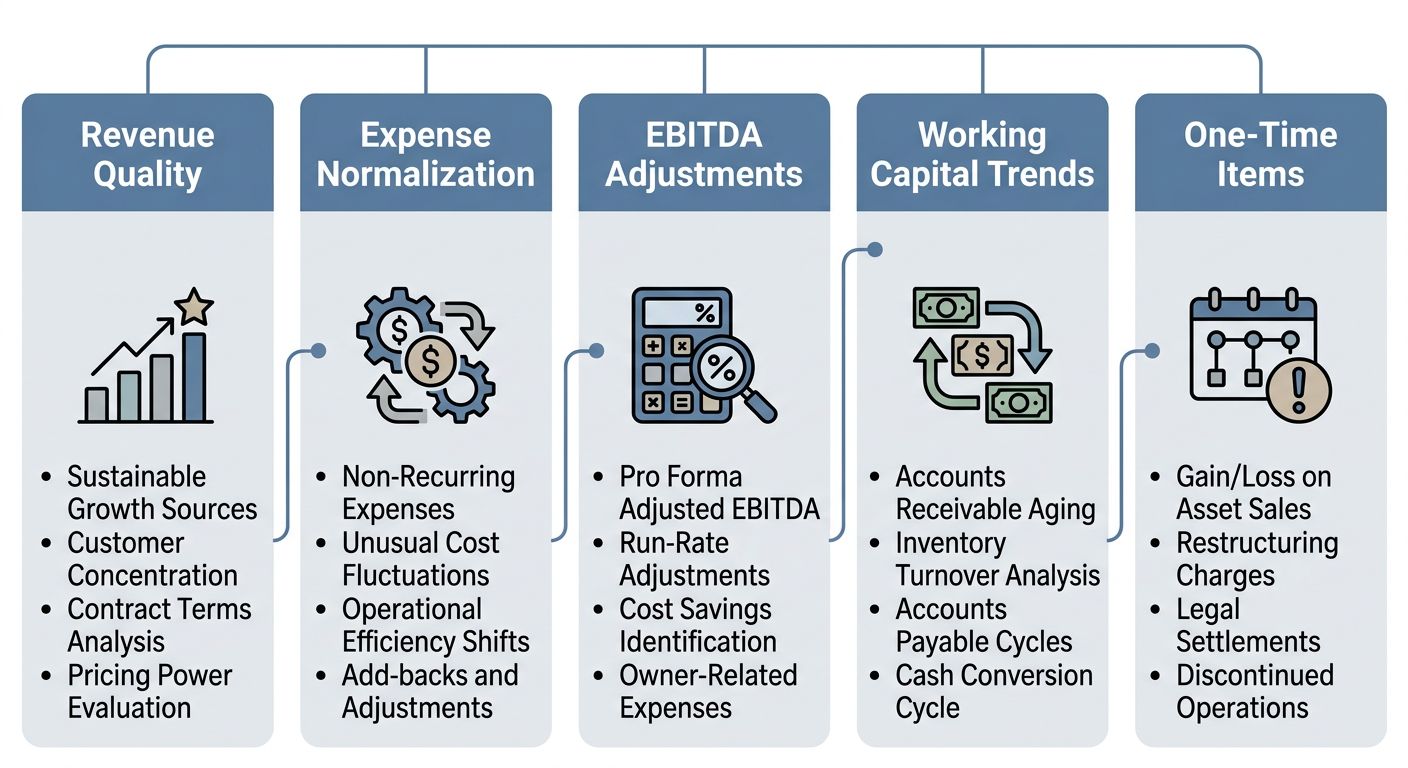
    Financial diligence scrutinizes historical and projected income statements, balance sheets, and cash flows to validate performance trends. We assess working capital adequacy, debt structure, and off-balance-sheet exposures that could mask hidden liabilities. The goal is to confirm that reported earnings translate into sustainable cash generation and to quantify any adjustments needed to normalize the target’s financial position.

    Legal diligence examines the target’s contract portfolio, litigation history, intellectual property ownership, and regulatory compliance. We pay special attention to change-of-control provisions that could trigger termination or consent rights. All legal and financial reviews are conducted in alignment with CFA Institute professional standards for objectivity and thoroughness, ensuring no material legal risk is overlooked.

    Operational diligence probes the resilience of the supply chain, the robustness of IT systems, and the composition of the workforce. We evaluate key person dependencies and facility redundancies that could disrupt post-close operations. Understanding these operational levers allows us to quantify integration risks and identify quick wins that enhance value from day one.

    Commercial diligence assesses customer concentration, the health of the sales pipeline, market competitiveness, and revenue diversification. By analyzing contract renewals and switching costs, we determine whether top customers are locked in or at risk of churn. A diversified revenue base reduces post-transaction volatility and strengthens the platform’s long-term growth trajectory.

    Strategic diligence evaluates how well the target aligns with the acquirer’s long-term plan, cultural values, and synergy potential. We map revenue and cost synergies to concrete integration milestones, ensuring that the deal advances the acquirer’s strategic objectives rather than diluting them. A systematic review across all five areas uncovers both hidden risks and value-creation opportunities.

    Each component warrants a deeper dive; in the following pages we examine the specific methodologies and best practices for each diligence area. Our approach, refined through extensive technology M&A experience as captured in our guide to tech transaction steps, ensures that no dimension of risk escapes scrutiny.

    In-Depth Process Walkthrough of M&A Due Diligence

    Now we examine the three phases that make up a comprehensive due diligence process. A walkthrough of our M&A due diligence services reveals how scoping, review, and integration work together to mitigate risk.

    Phase 1: Scoping and Data Room Preparation

    Comparison Table: Financial vs. Operational Due Diligence
    DimensionFinancial DiligenceOperational Diligence
    Primary goalValidate historical accuracy and future earnings capacityAssess the sustainability of operations and efficiency of processes
    Key documentsAudited P&L, balance sheet, cash flow, tax returnsSOPs, org chart, IT architecture, supplier contracts
    Typical teamCPAs, valuation analysts, FP&A specialistsOperations consultants, supply chain experts, HR specialists
    OutputQuality of earnings report, debt capacity analysisOperational risk matrix, integration readiness score

    Phase 1 begins with scoping sessions where our deal team and the buyer’s leadership jointly identify the value drivers and critical risk areas—such as customer concentration, key-person dependency, or regulatory exposure—that will shape the diligence agenda. From those discussions, we build a detailed data request list that typically includes multiple years of audited financial statements (P&L, balance sheet, cash flow), material customer and vendor contracts, IP registrations, employment agreements, and corporate governance documents. A secure virtual data room—our deal vault—is then deployed on our Sovereign Data Nexus platform. The environment is structured with a folder hierarchy that mirrors the diligence workstreams: financial, legal, commercial, and operations. We configure tiered access controls so that legal reviewers, for example, can only access contract folders, while financial analysts see only the finance section. We also align the workstream teams on review timelines, assign responsibilities, and confirm that all requested materials have been uploaded. This disciplined preparation is the foundation that makes the subsequent document review efficient and secure.

    Phase 2: Document Review and Issue Identification

    In Phase 2, our specialists simultaneously review financial statements, legal contracts, operational KPIs, and commercial agreements to surface risks and validate the target’s representations. Financial analysts verify historical earnings, working capital trends, and revenue quality by examining audited P&L, balance sheets, and tax returns, flagging any non-recurring items or accounting policy inconsistencies. Legal counsel scrutinizes customer and vendor contracts for change-of-control triggers, assignment restrictions, and indemnity provisions, and they review employment agreements for retention risks and non-compete enforceability. On the operational side, we assess KPIs such as revenue per employee, system uptime, and supply-chain resilience, comparing them against industry benchmarks to spot inefficiencies. Throughout the phase, we use the data room’s built-in Q&A module to submit targeted questions to the seller’s management; each response is logged and cross-referenced. This iterative process often brings hidden liabilities to the surface. The data room’s Q&A module tracks each query and response, and we cross-reference answers against the original documents to verify consistency. The issue log is shared with the buyer’s deal team in real time, enabling collaborative prioritization. As we illustrate in our complete guide on tech mergers and acquisitions, deep document review frequently uncovers unreported contingent liabilities or non-compliant IP assignments that can affect valuation. In regulated sectors, we also overlay compliance checks against FTC, CMS, and FCC standards, informed by our internal research on how regulatory shifts influence transaction risk. All identified issues are entered into a shared issue log, assigned severity ratings, and prioritized for the subsequent reporting phase.

    Phase 3: Reporting, Remediation, and Deal Integration

    In Phase 3, our team synthesizes all findings into a comprehensive diligence report, beginning with an executive summary that highlights the most critical risks and opportunities. The report segments findings by financial, legal, and operational dimensions, each with a severity rating. Red flags—such as excessive customer concentration, material litigation, or compliance exposures—are escalated immediately and can influence valuation adjustments or the inclusion of special indemnities in the purchase agreement. Our reporting delivers the core M&A due diligence services as actionable intelligence that shapes the client’s negotiation posture. We typically hold a findings review session with the buyer’s leadership to walk through every issue and agree on remediation priorities. To bridge the gap between diligence and post-close execution, we use our Velocity Matrix to translate key risks into a structured 100-day integration plan. Once the diligence report is finalized, the findings directly inform the negotiation of the purchase agreement and integration planning.
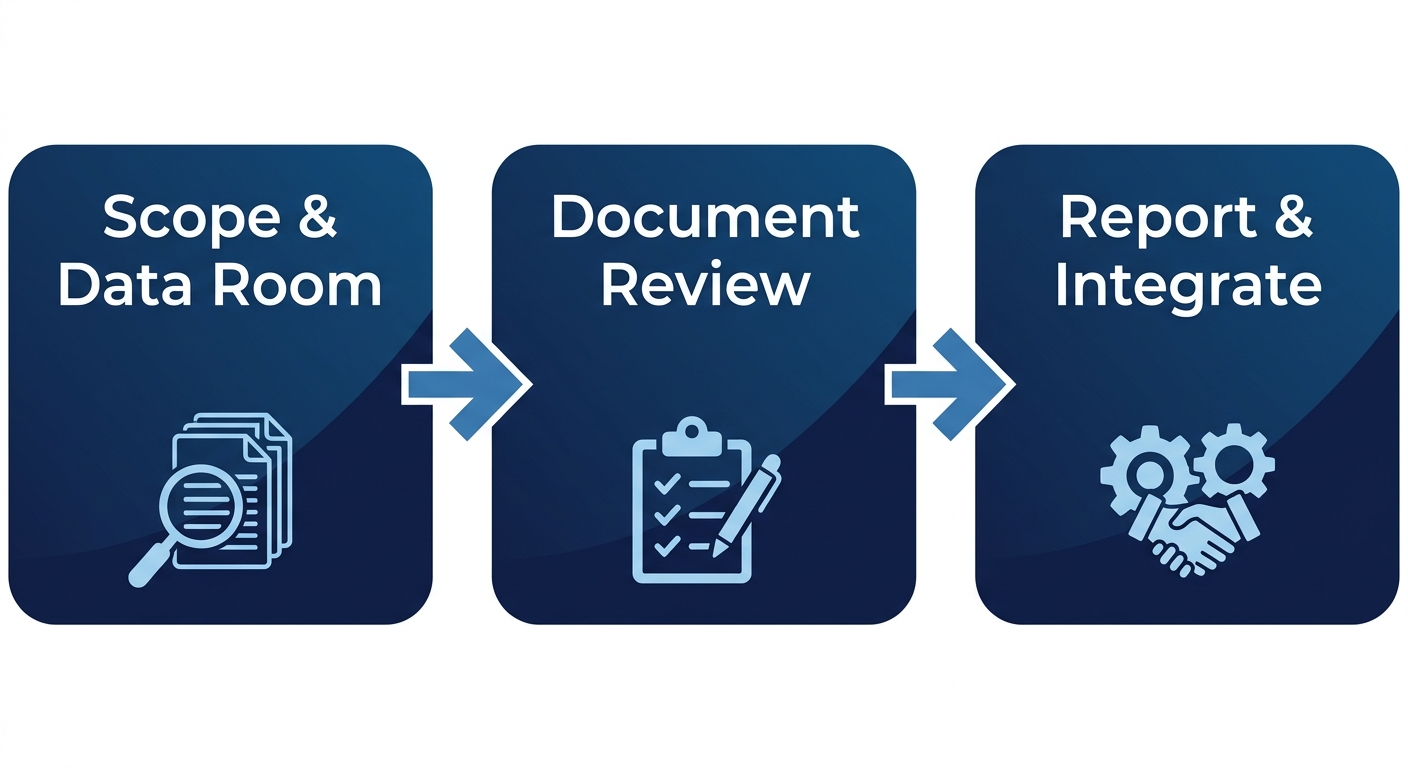
    M&A due diligence process flow diagram with three connected stages: scoping and data room preparation, document review and issue identification, and reporting with remediation and deal integration

    Due diligence process: Scoping, Review, Integration

    Practical Application of Due Diligence in M&A

    With the strategic importance of due diligence established, we now turn to its practical execution. When conducting due diligence in tech mergers and acquisitions, assembling the right team and timeline is critical. Our M&A due diligence services are anchored in a disciplined process that aligns financial, legal, and operational expertise to uncover risks and validate the deal thesis early.

    Assembling Your Diligence Team and Timeline

    A well-structured diligence engagement draws on three core roles: a financial advisor who leads the process—typically a boutique M&A firm like Zaidwood Capital—a legal counsel with deep M&A experience, and a technical or industry specialist who can assess operational and market realities. We converge these disciplines around a single checklist that maps every data request, interview, and verification step against a shared timeline.

    A sample 5-week timeline typically unfolds as follows:

    • Weeks 1-2 — Scoping and Information Request: Define the diligence scope, issue the initial document request list, and align client and target management on confidentiality protocols.
    • Weeks 3-4 — Intensive Review: Conduct document analysis, site visits, management interviews, and workstream-specific deep dives (financial, legal, operational, commercial).
    • Week 5 — Report Synthesis: Draft the due diligence report, isolate deal-breakers and conditions to closing, and present findings to the deal team.

    Pro Tip: Always verify key executives’ backgrounds before finalising the diligence timeline. Late-stage discoveries of litigation or misrepresentation can derail transactions, so we include these checks early.

    This collaborative staging keeps the entire team accountable and prevents last-minute surprises.

    Leveraging Data Rooms and Proprietary Tools

    A secure data room is a foundational piece of M&A diligence. Granular permissions, watermarking, and audit trails are non-negotiable. While basic cloud storage (Google Drive) works for small deals, most mid-market transactions demand virtual data room platforms like Intralinks or Ansarada with user-specific rights and detailed logs. For the highest-stakes cross-border scenarios, we rely on Zaidwood Capital’s Deal Vault, which leverages our Sovereign Data Nexus for air-gapped protection and end-to-end encryption.

    Comparison Table: Data Room Options for Due Diligence
    Provider TypeSecurity FeaturesIdeal For
    Basic cloud storage (e.g., Google Drive, Dropbox)Standard encryption, shared linksSmall, fast-moving deals where volume is low
    Virtual Data Room platforms (e.g., Intralinks, Ansarada)Granular permissions, audit trails, watermarkingMid-market M&A with multiple bidders
    Zaidwood Capital’s Deal Vault (private server)Air-gapped environment, Sovereign Data Nexus integrationComplex cross-border transactions demanding highest security

    Each tier matches deal complexity: basic for low-complexity asset sales, VDRs for multi-bidder auctions, and Deal Vault when sovereign-grade security is required.

    Beyond the data room, Precision Catalyst tracks investor engagement—document opens, time spent, repeat visits—flagging high-interest parties to accelerate follow-ups. This data-driven approach concentrates our M&A due diligence services on the most promising leads, shortening the overall diligence cycle.

    Synthesizing Findings into Actionable Reports

    Translating weeks of analysis into a decision-ready report requires discipline. We structure every due diligence report to be concise—typically 2–4 pages of core material plus supporting appendices—and to avoid absolute language. The standard sections include:

    • Executive Summary: A one-page synthesis of the target’s strategic fit, valuation range, and go/no-go recommendation.
    • Functional Findings: Separate subsections for financial, legal, operational, and commercial due diligence, each highlighting the top three risks and opportunities.
    • Deal-Breakers and Risk Matrix: A table that categorizes issues by severity and probability, clearly flagging items that could kill the deal.
    • Conditions to Closing: Concrete actions the target must complete before signing, such as resolving outstanding litigation, obtaining key customer consents, or cleaning up IP ownership.
    • Recommendations: Final guidance on whether to proceed, renegotiate terms, or walk away.

    This structure ensures every stakeholder—whether a CEO, private equity partner, or legal advisor—can grasp the essential picture in minutes and drill into the details as needed. The resulting report arms the deal team with clear conditions to closing, which we address in the next section on negotiation and deal structuring.

    Advanced M&A Due Diligence Strategies

    Building on the foundational due diligence framework, advanced strategies dive deeper into operational and sector-specific risks, especially in cross-border contexts. Our advanced M&A due diligence services in New York go beyond the financial basics, examining technology integration, regulatory exposure, and cultural alignment. This comprehensive approach is critical for deal success.

    For cross-border transactions, the data room requirements multiply significantly. We manage virtual data rooms that comply with diverse data residency laws and incorporate translation services, ensuring that parties in different countries can review documents securely and without legal friction. This operational infrastructure is a core part of our due diligence services, streamlining what is often a logistical bottleneck in international deals.

    Assessing cultural and operational fit is another vital layer of advanced M&A due diligence practices. In cross-border deals, we evaluate not only language barriers and business norms but also time-zone management and workforce integration. A typical domestic merger can stabilize in three to nine months, but international combinations often require six to eighteen months due to the need for deeper integration planning and trust-building. This extended timeline reinforces the need for patient capital and thorough vetting.

    Sector-specific expertise tailors these cross-border due diligence strategies further. For technology companies, advanced diligence includes IP ownership verification, a rigorous software code audit, a cybersecurity posture review, and subscription revenue validation. In healthcare M&A, our due diligence services cover HIPAA compliance, FDA regulatory pathways, clinical trial data integrity, and reimbursement dependencies. These strategies set the stage for executing a rigorous due diligence plan, which we cover next.

    Frequently Asked Questions About M&A Due Diligence

    Building on the steps above, we address some frequently asked questions about M&A due diligence.

    What is M&A due diligence and why is it important?
    Our M&A due diligence services provide a comprehensive evaluation of financial, legal, operational, and strategic factors to identify risks and support informed decisions.

    What key areas are assessed during M&A due diligence?
    We review financial statements, legal contracts, operational workflows, and strategic positioning, leveraging our Sovereign Data Nexus for data-driven insights.

    How does Zaidwood Capital support clients during M&A due diligence?
    Our M&A due diligence services combine Precision Catalyst for investor engagement and Velocity Matrix for rapid execution, ensuring efficient and thorough due diligence.

    This information is for informational purposes only and is not an offer, solicitation, recommendation, or commitment to buy or sell any security.

    Close Your Deals with Confidence

    With preparation complete, execution is where confidence is built. As a Boutique M&A and Capital Advisory Firm, we rely on rigorous M&A due diligence services tailored to each deal’s unique risks and opportunities, reducing uncertainty at every stage. The Sovereign Data Nexus provides proprietary real-time data that validates assumptions, flags hidden risks, and delivers actionable intelligence. Backed by a global network and capital markets experience, the Velocity Matrix accelerates closing timelines, giving clients the transparency to close with confidence, and carrying that assurance into the post-close relationship.

    Resources

  • Healthcare Mergers and Acquisitions: Key Trends for 2026

    Healthcare Mergers and Acquisitions: Key Trends for 2026

    Table of Contents

    Understanding Healthcare Mergers and Acquisitions

    Healthcare mergers and acquisitions encompass transactions involving hospitals, pharmaceutical companies, biotech firms, and healthcare services. These can be horizontal (combining similar entities like hospital systems), vertical (acquiring a supplier), or conglomerate (diversifying across sectors).

    Drivers of current healthcare M&A trends include regulatory shifts, technological advances, cost pressures, and the pursuit of economies of scale. An aging population and the shift to value-based care further accelerate activity. They also prompt cross-sector partnerships and targeted investments in outpatient and digital care models. With the increase in private equity healthcare acquisitions, firms are pursuing platform investments and buy-and-build strategies.

    At Zaidwood Capital, our Boutique M&A and Capital Advisory Firm guides clients through Full-Cycle M&A, applying proprietary intelligence and a global network to navigate this complex landscape. In the following sections, we explore how specialized advisory firms orchestrate these transactions.

    The landscape of healthcare mergers and acquisitions is undergoing a fundamental transformation, driven by powerful market forces that are reshaping how providers, payers, and technology companies structure deals. Our analysis has identified several converging trends that are accelerating consolidation and redefining value creation in the sector, from record private equity participation to the rapid integration of digital health capabilities into traditional care delivery models.

    The Private Equity Surge in Healthcare

    Private equity has emerged as a dominant force driving current healthcare M&A trends, with deal volume concentrated heavily in physician practice groups, outpatient surgical centers, and specialty care platforms. This influx of capital reflects PE sponsors’ recognition that fragmented healthcare delivery offers substantial opportunities for operational improvement and economies of scale. Private equity healthcare acquisitions now frequently target multi-site platforms rather than individual practices, creating regional networks that can negotiate more favorable payer contracts while standardizing clinical protocols. We observe that these investors are increasingly sophisticated, bringing dedicated healthcare operating partners who understand the regulatory and reimbursement complexities that define the industry, rather than applying generic financial engineering approaches that characterized earlier investment waves.

    The competitive dynamics have intensified, with dry powder levels in healthcare-focused funds reaching unprecedented levels. This abundance of capital has compressed cap rates and elevated purchase multiples, particularly for assets demonstrating strong organic growth and technology-enabled service models. Our experience indicates that successful transactions now require rigorous upfront financial modeling and operational due diligence that goes well beyond traditional quality-of-earnings analyses, examining payer mix concentration, physician retention incentives, and compliance history with equal weight to historical financial performance.

    Technology Convergence Reshaping Deal Structures

    The intersection of healthcare delivery and tech mergers and acquisitions has introduced new complexity into deal-making, as AI-powered diagnostics, telemedicine platforms, and remote patient monitoring systems become core operational assets rather than ancillary tools. Digital health startups attracting significant investment are being valued on technology-forward metrics that blend traditional healthcare EBITDA multiples with SaaS-like recurring revenue frameworks, creating novel valuation methodologies that challenge conventional approaches. Our internal analysis, drawing on aggregated transaction experience exceeding $24.4 billion in volume, indicates that acquirers are willing to pay meaningful premiums for platforms demonstrating scalable technology infrastructure that can accelerate post-merger integration and unlock synergy realization timelines.

    This convergence demands that advisors possess cross-sector expertise spanning both healthcare reimbursement architecture and technology intellectual property considerations. The due diligence process has expanded to encompass algorithm bias assessments, interoperability standards verification, and data privacy compliance under frameworks that continue to evolve as regulatory bodies increase their scrutiny of health data monetization. We believe that the most successful transactions will be those where technology integration planning begins during initial deal evaluation rather than as a post-closing workstream, allowing acquirers to accurately model the true cost and timeline for achieving projected synergies.

    Regulatory Dynamics and the Role of Investment Banks

    Heightened Federal Trade Commission scrutiny and antitrust enforcement have introduced extended review timelines and greater uncertainty into healthcare M&A, particularly for horizontal combinations that concentrate market share within specific geographies or clinical specialties. Investment banks play an essential role in navigating these dynamics by structuring transactions with appropriate risk-mitigation mechanisms, including reverse breakup fees and clearly defined regulatory-effort covenants. Our advisory approach, grounded in full-cycle M&A execution across sectors including healthcare, technology, and energy, emphasizes early engagement with antitrust counsel to identify potential competitive concerns before they can derail transaction momentum. The shift toward value-based care and population health management continues to serve as a strategic imperative for consolidation, as integrated delivery networks seek the scale necessary to assume risk under alternative payment models and invest in the infrastructure required for care coordination.

    As these dynamics evolve, we anticipate that the pace of healthcare M&A will remain robust, with technology-enabled platforms and private equity portfolio companies continuing to drive deal flow across the middle market and upper-middle market segments.

    The Impact of Regulatory Changes on Healthcare M&A

    Recent changes in healthcare mergers and acquisitions regulation have introduced new layers of complexity for buyers and sellers navigating today’s deal environment. We see these regulatory shifts directly shaping the trends in healthcare M&A activity, from deal timelines to valuation methodologies. Our team at Zaidwood Capital monitors these developments closely, ensuring that every transaction we advise on reflects the latest compliance requirements and strategic considerations.

    The evolving regulatory landscape demands rigorous financial analysis grounded in established professional standards. The CFA Institute’s Code of Ethics and Standards provides a critical benchmark for ensuring fair-valuation opinions withstand scrutiny from all stakeholders. When we evaluate healthcare M&A trends, we recognize that deal volume increasingly correlates with regulatory predictability. For instance, private equity healthcare acquisitions have intensified in subsectors where reimbursement policies remain stable, while heightened antitrust oversight has cooled activity in concentrated hospital markets.

    Key regulatory bodies shaping healthcare dealmaking include:

    • Federal Trade Commission (FTC) and Department of Justice (DOJ): Enforce antitrust guidelines under the Hart-Scott-Rodino Act, with recent revisions increasing pre-merger notification thresholds and extending review timelines.
    • Centers for Medicare & Medicaid Services (CMS): Drives value-based care policies that directly impact hospital and physician practice valuations through reimbursement reforms.
    • Federal Communications Commission (FCC): Governs spectrum allocation and telecommunications compliance, including FCC regulatory compliance for transactions involving wireless health platforms or connected medical devices.

    Antitrust enforcement has intensified considerably, with the FTC and DOJ applying stricter scrutiny to healthcare consolidation. The updated Hart-Scott-Rodino thresholds now trigger more filings, while extended review periods compress deal timelines and increase regulatory risk for both parties. We advise clients to factor these procedural changes into their transaction planning from day one, as delays can materially affect financing arrangements and seller expectations.

    CMS reimbursement reforms under value-based care models have fundamentally altered how acquirers assess target financials. Practices with strong performance metrics under alternative payment models command premium valuations, while those dependent on traditional fee-for-service structures face discounting. Understanding these policy-driven valuation dynamics is essential for both strategic and financial buyers.

    For digital health transactions, FCC oversight introduces a cross-sector compliance dimension that many deal teams overlook. Whether a target holds spectrum licenses for telehealth platforms or operates connected medical devices, FCC regulatory compliance must be verified during due diligence. Failing to address telecommunications regulations can delay closings or create post-transaction liability.

    Understanding these regulatory impacts is critical before examining the role of private equity in healthcare. We believe that preparedness—supported by disciplined financial analysis and proactive regulatory engagement—remains the most effective strategy for navigating today’s complex deal environment and executing successful Full-Cycle M&A transactions.

    Private Equity’s Growing Role in Healthcare Acquisitions

    The landscape of healthcare mergers and acquisitions has been fundamentally reshaped by the accelerating influence of private capital. Institutional investors and fund managers now view the healthcare sector as a prime target for deployment, driven by powerful secular trends like an aging global population, rapid technology advancements and a steady push toward value-based care models. Understanding what is an investment bank reveals the essential intermediary that facilitates these complex private equity healthcare acquisitions, guiding both buyers and sellers through a disciplined transaction lifecycle.

    This surge in activity is not speculative. Consolidation in fragmented markets like outpatient services and physician practice management continues to accelerate. We see current healthcare M&A trends characterized by a fierce competition for tech-enabled healthcare platforms, where private equity sponsors seek to back companies with scalable software, data analytics and telemedicine capabilities. These platform investments often serve as a foundation for aggressive add-on acquisition strategies, allowing a portfolio company to rapidly expand its geographic footprint and service lines through a series of smaller, complementary healthcare mergers and acquisitions.

    When structuring these deals, private equity firms rely on several common transaction frameworks. A leveraged buyout uses the target’s assets and cash flows as collateral to secure acquisition financing, maximizing return potential through debt. Growth capital investments provide minority or majority stakes to fuel expansion without a full transfer of control. Add-on acquisitions, as noted, are the tactical tool for building a dominant platform. Each structure demands rigorous financial analysis to model returns and identify synergies.

    We at Zaidwood Capital, as a Boutique M&A and Capital Advisory Firm, provide the critical advisory services that make these frameworks actionable. Our team conducts comprehensive valuation analysis, manages multi-dimensional due diligence, and architects optimal deal structures that balance risk and reward. We then lead the capital syndication process, leveraging a global network of over 4,000 institutional and private investors to secure the necessary financing. To enhance this Full-Cycle M&A execution, we deploy our proprietary technology suite. Our Sovereign Data Nexus powers intelligent target identification and data vault management, Precision Catalyst refines investor engagement and Velocity Matrix is purpose-built to accelerate deal timelines without sacrificing diligence quality.

    It is important to state clearly that while we deploy these sophisticated tools and processes, outcomes are never guaranteed. Our role as your advisor is to maximize process efficiency and strategic positioning, not to promise specific deal terms or investment returns. The dynamic forces shaping healthcare mergers and acquisitions show no sign of slowing, and in the next section, we will explore the step-by-step process for executing a healthcare acquisition mandate with precision.

    This website is for informational purposes only and is not an offer, solicitation, recommendation, or commitment to buy or sell any security. Securities are offered through Finalis Securities LLC; Zaidwood Capital is not a registered broker-dealer. Investments involve risk and are not guaranteed to appreciate; investors may lose all or part of their investment. Consult with legal, tax, and financial advisors or a registered representative before making investment decisions. Past performance does not guarantee future results.

    Preparing Your Company for a Healthcare Merger

    Amid accelerating trends in healthcare mergers and acquisitions, companies that prepare thoroughly gain a critical competitive edge. While many preparation steps mirror those of substantial tech mergers and acquisitions, healthcare adds layers of regulatory scrutiny and operational complexity that demand a specialized approach. As Zaidwood Capital outlines in its M&A workflow, a structured, milestone-driven process is essential to maximizing transaction value.

    Understanding current trends in healthcare M&A is foundational because new developments—such as private equity’s deepening interest in digital health and the shift toward value-based care consolidation—are reshaping deal timelines and diligence requirements. Recognizing the landscape of private equity healthcare acquisitions early in your planning allows you to position your company as an attractive target for the most active and well-capitalized buyers in the sector.

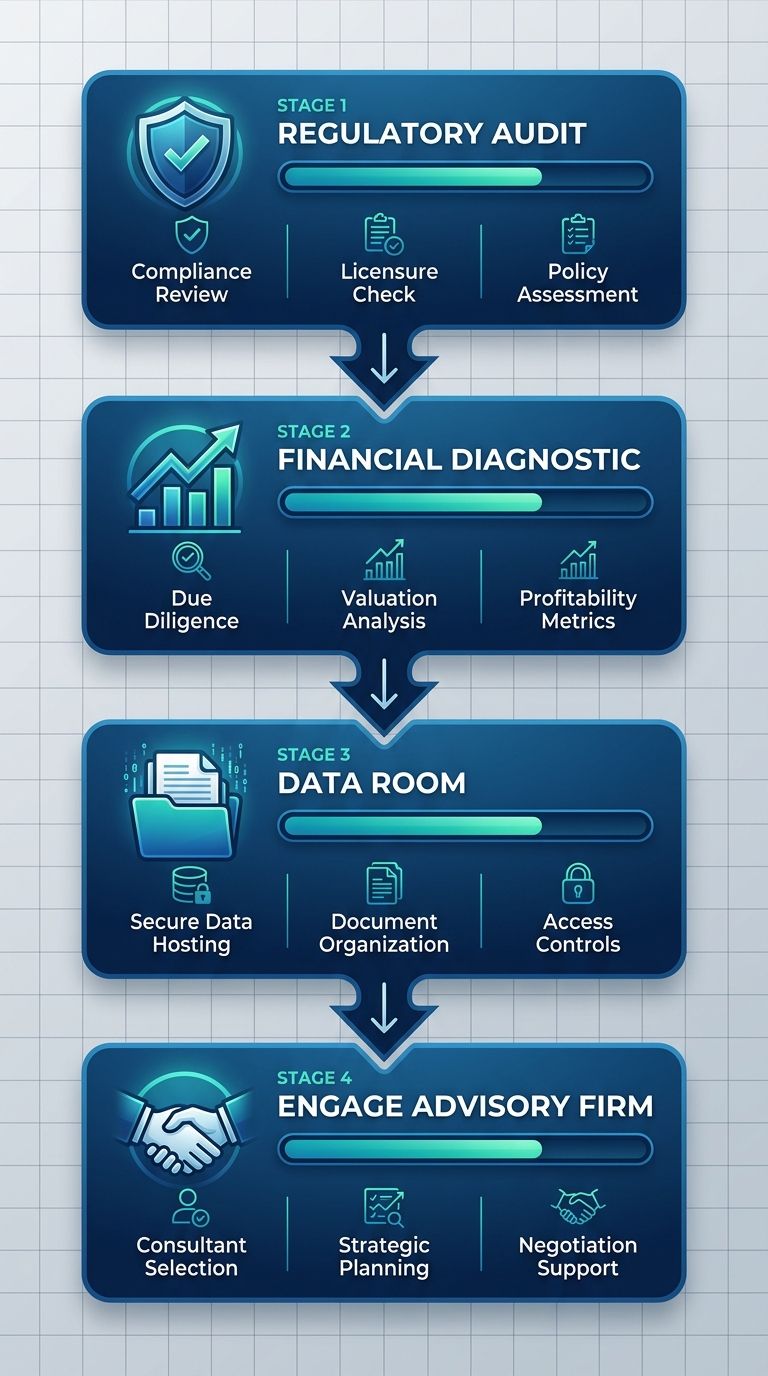
    • Conduct a Pre-Merger Regulatory Audit – Engage specialized counsel to review your compliance with HIPAA, the Stark Law, and FDA regulations. Addressing potential exposure before entering a transaction prevents deal delays and valuation discounts.
    • Perform a strategic financial diagnostic – Our team prepares the strategic documentation that buyers and investors expect: investor pitch decks, detailed business plans, and pro forma financial models. This diagnostic not only surfaces operational efficiencies but also demonstrates your company’s growth trajectory through rigorous, data-backed projections.
    • Organize a Confidential Data Room – We help you populate a secure Deal Vault so that patient data, payer contracts, and financial records are shared safely and efficiently. A well-organized data room signals institutional readiness and accelerates due diligence.
    • Engage a boutique M&A advisory firm – A Boutique M&A and Capital Advisory Firm with deep healthcare sector experience brings process discipline and strategic insight that generalist advisors cannot match. Zaidwood Capital deploys proprietary tools throughout preparation: Sovereign Data Nexus provides real-time market intelligence, Precision Catalyst optimizes investor targeting, and our Velocity Matrix compresses execution timelines.

    Zaidwood Capital emphasizes that the right advisory partner brings value far exceeding fees by aligning your preparation with the expectations of a global network of private equity and institutional investors. Our Full-Cycle M&A methodology ensures that no aspect of readiness is overlooked.

    Vertical process flow showing four stages for healthcare merger preparation: regulatory audit, financial diagnostic, data room setup, and engaging advisory firm.

    Four-step preparation process for healthcare M&A

    With a solid preparation foundation, the next critical phase is structuring the transaction—an area where Zaidwood Capital’s Full-Cycle M&A expertise excels. Contact Zaidwood Capital to begin your healthcare M&A preparation journey.

    How an M&A Advisory Firm Navigates Healthcare Transactions

    Given these unique challenges, an experienced M&A advisory firm approaches healthcare transactions with a careful, structured, sector-specific methodology. Healthcare deal-making requires far more than standard financial analysis—it demands deep regulatory fluency and the ability to identify value where others might overlook it. Our advisory team holds advanced credentials such as the CFA charterholder program, ensuring rigorous financial analysis and valuation discipline in healthcare mergers and acquisitions.

    Regulatory complexity is the defining feature of healthcare M&A. Every transaction must account for FDA approval pathways, HIPAA compliance obligations, and anti-kickback statutes that simply do not exist in other industries. Through our proprietary Sovereign Data Nexus infrastructure, we maintain continuously updated healthcare market data, enabling valuations that reflect not just historical performance but forward-looking regulatory risk. This data-driven approach, combined with our deep understanding of healthcare M&A trends, helps sellers position their assets more effectively and helps buyers understand exactly what they are acquiring from a compliance standpoint.

    Effective buyer targeting in healthcare transactions requires identifying both strategic acquirers—hospital systems, pharmaceutical companies, and payer organizations seeking vertical integration—and financial sponsors pursuing private equity healthcare acquisitions. Our Velocity Matrix methodology applies this segmented buyer intelligence to accelerate deal timelines through streamlined due diligence. By pre-packaging the compliance, reimbursement, and clinical data that healthcare investors prioritize, we can help reduce the friction that typically slows healthcare deal cycles.

    This full-cycle M&A capability extends from initial seller preparation and data room management through to post-close integration support. We continuously monitor healthcare mergers and acquisitions globally, integrating that intelligence into our post-close planning and investor outreach to improve execution timelines and clarity. As a Boutique M&A and Capital Advisory Firm, we bring Financial Services 3.0 infrastructure to every engagement—combining real-time analytics with the personalized guidance that complex healthcare transactions demand. Understanding this process reveals why engaging a specialized firm can deliver efficient outcomes for healthcare clients navigating today’s dynamic deal environment.

    Key Takeaways for Healthcare M&A Success

    Success in healthcare mergers and acquisitions demands a specialized, data-driven approach. Our experience navigating complex private equity healthcare acquisitions has shown that winning outcomes rely on a specific combination of proprietary intelligence and precise execution.

    • Sovereign Data Nexus is our foundational edge. Proprietary data access and private servers enable us to identify and evaluate healthcare targets with unmatched precision.
    • Precision Catalyst accelerates deal flow. Integrated digital marketing-driven investor engagement attracts the right capital partners for healthcare acquisitions.
    • Velocity Matrix ensures rapid closure. Our rapid execution capabilities help close healthcare M&A before market conditions shift.
    • Full-Cycle M&A expertise reduces risk. Guiding transactions from strategic documentation to post-merger integration maximizes value at every stage.
    • Deep sector knowledge is non-negotiable. Understanding regulatory dynamics, reimbursement models, and operational nuances separates successful healthcare M&A trends from costly missteps.

    Implementing these strategies with an experienced partner is the key to closing winning healthcare deals.

    Resources

  • What Is an Investment Bank? Key Services Explained

    What Is an Investment Bank? Key Services Explained

    Table of Contents

    The Role of Investment Banks in Modern Finance

    Understanding what is an investment bank is essential to grasping modern financial markets, as these institutions serve as vital intermediaries between companies seeking capital and the investors who provide it. According to the CFA Institute, the global standard-setter for the investment industry, investment banks facilitate capital formation, mergers and acquisitions, and market making, driving economic growth globally today.

    Investment banks perform three primary functions: capital raising, mergers and acquisitions advisory, and market making. In capital raising, we offer capital raising solutions that leverage our extensive investor network to secure equity and debt financing. In mergers and acquisitions, we advise on deal structuring, valuation, and negotiation, ensuring strategic alignment. Market making provides liquidity and price discovery, but boutique firms typically focus on advisory, delivering personalized, high-touch service enhanced by tools like our Sovereign Data Nexus and Velocity Matrix. These functions collectively channel capital to productive enterprises, fueling innovation and economic expansion.

    At Zaidwood Capital, we are redefining Financial Services 3.0 as a Boutique M&A and Capital Advisory Firm, combining proprietary data access via our Sovereign Data Nexus with precision execution through our Velocity Matrix to accelerate deals. Securities are offered through Finalis Securities LLC; Zaidwood Capital is not a registered broker-dealer.

    Investment Banking Services: From Advisory to Capital Markets

    When clients ask what is an investment bank, we answer with a clear definition: A financial institution that provides strategic advisory and capital-markets services to corporations, governments, and institutions. Unlike commercial banks that focus on deposit-taking and lending, investment banks operate on a fee-based model, guiding complex transactions like mergers and acquisitions and large-scale capital raising.

    Investment Bank vs. Commercial Bank
    Feature Investment Bank Commercial Bank
    Primary Focus Advisory & Capital Markets Deposits & Lending
    Revenue Model Fee-based Interest-based

    This distinction is foundational. While commercial banks serve everyday financial needs, investment banks unlock growth through corporate finance advisory, deal orchestration, and access to deep capital pools.

    Our firm’s advisory practice spans the full continuum of mergers and acquisitions—from target identification and valuation to negotiation and close—while our capital-markets capabilities help clients structure and secure equity, debt, and structured solutions. For a growing enterprise seeking capital raising, we craft strategic materials like pitch decks, business plans, and pro forma financials, then leverage our global network of over 4,000 institutional and private investors to create institutional introductions.

    Mergers and Acquisitions: How Investment Banks Drive Deal Execution

    To fully appreciate what an investment bank does in the context of mergers and acquisitions, it helps to examine the entire deal lifecycle. Investment banks serve as strategic partners that bring financial expertise, proprietary data tools, and a global investor network to the table. We follow a three-phase framework that covers deal sourcing and initial pitch, rigorous due diligence and financial modeling, and finally negotiation, structuring, and closing.

    Deal Sourcing and Initial Pitch

    We proactively identify acquisition targets or divestiture opportunities through our proprietary Sovereign Data Nexus and long-standing industry relationships. By continuously monitoring market signals and capital flows, we surface potential transactions that align with a client’s strategic objectives. Once a promising opportunity is identified, we craft a tailored pitch book that outlines a compelling investment thesis, preliminary valuation ranges, and a roadmap for value creation.

    Due Diligence and Financial Modeling

    Once a letter of intent is signed, we lead a comprehensive due diligence process that examines financial statements, operational metrics, legal risks, and market conditions. Following the best practices outlined by the CFA Institute, our team validates the target’s earnings quality, working capital dynamics, and growth assumptions. We build a suite of valuation models—discounted cash flow, precedent transaction, and leveraged buyout analyses—to triangulate intrinsic value and stress-test deal economics.

    Negotiation, Structuring, and Closing

    With due diligence findings in hand, we advise on deal structure—whether a stock or asset purchase, and how earn-outs, seller financing, or contingent consideration can bridge valuation gaps. We take the lead in negotiations, coordinating closely with legal and tax advisors to translate commercial terms into binding documents. Throughout this phase, our secure deal vaults serve as central hubs for all transaction materials, accelerating the exchange of sensitive information.

    Capital Raising Strategies: Equity and Debt Financing Pathways

    A core function of an investment bank is helping companies raise capital to fuel growth, execute strategic initiatives, or navigate complex transactions. At Zaidwood Capital, we specialize in capital raising as part of our Full-Cycle M&A and Capital Advisory services, connecting businesses with the right mix of equity and debt financing.

    Equity Financing: Private Placements and Growth Equity

    Equity financing allows businesses to raise capital by selling ownership stakes. Investment banks facilitate private placements, offering shares to accredited investors and institutional investors rather than public markets, which can be faster and more flexible. At Zaidwood Capital, we leverage a network of more than 4,000 investors to connect companies with the right capital providers.

    Debt Financing and Structured Solutions

    Debt financing allows companies to borrow capital without diluting ownership, preserving control for existing shareholders. Investment banks structure a range of instruments: senior debt is secured by company assets, carries a lower interest rate, and ranks first in repayment priority; mezzanine financing is subordinated, carries higher cost, and often includes equity warrants.

    Equity vs. Debt Financing
    Dimension Equity Debt
    Ownership Diluted Preserved
    Repayment None Regular Payments

    Preparing Your Business for a Capital Raise

    Thorough preparation significantly increases the likelihood of a successful capital raise. Start by compiling audited or reviewed financial statements that demonstrate historical performance and projections. A credible business valuation sets realistic expectations for deal terms. Develop a compelling investor pitch deck that clearly articulates the company’s value proposition, growth strategy, and use of funds.

    Boutique Investment Banking: The Zaidwood Capital Advantage

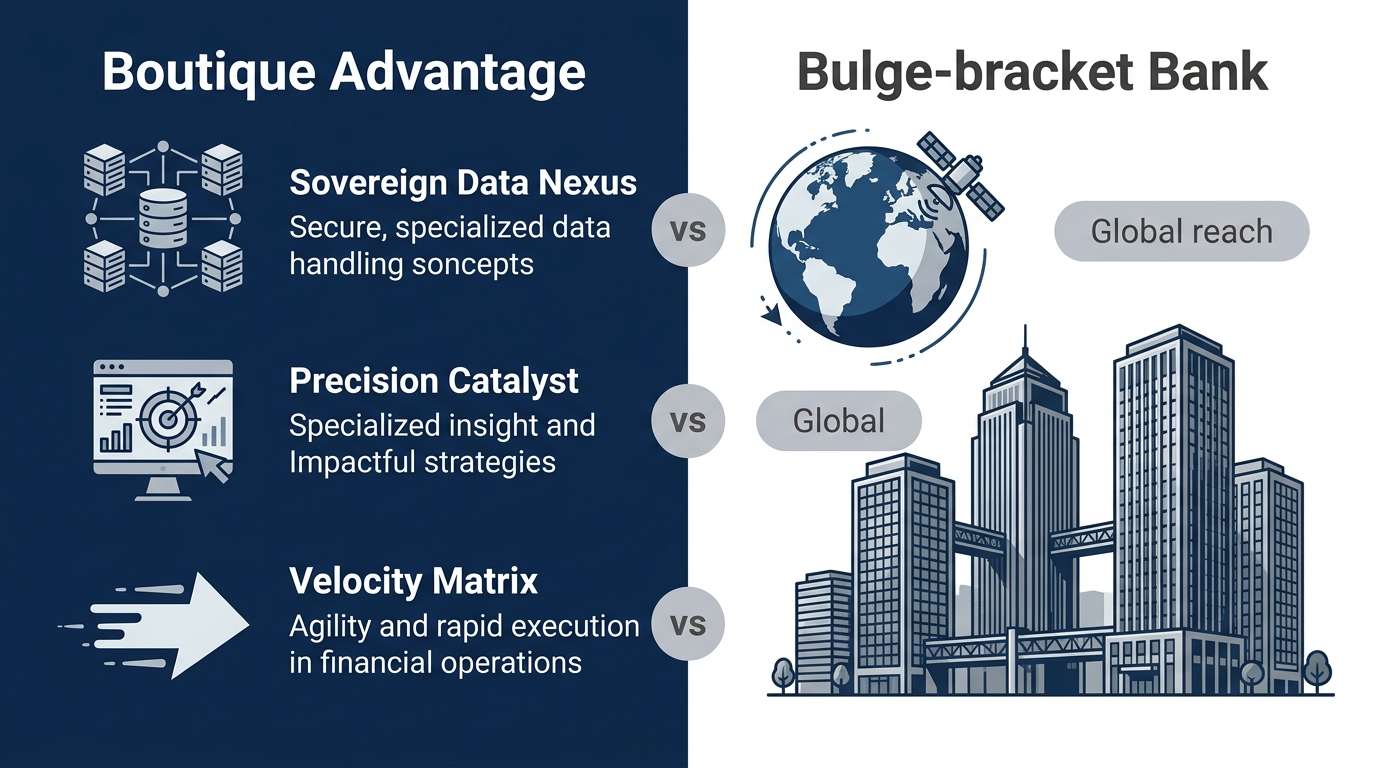
    If the searcher’s question is what is an investment bank, the clearest answer begins with the distinct categories of the industry. Investment banks facilitate the flow of capital, but they operate across a spectrum from boutique advisory firms to global full-service institutions and the largest bulge-bracket banks. At one end, boutique firms like Zaidwood Capital deliver high-touch, specialized guidance for mid-market and growth companies.

    Boutique vs. Full-Service vs. Bulge-Bracket
    Type Focus Advantage
    Boutique Advisory Senior Attention
    Bulge-Bracket Global Markets Balance Sheet
    Side-by-side infographic comparing boutique investment bank advantages with data, marketing, and speed icons versus traditional bulge-bracket bank with globe and buildings

    Comparison infographic showing boutique versus traditional banking advantages

    Common Questions About Investment Banking

    What is an investment bank?
    An investment bank is a financial intermediary that helps companies raise capital and execute mergers and acquisitions. They range from large bulge-bracket institutions to specialized boutique firms like ours, which provide senior-led, personalized advice and sector expertise.

    Unlike traditional investment banks, our boutique advisory provides end-to-end support throughout your transaction lifecycle. Our team brings expertise in mergers and acquisitions and capital raising, leveraging proprietary tools like the Sovereign Data Nexus for data-driven insights and the Velocity Matrix to accelerate execution. Zaidwood Capital is not a registered broker-dealer; securities are offered through Finalis Securities LLC.

    Resources

  • Tree Care Industry Trends 2026: What You Must Know

    Tree Care Industry Trends 2026: What You Must Know

    Table of Contents

    As we examine tree care industry trends 2026, it’s clear that technology and capital are driving a fundamental transformation. The adoption of AI-powered tree risk assessment technology allows arborists and municipalities to make data-driven decisions, improving safety and operational efficiency across urban canopies.

    At the same time, climate-resilient urban canopy management is moving from a niche concern to a mainstream priority. As extreme weather events intensify, cities are recognizing the critical role of trees in cooling, carbon sequestration, and stormwater management. In our view, the shift from reactive tree removal to proactive care enabled by technology and climate policy is a long-term structural change that will fuel demand for advanced services.

    Capital is following these structural tailwinds. We are observing growing M&A activity in the tree care sector, mirroring patterns identified in Zaidwood Capital’s overview of emerging markets M&A. Consolidation is enabling companies to scale and attract institutional investors seeking stable, infrastructure-linked returns. The influx of capital into tech-enabled tree care companies further signals market confidence in the sector’s growth.

    For investors, these converging trends create a favorable landscape for participating in the environmental infrastructure space. We believe that understanding these drivers can help position portfolios for the maturation of green infrastructure, though past performance does not guarantee future results. Ultimately, this article is for informational purposes and does not constitute an offer, solicitation, or investment advice.

    Understanding the Tree Care Industry’s Structural Shift

    The tree care industry trends 2026 point to a fundamental structural shift reshaping arboricultural services and their investment landscape. Three primary drivers are fueling this transformation:

    • Adoption of AI-powered tree risk assessment technology
    • Mandates for climate-resilient urban canopy management
    • Accelerating M&A consolidation across historically fragmented markets

    Technology is the first seismic force. Innovative firms are deploying AI-powered tree risk assessment technology to evaluate health, stability, and failure probability with precision never before possible. These platforms analyze multispectral imagery, weather patterns, and soil data to forecast liabilities at scale, capturing the attention of private equity and growth-focused investors.

    Climate imperatives are the second driver. Municipalities worldwide are mandating climate-resilient urban canopy management to combat heat islands and stormwater surges. The resulting fragmentation and unmet compliance demand create natural roll-up opportunities. Regional platforms that can consolidate services while meeting sustainability metrics are becoming prime targets for strategic acquirers and institutional funds seeking ESG-aligned exposure.

    Finally, M&A consolidation is accelerating across the tree care sector. Zaidwood Capital’s deep dive into emerging markets M&A reveals a 15 percent annual surge in transaction volumes across developing economies—a dynamic mirrored in North American specialty services. This structural momentum positions the tree care industry for increased emerging markets M&A activity, drawing interest from sovereign wealth funds and cross-border alliances.

    Technology and Climate Adaptation: Drones, AI, and Resilient Canopies

    Among the most impactful tree care industry trends 2026 are the rapid adoption of drone-based health assessments, AI-powered risk prediction, and climate-adaptive species selection.

    Horizontal infographic with three columns showing drone with multispectral camera over tree canopy, AI risk dashboard, and heat-tolerant tree species

    Technology and climate adaptation with drones, AI, and resilient canopies

    Drone-Based Arborist Health Assessments

    Drone-based arborist health assessments are revolutionizing the field. Equipped with multispectral and LiDAR sensors, drones capture high-resolution imagery and 3D data that reveal early signs of disease long before symptoms are visible to the naked eye. This approach improves safety and cuts inspection costs by up to 50% compared to traditional methods.

    AI-Powered Tree Risk Assessment Technology

    The next frontier in arboriculture is AI-powered tree risk assessment technology. By feeding data from IoT soil moisture probes and historical weather patterns into machine learning models, these systems can predict the probability of limb failure with remarkable accuracy. This allows arborists to schedule preventive maintenance proactively.

    Climate-Adaptive Tree Care Practices

    Professionals are rethinking species selection to create climate-resilient urban canopy management strategies. Heat- and drought-tolerant species gaining prominence include Quercus macrocarpa (Bur Oak), Ulmus ‘Morton Glossy’ (Triumph™ Elm), and Gleditsia triacanthos var. inermis (Thornless Honeylocust). These proactive steps ensure that urban forests continue to deliver ecosystem services as conditions shift.

    Residential Service Growth and the Labor Crisis: Practical Implications for 2026

    Outlook for Residential Tree Service Growth

    Three primary catalysts drive demand for residential tree services: home improvement activity, severe weather events, and accelerating urbanization. Homeowners are increasingly aware of the value mature trees bring to property valuations. According to the urban tree care framework, increased urban sprawl and aging tree stocks require professional risk mitigation well into 2026.

    How Labor Shortage Shapes Pricing and Operations

    Despite strong demand, a shortage of certified arborists is reshaping the sector. In acute markets, residential prices have risen 15–20% as firms bid up wages. Adoption of AI-powered tree risk assessment technology allows crews to prioritize inspections using drone imagery, mitigating the shortage by improving efficiency for existing staff.

    Investment Valuation and Capital Formation in the Tree Care Sector

    Understanding tree care industry trends 2026 is essential for business owners. Valuation typically revolves around adjusted EBITDA multiples in the 3-5x range. Beyond traditional metrics, companies demonstrating AI-powered tree risk assessment technology implementation and climate-resilient urban canopy management command premium pricing from institutional investors.

    How is AI transforming tree risk assessment in 2026?
    AI-powered tree risk assessment technology uses predictive analytics to detect hazards early, reducing emergency costs and improving safety.

    What is climate-resilient urban canopy management?
    It focuses on selecting diverse, drought-tolerant species and strategic planting to help urban forests weather climate shifts.

    Why choose a veteran-owned tree service?
    Consider a veteran owned tree service like Climbing Grunt for discipline and commitment to safety.

    Resources

  • Institutional Capital Sources: Ultimate Guide to Private Credit

    Institutional Capital Sources: Ultimate Guide to Private Credit

    Table of Contents

    Understanding Institutional Capital Sources

    Institutional capital sources represent large pools of investment funds managed by organizations such as pension funds, insurance companies, sovereign wealth funds, and private credit funds. These entities provide substantial financing for corporate growth, acquisitions, and real estate ventures.

    Private credit lenders operate in the direct lending space, offering customized financing solutions through asset-based lending and cash flow financing structures. Through our global lending services, companies can access these tailored institutional funding options. These lenders typically seek long-term partnerships with growing businesses, providing larger capital amounts with more flexible terms than traditional bank financing.

    Sovereign wealth funds, such as those in the Middle East and Asia, are government-owned investment vehicles that deploy capital into infrastructure, real estate, and strategic sectors globally. These government investment funds bring patient capital with extended investment horizons.

    Through our network of over 4,000 global investors, we connect clients with institutional investor capital sources suited to their transaction requirements. Securities offerings are facilitated through Finalis Securities LLC, a registered broker-dealer.

    Assess Your Readiness for Institutional Capital

    Institutional capital sources such as private credit lenders and sovereign wealth funds can provide transformative financing for growth-stage companies. At Zaidwood Capital, we encourage businesses to assess their readiness across several key dimensions before engaging these sophisticated capital partners.

    • Financial and asset readiness: Investors generally expect at least $5–$10 million in revenue and positive EBITDA. For asset-based lending, clear collateral coverage and strong asset quality are critical. And liquidity runway matters.
    • Management and governance: An experienced leadership team, a clean capitalization table, and transparent financial reporting demonstrate organizational maturity and reduce investor risk.
    • Market positioning: Defensible competitive advantages, a clear growth trajectory, and a large addressable market signal the ability to scale and capture value.
    • Compliance and due diligence readiness: Companies must be prepared to meet SEC regulations (including Regulation D) and have audited financials, legal documents, and a compelling pitch deck ready.

    Assessing these areas objectively is the first step. Engaging professional capital advisory services can help bridge any gaps, guiding you through due diligence and matching your profile with institutional investors who align with your growth objectives.

    Identify Target Institutional Investor Profiles

    Identifying the right institutional capital sources is the foundation of every transaction we advise on. Within the global capital ecosystem, we isolate institutional investor profiles that align precisely with each client’s industry, deal size, and financing structure—whether equity, debt, or hybrid capital.

    Our process draws on data published by the Federal Reserve Bank of New York to track institutional activity and capital flow trends, revealing which investor segments are most active for a given mandate. We then apply classification standards from the International Capital Market Association to map investors by risk appetite, asset class preference, and transaction size thresholds. This shapes a shortlist that can include private credit lenders, sovereign wealth funds, pension funds, endowments, and family offices.

    Through our mergers and acquisitions advisory, we connect each institutional profile to the appropriate transaction structure and capital strategy. With an aggregated network of over 4,000 institutional and private investors representing more than $15 billion of deployable capital, updated quarterly, we can surface the institutional capital pools most relevant to your objectives.

    This information is for informational purposes only and does not constitute an offer. Securities are offered through Finalis Securities LLC; Zaidwood Capital is not a registered broker-dealer.

    Prepare Investor Pitch Materials

    Based on the due diligence insights gathered earlier, we now assemble investor pitch materials designed to secure funding from institutional capital sources. This critical step translates analytical findings into compelling narratives that drive investment decisions. Our approach leverages Zaidwood Capital’s Full-Cycle M&A and capital advisory framework.

    • Value Proposition & Market Analysis: We craft a clear narrative that connects your opportunity to institutional capital sources, including a market analysis slide.
    • Targeted Messaging: Debt-oriented materials resonate among private credit lenders, while equity pitches are assessed by sovereign wealth funds.
    • Financial Projections: All pro formas carry the disclaimer: “These projections are for informational purposes and do not guarantee future results.”
    • Compliance & Regulatory Requirements: Every deck includes risk factors as required by the SEC. We are not a registered broker-dealer; securities are offered through Finalis Securities LLC. Always refer to the securities regulation authority for updated guidance on private placement rules.
    • Zaidwood Capital Advantage: Our Deal Vault and 4,000+ global investors provide a distribution edge without implying guaranteed outcomes.

    With completed materials, we move to presenting them through our institutional network of over 4,000 investors. Book a Call to finalize your materials and start engaging capital sources.

    Approach Sovereign Wealth Funds and Endowments

    We access diverse institutional capital sources by targeting sovereign wealth funds (SWFs) and endowments, each with distinct mandates. SWFs, such as stabilization funds in the Middle East, seek long-term value creation, while university endowments based in the US follow spending policies that balance growth and liquidity. Identifying these mandates is the critical first step in full-cycle M&A and capital advisory.

    Our engagement strategy leverages proprietary data, specifically the Sovereign Data Nexus, to pinpoint funds with aligned investment criteria. We then initiate contact through investor relations channels, presenting our capital introductions and due diligence capabilities. Communications are structured to comply with regulatory frameworks, including those established by the Financial Industry Regulatory Authority (FINRA), which governs promotional materials and accredited investor verification.

    We apply the Velocity Matrix to structure and accelerate deal flow, combined with Precision Catalyst for targeted matching between opportunities and institutional pools. We explicitly avoid promising specific outcomes or guaranteeing transactions. This website is for informational purposes only and is not an offer or solicitation. Securities are offered through Finalis Securities LLC; Zaidwood Capital is not a registered broker-dealer. Beyond sovereign wealth funds and endowments, institutional capital sources include private credit lenders, which we address next.

    Engage Private Credit Lenders

    As we expand the discussion beyond traditional institutional capital sources, private credit lenders represent a distinct and increasingly vital segment of the financing landscape. These are institutional investors — from specialized debt funds to family offices and sovereign wealth funds — that provide non-bank financing directly to companies. At Zaidwood Capital, we connect our clients to a deep network of these alternative capital providers.

    Two of the most common structures offered by private credit lenders are asset-based lending, which is secured by a company’s tangible assets, and cash flow financing, which is underwritten against projected revenue streams. Our qualification framework, which mirrors the rigorous documentation standards benchmarked by the International Capital Market Association (ICMA), ensures a smooth due diligence process. The broader liquidity environment, shaped by Federal Reserve Bank services, continuously affects the terms and availability of capital from these lenders.

    We facilitate these engagements by aligning a client’s financial profile — supported by three years of audited financials and multi-year cash flow projections — with the specific mandates of institutional investors. Individual outcomes will vary, but this targeted approach helps streamline what is often a complex capital raise, setting the stage for us to explain how we actively enable these introductions.

    Before any deal closes, a thorough due diligence and legal review must be completed. We guide clients through this phase to identify risks, verify claims, and ensure regulatory compliance, a prerequisite for attracting institutional capital sources like private credit lenders and sovereign wealth funds.

    Adhering to SEC securities regulation ensures disclosure compliance and reduces legal risk. The U.S. Securities and Exchange Commission (SEC) sets the baseline for securities offerings and anti-fraud provisions. Meanwhile, FINRA oversees the broker-dealer firms that execute transactions, adding another layer of oversight that institutional investors demand.

    A typical review includes:

    • Regulatory compliance check (SEC rules)
    • Broker-dealer oversight (FINRA)
    • Legal document review (NDAs, term sheets, purchase agreements)
    • Client material preparation (deal memoranda, legal opinions)

    This rigorous process satisfies the due diligence standards of private credit lenders and sovereign wealth funds. Once regulatory compliance is confirmed, our Full-Cycle M&A and capital advisory team streamlines the transition to negotiation and closing. (This website is for informational purposes only and is not an offer, solicitation, recommendation, or commitment to transact. Securities are offered through Finalis Securities LLC; Zaidwood Capital is not a registered broker-dealer and is separate from Finalis.)

    Negotiate Terms and Structure the Deal

    Once due diligence confirms the opportunity, the next phase is negotiating terms and structuring the deal to align with the expectations of institutional capital sources. Negotiating with institutional capital sources requires understanding their distinct priorities: private credit lenders typically focus on cash-flow coverage, collateral quality, and floating-rate benchmarks tied to effective Fed funds, while sovereign wealth funds often seek co-investment rights, board representation, and long-term alignment with investment horizons. Current monetary policy, as reflected in rate data from the Federal Reserve Bank of New York, directly influences structure choices—floating versus fixed rates, coupon floors, and covenant flexibility. At Zaidwood Capital, we leverage our full-cycle advisory and proprietary Sovereign Data Nexus to customize structures that balance these competing demands and institutional investor preferences. With terms negotiated and structure agreed, the transaction moves to documentation and closing.

    Close and Maintain Institutional Relationships

    We actively identify and cultivate long-term partnerships with institutional capital sources that align with our clients’ strategic objectives. Operating outside the scope of a registered broker-dealer — a distinction clarified by the Financial Industry Regulatory Authority (FINRA) — we serve as a capital introduction intermediary, facilitating connections rather than executing securities transactions.

    Our network spans sovereign wealth funds, private credit lenders, pension funds, endowments, foundations, and insurance companies. Through our proprietary Sovereign Data Nexus and Velocity Matrix platforms, we match clients to these institutional capital sources based on investment criteria, sector focus, and capital requirements. Beyond the initial introduction, we maintain these relationships through periodic updates, reporting, and facilitated meetings — ensuring sustained engagement without guaranteeing specific outcomes.

    With access to 4,000+ global investors and over $15 billion in deployable capital, we are positioned to support your capital formation goals. Book A Call to discuss your institutional strategy.

    Overcoming Common Barriers to Institutional Capital

    However, accessing these institutional capital sources is not automatic — companies must overcome several well-known hurdles. Many businesses find that institutional capital sources from sovereign wealth funds and other large investors remain out of reach due to gaps in documentation, governance, and financial transparency.

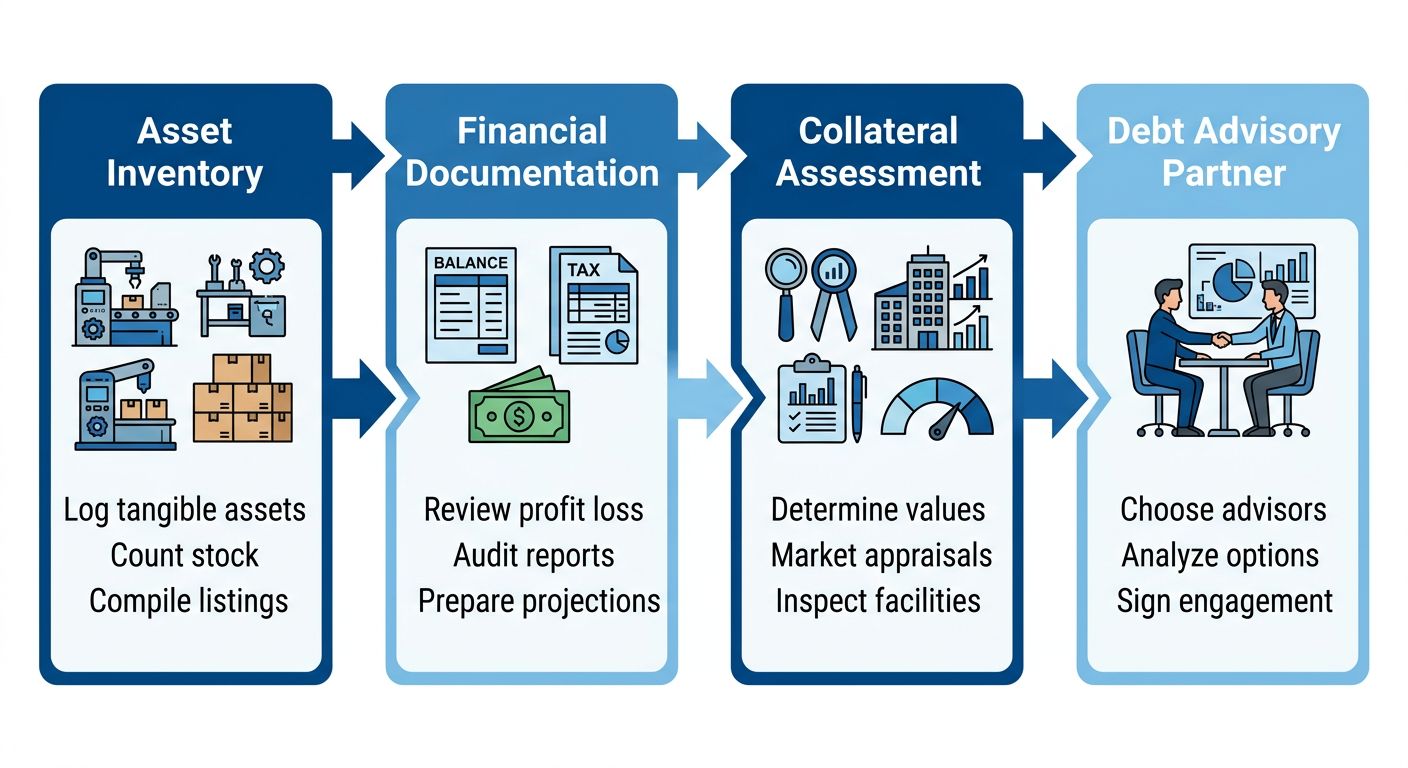
    A frequent barrier is insufficient or poorly organized asset documentation, which prevents companies from qualifying for asset-based lending. Our FAQ outlines that institutions require a clear, verifiable collateral base and detailed asset records. For asset-based lending or cash-flow financing, presenting a strong collateral package and a verifiable cash-flow history is essential. Companies that invest in structured asset tracking and formal appraisals greatly improve their eligibility and signal readiness to private credit lenders.

    Lack of audited financial statements and credible cash-flow projections is another top reason for rejection. Institutional investors typically require three years of audited financials and three- to five-year cash-flow forecasts. Our qualification framework shows that without these, even otherwise healthy businesses struggle to demonstrate their repayment capacity. By committing to regular audits and building realistic, multi-year projections, companies can close this critical gap.

    Inadequate governance structures and limited credit histories further complicate access. The International Capital Market Association (ICMA) emphasizes that institutional investors expect transparency, standardized reporting, and robust risk management. Adopting these standards reduces friction and builds the confidence of sovereign wealth funds and private credit market lenders. Additionally, preparing a detailed business plan with pro-forma financials, a clear use-of-funds explanation, and a credible repayment strategy demonstrates the kind of institutional readiness that professional investors expect.

    Proactive preparation and early engagement with a capital advisor can streamline the entire process. With proper documentation and governance alignment, these barriers can be systematically addressed — which is exactly where our Full-Cycle M&A and capital advisory services come into play.

    Your Pathway to Institutional Capital

    Accessing institutional capital sources—from private credit lenders in the US to sovereign wealth funds worldwide—requires a partner with deep investor relationships. Our network includes pension funds, family offices, and other institutional investors. Zaidwood Capital connects you to over 4,000 investors with more than $15B in deployable capital.

    Our proprietary tools—Sovereign Data Nexus, Precision Catalyst, and Velocity Matrix—streamline due diligence, investor outreach, and deal execution. With $24.4B+ in aggregate transaction volume and more than 300 deals completed, we deliver full-cycle M&A and capital advisory. Securities are offered through Finalis Securities LLC (member FINRA/SIPC) in compliance with regulatory requirements. Past performance does not guarantee future results.

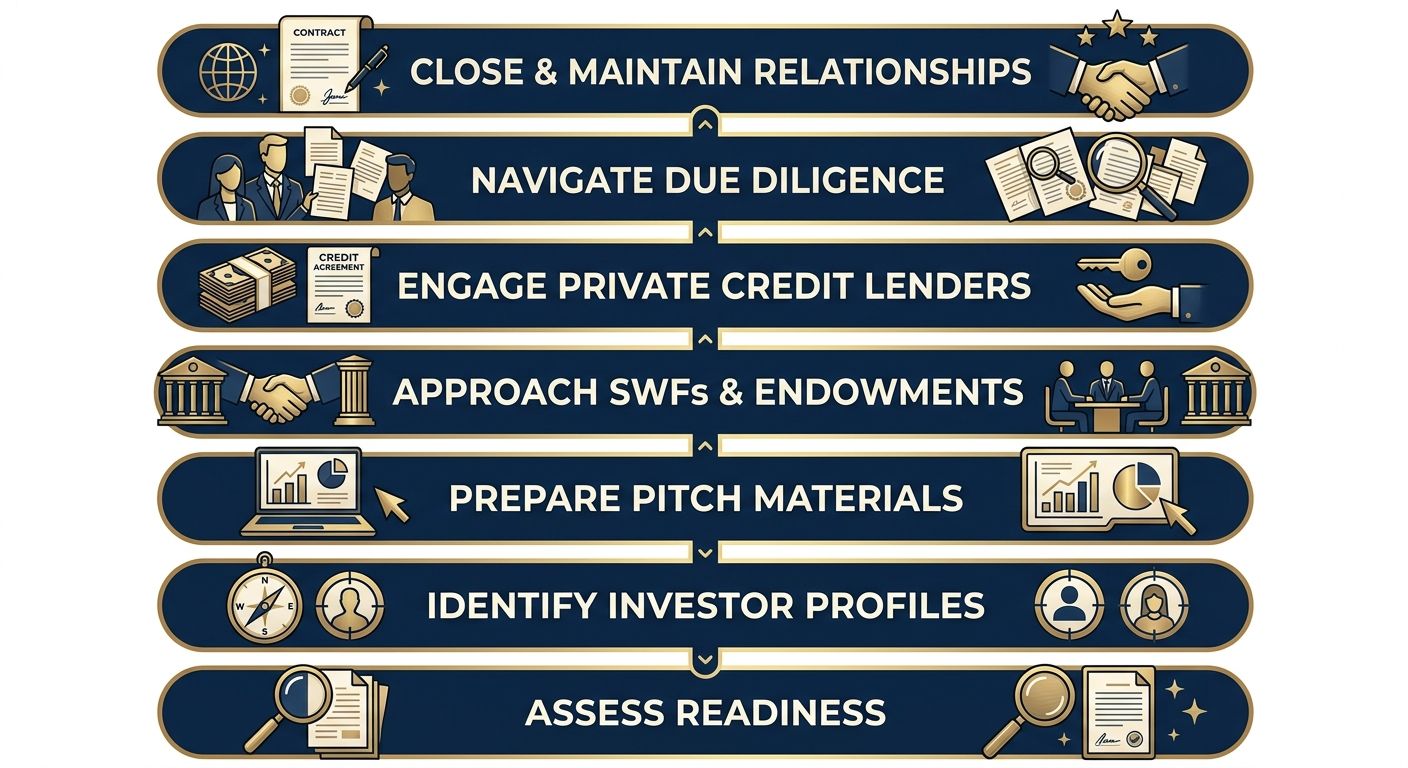
    Seven-step capital pathway infographic showing each advisory stage from readiness assessment to deal closing and relationship management.

    Your Pathway to Institutional Capital in seven clear steps

    This seven-step process brings clarity to every phase of capital raising, from readiness assessment to deal closing. Begin your pathway today. Book a call with our team to discuss your capital raising goals and discover how our investor network can work for you.

    Resources

  • Direct Lending Market Comparison: Top Private Capital Strategies

    Direct Lending Market Comparison: Top Private Capital Strategies

    Table of Contents

    Direct Lending Market: A Competitive Capital Source for Middle-Market Companies

    Middle-market firms facing rigid bank underwriting increasingly turn to the direct lending market for speed and flexibility. Unlike traditional bank loans, direct lending—provided by non-bank institutions—offers faster execution, covenant-light structures, and reduced regulatory hurdles. Our firm’s research confirms that borrowers value this private credit market for its ability to close deals swiftly.

    Current U.S. direct lending spreads remain competitive, attracting middle-market companies away from syndicated loans. Zaidwood Capital’s market intelligence shows direct lending integrates with broader private capital raising strategies, including GP-led secondary transactions that provide liquidity. Companies pursuing emerging markets M&A also benefit from direct lending’s speed and flexibility. In the following section, we outline how our team structures these customized solutions.

    1. Competitive Interest Rate Spreads

    In the U.S. direct lending market, borrowers seek competitive pricing amid tightening spreads. According to Zaidwood Capital’s market analysis, current all-in yields reflect the following typical ranges in basis points (bps):

    • Senior secured direct loans for mid-market transactions: SOFR + 400–600 bps.
    • Unitranche structures for high-quality sponsors: SOFR + 350–500 bps, while smaller or riskier borrowers may see spreads of +600–800 bps.
    • Second-lien or mezzanine tranches: SOFR + 800–1,200 bps.

    Spread compression over the past year has been driven by heightened competition among direct lenders, a trend we also observe in private capital raising strategies and GP-led secondary transactions. Deal size, credit quality, and leverage shape pricing, and our network enables us to secure competitive terms in the U.S. direct lending market. While spreads remain competitive, sponsors pursuing emerging markets M&A often face wider spreads due to higher perceived risk. These benchmarks directly influence the cost of capital across deal structures, a dynamic we navigate for every mandate.

    2. Flexible Financing Structures

    Beyond standard capital raising, we offer flexible financing structures that leverage the direct lending market to deliver faster execution and custom terms compared to traditional bank loans. As our internal FAQ on direct lending explains, this alternative to bank financing bridges gaps where conventional credit often falls short, especially for mid-market transactions.

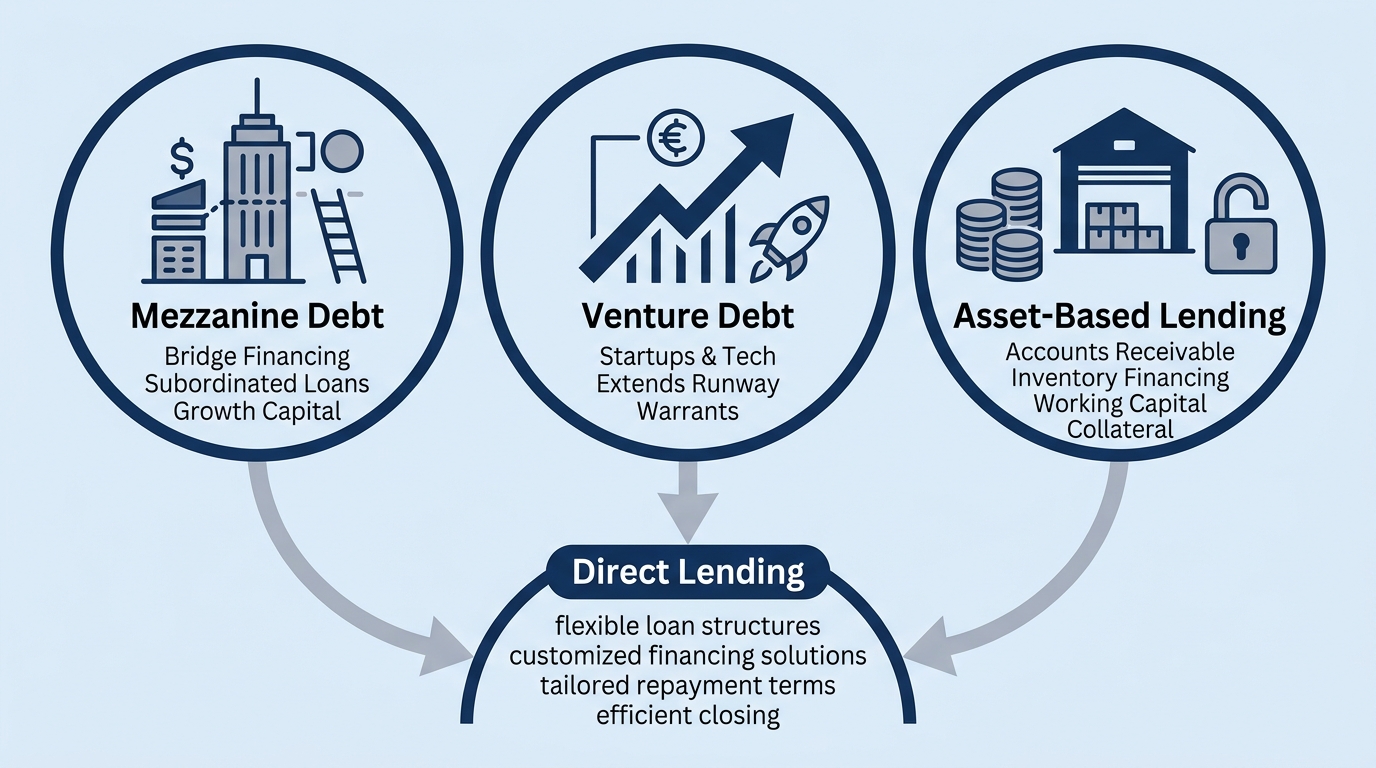
    Our tailored solutions encompass mezzanine debt, venture debt, equipment financing, and asset-based lending. Each instrument is custom-quoted to the client’s specific transaction, ensuring the right capital structure for growth, acquisitions, or liquidity. By operating in the direct lending market, we can craft flexible covenants and amortization schedules that align with your cash-flow profile. These structures support private capital raising strategies that go beyond one-size-fits-all bank terms.

    Infographic showing three flexible financing structures: mezzanine debt, venture debt, and asset-based lending connected to a direct lending hub.

    Flexible financing structures connected to direct lending.

    This flexible financing approach is designed to reinforce your buy-side M&A strategies with speed and precision, complementing our Full-Cycle M&A and capital advisory. To explore a custom-quote structure for your next transaction, Book A Call. This is not an offer or commitment; all financing is subject to due diligence and final documentation.

    3. Speed and Certainty of Execution

    In today’s direct lending market, speed and certainty of execution are decisive advantages for businesses evaluating private capital raising strategies.

    Traditional syndicated bank loans demand months of negotiation among multiple syndicate tiers and require extensive regulatory filings under SEC capital raising regulations; in stark contrast, direct lenders issue committed capital letters upfront and close in weeks, with fewer parties, less documentation, and a near-certain funding outcome.

    Zaidwood Capital’s proprietary market intelligence shows that current U.S. direct lending interest rate spreads remain favorable for borrowers, indicating that institutional lenders are actively seeking to deploy capital and can move swiftly when opportunities arise.

    Our approach to Streamlining Transactions shortens the search and negotiation cycle, and with a global network of over 4,000 investors, we accelerate execution for transactions ranging from corporate debt to GP-led secondary transactions, reducing opportunity cost and securing better terms.

    This speed and certainty, combined with Zaidwood Capital’s full-cycle advisory platform, streamlines access to substantial institutional capital for businesses pursuing growth.

    4. Middle-Market Capital Access

    Middle-market companies with revenues between $10 million and $1 billion frequently encounter a capital gap that traditional bank loans cannot fill, making access to capital in the direct lending market a vital alternative. As our FAQ notes, direct lending transactions close weeks faster than bank loans, with fewer covenants and flexible terms that adapt to a company’s cash flows rather than rigid formulas. Post-2008 regulatory changes constrained traditional bank lending, cementing the direct lending market as the core funding channel for mid-size firms. We help middle-market firms structure direct lending opportunities through our network of over 4,000 institutional investors and $15 billion in deployable capital, accelerating execution and reducing time-to-close. Beyond direct lending, our team deploys wider private capital raising strategies, including GP-led secondary transactions, to meet each company’s unique capital needs. Because direct lending operates under FINRA regulation direct lending, all participants must ensure strict compliance. Securities are offered through Finalis Securities LLC; Zaidwood Capital is not a registered broker-dealer and is separate from Finalis.

    5. Private Equity Buyout Support

    The direct lending market has become a cornerstone of private equity buyouts as firms seek speed and flexibility beyond traditional bank leverage loans. We at Zaidwood Capital see direct lender financing offering bespoke terms that align with the specific cash flow profiles of portfolio companies. This private credit approach sidesteps the rigid syndication processes of conventional banks, enabling faster closings and more creative capital structures. GP-led secondary transactions further illustrate how direct lending injects liquidity, allowing general partners to hold assets longer while offering LPs partial exits. Our private capital raising strategies incorporate direct lending solutions to support full-cycle buyout execution from acquisition through value creation. Direct lending also complements traditional bank financing by filling gaps where syndicated markets retreat, a dynamic we harness in our advisory work. As deal complexity grows, we view direct lending not as a niche instrument but as an enabling component driving the next phase of transaction structuring and capital deployment.

    6. Regulatory Landscape and Liquidity

    The direct lending market has experienced profound changes as regulatory oversight intensifies. Heightened scrutiny from the SEC and evolving risk-retention rules have dampened risk appetite among lenders, tightening liquidity dynamics across the sector. This shift is reshaping how capital flows into private credit.

    As bank-led lending retrenches, institutional capital increasingly pivots toward the direct lending sector. Stringent regulatory frameworks—including enhanced disclosure requirements and capital adequacy standards—drive allocators to reassess exposure. Our own analysis confirms that the regulatory environment compels investors to seek more resilient structures and transparency.

    These pressures have accelerated the adoption of private capital raising strategies and GP-led secondary transactions. By facilitating liquidity through secondary market solutions, managers can mitigate the constraints imposed by today’s regulatory landscape.

    Navigating this complexity demands deep market intelligence. Our firm leverages a network of over 4,000 institutional investors and $24.4B+ in aggregate transaction volume to help clients secure capital formation and liquidity in regulated markets. We help lenders and sponsors adapt their strategies, ensuring they remain positioned for success.

    7. Private Capital Raising Strategies

    For middle-market firms, private capital raising strategies offer an alternative to public markets, with the direct lending market serving as a vital source of flexible financing. These approaches enable capital formation for acquisitions, recapitalizations, and liquidity events while avoiding the regulatory complexities of an IPO.

    We help clients evaluate several private capital raising strategies:

    • Equity financing
    • Debt financing
    • Mezzanine debt
    • Direct lending
    • GP-led secondary transactions

    Direct lending, from non-bank institutional lenders, provides tailored capital complementing traditional bank loans. GP-led secondary transactions provide liquidity for limited partners while general partners can continue managing assets. At Zaidwood Capital, we design and execute these capital raises using our network of over 4,000 institutional investors and $15B+ in deployable capital, tailoring solutions to each firm’s profile. We integrate rigorous due diligence as part of our full-cycle M&A and capital advisory approach to ensure a seamless path from strategy to close.

    This site is for informational purposes only. Securities are offered through Finalis Securities LLC; Zaidwood Capital is not a broker-dealer.

    8. GP-Led Secondary Transactions

    In a GP-led secondary transaction, the general partner sells a portfolio company into a newly formed continuation fund backed by both existing and new limited partners. This approach, part of broader private capital raising strategies, provides early liquidity to LPs while allowing the GP to retain the asset and pursue additional value creation over a longer horizon. For careful LPs, these transactions offer a path to realize returns before a traditional exit; for GPs, they preserve management continuity and extend the runway for further growth.

    At Zaidwood Capital, we advise GPs on structuring these deals, securing institutional capital through our network of over 4,000 investors, and managing execution from start to finish. Our equity advisory and liquidity solutions practice ensures that each transaction is tailored to the fund’s objectives, streamlining transactions within our full-cycle M&A and capital advisory framework. Beyond GP-led secondaries, we support a spectrum of liquidity and capital formation strategies, including our broader equity advisory and debt advisory capabilities, positioned to serve mid-market funds across changing market cycles.

    Evaluating Direct Lending for Your Capital Strategy

    When evaluating the direct lending market, we recognize it as a private credit solution where institutional lenders provide capital directly to companies, bypassing traditional bank intermediaries.

    Direct lenders typically deliver faster execution, fewer covenants, and more flexible terms than banks—a key advantage when evaluating the direct lending market for companies with strong fundamentals seeking growth capital or acquisition financing without dilutive equity. Through direct lending, we streamline transactions, providing faster access to institutional capital. To determine fit, we assess the lender’s track record, deal flow, and alignment with your capital structure goals.

    As part of a broader set of private capital raising strategies, direct lending can complement other financing tools. GP-led secondary transactions frequently employ direct lending structures to facilitate liquidity or recapitalization.

    Resources

  • Asset-Based Lending for Corporate Expansion: Fast Capital

    Asset-Based Lending for Corporate Expansion: Fast Capital

    Table of Contents

    Funding Corporate Growth with Asset-Based Lending

    While many companies look to traditional bank loans, asset-based lending (ABL) provides a more flexible funding path. Using your accounts receivable, inventory, and equipment as collateral, asset-based lending for corporate expansion gives you faster access to capital—often without diluting equity. Institutional investors focus on asset quality rather than just credit scores, making ABL accessible to asset-rich companies poised for growth. Whether funding an acquisition, bridging working capital gaps, or expanding operations, collateral-based business funding offers a reliable capital solution.

    • Support ABL for growth initiatives without selling equity
    • Fund acquisitions with collateral-based business funding
    • Bridge working capital gaps using receivables and inventory

    Zaidwood Capital’s team of advisors streamlines the process, connecting you to institutional investors through our global lending services. To discuss asset-based financing for expansion that matches your growth plan, Book A Call today.

    Preparing Your Business for Asset-Based Financing

    After clarifying what asset-based financing entails, the next step is preparing your business for asset-based lending for corporate expansion. This involves assembling a detailed inventory of your accounts receivable, equipment, and inventory. Updated financial statements and cash flow projections are critical, as lenders assess collateral coverage and quality to determine borrowing capacity.

    For businesses exploring alternative lending marketplaces, Zaidwood Capital’s research highlights global lending services as one example of asset-based solutions. Our debt advisory team helps you navigate these options and prepare a competitive application. Partnering with an advisor can reduce common pitfalls such as incomplete asset schedules or outdated financials that delay approval.

    Begin your preparation with these essential steps:

    • Assemble a detailed asset inventory listing all accounts receivable, equipment, and inventory with current valuations.
    • Update financial statements and project cash flows for at least 12–24 months.
    • Calculate your collateral coverage ratio and address any shortfalls by adjusting asset schedules or obtaining additional guarantees.
    • Consult our debt advisory team to align your documentation with lender standards and strengthen your application.

    The four key stages—asset inventory, financial documentation, collateral assessment, and partnering with a debt advisor—are illustrated below. A thorough preparation typically takes four to six weeks, but our streamlined process can accelerate timelines.

    Diagram of four stages for preparing asset-based financing: Asset Inventory, Financial Documentation, Collateral Assessment, and Debt Advisory Partner

    Four-stage process for asset-based financing preparation

    Securing asset-based lending for corporate expansion ultimately depends on presenting a clear, lender-ready financial picture. Once your documentation is complete and your collateral position is clear, evaluating the right lender or loan structure becomes the next critical step. Our team can help you explore options and expedite your timeline—book a call to discuss your situation.

    Assessing Your Collateral Base for Maximum Borrowing Capacity

    With capital options spanning equity to structured debt, the next step is to assess your collateral base—the set of assets you can pledge to secure financing. In asset-based lending for corporate expansion, a well-documented collateral position directly strengthens your borrowing capacity.

    Common qualifying assets include accounts receivable, inventory, equipment, commercial real estate, and intellectual property. Lenders then apply valuation haircuts based on asset liquidity and risk to determine your borrowing base, the maximum amount available. A stronger collateral base not only boosts borrowing capacity but can also improve loan terms.

    Regular audits and accurate documentation are essential, as lenders value assets only to the extent they can be verified. This discipline is especially critical when financing emerging markets M&A, where robust collateral valuation mitigates cross‑border risk. A thorough collateral assessment is the first step toward a compelling loan application. Our advisory team leverages a network of over 4,000 institutional investors and access to $15B+ in capital to help you structure corporate expansion financing that fits your objectives. Book A Call to begin.

    Evaluating Your Financial Profile and Creditworthiness

    Securing asset-based lending for corporate expansion begins with a thorough evaluation of your company’s financial profile. We assess creditworthiness through detailed analysis of cash flow stability, collateral quality, and debt service capacity, examining both historical performance and forward-looking projections. This foundational step is critical to building a credible case for lenders and aligning your capital raising strategy with market expectations.

    Our full-cycle due diligence integrates financial, operational, and legal review to build a comprehensive credit profile that meets rigorous capital market standards. Unlike traditional lending, this approach prioritizes the intrinsic value of your company’s assets and recurring revenue, providing a more flexible path to growth capital.

    We look beyond conventional credit scores to evaluate asset liquidity, industry trends, and management experience, strengthening your credit narrative for expansion financing. This evaluation directly shapes the structure of debt solutions tailored to your objectives. By understanding your unique financial position, we help you access the capital needed to scale with confidence and transparency.

    Structuring the Asset-Based Debt for Your Expansion Goals

    Asset-based debt — asset-based lending for corporate expansion — unlocks liquidity by tying credit capacity to your company’s accounts receivable, inventory, and equipment. Drawing on our acquisition financing framework, we help you structure the borrowing base, where advance rates per asset class determine how much capital you can draw. Typically, receivables command higher advance rates than inventory, and equipment may be financed under a separate term component.

    Depending on whether you need flexible working capital for day-to-day operations or a dedicated term loan to fund capital expenditures, we tailor the structure to align with your specific expansion timeline and cash flow profile.

    Our Full-Cycle M&A and capital advisory expertise encompasses regulatory compliance, so your facility aligns with SEC market oversight and manages risk effectively. By partnering with us, you gain access to customized capital solutions that streamline the entire transaction. Book A Call to discuss how we will design your expansion financing.

    Gathering Documentation for the Application Process

    Once you understand the advantages of asset-based lending for corporate expansion, the next step is gathering the required documentation. We typically ask clients to prepare the following: balance sheet, income statement, cash flow statement, accounts receivable aging reports, inventory reports, accounts payable details, and a current business plan. Accurate, up-to-date financial data accelerates our due diligence and helps secure favorable terms from institutional lenders. Our advisory team, leveraging the proprietary Velocity Matrix, assists in organizing and presenting these materials as part of our Full-Cycle M&A and capital advisory services. Securing an asset-based loan for corporate growth financing demands thorough preparation. Our proactive document review, a core tenet of our Streamlining Transactions philosophy, simplifies the paperwork and keeps your transaction on track for secured lending for business expansion. Ensuring all documentation meets applicable disclosure standards is essential; as a capital advisory firm, we are not a registered broker-dealer and securities offerings are placed through Finalis Securities LLC, which adheres to FINRA securities regulation. For a comprehensive checklist tailored to asset-based lending deals, visit our internal Documentation Requirements page. With your documentation ready, Zaidwood Capital’s team will initiate a streamlined due diligence and review, covered in the next section.

    Engaging a Debt Advisory Partner to Secure Optimal Rates

    Asset-based lending for corporate expansion offers a direct path to scale, but securing optimal rates requires deep market access. Zaidwood Capital’s debt advisory team leverages relationships with over 4,000 institutional investors to negotiate competitive terms, and our proprietary Velocity Matrix analytics ensure each debt structure is tailored to your growth objectives.

    Our full-cycle support includes comprehensive due diligence, documentation, and seamless integration with our broader capital formation capabilities—from mezzanine and venture debt to equipment financing. In every transaction involving asset-based lending for corporate expansion, our $24.4 billion aggregate volume and 4,000+ investor network give clients a decisive edge.

    To discuss how our debt advisory can structure your next expansion, Book A Call for a confidential consultation. This communication does not constitute investment advice; please consult your own legal and financial advisors. Securities are offered through Finalis Securities LLC. Zaidwood Capital is not a registered broker-dealer.

    When you evaluate asset-based lending for corporate expansion, we initiate the institutional due diligence process — a structured assessment of financial, operational, legal and strategic factors. This systematic review draws on industry benchmarks such as the ICMA Capital Market Standards to ensure every assumption is tested.

    Our due diligence unfolds through three distinct stages: initial review, detailed analysis, and final validation. At each step, we scrutinize collateral quality, cash‑flow projections and covenant frameworks critical to asset‑based financing transactions. Following ICMA-aligned practices, we assess operational resilience and strategic fit, providing you with a comprehensive decision-making framework.

    Once you have completed a robust due diligence cycle, you can move into the final structuring and closing phase with confidence. Our integrated approach ensures that no material detail is overlooked, positioning your company for a successful execution. With Zaidwood Capital’s full‑cycle advisory, you gain the clarity needed to negotiate favorable terms and accelerate growth.

    Closing the Facility and Deploying Capital

    Once a business has evaluated its financing alternatives, closing an asset-based lending facility marks the final step before accessing expansion funding. This phase requires finalizing loan documentation and satisfying all conditions precedent, which our team coordinates to keep the transaction moving efficiently and effectively. The U.S. Securities and Exchange Commission provides regulatory oversight for capital deployment, and private offerings must align with its disclosure framework. Through our Full‑Cycle M&A and capital advisory framework, we structure the release of corporate expansion capital based on milestones, acquisition tranches, or working‑capital draws that match the company’s growth plan.

    Nothing in this section guarantees specific outcomes or constitutes a solicitation or commitment to transact. Parties should consult their own legal, tax, and financial advisors before proceeding. This content is for informational purposes only and does not represent investment advice. Zaidwood Capital is not a registered broker‑dealer.

    Overcoming Common Obstacles in Asset-Based Lending

    Overcoming common obstacles in asset-based lending for corporate expansion requires a strategic approach. While asset-backed funding for growth initiatives offers clear advantages, businesses often encounter hurdles that can slow momentum or create deal friction. We help our clients navigate these challenges efficiently.

    For instance, valuation disagreements between borrowers and lenders can stall negotiations. We resolve this by coordinating independent third-party appraisals and ensuring audited asset schedules are prepared well in advance, aligning expectations before formal discussions begin. Another challenge involves strict collateral eligibility criteria and conservative advance rates. To address this, we negotiate floating advance rates tied directly to asset quality, ensuring that the borrowing base reflects the true value of receivables, inventory, and equipment.

    Time-intensive documentation and approval cycles represent a third obstacle. Through our Full-Cycle M&A and capital advisory model, we leverage a pre-vetted network of institutional investors to dramatically compress timelines. Our streamlined due diligence process, covering financial, legal, and operational dimensions, reduces institutional friction and accelerates underwriting. By connecting the right assets to the right capital sources, we remove bottlenecks that often derail corporate expansion plans.

    Yet these challenges are manageable with the right partner. We invite you to Book A Call for a personalized assessment and to learn how we can structure a funding solution that supports your growth trajectory. We prioritize pragmatic structuring and rapid execution to maintain momentum, preserve cash flow, and protect operations.

    Accelerating Your Corporate Expansion Journey

    Beyond traditional financing, asset-based lending for corporate expansion offers a direct path to fund growth by leveraging your company’s receivables, inventory, and equipment as collateral. Institutional investors typically look for stable cash flows, strong asset quality, and a clearly defined use of funds—criteria designed to ensure alignment between your expansion objectives and investor mandates, as detailed in our advisory resources.

    At Zaidwood Capital, we connect businesses with our network of over 4,000 institutional investors and provide full-cycle advisory to streamline the funding process from qualification through closing. Asset-based lending to fund growth often delivers faster, more flexible capital compared to conventional bank loans, enabling you to seize market opportunities without the extended timelines traditional routes demand. To explore how your company qualifies for corporate expansion through asset-backed financing, book a consultation with our team or continue to the next section for a deeper look at the qualification framework.

    Resources

  • Best Quality of Earnings Report for Mid-Market Deals 2026

    Best Quality of Earnings Report for Mid-Market Deals 2026

    Table of Contents

    The Role of Quality of Earnings Reports in Mid-Market M&A

    Following a comprehensive due diligence review, buyers and lenders in mid-market M&A transactions focus on the Quality of Earnings (QoE) report, an independent assessment of a target company’s historical financial performance, adjusted for non-recurring items. This analysis goes far beyond audited financials by evaluating revenue sustainability, customer concentration, and the normalization of operating expenses and working capital. A well-prepared quality of earnings report provides a clearer view of recurring EBITDA, which serves as the foundation for valuation and debt sizing.

    Why QoE Matters in Mid-Market Deals

    The insights from an earnings quality analysis routinely reshape transaction terms. Buyers use the adjusted EBITDA to support purchase price adjustments, earnout structures, and net-working-capital targets. Lenders, in turn, demand a validated earnings baseline before committing acquisition debt. Moreover, the QoE often uncovers deferred-revenue patterns or concentration risks that, if ignored, can surface as costly post-close liabilities. In mid-market transactions where information gaps are common, a thorough QoE report reduces post-close surprises and gives the commissioning party a stronger negotiating position.

    Because mid-market companies frequently lack the internal resources to produce a GAAP-independent earnings analysis on their own, many engage specialized M&A advisors to manage the QoE process. At Zaidwood Capital, we integrate the QoE directly into our full-cycle due diligence offering, coordinating with independent accounting firms to deliver a report that buy-side and sell-side clients can rely on during negotiation and financing. We handle all financial data in accordance with rigorous confidentiality standards. For information on how we protect client information, please review Zaidwood Capital Privacy Policy.

    What Defines a Quality of Earnings Report

    A critical subset of due diligence, central to mid-market transaction diligence, is the Quality of Earnings Report, a financial analysis that evaluates the recurring, normalized earnings of a target company. At Zaidwood Capital, we define a QoE report as a rigorous assessment of earnings sustainability, designed to strip out non-recurring items and present a true picture of operating performance. This analysis is a cornerstone of our full-cycle due diligence process for mid-market M&A transactions.

    A comprehensive earnings quality analysis examines several critical areas. Revenue quality scrutinizes the predictability and diversification of income streams. Expense normalization adjusts for one-time costs, owner’s compensation, or other out-of-ordinary expenses. EBITDA adjustments remove non-operating or non-cash items to reflect sustainable earnings. Working capital trends highlight operational liquidity needs and potential cash drags. One-time items, such as litigation settlements or asset sales, are excluded to reveal the underlying earning power. These dimensions collectively inform whether the company’s earnings are sustainable and repeatable for future periods.

    Infographic with five columns representing core areas of a quality of earnings analysis: Revenue Quality, Expense Normalization, EBITDA Adjustments, Working Capital Trends, and One-Time Items, each with icons and bullet lists on a muted blue and gray palette.

    Zaidwood Capital’s Quality of Earnings analysis framework visualized in five key areas.

    By producing a normalized earnings base, the QoE report helps both buyers and sellers reach consensus on valuation. For buy-side M&A professionals, this analysis highlights the true recurring profitability of a target, removing distortions that could inflate or deflate the purchase price. Sellers also benefit, as a well-documented QoE report can justify a premium and accelerate negotiation.

    As part of our Full-Cycle M&A and capital advisory services, we integrate QoE analysis into every engagement to provide clients with clear, defensible financial insights. The report is not an audit; it does not verify financial statement accuracy in compliance with accounting standards. Instead, it offers transaction-specific intelligence that traditional audits often miss. Zaidwood Capital utilizes QoE reports as a core component of its full-cycle due diligence, ensuring that both buy-side and sell-side mandates are grounded in reliable earnings data. By identifying true economic earnings, a QoE report streamlines negotiations and reduces the risk of post-close surprises.

    Next, we examine the core components that define a comprehensive QoE analysis.

    Securities are offered through Finalis Securities LLC, an independent entity from Zaidwood Capital. This content is for informational purposes and does not constitute investment advice.

    Core Components of a Quality of Earnings Analysis

    A quality of earnings report for mid-market deals goes beyond audited financials to uncover the true recurring cash flow a buyer can rely on. In this section, we break down the three pillars of a quality of earnings analysis: normalization adjustments, working capital scrutiny, and EBITDA sustainability. Drawing on Zaidwood Capital’s due diligence expertise, we show how each component strengthens deal-making for institutional and private investors.

    Normalization Adjustments and Add-Backs

    Normalization adjustments strip away non-operational or inflated expenses to present a clean EBITDA. These adjustments are critical because audited financials may include non-recurring gains or expenses that distort the company’s sustainable earning power. In our analyses, we identify above-market owner compensation, one-time legal fees, personal expenses run through the business, and related-party transactions at non-market terms.

    • Owner’s Compensation Adjustment: Aligning above-market owner salary and benefits to industry-standard compensation for a replacement manager
    • Non-Recurring Expenses: One-time legal fees, consulting engagements, relocation costs, or restructuring charges unlikely to repeat post-acquisition
    • Personal Expenses: Personal travel, entertainment, vehicles, or family members on payroll not related to business operations
    • Related-Party Transactions: Above-market rent, management fees, or service charges paid to entities owned by the seller or their family

    We substantiate each adjustment with corroborating evidence—payroll records, lease agreements, invoices—and provide a clear rationale in our reports. A quality of earnings analysis also flags off-balance-sheet liabilities like operating leases or contingent obligations that can alter deal value. For example, an owner drawing $600,000 when market rate is $200,000 inflates expenses by $400,000, a typical adjustment we see. By documenting every add-back, we give buyers confidence in the normalized earnings figure. Additionally, QoE reports look beyond the balance sheet to identify contingent payments or environmental indemnities that may not be booked but represent real future cash outflows.

    Working Capital Analysis and Debt-Like Items

    Working capital analysis determines the normalized net operating capital needed post-acquisition. We assess seasonal needs, payment cycles, and industry norms, then compare that to the target company’s actual levels. The gap—whether surplus or deficit—becomes an adjustment to the purchase price. For instance, if a business has excess working capital relative to its normalized requirement, the buyer may credit the seller for that amount at closing; conversely, a deficiency reduces the price. Our QoE reports present these adjustments with supporting schedules so that both buyers and sellers can negotiate from a common understanding.

    Debt-like items are obligations that function as debt but are not on the balance sheet as such. Examples include deferred revenue, underfunded pensions, or installment sale obligations. We identify these, quantify their impact, and deduct them from the equity value, just as we would formal debt. This analysis prevents the buyer from inheriting hidden financial burdens and ensures the enterprise value accurately reflects the business’s true financial position.

    EBITDA Quality and Sustainability Assessment

    EBITDA sustainability evaluation dissects the recurring nature of earnings. We examine revenue concentration risk—if a company depends on a single customer for more than 10% of revenue, that concentration creates vulnerability. Customer retention trends, contract renewal probabilities, and churn rates indicate how sticky the revenue base is. We also assess margin stability, checking whether gross and operating margins are sustainable or eroded by pricing pressure. In emerging markets M&A, we place extra focus on revenue concentration and retention because currency swings, regulatory shifts, and political instability can quickly reshape earnings. We evaluate supplier relationships to ensure margins are not artificially supported by short-term concessions, and we consider macroeconomic trends that could influence future earnings. Through our QoE reports, we help buyers distinguish durable cash flows from those that could evaporate post-acquisition, providing a forward-looking perspective essential for informed investment decisions.

    Selecting a Quality of Earnings Provider for Your Mid-Market Deal

    A quality of earnings report for mid-market deals is one of the most important tools for de-risking an acquisition, and choosing the right provider directly influences the credibility of your financial analysis. For companies in the $20M–$100M revenue range, the provider’s expertise, speed, and post-engagement support can make a material difference in how the QoE findings are received by lenders, underwriters, and counterparties.

    Evaluating Boutique Firm Expertise for QoE Analysis

    Boutique firms such as Zaidwood Capital specialize in delivering a highly tailored Quality of Earnings analysis that aligns with the specific dynamics of mid-market transactions. Their teams typically bring deep industry knowledge and direct senior partner involvement, ensuring that the engagement is led by an experienced professional who understands both the financial and strategic dimensions of the deal. In contrast, Big Four accounting firms offer a broad, generalist approach with standardized QoE templates that can miss the nuances of niche sectors. Mid-tier regional firms occupy a middle ground, providing moderate specialization but often with less senior oversight than a dedicated boutique.

    The critical differentiator is the level of partner engagement. At a boutique, the senior team leads the QoE analysis from start to finish, which shortens feedback loops and results in a more focused report. Big Four firms typically rely on junior staff for the bulk of the fieldwork, with partner review at the conclusion, while mid-tier firms show variability in senior involvement. This direct access to senior talent often translates into faster turnaround times and more actionable insights for the acquirer.

    The following comparison table summarizes key distinctions to inform your selection.

    Common Add-Backs and Adjustments in Quality of Earnings Reports
    Adjustment TypeDescriptionTypical EBITDA ImpactCommon Example
    Owner’s Compensation AdjustmentAligning above-market owner salary and benefits to industry-standard compensation for a replacement manager+$150,000 to $500,000 add-backOwner paying themselves $600,000 when market rate for a general manager is $200,000
    Non-Recurring ExpensesOne-time legal fees, consulting engagements, relocation costs, or restructuring charges unlikely to repeat post-acquisition+$50,000 to $300,000 add-back$200,000 in legal fees from a one-time litigation matter
    Personal ExpensesPersonal travel, entertainment, vehicles, or family members on payroll not related to business operations+$25,000 to $150,000 add-backCompany-leased luxury vehicle used primarily for personal use
    Related-Party TransactionsAbove-market rent, management fees, or service charges paid to entities owned by the seller or their family+$75,000 to $400,000 add-backPaying $30,000/month rent to a seller-owned LLC when market rate is $15,000

    Boutique firms consistently deliver deep specialization and hands-on partner involvement, often completing a QoE engagement in as little as 2–4 weeks—roughly half the time of a Big Four engagement. Moreover, firms like Zaidwood Capital adhere to established capital markets best practices, incorporating frameworks from ICMA capital markets to ensure the analysis meets rigorous industry standards. This commitment to both speed and quality makes boutique advisors a compelling choice for mid-market acquirers.

    Scope and Cost Expectations for Mid-Market Companies

    For a $20M–$100M-revenue company, the scope of a Quality of Earnings engagement should be calibrated to deal complexity and the acquirer’s specific concerns. A one-size-fits-all report rarely adds value; instead, the engagement scope must be defined collaboratively, focusing on revenue recognition policies, working capital trends, customer concentration risks, and any carve-out adjustments that could affect normalized EBITDA. At Zaidwood Capital, we work directly with buyers to design a custom scope that addresses the unique drivers of the target business, avoiding unnecessary line items that inflate cost without improving decision-making.

    Cost expectations reflect the level of customization. Boutique firms like Zaidwood Capital typically quote $25,000–$50,000 for a $20M-revenue company, while Big Four firms can range from $75,000 to over $150,000 for a similar-sized engagement. Mid-tier regional firms generally fall between $40,000 and $80,000. All figures are custom quotes and depend on data availability, the number of entities involved, and the speed required. We emphasize that our pricing is never a fixed fee; each engagement is priced based on the precise scope and timeline agreed upon, with full-cycle support extending from the initial QoE analysis through deal close.

    Integrating QoE Findings into Deal Structuring

    A Quality of Earnings report is not just a diligence artifact—it directly shapes the final deal terms. When normalized EBITDA adjustments reveal that reported earnings overstate true recurring cash flow, buyers can negotiate purchase price reductions or post-closing true-ups. Earnout structures become more defensible when the QoE identifies revenue volatility or concentration risks that warrant contingent payments. Similarly, representation and warranty insurance underwriters increasingly rely on QoE findings to set coverage limits and exclusions, making a thorough report a valuable risk-transfer tool.

    At Zaidwood Capital, our full-cycle advisory model ensures that QoE insights flow seamlessly into the negotiation and documentation phases. We translate EBITDA adjustments into specific purchase price adjustment mechanisms, design earnout milestones linked to verifiable financial metrics, and help acquirers present the QoE to insurers to secure favorable underwriting terms. This integrated approach reduces re-trading risk and accelerates the path to a signed purchase agreement. Once you have selected the right partner, the next step is implementing a disciplined QoE process that turns financial analysis into concrete deal terms. As with any investment, past performance does not guarantee future results, and we recommend consulting professional advisors to tailor the approach to your deal.

    How Quality of Earnings Reports Influence Purchase Price and Deal Terms

    A quality of earnings report for mid-market deals does more than flag accounting irregularities; it serves as the core negotiating lever for adjusting the purchase price and crafting protective deal provisions. At Zaidwood Capital, we treat the QoE report as the definitive source for reconciling reported financials with normalized economic reality. This alignment is essential before we engage in price discussions.

    In our experience, the most direct impact of the QoE report is a purchase price adjustment derived from normalized EBITDA. When the report strips out non-recurring revenue or one-time expenses, it recalibrates the basis on which the acquisition multiple is applied. A lower sustainable EBITDA can reduce the implied valuation, prompting the buyer to seek a price reduction. Conversely, a seller whose earnings prove clean and recurring can leverage the report to sustain or elevate the offer. Beyond EBITDA, the working capital peg—determined by historical QoE trend analysis—can shift the final cash consideration. If the report reveals that the target’s normalized net working capital is lower than originally represented, the buyer rightfully demands a dollar-for-dollar reduction at closing. Sellers with positive QoE results often use this as a shield against overly burdensome indemnification clauses, while buyers rely on the analysis to insert additional covenants or expand representations and warranties when risks are evident.

    Earnout structures are another area where QoE findings carry substantial weight. We typically link earnout payments to forward-looking financial metrics that have been validated by the quality of earnings (QoE) review. This ensures that post-closing milestones are both achievable and reflective of the business’s true earning power, reducing disputes later. Likewise, indemnification horizons and escrow amounts are calibrated to the specific risks flagged in the report. A revenue recognition issue might extend the survival period for related claims and increase the escrow holdback, while a clean report shortens those protections. Underpinning this rigor are regulatory standards that shape our financial analysis. FINRA securities regulation, administered by the Financial Industry Regulatory Authority, sets expectations for broker-dealer reporting that influence how we assess earnings quality in private transactions. Similarly, SEC securities regulation, enforced by the U.S. Securities and Exchange Commission, mandates GAAP compliance and reinforces the importance of accurate data in all valuations. In the following section, we demonstrate how these adjustments play out in a real mid-market transaction.

    Common Questions About Quality of Earnings Reports in Mid-Market Deals

    After establishing the importance of a quality of earnings report for mid-market deals, we address the most common questions buyers and sellers ask before engaging a QoE provider.

    What is a quality of earnings report, and why is it essential for mid-market deals? A QoE analysis examines earnings sustainability and quality, revealing adjustments needed in private-company financials and uncovering risks like customer concentration.

    How does a QoE differ from standard due diligence, and what adjustments does it uncover? Unlike standard due diligence, a QoE report serves as a complementary tool—used by advisors like Zaidwood Capital—to examine normalized EBITDA, margin trends, and working capital, separating recurring from one-time items and revenue mix.

    How does a QoE report impact valuation and deal structure? By surfacing these insights, a QoE can bridge valuation gaps and influence purchase price multiples, giving both sides clearer grounds for negotiation.

    Next, we’ll walk through the practical steps of commissioning a QoE report for your mid-market transaction.

    Leveraging Quality of Earnings Reports for Smarter M&A Decisions

    A Quality of Earnings report for mid-market deals dissects financials to expose sustainable earnings by stripping out one-offs. It flags risks like premature revenue booking, strengthening your negotiation position. Mid-market firms with less polished reporting especially benefit. At Zaidwood Capital, a quality of earnings report for mid-market deals anchors our full-cycle due diligence, alongside operational, commercial, and IT assessments, to deliver a complete picture. Compliance with SEC securities regulation ensures data reliability, and leveraging QoE minimizes post-close shocks. Deeper insight drives smarter M&A decisions.

    Resources

  • Family Office Liquidity Management Strategies: Essential Guide

    Family Office Liquidity Management Strategies: Essential Guide

    Table of Contents

    The Foundations of Family Office Liquidity Management

    Effective family office liquidity management strategies ensure that sufficient cash and near-cash assets are available to meet obligations—capital calls, operating expenses, and strategic investments—without disrupting long-term portfolio allocations. This foundational discipline balances near-term liquidity needs with the family’s overarching wealth preservation goals.

    Capital call liquidity management is a critical concern, given that private equity and venture funds require sudden capital injections. At the same time, uneven cash flows from operating businesses underscore the need for disciplined family office treasury management to maintain adequate buffers without sacrificing returns.

    Institutional-grade advisory services, such as debt advisory and equity liquidity solutions, help family offices optimize their liquidity position. We draw on $24.4B+ in aggregate transaction volume and a network of over 4,000 global investors, aligned with ICMA guidelines, to provide solutions like global lending services. In the sections that follow, we’ll explore how these strategies are structured to meet the unique demands of family offices.

    1. Tiered Liquidity Buckets for Stability

    In family office liquidity management strategies, we define tiered liquidity buckets as a framework that segments assets by accessibility, ensuring that near-term obligations can be met without liquidating long-term holdings.

    • Operational: immediate access cash for expenses and capital calls.
    • Reserve: 30- to 90-day instruments, such as commercial paper.
    • Strategic: longer-term investments for planned growth.

    This structure anchors capital call liquidity management by pre-positioning funds before drawdowns occur. Family office treasury management relies on cash flow forecasting to calibrate each bucket, mitigating forced liquidation risk. As Zaidwood Capital’s educational materials note, commercial and industrial loans are a prime example of a short-term vehicle that fits naturally within the reserve tier, offering working-capital support while protecting longer-horizon assets.

    Three-tiered liquidity structure infographic showing operational, reserve, and strategic liquidity buckets with blue gradient arrows

    Tiered liquidity buckets for family office stability

    Ultimately, robust family office liquidity management strategies align each bucket with anticipated calls and contingencies — a principle Zaidwood Capital’s liquidity management best practices reinforce. In the next section, we detail the asset classes assigned to each tier.

    2. Private Equity Liquidity Solutions

    Building on our advisory platform, private equity liquidity solutions help investors access capital without selling assets. They are essential in family office liquidity management strategies, where preserving long-term investments during short-term cash needs is critical.

    A key driver of private equity liquidity strategies for family offices is capital call liquidity management. When a general partner calls capital, limited partners must fund commitments promptly. Liquidity demands also arise in other scenarios:

    • Addressing uneven cash flows
    • Funding opportunistic co-investments
    • Covering tax or estate obligations
    • Rebalancing portfolios without disruption

    Through our Equity Advisory practice, we leverage the Velocity Matrix and our network of over 4,000 institutional investors with $15 billion in available capital to source liquidity solutions tailored to specific needs. Our full-cycle M&A and capital formation expertise allows us to design facilities that meet family office treasury management objectives, providing cash when required without disrupting strategic portfolios. Every engagement is custom-quoted, and no outcome is guaranteed.

    This integrated approach to liquidity sets the stage for our debt advisory services, which provide the leverage for growth. This discussion is for informational purposes only and is not investment advice. Securities are offered through Finalis Securities LLC.

    3. Managing Illiquidity Premiums Effectively

    Effective family office liquidity management strategies begin with a clear understanding of what an illiquidity premium represents — the additional return investors demand for holding assets that cannot be quickly converted to cash without meaningful price concessions. At Zaidwood Capital, we emphasize that capturing this premium requires deliberate planning rather than passive acceptance. Successful liquidity management for family offices involves constructing portfolios with calibrated exposure across liquidity tiers, ensuring that long-duration commitments are matched with patient capital and clearly defined holding periods.

    We recommend rigorous assessment of illiquidity premiums through historical data analysis and liquidity discount models, which help quantify the expected compensation for reduced marketability. A disciplined approach to family office treasury management incorporates capital call liquidity reserves — cash or near-cash allocations specifically designated to meet drawdown requests from private investment commitments. This capital call liquidity management framework protects portfolios from forced selling and preserves the integrity of the long-term investment strategy.

    Industry best practices established by the International Capital Market Association provide valuable guidance on bond market liquidity and transparency standards. We incorporate these principles when advising on portfolio construction, recognizing that liquidity conditions evolve across market cycles. Educating stakeholders about the relationship between illiquidity and expected returns, and maintaining adequate liquidity buffers for capital calls, positions family offices to earn meaningful premiums while sustaining operational flexibility across full-cycle market environments.

    4. Capital Call Liquidity Management

    Effective capital call liquidity management is a cornerstone of capital call liquidity management for family offices and institutional investors. A capital call is a formal request from a fund manager requiring investors to fulfill their committed capital obligations. Our role is to help clients meet these requests on time without disrupting cash flow or long-term investment returns.

    We approach capital call liquidity strategies with three primary tools: maintaining a dedicated cash buffer, arranging a capital call line of credit, and structuring committed capital facilities. At Zaidwood Capital, our capital call financing solutions are specifically designed for family offices and private investors, as detailed in our Capital Call Financing FAQ. Unlike standard commercial and industrial loans—which are typically used for operating expenses or expansion and rely on asset-based or cash-flow lending—capital call financing is purpose-built for short-term bridging until called capital is distributed.

    This disciplined approach to family office treasury management helps investors avoid forced asset sales, default penalties, and missed opportunities. In the next section, we examine practical steps to implement these liquidity safeguards.

    5. Dividend Recapitalization for Diversification

    Family office liquidity management strategies often incorporate dividend recapitalization, a transaction where a company borrows to pay a dividend to its owners. This provides partial liquidity, letting family offices meet capital call liquidity management requirements or implement family office treasury management initiatives without selling underlying holdings. Freeing up capital in this way enables reinvestment across new asset classes, enhancing portfolio diversification and resilience.

    We also weigh the illiquidity premium inherent in private market investments. Zaidwood Capital’s FAQ highlights that limited partners demand a premium for reduced liquidity, shaping how we approach recapitalizations. Funding can come from sources like commercial and industrial loans, distinguishing this method from a full exit or secondary sale. By preserving ownership while accessing capital, family offices maintain ongoing alignment with management and redeploy proceeds strategically. This technique is one of several recapitalization tools we use to balance liquidity with long-term portfolio objectives.

    6. Treasury Management Best Practices

    To move from theory to practice, family offices should adopt proven family office liquidity management strategies, as outlined in our treasury management resources.

    • Prioritize cash flow forecasting with a rolling six-month horizon and monthly updates to anticipate liquidity needs, proactively manage upcoming capital calls, and avoid unexpected funding gaps.
    • Diversify counterparty risk by maintaining banking relationships with at least three independent institutions, reducing concentration risk and ensuring access to liquidity during market disruptions.
    • Develop a formal family office treasury management policy that includes liquidity stress testing under multiple market scenarios, such as interest rate spikes or capital call surges.
    • Use capital call liquidity management as a strategic tool to cover short-term funding gaps without forced asset sales, preserving long-term portfolio value.
    • Leverage treasury management software or real-time dashboards for consolidated visibility into cash positions, portfolio liquidity, and committed capital calls.

    These practices build a resilient liquidity framework; the next section explores advanced treasury technology solutions.

    7. Optimizing Private Equity Allocations

    Optimizing private equity allocations requires robust family office liquidity management strategies that balance the pursuit of the illiquidity premium with the need for accessible capital. At Zaidwood Capital, we see the illiquidity premium adding 2–3% to long-term returns, but it demands careful liquidity planning. Private equity commitments inherently involve multi-year lock-ups and unpredictable capital calls, so families must develop a clear liquidity strategy for family offices. Effective capital call liquidity management involves forecasting cash outflows and maintaining dedicated reserves to meet drawdowns without disrupting operating budgets or forcing premature asset sales.

    In our experience at Zaidwood Capital, family office treasury management plays a central role in ensuring that PE commitments align with overall portfolio liquidity. Diversifying commitments across vintage years and fund strategies mitigates concentration risk and smooths cash flow demands. We advise family offices to set allocation targets based on their investment horizon and liquidity constraints, not solely on return expectations. With these optimization principles, family offices can move to execute their private equity strategy confidently.

    8. Leveraging Capital Advisory Expertise

    Given these complexities, leveraging our Full-Cycle M&A and capital advisory expertise becomes essential. When designing in family office liquidity management strategies, we assess asset composition and cash flow profiles to select appropriate financing instruments.

    Through our full-cycle advisory process, we help family offices and companies prepare for the rigorous institutional qualification procedures associated with asset-based lending and cash flow financing. As outlined in our internal FAQ, this includes compiling audited financials, three-to-five-year cash flow projections, and detailed business plans that demonstrate creditworthiness. For capital call liquidity management, such financing can provide committed credit lines that support fund contributions without forcing asset sales.

    Our treasury management advisory, grounded in the best practices shared in our Treasury Management FAQ, strengthens family office treasury management by introducing disciplined cash flow forecasting, efficient working capital management, and strategic deployment of liquidity reserves. We work to ensure that surplus cash is invested in line with the family office’s risk tolerance and near-term cash needs.

    Zaidwood Capital’s institutional network—connecting to over 4,000 investors with more than $15 billion in deployable capital—can be structured to support both capital call liquidity management and ongoing treasury requirements.

    With this advisory support, family offices can build resilient liquidity strategies aligned with long-term objectives.

    Building a Resilient Liquidity Framework for Your Family Office

    To address capital efficiency challenges in family office liquidity management strategies, we recommend structuring a resilience framework across distinct tiers. Begin by segregating operational, reserve, and growth liquidity to align cash flows with investment horizons. A disciplined treasury function underpins effective capital call liquidity management, ensuring obligations are met without forced asset disposals.

    • Maintain a contingency reserve equal to 10–15% of committed capital to cover unexpected drawdowns.
    • Embed SEC regulatory updates into risk assessments, staying current with evolving compliance expectations.
    • Use capital call financing as a bridge, preserving invested assets during liquidity events.
    • Benchmark your approach against international wealth management firms to refine family office treasury management protocols.

    A robust framework transforms liquidity from a constraint into a strategic advantage for multi-generational wealth stewardship.

    Resources

  • Get Venture Debt for Scaleups 2026: Fast Non-Dilutive Capital

    Get Venture Debt for Scaleups 2026: Fast Non-Dilutive Capital

    Table of Contents

    Venture Debt Opportunities for Scaleups in 2026

    Beyond general capital formation, a particularly compelling path for venture debt for scaleups in 2026 is the strategic use of non-dilutive growth capital. This form of debt capital allows companies to extend their cash runway and fund critical growth milestones without further eroding founder and investor ownership. By prioritizing growth metrics over traditional cash-flow underwriting, venture debt stands apart from conventional bank loans.

    Current market conditions make this window especially relevant. Reduced venture equity availability, coupled with favorable debt terms for well-performing companies, means debt financing serves as a powerful tool between equity rounds. In our debt advisory practice, we connect growth-stage companies with appropriate capital partners, leveraging our access to over 4,000 global investors and $15B+ in deployable capital. Understanding the opportunity is the first step; the next section outlines how we structure and execute these engagements.

    Securities are offered through Finalis Securities LLC; Zaidwood Capital is not a registered broker-dealer. Book A Call for a custom venture debt consultation.

    Preparing for Your Venture Debt Strategy

    Now that you understand the advantages of venture debt, proper preparation is critical to securing favorable terms. For companies exploring in venture debt for scaleups 2026, readiness separates those who negotiate from a position of strength from those who accept whatever terms are offered. Thorough preparation signals to lenders that your business is a calculated risk, not a speculative one.

    We recommend our clients prepare the following key financial documents before approaching any lender:

    • Audited financials covering the last two fiscal years to demonstrate historical performance and accounting rigor
    • Twelve-month cash flow projections showing precisely how the debt will accelerate growth and when repayment capacity materializes
    • A clean, fully diluted cap table reflecting all equity rounds, option pools, and convertible instruments
    • A detailed use-of-funds memo tying every dollar to a specific growth milestone, whether a product launch or market expansion

    Lenders evaluate your application through specific metrics: annual recurring revenue (ARR), gross margin stability, monthly cash burn rate, and debt-service-coverage ratio (DSCR). According to Silicon Valley Bank services benchmarks, strong performance across these indicators often correlates with more flexible term structures. International Capital Market Association (ICMA) guidelines further emphasize the importance of transparent documentation in private debt placements.

    Venture debt functions as non-dilutive growth capital, allowing you to extend runway without surrendering equity. Unlike revenue-based financing, which ties repayments to top-line fluctuations, venture debt typically includes interest-only periods and may carry warrant coverage as standard structuring tools—not guarantees, but negotiable components.

    Vertical process flow diagram showing four steps for preparing a venture debt strategy: assess financial readiness, gather documentation, align strategy with milestones, and review lender criteria.

    Four-step venture debt preparation process flow

    Align your debt strategy with board-approved growth milestones and involve your CFO early. At Zaidwood Capital, our Debt Advisory team helps clients benchmark lender terms against current market standards, ensuring you approach conversations with the confidence that preparation provides. Once your strategy is fully prepared, the next step is approaching lenders with a compelling, data-backed narrative.

    Assess Your Capital Structure Needs

    Now that you understand the basics of capital structure, it’s time to assess your specific needs. How do you determine the right mix of debt and equity for your company? For scale-ups evaluating venture debt for scaleups in 2026, a structured self-assessment is the critical first step toward identifying the most suitable financing path.

    We guide founders through evaluating several key factors to build a coherent capital strategy:

    • Current debt-to-equity ratio: Understanding your existing leverage and its impact on future borrowing capacity
    • Projected cash flow: Assessing whether revenue streams can comfortably service debt obligations
    • Growth stage: Distinguishing between early-stage, scale-up, and mature company dynamics, each with distinct risk profiles and capital access
    • Purpose of capital: Clarifying whether funds are needed for working capital, an acquisition, or expansion initiatives

    Exploring non-dilutive growth capital options such as revenue-based financing can preserve ownership while funding growth. Engaging experienced venture capital consultants helps interpret these factors and design a structure aligned with your objectives.

    With your needs assessed, the next section explores the specific capital solutions that match your profile.

    Identify Leading Venture Debt Lenders

    To identify the right partner, scaleups should evaluate leading venture debt lenders based on their track record, industry expertise, and loan terms. For companies seeking venture debt for scaleups 2026, understanding the lender landscape is essential. Non-dilutive growth capital preserves equity while funding expansion, and revenue-based financing offers flexible repayment structures aligned with business performance.

    According to Zaidwood Capital, notable lenders include:

    • Silicon Valley Bank – Provides venture debt and banking services to technology and life sciences companies at all stages.
    • Hercules Capital – Specializes in growth-stage technology and life sciences companies with flexible financing solutions.
    • TriplePoint Capital – Offers debt financing and leasing to venture capital-backed companies across diverse sectors.
    • Western Technology Investment – Focuses on early to mid-stage technology and life sciences companies.
    • Oxford Finance – Provides senior secured loans to healthcare and life sciences firms.

    When evaluating lenders, scaleups should assess loan size range, interest rate benchmarks, warrant coverage, and repayment flexibility. At Zaidwood Capital, our network includes access to many of these lenders, and we can help match companies to the right partner. Once you have identified potential lenders, the next step is to prepare your approach.

    Prepare Your Financial Documentation

    Once you understand the types of capital available, preparing your financial documentation is essential when seeking venture debt for scaleups 2026. The following documents are critical:

    • Audited Financial Statements (last 3 fiscal years) demonstrate revenue stability and profitability trends.
    • Detailed Cash Flow Projections (12–24 months), especially for non-dilutive growth capital and revenue-based financing.
    • Corporate Tax Returns (last 2 years) validate financial health.
    • Current Debt Schedule (if applicable) lists existing loans or convertible notes.
    • Pro Forma Financials model the new venture debt’s impact on cash flow and leverage ratios.
    • Virtual Data Room with clear folder labels organizes all files for submission.

    For documentation standards, the International Capital Market Association provides a useful framework. Having these documents ready will streamline your capital raise. This information does not constitute investment advice. With your documents organized, you are ready to proceed with the application process.

    Structure the Deal Terms and Warrant Coverage

    Moving from an overview of venture debt, we now focus on the specific components that define a term sheet. When structuring venture debt for scaleups 2026, our team at Zaidwood Capital tailors each deal to the company’s stage and growth trajectory. A typical term sheet includes a maturity period of 3 to 5 years, an interest rate composed of a cash component plus payment-in-kind (PIK), and an upfront fee that covers due diligence and administrative costs.

    Warrant coverage — often ranging from 5% to 20% of the loan principal — provides the lender with equity participation without immediate founder dilution. We negotiate the strike price (typically set at the current preferred round price), the warrant term (commonly 5-7 years), and exercise rights to align incentives. This structure offers lenders upside while preserving non-dilutive growth capital for the company.

    Terms are calibrated to a company’s credit profile, revenue projections, and market stage; for instance, revenue-based financing considerations can influence the repayment schedule. Our full-cycle M&A and capital advisory approach ensures each element supports long-term scalability, which we will explore further in the next section covering the application process.

    Negotiate Covenants and Closing Conditions

    With your term sheet structured, the focus shifts to covenants and closing conditions — the final hurdles before funding. For a growth capital debt financing round, these terms define your operational boundaries and the prerequisites to access capital. In the 2026 landscape, venture debt for scaleups 2026 is an increasingly popular tool for companies seeking non-dilutive growth capital, but the protective mechanisms lenders require can significantly impact your financial flexibility.

    Covenants are contractual promises you make to the lender. They broadly fall into three categories:

    • Affirmative covenants: Actions you must take, like maintaining insurance or providing audited financials.
    • Negative covenants: Actions you cannot take without lender consent, such as incurring additional senior debt or selling key assets.
    • Financial covenants: Specific metrics you must meet, often a minimum cash balance or an EBITDA target.

    For a company using revenue-based financing, the financial covenants are typically tied to recurring revenue growth rather than static balance-sheet ratios. Zaidwood Capital’s advisory approach emphasizes aligning these tests with your realistic operating model. Closing conditions are the prerequisites you must satisfy before the initial draw. These can include a satisfactory legal due diligence review, board approval of the transaction, and delivery of a final legal opinion — standard steps that verify your company’s readiness for a full-cycle advisory engagement.

    We guide our clients to negotiate these terms with a pragmatic lens: insist on covenants that reflect your business’s actual trajectory, and build closing condition checklists with achievable timelines. Documenting all agreed terms in a commitment letter before moving to definitive documentation is a critical step. To discuss how we can help tailor these terms for your specific raise, we invite you to Book A Call with our team.

    Complete Full-Cycle Due Diligence

    As a prerequisite for securing non-dilutive growth capital such as venture debt for scaleups in 2026, we conduct full-cycle due diligence that serves as the intelligence backbone of every transaction. Our process is a comprehensive, integrated assessment spanning six core domains: financial, legal, operational, commercial, IT, and human capital.

    This approach identifies risks and uncovers hidden opportunities across the entire deal lifecycle. We tailor our methodology precisely to your transaction type—whether it is a buy-side M&A mandate, a sell-side divestiture, or a capital raise involving revenue-based financing. By leveraging our proprietary Sovereign Data Nexus, we enhance commercial and operational assessments with real-time market intelligence, positioning your company for stronger, more informed negotiations.

    Our full-cycle process is engineered to compress timelines and reduce transactional uncertainty, ensuring that every facet of the business is scrutinized before approaching our network of over 4,000 institutional investors. This diligence forms the foundation upon which we structure optimal deal terms, seamlessly connecting strategic insight with execution.

    Finalize Capital Deployment and Monitor

    Once capital is secured, the next critical phase is deploying those funds effectively. For clients utilizing venture debt for scaleups 2026, this means executing tailored agreements. We finalize the deployment process through precise document execution, coordinated fund transfers and direct alignment with the portfolio company’s treasury team. Whether the capital is structured as non-dilutive growth capital or revenue-based financing, our team manages the closing mechanics to ensure a seamless transition from commitment to working funds.

    Following deployment, our full-cycle mandate continues through a structured monitoring framework. We provide periodic performance reporting, access to our proprietary Deal Vault for real-time document review and regular strategic check-ins. Our oversight is powered by proprietary tools like the Sovereign Data Nexus—our integrated intelligence infrastructure—and the Velocity Matrix, which tracks transaction momentum. This commitment ensures we remain a long-term strategic partner, delivering tailored advisory long after the transaction closes. Our approach is a hallmark of our Full-Cycle M&A and capital advisory, streamlining transactions through Financial Services 3.0 efficiencies. Past performance does not guarantee future results.

    Overcoming Common Venture Debt Hurdles

    Securing venture debt for scaleups 2026 presents unique challenges, from stringent qualification requirements to complex term negotiations. We understand that navigating these obstacles can feel overwhelming, particularly when founders are focused on preserving equity and maintaining operational momentum.

    Qualification and Positioning

    A primary hurdle is demonstrating the revenue predictability and capital efficiency that lenders require. Many scaleups mistakenly apply before achieving the necessary financial milestones. To overcome this, companies must present clear growth metrics and a defensible business model. Accessing non-dilutive growth capital demands a narrative that aligns scalable unit economics with a realistic path to profitability, a positioning we help our clients refine.

    Term Negotiations and Structure

    Misunderstanding repayment structures is a common pitfall. We often see companies over-leverage by focusing solely on the headline amount rather than the amortization schedule and covenant package. This misalignment can strain cash flows at critical growth junctures. Revenue-based financing is one flexible alternative, but it requires careful modeling against projections to ensure it complements, rather than constrains, your growth trajectory. A successful strategy involves mapping debt service to specific, value-creating milestones to avoid triggering restrictive covenants.

    After securing growth capital, many firms look toward global expansion, pursuing emerging markets M&A as a subsequent step in their scaling journey.

    Our advisory approach at Zaidwood Capital, grounded in extensive institutional knowledge, directly mitigates these risks. We guide clients through due diligence, leveraging our network to secure terms that support rather than hinder growth. Unlike equity financing, venture debt is fundamentally a non-dilutive tool designed to extend your runway while preserving ownership. We invite you to Book A Call to discuss how we can structure a solution tailored to your specific growth milestones.

    Securities are offered through Finalis Securities LLC; Zaidwood Capital is not a registered broker-dealer and is separate from Finalis.

    Launch Your Venture Debt Journey with Confidence

    For scaleups evaluating venture debt for scaleups 2026, a new strategic path is emerging that protects your equity while fueling expansion. Venture debt is a form of non-dilutive growth capital designed to complement your existing equity rounds. Rather than trading away additional ownership, this approach offers revenue-based financing that aligns repayment with your company’s growth trajectory—giving you the resources to scale without surrendering control.

    At Zaidwood Capital, we structure this journey with precision. Through our Debt Advisory service and a global network of over 4,000 institutional investors, we help founders access the right capital for their stage. We tailor terms to each stage and leverage market insights from emerging markets and fintech trends strategically to align capital with your growth objectives. Book A Call to explore how venture debt can move your business forward.

    Resources