Zaidwood Capital

Category: Business Strategy

  • Tree Care Industry Trends 2026: What You Must Know

    Tree Care Industry Trends 2026: What You Must Know

    Table of Contents

    As we examine tree care industry trends 2026, it’s clear that technology and capital are driving a fundamental transformation. The adoption of AI-powered tree risk assessment technology allows arborists and municipalities to make data-driven decisions, improving safety and operational efficiency across urban canopies.

    At the same time, climate-resilient urban canopy management is moving from a niche concern to a mainstream priority. As extreme weather events intensify, cities are recognizing the critical role of trees in cooling, carbon sequestration, and stormwater management. In our view, the shift from reactive tree removal to proactive care enabled by technology and climate policy is a long-term structural change that will fuel demand for advanced services.

    Capital is following these structural tailwinds. We are observing growing M&A activity in the tree care sector, mirroring patterns identified in Zaidwood Capital’s overview of emerging markets M&A. Consolidation is enabling companies to scale and attract institutional investors seeking stable, infrastructure-linked returns. The influx of capital into tech-enabled tree care companies further signals market confidence in the sector’s growth.

    For investors, these converging trends create a favorable landscape for participating in the environmental infrastructure space. We believe that understanding these drivers can help position portfolios for the maturation of green infrastructure, though past performance does not guarantee future results. Ultimately, this article is for informational purposes and does not constitute an offer, solicitation, or investment advice.

    Understanding the Tree Care Industry’s Structural Shift

    The tree care industry trends 2026 point to a fundamental structural shift reshaping arboricultural services and their investment landscape. Three primary drivers are fueling this transformation:

    • Adoption of AI-powered tree risk assessment technology
    • Mandates for climate-resilient urban canopy management
    • Accelerating M&A consolidation across historically fragmented markets

    Technology is the first seismic force. Innovative firms are deploying AI-powered tree risk assessment technology to evaluate health, stability, and failure probability with precision never before possible. These platforms analyze multispectral imagery, weather patterns, and soil data to forecast liabilities at scale, capturing the attention of private equity and growth-focused investors.

    Climate imperatives are the second driver. Municipalities worldwide are mandating climate-resilient urban canopy management to combat heat islands and stormwater surges. The resulting fragmentation and unmet compliance demand create natural roll-up opportunities. Regional platforms that can consolidate services while meeting sustainability metrics are becoming prime targets for strategic acquirers and institutional funds seeking ESG-aligned exposure.

    Finally, M&A consolidation is accelerating across the tree care sector. Zaidwood Capital’s deep dive into emerging markets M&A reveals a 15 percent annual surge in transaction volumes across developing economies—a dynamic mirrored in North American specialty services. This structural momentum positions the tree care industry for increased emerging markets M&A activity, drawing interest from sovereign wealth funds and cross-border alliances.

    Technology and Climate Adaptation: Drones, AI, and Resilient Canopies

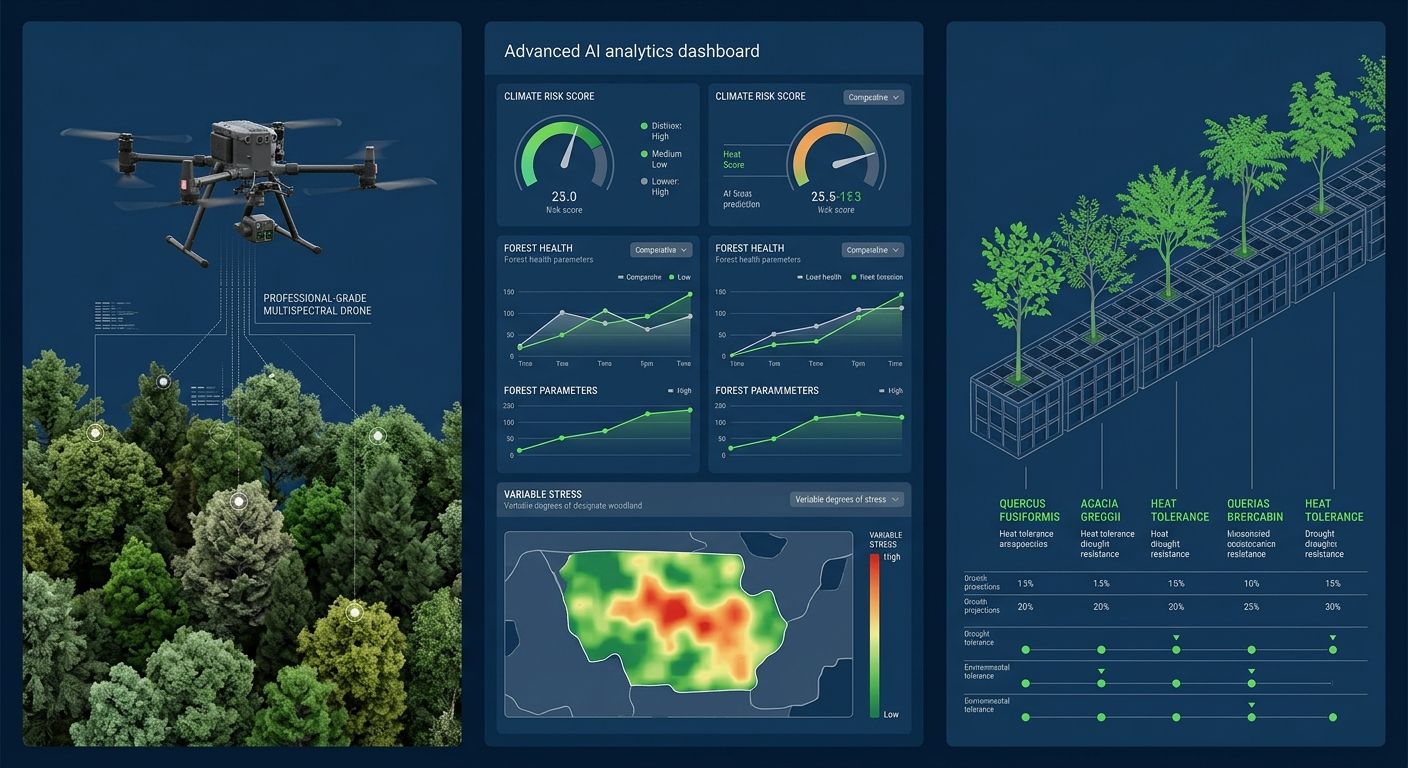
    Among the most impactful tree care industry trends 2026 are the rapid adoption of drone-based health assessments, AI-powered risk prediction, and climate-adaptive species selection.

    Horizontal infographic with three columns showing drone with multispectral camera over tree canopy, AI risk dashboard, and heat-tolerant tree species

    Technology and climate adaptation with drones, AI, and resilient canopies

    Drone-Based Arborist Health Assessments

    Drone-based arborist health assessments are revolutionizing the field. Equipped with multispectral and LiDAR sensors, drones capture high-resolution imagery and 3D data that reveal early signs of disease long before symptoms are visible to the naked eye. This approach improves safety and cuts inspection costs by up to 50% compared to traditional methods.

    AI-Powered Tree Risk Assessment Technology

    The next frontier in arboriculture is AI-powered tree risk assessment technology. By feeding data from IoT soil moisture probes and historical weather patterns into machine learning models, these systems can predict the probability of limb failure with remarkable accuracy. This allows arborists to schedule preventive maintenance proactively.

    Climate-Adaptive Tree Care Practices

    Professionals are rethinking species selection to create climate-resilient urban canopy management strategies. Heat- and drought-tolerant species gaining prominence include Quercus macrocarpa (Bur Oak), Ulmus ‘Morton Glossy’ (Triumph™ Elm), and Gleditsia triacanthos var. inermis (Thornless Honeylocust). These proactive steps ensure that urban forests continue to deliver ecosystem services as conditions shift.

    Residential Service Growth and the Labor Crisis: Practical Implications for 2026

    Outlook for Residential Tree Service Growth

    Three primary catalysts drive demand for residential tree services: home improvement activity, severe weather events, and accelerating urbanization. Homeowners are increasingly aware of the value mature trees bring to property valuations. According to the urban tree care framework, increased urban sprawl and aging tree stocks require professional risk mitigation well into 2026.

    How Labor Shortage Shapes Pricing and Operations

    Despite strong demand, a shortage of certified arborists is reshaping the sector. In acute markets, residential prices have risen 15–20% as firms bid up wages. Adoption of AI-powered tree risk assessment technology allows crews to prioritize inspections using drone imagery, mitigating the shortage by improving efficiency for existing staff.

    Investment Valuation and Capital Formation in the Tree Care Sector

    Understanding tree care industry trends 2026 is essential for business owners. Valuation typically revolves around adjusted EBITDA multiples in the 3-5x range. Beyond traditional metrics, companies demonstrating AI-powered tree risk assessment technology implementation and climate-resilient urban canopy management command premium pricing from institutional investors.

    How is AI transforming tree risk assessment in 2026?
    AI-powered tree risk assessment technology uses predictive analytics to detect hazards early, reducing emergency costs and improving safety.

    What is climate-resilient urban canopy management?
    It focuses on selecting diverse, drought-tolerant species and strategic planting to help urban forests weather climate shifts.

    Why choose a veteran-owned tree service?
    Consider a veteran owned tree service like Climbing Grunt for discipline and commitment to safety.

    Resources

  • Choosing the Right Mezzanine Debt Structures: Key Considerations

    Choosing the Right Mezzanine Debt Structures: Key Considerations

    Table of Contents

    Understanding Mezzanine Debt Structures

    Mezzanine debt structures are hybrid financing instruments that sit between senior secured debt and common equity in a company’s capital stack. Often viewed as junior capital, mezzanine debt fills the gap when conventional senior loans reach their capacity. This content is for informational purposes only and is not an offer, solicitation, or investment advice. Zaidwood Capital LLC is not a registered broker-dealer.

    Mezzanine debt is a form of subordinated debt financing that typically does not require hard collateral. Instead, lenders are compensated with a higher interest rate and an equity kicker—often warrants or conversion rights—which provides upside participation in the borrower’s success. This combination of debt and equity features makes it a flexible tool for companies needing capital beyond what senior lenders will provide. By taking a junior position, mezzanine lenders assume greater risk but also capture more of the company’s value creation.

    Mezzanine debt structures commonly bridge funding gaps in leveraged buyouts, acquisitions, and growth capital transactions where senior debt limits are reached but equity dilution is undesirable. Unlike unitranche debt, which combines senior and mezzanine layers into a single facility, traditional mezzanine structures remain clearly subordinated and offer lenders deeper equity participation.

    Engaging a debt advisor can simplify the sourcing and negotiation of mezzanine terms. At Zaidwood Capital we connect clients to a network of over 4,000 institutional and private investors with more than $15 billion of deployable capital, streamlining the process. Zaidwood Capital’s global lending services provide access to institutional investors and specialized debt funds that may not be reachable through conventional banking channels. This access is critical for firms that lack existing relationships with mezzanine providers.

    Of course, every transaction depends on the company’s specific situation, and no outcome is guaranteed. Our role is to present options, not promise particular results.

    Mezzanine Debt in the Capital Stack: Position, Pricing, and Purpose

    Within this layered structure, mezzanine debt occupies a distinctive position as the bridge between senior secured loans and pure equity. We view mezzanine debt structures as a flexible layer that is structurally subordinated to senior lenders but holds priority over equity holders in repayment and asset claims. This middle placement means mezzanine investors take on a moderate-to-high risk profile, reflecting the fact that they are repaid only after senior obligations are satisfied, yet before any residual value flows to equity.

    The following comparison table highlights how mezzanine fits within the capital stack alongside senior debt and equity:

    Mezzanine vs Senior Debt vs Equity in the Capital Stack
    AttributeSenior DebtMezzanine DebtEquity
    Position in StackFirst claim on assets and cash flowSubordinated to senior, senior to equityLowest priority, residual claim
    Risk LevelLowModerate to highHighest
    Typical ReturnLIBOR + 200-400 bps10-20% blendedVariable, target IRR 20%+
    Control RightsCovenants onlyMay include warrants or conversionVoting rights and board seats

    Senior debt holds the first claim on cash and assets; equity sits at the bottom targeting 20%+ IRRs and holding voting control. Mezzanine debt sits between them, subordinated to senior but senior to equity, typically offering a 10–20% blended return through interest, PIK, and equity-linked features such as warrants or conversion rights. Its control rights can include board observation or conversion triggers, providing a middle path.

    The 10–20% blended return commonly seen in mezzanine debt structures arises from a mix of contractual interest payments, payment-in-kind (PIK) accruals, and equity upside through warrants or conversion rights. Because mezzanine sits below senior debt in the capital stack, its risk profile is elevated; investors accept that they will be repaid only after all senior obligations are met. For this reason, mezzanine debt is often categorized as subordinated debt financing. In certain transactions, lenders may combine the senior and mezzanine layers into a single unitranche debt facility, streamlining documentation and reducing execution complexity. At Zaidwood Capital, we evaluate these structures against a company’s cash flow projections and strategic ambitions to build capital stacks that align risk and return profiles with long-term objectives.

    Mezzanine financing is most frequently used when a company’s senior debt capacity is exhausted, yet equity dilution is undesirable. Typical use cases include growth capital for expansion, acquisition financing, leveraged buyouts, and recapitalizations where flexible capital bridges the gap between senior debt and equity without ceding control. At Zaidwood Capital, our global lending services encompass mezzanine debt as a core component of the capital solutions we design—integrating subordinated debt financing and, where appropriate, unitranche debt structures that combine senior and mezzanine layers to streamline execution. This approach allows us to tailor risk-return profiles that match a company’s cash flow dynamics and strategic goals.

    While senior debt offers security and equity captures upside, mezzanine debt bridges the two with a balanced risk-return profile, providing essential flexibility for growing companies.

    This website is for informational purposes only and is not investment advice.

    Structuring Mezzanine Debt for Acquisitions and Growth

    As we move from senior to mezzanine structures, the role of hybrid capital becomes central to bridging funding gaps in complex transactions. Mezzanine debt structures occupy a unique position in the capital stack, sitting below senior obligations but above equity. At Zaidwood Capital, we structure these instruments as part of our full-cycle debt advisory, delivering flexible junior capital solutions for acquisitions and growth. While we leverage our network of over 4,000 institutional investors to source capital, we are not a registered broker-dealer and do not offer investment advice — please consult your own advisors before making financing decisions.

    The following table compares three common junior capital solutions used in acquisition financing:

    Mezzanine vs Unitranche vs Subordinated Debt
    FeatureMezzanine DebtUnitranche DebtSubordinated Debt
    StructureTwo-tranche (senior + sub) or standaloneSingle blended loan (senior + mezzanine combined)Strictly junior to senior debt
    Pricing10-18% all-inLIBOR + 500-800 bpsLIBOR + 600-900 bps
    CovenantsIncurrence-based, may include equity kickerMaintenance covenants typicalLess restrictive than senior
    Best Use CaseAcquisition financing with hybrid return profileMid-market borrowers seeking simplified documentationBridge financing or recapitalizations

    Each solution serves a distinct purpose, and the choice depends on the sponsor’s appetite for complexity, covenant flexibility, and return targets.

    Typical Interest Rates and Terms in 2026

    Current market conditions make mezzanine financing particularly relevant, with all-in pricing typically ranging from 10% to 18%. This spread includes a cash pay component tied to benchmark rates — often LIBOR-based — plus payment-in-kind interest and an equity kicker in the form of warrants. According to Zaidwood Capital’s internal CADE FAQ, the precise split between cash and PIK depends on transaction risk, while the warrants enhance the lender’s yield to compensate for junior security. Upfront fees, prepayment penalties, and structuring charges are also common, and we work with borrowers to model these layers so the total cost of capital remains transparent. In 2026, sustained demand from private equity firms and family offices continues to support a borrower-friendly but disciplined underwriting environment.

    The Role of Mezzanine in Buy-Side Transactions

    Mezzanine debt structures shine in leveraged buyouts and growth-capital raises where senior debt capacity alone falls short of the required enterprise value. By layering a junior tranche, sponsors can increase total leverage without ceding control — an approach we use frequently when advising on buy-side mandates. For emerging markets m&a acquisitions, where projected transaction volumes may surge 15% annually, mezzanine provides a flexible bridge that absorbs country and currency risks while preserving equity upside. The equity kicker aligns lender and sponsor incentives, allowing the financing to behave almost as quasi-equity, which is valuable in high-growth sectors like fintech or renewables. Our debt advisory team draws on the firm’s CADE FAQ and transaction experience to calibrate the right mix of senior debt, mezzanine, and equity for each acquisition.

    Integrating with Unitranche and Subordinated Debt

    In more complex capital structures, mezzanine debt is often combined with unitranche debt or subordinated debt financing to optimize the cost and documentation burden. Unitranche — a single blended loan — appeals to mid-market sponsors with its simplicity and maintenance covenants, but it may lack the return-enhancing features of a standalone mezzanine piece. When we integrate mezzanine with subordinated debt financing, the subordinated layer acts as a bridge facility or recapitalization tool sitting just above equity, while the mezzanine tranche retains its hybrid character. This layered approach can lower the weighted-average cost of capital and satisfy both covenant-light investors and lenders seeking higher yields. Zaidwood Capital’s internal CADE FAQ highlights that such integrated structures are especially common in emerging-market M&A and resource-intensive sectors, where bespoke terms and patient capital are essential. Our role is to design the sequencing — senior, unitranche, mezzanine, subordinated — so that the overall package meets the client’s strategic and liquidity objectives.

    Practical Framework for Evaluating Mezzanine Financing Options

    With a clear understanding of mezzanine basics, we now present a practical evaluation framework. For executives and private equity sponsors, selecting the right financing structure is critical to maximizing returns and minimizing risk. Our advisory team at Zaidwood Capital has developed this decision-focused guide to help you assess whether mezzanine debt structures align with your acquisition strategy and capital stack requirements.

    When to Choose Mezzanine Over Senior Debt

    Senior debt typically reaches its limit at 3-4x EBITDA, constrained by collateral coverage and maintenance covenant requirements. When additional capital is needed to close a transaction or fund growth initiatives, but further senior lien capacity is exhausted, mezzanine financing becomes a strategic solution. Unlike senior lenders who require secured collateral, mezzanine providers accept an unsecured or subordinated position, relying on cash flow analysis rather than hard asset coverage. This flexibility proves essential when the target company has limited fixed assets but strong, predictable free cash flow.

    In our experience, the decision often comes down to a trade-off between cost and flexibility. While unitranche debt can offer a simpler, single-document structure that blends senior and subordinated tranches, it typically provides less flexibility than a bifurcated capital structure. A unitranche facility may restrict prepayment options and lack the warrant overlay that aligns mezzanine investors with equity upside. We recommend evaluating your specific covenant tolerance and exit horizon before choosing between these subordinated alternatives.

    Step-by-Step Structuring for Private Equity Deals

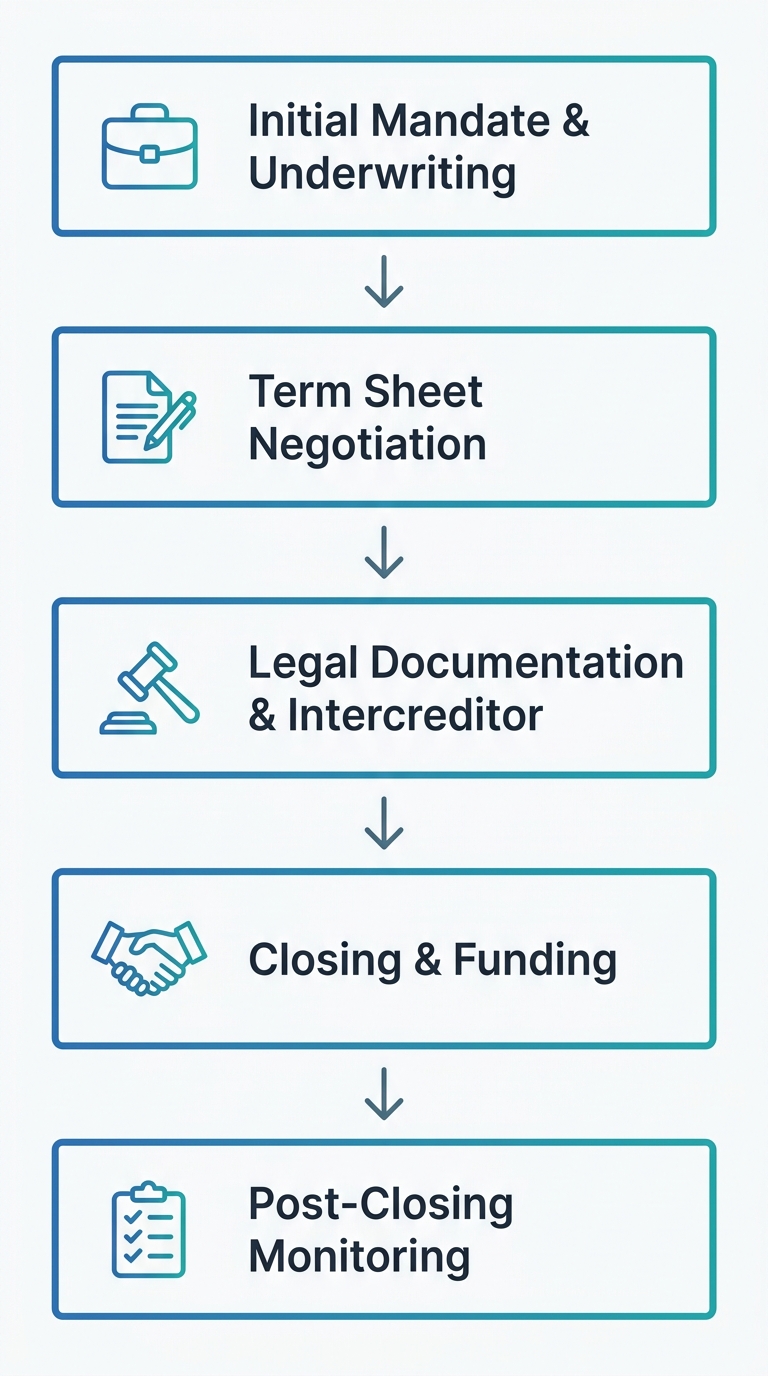
    Structuring mezzanine financing requires a methodical approach to balance the interests of sponsors, senior lenders, and subordinated investors. Our framework follows a five-stage process refined through over 300 completed transactions.

    Diagram showing five stages of a mezzanine financing evaluation process from initial mandate to post-closing monitoring with downward arrows connecting each stage

    Five-stage mezzanine financing evaluation process flow diagram

    The process begins with the initial mandate and underwriting phase, where we assess the target company’s credit profile, historical cash flows, and projected debt service capacity. This determines the appropriate sizing of the subordinated debt financing tranche, typically targeting a total leverage level of five to seven times EBITDA inclusive of senior debt.

    Next, term sheet negotiation addresses the critical economic and control terms. Warrant coverage—the equity kicker that enhances investor returns—is negotiated alongside the cash coupon and any payment-in-kind (PIK) toggle features. When negotiating warrant terms, it is important to ensure alignment with global capital market standards to maintain market conformity and facilitate syndication if needed. The amortization schedule for mezzanine is often back-end loaded, with minimal principal payments during the early years to preserve portfolio company cash flow. Legal documentation and the intercreditor agreement then codify the relative rights of senior and subordinated lenders, followed by closing, funding, and post-closing covenant monitoring.

    Benefits of Mezzanine in Acquisition Financing

    Mezzanine financing offers distinct advantages that make it a powerful tool in acquisition capital structures. Based on our proprietary benefit analysis, the most compelling attribute is its function as a bridge to equity without immediate dilution. Existing shareholders retain full ownership and control, while any equity participation via warrants is deferred and typically limited in scope. Unlike equity investors, mezzanine providers generally do not require board seats, preserving operational control for management.

    From a cost perspective, mezzanine debt structures carry an all-in cost of 10 to 18 percent, and critically, the cash interest component is tax-deductible. This contrasts sharply with equity financing, where investors target a 20 to 30 percent internal rate of return through capital appreciation and dividends that are not deductible to the company. The effective after-tax cost advantage makes mezzanine an efficient instrument for bridging valuation gaps in competitive auction processes.

    The following matrix helps executives compare mezzanine debt and equity on key decision criteria.

    Mezzanine Debt vs Equity: Decision Matrix for Acquisition Financing
    CriteriaMezzanine DebtEquity Financing
    DilutionMinimal (via warrants or conversion on limited basis)Full dilution of existing shareholders
    Cost of Capital10-18% all-in (tax-deductible interest)Target IRR 20-30% (higher required return)
    ControlNo board seats typically; covenants onlyInvestors often receive board representation
    FlexibilityPrepayment options vary, call protection commonExit required for liquidity; no redemption schedule
    Best ForCompanies with stable cash flow seeking bridge capitalHigh-growth companies needing strategic guidance and long-term capital

    This framework, informed by industry benchmarks and Zaidwood Capital case studies, provides a practical lens for evaluating trade-offs. The choice between subordinated debt and equity ultimately depends on your liquidity horizon, control preferences, and the underlying predictability of portfolio company earnings. To see how these structures work in practice, refer to our case studies below. This is for informational purposes only; consult your financial advisor before making financing decisions.

    Securities are offered through Finalis Securities LLC; Zaidwood Capital is not a registered broker-dealer and is separate from Finalis. Past performance does not guarantee future results.

    Advanced Considerations: Risk Allocation, Leverage Ratios, and Investor Alignment

    Building on our earlier discussion of baseline financing options, we now turn to the sophisticated structural elements that define effective mezzanine debt structures. For sponsors and companies evaluating growth capital, understanding risk allocation, leverage benchmarks and alignment mechanisms separates a well-structured transaction from one that introduces unintended friction. We focus here on the analytical framework Zaidwood Capital applies when advising clients through these complex capital stack decisions.

    Risk Allocation and Intercreditor Dynamics

    Risk allocation in mezzanine financing centers on contractual subordination and the intercreditor agreement. This agreement governs the relationship between senior and mezzanine lenders, defining payment waterfalls, standstill periods and remedies upon default. Because mezzanine debt sits behind senior obligations, recovery in a downside scenario depends heavily on how these provisions are drafted. We structure intercreditor terms that preserve mezzanine lender rights while respecting senior creditor priority, ensuring each party understands its position before capital is deployed.

    Leverage Ratio Benchmarks Across the Capital Structure

    Leverage ratios, typically expressed as Debt/EBITDA, provide a common yardstick for assessing financial risk. The table below summarizes the benchmarks we observe across Zaidwood Capital transactions and broader industry data:

    Leverage Ratio Benchmarks by Debt Type
    Debt TypeLeverage Ratio (Debt/EBITDA)Typical Uses
    Senior Debt2.5x – 4.0xRevolving credit, term loans
    Mezzanine Debt0.5x – 2.0x (on top of senior)Acquisition bridge, growth capital
    Unitranche Debt3.5x – 5.5x (combined)Mid-market leveraged buyouts
    Subordinated Debt1.0x – 2.5xRecapitalizations, rescue financing

    These ranges illustrate how each debt layer contributes to total leverage. Senior debt anchors the structure, while mezzanine facilities layer on additional capacity, typically 0.5x to 2.0x above the senior component. For unitranche debt, the combined ratio reaches materially higher levels, creating a different risk-return profile for investors.

    Higher leverage amplifies equity returns but also increases vulnerability to earnings volatility. Recent SEC regulatory updates reinforce the need for transparent leverage disclosure and risk retention compliance, particularly for structures that push total leverage beyond historical norms. We monitor these regulatory developments closely, as they directly influence structuring options and documentation standards for mezzanine and subordinated debt financing.

    Investor Alignment Mechanisms

    Aligning interests between debt holders and equity sponsors requires deliberate structural features. Beyond the base coupon, we often incorporate PIK interest components that preserve cash flow for operational needs while compounding value for lenders. Warrants or equity co-investment rights give mezzanine investors participation in upside, matching their risk exposure with potential reward. Board observer rights provide visibility into strategic decisions without impairing management autonomy, and change-of-control provisions ensure lenders are protected — or compensated — if ownership transitions occur.

    These mechanisms transform a simple debt instrument into a partnership-oriented capital solution. Sponsors benefit from flexible financing terms while investors gain safeguards and upside exposure that senior creditors typically do not receive.

    In the next section we explore how these structural considerations feed into the due diligence process and real-world case examples.

    This content is for informational purposes only and does not constitute investment advice. Readers should consult their own legal, tax and financial advisors before making any decisions.

    Frequently Asked Questions About Mezzanine Debt Structures

    What Are Mezzanine Debt Structures?

    Mezzanine debt structures sit between senior secured debt and equity in a company’s capital hierarchy. This financing is typically unsecured and subordinated to first-lien lenders, meaning it carries higher risk but also commands higher returns. A key feature of mezzanine financing is its equity participation component — often through warrants or conversion rights — which gives lenders upside potential beyond fixed interest payments.

    How Does Mezzanine Financing Compare to Unitranche Debt?

    While both are flexible capital solutions, unitranche debt blends senior and subordinated tranches into a single facility with one blended interest rate. In a mezzanine debt structure, the layers remain distinct: a senior lender holds first priority, and the mezzanine provider sits behind them. Unitranche simplifies administration but may limit the equity upside that defines mezzanine financing.

    What Are the Typical Uses for Mezzanine Debt?

    Companies commonly use subordinated debt to fund acquisitions, support growth capital initiatives, and execute recapitalizations. Because mezzanine financing does not require hard asset collateral, it is especially useful for businesses whose value lies in cash flows or intellectual property rather than physical assets. This flexibility makes it a go-to tool for middle-market transactions and sponsor-backed deals.

    How Does Mezzanine Debt Relate to Subordinated Debt Financing?

    Mezzanine debt is a form of subordinated debt financing, distinguished by its equity-linked features. All mezzanine instruments rank below senior obligations, but not all subordinated debt includes warrants or conversion rights. The additional return potential compensates mezzanine providers for their deeper position in the repayment waterfall.

    What Are the Main Risks of Mezzanine Financing?

    Because mezzanine debt is unsecured and junior to senior loans, recovery in a default scenario can be significantly lower. The higher interest cost also increases the financial burden on the borrower. However, for companies with stable cash flows and strong growth trajectories, the risk-return trade-off of a mezzanine debt structure can be strategically sound. Please note that all investments involve risk, and past performance does not guarantee future results; you should consult your legal, tax, and financial advisors before making decisions.

    Optimizing Your Capital Structure with Mezzanine Debt

    In our advisory work, we often position clients to benefit from hybrid instruments in mezzanine debt structures, which sit between senior obligations and common equity. This subordinated layer can strengthen the balance sheet while preserving ownership control.

    What Is Mezzanine Debt?

    We define this as subordinated debt financing that includes equity participation features, such as warrants, allowing lenders to share in upside without diluting founders prematurely.

    How It Optimizes Capital Structure

    By layering mezzanine capital above equity, companies reduce dilution and gain flexible repayment options like payment-in-kind interest. This bridge is particularly useful for acquisitions, management buyouts, and growth-stage expansion.

    Mezzanine vs. Unitranche vs. Senior Debt

    Feature Mezzanine Debt Unitranche Debt Senior Debt
    Position in capital structure Junior to senior, senior to equity Single blended tranche Most senior
    Interest rate type Higher fixed or floating with PIK Blended rate; typically floating Lowest, often floating
    Covenant strictness Fewer financial covenants Moderate Strictest
    Equity component Warrants or equity kickers common Usually none None
    Typical use case Acquisitions, buyouts, recapitalizations Mid-market LBOs, quick close Working capital, asset-heavy deals

    Unitranche debt blends senior and subordinated layers into one facility, while subordinated debt financing remains a more traditional second-lien or junior note. We help management teams evaluate each path against their capital needs and timeline.

    Trade-offs and Customization

    Mezzanine capital carries higher interest and potential equity give-ups, but it provides speed and fewer restrictive covenants than senior loans. Through our debt advisory services at Zaidwood Capital, we structure each facility to match a company’s cash flow profile without promising any specific outcome.

    This section is for informational purposes only and does not constitute investment advice. Consult your legal, tax, and financial advisors before making decisions. Securities are offered through Finalis Securities LLC; Zaidwood Capital is not a registered broker-dealer.

    Resources

  • Smart Manufacturing: Complete Guide for 2026

    Smart Manufacturing: Complete Guide for 2026

    Table of Contents

    Smart Manufacturing Defined for 2026

    Building on manufacturing’s evolution toward digital integration, smart manufacturing in 2026 represents interconnected systems leveraging IoT, AI, and data analytics for real-time optimization. These smart manufacturing ecosystems enable factories to adapt dynamically, minimizing waste and maximizing output through advanced automation.

    NIST’s smart manufacturing systems provide the foundation via three pillars: cyber-physical systems integration for seamless machine-human collaboration; real-time data analytics for predictive insights; and autonomous decision-making for self-optimizing operations. Authoritative U.S. government standards from the National Institute of Standards and Technology (NIST) emphasize model-based practices, digital threads, and industrial AI metrology. NIST research emphasizes model-based practices, digital threads, and industrial AI metrology, and promotes tools for systems modeling, heterogeneous data fusion, and trusted lifecycle data to support interoperable, measurable, and repeatable smart manufacturing deployments across complex supply chains with clear metrics and standards globally.

    2026 Key Tech: Digital Twins & AI

    Digital twins in manufacturing simulate production lines virtually, while ai predictive maintenance forecasts failures to slash downtime.

    By 2026, these yield 20-30% efficiency gains and cost reductions, per NIST benchmarks and industry data.

    At Zaidwood Capital, we view smart manufacturing as a high-growth sector ripe for investment. While defined by these principles, deploying smart manufacturing requires addressing implementation challenges ahead.

    Core Principles of Smart Manufacturing

    Building on these foundations, the core principles of smart manufacturing revolve around integrating Internet of Things (IoT), artificial intelligence (AI), big data, and cyber-physical systems to create adaptive production environments. This approach transforms static factories into dynamic, responsive operations known as smart factories or Industry 4.0 manufacturing. According to the National Institute of Standards and Technology (NIST), these principles drive innovation and competitiveness in modern industry.

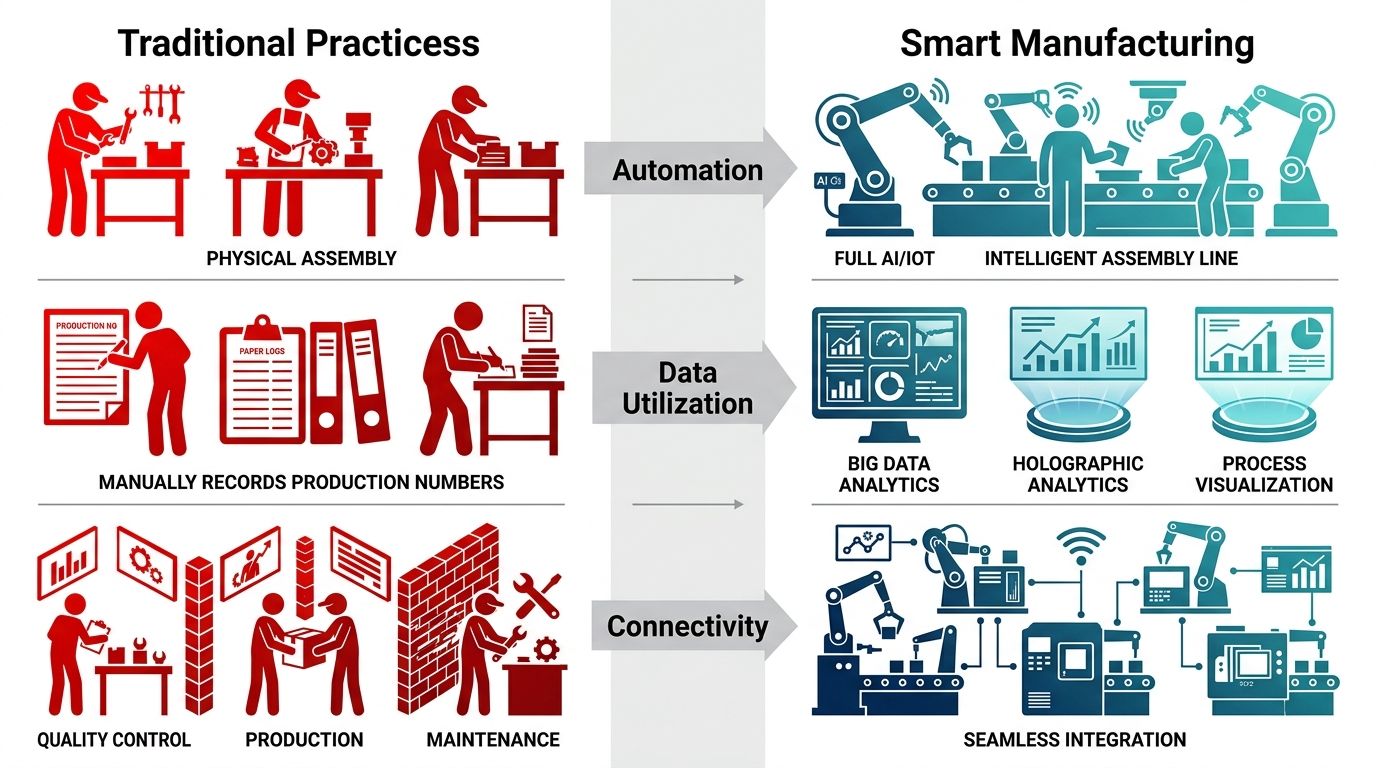
    Full Automation. Traditional manual and semi-automated processes give way to AI and IoT-driven full automation. We see ai predictive maintenance playing a pivotal role, where AI algorithms anticipate equipment failures, minimizing downtime and optimizing workflows. NIST guidelines on manufacturing systems design analysis highlight how this shift enhances reliability and efficiency.

    Real-Time Data Utilization. Siloed, reactive data is replaced by real-time analytics powered by big data. Digital twins in manufacturing enable simulation-based optimization, allowing virtual replicas of physical assets for testing scenarios without real-world risks. NIST research, cited as authoritative U.S. government frameworks, underscores data analytics for smart manufacturing to support informed decision-making.

    Seamless Connectivity. Isolated machines evolve into interconnected cyber-physical systems integration in manufacturing systems design, fostering machine interoperability. National Institute of Standards and Technology (NIST) systems integration frameworks provide standards for this connectivity, enabling resilient production networks as per government research on manufacturing systems integration.

    The following table illustrates key differences:

    Traditional vs. Smart Manufacturing

    Key Differences in Core Principles and Technologies (Data sourced from NIST manufacturing systems research and industry benchmarks for 2026 projections)

    Traditional vs. Smart Manufacturing
    AspectTraditional ManufacturingSmart Manufacturing
    Manual and semi-automated processesLimited roboticsAI and IoT-driven full automation
    Reactive, siloed dataPaper-based or basic ERPReal-time analytics and big data
    ConnectivityNo interoperabilityCyber-physical systems integration

    This comparison, drawn from NIST manufacturing systems design analysis, reveals how smart manufacturing principles outperform traditional methods in adaptability and efficiency. For instance, full automation reduces human error, while real-time data empowers proactive strategies. These shifts position Industry 4.0 manufacturing for scalable growth, aligning with NIST’s emphasis on cyber-physical advancements.

    Infographic comparing traditional and smart manufacturing across automation, data utilization, and connectivity with illustrative icons

    Traditional vs Smart Manufacturing comparison visualization

    Key Technologies Driving Smart Manufacturing

    Delving deeper into smart manufacturing, interconnected technologies like IoT, AI, and digital twins enable real-time data flow, predictive insights, and optimized operations for intelligent factories.

    IoT and Sensor Integration

    IoT and sensor integration form the foundation of smart manufacturing by enabling continuous real-time data collection across production lines.

    Sensors embedded in machinery capture vital metrics such as temperature, pressure, and vibration, transmitting data via IoT networks for immediate analysis. This connectivity allows factories to monitor equipment health proactively. For instance, vibration sensors on assembly lines detect imbalances early, preventing breakdowns.

    • Pressure sensors in hydraulic systems alerting to leaks.
    • Temperature monitors on motors to avoid overheating.

    AI and Machine Learning Applications

    AI and machine learning revolutionize smart manufacturing with predictive analytics and automation, transforming raw data into strategic advantages.

    These technologies excel in anomaly detection and process optimization, forecasting issues before they escalate. In ai predictive maintenance, machine learning identifies patterns to schedule upkeep efficiently, minimizing disruptions.

    AI Tools for Predictive Maintenance
    TechnologyCapabilitiesUse Case
    Machine LearningPattern recognition in dataAnomaly detection
    Deep LearningImage and sensor analysisAdvanced forecasting

    Digital Twins in Operations

    Digital twins in manufacturing create virtual replicas of physical assets, enabling simulation and real-time optimization per smart manufacturing technologies.

    The National Institute of Standards and Technology (NIST), through its authoritative U.S. government standards and research on digital twin technologies, supports SMEs via the Digital Twin Laboratory—a testbed for development and interoperability.

    Implementing Smart Manufacturing Practices

    Transition Roadmaps

    1. Assess current infrastructure: Evaluate legacy equipment compatibility and data silos.
    2. Pilot IoT sensors: Deploy on one production line to monitor real-time performance.
    3. Implement digital twins in manufacturing: Use simulation tools like NIST-inspired models to test scenarios without risk.
    4. Scale with AI analytics: Integrate data fusion for predictive insights.
    5. Establish digital thread: Ensure lifecycle data interoperability per NIST guidelines.
    6. Monitor and iterate: Use tools like SimPROCESD for discrete-event simulation.

    Overcoming Adoption Barriers

    Barriers to Smart Manufacturing Adoption
    BarrierImpactMitigation
    High Initial CostsCapital expenditure strainPhased investment, financing
    Skills GapLack of expertiseTraining programs

    Change Management Essentials

    • Leadership commitment: Align C-suite on smart factory implementation vision.
    • Comprehensive training: Hands-on sessions for IoT and AI systems.
    • Communication strategies: Regular updates to build trust.
    • Continuous monitoring: Track KPIs like uptime and efficiency.

    Advanced Smart Manufacturing Strategies

    Edge Computing

    Cloud Computing

    Digital Twins in Manufacturing

    AI Predictive Maintenance

    Advanced Tech Stacks
    StrategyEdge ComputingCloud Computing
    LatencyLowHigh
    ScalabilityLimitedHigh

    Smart Manufacturing FAQs

    • What is smart manufacturing?
      Smart manufacturing integrates IoT, AI, and data analytics for real-time production optimization and efficiency gains.
    • How do digital twins enhance manufacturing?
      Digital twins in manufacturing create virtual replicas to simulate processes, predict issues, and reduce downtime.
    • What role does AI predictive maintenance play?
      ai predictive maintenance uses machine learning to forecast equipment failures, minimizing disruptions.

    Future of Smart Manufacturing

    Building on today’s foundations, smart manufacturing will evolve through advanced integration by 2030, guided by National Institute of Standards and Technology (NIST) frameworks as authoritative U.S. government technical standards.

    This article was researched and written with the assistance of AI tools.

    Resources

  • Post Merger Integration: Complete Guide for Successful Mergers

    Post Merger Integration: Complete Guide for Successful Mergers

    Table of Contents

    Mastering Post-Merger Integration

    Mergers spark excitement for growth and expansion, yet they carry risks of operational disruption if mishandled. At Zaidwood Capital, we understand that successful mergers and acquisitions advisory hinges on robust post merger integration to capture intended value and foster post-acquisition synergy.

    Post merger integration is the strategic process of blending operations, cultures, and systems following a merger. It unfolds in key phases: planning to align objectives, execution to merge resources efficiently, and optimization to sustain long-term efficiency. Studies indicate 70-90% of mergers fail due to poor integration, eroding shareholder value as reported by IMAA Institute insights.

    We support clients with full-cycle due diligence and strategic documentation, leveraging our network of over 4,000 investors and 24.4B USD in transaction volume. Discover our eight essential best practices, starting with meticulous integration planning process to ensure seamless transitions and maximized outcomes.

    1. Strategic PMI Planning

    Effective post merger integration begins with a robust planning phase that sets the foundation for seamless deal execution. At Zaidwood Capital, we emphasize creating a synergy roadmap and developing successful merger integration plans that align objectives, allocates resources, and establishes timelines to capture maximum value from the merger. This proactive approach, informed by our experience structuring over 300 deals, helps corporate clients navigate complexities and avoid common pitfalls.

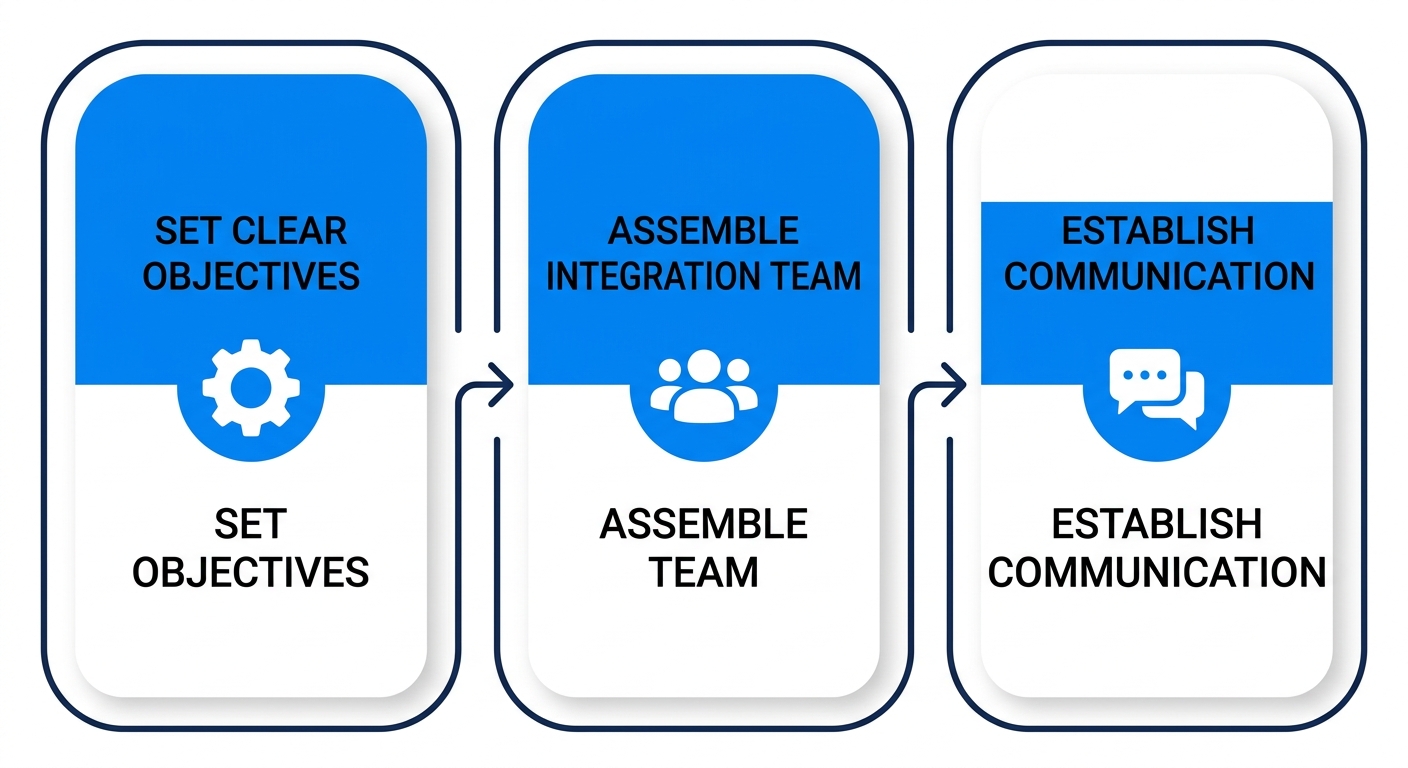
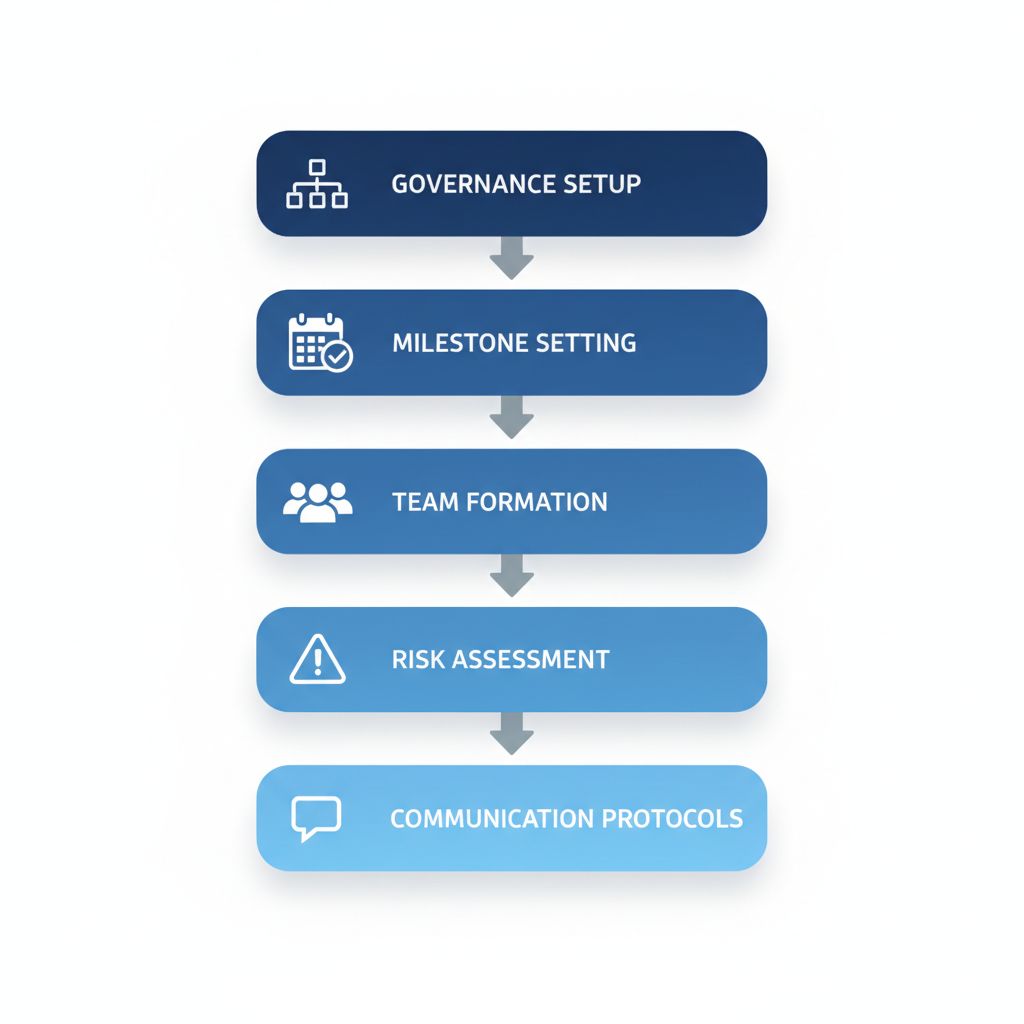
    Developing a comprehensive PMI plan starts with defining a clear governance structure, including a dedicated integration team comprising representatives from both organizations. We recommend setting critical milestones based on project management frameworks from PMI.org, prioritizing tasks with the highest rewards and dependencies. Communication protocols ensure transparency across stakeholders, while risk assessment draws directly from merger due diligence findings to address potential disruptions early. This planning directly supports broader merger strategies for growth, such as expanding market reach through private equity networks.

    For streamlined processes, Zaidwood employs our proprietary Velocity Matrix to accelerate timelines, as seen in recent integrations where planning reduced execution phases by up to 30 percent. By incorporating pro forma financials and strategic documentation, we enable clients to quantify synergies and mitigate risks effectively.

    Vertical process flow illustrating key phases of strategic post-merger integration planning

    Strategic PMI planning phases: governance, milestones, team, risks, and communication.

    While this strategic framework drives operational success, it must also consider human factors like culture to pave the way for alignment in subsequent phases.

    2. Cultural Alignment Practices

    In post merger integration, cultural alignment serves as the bedrock for sustainable success, mitigating conflicts and enhancing employee engagement. Misaligned values can erode productivity, but harmonizing behaviors fosters organizational synergy building. At Zaidwood Capital, our human capital due diligence expertise, drawn from over 300 deals, guides clients in creating unified cultures that drive long-term value.

    Assessing cultural compatibility begins with thorough merger due diligence pre-merger and continues post-merger through structured evaluations. Effective methods include transparent communication channels and targeted training programs to promote values harmonization. Leadership plays a pivotal role by modeling inclusive behaviors, especially in international mergers where trends show heightened cultural clashes due to diverse norms. Common mistakes, such as ignoring employee input, often lead to disengagement; instead, we recommend inclusive workshops to build trust. Drawing from IMD’s four success factors—select, secure, search, and match—successful integration balances adaptation with autonomy, as validated by 20 post-merger cases.

    We facilitate team-led cultural audits for private equity firms, ensuring seamless integration. This approach, informed by our full-cycle services, has empowered clients to achieve higher retention and performance in complex deals.

    3. Operational Synergies Realization

    In post merger integration, we prioritize realizing operational synergies to drive efficiency consolidation and system harmonization across merged entities. By streamlining processes, integrating IT systems, and optimizing supply chains, our approach captures cost savings of up to 15-20% as evidenced in FTC merger retrospectives, while fostering revenue growth through enhanced capabilities.

    We begin with comprehensive process mapping to eliminate redundancies, a key step in addressing how mergers affect companies by disrupting workflows. IT integration presents challenges like data migration and compatibility, which we mitigate through rigorous merger due diligence and phased rollouts—best practices include piloting changes in select departments before full deployment. For supply chain optimization, we consolidate vendors and logistics to reduce lead times. Our merger and acquisitions success steps emphasize early identification of these hurdles to ensure smooth execution and minimize risks uncovered during pre-integration assessments.

    At Zaidwood Capital, our operational due diligence, including IT evaluations, supports clients in pro forma planning for seamless transitions, as seen in manufacturing deals where synergies boosted margins by 10%. A practical tip: Leverage our full-cycle assessments to flag integration pitfalls early. These operational shifts, however, demand clear communication to align teams effectively.

    4. Effective Communication Strategies

    Effective communication forms the cornerstone of successful post merger integration, ensuring transparency and preserving employee morale amid organizational changes. We at Zaidwood Capital recognize that clear messaging aligns stakeholders, fosters trust, and prevents disruptions from misinformation. By prioritizing transparent dialogue, companies can navigate merger complexities with confidence.

    A robust multi-channel communication plan is essential for seamless transitions. This includes regular town halls for leadership updates, email newsletters for key milestones, and intranet portals for ongoing information. Addressing rumors promptly through fact-based responses maintains credibility and reduces anxiety. Linking these efforts to merger due diligence processes ensures that pre-close communications set the stage for post-close activities, as highlighted in our diligence frameworks. Best practices for consistent messaging emphasize tailored content for diverse audiences, promoting stakeholder engagement across all levels. As noted in integration models from leading institutes, real-time collaboration tools enhance reporting and coordination from Day One.

    In our strategic consulting, Zaidwood Capital draws on post merger integration best practices to develop customized plans that mitigate risks and drive value, supporting smooth transitions to talent retention strategies.

    5. Talent Retention Initiatives

    In post merger integration, retaining key talent is essential for sustained success. We at Zaidwood Capital emphasize human capital due diligence during the merger process to identify and mitigate retention risks early, ensuring workforce stability. By conducting thorough talent assessments, we help clients secure key personnel through targeted strategies that address common pitfalls, such as talent loss from uncertainty.

    Effective initiatives include offering retention bonuses to incentivize critical employees and implementing role mapping to provide clear career paths. Managing uncertainty involves transparent communication about future opportunities, while fostering a unified culture plays a pivotal role in boosting engagement. We recommend regular engagement surveys as a best practice to gauge employee sentiment and refine retention efforts, ultimately supporting seamless integration and long-term value creation. We also build retention playbooks and succession plans to protect institutional knowledge during transition periods and align incentives with strategic objectives.

    6. Financial Integration Approaches

    Effective post merger integration requires seamless financial systems alignment to realize cost synergies and ensure accurate reporting. At Zaidwood Capital, we leverage our expertise in financial due diligence and pro forma financials to guide clients through this critical phase. Accounting harmonization begins by standardizing policies and procedures across merged entities, mitigating discrepancies that could distort financial statements.

    ERP integration unifies enterprise resource planning systems, enabling real-time data flow and operational efficiency. Establishing robust financial controls safeguards assets and complies with regulatory standards, directly informed by insights from merger due diligence processes. These steps tie back to due diligence documentation, where we identify potential fiscal risks early.

    Financial metrics serve as the best tools for measuring success in post merger integration, tracking key performance indicators like cost savings and revenue growth. By focusing on reporting consolidation and fiscal alignment, organizations achieve sustainable value creation in the merger landscape.

    7. Risk Management Techniques

    Effective risk management is essential in post merger integration, where unforeseen challenges can impact financial stability and operational synergy. At Zaidwood Capital, our full-cycle due diligence process plays a core role in merger due diligence by identifying potential operational disruptions, regulatory hurdles, and market shifts early on. This proactive approach allows us to foresee issues such as integration delays or cultural clashes that often arise post-merger.

    Common risks uncovered in merger due diligence include antitrust concerns and competitive dynamics, as evidenced by the U.S. Federal Trade Commission’s retrospective studies. These analyses reveal how mergers can affect prices, innovation, and consumer welfare, underscoring the need for robust compliance assurance. To mitigate these threats, we recommend establishing comprehensive risk registers that catalog identified vulnerabilities and assign monitoring responsibilities.

    Ongoing monitoring involves regular audits and key performance indicators to track integration progress. Best practices for contingency planning include developing scenario-based response strategies, ensuring swift threat mitigation. By linking these techniques to our due diligence expertise, we help clients navigate post merger integration challenges with confidence and precision.

    8. Ongoing Monitoring Evaluation

    Effective post merger integration requires vigilant ongoing monitoring and evaluation to ensure strategies evolve and deliver measurable returns on investment. At Zaidwood Capital, we provide comprehensive transaction advisory that extends beyond closing, supporting clients through sustained performance tracking and adjustments.

    We begin by establishing key performance indicators and interactive dashboards tailored to each merger’s objectives, allowing real-time visibility into operational synergies and financial outcomes. Regular audits, informed by frameworks like those outlined in IMD’s M&A success steps, help identify deviations early, enabling proactive refinements based on stakeholder feedback. This iterative process ties directly to success measurement, focusing on value realization over the long term.

    For our clients, including leading private equity firms, this approach mitigates risks uncovered during initial merger due diligence and fosters sustained growth. By continuously adapting, we help secure enduring competitive advantages and resilience, paving the way for comprehensive deal success.

    Seamless PMI Execution

    Achieving seamless post merger integration requires interconnected best practices, from cultural alignment to operational synergy, ensuring sustained value beyond the deal close. As highlighted in industry insights, up to 85% of mergers fail due to integration shortcomings, underscoring the need for rigorous execution. We at Zaidwood Capital emphasize integration mastery through our comprehensive advisory, linking back to robust merger due diligence foundations that inform every step.

    Our expertise provides access to over $15 billion in deployable capital and a global network of 4,000+ investors, facilitating deal optimization and ongoing evaluation for long-term success. Contact us to leverage our full-cycle M&A support for your next transaction, empowering informed strategic growth without undue risks.

    Resources